
Our readers keep the lights on and the weekend projects moving. As an Amazon Associate, I earn from qualifying purchases.
If you are still hauling a 60-pound lead-acid battery into your boat, camper, or solar shed, you are working too hard and charging too often.
I’m Rikta — the co-founder and writer behind FitlyFast. I spend my research hours digging into battery chemistry specs, real-world cycle life data, and BMS safety features across dozens of brands to find the models that actually deliver on their capacity claims in marine, RV, and off-grid use cases.
This guide breaks down the specs, real buyer feedback, and build quality for each model so you can confidently pick the best 12 volt lithium battery that matches your power demands and budget.
How To Choose The Best 12 Volt Lithium Battery
The market is flooded with LiFePO4 batteries that look identical on paper but vary wildly in build quality, real-world capacity, and BMS behavior. You need to look past the marketing specs and focus on the components that determine whether a battery lasts three years or fifteen.
Capacity and Usable Energy (Amp-Hours and Watt-Hours)
A 100Ah 12.8V lithium battery delivers 1280Wh of usable energy — that is the full capacity. Unlike lead-acid, you can discharge it to nearly empty without damage. For a trolling motor pulling 30A, a 100Ah battery gives you about three hours at full speed. For an RV fridge drawing 5A, it lasts twenty-plus hours. Multiply amp-hours by 12.8 to get watt-hours for comparing energy storage across brands.
BMS Quality and Temperature Protection
The battery management system is the brain of the pack. Look for low-temperature charging cut-off (stops charging below 32°F to prevent permanent cell damage), short circuit protection, and high-temperature cut-off. Some premium BMS units also offer overload self-recovery in 30 seconds rather than requiring a manual reset, which matters when powering inverter loads with surge spikes.
Physical Weight and Form Factor
Standard Group 31 size is roughly 13 x 6.8 x 8.5 inches. A 100Ah lithium battery weighs 22-25 pounds versus 60-65 pounds for lead-acid. Smaller form factors like Group 22NF or Group 24 are available for tight spaces in kayaks, small campers, or SUVs. Every installation space is different, so measure your battery tray before buying.
Cycle Life Claims vs. Real-World Conditions
Manufacturers commonly advertise 4000-15000 cycles. Understand the fine print: 4000 cycles at 100% depth of discharge is extremely aggressive. Most real-world users operate at 60-80% DOD, so a battery rated for 6000 cycles at 80% DOD could realistically last 15-20 years in weekend-use applications. The cell construction (prismatic vs. cylindrical) and tab welding quality are what actually determine the durability.
Quick Comparison
On smaller screens, swipe sideways to see the full table.
| Model | Category | Best For | Key Spec | Amazon |
|---|---|---|---|---|
| LiTime 12V 50Ah Trolling Motor Bluetooth | Mid-Range | Kayak & Jon Boat Fishing | 11.27 lbs, 50A BMS, Bluetooth 5.0 | Amazon |
| Redodo 12V 100Ah Bluetooth | Premium | Marine & Sump Pump Backup | 22.2 lbs, 100A BMS, Bluetooth 5.0 | Amazon |
| LiTime 12V 100Ah Trolling Motor (Group 31) | Premium | Bass Boats & Heavy Trolling | 22.16 lbs, ABYC E-13, 100A BMS | Amazon |
| VEMDIA 12V 100Ah LiFePO4 Group 31 | Mid-Range | General RV & Solar Use | 24.5 lbs, 100A BMS, 15000 deep cycles | Amazon |
| DUMFUME 12V 150Ah LiFePO4 | Mid-Range | High-Capacity Solar Banks | 22.05 lbs, 100A BMS, 1920Wh | Amazon |
| LiTime 12V 100Ah Xtra-Mini Bluetooth | Premium | Compact Campers & Tacoma Builds | 19.13 lbs, Group 22NF, 100A BMS | Amazon |
| Power Queen 2-Pack 12V 100Ah Bluetooth | Premium | Off-Grid Cabin & Large Setups | 24 lbs each, 100A BMS, 500A surge | Amazon |
In‑Depth Reviews
1. LiTime 12V 50Ah LiFePO4 Trolling Motor Battery Bluetooth
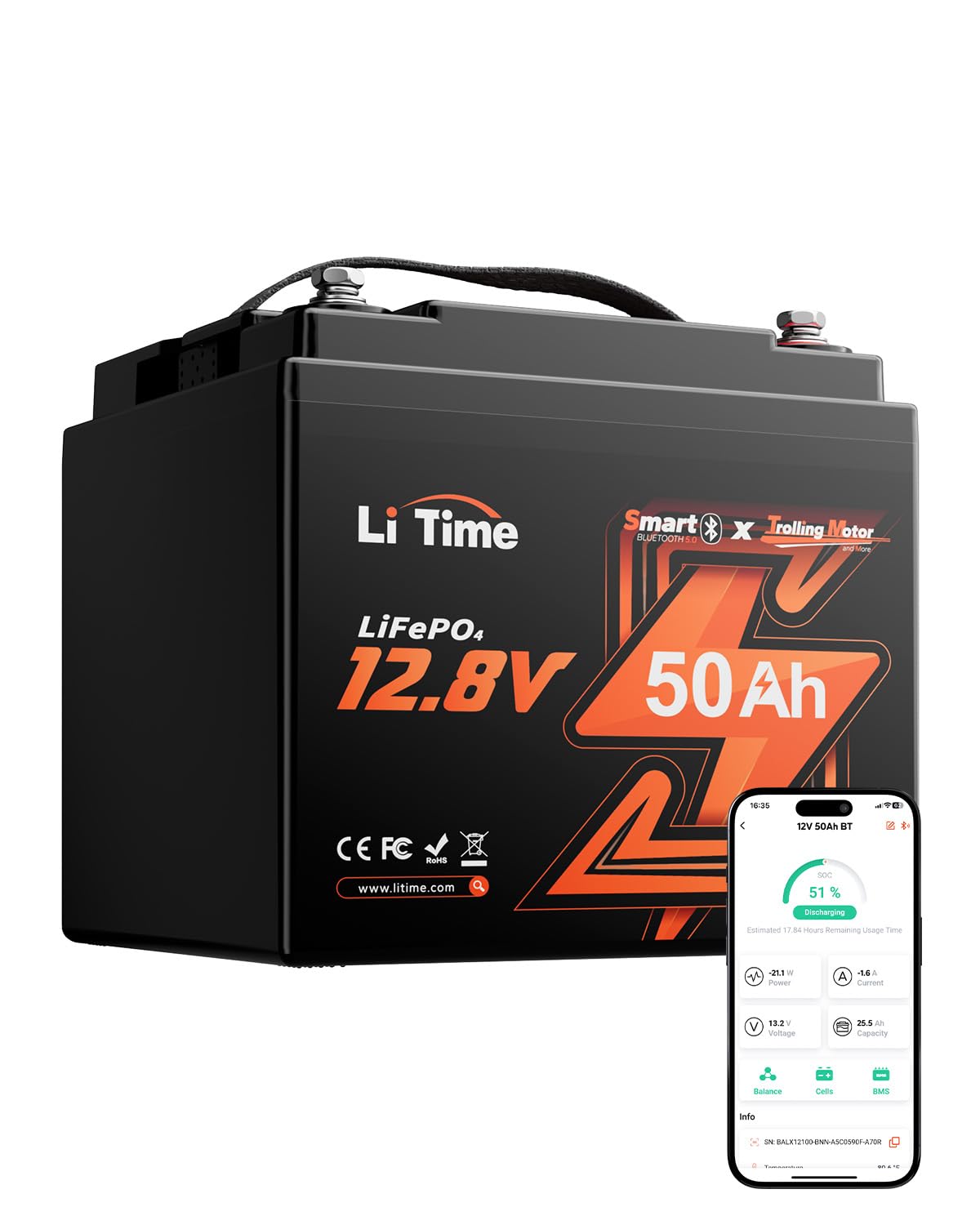
This 50Ah LiFePO4 battery weighs just over 11 pounds — one-sixth the weight of a comparable 100Ah lead-acid — making it the obvious choice for kayak anglers and lightweight setups. The built-in 50A BMS with low-temperature cut-off protects the cells during cold-weather charging, and the continuous 60A discharge for 30 minutes sustains the peak thrust of a 55-pound trolling motor without sagging. Real users report running an Endura 55 on a Jackson Big Rig for two full days of fishing and returning with 37% capacity remaining.
The Bluetooth 5.0 connectivity pairs instantly via the LiTime App with no pairing code needed. You get real-time voltage, current, state of charge, and the ability to switch the output on and off from the phone. The EV-grade prismatic cells and upgraded 40-milliohm internal resistance mean stable voltage delivery even under sustained load. Built for marine and RV use, this is a compact powerhouse that fits in places larger batteries cannot.
For kayak and small jon boat owners, the weight and size difference versus an AGM is transformative. No more struggling to lift 60 pounds over a gunnel. The integrated BMS handles the heavy lifting, and the app removes the guesswork from battery management. This earns the top spot because it perfectly balances portability, smart features, and proven real-world performance for its target use case.
Why it’s great
- Exceptionally light at 11.27 pounds
- Bluetooth monitoring with app-based on/off control
- 1.2C (60A) continuous discharge for peak trolling thrust
Good to know
- 50Ah capacity sufficient for short trips only at high draw
- Requires a lithium-compatible charger for best results
2. LiTime 12V 100Ah Xtra-Mini Bluetooth
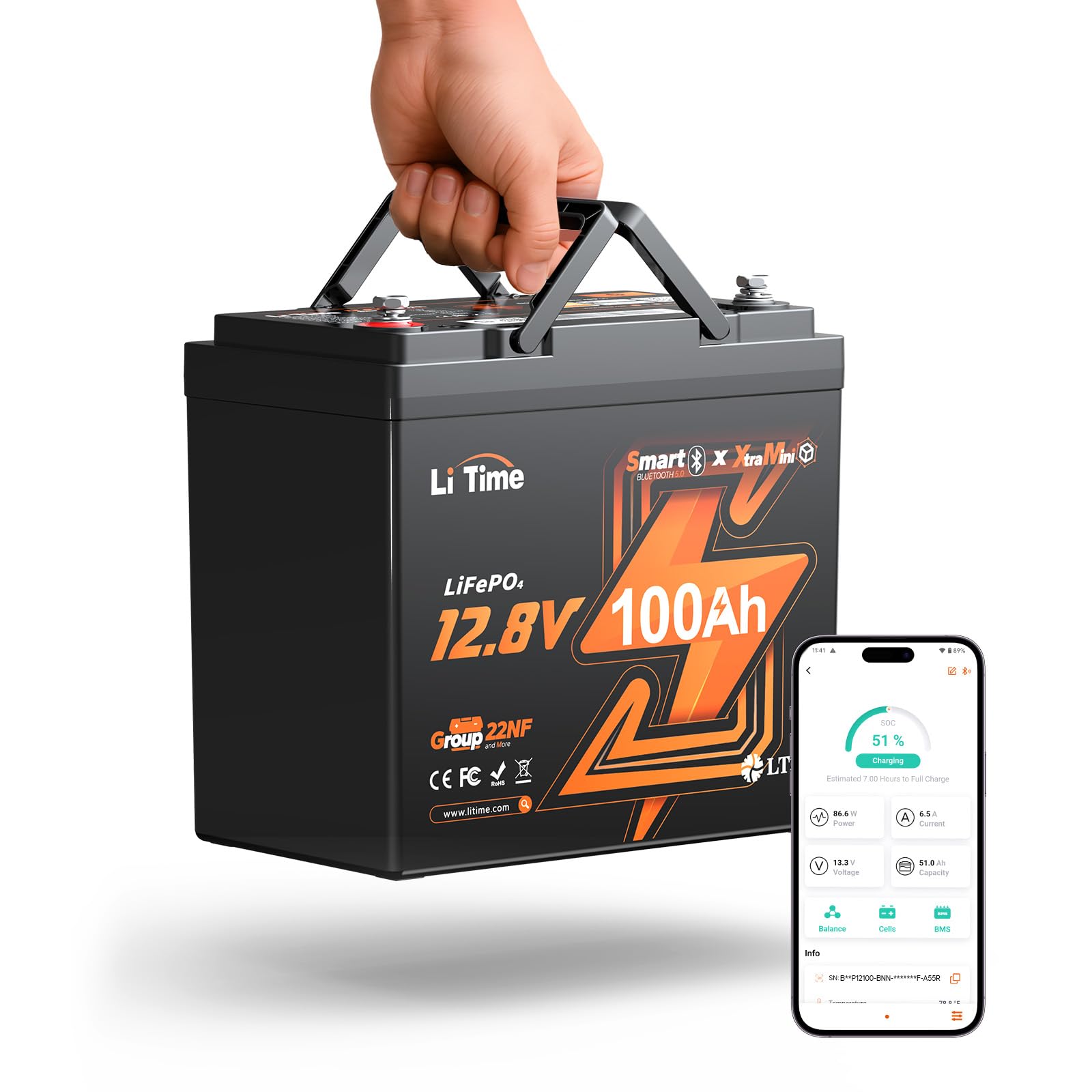
The Xtra-Mini squeezes a full 100Ah into a Group 22NF shell measuring just 9.02 x 5.43 x 8.19 inches and weighing only 19.13 pounds — that is a power density of 194.7Wh per liter, the highest of any battery in this guide. This form factor fits into spaces where a standard Group 31 battery will not go, such as under the seats of small campers, in the aft compartments of bass boats, or inside a Tacoma truck bed drawer system. The internal prismatic cells are the same Grade A quality used in the larger LiTime packs, so you sacrifice neither cycle life nor peak performance for a smaller footprint.
Bluetooth 5.0 monitoring via the LiTime App shows real-time state of charge, voltage, and current. The BMS includes low-temperature charge cut-off, moisture and dust resistance, and a 30-second overload self-recovery. Users report running a 65-pound Haswing trolling motor for over two hours at near-full speed and still having 44% capacity left. The 100A BMS handles continuous draw well above typical trolling use, and the 10-year service life backstop (4000+ cycles at 100% DOD) provides long-term confidence.
For anyone building a compact power system where every inch counts, this is the best 100Ah option available. The weight savings alone — 40 pounds less than lead-acid — makes installation and repositioning trivial. The trade-off is a slightly higher per-amp-hour cost compared to standard Group 31 batteries, but the space savings justify the premium for constrained installations.
Why it’s great
- Tiny footprint fits tight compartments
- Highest power density in the guide at 194.7Wh/L
- Full-featured BMS with Bluetooth remote monitoring
Good to know
- Premium price per amp-hour versus standard Group 31
- Not a drop-in for standard Group 31 battery trays
3. Redodo 12V 100Ah LiFePO4 Bluetooth (Group 24)
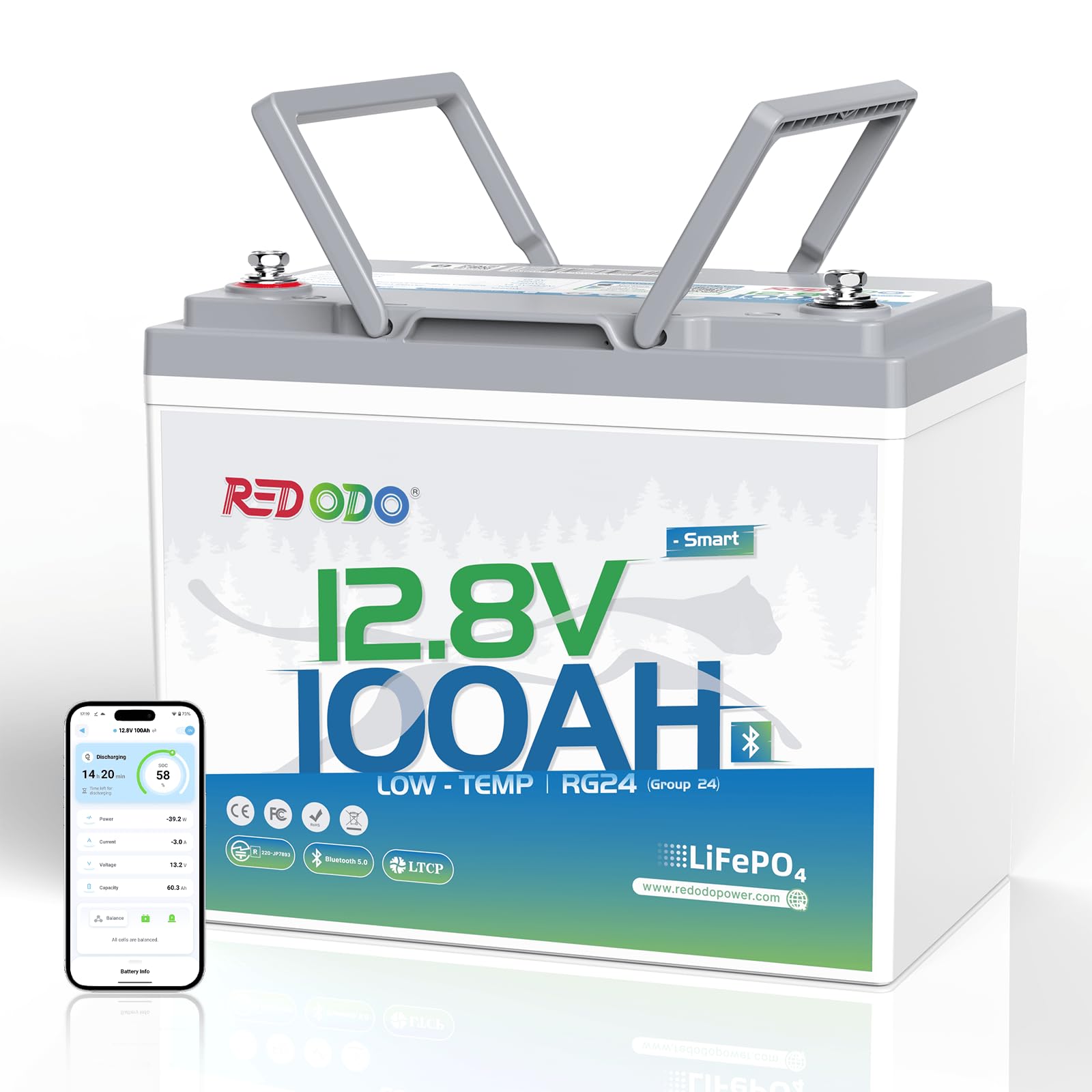
The Redodo 100Ah comes with an upgraded BMS specifically designed for marine environments: waterproofing, salt spray resistance, and anti-corrosion coating on the terminals. This makes it a strong choice for open-boat applications where spray and condensation are constant. It also includes a low-temperature charge cut-off and overload self-recovery, which prevents the battery from locking you out on the water if you accidentally draw too much current. The Bluetooth 5.0 module connects to the Redodo app and displays voltage, current, power, and state of charge with a 10-meter range.
Built with Grade A prismatic cells, the Redodo supports 4000+ cycles at 100% DOD and 15000 cycles at 60% DOD. Users have tested individual units and found they deliver 102Ah of actual capacity — exceeding the rated spec. The 22.2-pound weight and standard Group 24 dimensions make it a drop-in replacement for many marine battery trays. Multiple owners report using it as a sump pump backup battery in basements, with the folding handles making relocation easy.
The main caveat is that Redodo explicitly states this battery should not be used as a starter battery for an engine. It is designed specifically for deep-cycle house loads like trolling motors, RV fridges, and solar storage. Some users also experienced incompatibility with older Noco Genius chargers that do not have a dedicated lithium mode. For marine deep-cycle use, the additional salt-spray protection gives it a clear edge over standard batteries.
Why it’s great
- Waterproof and salt-spray resistant BMS for marine use
- Actual capacity tested above the rated 100Ah
- Folding handles make installation and movement easy
Good to know
- Not suitable for engine starting applications
- Some older lithium chargers may not fully charge it
4. LiTime 12V 100Ah Trolling Motor LiFePO4 (Group 31)

This LiTime 100Ah battery is the only model in this guide that meets the ABYC E-13 standard for marine electrical systems, which means an independent third party verified its safety and performance. It adds transient voltage suppression (TVS) that protects 12V to 36V trolling motors from voltage spikes that can burn out brushed motor controllers — a specific pain point for bass boat anglers running Minnkota Ultrex units. The BMS includes triple protection against dust, water ingress, and salt spray, plus low-temperature charge cut-off below 32°F and discharge cut-off below -4°F.
In real-world testing by users on 16-foot jon boats, a single 100Ah battery pushed three men into an 8 mph headwind for four hours with minimal discharge. The flat discharge curve typical of LiFePO4 chemistry means the motor sees consistent voltage regardless of state of charge, unlike lead-acid where you lose speed as the battery drains. At 22.16 pounds, it shaves roughly 40 pounds off a comparable lead-acid setup, which several owners reported improved hole shot and added 4 mph to their top speed.
Users who bought two units in parallel for a 13-foot travel trailer reported running a 12V fridge for six days before the BMS auto-shutoff engaged. Customer service from LiTime is noted as responsive and proactive, with one review mentioning they reached out directly to ensure satisfaction. For serious bass boat owners and larger RV builds that demand certified safety and raw endurance, this is the most rugged 100Ah option available.
Why it’s great
- ABYC E-13 certified for marine electrical safety
- TVS circuit protects expensive trolling motor controllers
- Substantial weight reduction improves boat performance
Good to know
- No built-in Bluetooth monitoring
- Requires lithium-ready charger or force mode to wake from sleep
5. DUMFUME 12V 150Ah LiFePO4 Deep Cycle Battery
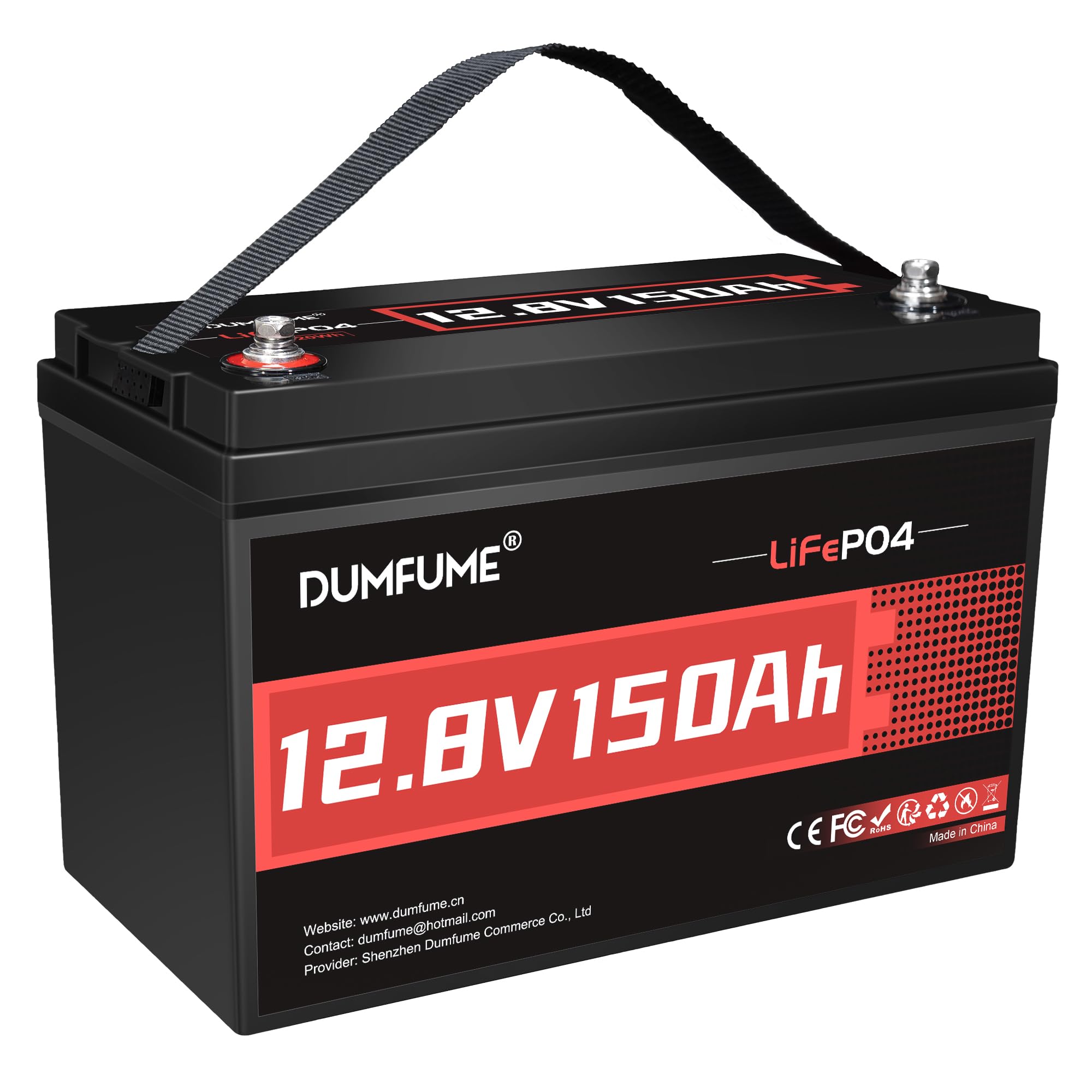
At 150Ah and 1920Wh of stored energy, the DUMFUME provides the highest single-unit capacity in this roundup without moving to a physically larger battery. The 22.05-pound weight is extraordinary for a 150Ah pack — standard lead-acid in this capacity class would weigh closer to 80 pounds. The built-in 100A BMS covers the standard protection suite including low-temperature cut-off, and the battery supports up to 4S4P expansion for building a 48V 400Ah bank with 20.48kWh of total energy. The Group 31 footprint means it fits existing battery trays designed for lead-acid replacements.
Multiple owner reports show these batteries testing at around 157Ah capacity when brand new, exceeding the rated spec by roughly 5%. Users running 36V and 48V golf cart conversions report the batteries work well once the initial capacitor inrush current is handled — the BMS may cut out momentarily during the first controller connection, but recovers after the capacitors are pre-charged. Home solar users running 24V 100Ah setups found them stable and reliable over months of daily cycling.
The main risk reported is that the 5-year warranty appears to apply only to direct purchases from DUMFUME, not through Amazon purchases. One user experienced a complete BMS lockout after one year with the battery refusing to accept a charge. This is a known failure mode for LiFePO4 packs that are deeply discharged and left in that state. For buyers who treat their batteries carefully and maintain a proper charging schedule, the value per amp-hour is excellent. For those who neglect their systems, the lack of Amazon warranty support is a real concern.
Why it’s great
- Highest capacity per pound in the guide at 150Ah
- Tested above rated capacity by some users
- Versatile expansion up to 4S4P for large battery banks
Good to know
- Warranty handled through manufacturer, not Amazon
- BMS may lock out after deep discharge if not recharged promptly
6. Power Queen 2-Pack 12V 100Ah Group 31 Bluetooth
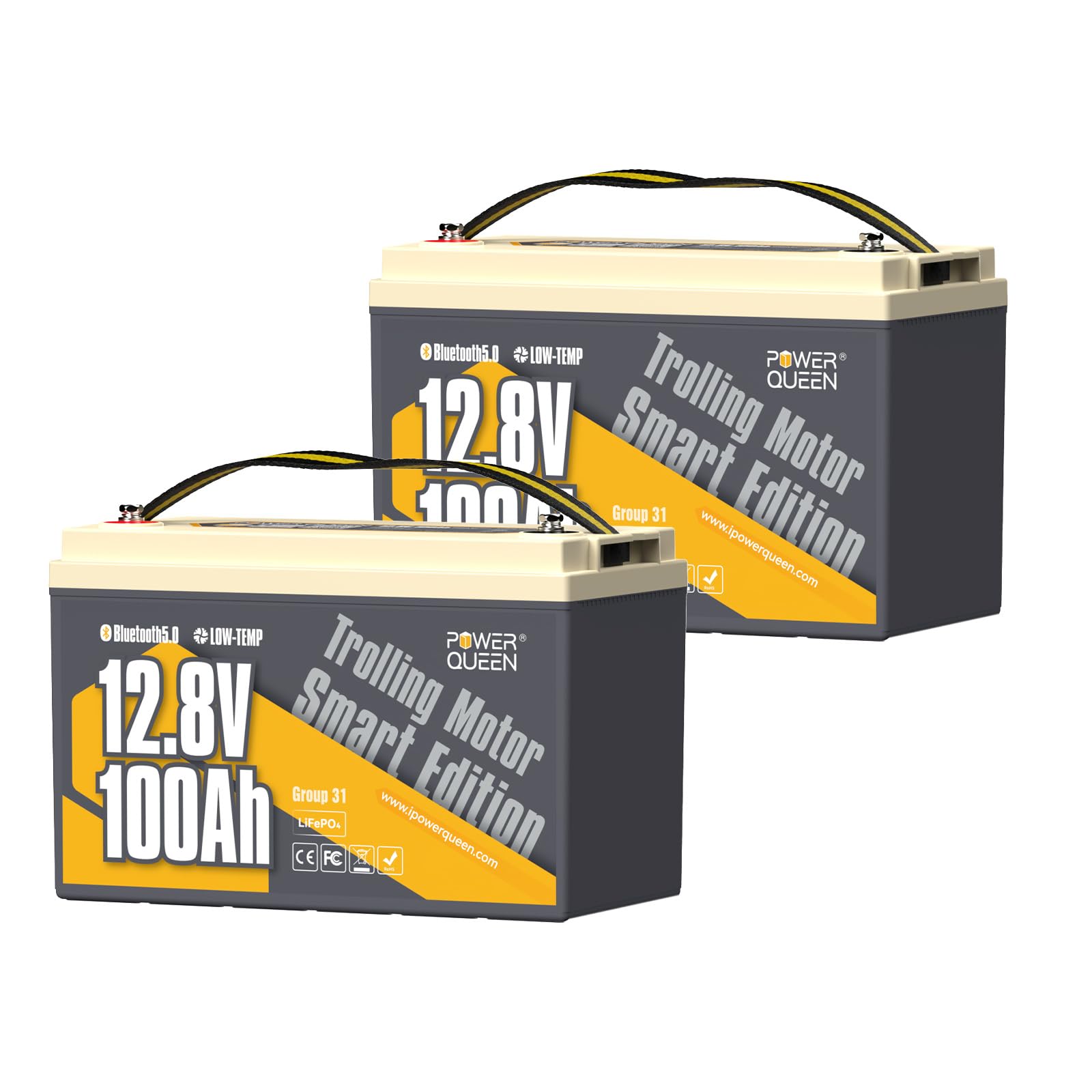
The Power Queen 2-pack delivers two 100Ah Group 31 batteries with a 100A continuous BMS that can surge up to 500A for a full second. That surge capacity is specifically designed to handle the inrush current of inverter loads and higher-thrust trolling motors (70 pounds and above) without tripping the BMS. The upgraded BMS also includes a pre-charge function that automatically limits inrush when connecting to large capacitor banks — a feature normally found in much more expensive systems. Bluetooth 5.0 monitoring via the Power Queen app shows real-time state of charge, voltage, and current with a 10-meter range.
Each battery weighs 24 pounds and measures standard Group 31 dimensions, making them direct replacements for existing lead-acid trays. The form factor is compliant with BCI Group 31 standards, so no custom mounting is required. Users report running a 30-pound Endura trolling motor on constant high speed for over four hours with only 20% battery drain, meaning two of these in parallel could easily handle an entire weekend of fishing on a single charge. The 4000 cycles at 100% DOD and 15000 cycles at 60% DOD match the best-in-class cycle life claims in this guide.
The 2-pack configuration is ideal for off-grid cabins, large solar banks, or any setup that needs a 200Ah capacity from the start. The per-unit price works out lower than buying two individual premium batteries separately. The 5-year warranty and 10-year service life provide long-term coverage. The only trade-off is that 100Ah is the maximum single-unit capacity — if you need 150Ah or more per battery, you would need to look elsewhere or add more units in parallel.
Why it’s great
- 500A surge capacity for inverter and large motor loads
- Pre-charge function prevents BMS tripping on capacitor banks
- 2-pack provides excellent value for 200Ah total capacity
Good to know
- Each unit limited to 100Ah capacity
- Requires a 20A 14.6V lithium charger for optimal charging speed
7. VEMDIA 12V 100Ah LiFePO4 Battery Group 31

The VEMDIA 100Ah battery hits a price point that makes it the most accessible entry into LiFePO4 power for budget-conscious buyers. It uses LiFePO4 chemistry rated for thermal stability up to 500°F and includes a full 100A BMS with protection against overcharge, over-discharge, over-current, overheating, and short circuits. The Group 31 dimensions of 12.9 x 6.69 x 8.5 inches match standard battery trays, and the 24.5-pound weight is a significant upgrade from lead-acid. The seller claims 15000 deep cycles at 60% DOD and a 10-year lifespan, which matches premium-tier claims on paper.
Real-world capacity tests by an owner showed the battery delivering 105Wh of output under a 3.5A cycling load — above the rated 102.4Wh. Another user successfully used it as a direct replacement for a TrippLite UPS, with the F2 terminals fitting the existing connectors and the battery reaching full charge in under three hours. The battery also supports 4S4P expansion up to 4 units in series or parallel, building a 400Ah or 48V bank with 20.48kWh of storage.
The most serious concern comes from a review that found the BMS stops charging at around 13.75V instead of the expected 14.6V, which prevents the battery from reaching full capacity. That review also notes the pack uses 24 cylindrical cells in a 4S6P configuration, epoxied inside the case, which traps heat and complicates cell balancing. Not all units exhibit this behavior, and many owners report normal operation. But the inconsistency in BMS calibration and the cylindrical cell construction are notable compromises at this price tier. For undemanding applications like basic solar lighting or weekend RV use, the value is hard to beat. For critical systems like a home inverter backup, the reliability variance is a risk worth considering.
Why it’s great
- Lowest entry price for a 100Ah LiFePO4 Group 31
- Some units test above rated capacity
- Full expansion support up to 4S4P for large banks
Good to know
- BMS calibration varies; some units stop charging early
- Uses cylindrical cells (epoxied) rather than prismatic cells
FAQ
Can I charge a LiFePO4 battery with a standard lead-acid charger?
Why does my new lithium battery show a low voltage before I use it?
What is the difference between starting a motor and deep-cycle use for lithium?
How do I calculate how long a 12V 100Ah battery will run my gear?
Final Thoughts: The Verdict
For most users, the 12 volt lithium battery winner is the LiTime 12V 50Ah Bluetooth because it blends an ultra-light 11-pound form factor with smart app-based battery management and proven performance in real trolling motor use. If you need the highest power density for a tight install, grab the LiTime 12V 100Ah Xtra-Mini. And for a salt-water-ready marine setup with excellent corrosion protection and above-rated capacity, nothing beats the Redodo 12V 100Ah Bluetooth.