
Our readers keep the lights on and the weekend projects moving. As an Amazon Associate, I earn from qualifying purchases.
Watching an action movie without a proper bass surround sound system is like watching fireworks with the sound off — you get the visual but miss the physical impact that makes the experience memorable. A dedicated system with a powered subwoofer and multiple satellite speakers transforms your living room into a personal cinema, where the sound of explosions rumbles through your chest and the dialogue remains crystal clear amidst the chaos.
I’m Rikta — the co-founder and writer behind FitlyFast. I’ve spent countless hours analyzing audio hardware specifications, comparing subwoofer driver sizes, amplifier power ratings, and channel configurations to separate the systems that genuinely deliver deep, room-shaking bass from those that merely promise it.
Whether you’re a movie enthusiast looking to upgrade from TV speakers or a gamer wanting to feel every in-game explosion, finding the right bass surround sound system involves understanding key specs like subwoofer driver size, amplifier power, and channel configuration.
How To Choose The Best Bass Surround Sound System
Selecting the right system for deep, impactful sound requires understanding a few critical specifications beyond just the brand name. The goal is to match the system’s physical capabilities with your room size, usage habits, and the kind of audio experience you’re chasing — whether that’s gentle rumble or chest-thumping bass.
Subwoofer Driver Size and Amplifier Power
The subwoofer is the heart of any bass-focused system. A larger driver — typically 10 inches or 12 inches — moves more air and produces deeper, more authoritative low frequencies compared to an 8-inch driver. An 8-inch sub is adequate for smaller rooms (under 200 sq ft), but a 10-inch or 12-inch driver is recommended for medium to large rooms where you want to feel the bass physically. Amplifier power, measured in peak watts, indicates the system’s maximum output capacity, but the more consistent RMS rating tells you how cleanly the system can sustain that bass without distortion.
Channel Configuration: 5.1, 7.1, and Dolby Atmos
The channel count defines how many discrete audio channels the system can reproduce. A 5.1 system has five main channels (left, center, right, two rear) plus a subwoofer. A 7.1 system adds two additional side or rear channels for a wider soundstage. Dolby Atmos systems (designated as 5.1.2 or 7.1.4) add overhead or up-firing speakers that create a three-dimensional sound bubble — essential for modern movie soundtracks that place sounds above the listener. For a truly immersive experience, a 5.1.2 or higher configuration delivers the best spatial realism.
Wired vs Wireless Surround Speakers
Traditional wired systems offer the most reliable and unadulterated audio signal, but they require running speaker cables across the room, which can be a challenge in rental spaces or living rooms where aesthetics matter. Modern wireless surround speakers eliminate those cable runs, using dedicated 2.4GHz or 5GHz wireless transmission to maintain stable, low-latency audio. The trade-off is that wireless systems must be plugged into a power outlet near each rear speaker, so they are “wireless” only in the audio signal sense, not in terms of power.
Quick Comparison
On smaller screens, swipe sideways to see the full table.
| Model | Category | Best For | Key Spec | Amazon |
|---|---|---|---|---|
| ULTIMEA Skywave X70 | Premium | Cinematic bass & height | 10″ sub, 20Hz low freq, 980W peak | Amazon |
| Klipsch Reference 5.1 | Premium | Audiophile floorstanding | 12″ sub, 400W peak, floorstanding towers | Amazon |
| Sony BRAVIA Theater System 6 | Premium | Brand reliability & balance | 5.1ch, Dolby Atmos/DTS:X | Amazon |
| JBL Bar 700MK2 | Mid-Range | Detachable wireless surrounds | 10″ sub, 780W peak, detachable rears | Amazon |
| Polk Audio MagniFi Max AX SR | Mid-Range | Voice clarity & wide soundstage | 10″ sub, SDA 3D tech, 7.1.2ch | Amazon |
| ULTIMEA Skywave X40 | Mid-Range | Affordable Atmos with rears | 6.5″ sub, 530W peak, 5.1.2ch | Amazon |
| Hisense AX5140Q | Mid-Range | Compact design & 5.1.4 height | 6.5″ sub, 5.1.4ch, Dolby Atmos | Amazon |
| Amazon Fire TV Soundbar Plus | Entry-Level | Fire TV integration & simplicity | 5.1ch, Dolby Atmos, wireless rears | Amazon |
| Bobtot Home Theater System | Entry-Level | Budget deep bass & karaoke | 10″ sub, 1200W peak, 5.1ch | Amazon |
In‑Depth Reviews
1. ULTIMEA Skywave X70 7.1.4ch Professional Wireless Surround Sound System
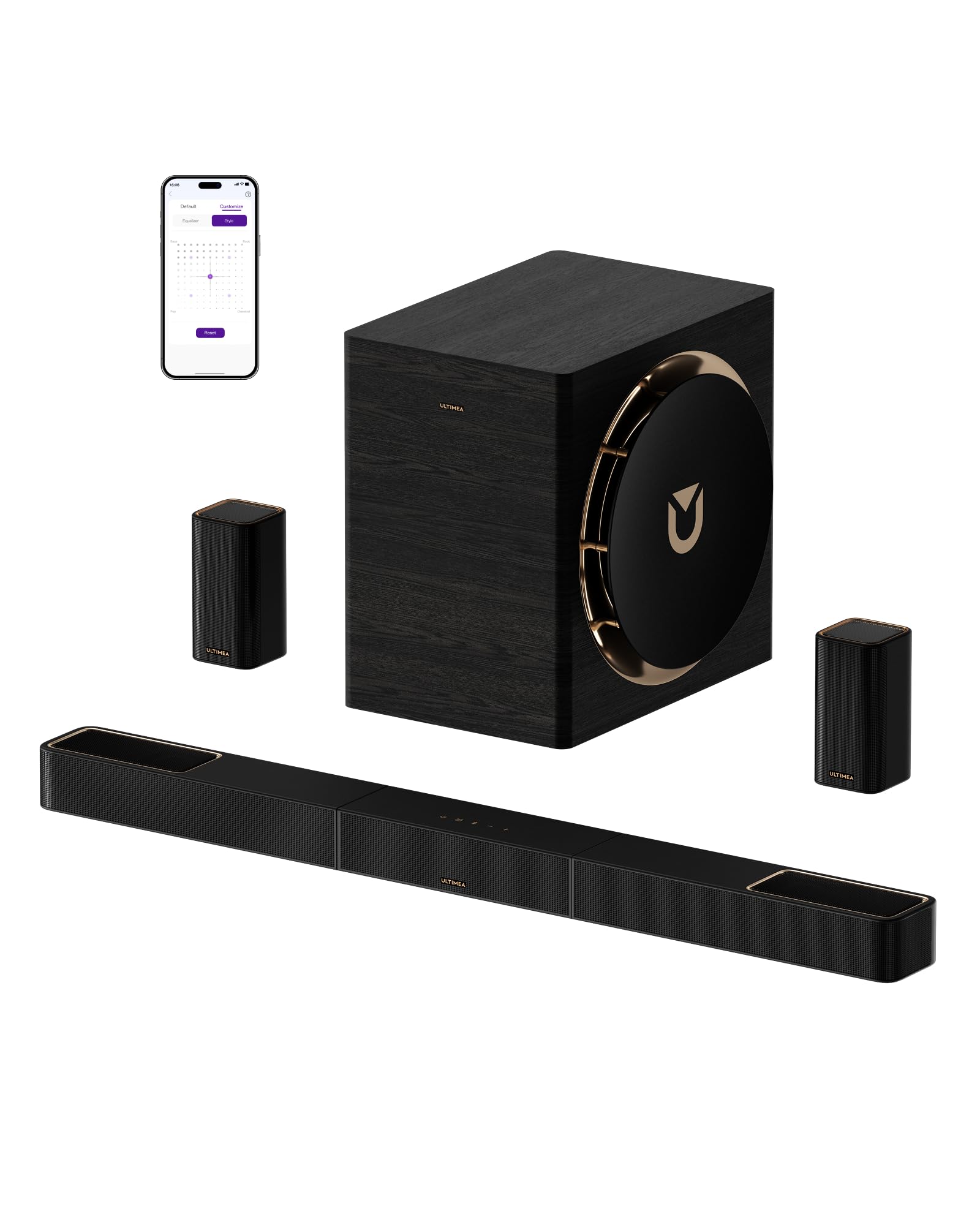
The Skywave X70 sets a new benchmark in the premium segment by combining a 10-inch wireless subwoofer with a 980W GaN amplifier that drives bass down to a genuinely tactile 20Hz. This is the lowest frequency response in this roundup — most competitors stop at 35Hz — which means you’ll feel the subsonic rumble of explosions and movie scores as a physical presence in the room, not just an audible thump. The 7.1.4 channel configuration includes two up-firing drivers in the soundbar and dedicated rear surrounds, creating a true Dolby Atmos bubble with overhead effects that feel convincingly three-dimensional.
Setup is refreshingly straightforward thanks to pre-linked wireless subwoofer and surround speakers that sync automatically over the 5GHz band. The soundbar itself arrives in three snap-together segments, which simplifies wall-mounting and placement. The accompanying app provides a 10-band EQ and 121 sound presets, allowing granular tuning that most systems at this level lack. Dialogue remains crisp even at reference volumes, and the AI surround feature intelligently upmixes stereo content to engage the rear channels, reducing the feeling of wasted hardware when streaming non-Atmos media.
Build quality is split: the subwoofer’s wood-crafted cabinet feels substantial, but the soundbar and satellite enclosures are lighter than expected. The lack of auto-calibration means you’ll need to manually adjust levels based on your room acoustics. For listeners who prioritize deep, chest-compressing bass and a genuinely immersive height channel experience, the Skywave X70 delivers performance that rivals systems costing significantly more.
Why it’s great
- Industry-leading 20Hz low-frequency extension from the 10-inch subwoofer
- GaN amplifier provides clean power with minimal heat and distortion
- 7.1.4 channel layout with up-firing drivers for convincing overhead Atmos effects
Good to know
- Soundbar and surround enclosure materials feel lighter than premium competitors
- No auto-room calibration — manual EQ adjustment required for optimal sound
2. Klipsch Reference 5.1 Dolby Atmos Home Theater System

This is a traditional passive speaker system, meaning it requires an external AV receiver (not included) to power the five speakers and the 400W all-digital subwoofer. The R-625FA floorstanding towers stand 40 inches tall and each house a built-in up-firing Dolby Atmos elevation driver, eliminating the need for separate ceiling or upward-firing add-on modules. The 12-inch R-12SW subwoofer is the largest driver in this lineup, delivering down-firing bass that can shake a medium to large room with authority, reaching frequencies that few soundbar-based systems can match.
Klipsch’s signature Tractrix horn-loaded tweeters produce high efficiency (90-96dB sensitivity), which means even a modest 75W receiver can drive these speakers to satisfying volumes without strain. The aluminum LTS tweeters and spun copper IMG woofers deliver a detailed, dynamic sound signature that excels in both movie soundtracks and music playback. The R-52C center channel focuses dialogue with precision, while the R-41M bookshelf surrounds provide clear, directional effects. Setting up requires running speaker wire to each passive unit and configuring the receiver’s crossover levels, but the end result is a system that scales with your equipment upgrades.
The supplied foot screws for the tower speakers are weak and should be replaced with better hardware. The cabinets are finished in scratch-resistant black textured wood grain, and magnetic grilles give a clean aesthetic. At this price point, the system offers exceptional value for someone who already owns or is willing to invest in a separate AV receiver and values the long-term upgradability and outright performance of passive speakers over an all-in-one soundbar.
Why it’s great
- 12-inch subwoofer delivers the deepest, most physical bass in this guide
- Floorstanding towers with built-in up-firing Atmos elevation channels
- High sensitivity design means clean, dynamic sound even with moderate amplification
Good to know
- Requires a separate AV receiver — not a self-contained system
- Speaker wire must be run to each passive unit; not suitable for clutter-free spaces
3. Sony BRAVIA Theater System 6, 5.1ch Home Theater System HT-S60

The Sony HT-S60 is a self-contained 5.1-channel system that marries a soundbar, wireless subwoofer, and wired rear speakers (connected to a wireless receiver box) into a cohesive package that integrates deeply with compatible BRAVIA TVs through the BRAVIA Connect app. The soundbar houses three front-firing channels including a dedicated center for dialogue, and the included two rear speakers create a convincing surround field. The subwoofer delivers clean, tactile bass that is powerful enough for a medium-sized living room without overwhelming the midrange or dialogue clarity.
Dolby Atmos and DTS:X support are present but implemented virtually through DSP processing rather than dedicated up-firing drivers — the system relies on psychoacoustic algorithms to create a sense of height. In practice, the overhead effect is subtle but adds a noticeable sense of vertical space to action scenes. Multi Stereo mode engages all speakers simultaneously for a room-filling sound boost during music playback. The app allows granular control over sound profiles and volume adjustments, and Voice Zoom 3 (when paired with a compatible BRAVIA TV) provides adjustable dialogue enhancement that works well for content with quiet vocal passages.
The wired subwoofer connection is a notable limitation — the sub must be placed near the soundbar with a dedicated cable, reducing placement flexibility. Rear speaker wires require routing across the room or under carpets. The virtual sound field technology, while effective, cannot match the physical height channel performance of systems with dedicated up-firing speakers. For users who prioritize ecosystem integration with Sony TVs and desire a polished, balanced sound signature with clear dialogue, the HT-S60 is a strong contender.
Why it’s great
- Deep Sony BRAVIA TV integration including Voice Zoom 3 dialogue enhancement
- Clean, balanced sound signature with clear center channel dialogue
- Multi Stereo mode effectively fills the room for music listening
Good to know
- Subwoofer connection is wired, limiting placement flexibility
- Virtual height processing is less convincing than physical up-firing drivers
4. JBL Bar 700MK2 7.1 Channel Soundbar System

The defining feature of the JBL Bar 700MK2 is its detachable wireless surround speakers that physically dock onto the soundbar for charging and detach for placement behind the listening position. These battery-powered surround speakers eliminate the need for both audio cables and power outlets near the rear of the room — a true wireless solution that no other system in this roundup offers. The 780-watt peak power system is anchored by a 10-inch wireless subwoofer that produces deep, authoritative bass capable of shaking a medium-sized room.
Dolby Atmos performance is enhanced by MultiBeam 3.0 technology, which uses multiple beam-forming drivers in the soundbar to create a wide, cinema-like soundstage without requiring exact seating placement. PureVoice 2.0 automatically optimizes dialogue levels based on the ambient sound mix, ensuring whispered lines are audible without blasting the rest of the soundtrack. Night listening mode mutes the soundbar and subwoofer while routing audio exclusively through the detachable speakers, allowing late-night viewing without disturbing others. The JBL ONE app provides precise EQ customization, though many users find the initial bass response too heavy and need to dial it back significantly.
The detachable speakers have a battery life that lasts several days under normal use, but they must be docked regularly for recharging. The surround volume from the detachable speakers is slightly lower than wired alternatives, which can reduce immersion in large rooms. For users in apartments, rental homes, or rooms where running wires is impractical, the JBL Bar 700MK2’s convenience and clean bass make it an compelling choice.
Why it’s great
- Battery-powered detachable surround speakers require no wires or outlets
- Powerful 10-inch subwoofer delivers deep, room-filling bass
- MultiBeam 3.0 creates wide soundstage without precise seating positions
Good to know
- Surround speaker volume is lower than wired competitors in large rooms
- Default bass tuning is heavy and requires EQ adjustment for balanced sound
5. Polk Audio MagniFi Max AX SR 7.1.2 Channel Sound Bar System

Polk’s MagniFi Max AX SR excels in one area that frustrates many home theater enthusiasts: dialogue clarity. Polk’s patented VoiceAdjust technology works through the dedicated center channel speaker to independently boost vocal levels without affecting the rest of the soundtrack, making it ideal for content where dialogue competes with loud sound effects. The 7.1.2 channel configuration includes two up-firing speakers in the soundbar for Dolby Atmos and DTS:X height effects, and the included SR2 wireless surround speakers create a coherent rear soundstage.
The 10-inch wireless subwoofer produces smooth, effortless bass that integrates well with the soundbar rather than dominating the mix. The SDA 3D technology processes the audio signal to create a wide, immersive soundstage that extends beyond the physical speaker boundaries. The system includes three HDMI inputs for connecting source devices directly, reducing the need for an external switch. Setup is straightforward with no app required — the system automatically responds to the TV remote via HDMI-CEC, and the included calibration microphone helps optimize the sound for the room.
While the up-firing speakers do create a perceptible height effect, it is subtle even with reflective ceilings and doesn’t match the presence of dedicated ceiling speakers or higher-end systems with more powerful elevation drivers. The voice clarity, however, is genuinely best-in-class — difficult to find in any other system at this price point. For users who prioritize being able to hear every line of dialogue in action-heavy movies, the MagniFi Max AX SR delivers unmatched performance.
Why it’s great
- VoiceAdjust technology independently boosts dialogue without affecting sound effects
- Three HDMI inputs provide flexible device connectivity
- Effortless bass that integrates smoothly with the soundbar
Good to know
- Up-firing Atmos height effects are subtle and depend on ceiling reflectivity
- Recent price increases have reduced the value proposition
6. ULTIMEA Skywave X40 5.1.2ch Sound Bar with Dolby Atmos
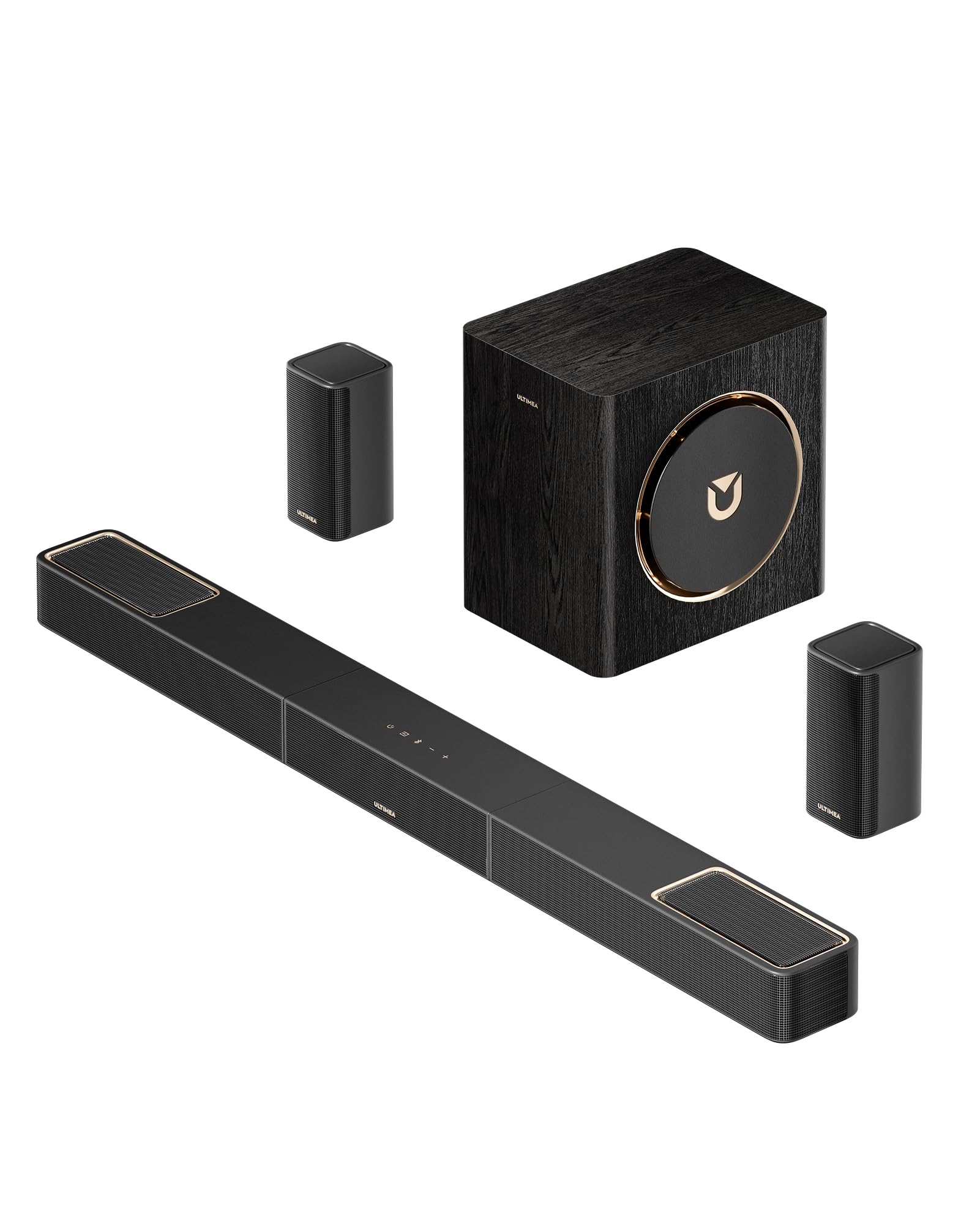
The Skywave X40 brings true Dolby Atmos with dedicated wireless rear speakers and up-firing drivers to a price point that typically forces buyers to choose between surround and height — here you get both. The 5.1.2 configuration includes a 6.5-inch wireless subwoofer, two wireless surround speakers, and a soundbar with integrated up-firing drivers. The GaN amplifier delivers 530 watts of peak power with 98% efficiency, producing clean audio even at high volumes without the thermal buildup associated with traditional Class-D amps.
The 6.5-inch subwoofer, while smaller than the 10-inch units found on higher-tier systems, produces surprisingly deep bass down to 35Hz, which is sufficient for adding palpable weight to movie explosions and music kick drums in small to medium rooms. The NEURACORE multi-channel audio engine processes up to 17 channels of audio at 24-bit/192kHz resolution, supporting the Dolby Atmos object-based audio format with precise spatial placement. Setup is genuinely plug-and-play — the wireless sub and surrounds pair automatically upon power-up, and the HDMI eARC connection enables single-cable control with the TV remote.
The surround speakers, while wireless in audio signal, still require power cables, which can complicate placement in rooms without conveniently located outlets. The up-firing Atmos effect is most noticeable with action-heavy Dolby demo content but becomes subtle with standard broadcast material. For buyers seeking an affordable entry point into Atmos surround sound with both rear and height channels, the Skywave X40 offers exceptional value.
Why it’s great
- Full 5.1.2 configuration with wireless rear surrounds at an accessible price point
- GaN amplifier runs cool and delivers clean power up to 530W peak
- Plug-and-play wireless pairing with automatic sub and surround sync
Good to know
- 6.5-inch subwoofer lacks the deep extension of larger 10-inch or 12-inch units
- Atmos height effect is most apparent with dedicated demo content
7. Hisense AX5140Q 5.1.4ch Home Theater Soundbar
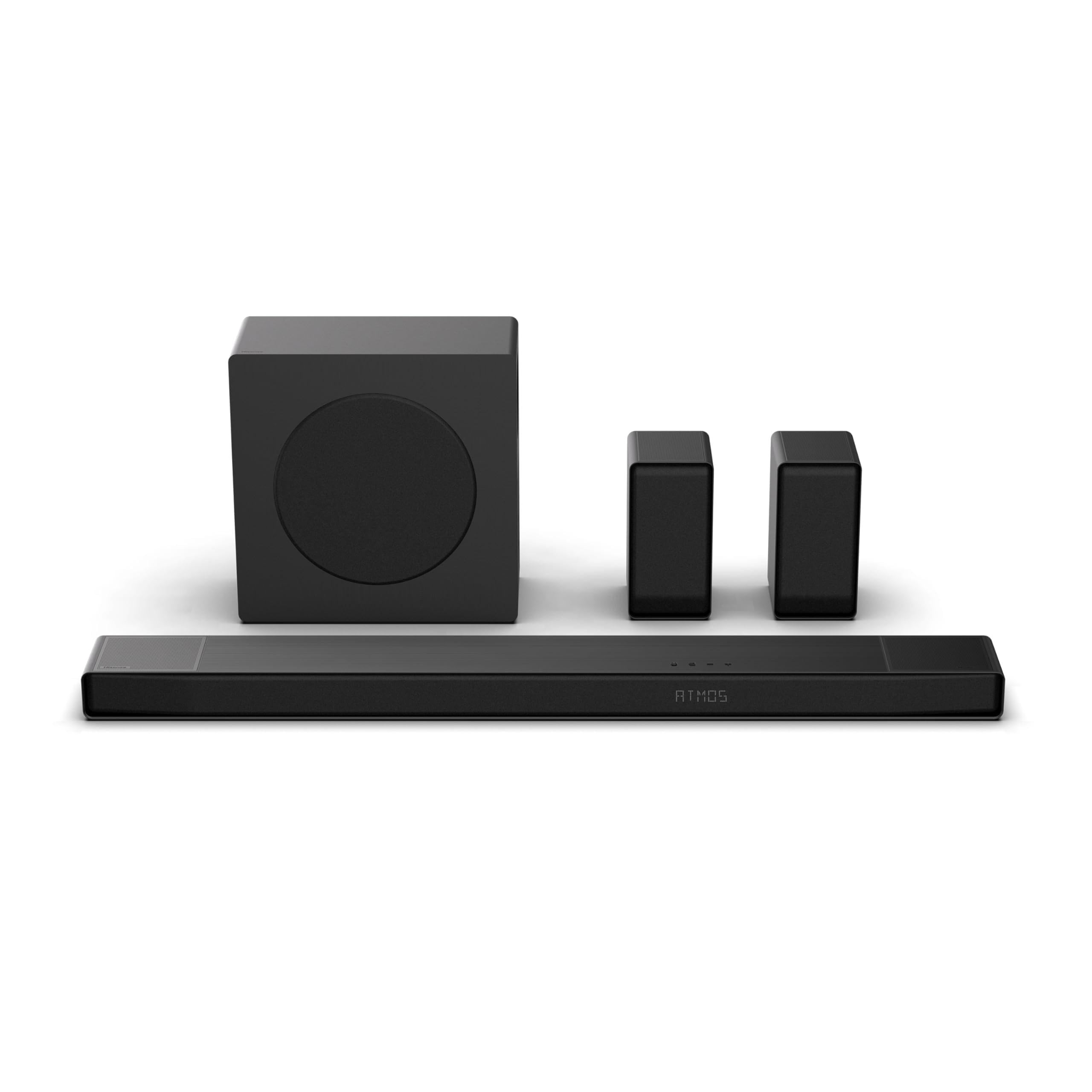
The Hisense AX5140Q stands out by offering a 5.1.4 channel configuration at a mid-range price, packing more up-firing speakers than comparably priced competitors. The system features two up-firing drivers within the soundbar, combined with the wireless subwoofer and wireless rear surround speakers, to create a total of four height channels. This increased height channel count theoretically provides more precise overhead object placement in Dolby Atmos soundtracks compared to 5.1.2 systems.
The 6.5-inch wireless subwoofer delivers punchy bass down to 40Hz, which is sufficient for adding impact to action scenes and music in small to medium rooms. Seven EQ presets (Standard, Movie, Music, Voice, Night, Stadium, and AI) can be switched via the remote or app, allowing quick optimization for different content types without manual EQ adjustment. Room calibration uses a built-in microphone to analyze the space and adjust the sound accordingly, which helps compensate for furniture placement and room reflections. The compact soundbar chassis — just 2.24 inches deep and 40 inches wide — fits neatly under most TVs without blocking the screen or IR sensor.
Some users have reported occasional Bluetooth audio glitches when streaming from an iPhone. The rear surround speakers, while wireless, still need to be plugged into power outlets. The upward-firing speakers produce a noticeable but subtle height effect — adequate for adding a sense of space, but not as convincing as dedicated ceiling speakers. For homeowners with compatible Hisense TVs seeking a seamless integration, or for buyers who prioritize a higher channel count in a compact form factor, the AX5140Q delivers good value.
Why it’s great
- 5.1.4 channel configuration offers more height channels than competing soundbars
- Built-in room calibration helps optimize sound for your specific space
- Compact soundbar chassis fits under TVs without blocking screen or sensors
Good to know
- Occasional Bluetooth audio glitches reported with iPhone streaming
- Up-firing height effect is subtle and room-dependent
8. Amazon Fire TV Soundbar Plus 5.1 Channel System

The Fire TV Soundbar Plus is Amazon’s integrated 5.1-channel solution that pairs a soundbar with a wireless subwoofer and two wireless surround speakers, all designed to work seamlessly with Fire TV devices. The dedicated center channel ensures dialogue clarity with a 5-level dialog boost that works well for content where voices are buried in the mix. The subwoofer delivers solid bass that adds weight to action scenes and music, though it lacks the deep, physical extension of larger drivers found in premium systems.
Dolby Atmos and DTS:X support are included, but like many virtual implementations, the height effects are generated through DSP processing rather than physical up-firing drivers. This means the overhead sensation is present but less convincing than systems with dedicated elevation speakers. Setup is as straightforward as it gets — the subwoofer and surround speakers pair automatically with the soundbar, and connection to the TV via HDMI-ARC enables single-remote control. The soundbar detects the HDMI-ARC signal and switches on automatically with the TV, a convenience that reduces remote count. Movie, Music, Sports, and Night modes optimize the audio profile for different content types.
Without dedicated up-firing speakers, the system cannot create a true 3D sound bubble, and the surround effect is primarily lateral rather than overhead. The subwoofer connectivity is wireless, but the rear surround speakers still require power outlets. For Fire TV users who want a no-fuss upgrade from TV speakers with clear dialogue and room-filling sound, the Fire TV Soundbar Plus is a well-integrated, user-friendly option that prioritizes simplicity over maximum performance.
Why it’s great
- Seamless Fire TV integration with single-remote control via HDMI-CEC
- 5-level dialog boost dramatically improves vocal clarity in action scenes
- Wireless surrounds and subwoofer pair automatically out of the box
Good to know
- No dedicated up-firing speakers — Atmos height effects are virtual and subtle
- Surround effects are primarily lateral without overhead presence
9. Bobtot Home Theater Systems 1200W 10-Inch Subwoofer 5.1/2.1 Channel
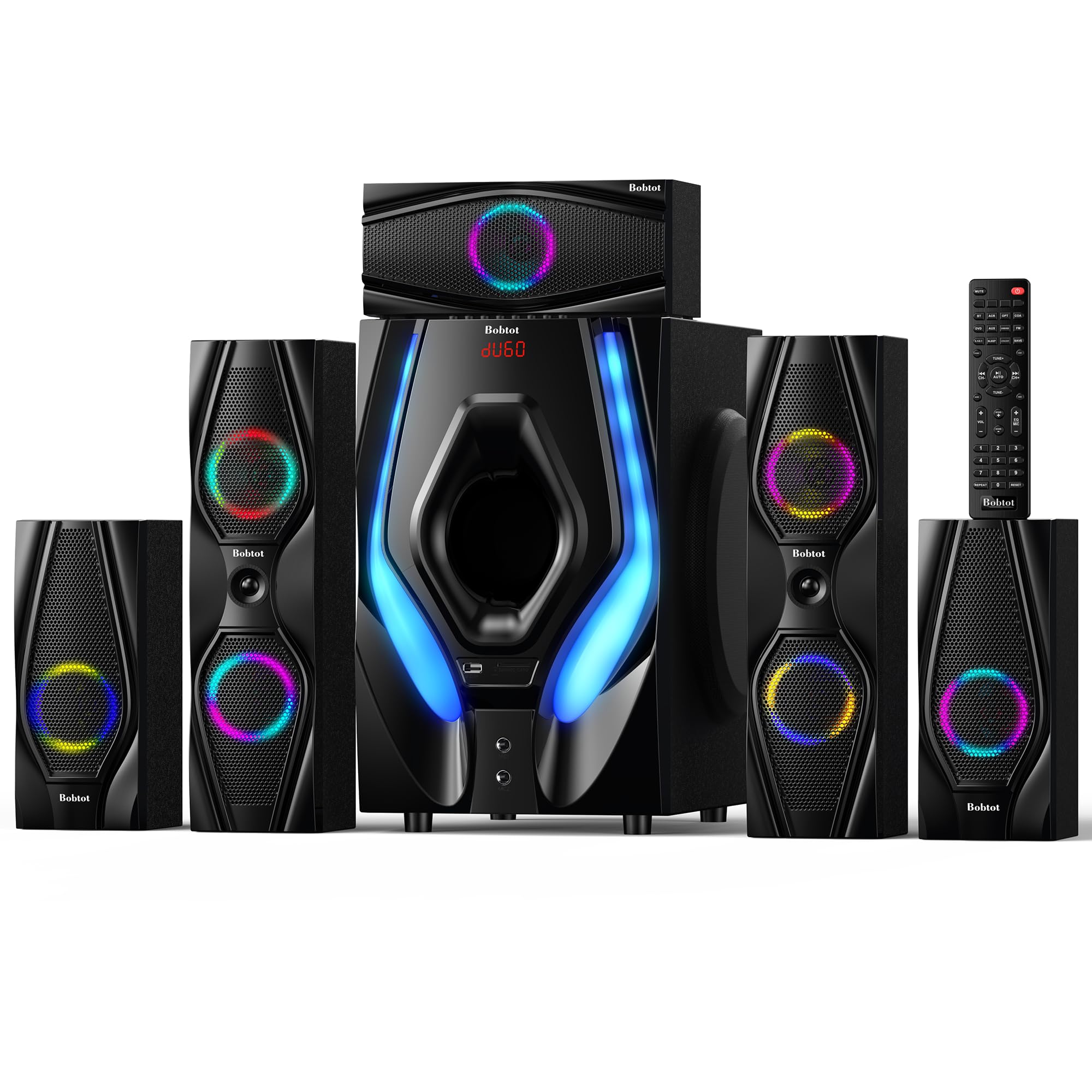
Bobtot’s system proves that deep, room-shaking bass doesn’t require a premium budget. The centerpiece is a 10-inch subwoofer with a built-in receiver, delivering 1200 watts of peak power that produces thunderous low-end capable of rattling furniture. The system supports both 5.1 and 2.1 channel modes, switchable via remote, and includes four satellite speakers plus a center channel for full surround immersion. The LED lighting on the subwoofer offers four modes (blink-to-beat, solid, spectrum EQ analyzer, or off) that add visual flair to movie nights and parties.
Connectivity covers all the basics: Bluetooth 5.3 for wireless streaming from phones or tablets, ARC/Optical/Coaxial/AUX/USB inputs for TV and gaming console integration, FM radio, dual 1/4-inch microphone inputs with echo effect for karaoke, and a USB/SD card slot supporting up to 64GB. The built-in receiver handles source switching and volume management for each speaker independently, giving users granular control over the sound balance. The included remote allows independent volume adjustment for the subwoofer and front speakers, which helps tame the bass-heavy default tuning that some users find overpowering.
Multiple customer reports indicate reliability issues — subwoofer failures after 6-8 months, crackling speakers, and difficulty reaching responsive customer service based in Asia. The speaker wires are fixed-length and cannot be extended, limiting placement flexibility. The center speaker may block the bottom of the TV screen or the IR sensor on some TV models. For buyers on a strict budget who prioritize raw bass output and feature quantity over long-term reliability and polished sound, the Bobtot system delivers incredible bang for the buck if the unit works as intended.
Why it’s great
- 10-inch subwoofer delivers thunderous bass at an entry-level price point
- Extensive connectivity including Bluetooth 5.3, ARC, USB, and dual mic inputs
- Independent volume control for each speaker channel via included remote
Good to know
- Reliability concerns with multiple reports of subwoofer and speaker failures
- Fixed-length speaker wires cannot be extended for flexible placement
FAQ
What is the difference between a 5.1 and a 5.1.2 surround system?
Do I need an AV receiver for a passive speaker system like the Klipsch Reference 5.1?
How important is Dolby Atmos for a bass-focused surround sound system?
Final Thoughts: The Verdict
For most users, the bass surround sound system winner is the ULTIMEA Skywave X70 because its 10-inch subwoofer delivers bass down to 20Hz — deeper than any other system at this price — while the 7.1.4 channel configuration with up-firing drivers provides a genuinely immersive Dolby Atmos experience with overhead effects. If you want uncompromising dialogue clarity and the ability to fine-tune vocal levels independently, grab the Polk Audio MagniFi Max AX SR. And for users who need a completely wire-free solution for rear surround speakers in a room where running cables is impossible, nothing beats the JBL Bar 700MK2 with its detachable battery-powered surrounds.