
Our readers keep the lights on and the weekend projects moving. As an Amazon Associate, I earn from qualifying purchases.
Deciding on your first telescope can feel like a paradox: you want enough light-gathering punch to see Saturn’s rings, but you also need a price tag that doesn’t drain your wallet. The affordable category packs surprising performance—if you know which specs actually deliver and which are just marketing flare.
I’m Rikta — the co-founder and writer behind FitlyFast. My buying guides are built on deep market research and hours of spec-analysis, comparing aperture size, focal ratio, mount stability, and included accessories across dozens of models to separate real value from empty promises.
A clear view of craters, star clusters, and the moons of Jupiter starts with matching the right optical package to your own expectations — and this guide is built to help you confidently choose the best affordable telescope for your sky.
How To Choose The Best Affordable Telescope
In the sub- category, every dollar needs to earn its keep. Beginners often chase the highest “magnification” number on the box, but that number is meaningless without enough aperture to keep the image bright. The real foundation of a satisfying first scope is pairing a stable mount with an aperture that matches where you’ll observe—backyard suburban skies tolerate 70mm, while a 90mm starts pulling in structure on Jupiter’s bands and the dimmer Messier objects.
Aperture and Focal Ratio – The Light-Gathering Duo
Aperture is the diameter of the main lens (measured in millimeters). Bigger aperture = more light captured = brighter, sharper images. Most affordable telescopes land between 70mm and 90mm. The focal ratio (focal length divided by aperture) tells you the field of view: a lower f-ratio (like f/5) gives wide, bright views better for star clusters; a higher f-ratio (like f/8.8) gives more magnification per inch of eyepiece, ideal for planets and the moon.
Mount Stability – The Silent Game-Changer
An unstable mount turns high-power viewing into a wobble-fest. Budget scopes often pair optics with lightweight tripods that amplify every breeze and touch. Look for a mount with slow-motion control cables or at least stiff leg locks. Alt-azimuth (up-down, left-right) mounts are the standard in this range and are perfectly fine for lunar and planetary work — just make sure the tripod legs are metal and the spreader tray is included.
Accessory Kit – Separating Useful from Plastic Filler
Every budget telescope bundles eyepieces, a finderscope, and often a phone adapter. The useful pieces are a 25mm eyepiece (low power, wide view) and a 10mm eyepiece (higher power for details). A 3x Barlow lens doubles your magnification options — but a cheap Barlow degrades image clarity. A reflex or straight-through finderscope is adequate; avoid models with no finder at all. The included smartphone adapter is a real plus for sharing moon shots with family.
Quick Comparison
On smaller screens, swipe sideways to see the full table.
| Model | Category | Best For | Key Spec | Amazon |
|---|---|---|---|---|
| MEEZAA 90800 | Refractor | Planetary & Lunar Detail | 90mm aperture / 800mm f/l | Amazon |
| Koolpte VAZ90700 | Refractor | Smooth Tracking at High Mag | 90mm aperture / 700mm f/l | Amazon |
| Celticbird 80900 | Refractor | Long Focal Length Value | 80mm aperture / 900mm f/l | Amazon |
| Dianfan 90×550 | Refractor | Wide-Field & Portability | 90mm aperture / 550mm f/l | Amazon |
| SOLOMARK 80900 | Refractor | Deep Lunar Craters | 80mm aperture / 900mm f/l | Amazon |
| HUGERSTAR 80600 | Refractor | Included Moon Filter | 80mm aperture / 600mm f/l | Amazon |
| Dianfan 80×500 | Refractor | Starter Kit with Backpack | 80mm aperture / 500mm f/l | Amazon |
| Hawkko 80500 | Refractor | Family-Friendly Stickers | 80mm aperture / 500mm f/l | Amazon |
| Gskyer 70400 | Refractor | Ultra-Portable 70mm | 70mm aperture / 400mm f/l | Amazon |
In‑Depth Reviews
1. MEEZAA 90800

The MEEZAA 90800 combines a 90mm aperture with an 800mm focal length (f/8.88) — the highest light-gathering capacity in this price tier. Results are immediate: lunar craters snap into crisp relief, Jupiter’s cloud bands become visible with the 10mm eyepiece, and even Saturn’s ring separation is distinguishable on a steady night. The fully multi-coated lenses minimize internal reflections, keeping contrast high.
The stainless steel tripod is the standout build feature here — at this price point, most competitors use thinner aluminum legs that amplify vibrations. The AZ mount is smooth enough for casual tracking, and slow-motion control would be a future wish but the included 25mm and 10mm Kellner eyepieces are genuinely usable. The included phone adapter attaches firmly, making it simple to capture moon shots.
Assembly takes around 15 minutes following the paper manual; the accessory tray doubles as a leg spreader for added stability. A 3x Barlow lens is included, bringing magnification up to 240x, though real-world use at that power depends on atmospheric conditions. There is no finderscope alignment frustration — the straight-through finder works fine once the main scope is roughly aimed.
Why it’s great
- 90mm aperture captures enough light for Jupiter band detail
- Stainless steel tripod provides above-average stability
- Included 3x Barlow pushes useful magnification range
Good to know
- No slow-motion control cable on the mount
- Straight-through finder can be awkward for overhead targets
2. Koolpte VAZ90700
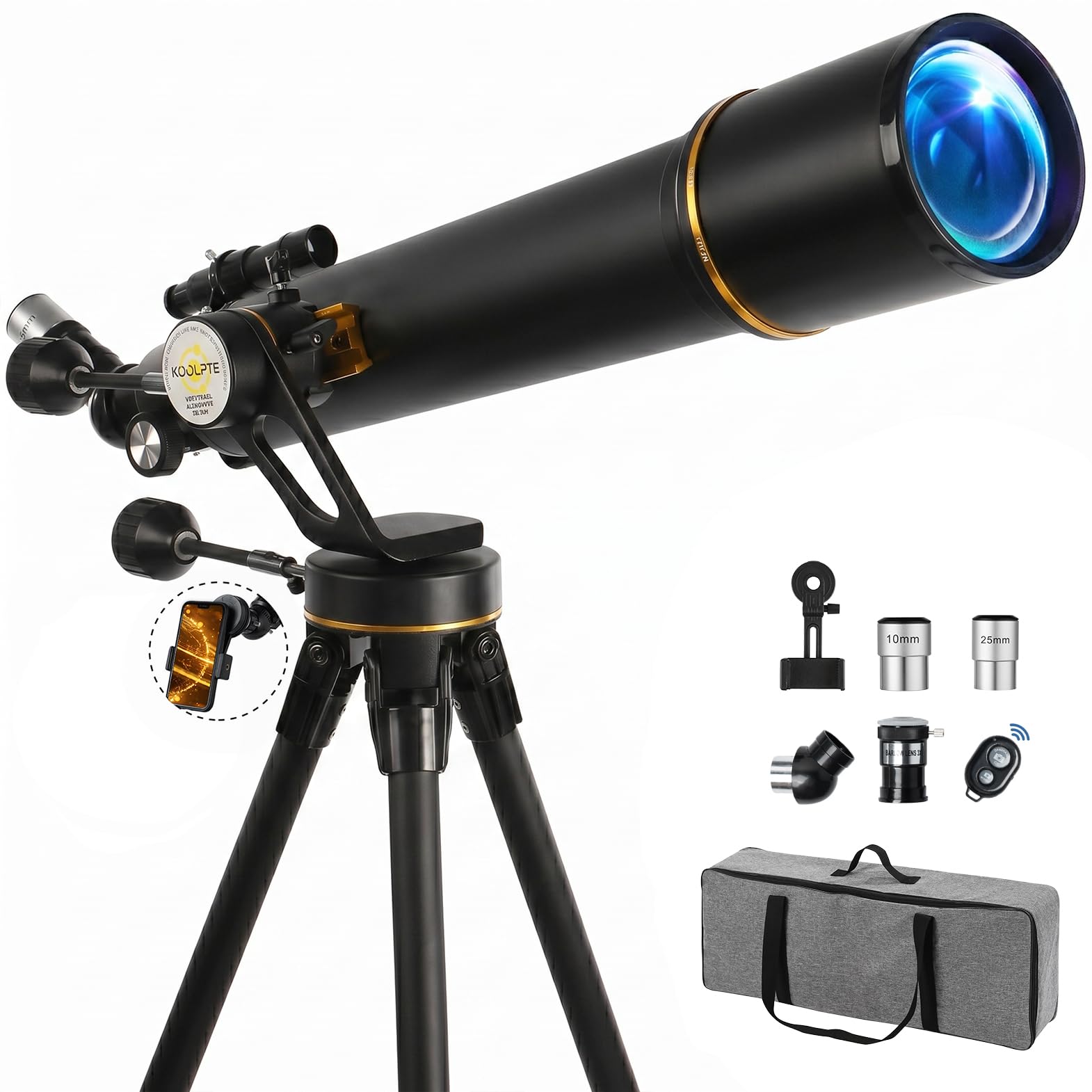
The Koolpte VAZ90700 sets itself apart with its proprietary Vertisteel AZ Slow-Motion Mount — a rare feature in the affordable bracket. The slow-motion cable allows micro-adjustments in altitude without overshooting the target, making high-power views of Saturn and Jupiter much less frustrating. The 90mm aperture paired with a 700mm focal length (f/7.8) delivers bright, high-contrast lunar and planetary images.
The tripod uses a mix of thin metal legs and plastic end caps — functional but not as rigid as the MEEZAA’s stainless tripod. The included 10mm and 25mm Kellner eyepieces are decent, and the 3x Barlow triples the eyepiece magnification to a maximum of 210x, though atmospheric stability will cap useful viewing around 180x. The wireless remote and phone adapter are welcome additions for astrophotography beginners.
Setup takes about 15-20 minutes, and the included carry bag keeps the tube and accessories organized. A reflex finder makes initial targeting intuitive for kids and adults alike. The main compromise: tripod leg adjustments are stiff, and the mount can feel a bit wobbly at extreme angles. Still, for the price, the slow-motion tracking is a genuine usability upgrade over standard entry-level mounts.
Why it’s great
- Slow-motion Alt-Az mount for precise celestial tracking
- 90mm aperture provides bright, detailed lunar views
- Includes wireless remote and phone adapter for imaging
Good to know
- Tripod leg adjustments can be stiff
- Mount stability weakens at high angles
3. Celticbird 80900

The Celticbird 80900 uses an 80mm aperture with a 900mm focal length, yielding a focal ratio of f/11.25 — the highest in this roundup. A longer focal ratio reduces chromatic aberration (false color fringing around bright objects) and packs more magnification per millimeter of eyepiece. The result: stunningly sharp views of the moon, and for the first time in this bracket, Jupiter’s four Galilean moons appear as distinct pinpricks.
The telescope tube is metal, giving it a reassuring weight, and the included 20mm and 10mm wide-angle eyepieces are a step above the generic Kellners found on many competitors. The tripod is acceptable but the tradeoff for the long tube is that it extends higher, making the tripod more susceptible to vibration in light winds. The phone mount is functional and fits most smartphone cases.
The 5×24 finderscope has crosshairs that simplify locating bright targets, and the AZ mount has enough friction to hold position without drifting. The carry bag is a simple nylon case — adequate for storage but minimal padding. For buyers prioritizing planetary sharpness and contrast over a super-wide field, this is a strong contender in the 80mm class.
Why it’s great
- 900mm focal length delivers high planetary magnification
- Wide-angle eyepieces included are above-average quality
- Long f-ratio minimizes chromatic aberration
Good to know
- Long tube makes mount more vibration-prone
- Carry bag has minimal padding
4. Dianfan 90×550
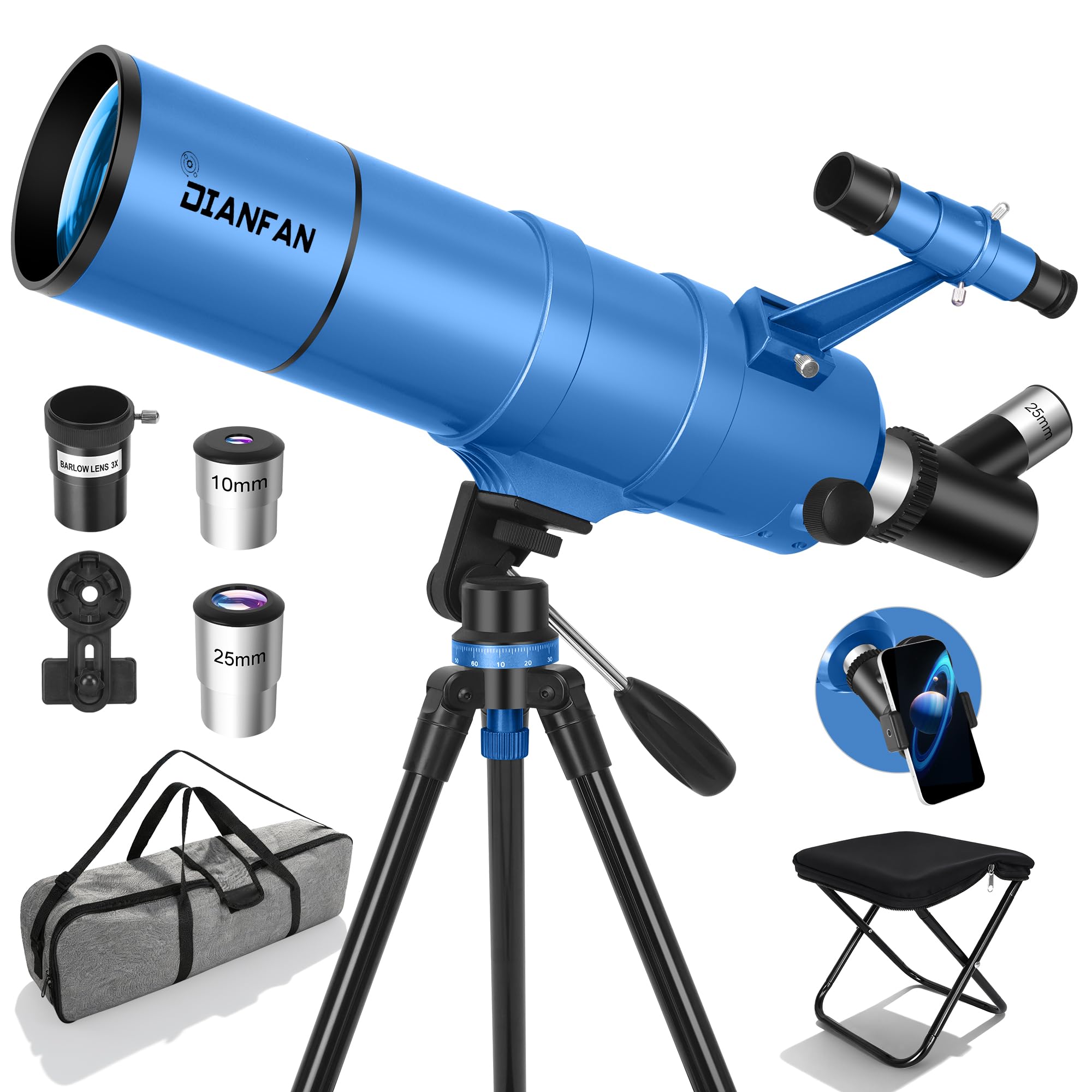
The Dianfan 90×550 flips the script on the typical long-tube formula. Its 90mm aperture paired with a 550mm focal length (f/6.1) produces a short, wide-field refractor — ideal for sweeping sections of the Milky Way, open star clusters like the Pleiades, and wide lunar landscapes. The fast focal ratio delivers bright, contrasty images at lower magnifications, making it a joy for backyard scanning.
The scope’s portability is a key advantage: it packs into a custom-fit carry bag, and the included folding stool (rated for up to 90 kg) solves the common problem of stooping to view through a too-short tripod. The fully multi-coated optics are crisp, and the 10mm and 25mm eyepieces plus 3x Barlow provide a versatile range from 22x to 165x. The phone adapter works well for quick captures.
Assembly is straightforward at around 15 minutes, but the lightweight tripod means focusing at high power can induce shakes. The slow-motion mount is absent, so tracking at 165x requires gentle touches. For deep-sky enthusiasts on a budget who want the widest possible window into the cosmos, the 90×550 delivers a unique combination of aperture and compactness.
Why it’s great
- Wide-field views of star clusters and Milky Way
- Folding stool adds comfort for extended viewing
- 90mm aperture in a compact, portable package
Good to know
- Lightweight tripod can shake at high magnification
- No slow-motion control for precise tracking
5. SOLOMARK 80900

The SOLOMARK 80900 is another entry in the long-tube 80mm class, but it distinguishes itself with an eyepiece design choice: the included 10mm and 20mm are Super Plössl eyepieces, which offer wider apparent field of view and better eye relief than the standard Kellners. This translates to more comfortable extended viewing sessions of the moon’s Tycho crater and the terminator line where shadows define peaks.
The mount includes altitude and azimuth scales — a rare bonus at this price — that help beginners aim at known sky coordinates. The 5×24 finderscope has a reflex-style sight that is easier for younger users. The tripod is a standard aluminum full-size model with decent leg locks, but the spreader tray is fixed and adds needed rigidity. The phone adapter clips on securely.
Image quality is impressively free of false color for an 80mm f/11.25 scope. The included carrying bag holds everything, though the bag itself is utilitarian. For the budget-conscious buyer who values eyepiece quality and doesn’t need the widest aperture, the SOLOMARK offers a refined optical experience for lunar and planetary work.
Why it’s great
- Super Plössl eyepieces for better eye relief and field of view
- Alt-az mount with angle scales for easier targeting
- Minimal chromatic aberration at f/11.25
Good to know
- Carry bag is basic with minimal padding
- Limited to lunar, planetary, and brightest DSOs
6. HUGERSTAR 80600
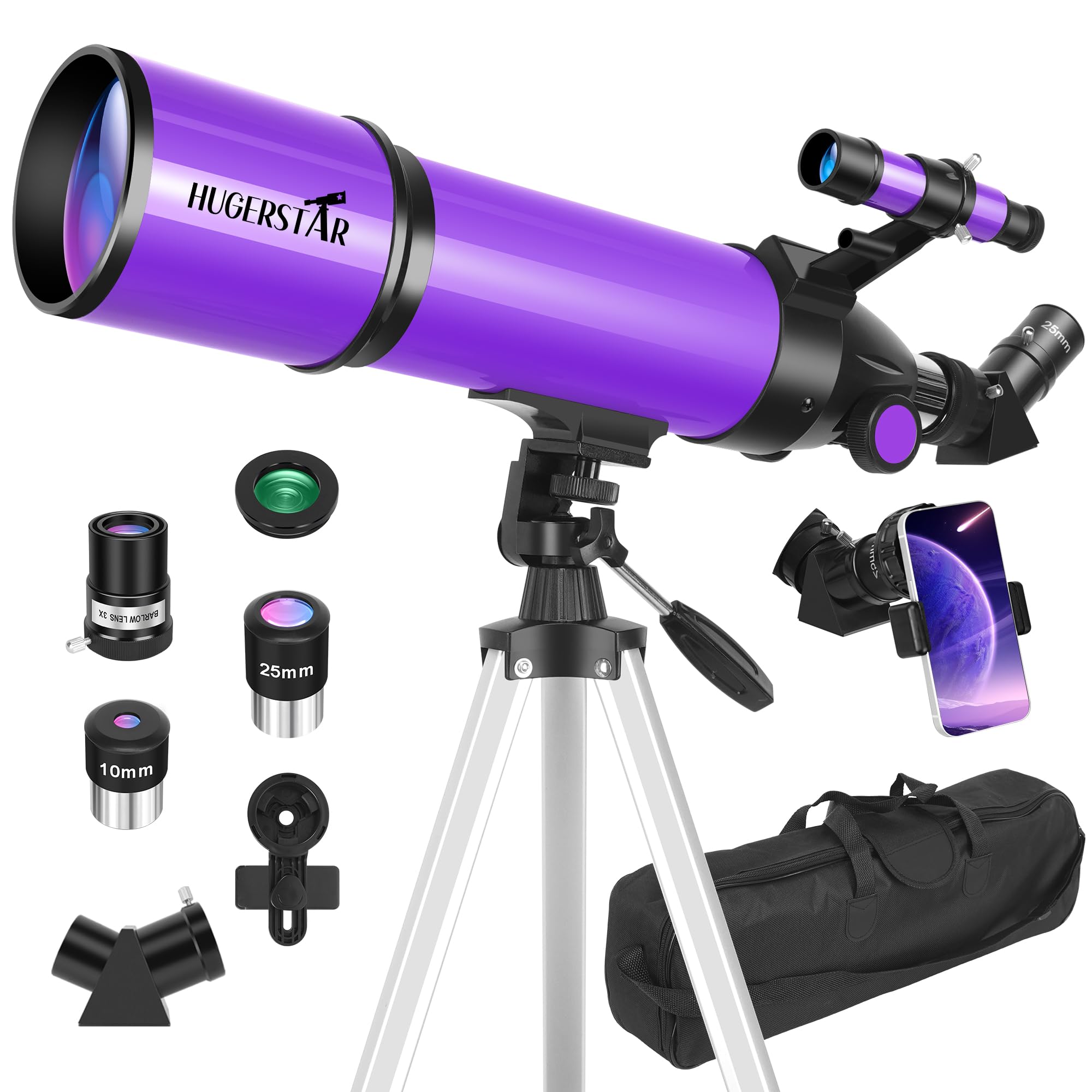
The HUGERSTAR 80600 hits a sweet spot with an 80mm aperture and 600mm focal length (f/7.5), offering a versatile middle ground between wide-field sweeping and planetary close-ups. The inclusion of a moon filter is a thoughtful addition — it screws onto the eyepiece barrel to cut lunar glare, revealing more subtle detail across the heavily cratered surface without eye strain.
The fully multi-coated optics deliver crisp, high-contrast images, and the 25mm eyepiece provides a comfortable 24x for checking out the Andromeda Galaxy as a faint smudge. The 10mm eyepiece pushes to 60x, and the 3x Barlow brings it to 180x — enough to see the Cassini Division in Saturn’s rings under steady skies. The AZ mount and aluminum tripod are standard fare but functional.
The assembly is tool-free and the instruction manual is clear, making it an excellent choice for families. The carry bag is compact and fits the tube and tripod. The phone adapter is a universal clamp type. While the focuser is a fixed-speed rack-and-pinion, it’s smooth enough for fine adjustments. Overall, the HUGERSTAR 80600 is a well-rounded, thoughtful package for a first-time buyer.
Why it’s great
- Includes a moon filter for comfortable lunar viewing
- Versatile 600mm focal length balances wide field and power
- Tool-free assembly is beginner-friendly
Good to know
- Standard eyepieces can be upgraded for better performance
- No slow-motion controls on the mount
7. Dianfan 80×500
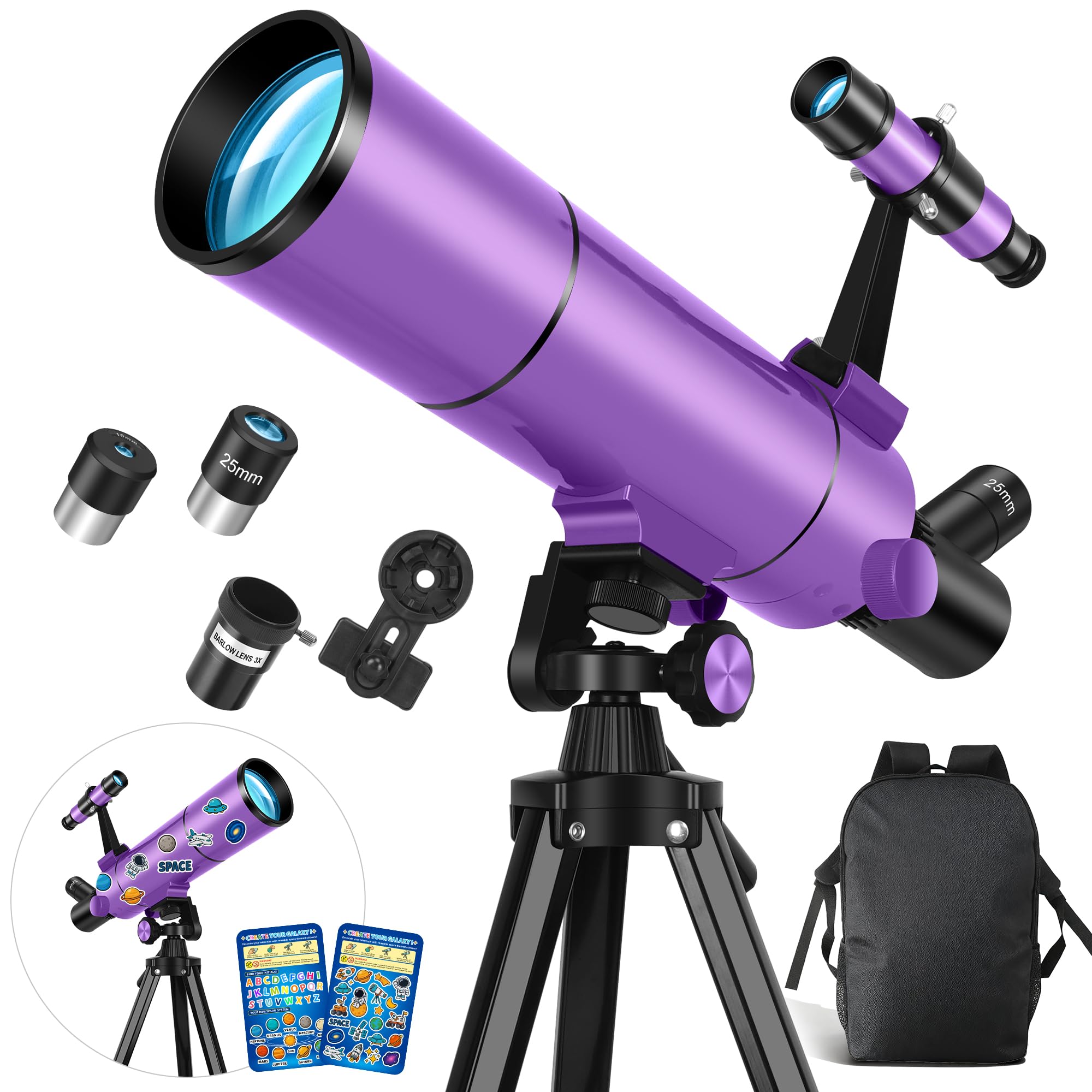
The Dianfan 80×500 is designed with portability and kid appeal front and center. The 80mm aperture and 500mm focal length (f/6.25) create a short, light OTA that fits into a custom-branded backpack, making it easy to take to a dark park or camping site. The kit even includes astronomy-themed and alphabet stickers, letting young users personalize the purple tube and feel ownership over their gear.
Optical quality is solid: the fully coated lenses gather enough light for crisp lunar views and show Jupiter’s moons as distinct points. The included 10mm and 25mm eyepieces plus 3x Barlow provide 20x to 150x magnification. The phone adapter is easy to attach, and the backpack has enough space for all accessories, though the tripod must be strapped to the outside.
Assembly is tool-less and takes roughly 15 minutes. The tripod is a lightweight aluminum model — adequate for the compact tube but prone to vibration at higher magnifications. For a child or a family wanting a grab-and-go scope that encourages outdoor exploration, this package delivers on both function and fun.
Why it’s great
- Lightweight and compact with a dedicated backpack
- Stickers and purple color make it fun for kids
- Quick tool-less assembly for beginners
Good to know
- Tripod vibration affects high-power stability
- Best suited for lunar and bright planet viewing
8. Hawkko 80500
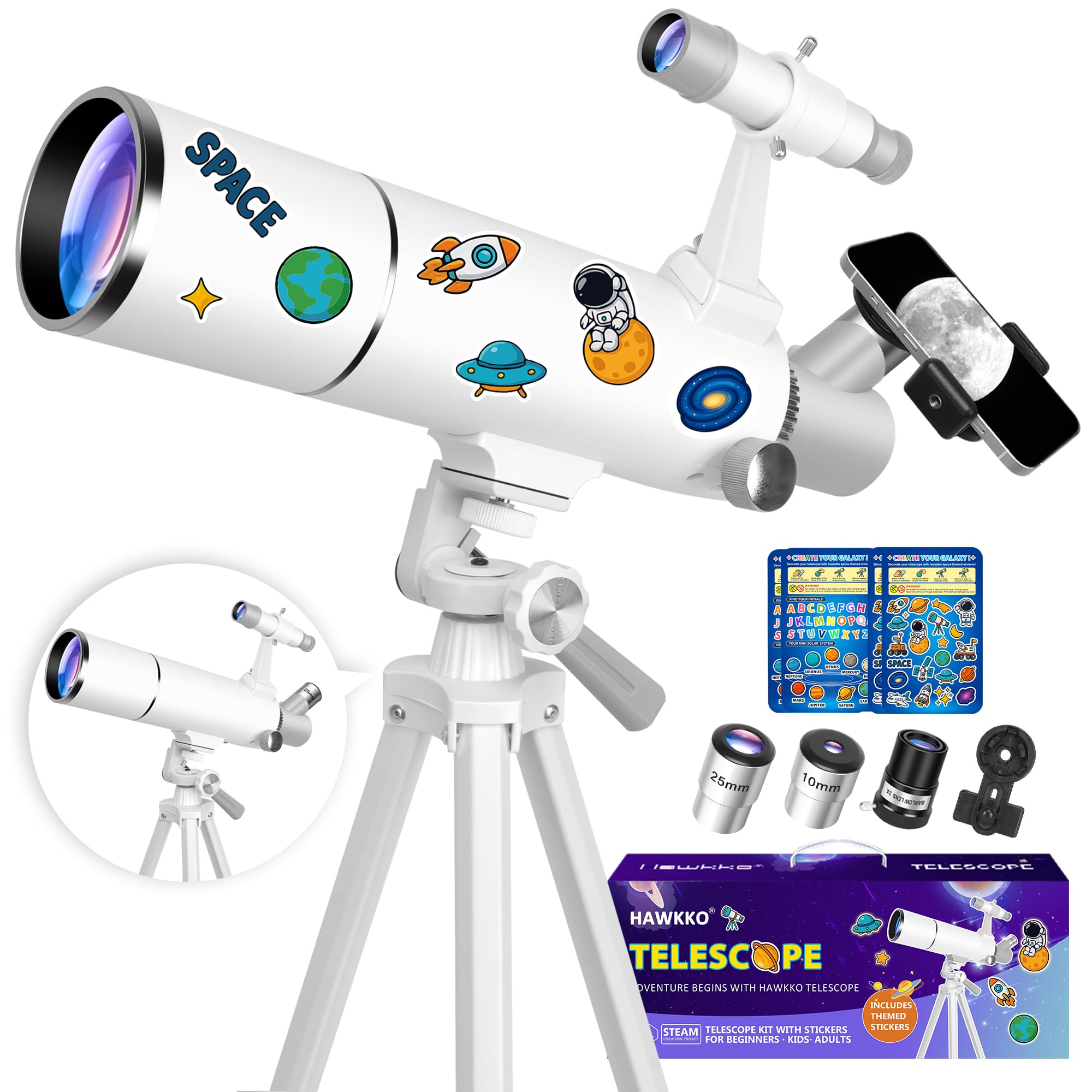
The Hawkko 80500 is the most value-conscious entry in the 80mm class. With an 80mm aperture and 500mm focal length (f/6.25), it provides similar optical fundamentals to the Dianfan above but at a slightly lower price point. The fully multi-coated lens gathers 60% more light than a 70mm scope, meaning the moon, Jupiter, and Saturn are within reach for a brand-new observer.
The kit includes two Kellner eyepieces (10mm and 25mm), a 3x Barlow lens, a straight-through finderscope, and a phone adapter. The unique addition is a sheet of space-themed and alphabet stickers, allowing younger users to customize the telescope tube. The tripod is an adjustable aluminum alloy unit that extends to a reasonable height for both seated kids and standing adults.
Setup is straightforward with no tools required, and the included manual is clear. The tripod is functional but on the lighter side — expect some shake at the highest magnification (150x). It is a true entry-level grab-and-go option best suited for a first look at the moon’s craters and the brighter planets.
Why it’s great
- 80mm aperture captures noticeably more light than 70mm scopes
- Sticker set adds personalization for kids
- Easy, tool-free assembly
Good to know
- Tripod is light and prone to vibration
- Best for lunar and planetary observing, not faint DSOs
9. Gskyer 70400

The Gskyer 70400 is the most compact and budget-friendly model in this guide. The 70mm aperture and 400mm focal length (f/5.7) result in a very short, lightweight tube that is perfect for quick backyard sessions or packing into a small backpack. The wide field of view is excellent for scanning star fields and the moon, though it is inherently limited for detailed planetary observation.
The kit is generous for the price: two eyepieces, a 3x Barlow lens, a reflex finderscope, an aluminum tripod, a phone adapter, and a wireless camera remote for hands-free smartphone imaging. The fully coated optics are decent, and the 70mm aperture is enough to clearly show the moon’s major craters and the four moons of Jupiter as faint dots.
Assembly is simple, and the tripod adjusts to heights suitable for both kids and adults, though the overall stability is entry-level. The wireless remote is a nice touch for astrophotography beginners. This telescope is best viewed as an affordable and portable introduction to astronomy — a stepping stone that can confirm a budding interest before a larger investment.
Why it’s great
- Ultra-compact and lightweight for travel
- Includes wireless remote for easy phone photos
- Quick setup with a straightforward reflex finder
Good to know
- 70mm aperture limits planetary detail and DSO visibility
- Tripod stability is basic; light pollution is more noticeable
FAQ
Can I see Saturn’s rings with an affordable 70mm telescope?
Is the magnification number on the box accurate?
Do I need a smartphone adapter for astrophotography?
Final Thoughts: The Verdict
For most users, the best affordable telescope winner is the MEEZAA 90800 because its 90mm aperture and stainless steel tripod provide the best balance of light-gathering power and stable mounting in this price range. If you want smooth tracking for high-magnification planet views, grab the Koolpte VAZ90700 with its Vertisteel slow-motion mount. And for a wide-field, portable setup that includes a comfort stool, nothing beats the Dianfan 90×550.