
Our readers keep the lights on and the weekend projects moving. As an Amazon Associate, I earn from qualifying purchases.
A bench power supply that delivers noisy, unstable voltage can turn a simple circuit test into a frustrating search for phantom failures. The difference between a reliable project and a toasted component often comes down to the quality of the DC power feeding your work. Selecting the right bench unit for your lab, ham radio setup, or electronics bench means understanding ripple, regulation, and the real current demands of your gear.
I’m Rikta — the co-founder and writer behind FitlyFast. For this guide, I spent dozens of hours cross-referencing datasheets, analyzing customer stress tests, and studying the build quality and protection circuits of each unit to separate the true workhorses from the noise.
Whether you need pure linear regulation for audio projects or high-current capability for charging battery packs, choosing the right bench power supply depends on several key specs that directly affect your circuit performance.
How To Choose The Best Bench Power Supply
A bench supply is a long-term investment for your electronics work. Choosing the wrong one can limit your project scope or introduce measurement errors that waste hours. Focus on these key differentiators when comparing models.
Linear vs. Switching Topology
The internal architecture defines the output quality. Linear supplies use a heavy transformer and pass transistors to produce very clean DC with minimal ripple — essential for analog audio and RF circuits. Switching supplies are lighter, more efficient, and offer higher currents per dollar, but they inject high-frequency noise into the output that can couple into sensitive circuits. For general digital work and battery charging, switching is fine. For precision work, linear is the gold standard.
Voltage, Current, and Power Ratings
Look at both the voltage range and the maximum current your projects need. A 0-30V supply at 5A covers most common needs for Arduino, op-amp circuits, and motor drivers. If you work with high-voltage battery packs (e.g., Ebike or power tool packs), a 0-60V model is necessary. The total power rating in watts (Volts x Amps) sets the practical limit — never exceed 80% of the unit’s rating for continuous use.
Adjustment Controls and Display Precision
Fine and coarse adjustment knobs let you dial in a specific voltage quickly. Digital models with encoder knobs offer 1mV or 10mV steps. Look for a display resolution of 0.01V and 0.001A if you work on low-power circuits. Some budget units use cheap potentiometers that drift or have mechanical dead zones — a quality encoder or ten-turn pot is a strong indicator of build quality.
Protection Circuitry and Safety Features
A good bench supply must protect both itself and the device under test. Look for short-circuit protection (which safely limits current), adjustable over-voltage protection (OVP) that cuts output if a set limit is exceeded, and reverse polarity protection (via a diode or MOSFET) that prevents damage from connecting leads backward. A separate output enable/disable switch lets you apply power to your circuit on your terms, not when the unit powers on.
Quick Comparison
On smaller screens, swipe sideways to see the full table.
| Model | Category | Best For | Key Spec | Amazon |
|---|---|---|---|---|
| KORAD KD3005D | Linear Lab | Precision bench work | 1mV Reg / 0.01V resolution | Amazon |
| Siglent SPD3303X-E | Programmable | Engineering labs | 3 channel / 1mV accuracy | Amazon |
| Tekpower TP3005T | Linear Classic | Low-noise analog circuits | 0.1V / 0.01A resolution | Amazon |
| Jesverty SPS-6005 | High Voltage | 60V battery charging | 0.01V / 0.001A display | Amazon |
| HYELEC HY50-06A | Mid-Range | General electronics lab | 4-digit LED display | Amazon |
| Pyramid PSV150 | Fixed Voltage | 12V ham radio base | 12A @ 13.8V linear | Amazon |
| Jesverty SPS-50II | High Current | 50A radio amplifiers | 50A continuous / 9-15V | Amazon |
In‑Depth Reviews
1. KORAD KD3005D

The KORAD KD3005D is a classic linear regulated supply that delivers 0-30V and 0-5A with a resolution of 0.01V and 0.001A. Its true linear architecture keeps output ripple very low, essential for powering sensitive analog and audio circuits. The dual 4-digit LED displays show voltage and current simultaneously, and the knobs let you select digits for precise adjustment. It is built around a substantial toroidal transformer and boasts excellent heat sinking, keeping internal temperatures manageable under continuous load.
Users report that the voltage metering is accurate to within 1% or better, though some units show a slight offset of around 50mV on the current reading. The constant current (CC) mode works reliably and is highly stable, even compared to some much more expensive laboratory supplies. The fan uses an automatic speed control, staying nearly silent at low current draws and spinning up only when needed. The unit includes a locking panel function to prevent accidental setting changes during tests.
A known quirk is that the output can produce a voltage spike when the unit is first powered on, and voltage accuracy below 1V falls off to about a 10% error. The reverse polarity protection uses a single diode that can fail if you accidentally back-feed the supply with a high-current battery. Despite these limitations, the KD3005D offers class-leading precision and build quality for the price point, making it a favorite among hobbyist and lab users who demand clean power.
Why it’s great
- Genuine linear regulation for low output noise
- Fine 1mV voltage adjustment steps
- Stable constant current mode for charging
- Quiet auto-speed cooling fan
Good to know
- Voltage spike on initial power-up
- Accuracy degrades below 1V output
- Weak reverse polarity protection diode
- Fan can be loud at moderate RPM
2. Siglent Technologies SPD3303X-E
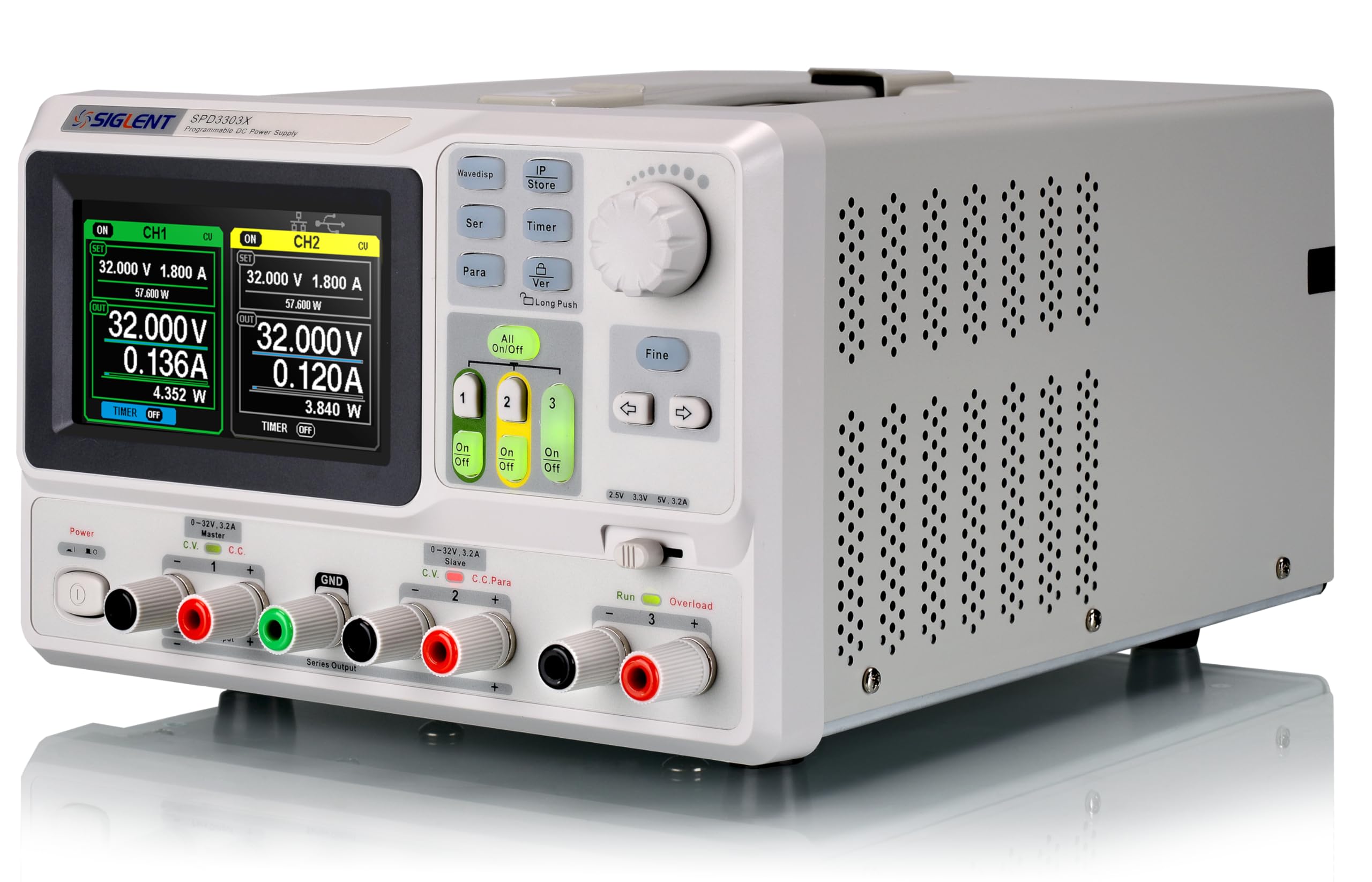
The Siglent SPD3303X-E is a premium triple-output programmable supply designed for the serious engineering bench. It features two independent 32V/3.2A channels and one logic channel that can output 2.5V, 3.3V, or 5V at up to 3.2A. The outputs are fully isolated and can be run in independent, series (for up to 60V), or parallel mode. The unit offers 1mV and 1mA setting resolution, making it ideal for low-voltage digital and analog circuits that demand tight tolerances.
Build quality is high, with a solid metal chassis that weighs over 17 pounds. The bright OLED display includes trending graphs of voltage and current over time — a feature normally found on much more expensive instruments. The unit includes a timing output function, allowing automated test sequences with timed power application. Connectivity is strong with built-in USB and Ethernet ports, enabling remote control via SCPI commands that work well with Python scripting on Linux.
Reviewers highlight that the voltage accuracy is exceptional — within 0.016% from 1V to 30V — and residual AC ripple is under 0.5mV. The variable-speed fan remains silent at idle but becomes audible under heavy load. A minor weak point is the bundled test leads, which are only 1 meter long and use banana plugs that feel slightly less robust than the rest of the unit. The third channel lacks its own current limit setting and display, which limits its utility for powering unknown loads. For a programmable lab supply with network control, the SPD3303X-E offers a compelling feature set that punches well above its price tier.
Why it’s great
- Triple isolated outputs with series/parallel modes
- Ethernet/USB remote control via SCPI
- Trending voltage/current graph display
- Exceptional voltage accuracy within 0.016%
Good to know
- Third channel lacks current limiting
- Fan can be noisy above 50% load
- Windows-only firmware updates
- Included test leads are basic
3. Tekpower TP3005T
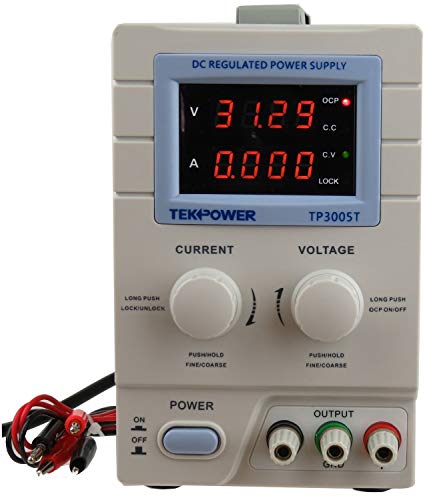
The Tekpower TP3005T is a workhorse linear supply that delivers 0-30V at 0-5A using a heavy toroidal transformer and clean linear regulation. It weighs 12 pounds, and that weight comes from the substantial transformer core and large heat sink inside. The backlit LED display reads down to 0.1V and 0.01A, which is adequate for most bench work though less refined than the 4-digit units. The enclosure is all metal and feels industrial-grade, with a cooling fan that activates automatically via a thermo-sensor.
Users praise the TP3005T for its very low noise output, essential for audio amplifier testing and RF communications work. The constant current mode works well for Li-ion battery charging. The adjustment uses a single knob with a push-to-toggle function for coarse and fine mode. One reviewer found the UI takes about 10 minutes to learn, with the knob auto-locking after 1-2 seconds of inactivity to prevent accidental changes. The unit handled repeated short circuits flawlessly without tripping or damage.
Some early units had a strong paint odor that dissipated within a few days of use. The banana jack inputs were reported as slightly loose on some units, requiring a replacement set for a secure connection. The fan is loud when running above 1A output, but the auto-thermostat keeps it off at low power. For its price, the TP3005T delivers a robust linear topology that many consider a quality lab supply at a fraction of the cost of name-brand equivalents.
Why it’s great
- True linear regulation for very low noise
- Robust metal chassis and heavy transformer
- Handles repeated short circuits safely
- Accurate within 0.01V and 0.001A
Good to know
- 0.1V resolution is coarser than some rivals
- Fan is loud when active
- Banana jacks can be intermittent
- Strong paint smell initially
4. Jesverty SPS-6005
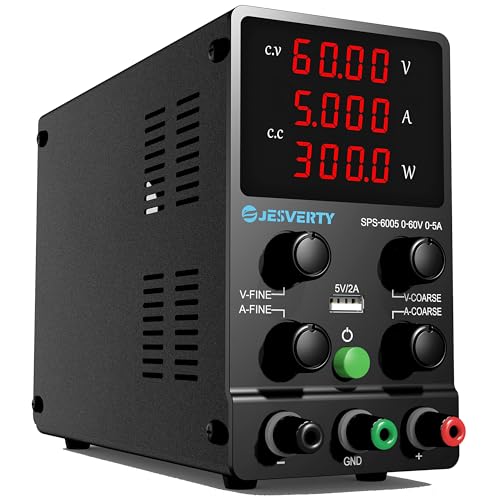
The Jesverty SPS-6005 is a compact switching bench supply that outputs 0-60V at 0-5A — ideal for charging high-voltage lithium battery packs and testing power tool battery circuits. Its bright 4-digit LED displays show voltage, current, and calculated power in watts simultaneously, with a resolution of 0.01V and 0.001A. The unit weighs only 2.5 pounds and measures 7.1 x 3.4 x 6.1 inches, making it highly portable for a mobile workbench. It switches automatically between constant voltage (CV) and constant current (CC) modes based on the load.
The controls use coarse and fine knobs. These are encoder-based but feature mechanical end stops rather than continuous rotation, which means you have to go back and forth to reach the exact setting. Users report that the knobs feel “touchy” and require a gentle touch for fine adjustment. The built-in fine/coarse selection helps, but some found it fiddly. The display is accurate: one reviewer tested the voltage against a DMM and found it matched within 10mV across the full 60V range.
A common use case is rejuvenating dead Ryobi and other 40V/54V power tool battery packs by applying a gentle 500mA charge until the internal BMS reactivates. The SPS-6005 performed this task reliably for several users. The unit includes multiple protection features: short-circuit, over-load, and a temperature-regulated fan. The included test leads are a basic giveaway set — users recommend upgrading to heavier-gauge leads for sustained high-current use. The fan is tolerable at idle but becomes noticeable under heavy load.
Why it’s great
- 60V output covers power tool battery ranges
- Lightweight and compact for bench portability
- Simultaneous V/A/W display
- Auto CV/CC switching
Good to know
- Adjustment knobs feel touchy with end stops
- Included test leads are low quality
- Fan can be audible under load
- Enclosure is plastic, not metal
5. HYELEC HY50-06A

The HYELEC HY50-06A is a programmable switching bench supply offering 0-50V at 0-6A up to 150 watts total. Its standout feature is three memory preset buttons (M1, M2, M3) that let you save and recall voltage and current settings — a huge time-saver for repetitive tests. The unit uses a precision encoder knob with coarse and fine adjustment modes, and the 4-digit LED display resolves to 0.01V and 0.001A. It also has a 5V/2A USB charging port on the front, handy for powering phones or small prototypes.
Multiple users successfully used the HY50-06A for balancing EV battery cells at 48V with micro-amp precision over several days, reporting stable output with no drift. The output enable/disable switch is a safety plus: it prevents accidental voltage application when connecting a new circuit. The unit offers adjustably over-voltage and over-current protection, a record of 72 hours of uninterrupted full-load testing, and a temperature-controlled fan that stays very quiet. The user interface is straightforward, with simple push-buttons for setting limits and recalling memory slots.
A minor drawback is that some units show a small residual voltage on the probes even when the output switch is off. The device is limited to 110V AC input only and does not support 220V. The plastic enclosure feels less premium than metal chassis competitors, but it keeps weight down to around 2.7 pounds. For a mid-range supply with memory presets and reliable performance, the HY50-06A delivers strong value for the general electronics lab.
Why it’s great
- Three memory presets for quick recall
- Fine 0.01V and 0.001A resolution
- 5V/2A USB output included
- Stable output for long-duration battery charging
Good to know
- Residual voltage present when output is off
- 110V AC input only
- Plastic enclosure feels less durable
- Fan occasionally audible at high load
6. Pyramid PSV150

The Pyramid PSV150 is a specialized linear regulated bench supply designed for a specific but common task: powering 12V DC equipment like CB radios, ham transceivers, and car audio test gear. It provides a fixed 13.8V DC output (adjustable from 9-15V via an internal trim pot) at up to 12 amps continuous. The linear regulation keeps the output clean and free from the radio-frequency interference that switching supplies can produce. It features both screw-type terminals for main connections and a front-panel cigarette lighter socket for powering mobile devices.
Users running 50-watt amateur radio base stations report that the PSV150 delivers consistent voltage even under transmit peaks, with no noticeable noise or hum on the received signal. The built-in cooling fan keeps the unit running cool during extended use. The unit includes short-circuit and overload protection that worked as advertised for several reviewers. The all-metal enclosure is rugged and suitable for a permanent desktop placement or a radio shack shelf.
A limitation is that this is not a general-purpose variable supply — it is fixed at 13.8V (for nominal 12V systems) and cannot be adjusted to lower voltages like 5V or 3.3V without modifying the internal potentiometer. The amperage rating of 12A is stated as constant, but the actual power output is about 165 watts. The unit does not have a digital display — it uses analog meters that are sufficient for monitoring but less precise than digital readouts. For its intended use as a clean, reliable power source for radio gear, the Pyramid PSV150 is an excellent and affordable choice.
Why it’s great
- Clean linear regulation with no RF noise
- 12A output for radio equipment
- Rugged all-metal construction
- Front USB and cigarette lighter ports
Good to know
- Fixed 13.8V output, not general-purpose
- Analog meters, not digital
- No fine voltage adjustment without modification
- Fan can be loud under continuous load
7. Jesverty SPS-50II

The Jesverty SPS-50II is a 50-amp high-current bench supply built specifically for powering linear amplifiers, high-power transceivers, and large DC loads. It delivers 13.8V at a constant 50A (adjustable from 9V to 15V) using a switching architecture with a Noise Offset Circuit to push switching artifacts to a less problematic frequency. The unit features screw-type main terminals capable of handling high current, plus two pairs of auxiliary snap-in terminals and a front-panel cigarette lighter socket. Analog V/A meters provide real-time monitoring.
Ham radio operators are the primary users, reporting that the SPS-50II runs a 100-watt transceiver without any voltage drop and with no detectable RF interference. The fan uses forced-air cooling and, according to multiple two-year users, rarely activates during normal CB or 11-meter radio use. The 13.8V output is stable and accurate, and the unit has a “birdie” adjustment knob to shift any switching noise off a particular operating frequency. The output is rated at 40A continuous with 50A surge capability.
Construction quality is solid with a metal enclosure weighing 6.2 pounds. The dual analog meters offer good visibility but lack the precision of digital displays. The unit includes short circuit protection and automatic current limiting. Some users noted that the fan runs only under severe duty cycles, keeping things quiet during normal use. This is not a general-purpose variable supply — it is purpose-built for high-current 12V applications. For radio enthusiasts who need clean high current for amplifiers or base stations, the SPS-50II is a top contender.
Why it’s great
- 50A continuous output for high-power gear
- Very low RF noise for radio applications
- Fan stays off under normal use
- Multiple terminal types for flexibility
Good to know
- Fixed nominal 13.8V output range
- Analog meters, no digital display
- Heavy (6.2 lbs) for a switching unit
- Not suited for low-voltage or low-current lab work
FAQ
What is the difference between a linear and a switching bench power supply?
How do I protect my circuit from a voltage spike when turning on the supply?
Can I use a bench power supply to charge lithium batteries?
Final Thoughts: The Verdict
For most users, the bench power supply winner is the KORAD KD3005D because it offers genuine linear regulation with excellent voltage/current resolution at a price that doesn’t break the lab budget. If you need programmable dual-channel output with network control and timing functions, the Siglent SPD3303X-E is the premium choice for serious engineering. For high-current 12V radio applications, nothing beats the Jesverty SPS-50II with its 50A output and interference-free operation.