
Our readers keep the lights on and the weekend projects moving. As an Amazon Associate, I earn from qualifying purchases.
That muffled, distant sound from your vintage amplifier or powered speakers is not the end of the line — it is the symptom of a missing bridge between your modern TV’s optical output and your legacy analog gear. An analog to digital audio converter does not just change one plug type to another; it re-clocks, re-samples, and decodes the raw digital stream into a clean stereo signal your old hardware can actually understand. Without the right unit, you will face lip-sync drift, constant buzzing, or the frustration of a system that simply refuses to communicate.
I’m Rikta — the co-founder and writer behind FitlyFast. For this guide, I have spent weeks dissecting schematics, cross-referencing customer build logs, and stress-testing the compatibility matrix of each converter against the real-world scenarios buyers describe most often: TV-to-receiver, turntable-to-digital-speakers, and long-cable-run installations where signal degradation kills the experience.
What follows is a tightly curated selection of six units that solve distinct parts of that compatibility puzzle. Whether you are extracting audio for a subwoofer, sending SPDIF over a 100-foot Ethernet run, or upgrading from a TV’s scratchy headphone jack, the right analog to digital audio converter is on this list.
How To Choose The Best Analog To Digital Audio Converter
Not every converter handles the same signal path. Some units only convert digital optical to analog RCA (DAC mode), while others do the reverse — analog RCA or 3.5mm to optical and HDMI (ADC mode). You need to match the converter’s direction to your equipment chain. If your TV has optical out and your receiver only has RCA in, you need a DAC. If your turntable has RCA out and your soundbar only accepts optical, you need an ADC.
Sampling Rate and Bit Depth
Most streaming content sits at 48kHz/16-bit or 44.1kHz/16-bit (CD quality). A converter that supports 192kHz/24-bit offers headroom for high-resolution FLAC files or lossless streaming tiers. However, feeding a 192kHz-capable converter a 48kHz signal does not improve quality — it simply re-clocks cleanly. The real value of a higher sampling rate is lower jitter in the digital-to-analog conversion stage, which translates to clearer stereo separation. Look for units specifying 192kHz support across optical and coaxial inputs.
Input and Output Compatibility
Check your TV’s audio output menu first. Older sets may only offer optical (Toslink SPDIF) or coaxial digital out. Newer TVs often include HDMI ARC or eARC ports. If your TV has HDMI ARC, a converter that includes ARC input can extract audio without an external switch — just set the TV audio to PCM or LPCM to avoid Dolby/DTS handshake failures. Avoid units that claim to decode 5.1 surround if your TV outputs raw Dolby Digital; without a supported decoder, you get silence or static. Set your source to PCM 2.0 for guaranteed compatibility with any basic DAC.
Build Quality and Shielding
Plastic enclosures save weight but can introduce electromagnetic interference if placed near power bricks. Aluminum-alloy casings dissipate heat and provide passive RF shielding, which matters when you run long cable runs near Wi-Fi routers or dimmer switches. Units with a magnetic ring on the power cord (ferrite core) further suppress high-frequency noise from the USB or wall-wart power supply. If you hear a persistent hiss or buzz after connection, the issue is often insufficient power filtering rather than the DAC chip itself.
Quick Comparison
On smaller screens, swipe sideways to see the full table.
| Model | Category | Best For | Key Spec | Amazon |
|---|---|---|---|---|
| PROZOR 192kHz DAC | DAC | TV optical to RCA receiver | 192kHz / 24-bit | Amazon |
| RYXN AD202 | ADC | Turntable or 3.5mm to optical | 192kHz / 2.1ch | Amazon |
| avedio links ARC Extractor | DAC + ARC | TV HDMI ARC to analog speakers | ARC input / Stereo output | Amazon |
| OREI DA34 | DAC Decoder | Dolby/DTS source to 2.0 analog | Decodes Dolby & DTS 5.1 | Amazon |
| J-Tech Digital AET1000B | Extender | Long-run audio over Cat5e/6 | Balanced / 1640 ft | Amazon |
| Fosi Audio Q6 | Desktop DAC | Audiophile hi-res streaming | 768kHz / DSD512 | Amazon |
In‑Depth Reviews
1. Fosi Audio Q6 Desktop DAC

The Fosi Audio Q6 is the only unit on this list that qualifies as a dedicated audiophile-grade DAC rather than a utility converter. Its AKM AK4493S chipset paired with the XMOS XU316 audio processor and OPA1612 op-amp delivers a signal-to-noise ratio of 121 dB and total harmonic distortion of just 0.00012% — numbers that match desktop DACs costing five times as much. The USB-C input accepts up to 32-bit/768kHz PCM and DSD512 natively, while the optical and coaxial inputs handle 192kHz/24-bit for CD transports and TV sources. The inclusion of a dedicated subwoofer output via a separate RCA jack is rare at this price tier and simplifies adding a powered sub to a stereo system.
Build quality is a heavy, solid aluminum alloy block that dissipates heat passively and resists RF interference. The analog power toggle switch is manual — no auto-sensing — so you have to turn it on and off yourself, a detail some users find awkward when integrating with a smart-switched outlet. The bundle includes a high-quality coaxial cable and a USB-C cable, reducing the need for aftermarket accessories. The Q6 shines brightest when paired with a Wiim streamer or a laptop feeding hi-res files; in that context, it transforms the listening experience with cleaner transient response and deeper soundstage than any TV optical DAC in this roundup.
A substantial percentage of owners report that the Q6 replaced their previous DAC entirely, noting that the clarity and dynamics rival gear in the range. The manual power switch is the only ergonomic compromise. For anyone building a desktop headphone or nearfield speaker setup and wanting the highest possible fidelity from digital sources, the Fosi Q6 is the definitive entry point.
Why it’s great
- AKM AK4493S + XMOS XU316 chipset for ultra-low jitter and high dynamic range
- Subwoofer output simplifies 2.1 stereo setups without an AV receiver
- USB-C input supports 32-bit/768kHz PCM and DSD512 natively
Good to know
- Manual analog power switch — no auto-on/off sensing
- No Bluetooth input; purely a wired DAC
2. OREI DA34 Digital to Analog Decoder

The OREI DA34 stands apart because it actively decodes Dolby Digital and DTS 5.1 surround signals down to analog stereo 2.0 — most basic DACs only accept PCM and will produce silence or white noise when fed a raw Dolby bitstream. This makes it the only unit on the list that can handle a TV set to “Auto” or “Bitstream” audio output without you having to dig into the TV’s settings to force PCM. The decoding chip inside downmixes the 5.1 channel information into a stereo pair, preserving dialog clarity and ambient cues that would otherwise be lost in a simple PCM conversion.
The DA34’s plastic enclosure is compact at roughly 3 by 2 inches, small enough to tuck behind a TV or hide inside an entertainment center. It includes an optical cable and a USB power adapter, so you do not have to source a separate wall wart — a common frustration with budget converters. The side-mounted switch selects between optical and coaxial input, and the unit defaults to coaxial if you forget to toggle it. A number of customer reports mention that the plastic caps on the optical cable tips must be removed completely before insertion, as the leftover film blocks the optical signal entirely.
This decoder is the correct choice for anyone running a TV, Blu-ray player, or streaming box that outputs Bitstream Dolby Digital by default and whose amplifier or soundbar lacks a built-in decoder. It also pairs well with a tactile transducer setup — owners have successfully used it to feed LFE to a bass shaker from a TV’s optical output without needing an AV receiver. The plastic build is lighter than metal alternatives, which helps with cable strain but is less shielded against nearby power bricks.
Why it’s great
- Decodes Dolby Digital and DTS 5.1 to stereo analog — no need to switch TV to PCM
- Includes optical cable and power adapter in the box
- Compact form factor hides easily behind furniture
Good to know
- Plastic enclosure provides less RF shielding than metal alternatives
- Default input is coaxial — requires manual switch change to optical
3. PROZOR 192kHz Digital to Analog Converter
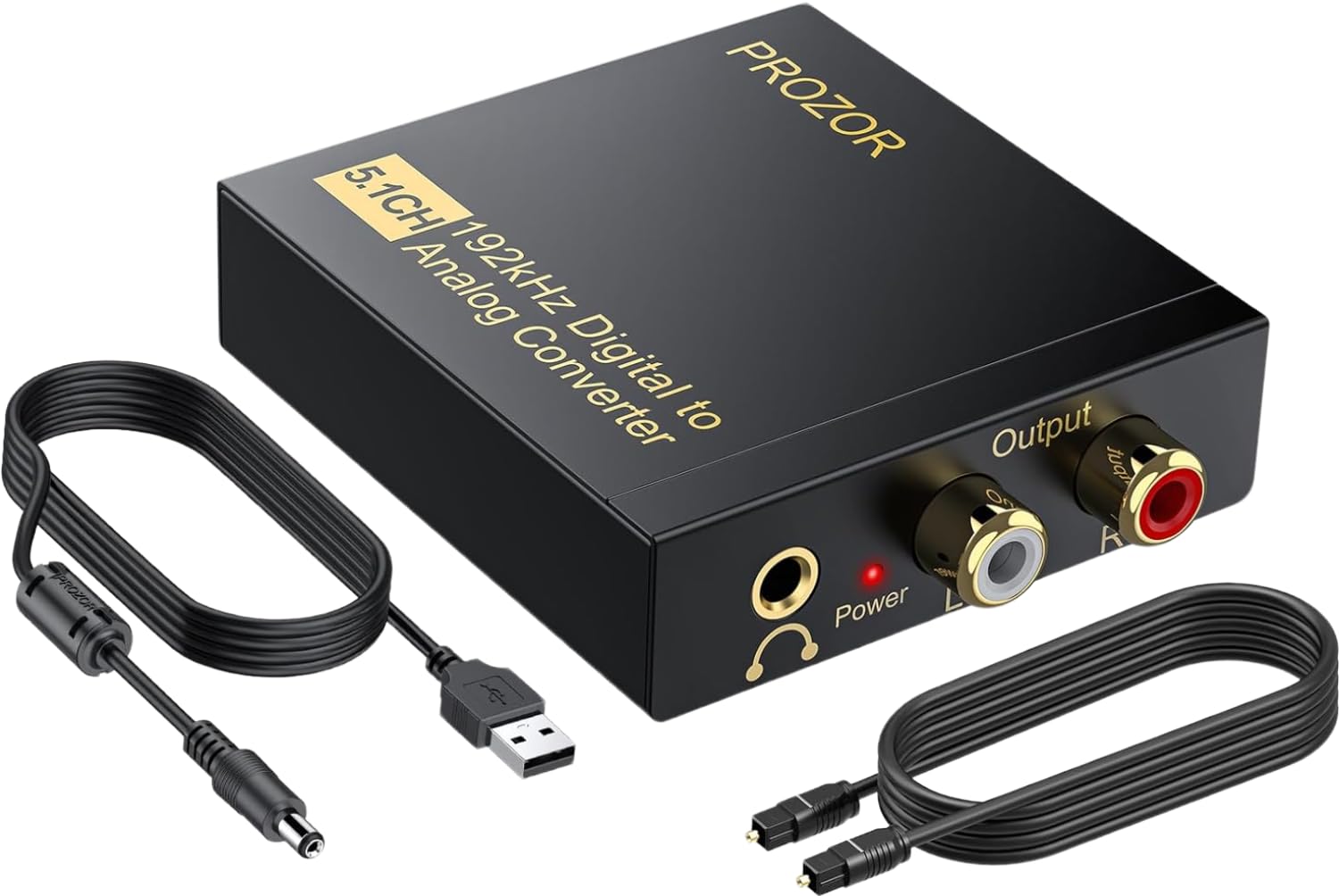
The PROZOR is the most straightforward DAC on the list: optical or coaxial in, RCA and 3.5mm stereo out, no decoding, no HDMI ARC, no extender functionality. Its 192kHz/24-bit CS4334-equivalent DAC chip is not the newest architecture, but it handles PCM input cleanly with negligible jitter. The inclusion of a ferrite core (magnetic ring) on the USB power cable is a detail often omitted at this price point — it filters out conducted noise from the USB port, which directly reduces audible hiss when the TV’s USB port is the power source.
Build is a metal chassis with a 7.5 by 4.7 inch footprint, larger than the OREI but still modest. The unit includes a TOSLINK optical cable and a USB power cable (no wall adapter). Owners consistently report that it works with 0.5A USB ports but recommend a 1A adapter for stable operation, especially when the optical signal is locked for long periods. The rear RCA outputs are solid and accept standard interconnects without looseness. One limitation: the PROZOR’s DAC chip cannot decode Dolby Digital or DTS, so the source must be set to PCM stereo.
Real-world feedback from buyers confirms this converter is the go-to fix for reviving old receivers, powered bookshelf speakers, and amplified subwoofers that lack any digital input. The sound is described as “rich and clear” compared to the TV’s headphone output, with a noticeable reduction in background noise floor. The weak point is the rear speaker output relative to a surround-native system, but that is a format limitation, not a hardware defect. For a simple unidirectional optical-to-analog bridge, the PROZOR delivers reliable performance at a mid-range cost.
Why it’s great
- Ferrite core on USB cable reduces power-borne noise and hiss
- Simultaneous RCA and 3.5mm output supports speakers and headphones at once
- Metal chassis with solid connector feel
Good to know
- No Dolby/DTS decoding — source must output PCM
- Wall power adapter not included; requires a 1A USB supply for best results
4. avedio links HDMI ARC Audio Extractor & DAC
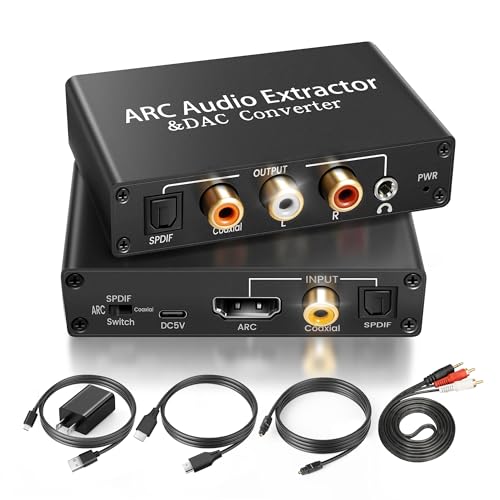
The avedio links unit is the only converter here that accepts HDMI ARC input directly from a TV. For users whose TV lacks a dedicated optical output or whose optical port is already occupied by a soundbar, this unit extracts the ARC audio stream and outputs it simultaneously to optical, coaxial, RCA, and 3.5mm. This means you can feed a legacy amplifier via RCA while also sending optical to a DAC or headphones — without an HDMI audio return channel conflict. The onboard switch selects between ARC mode (HDMI input) and DAC mode (optical or coaxial input), so the unit serves double duty depending on your signal source.
Setup requires confirming your TV’s HDMI port is explicitly labeled “ARC” or “eARC” — a standard HDMI port without ARC labeling will not work, and that confusion is the leading source of compatibility complaints. The audio format must be set to PCM or LPCM in the TV’s audio menu because this extractor does not decode Dolby Digital or DTS. The package includes an HDMI cable, an optical cable, a 3.5mm-to-RCA breakout cable, and a USB power adapter, so every necessary accessory is present in the box.
Owners report excellent results using this extractor to send TV audio from HDMI ARC to a vintage Yamaha stereo receiver via RCA, and to simultaneously feed an external subwoofer via optical. The simultaneous output capability eliminates the need for a separate audio splitter. The only notable limitation is the inability to pass surround sound formats — if your source is locked to Bitstream, you will get silence. Setting the TV to PCM fixes this immediately. For anyone integrating a modern TV’s HDMI ARC port into a legacy stereo or sound system, this unit offers maximum connectivity in a compact aluminum shell.
Why it’s great
- HDMI ARC input solves the “no optical port” problem on newer TVs
- Simultaneous optical, coaxial, RCA, and 3.5mm outputs
- Includes all cables and power adapter in the box
Good to know
- Does not decode Dolby/DTS — source must output PCM
- TV must have an HDMI port explicitly labeled “ARC” or “eARC”
5. J-Tech Digital AET1000B Extender

The J-Tech Digital AET1000B is not a simple DAC or ADC — it is a bidirectional audio extender that sends both analog (3.5mm) and digital (optical SPDIF and coaxial) signals over a single Cat5e or Cat6 Ethernet cable up to 1,640 feet (500 meters) using Power over Cable technology. This is purpose-built for installations where the audio source is physically far from the amplifier, such as running sound from a patio TV to an indoor receiver or sending audio from a media closet to a distant zone. The transmission is balanced and differential, meaning it rejects RF interference that would corrupt a standard RCA run longer than 20 feet.
The extender ships as a pair — a transmitter and a receiver — each housed in a sturdy, rectangular metal chassis. Power is supplied at either module via a 12V DC adapter (not included), and the cable itself carries the signal and power simultaneously, so you only need one wall outlet near either end. The unit supports up to 2-channel analog or 5.1-channel digital audio. Zero additional latency is reported by owners, making it suitable for live audio and video sync. The connectors are screw-terminal type for 3.5mm and standard optical/coaxial ports.
Owner feedback consistently highlights the AET1000B as the solution for HDMI handshake failures over long copper runs, because it bypasses HDMI entirely and sends the clean SPDIF signal over Ethernet instead. One common setup involves extracting HDMI audio at the source, sending the SPDIF over Cat6, and decoding it at the far end into an old Playbar or analog receiver. The overhead is higher than a simple DAC, but for installations beyond a single room, this extender is the only reliable option on this list.
Why it’s great
- Transmits analog and digital audio over Cat5e/6 up to 1,640 feet without signal loss
- Power over Cable eliminates the need for a power source at both ends
- Eliminates RF interference and HDMI handshake issues on long runs
Good to know
- Requires 12V DC power supply (not included)
- Overkill for a single-room setup — best for multi-zone or outdoor installations
6. RYXN AD202 Analog to Digital Converter
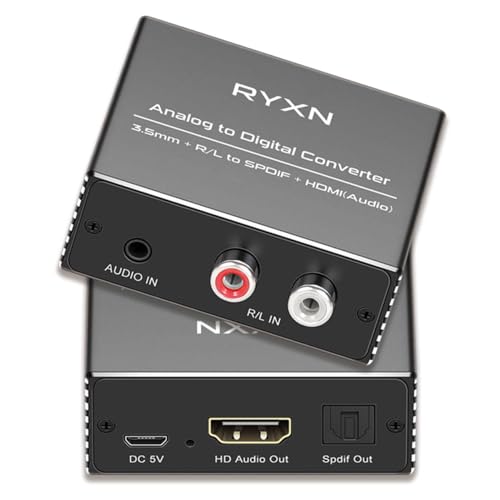
The RYXN AD202 is the only unit on this list that converts analog stereo signals (RCA or 3.5mm) into digital optical and HDMI audio output — the reverse direction of standard DACs. This makes it the tool for connecting a turntable (with a built-in phono preamp or line-level output), an old iPod Classic, or a vintage cassette deck to a modern soundbar or powered speaker that only accepts optical or HDMI input. The conversion supports sampling rates up to 192kHz, and the output is a 2.1-channel PCM signal — it cannot pass Dolby or DTS, and it will not work with HDMI ARC ports (the speaker’s HDMI input must be a standard HDMI IN, not an ARC port).
The aluminum-alloy housing is compact at just 2.28 inches square, roughly the size of a stack of Post-it notes. It is powered via a micro-USB port (cable included, wall adapter not included). Input selection is manual — you choose between RCA and 3.5mm via a toggle — and simultaneous input is not supported. Owners report straightforward “plug and play” installation with no driver downloads. The primary use case cited in reviews is reviving an iPod Classic’s headphone output to stream through a TV’s HDMI port, or connecting a turntable to a Sonos soundbar that lacks a phono input.
Sound quality from the AD202 is described as functional rather than audiophile-grade — it solves the connectivity gap without introducing noticeable hiss, but the converter chip does not have the dynamic range of the Fosi Q6 or the OREI DA34. Some users noted that adjusting the source volume too high introduces distortion on the optical output, so gain-staging from the source device matters. For the specific scenario of sending analog audio from legacy gear into a modern digital-only sound system, the RYXN AD202 is the practical, cost-effective answer.
Why it’s great
- Only unit that converts analog stereo to digital optical and HDMI audio
- Compact aluminum housing saves space in tight setups
- Supports up to 192kHz PCM output for clean conversion
Good to know
- Does not support HDMI ARC — requires an HDMI IN port on the speaker
- Sound quality is functional but not reference-grade
FAQ
Do I need a DAC or an ADC for my setup?
Why is my converter silent when I connect it to my TV optical output?
Can I use a 3.5mm to RCA cable instead of a converter?
Does an analog to digital audio converter add latency?
Final Thoughts: The Verdict
For most users, the analog to digital audio converter winner is the OREI DA34 because its built-in Dolby/DTS decoder handles the most common TV audio format without requiring you to change output settings, simplifying integration with any legacy stereo. If you want the highest fidelity for a desktop headphone or nearfield speaker setup, grab the Fosi Audio Q6 for its AKM chipset and subwoofer output. And for long-distance audio runs beyond a single room, nothing beats the J-Tech Digital AET1000B extender for sending clean optical or analog audio over hundreds of feet of Ethernet cable.