
Our readers keep the lights on and the weekend projects moving. As an Amazon Associate, I earn from qualifying purchases.
A bedwetting alarm is not a punishment — it is a training tool that rewires a deep sleeper’s brain to recognize a full bladder before the bed gets soaked. The difference between a three-month solution and a three-year struggle comes down to picking an alarm with the right sensor sensitivity, volume output, and wearing comfort for your specific child. Skip the cheap, flimsy units that false-alarm on sweat and you save months of sleep for everyone.
I’m Rikta — the co-founder and writer behind FitlyFast. I have spent hundreds of hours studying pediatric enuresis research, analyzing user-reported cure rates across dozens of alarm models, and cross-referencing sensor technologies, decibel outputs, and battery life specs to find exactly which alarms deliver consistent dry-night results.
Whether your child bedwets nightly or occasionally, the right device trains them to self-wake within weeks. This guide details the seven best options to help you find the perfect bedwetting alarm for your family’s needs.
How To Choose The Best Bedwetting Alarm
Every bedwetting alarm operates on the same principle — detect moisture the instant it appears and wake the sleeper before the bladder fully empties. But execution varies wildly. You must weigh sensor type (wireless clip vs. bed pad vs. wired clip), decibel range, vibration strength, and ease of reset to match your child’s sleep depth and sensitivity.
Wired vs. Wireless vs. Bed-Pad Alarms
Wired alarms connect the sensor clip directly to the alarm unit via a cord. They are less expensive and never lose signal, but the cord can tangle or pose a strangling risk for young children. Wireless alarms separate the transmitter from the receiver with a range of up to 40 feet — ideal for kids who move a lot or for parents who want to hear the alarm from another room. Bed-pad alarms place the sensor under the bottom sheet; no clip touches the child’s skin, making them best for sensory-sensitive users or those prone to false alarms from sweat.
Sensor Sensitivity and False Alarm Rates
The most common failure mode in bedwetting alarms is false triggering from sweat, humidity, or improper sensor placement. Alarms with quick-detect technology that senses the first drop of urine produce faster learning curves. Units that allow you to adjust sensitivity or shield the sensor from ambient moisture with a paper-towel wrap reduce nightly disruptions significantly.
Volume Control and Vibration Modes
A single loud tone that wakes the whole house is not always the goal. Look for alarms offering at least six selectable tones and a separate vibration-only mode. Children with autism or auditory processing differences often respond better to vibration alone. Parents of deep sleepers need alarms with at least 80 decibels combined with strong vibration to create a reliable wake-up signal.
Battery Life and Maintenance
Alarms running on replaceable AA or AAA batteries are simpler to maintain than rechargeable lithium-ion units that eventually lose capacity. However, rechargeable models with USB charging reduce long-term waste. Clip-on sensors should be easy to clean — preferably made of plastic-coated material that wipes clear rather than porous cloth that absorbs urine and causes odor.
Quick Comparison
On smaller screens, swipe sideways to see the full table.
| Model | Category | Best For | Key Spec | Amazon |
|---|---|---|---|---|
| Eclipse Wireless | Wireless | Deep sleepers / Parents wanting range | 40 ft. wireless range | Amazon |
| Malem Ultimate Camo | Wired Clip | Kids needing 8 tone options + app | 8 tones + vibration | Amazon |
| Malem Ultimate Blue | Wired Clip | Clinically proven deep-sleeper training | Quick Detect sensor | Amazon |
| Wet Detective Kit | Bed Pad | Sensory-sensitive kids / Teens | 2 waterproof sensor pads | Amazon |
| DryEasy Pro Wireless | Wireless | Active sleepers / Wired avoidance | 6 sounds + 6 volume levels | Amazon |
| Wet-Stop3 + Pad Kit | Wired + Pad | Families wanting a mattress protector bundled | 6 tones + waterproof pad | Amazon |
| Wet-Stop 3 Blue | Wired Clip | Budget-conscious families | 80 dB + vibration | Amazon |
In‑Depth Reviews
1. Eclipse Wireless Bedwetting Alarm

The Eclipse Wireless sits at the top tier for a reason — its transmitter clips onto the child’s underwear and sends a signal up to 40 feet to the receiver. This means no cord tangle, no strangling risk, and the ability for parents to hear the alarm from another room. The thin plastic-coated sensor is designed to avoid skin irritation, making it comfortable for long-term overnight wear.
Customer reports show it resolved lifelong bedwetting in a 12-year-old deep sleeper within weeks when placed in a panty liner inside a diaper. The alarm is very loud, and parents praised its sensitivity at detecting the first drops. One user with a teenager achieved 10 consecutive dry nights after just one week of use. The wireless format eliminates the risk of the sensor falling off during active sleep.
The drawback is price — this is the most expensive unit on the list — and some users report rare false alarms from sweat when the sensor is not wrapped correctly. A simple layer of toilet paper between the sensor and skin resolves this. The sensor is small and can be misplaced if not stored properly. Overall, the combination of wireless freedom, reliable detection, and parent-range audio makes this the gold standard.
Why it’s great
- Wireless range up to 40 feet.
- Plastic-coated sensor prevents skin irritation.
- Loud alarm wakes deep sleepers reliably.
- Clinically proven method, up to 90% success rate.
Good to know
- Premium price point.
- False alarms possible if sensor directly contacts sweat.
- Small transmitter easy to misplace.
2. Malem Ultimate Selectable Camouflage

The Malem Ultimate Selectable offers a unique feature set: eight selectable alarm tones plus a vibration-only mode, all housed in a lightweight 1-ounce unit. The advanced Easy-Clip Sensor uses Secure Grip technology that locks the sensor in place without pins or tape, solving the common problem of sensors falling off mid-night.
Users report that a 5-year-old heavy sleeper achieved overnight dryness in about three weeks using vibration-only mode. The camouflage design appealed to older kids who disliked childish colors. The included free smartphone app provides instructional videos and support directly from the manufacturer. Parents of children with autism appreciated the vibration-only option for non-auditory wake-up training.
Some children found the alarm difficult to turn off during panic episodes — the reset requires unplugging the sensor cable rather than a simple button press. One reviewer noted a quality issue where the button and clasp did not stop the alarm, causing distress. Reward charts included with the kit help maintain motivation, and the rotation of tones prevents auditory habituation.
Why it’s great
- 8 selectable tones prevent habituation.
- Secure Grip clip stays on active sleepers.
- Free smartphone app for support.
- Vibration-only mode for sensory-sensitive kids.
Good to know
- Reset requires unplugging sensor.
- Some users report button malfunction.
- Premium price.
3. Malem Ultimate Bedwetting Alarm Blue

The Malem Ultimate Blue is the original award-winning model that has been proven in clinical trials and recommended by doctors worldwide. It combines light, sound, and strong vibration to wake even the deepest sleepers. The Quick Detect technology claims to sense the first drop of urine, and the Secure Grip clip holds the sensor comfortably without poking holes in fabric.
Parent reviews are overwhelmingly positive: a 7.5-year-old deep-sleeping son who wet nightly became completely dry after 2.5 weeks. Another user reported their 9-year-old daughter achieved 28 consecutive dry nights after 6 weeks. The alarm is loud enough that it wakes the child but does not typically wake siblings in adjacent rooms. The company emailed check-ins during the training process, adding a layer of support.
The biggest challenge is the initial adjustment period — children often cry and resist the first few nights. One parent abandoned the Malem for a different brand because their child found it uncomfortable. The reset mechanism requires pressing and holding a button while drying the sensor, which some children accidentally triggered during sleep. Overall, it is worth the difficult start for proven long-term results.
Why it’s great
- Clinically proven and award-winning.
- Quick Detect senses first drop of urine.
- Secure Grip clip with no pins.
- Strong vibration plus loud sound.
Good to know
- Difficult initial adjustment for kids.
- Reset button may be triggered accidentally.
- Not wireless — sensor cord attached.
4. Wet Detective Bedwetting Kit

The Wet Detective system flips the standard approach — instead of clipping a sensor to underwear, it places two large waterproof sensor pads under the bottom sheet. The alarm unit sits on the bedside table, connected by a removable cable. This design is ideal for sensory-sensitive children who cannot tolerate a clip or pin against their skin, and for teenagers who need a more discreet solution.
Users consistently report that the mat is large enough to protect the mattress even during heavy accidents, and it comes with two pads for rotation. The alarm offers four volume settings from a light beep to a loud alarm, plus a flashing LED response light. A 9-year-old who had never had a dry night achieved two consecutive dry nights within a week after adding a flat sheet over the mat to reduce false alarms from sweat.
However, the system is finicky — sweat and humidity can cause false alarms if the child sleeps directly on the pad. Reducing room temperature and placing a flat sheet barrier helps. Some users reported that the pads broke within a single use, producing continuous false alarms, though a second pad is included. The pads must be air-dried after washing; machine drying ruins them. Despite these quirks, one parent called it “the best bedwetting alarm on the market,” beating arm-clip and competitor mats.
Why it’s great
- No sensor touches the child’s skin.
- Comes with two waterproof sensor pads.
- Adjustable volume from beep to loud alarm.
- Doctor-developed by board-certified urologist.
Good to know
- False alarms from sweat are common.
- Pads must be air-dried, not machine-dried.
- Some units fail after one use.
5. DryEasy Pro Wireless Bedwetting Alarm
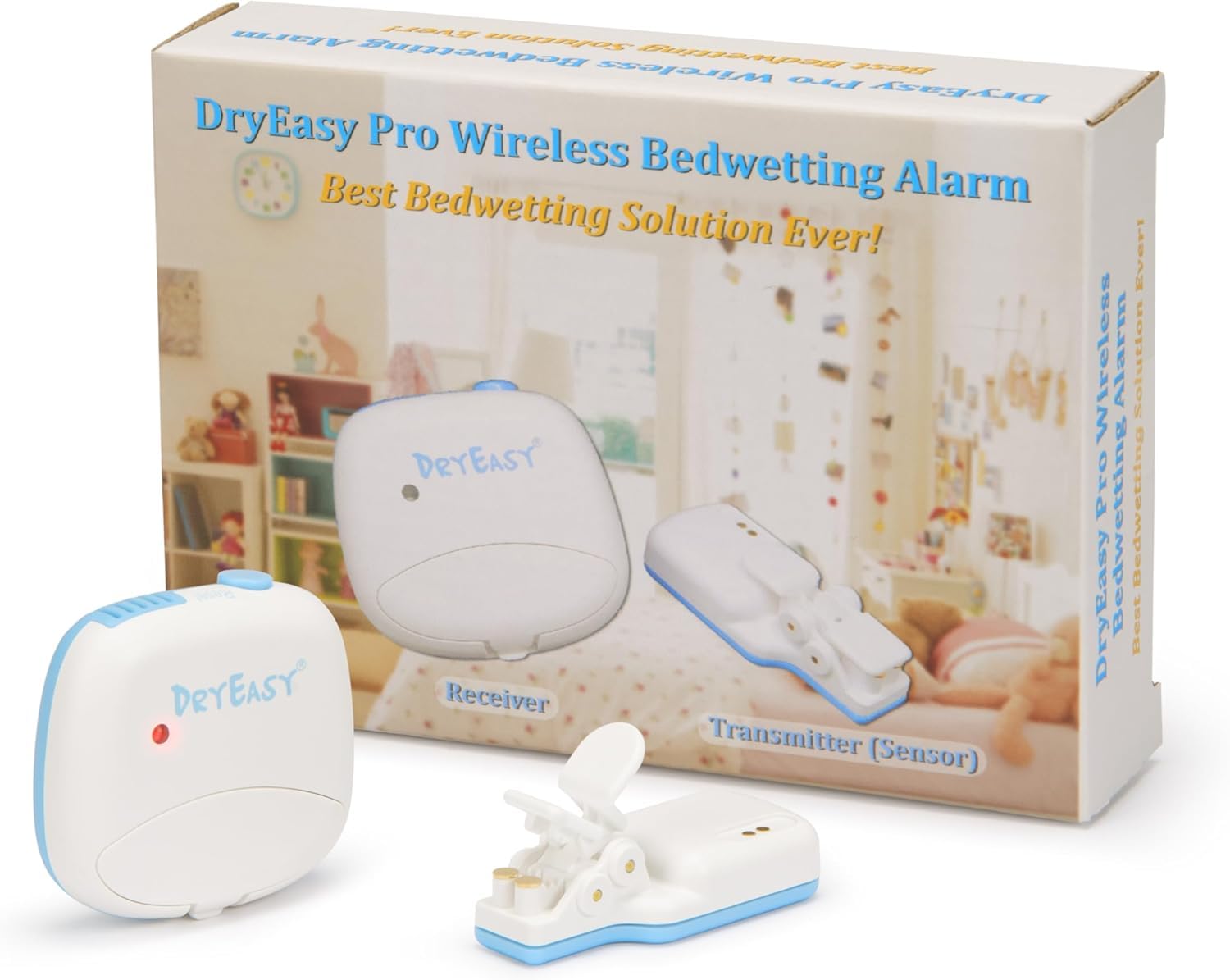
The DryEasy Pro is a modern wireless alternative that sits in the mid-range. The transmitter clips to the underwear and communicates wirelessly to a receiver that can be placed on the bedside table or attached to the child’s arm with a Velcro strap. The toggle clamp design is new and improved, promising to stay secure on underpants without slipping off.
Parents of an 11-year-old with ADHD and autism reported that after 10 days the child achieved consistent dry nights. The alarm sounds immediately upon urine detection, and the child stops urination quickly with minimal wetness. Battery life lasts over a month between charges via USB. The company sent a free replacement charging cord when one was lost, demonstrating strong customer support.
The main complaint is that the wireless transmitter is small and easy to misplace — one user accidentally threw it away. Another user reported that the alarm did not trigger when moisture was applied indirectly through fabric. The receiver can also fall off the child’s arm if the strap is not tight enough. Despite these issues, the wireless convenience at this price point is hard to beat for active sleepers who tangle in cords.
Why it’s great
- Wireless — no cord tangling.
- 6 selectable sounds and 6 volume levels.
- Long battery life with USB charging.
- Responsive customer service.
Good to know
- Small transmitter easily lost.
- Some units fail to detect indirect moisture.
- Arm strap may loosen during sleep.
6. Wet-Stop3 Kit with Waterproof Bed Pad

The Wet-Stop3 Kit bundles the standard wired clip alarm with a reusable, washable waterproof mattress pad. This is a smart practical addition for families tired of stripping the bed after every accident. The alarm itself offers six varying tones plus a vibration alert, and it comes with a reward chart, star stickers, and a free download of “The Complete Bedwetting Book.”
Parent reviews highlight that a 7-year-old who had wet the bed nightly for seven years used the alarm for one month, had only two accidents, and remained dry for three months after stopping. Another user called it the best investment they had made — their son went from a serious bedwetter to one week with zero accidents after just a few weeks. The mattress pad works well to protect bedding and is machine washable.
However, the cord length is a safety concern for young children who move during sleep — one reviewer noted it posed a strangling risk. The alarm is very loud on the max setting and difficult to turn off (requires removing the battery). Some users experienced false alarms from sweat and reported that the sensor unclips easily with active sleepers. The pad itself performs well, but the alarm hardware shows its age compared to newer wireless competitors.
Why it’s great
- Includes waterproof, washable bed pad.
- 6 tones plus vibration alert.
- Reward chart and stickers included.
- Proven results for nightly wetters.
Good to know
- Long cord can be a strangling risk.
- Very loud on max, hard to turn off.
- False alarms from sweat common.
7. Wet-Stop 3 Blue Bedwetting Alarm

The Wet-Stop 3 Blue is the entry-level workhorse that has helped thousands of children achieve dry nights. Despite the budget-friendly price, it includes six varying alarm tones, a strong vibration alert, and a patented sensor that is easy to clean. The two-step shut-off method — press the button and dry the sensor simultaneously — prevents accidental resets during sleep.
Customer feedback is consistently positive: a 5-year-old heavy sleeper was night-trained within 3 weeks, achieving 70% accident detection by the alarm and self-waking 2 out of 14 nights. Another parent used it successfully on two boys aged 4 and 6, with the oldest becoming dry after 2 months. The included reward chart and star stickers provide external motivation. The compact 2.5-inch unit runs on two AAA batteries and is light enough for children to wear comfortably.
The primary concern is sensitivity — the alarm triggers easily on sweat, causing false alarms. Parents solved this by wrapping the sensor with a paper towel and tape to block humidity while still detecting liquid. The 80-decibel output is loud but not adjustable, and some children find the alarm startling enough to cause panic attacks. The cord is relatively short compared to the pad kit version, reducing tangle risk but limiting placement options. For the price, it is an effective starting point for families on a tighter budget.
Why it’s great
- Affordable entry point.
- 6 alarm tones plus vibration.
- Two-step shut-off prevents accidental reset.
- Reward chart and stickers included.
Good to know
- False alarms from sweat are common.
- No volume control — fixed 80 dB.
- Some children find it startling.
FAQ
How long does it take for a bedwetting alarm to work?
Can a bedwetting alarm be used on a child with autism or ADHD?
What is the difference between wired, wireless, and bed-pad alarms?
How do I stop false alarms from sweat with my bedwetting alarm?
What should I do if my child sleeps through the alarm completely?
Final Thoughts: The Verdict
For most users, the bedwetting alarm winner is the Eclipse Wireless because its 40-foot range, reliable urine detection, and comfortable wireless sensor solve the two biggest pain points: cord safety and parent monitoring. If you want the flexibility of eight alarm tones plus a free smartphone app to support the training journey, grab the Malem Ultimate Selectable Camouflage. And for a sensory-friendly, clip-free experience with two washable sensor pads, nothing beats the Wet Detective Bedwetting Kit.