
Our readers keep the lights on and the weekend projects moving. As an Amazon Associate, I earn from qualifying purchases.
Aloe plants have a simple demand: fast drainage, sharp drainage, and then more drainage. The number one cause of a brown, mushy aloe isn’t neglect — it’s the wrong mix holding water against the roots long enough to invite rot. A standard potting soil, rich in moisture-retaining peat, is essentially a death sentence for these desert-adapted plants.
I’m Rikta — the co-founder and writer behind FitlyFast. I’ve spent countless hours cross-referencing bag labels, pore structures, and water-retention curves to find the commercially available mixes that actually deliver the aeration and dry-back speed that aloe roots require.
This guide breaks down seven formulations, from budget blends to bio-active premium mixes, to help you pick the best aloe soil for your specific pot size, watering habits, and plant maturity.
How To Choose The Best Aloe Soil
Aloe vera is a succulent, but its thick, fleshy roots demand a coarser, more mineral-heavy environment than the average echeveria or haworthia. The right soil must balance drainage with just enough water-holding capacity to sustain growth between soakings.
Particle Size and Texture
The most reliable predictor of a mix’s performance is its particle size distribution. A high-quality aloe soil contains a visible percentage of chunky aggregate — pumice, perlite, lava rock, or coarse sand — that creates air pockets. If the bag feels uniformly fine and dusty, it will compact and hold moisture too long for aloe.
Organic Matter Content
Aloe does not need rich, compost-heavy soil. Too much organic matter (peat moss, bark fines, worm castings in excess) retains water and breaks down into a dense sludge over time. A good mix keeps organic content low — enough to provide trace nutrients, but not enough to hold a sponge-like wetness for days.
pH and Nutrient Profile
Aloe prefers a slightly acidic to neutral pH range, roughly 6.0 to 7.0. Most commercial cactus mixes naturally fall within this range. Avoid mixes with added synthetic fertilizers, which can burn aloe’s sensitive roots. Slow-release organic amendments, like worm castings, are preferable if any nutrients are present.
Quick Comparison
On smaller screens, swipe sideways to see the full table.
| Model | Category | Best For | Key Spec | Amazon |
|---|---|---|---|---|
| Rosy Soil Cactus & Succulent | Peat-Free | Premium aeration & root health | 4 qt bag; chunky with biochar, worm castings | Amazon |
| Tinyroots Succulent Soil | Fine-Grit | Small pots & lithops | 2.25 qt; very fine grain, zero perlite | Amazon |
| DUSPRO 7-in-1 Mix | Multi-Aggregate | Nutrient-rich, fast drainage | 1 qt; blend of pumice, lava rock & worm castings | Amazon |
| Hoffman Organic Cactus Mix | Organic | Fungus gnat elimination | 4 qt; low organic matter, sand & perlite | Amazon |
| Midwest Hearth Cactus Mix | pH-Balanced | Versatile indoor/outdoor containers | 4 qt; peat, perlite & vermiculite blend | Amazon |
| Miracle-Gro Succulent Potting Mix | Beginner Friendly | Entry-level, widely available | 4 qt; peat-based with added plant food | Amazon |
| Miracle-Gro Cactus, Palm & Citrus 3-Pack | Multi-Bag | Large collections & multiple repots | 3 x 8 qt; fast-draining with added plant food | Amazon |
In‑Depth Reviews
1. Rosy Soil Cactus & Succulent Potting Mix
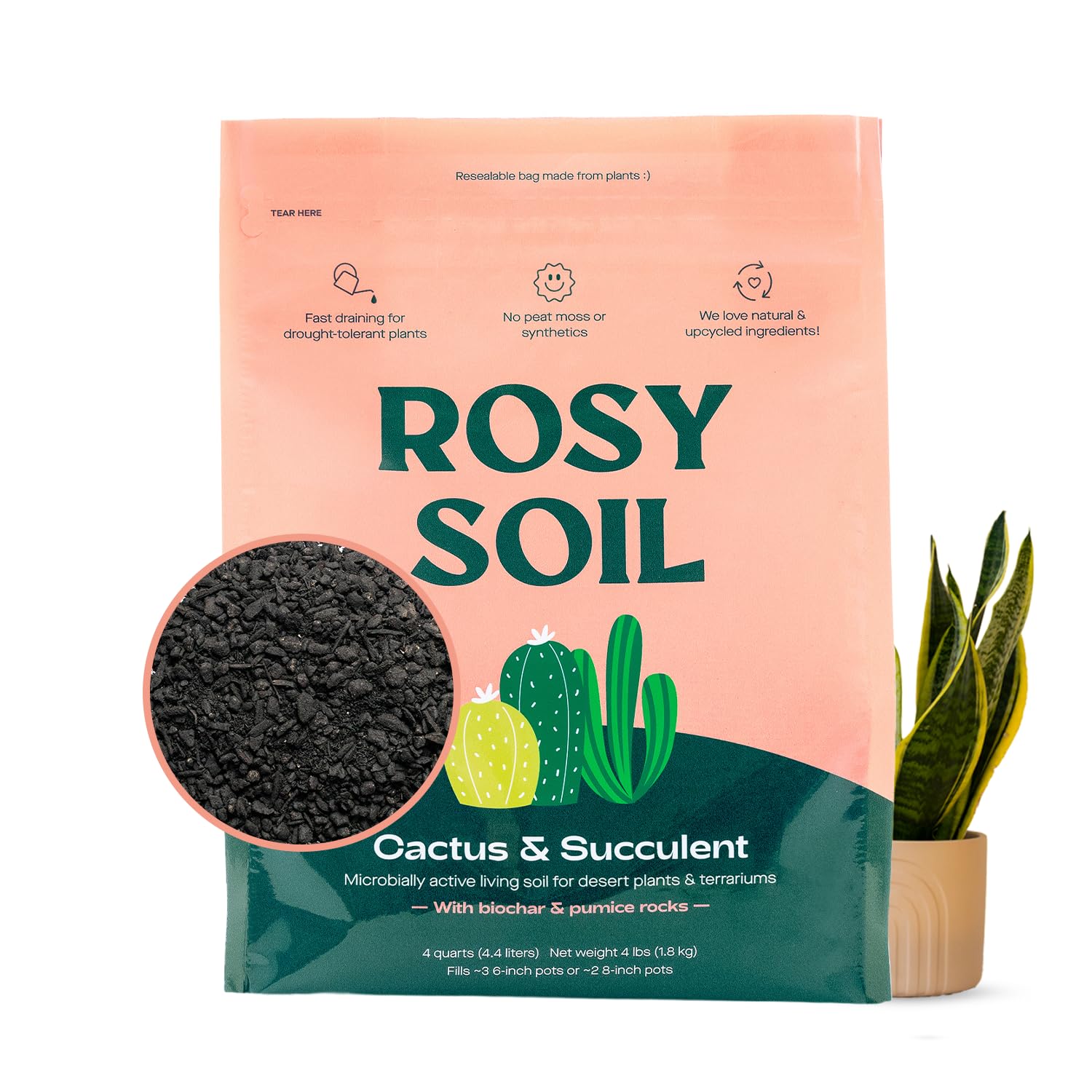
Rosy Soil takes a fundamentally different approach. Instead of a peat-and-perlite base, this mix uses a chunky, airy structure built around biochar, pumice, and worm castings. The texture stays loose and doesn’t compact over time — exactly what aloe roots need to spread and breathe. The absence of peat means the mix dries back considerably faster, reducing the risk of overwatering even for those with a heavy hand.
This is a living soil, pre-loaded with beneficial microbes and fungi that support root health without requiring synthetic inputs. Aloe vera repotted into this mix showed strong new root development within weeks. The bag is a generous 4 quarts, enough to handle three standard 6-inch pots, and the resealable packaging keeps the remaining mix fresh for future repots.
Some users noted that older, established aloe plants may benefit from adding a bit of extra gravel or coarse sand to the blend, but for most repotting tasks — especially for pups or young offsets — this mix performs straight out of the bag. It is a top-tier choice for anyone serious about aloe health.
Why it’s great
- Peat-free formula prevents moisture oversaturation
- Chunky, porous texture ensures long-term aeration
- Bio-active ingredients feed roots naturally
Good to know
- May need additional grit for very large, top-heavy aloe
- Premium pricing reflects the specialized formulation
2. Tinyroots Succulent Soil

Tinyroots markets itself as a premium substrate, and the attention to particle size is immediately evident. Unlike many cactus mixes that rely on large, floating perlite chunks, this formula uses a consistently fine-grit texture that packs evenly around delicate root systems. For aloe pups or small offsets in 2-to-4-inch pots, this creates an intimate root-to-soil contact that encourages rapid establishment.
The drainage is genuinely excellent — water flows through the pot in seconds, and the mix feels barely damp within a day. This makes it nearly impossible to overwater, a huge advantage for beginners still learning the soak-and-dry rhythm. A reviewer noted that using this mix was the first time they saw blooms on a cactus, which speaks to its balanced nutrient profile.
The bag is smaller than most at 2.25 quarts, so value-conscious buyers with a large aloe collection may find themselves buying multiple bags. But for single-plant owners or those starting small, this is a plug-and-play solution that eliminates guesswork.
Why it’s great
- Finer grain structure is ideal for small roots and pups
- Extremely fast drainage prevents overwatering
- Contains no perlite, reducing float-to-surface issues
Good to know
- Small bag size limits value for bulk repotting
- Premium-tier pricing per quart
3. DUSPRO 7-in-1 Succulents Soil Potting Mix
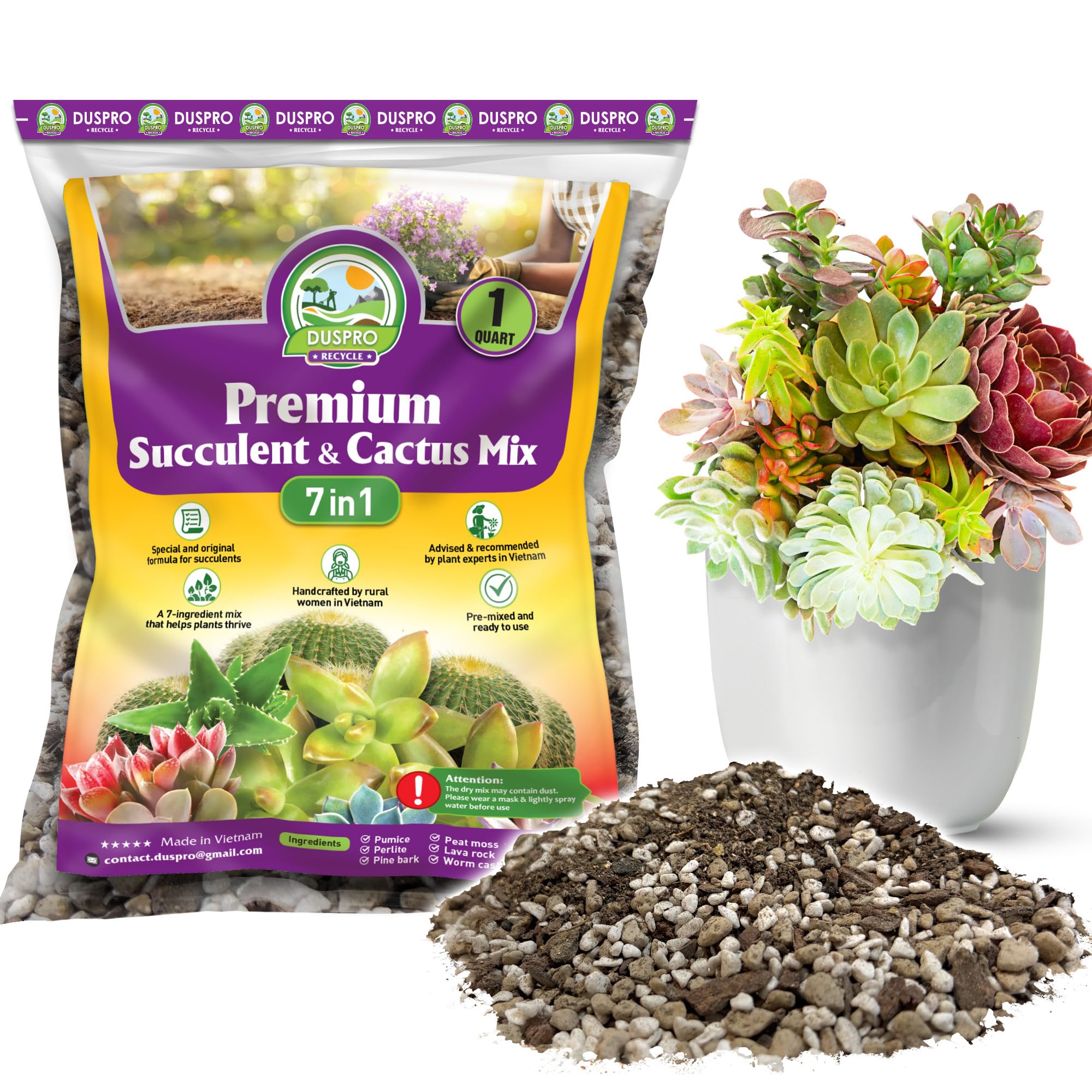
DUSPRO’s 7-in-1 mix is a thoughtfully constructed blend that includes pumice, lava rock, pine bark, perlite, peat moss, vermiculite, and worm castings. The inclusion of pumice and lava rock is significant — both are porous aggregates that provide lasting aeration without breaking down. For aloe, this translates into a structure that stays open and breathable for the entire life of the potting cycle.
The worm castings add a gentle, slow-release nutrient source that fuels steady growth without the burn risk of synthetic fertilizers. Customers reported that their succulents and aloe were healthy and thriving after repotting, with no signs of moisture stress. The bag arrived slightly dusty, but that’s typical of any mix containing pine bark fines and peat.
One caveat: the ingredients can separate during shipping, so you’ll want to dump the bag into a bucket and hand-mix before potting to redistribute the aggregates evenly. The 1-quart size is small and best suited for a single aloe plant or two small pots. Larger versions are available for bigger projects.
Why it’s great
- Diverse aggregate blend (pumice, lava rock) for lasting aeration
- Worm castings provide gentle organic nutrition
- Ready to use straight from the bag after a quick mix
Good to know
- Ingredients may settle during shipping; requires manual remixing
- Entry-level bag size is only 1 quart
4. Hoffman Organic Cactus and Succulent Soil Mix

Hoffman’s Organic Cactus Mix has been a staple in the succulent community for years, and its formula remains one of the most reliable for combating root rot. The key is its low content of decomposable organic matter — no large wood chips or bark chunks that break down into moisture-holding sludge. Instead, it uses a sandy, perlite-rich base that drains quickly and stays light.
Numerous reviewers reported that switching to Hoffman eliminated persistent fungus gnat problems and reversed soggy-root issues in aloe, snake plants, and jade. The mix is pH-balanced to support desert plants, and the texture is noticeably coarser than standard potting soils. It is ready to use and requires no amendments for most aloe vera plants in standard containers.
A small percentage of bags arrived with a tear in the outer packaging, so inspect upon delivery. The soil itself is consistently good, but the bag’s thin material can be a weak point during shipping. Overall, this is a solid, no-fuss organic option for aloe owners who want a proven track record.
Why it’s great
- Low organic matter content resists compaction
- Proven to eliminate fungus gnats
- pH-balanced for succulent health
Good to know
- Bag material can tear during shipping
- Some users add extra perlite for very heavy aloe specimens
5. Midwest Hearth Cactus & Succulent Potting Soil
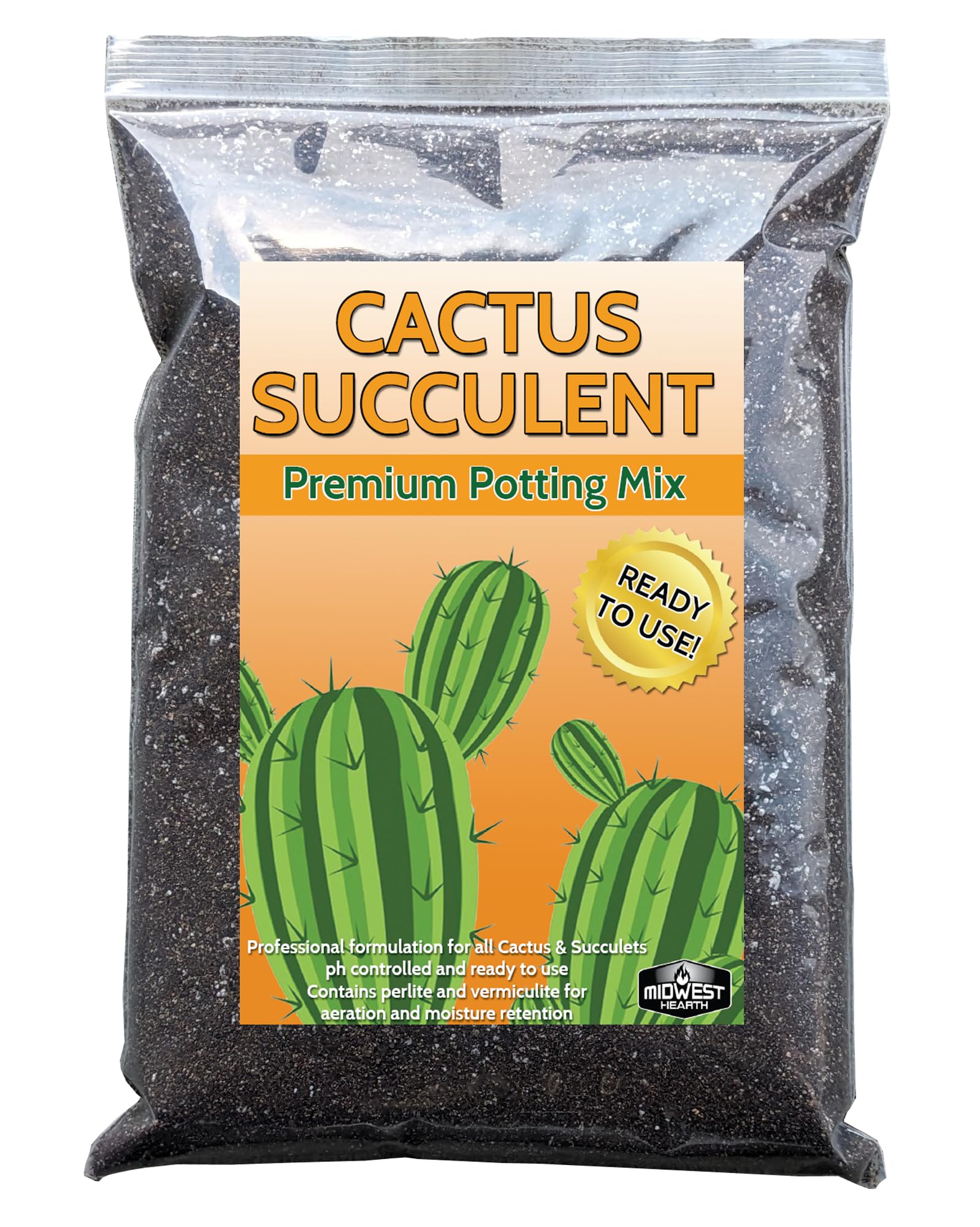
Midwest Hearth’s formula is a straightforward, well-executed blend of peat moss, perlite, and vermiculite. The inclusion of vermiculite, which has a higher water-holding capacity than perlite, means this mix retains a bit more moisture than the chunkiest blends. This can be an advantage for aloe owners who live in arid climates or tend to underwater, as the mix provides a small buffer against complete dryness.
The pH is controlled to match the preferences of drought-tolerant plants, and the bag is large enough (4 dry quarts) to handle several repotting sessions. Users found it effective for a wide range of plants — aloe, jade, Christmas cactus, and desert rose all performed well. The texture is well-balanced, not too fine and not overly chunky.
A minor but real issue is that the dry top layer of particles can blow away if you keep the pot near an open window or fan. This is a surface-level annoyance and doesn’t affect the soil’s performance below the surface. For indoor aloe on a windowsill, it’s a small trade-off for a consistent, reliable mix.
Why it’s great
- pH-controlled for optimal cactus and succulent growth
- Vermiculite in blend offers moderate moisture retention for dry homes
- Generous 4-quart bag for multiple pots
Good to know
- Dry top particles can be messy near open windows
- Not as chunky as premium bio-active blends
6. Miracle-Gro Succulent Potting Mix

Miracle-Gro’s succulent mix is the most accessible entry-point for new aloe owners. It’s a peat-based formula with processed forest products and a light dose of plant food. For a first-time repot, this is miles better than standard potting soil — it drains faster and is less likely to cause immediate rot. Many users reported improved growth and color after switching from generic soils.
The trade-off is in the particle structure. This mix is much finer and more homogeneous than the chunky premium blends. Peat moss holds moisture longer, and several experienced growers noted that after a deep watering, the soil remained wet for days. This requires the owner to be more disciplined with watering frequency, especially in non-terracotta pots. Adding perlite is a common workaround.
At the price point, it’s a fair value for a bagged mix that works. But for serious aloe collectors or anyone who has lost plants to rot before, spending a bit more on a chunkier, peat-free blend is a safer long-term investment.
Why it’s great
- Readily available and affordable entry point
- Better drainage than standard potting soil
- Includes a small amount of plant food for initial growth
Good to know
- Peat-heavy base can stay too wet for sensitive aloe
- Fine texture may compact over time
7. Miracle-Gro Cactus, Palm & Citrus Potting Mix (3-Pack)

This is the same core Miracle-Gro formula as the succulent mix, but in a larger, multi-bag bundle specifically labeled for cactus, palm, and citrus. The fast-draining formula is slightly grittier than the straight succulent version, making it a marginally better fit for aloe right out of the bag. The three 8-quart bags provide enough volume to handle a significant collection of aloe and other succulents.
Owners of multiple holiday cacti and aloe plants reported that this mix boosted growth noticeably compared to standard potting soil. The key is still caution with watering — as with any peat-containing mix, the wet-dry cycle needs to be monitored. Many experienced users cut this mix with additional perlite or pumice to reach the optimal particle size for aloe.
The multi-pack format is the primary draw here. If you have a large number of plants to repot or a sizable aloe in a deep container, buying in bulk reduces the cost per quart significantly. Just be prepared to amend the mix if your aloe tends to be sensitive to moisture.
Why it’s great
- Excellent bulk value for large repotting projects
- Fast-draining formula works better than standard potting soil
- Convenient multi-pack saves individual bag purchases
Good to know
- Still peat-based; may require additional perlite for aloe
- Not as airy as chunky, premium blends
FAQ
Can I use regular potting soil for my aloe vera?
How can I tell if my aloe soil is draining fast enough?
Should I add perlite to bagged cactus soil for aloe?
Final Thoughts: The Verdict
For most users, the best aloe soil winner is the Rosy Soil Cactus and Succulent Potting Mix because its peat-free, chunky, bio-active formula delivers the drainage and aeration that aloe roots need without requiring any amendments. If you want a fine-grain substrate ideal for small pots and offsets, grab the Tinyroots Succulent Soil. And for large-scale repotting on a budget, nothing beats the value of the Miracle-Gro Cactus, Palm and Citrus 3-Pack — just plan to add some perlite.