
Our readers keep the lights on and the weekend projects moving. As an Amazon Associate, I earn from qualifying purchases.
A 2000-watt power station sits at the critical threshold where backup capability meets genuine whole-home partial power, making the choice of battery chemistry, inverter type, and expansion options the difference between a reliable energy partner and a costly paperweight.
I’m Rikta — the co-founder and writer behind FitlyFast. After spending countless hours analyzing inverter specs, battery cycle life ratings, surge capabilities, and real-world load tests across dozens of models, I’m confident this guide separates the serious contenders from the also-rans.
Whether you’re preparing for hurricane season or building a mobile power system for your RV, finding the best 2000 watt power station requires understanding the interplay between continuous output, surge capacity, and battery management systems that define real-world usability.
How To Choose The Best 2000 Watt Power Station
A 2000-watt power station is a serious investment. The difference between a unit that runs your fridge for two days and one that trips under a microwave load often comes down to three critical factors: battery chemistry, inverter quality, and the expansion architecture. Many shoppers focus on watt-hours first, but the inverter’s ability to handle surge loads from compressors and pumps defines what you can actually plug in.
Battery Chemistry: LiFePO4 vs. Lithium-Ion
Nearly every premium power station at the 2000W class now uses LiFePO4 (lithium iron phosphate) chemistry. Compared to standard lithium-ion, LiFePO4 offers 3,500 to 6,000 charge cycles before dropping to 80% capacity, versus roughly 500 cycles for older NMC chemistries. This directly impacts the cost-per-cycle over a decade of use. The trade-off is weight — LiFePO4 cells are denser, making premium units heavier but safer with lower thermal runaway risk.
Inverter Type and Surge Capacity
A pure sine wave inverter is non-negotiable for sensitive electronics like CPAP machines, laptops, and variable-speed refrigerators. Beyond the rated continuous wattage, check the surge rating — some units deliver 3,600W peaks for up to 30 seconds, essential for starting inductive loads like well pumps or air conditioner compressors. Units advertising “Power Lifting” or “X-Boost” modes can maintain higher continuous output beyond their nominal rating for brief periods.
Charging Speed and Solar Input
A 2000Wh battery recharged in under two hours via AC input is now standard among mid-range and premium units. Solar input voltage range and amperage determine how fast you can recharge off-grid — look for MPPT controllers with at least 800W solar input capacity. Some units support dual charging (AC + solar simultaneously) for the fastest refill when both sources are available.
Quick Comparison
On smaller screens, swipe sideways to see the full table.
| Model | Category | Best For | Key Spec | Amazon |
|---|---|---|---|---|
| GRECELL 2400W | Mid-Range | Budget-conscious whole-home backup | 1843.2Wh / 2400W continuous | Amazon |
| OUPES Exodus 2400 | Mid-Range | Fast recharge with app control | 2160Wh / 2400W continuous | Amazon |
| BLUETTI AC200L | Premium | Expandable home backup system | 2048Wh / 2400W (3600W lifting) | Amazon |
| EcoFlow DELTA 3 Max | Premium | Ultra-quiet UPS with app control | 2048Wh / 2400W (3400W X-Boost) | Amazon |
| Jackery Explorer 2000 v2 | Premium | Lightest 2kWh unit for portability | 2042Wh / 2200W continuous | Amazon |
| BLUETTI Elite 200 V2 | Premium | Highest cycle life and efficiency | 2073.6Wh / 2600W (3900W lifting) | Amazon |
| PECRON F3000LFP | Premium | Large capacity expandable system | 3072Wh / 3600W continuous | Amazon |
| AFERIY 3840Wh | Premium | Massive runtime with expansion | 3840Wh / 3600W (7200W peak) | Amazon |
| BLUETTI Elite 300 | Premium | Compact 3kWh with RV port | 3014Wh / 2400W (4800W surge) | Amazon |
| EcoFlow DELTA 3 Ultra | Premium | Whole-home standby power | 3072Wh / 3600W (7200W surge) | Amazon |
| BLUETTI Apex 300 | Premium | Dual-voltage 120/240V system | 2764.8Wh / 3840W (7680W surge) | Amazon |
In-Depth Reviews
1. GRECELL 2400W Portable Power Station
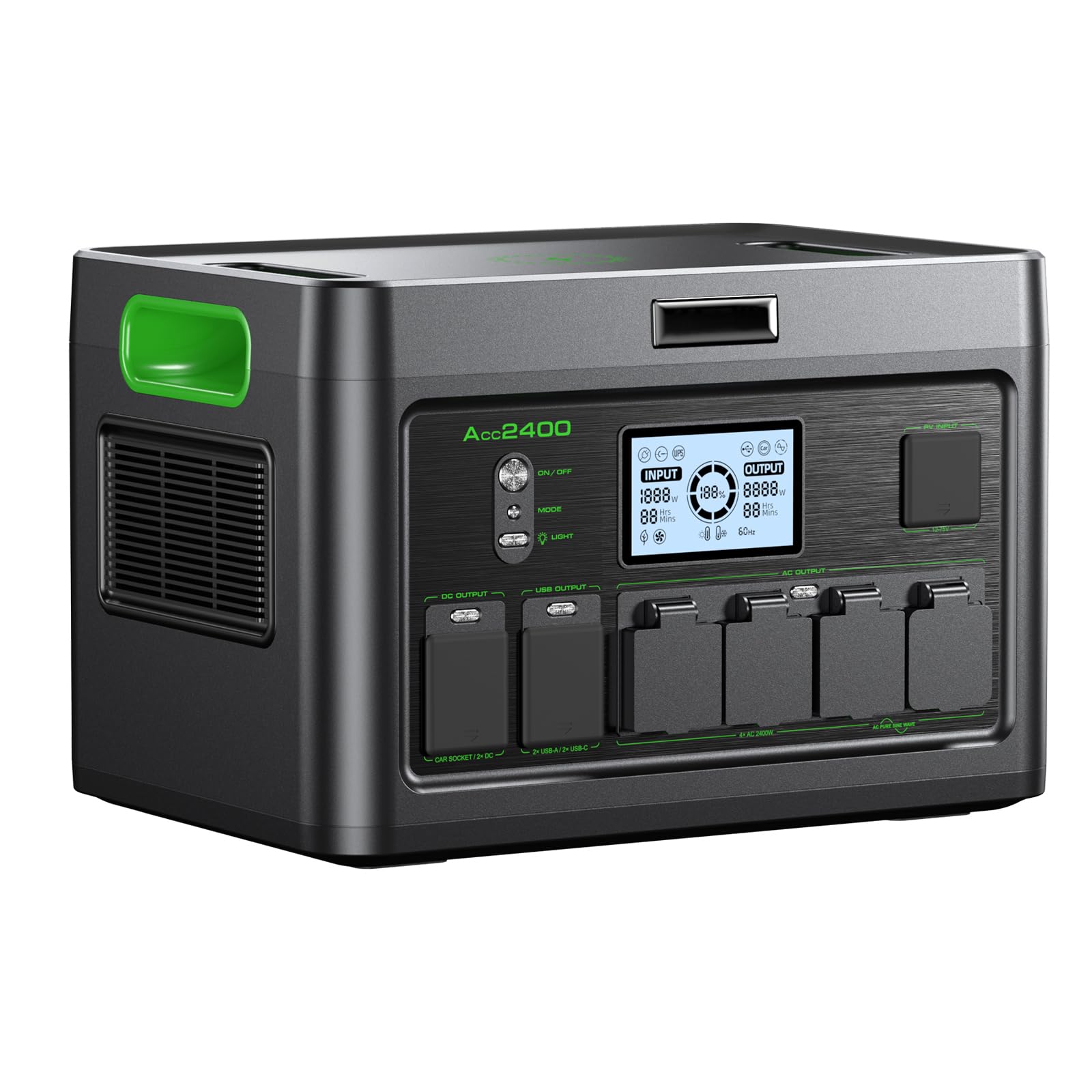
The GRECELL 2400W packs an 1843.2Wh LiFePO4 battery with a 4800W peak surge rating, making it one of the most aggressive price-to-performance ratios in the 2000W class. The pure sine wave inverter delivers 2400W continuous, enough to handle a window AC unit or microwave, while the 12-port output panel includes two 100W USB-C PD ports and a 10W wireless charging pad — a thoughtful addition for modern device ecosystems.
Recharging is remarkably fast: the bidirectional inverter pulls 1200W via AC for a full fill in under two hours, and dual charging (800W solar + AC) cuts that to roughly 1.8 hours. The 4-mode LED emergency light with adjustable brightness adds genuine utility during blackouts. At this price point, the GRECELL competes directly with units costing significantly more, though the 1843Wh capacity is slightly below the 2kWh standard of premium models.
The 0.1-second UPS switchover is fast enough for most desktop computers and networking gear, though sensitive medical devices may prefer the sub-20ms response of pricier competitors. Build quality feels solid, and the intelligent BMS with thermal management adds confidence for long-term ownership. For budget-minded buyers who refuse to compromise on inverter quality, this is the clear starting point.
Why it’s great
- Exceptional value for 1843Wh capacity with pure sine wave output
- Ultra-fast 1.6-hour AC recharge with bidirectional inverter
- 10W wireless charging pad and dual 100W USB-C PD ports
Good to know
- Capacity is 11% less than standard 2kWh competitors
- UPS switchover at 0.1 seconds is slower than premium units
2. OUPES Exodus 2400
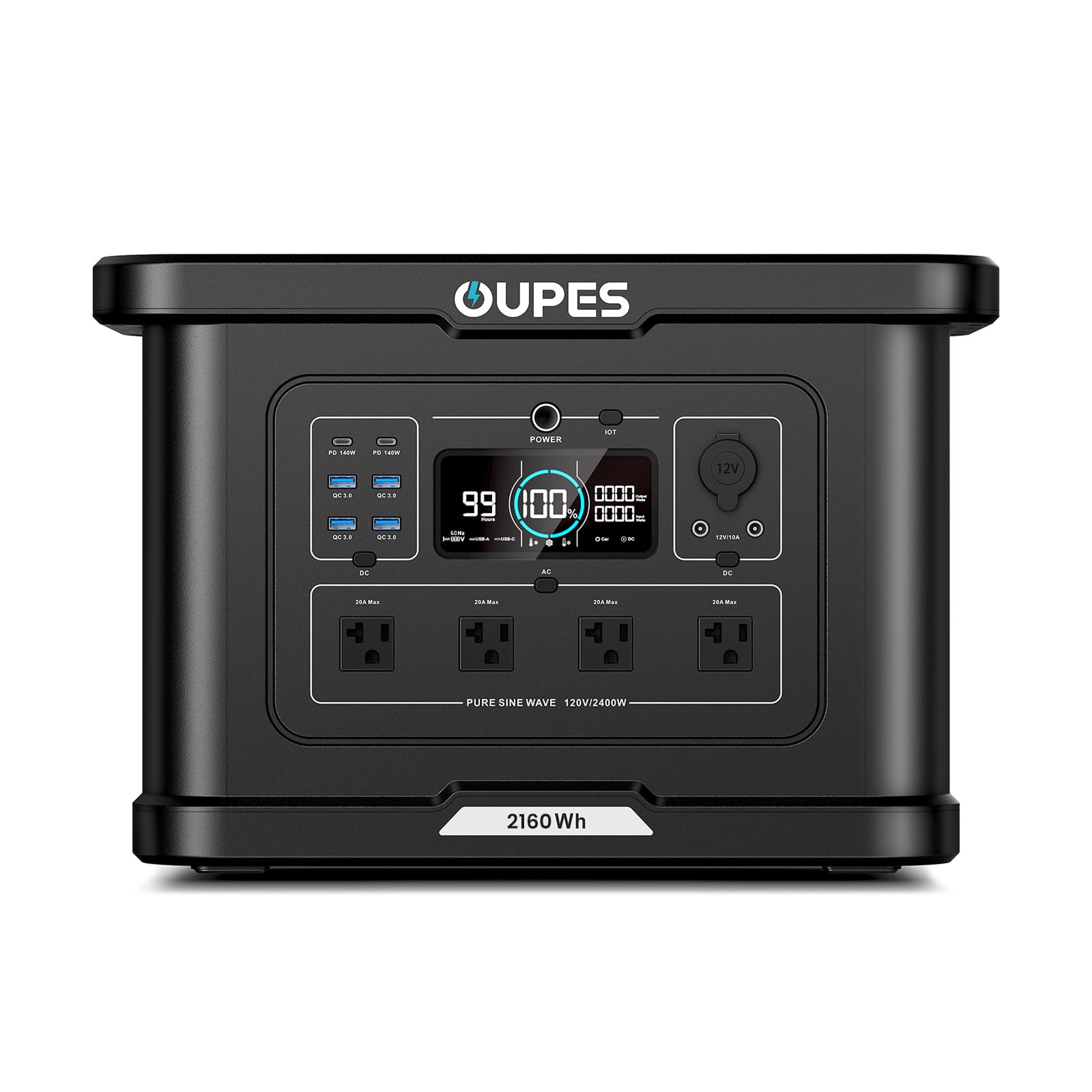
OUPES enters the 2000W arena with the Exodus 2400, a 2160Wh LiFePO4 station that boosts to 2600W continuous and surges to 4500W for starting motor-driven appliances. The 1.2-hour 0-80% AC recharge speed is among the fastest in its class, thanks to a 1400W input circuit that rivals premium-tier charging performance.
The app control via WiFi and Bluetooth sets the Exodus apart — users can schedule charging, monitor solar input in real time, and toggle Eco Mode remotely. The <20ms UPS transfer keeps sensitive electronics safe, and the 13-output panel includes dual 140W USB-C PD ports, a notable step up from the standard 100W. At 45.2 pounds, it’s lighter than many 2kWh competitors, aided by ergonomic handles for campsite or job-site transport.
Solar input tops out at 800W, which is adequate but below the 1200W+ capacities of premium rivals. Some users noted the car charging cable was damaged in transit, though OUPES customer service responded quickly with replacements. The 5-year warranty adds peace of mind for a mid-range investment. For users who prioritize app integration and fast wall charging, the Exodus 2400 delivers a polished experience.
Why it’s great
- 0-80% AC recharge in just 1.2 hours via 1400W input
- Full WiFi/Bluetooth app control with charging schedules
- Dual 140W USB-C PD ports outperform typical 100W ports
Good to know
- Solar input limited to 800W maximum
- Car charging cable reported as fragile by some users
3. BLUETTI AC200L

The AC200L is an upgraded version of the AC200MAX, boosting output to 2400W continuous with 3600W Power Lifting for short-duration high-demand loads. The 2048Wh LiFePO4 battery is expandable to 8192Wh via B300K, B210, or B300 expansion batteries, making this a true home backup foundation that grows with your needs.
Charging is where the AC200L separates itself: the 2400W AC input pushes 0-80% in just 45 minutes — the fastest standard recharge in this comparison. Solar input maxes at 1200W, enough to fully refill in under two hours with sufficient panels. The 11-port panel includes a 30A RV output and a 48V/8A DC port, plus the ≤10ms UPS switchover protects critical electronics seamlessly.
At 61.4 pounds, the AC200L is heavier than the Jackery or OUPES alternatives, but the expandability and 3000+ cycle battery justify the bulk. The app supports both WiFi and Bluetooth monitoring, and the 5-year warranty reflects BLUETTI’s confidence in the platform. For homeowners planning to eventually power multiple circuits, the AC200L’s expansion path is unmatched at this price tier.
Why it’s great
- 0-80% recharge in 45 minutes via 2400W AC input
- Expandable to 8192Wh with multiple battery options
- 30A RV port and 48V DC output for specialized use
Good to know
- Heavier than many competitors at 61.4 pounds
- Proprietary AC adapter cord may limit replacement options
4. EF ECOFLOW DELTA 3 Max
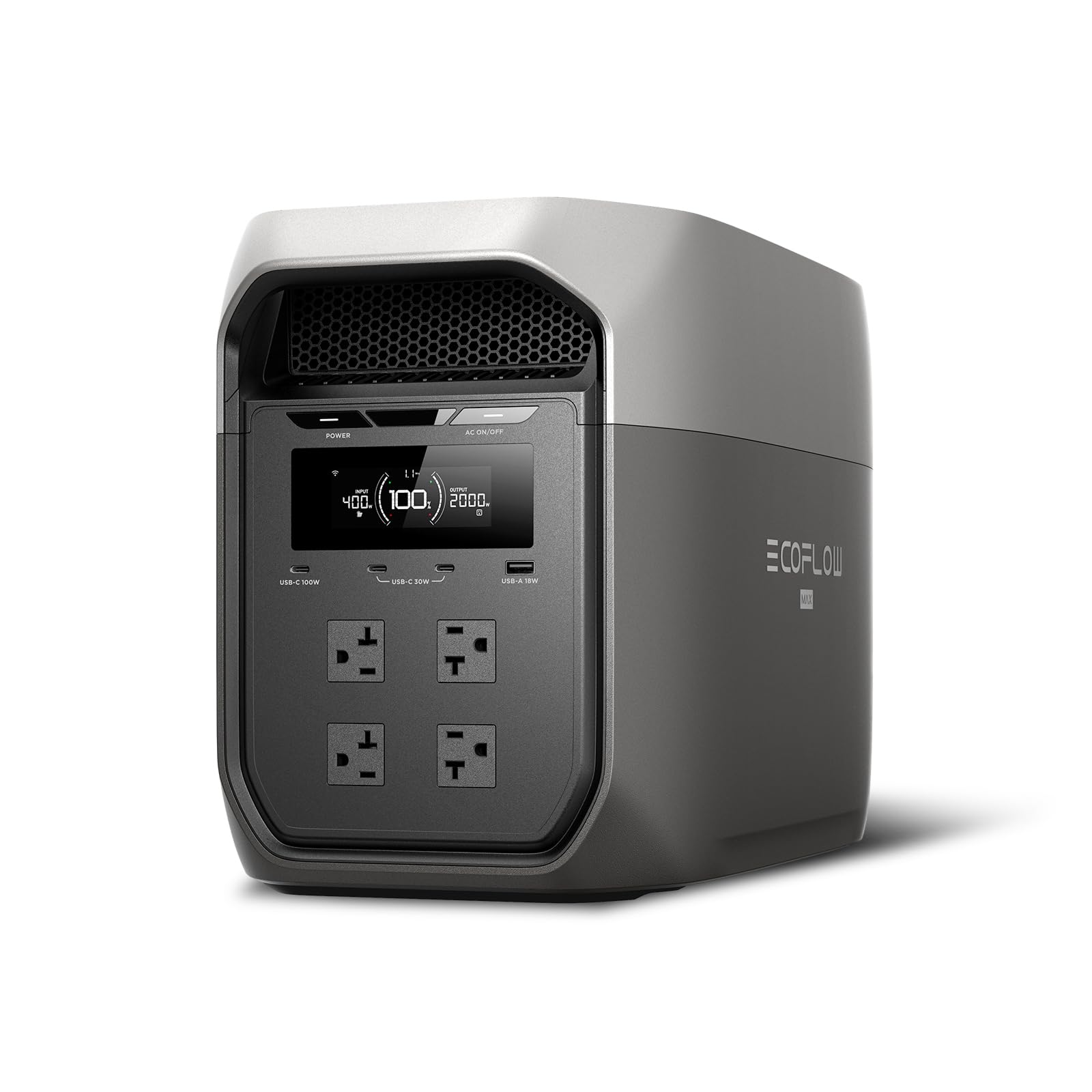
EcoFlow’s DELTA 3 Max brings 2048Wh of LiFePO4 storage with a 2400W continuous inverter that can X-Boost to 3400W for high-demand appliances. The standout feature is the <10ms UPS transfer time — fast enough to keep a desktop PC or medical device running through a grid flicker without even noticing the transition.
X-Stream technology recharges 0-80% in 1.13 hours, and the ultra-quiet design (25dB under load) makes it suitable for overnight use in bedrooms or RVs where noise matters. The app includes a Storm Guard function that pre-charges the battery ahead of weather events, automatically keeping the unit at high state of charge when severe conditions are forecast.
At roughly 40 pounds, the DELTA 3 Max is lighter than most 2kWh competitors, though the dimensions are somewhat tall at 19.44 inches. The XT60i solar connector supports fast solar charging, and the aluminum alloy build feels premium. Filmmakers and remote professionals praised its reliability for powering camera rigs and monitors on location. The main compromise is non-expandable capacity — what you see is what you get.
Why it’s great
- Ultra-quiet 25dB operation under load, ideal for indoor use
- <10ms UPS transfer for seamless electronics protection
- Storm Guard app feature pre-charges ahead of weather events
Good to know
- Battery capacity is not expandable
- Tall profile at 19.44 inches may challenge shelf storage
5. Jackery Explorer 2000 v2

Jackery’s Explorer 2000 v2 leverages CTB (Cell-to-Body) technology borrowed from EV manufacturing to achieve a remarkable 39.5 pounds — 41% lighter and 34% smaller than typical 2kWh LiFePO4 stations. The 2042Wh battery feeds a 2200W pure sine wave inverter, and the 0-80% AC fast charge completes in just 66 minutes, with an Emergency Super Charging mode hitting full charge in 102 minutes via the app.
The silent charging mode operates below 30dB, letting you recharge overnight without disturbance. The 20ms UPS switchover is UL1778 certified, and the built-in handle makes carrying manageable despite the weight.
Users in off-grid Belize and on boats praised the unit’s ability to power internet equipment and 12V fridges for extended periods. The 10-year battery lifespan and 5-year warranty support Jackery’s reputation for reliability. The trade-off is that 2200W is slightly below the 2400W standard of many competitors, and the solar input of 400W max is half of what premium units offer.
Why it’s great
- Lightest 2kWh station at 39.5 pounds with CTB technology
- 0-80% charge in 66 minutes; silent mode below 30dB
- UL1778 certified UPS with 20ms switchover
Good to know
- Solar input limited to 400W, slower off-grid recharge
- Continuous output at 2200W is below the 2400W standard
6. BLUETTI Elite 200 V2

The BLUETTI Elite 200 V2 packs 2073.6Wh into a compact chassis with a 2600W continuous inverter that can Power Lift to 3900W — the highest sustained output in this comparison. The 6000-cycle LiFePO4 battery is CNAS-certified automotive-grade, delivering an estimated 17-year lifespan under daily use, which is 12 times longer than industry-average NMC batteries.
Energy efficiency is a signature strength: standby power consumption drops to just 10W, three times lower than typical power stations, translating to longer runtime under light loads. The Turbo Mode achieves 0-80% in 50 minutes via dual AC and DC charging, while Silent Mode operates at 16-30dB for discreet overnight charging. The BLUETTI app offers Turbo, Standard, and Silent charging modes with full customization.
The 15ms UPS switchover protects sensitive electronics, and the dual handles improve portability despite the 53.35-pound weight. Users consistently praise the unit’s ability to run hair dryers, shop vacs, and air conditioners without hesitation. The only notable omission is the lack of a 30A RV port, which may disappoint RV owners who want direct TT-30 connectivity without an adapter.
Why it’s great
- 3900W Power Lifting for demanding appliances like dryers and vacuums
- 6000-cycle LiFePO4 with 17-year estimated lifespan
- Ultra-low 10W standby power consumption for longer runtime
Good to know
- No TT-30 RV port for direct RV hookup
- Heavier than Jackery 2000 v2 at 53.35 pounds
7. PECRON F3000LFP
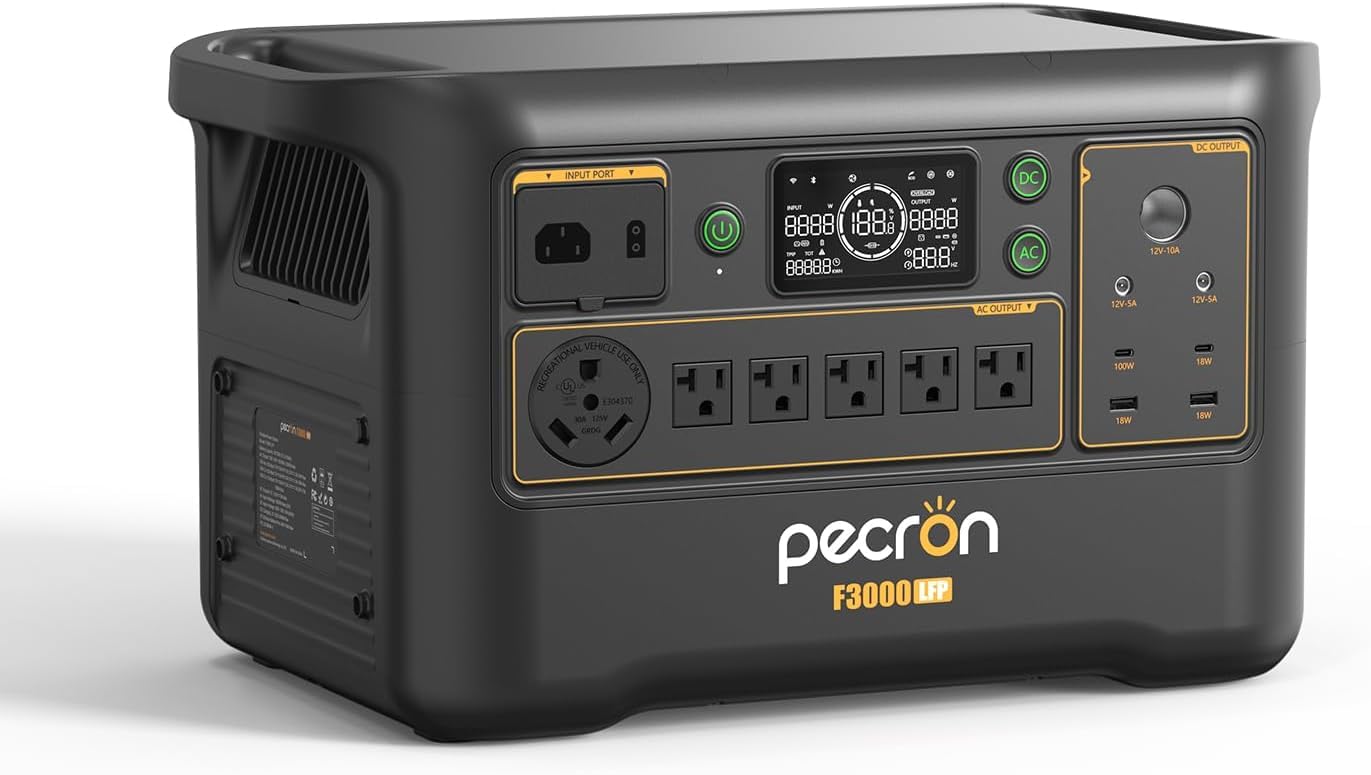
The PECRON F3000LFP steps into the 3kWh class with a 3072Wh LiFePO4 battery and a 3600W pure sine wave inverter, expandable to 10752Wh via external battery packs. The 1800W AC input delivers a full charge in just two hours — 30% faster than many 3kWh competitors — making it practical for rapid turnarounds between power outages.
The 13-port output panel includes six AC outlets, two 100W USB-C PD ports, and dual DC 5525 outputs, supporting up to 13 devices simultaneously. The 8-20ms UPS switchover protects computers and medical equipment, and the app provides real-time monitoring of power draw and battery status. Solar input reaches 1600W, enough to refill the large battery in about three hours with sufficient panel capacity.
Users note the fan runs audibly when charging at high power, and idle consumption around 30W when the unit is on is higher than some competitors. The 63.3-pound weight and 19.3-inch length demand dedicated floor space. However, the combination of 3kWh capacity, 3600W output, and expandability at this price point creates strong value for home backup scenarios where runtime matters more than portability.
Why it’s great
- 3072Wh capacity with 3600W continuous output at a competitive price
- 1800W AC charging achieves full recharge in two hours
- Expandable to 10752Wh for whole-home backup scenarios
Good to know
- Idle power draw of ~30W is higher than premium competitors
- Fan noise is audible during high-power charging
8. AFERIY 3840Wh Power Station

The AFERIY 3840Wh station is a true heavy hitter, delivering 3.8kWh of LiFePO4 storage with a 3600W continuous inverter that surges to 7200W for starting large motors. The capacity can be expanded to 11.5kWh with additional battery packs, making this one of the few units capable of powering an entire home’s essentials for multiple days.
The 15-port output panel includes five AC outlets, dual USB-C PD 3.0 ports, and a 12V car socket. The <10ms UPS transfer ensures seamless backup for computers and networking equipment. The pull handle and rugged wheels make the 80.46-pound unit surprisingly mobile, and the 1.5-hour fast AC recharge minimizes downtime. The app provides full monitoring and scheduling capabilities.
UL listing adds independent safety verification, and the 7-year support period is among the longest in the category. Users in RVs reported the unit runs most essentials except air conditioning, and the expansion battery option extends runtime significantly. The main drawbacks are the substantial footprint (23 x 12.6 x 18.3 inches) and the initial cost, though the per-watt-hour value is excellent for this capacity tier.
Why it’s great
- Massive 3840Wh capacity expandable to 11.5kWh
- 7200W peak surge handles heavy motor starts
- UL listed with 7-year support period for peace of mind
Good to know
- Large footprint at 23 x 12.6 x 18.3 inches requires dedicated space
- Weighs 80.46 pounds before adding expansion batteries
9. BLUETTI Elite 300
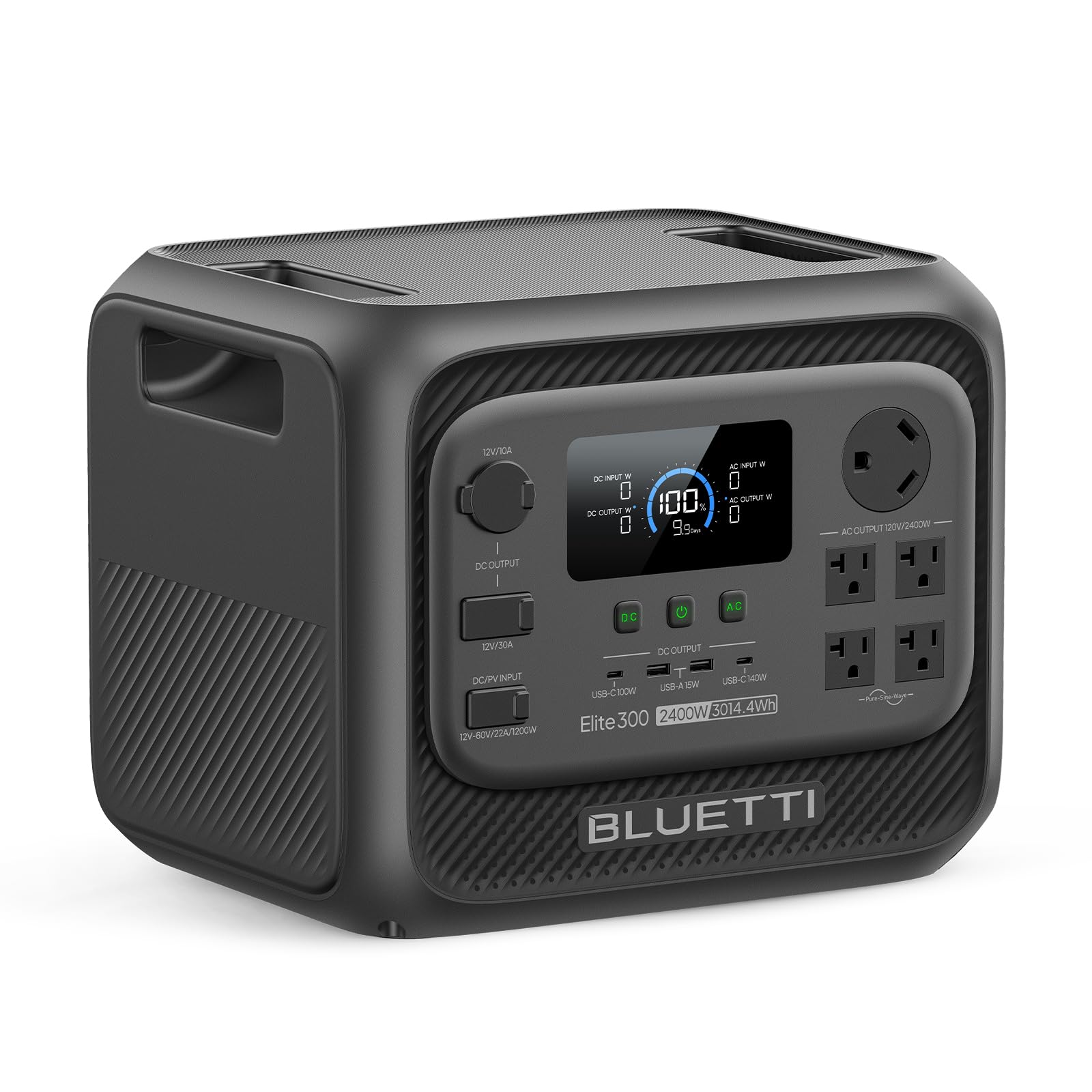
The BLUETTI Elite 300 earned recognition from Frost & Sullivan as the world’s smallest 3kWh portable power station, packing 3014Wh into a chassis that is 59% smaller than traditional large stations. The 2400W pure sine wave inverter delivers a 4800W surge, and the dual-voltage design includes a TT-30 RV port plus a 12V/30A DC output specifically for RV appliances like water pumps and diesel heaters.
Charging from 0-100% takes just 78 minutes via AC input, and the 10ms UPS switchover keeps critical devices running during outages. The 1200W solar input is adequate for a 3kWh battery, though users note it is slightly lower than the AC200L’s 1200W limit. The BLUETTI app provides full control over charging modes and power monitoring, and the 58-pound weight is remarkable for a 3kWh unit.
Users consistently praise the compact design for RV and boondocking applications — one camper reported running a fan, lights, and phone charging all weekend with 35% remaining. The 6000+ cycle LiFePO4 battery ensures long-term value. The main limitation is that the Elite 300 is not expandable, so the 3014Wh is fixed. The solar input voltage range is also narrower than the AC200L, potentially limiting panel configurations.
Why it’s great
- Smallest 3kWh station with 59% space savings over rivals
- TT-30 RV port and 12V/30A DC for dedicated RV use
- 0-100% charge in just 78 minutes from AC input
Good to know
- Battery capacity is not expandable
- Solar input voltage range is narrower than some competitors
10. EF ECOFLOW DELTA 3 Ultra
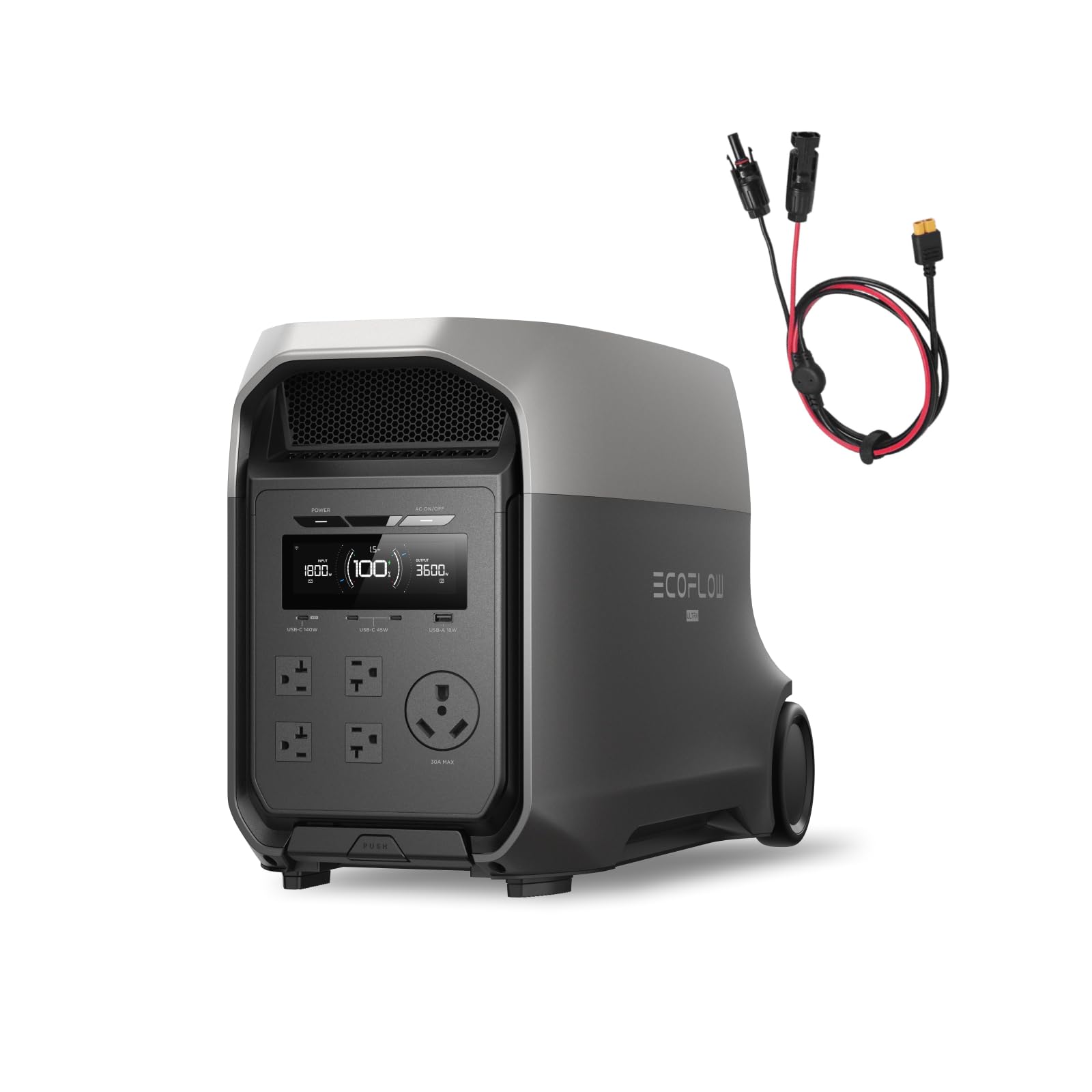
The DELTA 3 Ultra brings 3072Wh of LiFePO4 storage with a 3600W continuous inverter that surges to 7200W — enough to handle a griddle and oven simultaneously, as one user confirmed. The X-Quiet 3.0 technology keeps noise at just 25dB under load, making this one of the quietest 3kWh units available for home backup use.
The <10ms UPS transfer is instantaneous, and the 1600W AC input achieves a 90-minute full recharge. The 4-way charging flexibility (AC, solar, car, or generator) and telescoping handle with wheels make the 72.1-pound unit transportable despite its size. The output panel includes a 30A RV outlet, four 20A AC outlets, four USB ports, and a 12V port, covering the full range of home and RV needs.
Users praised the seamless grid-to-battery transition during power outages — one reviewer noted the switchover kept a 1500W heater running continuously without interruption. The 10-year battery lifespan adds confidence for long-term investment. The main catch is that the DELTA 3 Ultra is non-expandable, and the solar input is limited to 800W, which is below the 1200W standard of some competitors at this price tier.
Why it’s great
- Ultra-quiet 25dB operation under full load for indoor use
- 7200W surge handles simultaneous high-power appliances
- Telescoping handle and wheels for easy transport at 72.1 lbs
Good to know
- Battery capacity is not expandable
- Solar input limited to 800W, slower off-grid recharge
11. BLUETTI Apex 300
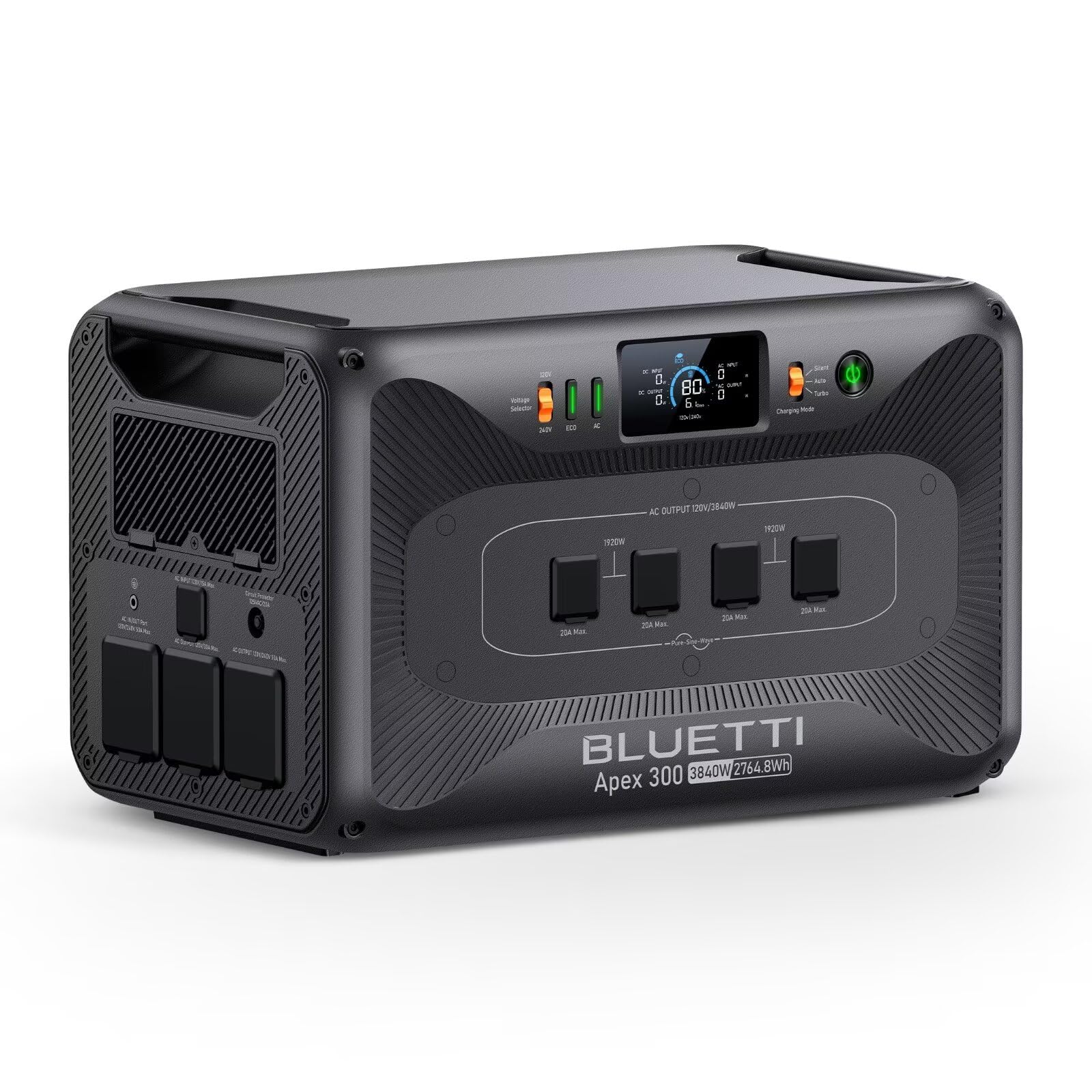
The BLUETTI Apex 300 is designed for users who need both 120V and 240V output from a single portable system. The 2764.8Wh LiFePO4 battery feeds a 3840W continuous inverter with a 7680W surge, and the system supports switchable dual-voltage operation via the app or onboard controls — bridging the gap between standard residential circuits and heavy-duty appliances like well pumps or large RV air conditioners.
The modular ecosystem allows expansion with B300K or B500K batteries, plus accessories like Hub D1 for RV 12V loads and Charger 2 for fast alternator charging while driving. The 0ms UPS (instantaneous switchover) is the fastest in this comparison, protecting even the most sensitive electronics. The BLUETOPUS AI-BMS manages 6000+ cycles with intelligent thermal regulation.
At 66.1 pounds, the Apex 300 is relatively light for a 2.8kWh unit with 240V capability. The app provides full control over voltage switching, charging schedules, and power monitoring. Users with 50-amp transfer switches reported seamless integration during outages. The main caveat is the 60V PV input limit, which may require careful solar panel string planning — 110Voc arrays fall into an unsupported voltage gap that requires alternative charging methods.
Why it’s great
- Dual 120V/240V output for both residential and heavy-duty loads
- 0ms UPS with instantaneous switchover for critical electronics
- Modular expansion with B300K/B500K batteries and RV accessories
Good to know
- 60V PV input limit creates voltage gap for some solar arrays
- No DC ports included; expansion modules sold separately
FAQ
Can a 2000 watt power station run a window air conditioner?
How long does a 2000Wh power station keep a refrigerator running?
What is the difference between LiFePO4 and standard lithium-ion for power stations?
Final Thoughts: The Verdict
For most users, the best 2000 watt power station winner is the BLUETTI Elite 200 V2 because it combines a 3900W Power Lifting output, 6000-cycle lifespan, and ultra-low 10W standby consumption into the most efficient package for daily use and emergency backup. If you need expandable capacity for whole-home backup, grab the BLUETTI AC200L with its 8192Wh expansion capability. And for the lightest 2kWh unit that travels easily between home and campsite, nothing beats the Jackery Explorer 2000 v2 at just 39.5 pounds.