
Our readers keep the lights on and the weekend projects moving. As an Amazon Associate, I earn from qualifying purchases.
Finding a board game that delivers real strategic depth without demanding a massive table or a long evening can feel like a search for a unicorn. You want something that clicks after one read of the rules, keeps every player engaged, and holds up to repeated play — all without breaking the bank. The challenge is separating the filler from the genuinely replayable hits.
I’m Rikta — the co-founder and writer behind FitlyFast. I spend my time analyzing game mechanics, studying player count dynamics, and cross-referencing rulebook complexity with actual table-time reports to find the titles that earn their shelf space.
My research for this guide involved combing through thousands of verified user play reports and mechanic breakdowns to deliver a final list of the best board games under $30 that respect your time, your group size, and your budget.
How To Choose The Best Board Games Under $30
In the sub-$30 bracket, the difference between a game that gets played weekly and one that gathers dust often comes down to four factors: player count flexibility, round time, rulebook weight, and component quality. A game that plays well at two players but drags at four might be perfect for a couple but a flop for a family of five. Similarly, a game with a 45-minute rule explanation might offer deep strategy but won’t hit the table often on casual weeknights. Focus on your group’s natural rhythm first.
Player Count and Scalability
The best budget games either lock into a dedicated player count with tight balance (like pure two-player duels) or scale smoothly from 2 to 6 or 8 without broken mechanics. Check the listed player range critically — a game that says 2-8 players but requires a 30-minute round per player is not truly scalable. Look for games where the play time stays roughly flat regardless of player count.
Play Time and Learning Curve
Twenty to thirty minutes is the sweet spot for most under-$30 games. Any longer and the lack of pricey components becomes more noticeable; any shorter and you risk the game feeling shallow. The rulebook should be digestible in under five minutes. A game with a short learn time but hidden strategic depth (like poker-like bluffing or risk-reward withdrawal mechanics) offers the best value-per-dollar ratio.
Replayability and Component Durability
Check for modular boards, variable setups, or randomized card decks — these are the engines of replayability. A fixed board with a single scenario will feel solved after a few plays. Also note card stock thickness and box construction. Budget-friendly games with high-quality card stock and indented trays for tiles will survive travel and clumsy hands far better than those with flimsy paper cards and loose bags.
Quick Comparison
On smaller screens, swipe sideways to see the full table.
| Model | Category | Best For | Key Spec | Amazon |
|---|---|---|---|---|
| Schotten Totten | 2-Player Duel | Poker-style strategy duels | 20-min playtime, 2 players | Amazon |
| Exploding Kittens | Party Card Game | High-stakes family fun | 15-min playtime, 2-5 players | Amazon |
| SKYJO | Family Card Game | Low-point scoring battles | 30-min playtime, 2-8 players | Amazon |
| My City | Legacy Board Game | Evolving campaign play | 24 episodes, 2-4 players | Amazon |
| Azul Mini | Tile-Placement | Travel-friendly mosaic strategy | 30-min playtime, 2-4 players | Amazon |
| Air, Land & Sea | 2-Player Tactical | Quick bluffing battles | 20-min playtime, 2 players | Amazon |
| Battle Sheep | Abstract Strategy | Modular board area control | 20-min playtime, 2-4 players | Amazon |
In‑Depth Reviews
1. IELLO: Schotten Totten

Schotten Totten distills deep two-player strategy into a compact 20-minute duel that feels like a hybrid of poker and territorial control. Each player builds three-card poker-style formations on one side of a central stone, and the higher-ranked formation wins that stone — first to five stones wins the game. The tension comes from the reveal: you never know if your opponent is holding a straight flush or bluffing with random cards.
The rulebook is a single page of illustrations, making it accessible for beginners while the hand-ranking system (pair, flush, straight, three-of-a-kind) rewards strategic discarding and reading the opponent. The artwork is quirky but clean, and the card stock is thick enough to survive repeated travel in a weekend bag. The compact box — roughly 4 x 1.5 x 6 inches — fits into any coat pocket.
For what it offers in strategic density per minute, Schotten Totten is a standout in the budget space. It rewards repeat plays because the meta shifts as you learn each other’s tendencies. The included tactic cards add an optional layer of take-that actions for players who want more chaos. It is a pure two-player experience — skip if your group is larger.
Why it’s great
- Extremely high strategic depth for a 20-minute game
- Premium card stock and compact travel-friendly box
- Easy to learn but hard to master
Good to know
- Strictly 2-player only — no solo or group variant
- Luck of the draw can occasionally override skill
2. Exploding Kittens Original Edition

Exploding Kittens is the highest-playtested card game in Kickstarter history, and that pedigree shows in its tight ruleset and immediate accessibility. Players draw cards from a deck hoping to avoid drawing the Exploding Kitten card — if you do, you are eliminated unless you have a Defuse card (laser pointer, catnip sandwich). Action cards like Skip, Attack, and Shuffle keep every turn tense and interactive.
The artwork from The Oatmeal is absurd and hilarious — Tacocat and Rainbow-Ralphing Cat are fan favorites — which lowers the barrier for casual players and kids. Rounds run about 15 minutes, so you can play multiple hands in one sitting. The deck contains 56 cards, and the variety of action cards ensures no two games feel identical despite the simple win condition.
Component quality is decent for the price point: cards are standard poker-size thickness and the box is sturdy enough for travel. The main downside is that player elimination can leave someone sitting out for the final moments of the round. The game works best with 3-5 players; with 2 players, the strategy becomes too predictable.
Why it’s great
- Ridiculously fast setup and cleanup — under 1 minute
- Hilarious art that appeals to kids and adults equally
- High replay value due to randomized deck and action variety
Good to know
- Player elimination can leave one player inactive for the final minute
- Best with 3-5 players; 2-player mode is weak
3. magilano SKYJO

SKYJO is a card game built on a brilliantly simple premise: collect as few points as possible over multiple rounds. Each player starts with 12 face-down cards arranged in a 4×3 grid. On your turn, you either take a card from the draw pile or the discard pile and swap it with one of your facedown cards, trying to close out high-value cards while pairing low-value ones. The round ends the moment one player has all their cards face-up.
What makes SKYJO special for its price is the scalability. It plays 2 to 8 players with zero downtime increase because everyone acts in sequence and the round ends quickly. The box includes 150 cards, a notepad for scorekeeping, and a manual in multiple languages. The cards are slightly thicker than standard playing cards, which helps them hold up in high-traffic family settings.
The game teaches basic addition under 100 and probability estimation, making it a stealth educational tool for kids. Negative-number cards add an exciting scoring twist — going negative is excellent. The only real knock is the box size (7.6 x 4 inches) is slightly larger than a standard deck, though still portable. For large families or parties, SKYJO is the most efficient buy on this list.
Why it’s great
- Scales seamlessly from 2 to 8 players without extra rules
- Thick, durable card stock made in Germany
- Educational value — teaches addition and probability naturally
Good to know
- Box is slightly larger than a standard card deck
- Scorekeeping notepad runs out after many sessions
4. Thames & Kosmos My City

My City is a legacy board game designed by the legendary Reiner Knizia (multiple Spiel des Jahres winner), and it delivers a full campaign of 24 episodes where each game permanently alters the board with stickers and unlockable envelopes. You start with a simple grid of empty terrain and gradually build a city from settlement through industrialization, with choices from earlier games affecting your available options in later games.
Each episode takes about 15-20 minutes, which is remarkably fast for a legacy game. The Tetris-like tile placement feels satisfying — colored shapes must fit within your personal board, and you earn bonus points for covering specific terrain icons. The catch-up mechanic (losing players receive helpful stickers) keeps the campaign competitive even if one player dominates early episodes.
The replayability is a dual-mode design: after completing the 24-episode campaign, you flip the board over for a perpetual non-legacy mode that works like a standard tile-placement game. Component quality is strong for the price — thick cardboard tiles and a sturdy box. The biggest caveat is that the legacy format demands commitment; if your group meets infrequently, you may forget the evolving rules between sessions.
Why it’s great
- Knizia design pedigree with tight 15-20 minute episodes
- Dual-mode board — legacy campaign plus permanent game
- Catch-up stickers prevent runaway leaders
Good to know
- Requires consistent group to track evolving rules
- Only 24 episodes — campaign has a natural end
5. Azul Mini Board Game

Azul Mini takes the acclaimed tile-placement game and shrinks it into a travel-friendly format without sacrificing gameplay. The core loop remains intact: players draft colorful resin tiles from factory displays and arrange them on their personal board in patterns that maximize points. The tension comes from denying tiles to opponents while optimizing your own mosaic — it is a classic interactive Euro-game mechanic.
The Mini edition fixes the one complaint about the original: the player boards now have indented notches that lock tiles into place, preventing them from sliding during table bumps or travel. The included plastic trays keep factory tiles organized, and the scoring track uses a sliding clip rather than loose markers. Setup and teardown take under two minutes, and the game plays smoothly on a small coffee table or tray table.
Component quality is excellent for the price — the resin tiles are colorful and slightly textured, and the boards are thick cardboard. The only weak point is the box itself, which uses a thin cereal-box-style cardboard that can be hard to close. The game lasts about 30 minutes with 2-4 players. For frequent travelers or couples who want a compact strategy game, Azul Mini is the best pick.
Why it’s great
- Indented boards keep tiles locked in place during travel
- Fast setup and teardown — great for coffee table play
- Deep strategy with simple 5-minute learn time
Good to know
- Box is flimsy cereal-box-style cardboard
- Two blue tile shades can be confusing at first
6. Arcane Wonders Air, Land & Sea

Air, Land & Sea is a tactical 2-player card game where each player commands forces across three theaters: Air, Land, and Sea. Each battle card can be played face-up to activate its special ability or face-down as a wild card with a base power value. This simple binary choice — play for effect or play for strength — creates a bluffing and counter-bluffing dynamic that is remarkably deep for a 6-card hand.
Winning a battle requires controlling two of the three theaters, forcing your opponent to withdraw, or having the highest total power when both players pass. The withdrawal mechanic is the star: you can voluntarily retreat from a losing battle to save your cards for the next round, but your opponent scores partial points. This risk-reward loop keeps every turn tense and prevents runaway victories.
The card stock is high quality with a textured matte finish, and the compact box (1.5 x 4.5 x 6.25 inches) fits in a jacket pocket. Rounds last about 20 minutes, making it ideal for lunch breaks or waiting rooms. The only notable downside is that the base set includes only 36 cards, so after 20-30 plays the strategic paths become familiar. Expansion packs address this, but they add to the total cost.
Why it’s great
- Brilliant withdrawal mechanic creates tense decision-making
- Easy to learn but offers deep emergent strategy
- Highly portable — fits in any pocket
Good to know
- Limited card pool — expansions improve variety
- Strictly 2-player only
7. Blue Orange Battle Sheep
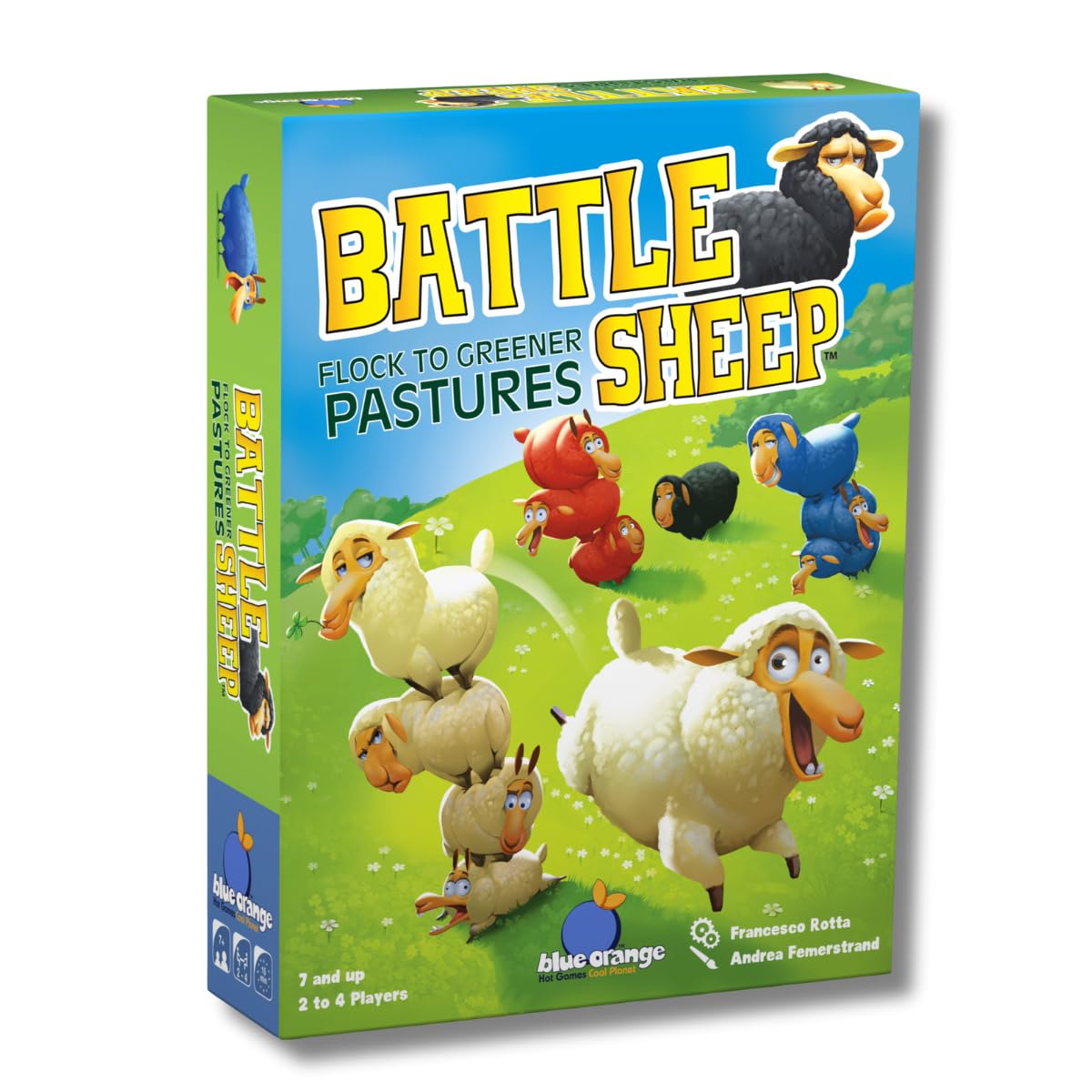
Battle Sheep is an area-control abstract strategy game where players claim hex-grid pasture tiles by moving stacks of sheep tokens. The board is modular — 16 identical four-hex tiles can be arranged in countless configurations, ensuring every game has a unique geography. Players take turns splitting a stack and moving the new stack as far as possible in a straight line, gradually filling the board until no moves remain.
The rules are simple enough for a 7-year-old to grasp: leave at least one sheep behind when moving, never cross occupied hexes, and the player controlling the most hexes at the end wins. But the strategy runs deep — early game positioning, blockades, and sacrificing territory for long-term advantage mirror the depth of Chess but with a lighter mood. The sheep tokens are heavy, high-quality urea plastic that feel substantial in hand.
Setup takes about 2 minutes because players collaboratively build the board. The game plays in roughly 10-20 minutes, and the modular board gives it exceptional replay value. The only mechanical issue is that tall stacks can topple in small hands, though the grippy board pieces reduce this. For parents who want to introduce abstract strategic thinking without a heavy rulebook, Battle Sheep is the top choice.
Why it’s great
- High-quality urea sheep tokens that are nearly indestructible
- Modular board ensures no two games play the same
- Easy to learn with surprising depth for abstract strategy fans
Good to know
- Tall stacks can topple with small or unsteady hands
- Box is standard-sized — not travel minimal
FAQ
What makes a board game replayable at this price point?
Is a legacy format worth it if my group meets infrequently?
How do I know if a 2-player game will work well for my partner and me?
Final Thoughts: The Verdict
For most users, the board games under $30 winner is the Schotten Totten because it packs the deepest strategy-to-dollar ratio on this list and the rules fit on a single page. If you want a scalable family experience that handles large groups, grab the SKYJO. And for a travel-friendly tile-placement classic, nothing beats the Azul Mini.