
Our readers keep the lights on and the weekend projects moving. As an Amazon Associate, I earn from qualifying purchases.
Dropped calls, endless buffering, and zero bars in the middle of a long haul aren’t just frustrating—they’re a safety risk. An auto cell phone booster is the only reliable way to take a weak outside signal and amplify it inside your vehicle, turning a dead zone into a connected workspace.
I’m Rikta — the co-founder and writer behind FitlyFast. I’ve spent hundreds of hours analyzing signal booster specifications, reading real-world user tests, and comparing antenna gain, frequency band support, and installation requirements to separate the hardware that actually works from the hype.
Whether you drive a semi, an RV, or a family SUV, finding the best auto cell phone booster means matching the device’s band compatibility, gain rating, and antenna design to your specific carrier and driving environment.
How To Choose The Best Auto Cell Phone Booster
A signal booster does not create a signal—it amplifies whatever weak signal is already present outside your vehicle. If you have zero bars at the antenna mount, no booster in the world will generate bars for you. Start by confirming you have at least one bar of usable outdoor signal where you park or drive.
Match the Frequency Bands to Your Carrier
Verizon relies heavily on Band 13 (700 MHz), while AT&T and T-Mobile use Band 12/17 (also 700 MHz) plus Band 2/4/5 (1900/1700/850 MHz). An auto booster that only covers Band 12/13 will work for basic voice and 4G on those carriers, but a multi-band unit covering bands 2, 4, 5, 12, 13, 17, 25, and 66 provides faster data and better 5G performance. Check your phone’s field test mode or an app like CellMapper to identify which bands your carrier uses in the areas you travel.
Gain (dB) vs. Real-World Output
Manufacturers advertise max gain values like 65 dB or 72 dB, but that number represents the booster’s internal amplifier capability—not what reaches your phone. Antenna quality, cable length (50 feet of RG174 loses 3–5 dB), and vehicle body materials all reduce effective gain. A booster with 72 dB max gain and a high-gain directional outdoor antenna will outperform a 65 dB unit with a cheap omni antenna, even though the numbers look close on paper.
Antenna Type: Omni-Directional vs. Directional
Omni-directional magnetic antennas (common on vehicle boosters) receive signals from all 360 degrees, so you don’t need to point them at a tower. They are ideal for moving vehicles but offer less gain. Directional Yagi or panel antennas focus on one tower direction and provide 3–6 dB more gain, making them better for stationary use like an RV parked at a campsite. If you drive, stick with an omni antenna; if you park for extended periods, consider a directional setup.
FCC Certification Is Non-Negotiable
Uncertified boosters can interfere with cell towers, cause oscillation that destroys your own signal, and are illegal to operate in the US. Every booster on this list is FCC approved, which means it includes automatic gain control (AGC) and oscillation detection to shut down before creating network interference. Never buy a booster that lacks an FCC ID—it will likely cause more problems than it solves.
Installation Complexity and Vehicle Compatibility
Vehicle boosters require physical separation between the outside antenna (mounted on the roof, hood, or tailgate) and the inside antenna (placed near the booster inside the cabin). Without at least 12–20 inches of vertical or horizontal separation, the system can oscillate and become useless. Magnetic mount antennas are easiest to install and remove, but on aluminum-bodied vehicles or fiberglass RVs, you may need a permanent bracket. Pre-wired cable lengths also matter—short 10-foot cables limit where you can place the booster, especially in a long semi cab.
Quick Comparison
On smaller screens, swipe sideways to see the full table.
| Model | Category | Best For | Key Spec | Amazon |
|---|---|---|---|---|
| weBoost Drive 4G-X OTR | Premium Truck | Long-haul semi-trucks, extreme range | 50 dB gain, 17” omni antenna | Amazon |
| Metarepeater MB1 LCD | Smart Vehicle | Real-time band monitoring, SUVs | 65 dB gain, LCD display | Amazon |
| GAGBK 6-Band RV Booster | Multi-Band | Full band coverage for all carriers | 65 dB gain, bands 2/4/5/12/13/17/25/66 | Amazon |
| GAGBK Car Booster (Band 12/13/17) | Universal Car | All carriers, straightforward install | 65 dB gain, 3-band coverage | Amazon |
| ZORIDA Ace 5S | High Gain Home/Vehicle | Stationary cabins or RVs with app support | 72 dB gain, 5-band coverage | Amazon |
| GAGBK Verizon Band 13 Home | Carrier-Specific | Verizon/Straight Talk at home or garage | 65 dB gain, single-band 13 | Amazon |
| F FREEQUEEN AT&T/T-Mobile Booster | Carrier-Specific | AT&T/T-Mobile homes or small offices | 65 dB gain, band 12/17 | Amazon |
In‑Depth Reviews
1. weBoost Drive 4G-X OTR (470210)

The weBoost Drive 4G-X OTR is the heavy-duty standard for professional truckers. Its 17-inch omnidirectional antenna uses a 3-way CB mirror mount with mast extension, providing significantly more gain than any magnetic stub antenna. Users consistently report jumping from 1 bar to 3 solid bars in weak zones and seeing data speeds improve from unusable (under 1 Mbps) to functional for streaming and VOIP calls.
This booster supports all major US carriers across bands 12/17, 13, 5, 4, and 25/2. The multi-user design means everyone in the cab gets stronger signal, not just the driver. The included DC/DC power supply converts 12V vehicle power efficiently, and the slim low-profile inside antenna mounts discreetly. Real-world tests show a 10x speed improvement in areas with around -115 dBm outside signal.
Installation requires thoughtful routing of the antenna cable and ensuring the inside antenna has clear line-of-sight separation from the outside unit—typically 20 feet of vertical distance through a metal roof is ideal. Some users note the thread-lock on connectors is aggressive (similar to superglue), so pre-assemble loosely before tightening permanently. The weBoost team offers strong US-based support, and the unit carries a solid warranty.
Why it’s great
- Massive 17” OTR antenna captures far more signal than magnetic stubs
- Proven 10x speed improvements in weak signal zones
- Multi-user support for everyone in the cab
- FCC approved with oscillation protection
Good to know
- Installation is more involved than magnetic-mount kits
- Connector thread-lock is very strong; careful assembly needed
- Premium price reflects the professional-grade hardware
2. Metarepeater MB1 Car Booster with LCD
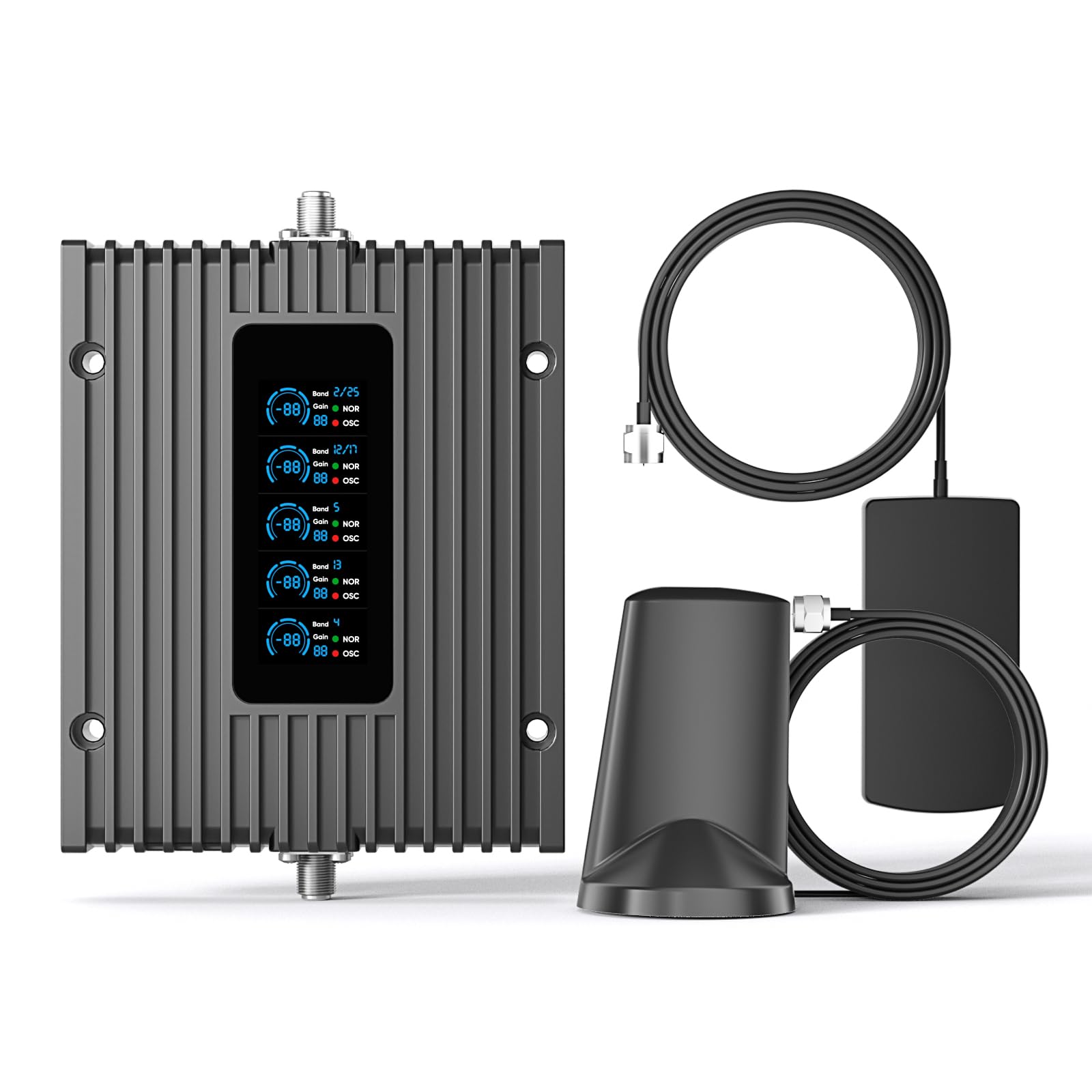
The Metarepeater MB1 stands out with its large color LCD display that shows real-time gain per frequency band, making it easy to confirm the booster is actually amplifying your carrier’s signal. For drivers who want to know exactly what their booster is doing rather than just trusting a green LED, this visibility is a game-changer. The 360° omni-directional magnetic antenna requires zero aiming at towers, which is ideal for moving vehicles.
This unit covers bands 12/17, 13, 5, 2/25, and 4, delivering 65 dB max gain. Users in Subarus and SUVs report adding 1–2 bars in areas that previously had less than one bar of detectable signal. The smart automatic gain control (AGC) prevents oscillation by adjusting the amplifier in real time. The compact booster body fits in a glovebox or center console cubby, though the included power adapter and cables are on the shorter side, which can limit placement options in larger vehicles.
One noted limitation: the outdoor antenna is low-profile for easy car-wash clearance, but this design sacrifices some peak gain compared to taller antennas. A user who went from -140 dBm to -126 dBm was able to make calls where they previously couldn’t, which is the real test. For the price, the MB1 offers the best balance of transparency (the LCD) and performance for daily commuters and weekend road trippers.
Why it’s great
- Real-time LCD display shows gain per band, not just a vague LED
- Magnetic 360° omni antenna requires no aiming
- Smart AGC eliminates self-oscillation automatically
- Compact booster body fits in small compartments
Good to know
- Power and antenna cables are short, limiting placement
- Low-profile antenna trades some gain for convenience
- Some users report no improvement in extremely weak zones
3. GAGBK 6-Band RV Cell Booster
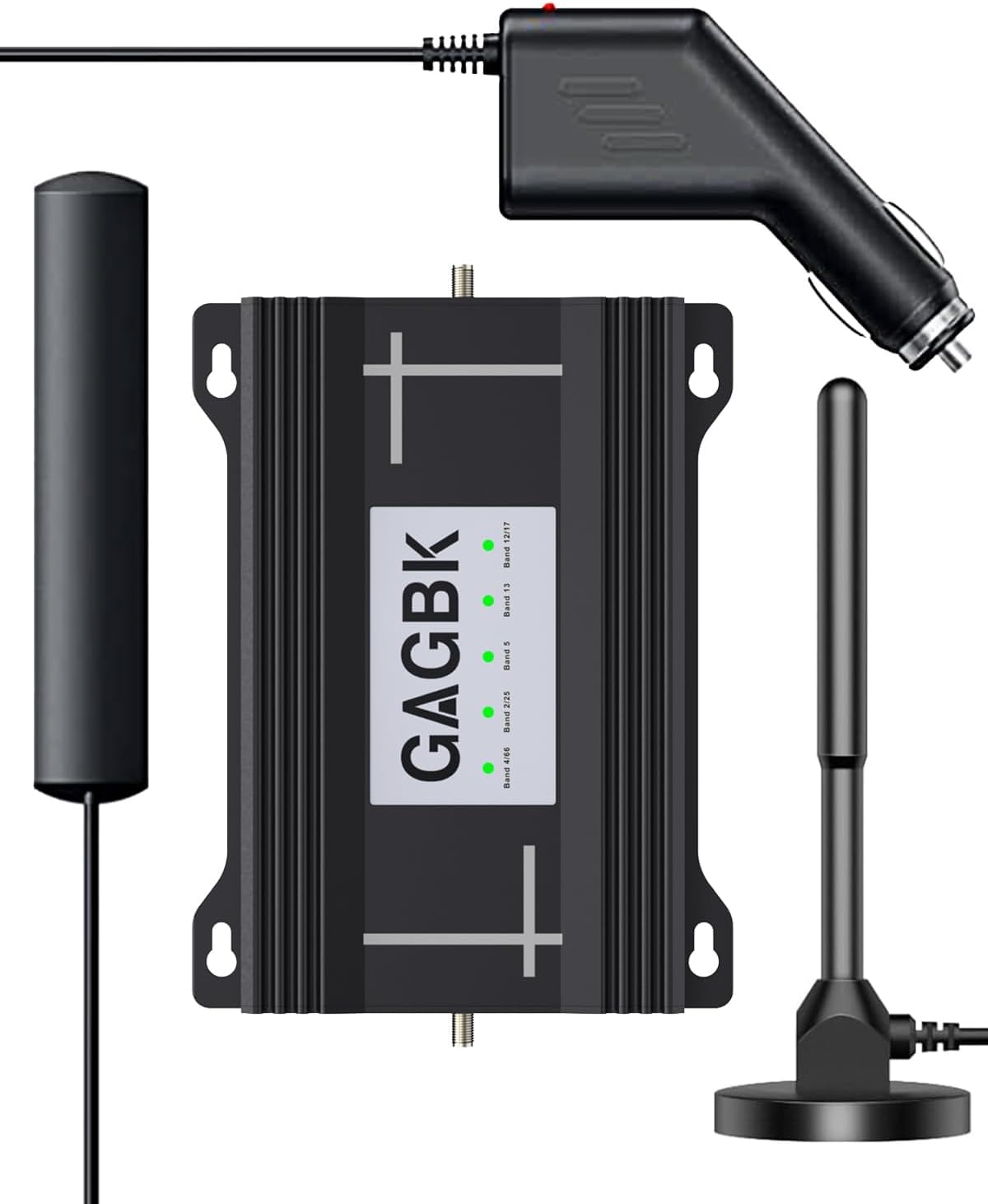
The GAGBK 6-Band booster delivers the widest frequency coverage at its price point, supporting bands 2, 4, 5, 12, 13, 17, 25, and 66. This means it works with 5G NR bands (n2, n5, n7, n12, n25, n41, n66, n71) as long as your carrier uses those frequencies for 5G. For RV owners or truckers who switch between carriers while roaming, this broad compatibility ensures you’re covered regardless of which tower you connect to.
The 65 dB gain amplifier comes with a magnetic outdoor whip antenna (16-foot cable) and an indoor patch antenna (10-foot cable). The system supports multiple devices simultaneously, so passengers can stream, hotspot, and browse without fighting for bandwidth. Users report that once installed correctly, the booster can pull a usable signal from 5–8 miles away from a tower, making it effective in remote camping spots and along rural highways.
Installation is straightforward: mount the magnetic antenna on the roof or hood, place the indoor antenna at least 20 inches away from the outdoor antenna (vertical separation through metal is best), and plug into the 12V adapter. Some users note that the cables are pre-terminated and cannot be extended without adapters, so plan your route carefully. The 3-year warranty and 30-day money-back guarantee add peace of mind for a mid-range investment.
Why it’s great
- Broadest band coverage in its class (8+ bands including 5G NR)
- Effective 5–8 mile range to nearest tower
- Supports multiple devices simultaneously
- Includes both magnetic whip and indoor patch antenna
Good to know
- Pre-terminated cables cannot be extended without adapters
- Magnetic base may not stick to aluminum or fiberglass roofs
- Some buyers received units with different revision hardware
4. GAGBK Car Cell Booster (Band 12/13/17)

This GAGBK car booster targets the three most common 700 MHz bands (12, 13, and 17) used by Verizon, AT&T, T-Mobile, and their MVNOs like Straight Talk and Cricket. It is the most direct option if you only need 4G LTE voice and data on those frequencies and don’t need extended band 2/4/5/66 coverage. For many drivers—especially those in rural areas where 700 MHz signals travel farther—this three-band focus is sufficient.
The kit includes a magnetic whip outside antenna with a 16-foot cable, an inside patch antenna with a 10-foot cable, and a 12V 2A power adapter. The booster body is compact and lightweight (aluminum alloy for heat dissipation). AGC and sleep mode are built in. Installation takes about 10–20 minutes with no drilling required. Users report going from 1 bar to 4 bars on AT&T in rural country settings, enabling clear calls and usable data where it previously dropped.
The main limitation is band scope: this unit does not cover band 2 (1900 MHz), band 4 (1700/2100 MHz), or band 5 (850 MHz), which some carriers use for additional capacity and 5G. If you travel through areas where your carrier shifts to those bands, the booster may not help. Also, a few users report the unit stopped functioning after a few months, though the 3-year warranty covers replacements.
Why it’s great
- Affordable entry point for 700 MHz band coverage
- Simple magnetic install with no drilling required
- Compact aluminum body with good heat dissipation
- 3-year warranty and 30-day money-back guarantee
Good to know
- Only covers bands 12/13/17; no high-band support
- Some users experienced unit failure within 3 months
- Cable length limits placement options
5. ZORIDA Ace 5S Cellular Booster

The ZORIDA Ace 5S pushes max gain to 72 dB—the highest on this list—and covers five bands (12/17, 13, 5, 4, and 2/25). While intended for home and small office use up to 2,000 sq ft, its 5-band compatibility and high gain make it a strong candidate for stationary RVs, cabins, or metal buildings where you can mount the directional outdoor antenna permanently. The included app provides 1-on-1 installation guidance.
Real-world reports from RV users show dramatic improvements: from 1–2 bars to 5 solid bars, with HD video streaming that was previously impossible. Key to success is correct antenna placement—users emphasize 20+ feet of vertical separation and 30+ feet of horizontal separation between the outdoor directional antenna and the indoor whip antenna. The directional antenna focuses on the nearest tower, which provides more gain than an omni but requires aiming.
The Ace 5S works with all US carriers and supports 5G on compatible bands. The setup is more involved than a simple magnetic car booster—you need to route the 49-foot cable, ground the antenna, and possibly use a lightning arrestor—but the performance ceiling is higher. Customer service (US-based, via app) is consistently praised as excellent, with follow-up support extending well beyond initial setup.
Why it’s great
- Highest max gain (72 dB) of any unit reviewed
- Five-band coverage supports all major carriers
- App-assisted setup with US-based tech support
- Proven 5-bar improvement for stationary installations
Good to know
- Requires careful antenna aiming and separation
- Best suited for stationary RVs or cabins, not moving vehicles
- Cable length management and grounding add install time
6. GAGBK Verizon Booster (Band 13)

This GAGBK booster is laser-focused on Verizon and its MVNO Straight Talk, operating exclusively on Band 13 (746–757 MHz downlink, 776–787 MHz uplink). If you are a Verizon subscriber and your phone shows 1–2 bars outside your home, this single-band amplifier can push coverage up to 5,000 sq ft. For a home or garage where Verizon is the only carrier you rely on, there is no reason to pay for broader band support you won’t use.
The kit includes a high-gain directional outdoor antenna, an indoor whip antenna, 50 feet of N-SMA coaxial cable, and a 12V 2A power supply. The 65 dB amplifier uses automatic gain control and LED indicators to show status. Users report that after installation, phones that previously required stepping outside to make calls now work reliably throughout the house. The system supports multiple devices simultaneously for voice and data.
The main downside is obvious: if you switch carriers or have guests with AT&T or T-Mobile phones, this booster will not help them—those carriers use different frequency bands. Also, some users found that the indoor whip antenna must be physically close to the phone for maximum effect, rather than passively covering the whole house. Installation requires mounting the outdoor directional antenna and routing the 50-foot cable, which takes an hour for most homeowners.
Why it’s great
- Optimized specifically for Verizon Band 13 performance
- Covers up to 5,000 sq ft with proper install
- Includes 50 ft of cable for flexible outdoor antenna placement
- 3-year warranty and FCC approved
Good to know
- Only works with Verizon/Straight Talk on Band 13
- Indoor whip antenna works best when in close proximity to the phone
- Directional antenna requires aiming at the nearest tower
7. F FREEQUEEN AT&T/T-Mobile Booster (Band 12/17)
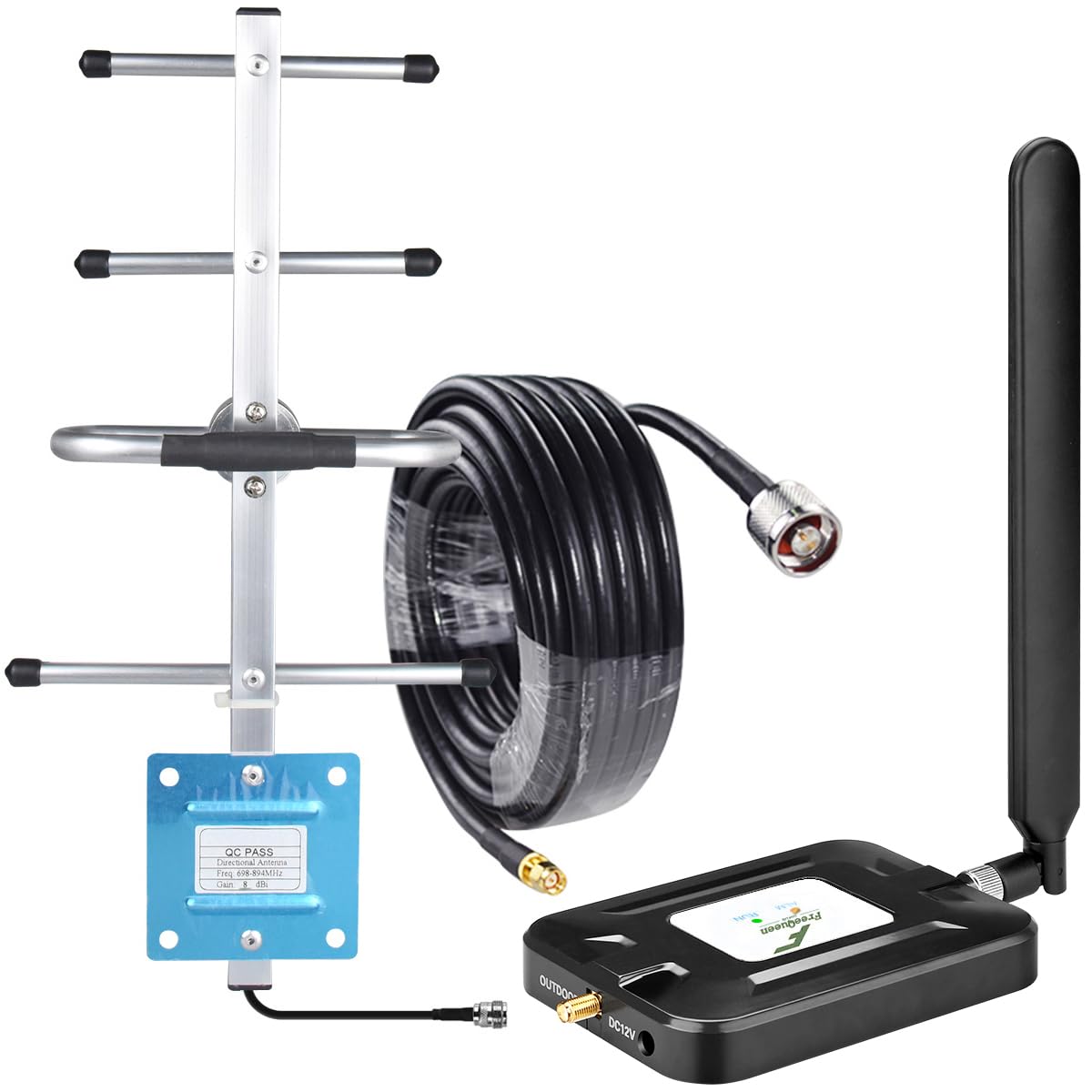
The F FREEQUEEN booster targets AT&T, T-Mobile, US Cellular, Cricket, and Straight Talk on Band 12/17 (728–746 MHz downlink, 698–716 MHz uplink). With a 65 dB gain amplifier and a high-gain outdoor directional Yagi antenna, this kit is designed to pull in weak signals from a distant tower and amplify them for a home or small office up to 4,500 sq ft. The Yagi antenna provides more focused gain than a panel antenna, ideal for rural homes with a known tower location.
The package includes a 50-foot N-SMA coaxial cable (extendable to 100 feet), an indoor whip antenna, mounting hardware, and a 12V 2A power supply. The booster uses automatic gain control and includes a sleep or inactivity mode. Installation is straightforward: mount the Yagi on a pole or roof eave, point it at the nearest tower, route the cable to the indoor booster, and plug in the indoor whip antenna.
One quirk: some users received the unit with hardware that did not match the listing photos, suggesting possible revision inconsistency. Also, a few customers noted that the indoor whip antenna needs to be placed on the phone itself to achieve maximum strength, which reduces the convenience of whole-room coverage. For the entry-level price, it works well for small homes where one or two people need reliable AT&T or T-Mobile calls, but it is not a set-it-and-forget-it solution for large spaces.
Why it’s great
- Entry-level price for AT&T/T-Mobile Band 12/17 coverage
- Yagi directional antenna provides focused long-range gain
- Covers up to 4,500 sq ft with AGC and sleep mode
- Cable can be extended to 100 ft for flexible mounting
Good to know
- Indoor antenna works best when placed directly beside the phone
- Hardware revisions may not match product images exactly
- Only covers AT&T/T-Mobile bands; no Verizon Band 13 support
FAQ
Can I use a home booster in my car?
Why does my booster show full bars but data is still slow?
Do I need to register my booster with my carrier?
Will a booster work in a metal building or a car with a metal roof?
Final Thoughts: The Verdict
For most users, the best auto cell phone booster winner is the GAGBK 6-Band RV Booster because it offers the widest frequency band coverage at a mid-range price, supporting both 4G LTE and 5G-ready bands for all US carriers. If you want real-time performance monitoring and a smarter install experience, grab the Metarepeater MB1 with LCD. And for professional truckers who need maximum range from a true high-gain antenna, nothing beats the weBoost Drive 4G-X OTR.