
Our readers keep the lights on and the weekend projects moving. As an Amazon Associate, I earn from qualifying purchases.
Color laser printing has shifted from a luxury for large corporations to a practical necessity for home offices and small teams that demand professional-grade documents, crisp graphics, and dependable output without the constant anxiety of dried-up inkjets or smudged pages. The fundamental advantage of toner-based technology—fusing powdered particles onto paper with heat—eliminates the slow, clog-prone maintenance that plagues inkjet workflows, making it the clear choice for anyone printing reports, presentations, marketing materials, or client communications in volume.
I’m Rikta — the co-founder and writer behind FitlyFast. My approach to this guide involved cross-referencing dozens of verified owner experiences, dissecting manufacturer spec sheets, and mapping real-world performance metrics like first-page-out time, duplex reliability, and total cost per page across the current landscape of multifunction color lasers.
Whether you need to print, scan, copy, and fax from a single machine, the decision comes down to speed, paper handling, connectivity, and long-term toner economics — and we’ve done the heavy lifting to identify the most reliable contender for your specific setup. This review will help you find the absolute best aio color laser printer for your specific workload and budget.
How To Choose The Best AIO Color Laser Printer
An all-in-one color laser printer is a multi-year investment for your office, so matching its capabilities to your actual workload prevents costly over-spec or frustrating under-performance. Focus on the five factors that determine whether a machine feels like a productivity asset or a daily headache.
Print Speed and First-Page-Out Time
Speed is measured in pages per minute (ppm) for both black-and-white and color output — and the gap between them matters. Many budget-friendly models print color at the same 19-24 ppm as mono, while premium units push 35-42 ppm across the board. Equally important is first-page-out time (FPOT): a printer that takes 15 seconds to warm up kills the perception of speed for single-page jobs. If you print mostly one- or two-page documents, a fast FPOT matters more than raw ppm.
Duplex and Document Feeder Capabilities
Automatic duplex printing (double-sided) should be standard on any AIO you consider — it halves paper usage and makes professional-looking booklets and reports easy. For scanning and copying, the type of automatic document feeder (ADF) is the real differentiator. A single-pass duplex ADF scans both sides of a page in one pass, roughly doubling your scan speed for two-sided originals compared to a simplex ADF that flips the page mechanically. Look for at least a 50-sheet ADF capacity to handle multi-page contracts or client files without constant reloading.
Toner Yield and Total Cost Per Page
The upfront price is only half the equation. Every laser printer ships with “starter” toner cartridges that yield significantly fewer pages than standard or high-capacity replacements — sometimes as few as 500-700 pages per color. Before buying, check the yield of standard (STD) and high-yield (XL or XXL) cartridge options for black, cyan, magenta, and yellow. A printer with affordable XL cartridges that last 3,000-5,000 pages can be cheaper to run over two years than a cheaper machine with expensive, short-lived toner. Also verify whether the printer blocks third-party toner through firmware — a common practice that locks you into the manufacturer’s pricing.
Connectivity and Mobile Workflow
Modern color laser printers should offer dual-band Wi-Fi (2.4 GHz and 5 GHz) for reliable connection, plus Ethernet for wired office networks. Wireless direct (Wi-Fi Direct) allows printing without a router — useful for guest devices or temporary setups. Mobile printing support via Apple AirPrint, Mopria, and the manufacturer’s own app (Brother iPrint&Scan, Canon PRINT Business, HP Smart) is now essential. If your team uses cloud services like Google Drive or Dropbox, look for models that let you scan directly to those destinations without a PC intermediary.
Physical Footprint and Paper Handling
Color laser AIOs are heavy — most weigh between 40 and 70 pounds — so make sure you have a sturdy, well-ventilated surface with clearance for the output tray and access to rear paper paths for jam clearance. Standard paper capacity (250 sheets) is adequate for light use, but a 500-sheet or expandable tray (some Canon models support up to 850 sheets) is better for shared offices. If you print on cardstock, envelopes, or labels, a dedicated multipurpose tray that feeds straight through (rather than curving) prevents jams on stiff media.
Quick Comparison
On smaller screens, swipe sideways to see the full table.
| Model | Category | Best For | Key Spec | Amazon |
|---|---|---|---|---|
| Brother MFC-L3720CDW | AIO | Best Overall | 19 ppm color / 3.5″ touchscreen | Amazon |
| Canon imageCLASS MF753Cdw | AIO | Speed & Scan | 35 ppm / single-pass duplex scan | Amazon |
| HP Color LaserJet Pro MFP 3301fdw | AIO | Team Office | 26 ppm / TerraJet toner | Amazon |
| Canon imageCLASS MF751Cdw | AIO | Value Speed | 35 ppm / 50-sheet simplex ADF | Amazon |
| HP Color LaserJet Pro MFP 4301fdw | AIO | High-Volume | 35 ppm / 7,500-page black XL toner | Amazon |
| Xerox C235dni | AIO | Compact Office | 24 ppm / smartphone setup | Amazon |
| Lexmark CX331adwe | AIO | Security Focus | 26 ppm / steel frame build | Amazon |
| Brother HL-L3220CDW | Print Only | Budget Print | 19 ppm / compact 15.7″ cube | Amazon |
| Xerox C410dn | Print Only | Raw Speed | 42 ppm / Ethernet only | Amazon |
In‑Depth Reviews
1. Brother MFC-L3720CDW

The MFC-L3720CDW strikes the most balanced equation of features, reliability, and ongoing cost in the mid-range AIO category. Its 19 ppm color speed matches the HL-L3220CDW print engine, but the added 50-sheet ADF, 3.5-inch color touchscreen with customizable shortcuts, and dual-band Wi-Fi make it a true hub for a small office or advanced home workspace. The automatic duplex printing is seamless, and the 250-sheet paper tray handles standard letter and legal sizes without issue.
Owner feedback consistently highlights the sharp, vibrant print quality for documents and graphics, along with reliable wireless connectivity across Windows, Mac, and mobile platforms. The scanner performs well for multi-page jobs, and the ability to scan directly to cloud services like Google Drive and Dropbox eliminates extra steps in document management. The companion app provides real-time toner monitoring and remote print management.
The primary drawback reported is Brother’s toner chip countdown — the machine stops printing when a cartridge’s page count is exhausted, even if usable toner remains. Some users also report paper curl from the fuser, and the ADF can occasionally double-feed. However, the TN229-series high-yield cartridges (up to 4,500 pages black) offer competitive cost per page, and Brother does not aggressively block third-party toner, giving you flexibility on supplies.
Why it’s great
- 3.5″ color touchscreen with 48 customizable shortcuts
- Dual-band Wi-Fi (2.4/5 GHz) and Wi-Fi Direct
- Strong cloud integration (Google Drive, Dropbox, OneNote)
Good to know
- Toner chip stops printing on page count, not actual toner level
- Paper curl from hot fuser can affect output stacking
- No single-pass duplex scanning (simplex ADF)
2. Canon imageCLASS MF753Cdw

The MF753Cdw is the fastest true all-in-one on this list, delivering 35 ppm in both color and black-and-white — nearly double the throughput of the mid-range Brother options. Its defining productivity feature is the single-pass duplex ADF that scans both sides of a page simultaneously, which cuts scan time for double-sided documents in half compared to traditional flip-over feeders. The 250-sheet cassette plus 50-sheet multipurpose tray provides solid baseline capacity, expandable to 850 sheets with an optional cassette.
Print quality is exceptional for a laser at this price point, with Canon’s 069-series toner producing crisp text and vivid color fills that rival light-production work. The 3-year limited warranty adds peace of mind for a shared office environment. Users consistently rate the one-pass scanning and quiet operation as standout qualities, and the Canon PRINT Business app enables straightforward mobile scanning to email or cloud folders.
Potential buyers should be aware that the starter toner cartridges (1,100-page CMY, 2,100-page black) run out quickly, and replacement high-capacity cartridges are expensive — over each for color, meaning a full set can cost more than many budget printers. The printer also blocks third-party toner via firmware. Some users received gray-market units without valid US warranties, so verify the seller’s stock before purchasing.
Why it’s great
- 35 ppm color/black speed with fast FPOT
- Single-pass duplex ADF for rapid two-sided scanning
- Expandable paper capacity to 850 sheets
Good to know
- Very expensive high-capacity toner replacements
- Firmware blocks third-party toner cartridges
- Gray-market units reported from some sellers
3. HP Color LaserJet Pro MFP 3301fdw
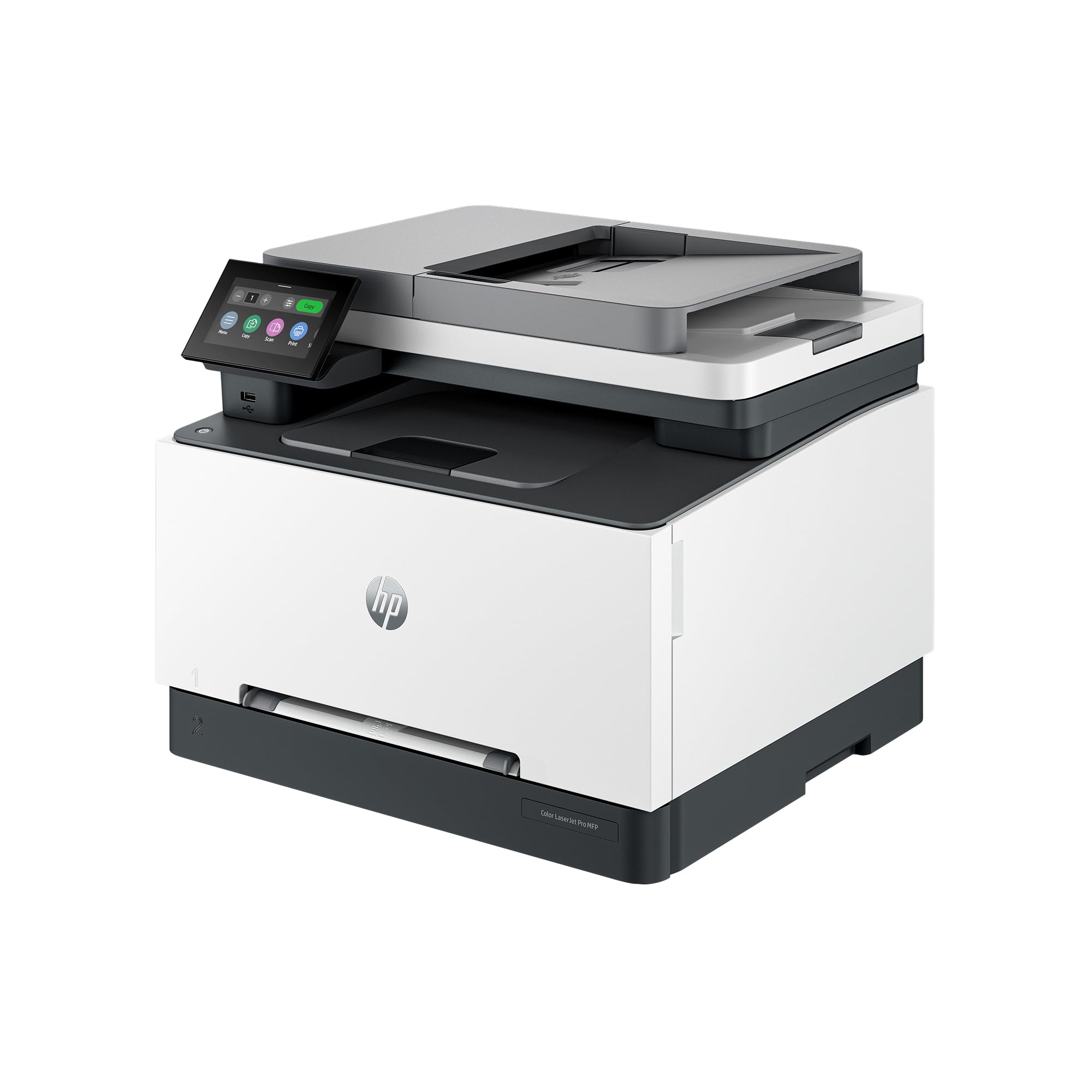
The MFP 3301fdw is HP’s answer to the small-team office that needs fast, reliable color output with minimal maintenance. Its 26 ppm speed for both color and mono is competitive in the mid-range, and the dual-band Wi-Fi with self-reset capability means the printer automatically resolves connection drops without user intervention — a genuinely useful feature for busy shared networks. The 250-sheet tray and auto-duplex are standard, and the single-pass duplex ADF adds scanning speed.
HP’s TerraJet toner technology delivers noticeably more vivid color saturation than previous HP generations, and the touchscreen interface is responsive and intuitive for walk-up copying and scanning. Setup is faster than older HP models, with strong integration with the HP Smart app for mobile printing and monitoring. The printer supports direct scanning to email and network folders, which reduces dependency on a connected PC.
The catch is HP’s aggressive cartridge lockout: the printer will reject non-HP cartridges and periodic firmware updates maintain this restriction, eliminating the option of cheaper third-party toner. Several users report defective introductory cartridges with streaks or missing colors, and HP support has been slow to replace them. The “introductory” cartridges yield roughly 1,200 pages black and 1,000 color, so factor in replacement costs from day one.
Why it’s great
- Dual-band Wi-Fi with self-reset for stable connectivity
- Vibrant color output with TerraJet toner technology
- Single-pass duplex ADF for efficient scanning
Good to know
- Strictly blocks third-party toner via firmware updates
- Introductory cartridges have lower-than-standard yields
- Firmware updates can sometimes introduce new restrictions
4. Canon imageCLASS MF751Cdw

The MF751Cdw delivers the same 35 ppm print speed and 069-series toner system as the higher-end MF753Cdw but cuts costs by removing the fax function and using a simplex (single-sided) ADF instead of a single-pass duplex feeder. This makes it the best speed-per-dollar option for offices that print fast but don’t frequently scan double-sided documents. The 250-sheet cassette and 50-sheet multipurpose tray are identical, and expandable paper capacity to 850 sheets is available via the optional PF-K1 cassette.
Print quality is excellent — sharp text and vibrant graphics on plain paper — and the automatic duplex printing works reliably without slowing down throughput. Users praise the easy Wi-Fi setup (once the initial network configuration is done), the lack of bloatware on the driver installation, and the responsive touchscreen. Canon allows third-party toner cartridges, giving you control over ongoing supply costs, which is a significant advantage over HP’s locked system.
The main trade-off is the simplex ADF: scanning a 20-page double-sided document requires flipping each page manually or scanning in two passes. The starter toner yield is standard for this class (1,100-page CMY), and high-capacity replacements remain expensive. Some users found the initial network setup non-intuitive, particularly SMTP email configuration, but once configured the printer runs reliably for long periods between interventions.
Why it’s great
- 35 ppm speed at a lower entry price than the MF753Cdw
- Allows third-party toner cartridges for cost control
- Expandable paper handling up to 850 sheets
Good to know
- Simplex ADF — no single-pass duplex scanning
- No fax function (may be irrelevant for many users)
- Initial network setup can be confusing
5. HP Color LaserJet Pro MFP 4301fdw
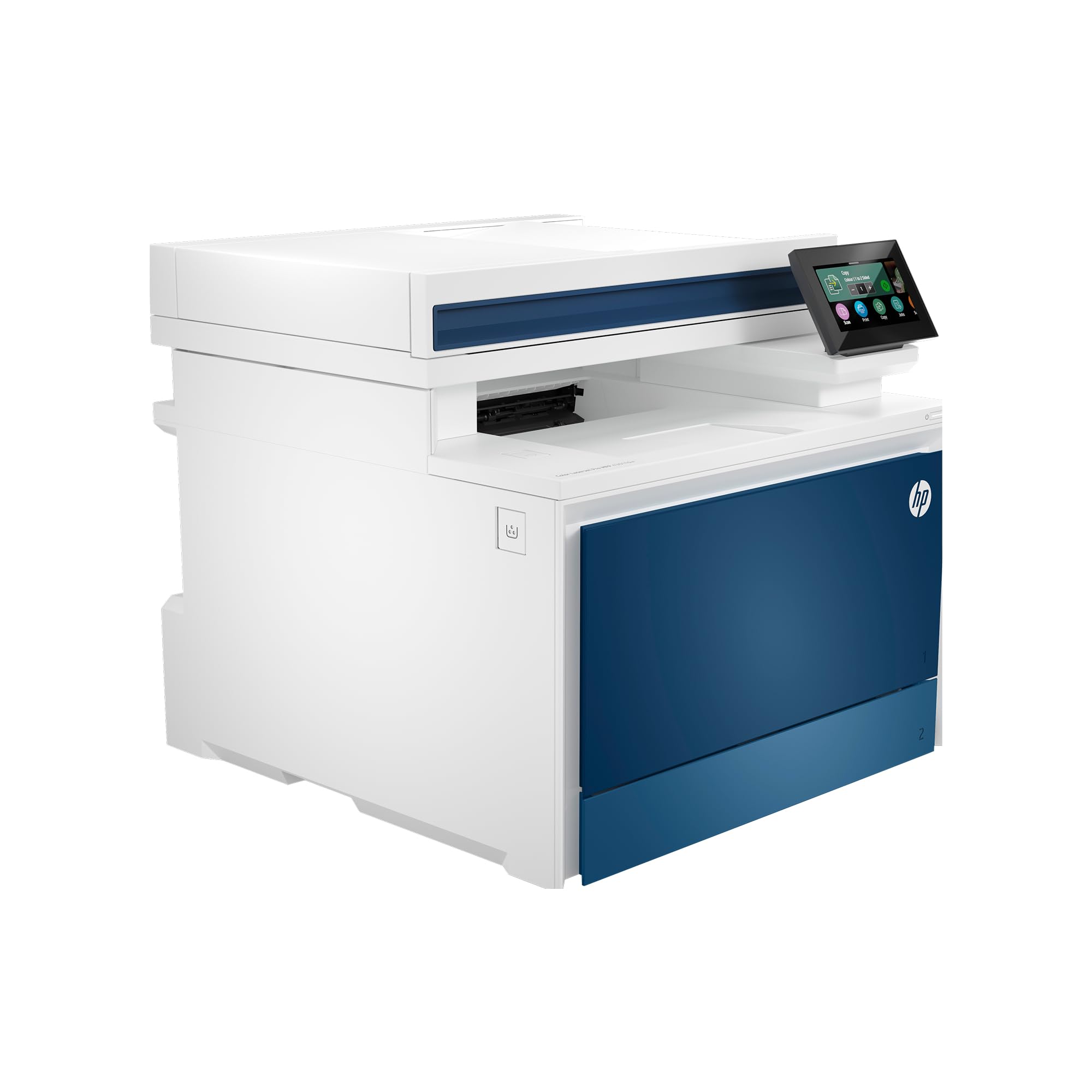
The MFP 4301fdw is built for teams of up to 10 people who print high volumes of color documents and need minimal downtime. At 33-35 ppm, it matches Canon’s speed tier, but HP differentiates through toner economics: the black XL cartridge yields 7,500 pages, and color XL cartridges yield 5,500 pages — significantly reducing the frequency of replacements compared to standard-yield cartridges. The 250-sheet tray can be supplemented with an optional second tray for a total of 550 sheets.
HP Wolf Pro Security provides customizable security settings for protecting sensitive documents, a rare feature in this class that matters for legal, financial, or healthcare environments. The intelligent Wi-Fi with self-reset maintains stable connections, and the printer supports Ethernet, Bluetooth, and direct USB connectivity for flexible deployment. Print quality is professional-grade with accurate color reproduction suitable for client-facing materials.
The downsides are typical of HP’s ecosystem: the printer blocks third-party toner, and the introductory cartridges (1,200-page black, 1,000-page CMY) require early replacement. Several long-term owners report the printer becoming unreliable after 12-18 months, with false paper jam errors and Wi-Fi disconnects. Replacement toner costs are substantial — a full set of XL cartridges approaches the price of the printer itself — so calculate your monthly page volume carefully before committing.
Why it’s great
- High-yield XL toner reduces replacement frequency
- HP Wolf Pro Security for document protection
- Fast 33-35 ppm with self-reset Wi-Fi
Good to know
- Strictly blocks third-party toner cartridges
- Some units develop paper jam and Wi-Fi issues after a year
- XL toner replacements are expensive
6. Xerox C235dni
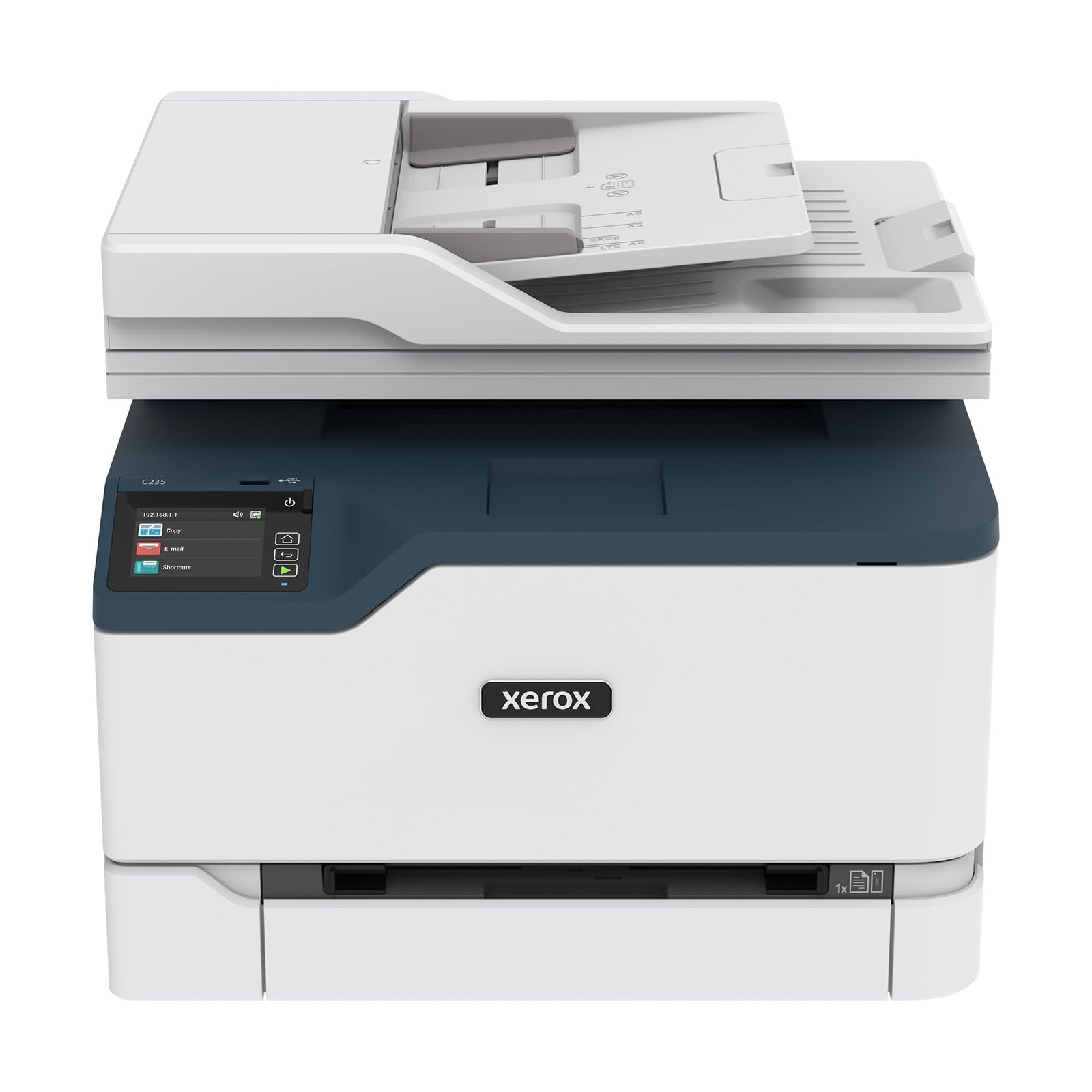
The Xerox C235dni is a space-efficient all-in-one designed for home offices and small teams that need print, scan, copy, and fax in a compact footprint. Its 24 ppm color speed is adequate for low-to-moderate volume users (up to 1,500 pages per month), and the Xerox Easy Assist App simplifies the initial smartphone-based setup — a real convenience for users who want to avoid traditional CD-ROM driver installations. The automatic duplex printing is standard, and the 250-sheet paper tray handles the basics.
Print quality is generally strong, with sharp text and decent color reproduction for business documents when using quality paper. Hammermill Premium Inkjet/Laserjet paper noticeably improves output density compared to generic copy paper. The front-panel controls are more reliable than the companion app for adjusting scan settings, and the scanner/copier produces good results once properly configured. Xerox brand reliability gives confidence for consistent everyday use.
The most significant limitation is the starter toner yield — only 500 pages per color — which forces early cartridge purchases and makes the true cost-per-page higher than it appears. Several users report the scanner producing very light copies straight out of the box, and the SmartStart software has trouble discovering the printer on Windows 11 networks. The fax function requires manual DNS configuration for Gmail-based email-to-fax, adding complexity.
Why it’s great
- Compact design saves desk space
- Smartphone-based setup via Easy Assist App
- Automatic duplex for paper savings
Good to know
- Starter toner yields only 500 pages per color
- Scanner can produce light output on some units
- Software driver discovery can fail on Windows 11
7. Lexmark CX331adwe

The CX331adwe is the only printer on this list built with a steel-frame chassis, giving it a distinctly industrial feel and durability that suggests a longer service life than plastic-heavy competitors. Its 26 ppm speed for both color and mono is competitive in the mid-range, but the real differentiator is the built-in security suite that protects data on the device, over the network, and at all touchpoints — a priority for businesses handling sensitive client information. The standard Wi-Fi, Ethernet, and USB connectivity support flexible network placement.
Print and copy quality is excellent for text and business graphics, and the auto-duplex function works reliably. The all-in-one functionality (print, copy, scan, optional fax) covers every basic office need, and the Lexmark Mobile Print app provides decent mobile integration. The compact footprint (15.5 x 16.2 x 13.6 inches) is manageable for a desk or small table.
Owner experience is mixed on reliability: while some units run flawlessly for years, several buyers report the printer failing completely (powering off and never restarting) after 10-12 months. The “scan to computer” utility is somewhat clunky and not particularly intuitive. A notable complaint involves a “waste toner full” message on brand-new units — the waste toner box should not be full from the factory, suggesting quality control gaps. Toner costs are also on the higher side for this class.
Why it’s great
- Steel-frame construction for durability
- Comprehensive built-in security features
- Compact footprint for an AIO
Good to know
- Some units fail completely within a year
- “Scan to computer” setup is non-intuitive
- Waste toner full error reported on new units
8. Brother HL-L3220CDW

The HL-L3220CDW is Brother’s entry-level color laser printer that strips away the scanner and fax to deliver reliable, fast color printing at an accessible price point. At 19 ppm for both color and mono, it is not the fastest option, but the automatic duplex printing, 250-sheet paper tray, and manual feed slot for envelopes and cardstock provide solid versatility for a personal or small home office. Its compact dimensions (roughly a 15.7-inch cube) make it one of the most space-efficient color lasers available.
Print quality is genuinely impressive for the budget tier — text is razor-sharp and color graphics show good saturation and detail, with most users reporting excellent results for business documents and even photo-quality prints on glossy paper (though laser photo output is inherently different from inkjet). The Wi-Fi setup works well for most users, and the printer supports direct USB printing for those avoiding wireless networks. Brother’s TN229-series toner offers competitive yields, including XXL cartridges that reduce replacement frequency.
The main limitations are the absence of scanning, copying, and faxing — this is strictly a print-only device, so it will not replace a dedicated AIO. Some Mac users report significant difficulty with driver installation and network configuration, including SSL certificate errors that require manual workarounds. The LED display is basic and its prompts can be confusing during initial setup. Heavy users may also find the 250-sheet capacity too small for frequent reloads.
Why it’s great
- Excellent print quality for the price tier
- Compact 15.7″ cube saves desk space
- High-yield XXL toner options available
Good to know
- Print-only — no scanner, copier, or fax
- Mac driver setup can require manual certificate fixes
- Basic LED display with sometimes confusing prompts
9. Xerox C410dn
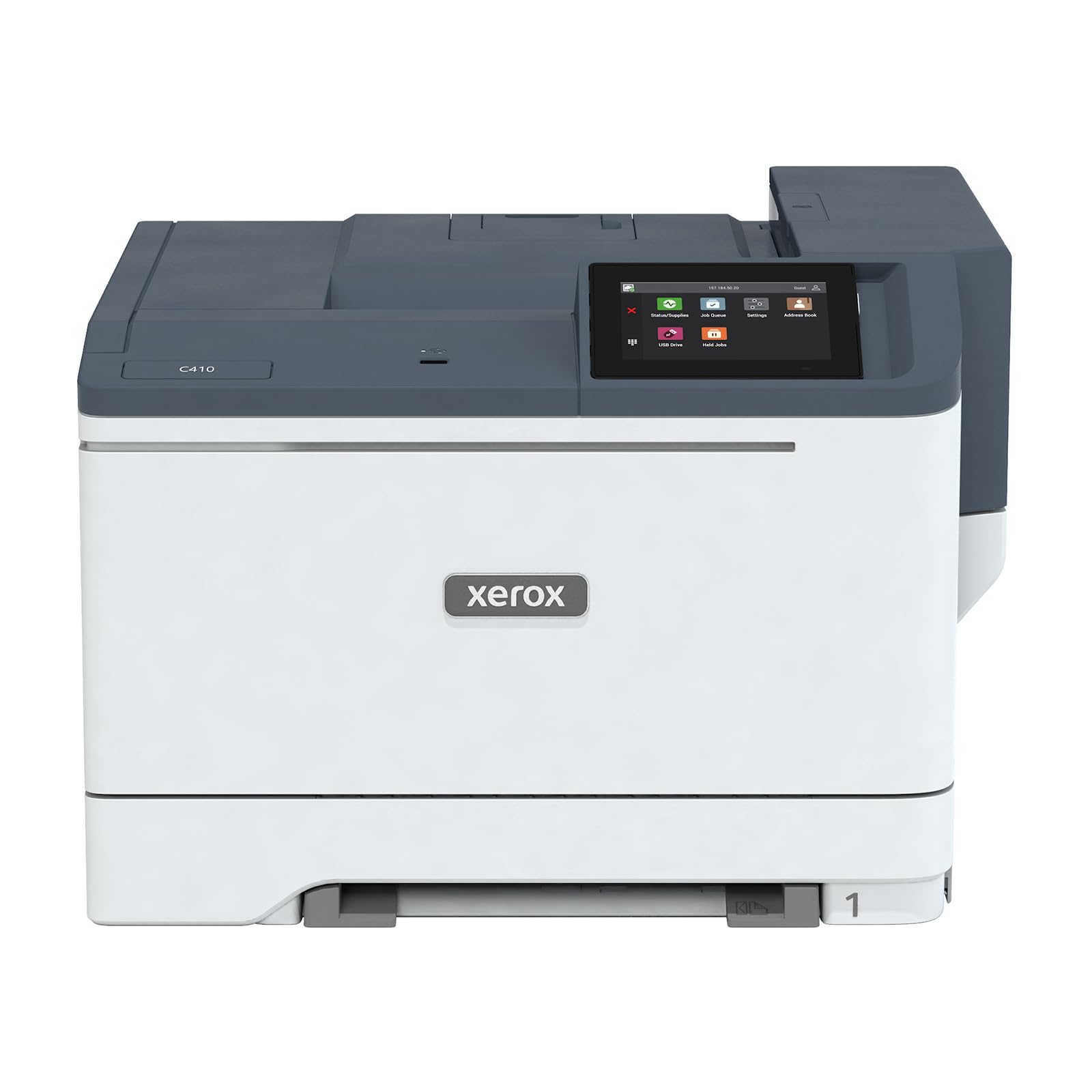
The Xerox C410dn is a pure print-speed machine, delivering 42 ppm in both color and black-and-white — the fastest raw throughput on this list and competitive with printers costing significantly more. It is designed for high-volume environments printing up to 4,500 pages per month, with a sturdy build and a responsive 4.3-inch touchscreen that makes job management straightforward. The automatic duplex printing is standard, and the included starter toner yields 2,400 pages black and 2,000 color — more generous than most competitors’ introductory cartridges.
Print quality is consistently described as vibrant and crisp, with excellent color saturation for marketing materials and client presentations. The Ethernet-only connectivity (Wi-Fi is not built in, requiring a separately purchased adapter) means this printer is best suited for wired office networks where a direct cable connection ensures stability and speed. The printer does not block third-party toner, which is a meaningful cost advantage for high-volume users who need to manage supply budgets.
The lack of built-in Wi-Fi is a glaring omission at this price point — the optional Wi-Fi adapter is difficult to find and expensive when available. Several users received units with visible wear or print quality defects (lines, failed self-test), suggesting quality control inconsistencies. The physical footprint is large, and some units produce a squealing noise during operation. This is a print-only device, so it cannot scan, copy, or fax — it is purely a high-speed output engine.
Why it’s great
- Fastest print speed on this list at 42 ppm
- Does not block third-party toner cartridges
- Generous starter toner yields included
Good to know
- No built-in Wi-Fi; adapter sold separately and hard to find
- Print-only — no scanning, copying, or fax
- Some units arrive with wear or print defects
FAQ
What does the starter toner yield typically cover?
Can I use third-party toner cartridges in these printers?
What does single-pass duplex scanning mean for my workflow?
How do I calculate the true cost per page for a color laser printer?
How much space do I need for an AIO color laser printer?
Final Thoughts: The Verdict
For most users, the best aio color laser printer winner is the Brother MFC-L3720CDW because it combines reliable print quality, a useful 3.5-inch color touchscreen, dual-band Wi-Fi, and strong cloud integration at a mid-range price with flexible toner options. If you need maximum speed and the fastest scanning workflow, grab the Canon imageCLASS MF753Cdw for its 35 ppm output and single-pass duplex ADF. And for raw, uncompromising throughput in a print-only setup, nothing beats the Xerox C410dn with its 42 ppm color speed and third-party toner support.