
Our readers keep the lights on and the weekend projects moving. As an Amazon Associate, I earn from qualifying purchases.
A combination belt and disc sander is the centerpiece of any serious woodworking or metalworking bench, but the wrong choice can stall on a tough piece of oak, walk across your workbench, or fill your shop with dust. The market is flooded with models that look identical on paper but differ massively in real-world power delivery, stability, and dust management. This guide breaks down exactly which specs translate to real cutting performance so you can make an informed decision.
I’m Rikta — the co-founder and writer behind FitlyFast. Through hundreds of hours of research into motor types, belt tracking mechanisms, table rigidity, and dust collection efficiency, this guide zeroes in on the models that deliver genuine value for your workshop.
Whether you are a hobbyist building furniture, a knife maker shaping bevels, or a metal fabricator polishing components, this detailed breakdown of the best belt and disc sander options will help you find the right tool for your specific needs.
How To Choose The Best Belt And Disc Sander
Selecting a combination sander is a balance of motor power, build weight, and practical features. A machine that is too light will vibrate across the bench, and one with an underpowered universal motor will stall when you apply pressure. Focus on three main areas: the motor and drive system, the base and table construction, and the belt and disc specifications.
Motor and Drive System
The motor is the heart of the sander. Look for a fully enclosed induction motor, which is quieter and more durable than a universal motor with brushes. Direct-drive models (where the motor shaft directly spins the disc) are more efficient and require less maintenance than belt-driven systems. A 3/4 HP (5 Amp) motor is the sweet spot for home hobbyists, while a full 1 HP motor (around 5 Amps with higher torque) is better for metalworkers who need sustained power without bogging down. The RPM rating for the disc is typically between 3200 and 3600 RPM, which provides the right surface speed for efficient material removal.
Build Quality and Stability
Weight is your friend in a benchtop sander. A cast iron base provides the mass needed to absorb vibration and keep the machine planted during heavy sanding. Cheaper models use stamped steel or thin aluminum, which can cause the machine to walk and produce a rough finish. Cast aluminum is a good middle ground—lighter than iron but still quite rigid. The work tables should be thick and flat, ideally cast iron or heavy cast aluminum. A miter gauge slot is essential for accurate angle work. Check that the belt tilt mechanism uses a positive locking lever rather than just a bolt, which can slip under load.
Belt and Disc Specifications
The standard belt size is 4 x 36 inches, which offers a good balance of reach and control. A quick-release tension lever is a must-have for swapping grits frequently. The belt should track easily via a simple knob. A disc diameter of 6 inches is the most common and sufficient for most woodworking tasks. An 8-inch disc provides a larger work surface and a slower effective surface speed at the center, which can be useful for metal polishing or finishing intricate parts. Ensure the disc is truly flat—some cheaper aluminum discs arrive warped. The dust collection port is critical; a 2 1/2-inch port matches standard shop vac hoses, while smaller ports can create frustrating airflow restrictions.
Quick Comparison
On smaller screens, swipe sideways to see the full table.
| Model | Category | Best For | Key Spec | Amazon |
|---|---|---|---|---|
| BUCKTOOL BD4801-M | Pro Metal | Heavy-duty metalworking | 1 HP Direct-Drive, 8in Disc | Amazon |
| Rikon 50-112 | Premium Wood | Vibration-free wood sanding | Cast Iron Base, 38.5 lbs | Amazon |
| VEVOR Professional 8in | Large Disc | Wood & soft metal sanding | 5A Motor, 8in Disc, 4×36 Belt | Amazon |
| SKIL BB9504-00 | Reliable Standard | Reliable all-purpose sanding | 4.5A Induction Motor, 2.5in Port | Amazon |
| BUCKTOOL BD4603 | Direct Drive | Efficient hobbyist use | 5A Direct-Drive, Cast Al Base | Amazon |
| Woodskil Upgraded Model | Lightweight | Lightweight/portable work | 39.6 lbs, 3/4 HP Motor | Amazon |
| WORKPRO W125074A | Heavy Base | Stability on a budget | Cast Iron Base, 40.8 lbs | Amazon |
| Woodskil 610452351737 | Budget Value | Entry-level DIY projects | 4.3A Motor, Steel Base | Amazon |
| VEVOR BSH1510C | Compact | Small space/value sanding | 400W Motor, 33.7 lbs | Amazon |
In‑Depth Reviews
1. BUCKTOOL BD4801-M

The BUCKTOOL BD4801-M is the most powerful combination sander in this lineup, featuring a true 1 HP direct-drive induction motor that delivers constant torque without bogging down. This makes it the go-to choice for metalworkers and knife makers who need to grind high-carbon steel or work with heavy material removal over extended periods. The 8-inch disc provides a larger sanding surface with a hook-and-loop backing for quick paper changes, and the belt runs on a cast aluminum base with rubber feet to minimize walking.
Build quality is impressive for its price tier, with a sturdy aluminum housing that feels substantial. The belt arm includes a small platen for detailed knife notching, and the switch box is conveniently placed on top for easy access. The belt tilts from 0 to 90 degrees, and the disc table adjusts from 0 to 45 degrees, giving you full flexibility. Users consistently report that the motor never stalls under heavy pressure, which is the defining characteristic of this machine.
The main drawbacks are its large footprint, which requires substantial bench space, and the plastic dust guard which one user noted can be a fire risk under heavy metal grinding. The instructions are also notoriously poor, requiring some assembly guesswork. For metalworking or any application demanding sustained power, this is the clear leader.
Why it’s great
- Powerful 1 HP direct-drive motor never stalls under heavy load.
- 8-inch disc with hook-and-loop backing for quick paper changes.
- Solid cast aluminum base and rubber feet for stability.
Good to know
- Large bench footprint requires dedicated space.
- Assembly instructions are minimal and frustrating.
- Plastic dust guard can melt under prolonged metal grinding.
2. Rikon 50-112
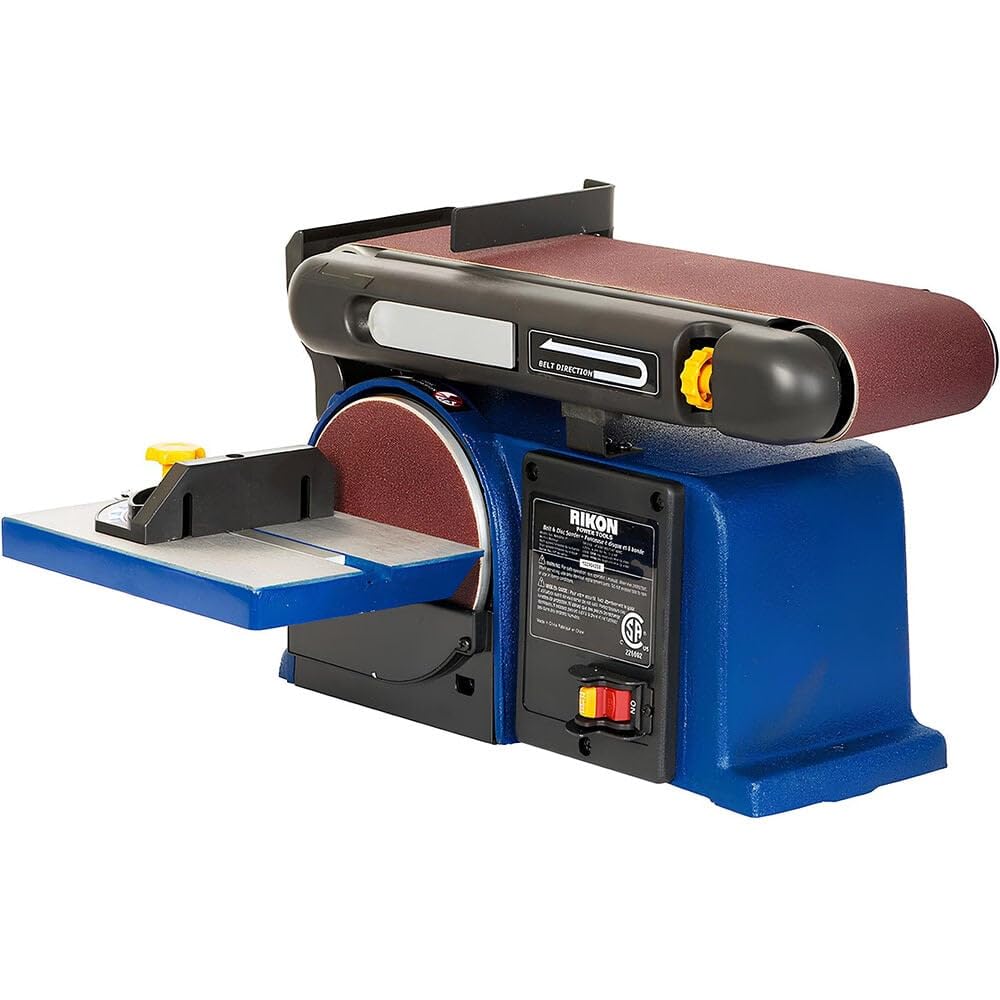
The Rikon 50-112 is a benchmark for build quality in the combination sander category. Its foundation is a heavy cast iron base weighing over 38 pounds, which absorbs vibration and keeps the machine planted during aggressive sanding. The induction motor, while rated at a moderate power spec, is paired with a direct-drive disc system that delivers smooth, consistent 3450 RPM operation. This translates to a refined sanding experience, especially when working with hardwoods where vibration can mar the finish.
Setup is fast, often under ten minutes, and the belt tracking mechanism is intuitive and stays true. The belt tilts from horizontal to vertical, which is a standard feature but executed here with a solid locking lever. The disc table includes a miter gauge slot for accurate angle work. Users praise the quiet operation, which is a significant step up from the buzzy universal motors on cheaper units. The 5-year warranty also adds considerable peace of mind.
The downsides are that the motor has been reported to fail after several years of heavy use, and the initial quality control can be inconsistent—one user received a unit that was dead on arrival. It also lacks the 8-inch disc of the VEVOR or BUCKTOOL models, limiting its surface area for larger workpieces. For the dedicated woodworker who values smooth operation and long-term durability, this is a top-tier choice.
Why it’s great
- Heavy cast iron base provides excellent vibration dampening.
- Very quiet operation compared to belt-drive alternatives.
- Fast setup and intuitive belt tracking adjustment.
Good to know
- Motor lifespan may be limited under heavy professional use.
- Only a 6-inch disc, no 8-inch option.
- Some quality control issues reported with dead-on-arrival units.
3. VEVOR Professional 8in (BD4083)

The VEVOR Professional 4×36 belt and 8-inch disc sander bridges the gap between the standard 6-inch models and the premium BUCKTOOL. It is powered by a 5 Amp fully enclosed induction motor that runs at 3450 RPM on the disc, providing smooth and quiet operation. The 8-inch disc is a standout feature at this price point, offering a larger work surface that is excellent for both woodworking and finishing soft metals like aluminum or copper. The belt speed is slower at 2160 RPM, which is actually beneficial for controlled material removal.
The build uses a cast aluminum worktable and a steel plate base with non-slip rubber pads, which provides decent stability for the price. The belt tilts 0-90 degrees, and the disc table tilts 0-45 degrees. Users report that the machine handles hardwood well with 80-120 grit belts and that the direct-drive design eliminates belt maintenance. One reviewer who is a master craftsman highly recommended it for home use, noting its smooth operation and compact footprint relative to its capability.
However, the 8-inch disc on some early units was reported to have a 2mm warp, requiring a replacement. The dust collection is mediocre, and the plastic disc guard is fragile and cracks easily if overtightened. Despite these issues, the combination of an 8-inch disc, 5 Amp induction motor, and a very competitive price makes this a compelling option for those who need the larger sanding surface.
Why it’s great
- 8-inch disc provides a larger work surface than standard 6-inch models.
- Quiet and smooth 5 Amp induction motor.
- Excellent value for the features offered.
Good to know
- 8-inch disc may arrive warped (replaceable under warranty).
- Fragile plastic disc guard and mediocre dust collection.
- Belt drive mechanism uses plastic components, not metal.
4. SKIL BB9504-00

The SKIL BB9504-00 is a well-rounded, no-nonsense combination sander that gets the fundamentals right. It uses a 4.5 Amp induction motor, which is powerful enough for most woodworking and light metal tasks without the excessive noise of a brushed motor. The standout feature here is the dust port, which accepts a standard 2 1/2-inch vacuum hose—a simple but often neglected detail that dramatically improves dust collection effectiveness compared to the smaller ports on many competitors.
The build quality is solid, with a stable base and a quick tension release lever for easy belt changes. The belt tilts from 0 to 90 degrees, and the disc worktable tilts from 0 to 45 degrees, both with secure locking mechanisms. A miter gauge is included for accurate crosscuts. User reviews consistently note that the motor maintains constant speed under load without bogging down, which is critical for a consistent finish. The assembly is straightforward, and the 3-year warranty provides good coverage.
The potential drawback is that this is a standard 6-inch disc and 4×36 belt configuration, so it lacks the larger 8-inch disc of the VEVOR or BUCKTOOL. It also weighs only about 25.5 pounds, which is lighter than the cast iron Rikon, making it more prone to walking if not bolted down. For the hobbyist who wants a dependable, well-designed tool that prioritizes essential features like dust management, this is a very strong pick.
Why it’s great
- Standard 2.5-inch dust port for excellent shop vac compatibility.
- Constant-speed induction motor resists bogging under load.
- Easy assembly and user-friendly belt tension lever.
Good to know
- Only 25.5 pounds; may need to be bolted down for stability.
- Lacks the 8-inch disc option of higher-tier models.
- Both belt and disc run simultaneously—watch for snagging clothing.
5. BUCKTOOL BD4603

The BUCKTOOL BD4603 is the upgraded version of their popular model, featuring a 5 Amp direct-drive motor that eliminates the need for belt tension adjustments or belt replacement. The direct-drive design is claimed to be 25% more efficient than traditional belt-driven systems, which translates to more power at the disc and belt with less noise. The motor is a fully enclosed induction type, providing quiet and consistent performance.
The machine is built on a portable cast aluminum base with rubber feet to prevent vibration. It includes two cast aluminum worktables (one for the belt, one for the disc), which are more durable than the stamped metal tables found on budget models. The belt tilts 0-90 degrees, and the driven drum allows for sanding curved workpieces. Setup is straightforward, and the tracking control is simple to adjust. Users praise its power, stability, and quiet operation, calling it a solid upgrade from weaker 2.4 Amp sanders.
The main issues are that the dust ports are smaller than standard shop vac fittings, requiring an adapter. The guide fences are light-duty and can flex. One user noted that the disc sander lacks a safety cover. For the hobbyist who wants a quiet, powerful, and low-maintenance machine, this is an excellent step-up from entry-level units.
Why it’s great
- Direct-drive motor requires no belt tension adjustments.
- Quiet and powerful 5 Amp induction motor.
- Two sturdy cast aluminum worktables included.
Good to know
- Dust ports are smaller than standard shop vac hoses.
- Guide fences are light-duty and may flex under pressure.
- Disc sander lacks a safety cover.
6. Woodskil Upgraded Model (B09ZV7RBFQ)
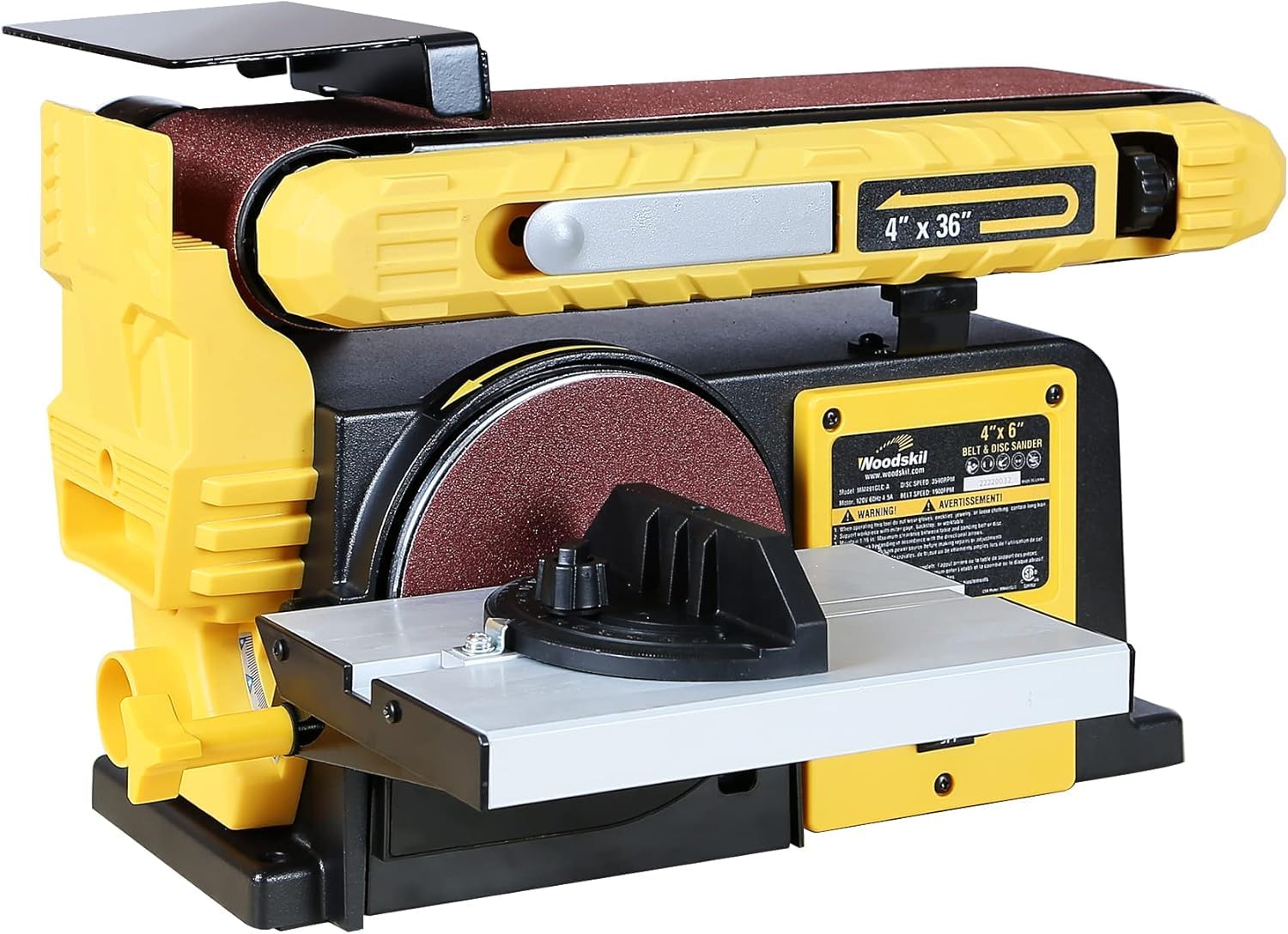
The Woodskil Upgraded Model is a direct-drive combination sander that focuses on being lightweight and portable without sacrificing too much power. It is powered by a 3/4 HP motor that drives the disc at 3590 RPM and the belt at 1900 FPM. At just under 40 pounds, it is significantly lighter than the cast iron Rikon or WORKPRO, making it easier to move around the shop but also more prone to vibration if not secured.
The belt tilts from 0 to 90 degrees, and the work table tilts from 0 to 45 degrees with a miter gauge included for accuracy. One of its strong points is the easy belt replacement mechanism: you simply loosen the dust exhaust screw, pull the tension lever, and swap the belt. Users who upgraded from older, heavier sanders noted the lightweight design as a positive for their workshop space. The motor provides sufficient power for typical woodworking tasks like shaping and sanding.
The most common complaint is that the dust collection is poor and requires external assistance. Some users also noted that while it is powerful for its size, it is slightly underpowered compared to heavier, more expensive models. For the DIYer who prioritizes a small footprint and easy portability, this is a good value, but it is not built for heavy daily professional use.
Why it’s great
- Lightweight at 39.6 lbs, easy to move and store.
- Simple and fast belt replacement with tension lever.
- Good power to weight ratio for home woodworking.
Good to know
- Dust collection is poor and requires an external vacuum.
- Slightly underpowered compared to heavier, more expensive models.
- Not designed for sustained heavy-duty professional use.
7. WORKPRO W125074A

The WORKPRO W125074A is a budget-oriented combination sander that surprises with a heavy cast iron base. Weighing in at nearly 41 pounds, this is one of the heaviest machines in its price range, which directly translates to excellent stability and vibration absorption during use. It is powered by a 4.3 Amp, 1/2 HP motor that delivers 1900 SFM on the belt and 3600 RPM on the disc—adequate for hobby-level woodworking and light trimming.
The machine includes a 4×36 belt and a 6-inch disc, along with 3 extra belts and 3 extra discs to get you started. The tension quick-release lever makes it easy to swap sandpaper. The belt can be adjusted from horizontal to vertical, and the work table tilts 0-45 degrees with a miter gauge included. Users generally praise its power and consider it a great addition to a home shop, noting that once the belt tracking is adjusted properly, it works great.
However, several users pointed out that while the base is solid cast iron, the tables and gauges feel flimsy. One reviewer noted that the belt transition requires an Allen wrench and disassembly rather than a simple lever, which is a design flaw. The miter gauge is also described as hollow and noisy. For the budget-conscious buyer who prioritizes a heavy, stable base above all else, this is a decent choice, but you are trading off precision hardware.
Why it’s great
- Heavy cast iron base provides excellent stability and vibration dampening.
- Includes 3 extra belts and 3 extra discs as a starter pack.
- Quick-release tension lever for easy sandpaper changes.
Good to know
- Tables and miter gauge feel cheap and flimsy.
- Belt transition requires tools (Allen wrench), not a quick lever.
- Plenty of power, but motor is only 1/2 HP.
8. Woodskil 610452351737

The Woodskil model 610452351737 is an entry-level combination sander that provides a good balance of features for the home DIYer just getting started. It features a 3/4 HP motor (4.3 Amps) that spins the disc at up to 3600 RPM and the belt at 1732 FPM. The base is steel rather than cast iron, which keeps the weight down to 25 pounds and the price affordable, but it does not provide the same vibration absorption as heavier units.
It offers a 4×36 belt and a 6-inch disc, with the belt adjustable from 0 to 90 degrees and the work table tilting 0-45 degrees. A miter gauge is included for more accurate angle work. A standout feature at this price point is the double dust exhaust ports—one for the belt and one for the disc—which are separate for better collection. The belt tension adjustment device is designed to prevent the belt from wandering. Users consistently call it a “great little sander” for home projects, working well with wood, metal, and plastic.
The major trade-off is the lightweight steel base, which makes it prone to walking on the bench during heavy sanding. The motor, while adequate for small projects, will bog down under sustained pressure on harder woods. For the absolute beginner or for occasional light-duty tasks, this is a solid starting point, but it is not a professional-grade tool.
Why it’s great
- Double dust exhaust ports (belt and disc separate) improve collection.
- Good value for the price with a 3/4 HP motor.
- Versatile, works on wood, metal, and plastic.
Good to know
- Lightweight steel base leads to walking on the bench.
- Motor bogs down under sustained heavy pressure.
- Not suitable for professional or heavy-duty use.
9. VEVOR BSH1510C
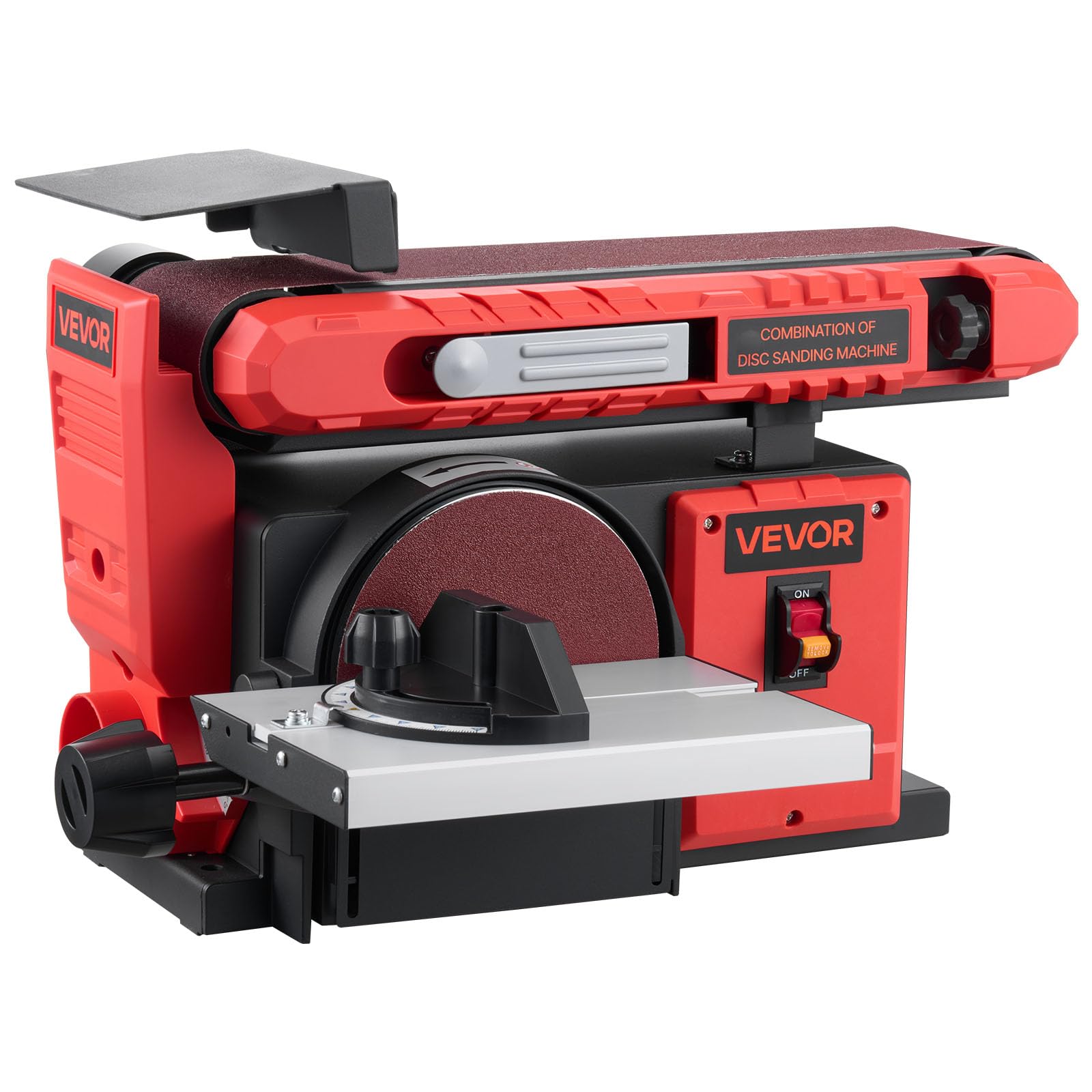
The VEVOR BSH1510C is an ultra-budget combination sander that prioritizes a compact footprint and a low entry price. It is powered by a 400W motor (roughly 0.54 HP), which is the least powerful in this lineup. The disc spins at 3550 RPM, and the belt runs at a slower 600 RPM, which limits its material removal rate. The build uses a stable frame with a steel base, weighing 33.7 pounds, which is moderate but not as rigid as a cast iron alternative.
The belt can be adjusted from 0 to 90 degrees, and the disc work table tilts from 0 to 45 degrees with a miter gauge included. A dust collection port allows for connection to a shop vacuum. The machine is designed for DIYers and home woodworking, with a focus on sanding, shaping, and knife sharpening. Some users found it to be a good value for a small space, with one noting it allowed a friend to quadruple their sharpening output.
The main concerns are the underpowered motor, which one reviewer called “a little underpowered, don’t expect a lot.” A significant mechanical flaw reported is that the shaft is threaded in the wrong direction on some units, causing the wheel to loosen during operation (fixable with Loctite). Build quality is inconsistent, with one user calling it “cheap Chinese junk.” For the absolute tightest budget or for a very specific, light-duty dedicated task like knife sharpening, it may suffice, but it is not recommended for general woodworking.
Why it’s great
- Very compact and space-saving benchtop design.
- Dust collection port compatible with shop vacs.
- Miter gauge included for basic angle work.
Good to know
- Underpowered 400W motor bogs down easily.
- Shaft threading flaw can cause wheel to loosen during use.
- Inconsistent build quality and materials.
FAQ
Is a direct-drive sander better than a belt-driven sander?
What size dust port is best for connecting to a shop vac?
Final Thoughts: The Verdict
For most users, the best belt and disc sander winner is the SKIL BB9504-00 because it combines a powerful induction motor, proper dust collection, and reliable build quality at a reasonable price point. If you need the highest power for metalworking, grab the BUCKTOOL BD4801-M. And for a heavy-duty woodworking machine with premium vibration dampening, nothing beats the Rikon 50-112.