
Our readers keep the lights on and the weekend projects moving. As an Amazon Associate, I earn from qualifying purchases.
Your TV sits in the basement—a concrete-lined signal graveyard where standard antennas go to die. The combination of below-grade placement, concrete walls, and potential interference from ductwork or electrical panels demands an antenna built to punch through serious obstruction, not a cheap set of rabbit ears.
I’m Rikta — the co-founder and writer behind FitlyFast. This guide comes from cross-referencing customer signal reports, frequency response data, and real-world basement installation outcomes to find the models that reliably pull in stations when physics works against you.
Whether you are fighting rebar-laced concrete or just the sheer depth of your entertainment space, the right antenna for tv in basement can mean the difference between a dozen pixelated channels and a full lineup of crisp HD local broadcasts.
How To Choose The Best Antenna For TV In Basement
Selecting an antenna for a basement installation requires you to prioritize signal penetration over convenience. You will need an amplified unit with enough gain to overcome the attenuation caused by below-grade concrete. Passive or lightweight indoor models will almost certainly fail. Focus on three main factors: amplification strength, directional adjustability, and mounting flexibility.
Amplification: Your First Line of Defense
A built-in amplifier is non-negotiable for basement use. Look for a low-noise amplifier (LNA) that boosts weak signals without adding excessive static. The amplifier compensates for the 10–20 dB of signal loss a concrete basement introduces. Models without one will likely deliver a fraction of the channels you expect.
Directional vs. Omnidirectional for Basement Placement
Omnidirectional antennas can work if your signal towers surround you, but a directional or motorized option is often better for basements. You need to focus energy in one direction to punch through concrete. A motorized rotator, like the one found on the PBD, lets you dial in the exact tower direction without climbing onto the roof for manual adjustments.
Mounting and Cable Quality
Basement antennas should be mounted as high as possible within the room, ideally near a window well or a crawlspace egress. The coaxial cable run to your TV is often longer in a basement setup. A thicker RG6 cable with proper shielding reduces signal degradation over distance. Check that the included cable is at least 38 feet to reach your TV without needing a low-quality extension.
Quick Comparison
On smaller screens, swipe sideways to see the full table.
| Model | Category | Best For | Key Spec | Amazon |
|---|---|---|---|---|
| Five Star Multi-Directional 4V | Premium | Long-term mount & high obstruction | 200 mi range, multi-directional elements | Amazon |
| PBD Amplified Outdoor with Motorized Rotation | Motorized | Tuning from one direction | 360° remote rotation, dual TV output | Amazon |
| Qboy 5000+ Miles Smart Antenna | Mid-Range | Compact basement window placement | 5000+ mi range, 40ft RG6 cable | Amazon |
| Qellaff 5000+ Miles Smart Antenna | Mid-Range | Long cable runs in large basements | 5000+ mi range, high-gain amplifier | Amazon |
| Tegnat 5000+ Miles Antenna | Mid-Range | Indoor/outdoor flexibility | 5000+ mi range, 38ft coax cable | Amazon |
| PIBIDI Outdoor Long Range | Budget | Simple install, low obstruction | 200 mi range, lightweight design | Amazon |
| 1byone Omni-Directional Outdoor | Budget | Attic or partially above-grade | 100+ mi range, built-in pre-amplifier | Amazon |
In‑Depth Reviews
1. Five Star Multi-Directional 4V HDTV Amplified Antenna

The Five Star antenna uses a multi-directional element design that gives you the ability to capture signals from two separate directions simultaneously. For a basement, this is a critical advantage: you can aim one side at the nearest broadcast tower and the other at a secondary tower, maximizing your channel count without needing a rotator. The included 200-mile range amplifier provides the gain necessary to overcome concrete attenuation.
Real-world reports from users mounting this in attics at roughly 25 feet show it pulls in 75 channels from within 30–40 miles, with strong performance on both UHF and VHF bands. The weatherproof build and included 40ft RG6 cable make it ready for a permanent install, and the amplifier is crucial—users note that disconnecting it causes a measurable drop in signal strength.
The product ships with a mounting pole and hardware, and while the assembly instructions are thin, the build quality is solid. For a basement, this unit’s ability to lock onto multiple signal vectors without manual re-aiming makes it the most set-and-forget option available.
Why it’s great
- Multi-directional design captures signals from two vectors simultaneously
- Included amplifier compensates for basement signal loss
- Comes with 40ft RG6 cable and mounting pole
Good to know
- Assembly instructions are minimal and could be clearer
- Performance drops noticeably if the amplifier is not used
2. PBD Amplified Outdoor TV Antenna with 360° Motorized Rotation

The PBD antenna solves one of the biggest basement problems: you cannot easily re-aim a fixed antenna. With its wireless remote-controlled 360° motorized rotation, you can sit in your basement and fine-tune the direction toward the nearest tower without climbing upstairs. This is a massive time saver when concrete is blocking half the signal range.
The built-in high-gain amplifier and 150-mile range are backed by a dual TV output, so you can connect two basement televisions without a separate splitter. Real customer reports show this unit outperforming previous antennas, especially when mounted in an attic space above the basement but still connected to the basement TV. The included 40ft RG6 cable is sufficient for most below-grade runs.
Users have noted that the unit detects channels previously missed, and the manufacturer’s customer service is responsive. The weatherproof housing is built for outdoor use, so mounting it outside the foundation wall is a viable option for maximum signal.
Why it’s great
- Motorized rotation lets you adjust direction from the basement
- Dual TV output supports two televisions without a splitter
- Amplified design compensates for deep signal obstruction
Good to know
- Some users report missing the advertised 40ft coax in the box
- Requires a clear line-of-sight path to the tower for full range
3. Qboy 2026 Strongest TV Antenna
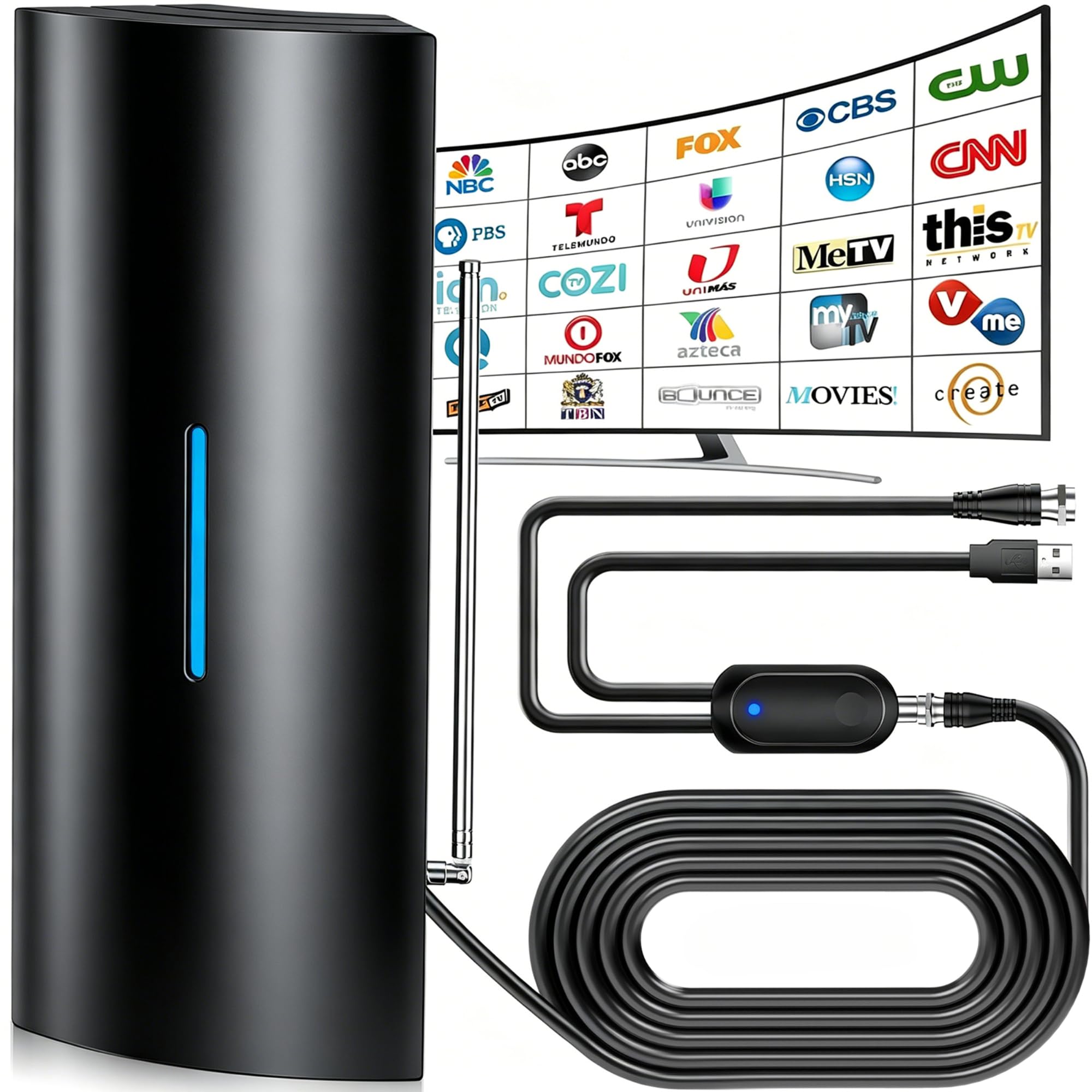
The Qboy antenna brings a compact form factor with a telescopic pole that allows you to extend and angle the element for maximum signal capture. This is useful for a basement window well or egress placement where space is tight. The 5000+ mile range claim is aggressive, but the built-in smart chip amplifier and anti-interference filtering are the real tools for basement work.
User reports from basement installations confirm that this unit delivers 50+ channels with crystal-clear reception despite below-grade placement. The 360° omnidirectional pickup means you do not need to aim it perfectly—it captures signals from all directions, which helps if you are unsure of your tower locations. The included 40ft coaxial cable is enough to route from a window well to a basement TV without splicing.
The design is weatherproof, so mounting it outside a below-grade window is safe. The amplifier requires USB power from your TV, so ensure your set has an available USB port or plan to use a wall adapter.
Why it’s great
- Telescopic pole allows precise adjustment in tight basement spaces
- Omnidirectional capture eliminates need for exact aiming
- Weatherproof build for exterior below-grade mounting
Good to know
- USB power required—TV must have a free USB port
- Range claims are marketing optimized; real-world range depends on obstruction
4. Qellaff 2026 Smart TV Antenna Indoor
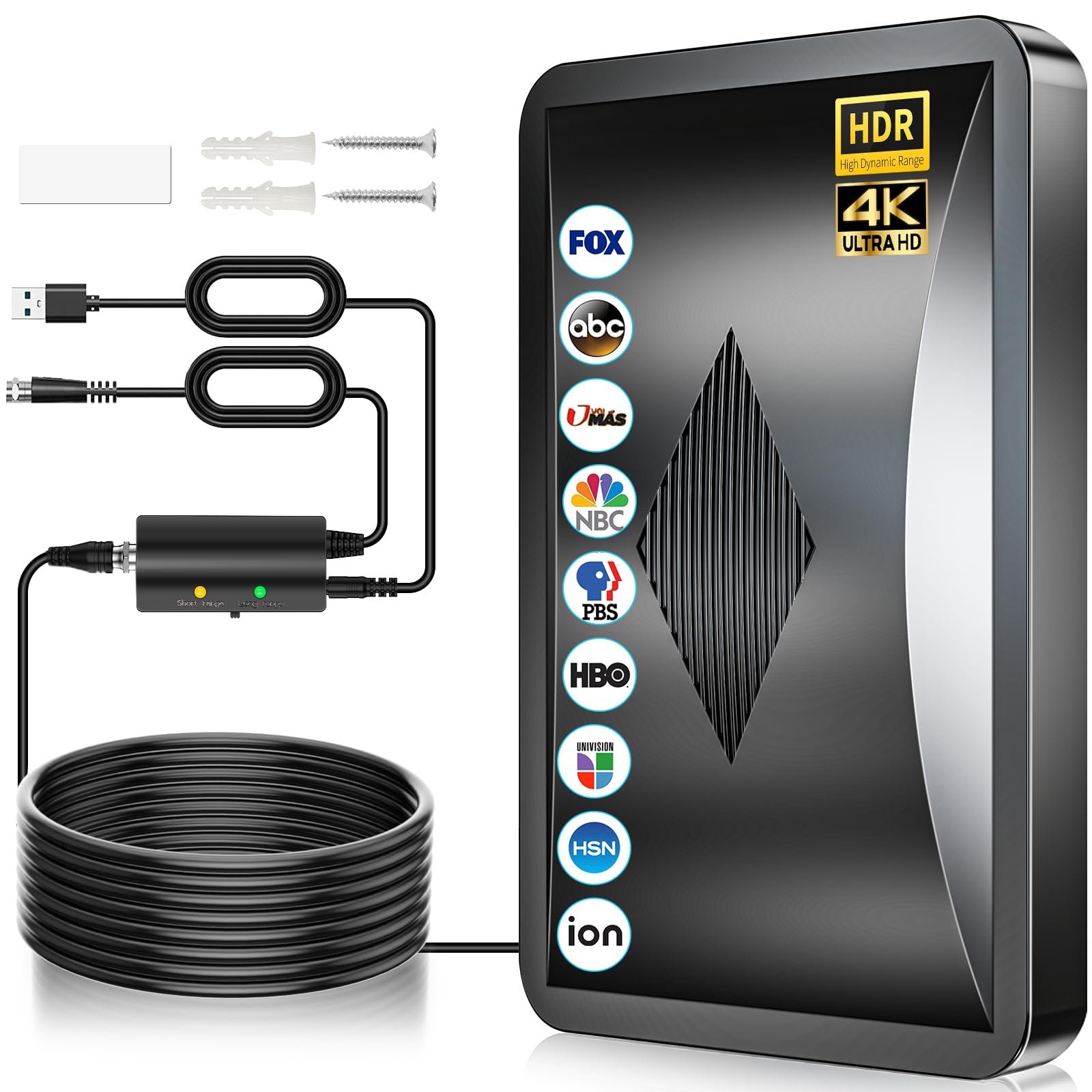
The Qellaff antenna is a solid mid-range option that balances performance with a low-profile design. Its amplified signal booster with the 2026 smart IC chip is designed to filter out cellular and RF interference that is common in basement environments with exposed ductwork and wiring. The 5000+ mile range provides enough headroom for deep obstruction.
In practice, users report picking up 60+ local channels from basement placements, especially when the antenna is mounted high on a wall or near a window. The kit includes both mounting screws and double-sided adhesive tape, giving you flexibility without needing to drill into concrete if that is not an option. The package includes a 38ft coaxial cable, which is slightly shorter than the 40ft standard but still workable for most basement layouts.
The amplifier has short-range and long-range settings, allowing you to dial back gain if you are close to towers but still fighting concrete. The product carries a 2-year warranty, which offers some assurance for a basement installation that stays in place permanently.
Why it’s great
- Selectable amplifier gain for short and long-range optimization
- Adhesive and screw mounting options for concrete wall avoidance
- Smart chip filters interference from basement wiring
Good to know
- 38ft coax cable may be tight for larger basements
- USB adapter not included for TV power supply
5. Tegnat 5000+ Miles Range TV Antenna

The Tegnat antenna uses a 360° omnidirectional design paired with a high-gain smart amplifier. The advantage for basement users is that you can place this unit on a window sill, a table, or mount it outside without worrying about orientation. The amplifier includes anti-interference technology that filters cellular and FM signals that are more pronounced in below-grade spaces.
Customer reports from suburban placements show 58 HD channels after a bit of placement experimentation, which is consistent with a basement-level signal that requires fine-tuning. The 38ft low-loss coaxial cable is thickened to reduce signal drop over distance. The kit includes adhesive stickers, expansion screws, and nylon ties, covering both permanent and temporary mounting.
The antenna is rated for both indoor and outdoor use, so if you have a basement egress window, you can place it outside the foundation for significantly better signal. The amplifier requires USB power, and the small blue LED indicates it is active.
Why it’s great
- Omnidirectional reception reduces the need for aiming
- Anti-interference filter cleans up basement noise
- Multiple mounting options for concrete wall challenges
Good to know
- Placement can be finicky; expect to test a few locations
- Some channel drop-out reported in severe weather
6. PIBIDI Outdoor TV Antenna UHD-8903

The PIBIDI antenna is a straightforward, budget-friendly directional design with a 200-mile range. It is lightning protected and built to withstand outdoor weather, which makes it a candidate for mounting on a basement wall exterior or on a mast. The lack of a built-in amplifier or motorized rotator means you need a solid line-of-sight path to your nearest tower.
User reports from relatively open suburban areas show 64–86 channels, which is impressive for an unamplified antenna. For basement use, however, the lack of amplification means you will need to mount it as high as possible—ideally at the rim joist level or on an exterior wall above the foundation. The assembly is mostly pre-assembled and requires no tools beyond what is in the kit.
The product is a good entry-level option if your basement has a window well that provides a relatively unobstructed path to the broadcast towers. It is not the best choice for deep basements with reinforcement bar in the concrete.
Why it’s great
- Lightweight and easy to assemble with no tools required
- Lightning protected for outdoor mounting safety
- Delivers 60+ channels in open suburban conditions
Good to know
- No built-in amplifier makes basement performance marginal
- Fixed directional design requires precise tower alignment
7. 1byone Outdoor TV Antenna Omni-Directional

The 1byone antenna is a compact omni-directional unit with a built-in pre-amplifier and a 4GLTE filter to prevent cellular signal interference. It is designed for 100+ mile range and supports 4K resolution. The 360° reception means you do not need to aim it, which simplifies installation in a basement where tower location knowledge might be limited.
Customer reports from attic installations at roughly 10 feet off the ground show reliable channel scanning with good HD quality. For basement use, the omni-directional design helps capture weaker signals that bounce off concrete walls, but the amplifier’s gain is moderate compared to dedicated amplified models. The included 39ft RG6 cable is sufficient for routing through a basement ceiling to the TV.
A known issue from outdoor installations is water ingress after extended exposure—the pre-amplifier and RF connectors corrode over time. If you mount this inside the basement itself, you avoid that problem and still benefit from the pre-amplifier’s modest boost. For deep basements, consider a more powerful amplified unit.
Why it’s great
- Omni-directional design eliminates the need for precise aiming
- Built-in 4GLTE filter reduces interference from cell signals
- Compact form factor fits in tight basement window wells
Good to know
- Pre-amplifier is susceptible to moisture damage in outdoor installations
- Amplifier gain is lower than dedicated amplified models
FAQ
Will any antenna work in a basement?
Should I mount the antenna inside or outside my basement?
How long should the coax cable be for a basement antenna?
Final Thoughts: The Verdict
For most users, the antenna for tv in basement winner is the Five Star Multi-Directional 4V because its multi-directional elements and included amplifier give you the best chance of capturing strong signals from multiple towers without needing a motorized rotator. If you want the ability to fine-tune from your couch, grab the PBD with Motorized Rotation. And for a compact budget-friendly setup in a basement with a window well, the Qboy Telescopic Antenna is a solid performer.