
Our readers keep the lights on and the weekend projects moving. As an Amazon Associate, I earn from qualifying purchases.
Your podcast’s audio quality is the single thing that decides if a listener hits subscribe or skips to the next show. A muddy recording, a clipped vocal, or a background hum tells the audience you didn’t care enough to get the right gear. The choice of an interface or recorder dictates your preamp noise floor, your headphone routing, and whether you can bring in a second host or a remote guest without echo. This guide cuts through the marketing noise and focuses on the specs that actually matter for spoken‑word production: gain range, phantom‑power flexibility, multitrack recording capability, and the number of independent headphone mixes your setup can deliver.
I’m Rikta — the co‑founder and writer behind FitlyFast. For this guide, I’ve spent dozens of hours dissecting preamp signal‑to‑noise ratios, channel counts, sound‑pad configurability, and real‑world user reports to separate the gear that elevates your show from the gear that just takes up desk space.
Whether you’re a solo host upgrading from a USB mic or running a multi‑guest roundtable, the right audio recorder for podcasts must give you transparent preamps, enough I/O for your current show, and a workflow that doesn’t require a degree in audio engineering.
How To Choose The Best Audio Recorder For Podcasts
Choosing the right recorder or interface means understanding your show’s core demands before you look at a single knob. A solo host with one microphone has different needs than a four-person roundtable that also takes remote calls. Focus on three pillars: input count and preamp quality, headphone routing flexibility, and the ability to record without a computer when you need portability.
Preamp Gain and Noise Floor
Your microphone’s signal passes through the preamp before it becomes a digital file. A weak preamp (under 50 dB of gain) forces you to crank the volume, which raises the noise floor and introduces hiss. Dynamic mics like the Shure SM7B or RØDE PodMic need at least 55 dB of clean gain. Look for a noise floor spec around -120 dBu or lower — that tells you the preamp stays quiet even when you push it hard.
Channel Count and Headphone Mixes
One XLR input works for a solo host. Add a guest and you need two inputs and at least two headphone outputs with independent volume controls. For three or more in‑person participants, four or six XLR inputs with separate headphone mixes become essential. The ability to create a custom monitor mix for each guest prevents the “I can’t hear myself” complaints that kill the flow of a live recording.
Standalone Recording vs. Computer‑Dependent Operation
Some recorders capture audio directly to an SD card without a laptop, which is a lifesaver for mobile recording sessions or backup safety. Others are pure USB interfaces that rely entirely on your computer or tablet. If you ever record on location or want a failsafe in case your DAW crashes, a unit with onboard recording to SD is a smarter investment than a box that requires a PC to function.
Quick Comparison
On smaller screens, swipe sideways to see the full table.
| Model | Category | Best For | Key Spec | Amazon |
|---|---|---|---|---|
| Zoom PodTrak P8 | Standalone Recorder | Multi‑guest roundtables with phone callers | 6 XLR / 6 headphone outs | Amazon |
| Zoom LiveTrak L-8 | Recorder/Mixer | Bands and multi‑person productions | 8 inputs / 12‑track recording | Amazon |
| RØDE NT1 5th Gen | XLR/USB Mic | Solo pro with dual connectivity | Self‑noise 4 dB (ultra‑low) | Amazon |
| Focusrite Vocaster Two | Audio Interface | Easy two‑host setups with Bluetooth | 70 dB gain / Auto Gain | Amazon |
| MAONO MaonoCaster E2 Gen2 | Podcast Mixer | Budget dual‑host with sound pads | 2 XLR / 60 dB gain / battery | Amazon |
| Shure MVX2U | XLR‑to‑USB Adapter | Mobile recording with one mic | 60 dB gain / zero‑latency monitoring | Amazon |
| Audio‑Technica AT2020USB‑X | USB Condenser Mic | Plug‑and‑play solo host | 24‑bit / 96 kHz AD converter | Amazon |
| SENNHEISER Profile USB | USB Condenser Mic | Everyday voice work without software | Metal housing / zero‑latency monitoring | Amazon |
| MAONO MaonoCaster AME2 | Podcast Mixer | Affordable 10‑channel mixing | 11 customizable sound pads | Amazon |
In‑Depth Reviews
1. Zoom PodTrak P8
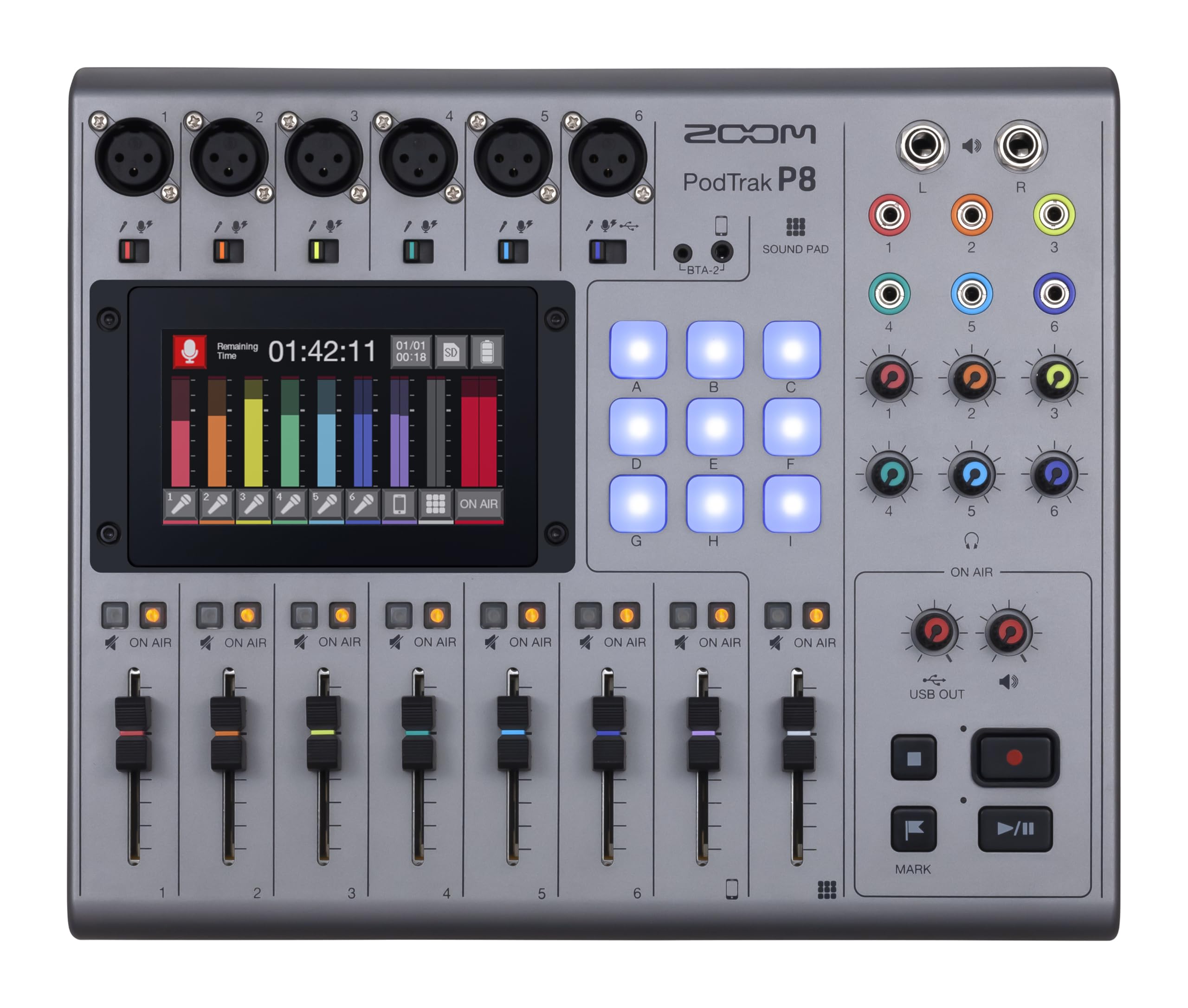
The Zoom PodTrak P8 is the most complete all‑in‑one podcast production hub available today. It packs six XLR mic inputs with clean preamps, six independent headphone outputs with individual volume controls, and a 4.3‑inch color touchscreen that puts EQ, compression, de‑essing, and noise reduction right under your finger. You can record all tracks simultaneously to an SD card without ever touching a computer, making it ideal for live roundtables and remote sessions.
The built‑in Mix‑Minus function handles phone calls and remote guests automatically, eliminating echo and feedback that plague lesser interfaces. Nine multi‑color sound pads spread across four banks give you 36 assignable clips for intro music, ads, or bumper effects. Battery power over four AAs gives you around two hours of untethered recording — a critical feature for location shoots or backup during power interruptions.
Audio quality is clean with a low noise floor, and the touchscreen workflow eliminates the menu‑diving frustration of older recorders. The P8 is larger than a compact interface, but that size buys you dedicated controls for every channel. For podcasters running three or more in‑person guests plus remote callers, this is the unit that scales with your show.
Why it’s great
- Six XLR inputs and six headphone outs handle large roundtables without an external mixer
- Touchscreen with onboard EQ, compression, and de‑essing reduces post‑production work
- Mix‑Minus for phone callers is built in — no extra hardware needed
- Records to SD card for standalone operation
Good to know
- Battery life is limited to about two hours on AA batteries
- Larger footprint than a simple USB interface
- SD card not included
2. Zoom LiveTrak L-8

The Zoom LiveTrak L-8 straddles the line between a podcast recorder and a band mixer, and it does both jobs exceptionally well. It offers six combo XLR‑¼˝ inputs plus two stereo line inputs, capturing up to 12 tracks simultaneously at 24‑bit/96 kHz resolution to an SD card or computer. The preamps deliver a impressively low noise floor of -121 dBu with gain up to +54 dB, keeping your vocal tracks hiss‑free even with dynamic mics.
Four headphone outputs with three independent monitor mixes allow each participant to hear a personalized blend of mics, music, and effects. The onboard 3‑band EQ and reverb effects are tuned for spoken word and music alike. Unlike the PodTrak P8, the L-8 records to SD and computer simultaneously, giving you an instant backup of every session.
The trade‑off is that phantom power is switched globally for all six channels — you cannot activate it per‑channel like on the more expensive L‑12. The micro‑USB port for computer connection feels dated compared to the USB‑C standard on newer gear. But for a podcaster who also records music or wants the flexibility of a small mixer, the L‑8’s portability and battery power make it a versatile tool that punches above its size.
Why it’s great
- Dual recording to SD card and computer simultaneously
- Four headphone outputs with three independent mixes
- Ultra‑low noise floor preamps (-121 dBu)
- Battery‑powered for portable sessions
Good to know
- Phantom power is global — all six channels on or off at once
- Micro‑USB interface instead of USB‑C
- Learning curve for beginners unfamiliar with mixer workflows
3. RØDE NT1 5th Gen

The RØDE NT1 5th Gen takes the legendary warmth and silky high‑end of the NT1 and adds a built‑in Revolution Preamp with USB output. This dual‑connectivity approach means you can plug directly into your computer via USB‑C for a clean digital signal, or use the XLR output with a traditional audio interface. The self‑noise spec of just 4 dB is among the lowest of any studio condenser, meaning your vocal recordings start with an almost black background.
The included SM6 shock mount and pop filter remove the need for aftermarket accessories, and the high‑grade aluminum body with military‑grade ceramic coating feels built for daily studio use. The USB mode supports up to 192 kHz sample rate, but for podcasting, the 48 kHz setting is more than sufficient and keeps file sizes manageable.
This microphone is not a recorder itself — it needs an interface or computer to operate. But its combination of ultra‑low noise, dual output, and included studio accessories makes it the premier choice for the solo host who demands broadcast‑level clarity. If your budget allows for a premium microphone paired with a solid interface, the NT1 5th Gen delivers vocal detail that few USB mics can touch.
Why it’s great
- Ultra‑low 4 dB self‑noise for pristine vocal recordings
- Dual XLR and USB output for flexible setup
- Includes high‑quality shock mount and pop filter
- Built‑in Revolution Preamp with 192 kHz AD conversion
Good to know
- Requires an interface or computer — no standalone recording
- Sensitive capsule picks up room reflections; needs a treated space
- Premium price reflects studio‑grade components
4. Focusrite Vocaster Two

The Focusrite Vocaster Two is designed specifically for podcasters who want broadcast‑ready audio without digging through menus. Its headline feature is over 70 dB of clean gain — enough to drive a Shure SM7B or RØDE PodMic without an external booster. The Auto Gain button sets your input level in seconds: press it, talk at your normal volume, and the interface locks in the optimal level.
Two XLR inputs labeled “Host” and “Guest” are paired with two headphone outputs, each with its own volume knob and Show Mix control so both people hear a balanced blend of mics and playback. The Enhance button offers four voice‑shaping presets that apply EQ and compression tailored for speech. Bluetooth connectivity lets you bring in phone callers wirelessly — a huge convenience for interviews.
The plastic chassis feels lighter than some all‑metal competitors, but the build is rugged enough for regular transport. The USB‑C connection powers the unit, and some users report it can run off an iPad or iPhone in a pinch. For a two‑host show that values speed of setup and clean preamps without external processors, the Vocaster Two is the most effortless interface in this lineup.
Why it’s great
- Over 70 dB of clean gain — no booster needed for dynamic mics
- Auto Gain and Enhance presets deliver pro sound in seconds
- Bluetooth phone connection simplifies remote interviews
- Two headphone outputs with independent Show Mix
Good to know
- Plastic body feels lighter than metal interfaces
- No SD card recording — relies entirely on computer
- Software ecosystem is more limited than Focusrite’s larger Scarlett series
5. MAONO MaonoCaster E2 Gen2

The MAONO MaonoCaster E2 Gen2 offers a remarkable feature set at a price that undercuts most competitors. It provides two combo XLR‑¼˝ inputs with up to 60 dB of clean gain and 48V phantom power, making it suitable for both dynamic and condenser mics. The built‑in 1500 mAh battery delivers up to eight hours of operation — more than enough for a full recording day without a wall outlet.
Eight customizable sound pads, each storing up to 20 seconds of audio, let you trigger intro music, sound bites, or ad reads on the fly. Six reverb presets and a pitch‑changing effect add creative flexibility for themed episodes or character voices. The loopback function lets you stream with a single computer, routing desktop audio and your mic signal into one output for platforms like Twitch or Zoom.
The noise reduction technology effectively suppresses fan hum and ambient rumble, though the noise gate itself is not the most aggressive you’ll find. The plastic chassis keeps weight low, but it lacks the premium feel of metal interfaces. For the podcaster on a tight budget who needs two XLR inputs, onboard effects, and true portability, the E2 Gen2 is the strongest value proposition in this list.
Why it’s great
- Two XLR inputs with 60 dB gain and phantom power
- Built‑in battery offers up to 8 hours of recording
- Eight programmable sound pads and multiple reverb modes
- Loopback function simplifies live streaming
Good to know
- Noise gate performance is adequate but not professional‑grade
- Plastic construction may not survive heavy travel
- Sound pads are not preloaded — you must record or upload sounds
6. Shure MVX2U

The Shure MVX2U solves a very specific problem: how to turn any XLR microphone into a professional USB‑C device without buying a full‑size interface. This compact unit clips directly onto the mic or sits inline with an XLR cable, delivering up to 60 dB of clean gain and 48V phantom power from a thumb‑drive‑sized body. It draws power from the USB‑C connection, so no wall wart is needed.
The built‑in 3.5 mm headphone jack provides zero‑latency monitoring, meaning what you hear is exactly what the mic captures with no digital delay. The ShurePlus MOTIV desktop app gives you control over gain, EQ, compression, and a limiter — and the unit remembers your settings even after being unplugged. Auto Level Mode sets your input automatically, which is a boon for solo podcasters who don’t want to fiddle with knobs during a monologue.
This is a single‑channel solution only. You cannot record two mics simultaneously without buying a second unit. And while the app‑based controls are powerful, you need a computer to adjust them; there are no physical knobs on the device itself. For the solo host who already owns an SM7B or SM58 and wants studio‑grade conversion in a travel‑friendly package, the MVX2U is an elegant upgrade path.
Why it’s great
- 60 dB clean gain drives dynamic mics without external boosters
- Zero‑latency headphone monitoring with no digital delay
- Ultra‑compact design mounts directly on the microphone
- Settings persist after unplugging
Good to know
- Single‑channel only — cannot record two mics at once
- No physical controls; adjustments require the MOTIV app
- Not recommended for smartphone use despite USB‑C
7. Audio‑Technica AT2020USB‑X

The Audio‑Technica AT2020USB‑X is the USB evolution of the legendary AT2020 studio condenser. It maintains the cardioid polar pattern that rejects off‑axis noise while adding a high‑resolution 24‑bit/96 kHz AD converter for exceptional clarity. The built‑in headphone jack allows direct monitoring of your microphone signal with zero latency, and the soft‑touch capacitive mute button on the body silences audio silently — no click heard on the recording.
The two‑state LED ring glows blue when powered and red when muted, giving you a clear visual status at a glance. The included custom desk stand and USB‑C to USB‑A cable with a USB‑A to USB‑C adapter ensure compatibility across modern and legacy ports. The extended frequency response (20 Hz – 20 kHz) is ideally suited for voice, with a slight presence boost that helps spoken word cut through a mix without sounding harsh.
This microphone picks up ambient noise — keyboard clicks, computer fans, room echoes — more readily than a dynamic mic would, so it works best in a treated or quiet space. It is a USB microphone, not a recorder or interface, meaning it cannot connect to an XLR mixer or record without a computer. For the solo podcaster who wants a proven capsule with plug‑and‑play simplicity and studio‑grade conversion, the AT2020USB‑X is a reliable workhorse.
Why it’s great
- 24‑bit/96 kHz converter delivers studio‑grade digital clarity
- Zero‑latency headphone monitoring via built‑in jack
- Capacitive mute button with clear LED status indicator
- Includes desk stand and USB‑C to USB‑A cable with adapter
Good to know
- Condenser capsule picks up environmental noise — needs a quiet room
- USB only — no XLR output for use with professional interfaces
- Stand is functional but may feel lightweight for some users
8. SENNHEISER Profile USB

The SENNHEISER Profile USB microphone strips away software dependence and delivers warm, natural vocal tone through a plug‑and‑play USB‑C connection. The cardioid condenser capsule is German‑engineered and housed in a full metal chassis that feels substantial on the desk. The controls — gain, headphone volume, and a mix knob that blends your mic input with computer audio — are all physical dials on the front face, so you never open a settings panel.
The built‑in headphone jack provides zero‑delay monitoring, and the mute button on the top is easy to find by touch during a live recording. The included table stand is compact and stable, though it positions the mic at a low angle that may require a boom arm for ergonomic speaking posture. The Profile uses a universal USB audio standard, meaning it works on Windows, macOS, and Linux without proprietary drivers.
This microphone lacks XLR output, so it cannot integrate with a traditional audio interface or multitrack recorder. The sound signature is slightly warm with a natural body that flatters spoken word without excessive sibilance. For the podcaster who values simplicity, build quality, and the ability to control everything from the microphone itself, the Sennheiser Profile is a refreshingly focused tool.
Why it’s great
- All‑metal construction with German‑engineered capsule
- Zero‑delay headphone monitoring with physical mix knob
- No software needed — universal USB audio driver works on any OS
- Warm, natural vocal tone that reduces post‑processing
Good to know
- USB only — cannot connect to XLR mixers or recorders
- Included stand is short; a boom arm is recommended
- No advanced DSP effects like EQ presets or compression
9. MAONO MaonoCaster AME2

The MAONO MaonoCaster AME2 packs a 10‑channel mixer, 11 customizable sound pads, and a built‑in preamp with 48V phantom power into a desktop form factor that costs less than many two‑input interfaces. The preamp delivers up to 60 dB of gain with ultra‑low noise, and the 32‑bit chipset includes a DENOISE function that cleans up ambient background hiss. Six reverb modes, 12‑step auto‑tune, and three‑band EQ give you vocal processing options usually reserved for software plug‑ins.
Three of the sound pads can record up to 60 seconds of audio each with one‑key looping — a standout feature for loop‑based intro music or live soundscaping. The remaining eight pads hold 20‑second clips. You can load audio via smartphone, PC, microphone, or Bluetooth. Physical I/O includes two XLR inputs, a 6.35 mm instrument jack for guitar or bass, AUX‑IN, USB‑C, and dual stream outputs for connecting to a phone and computer simultaneously.
Build quality is solid for the price, though some units have reported USB‑C port failure after about a year of use, and the headphone monitor signal may include a slight reverb effect that does not appear in the final recording. For the podcaster, streamer, or musician who wants an all‑in‑one production board with extensive sound effect capabilities at an entry‑level budget, the AME2 offers exceptional breadth of features.
Why it’s great
- 10‑channel mixer with 11 customizable sound pads (3 with 60‑sec looping)
- 60 dB preamp and 48V phantom power for all mic types
- Six reverb modes, auto‑tune, and 3‑band EQ built in
- Dual stream outputs for simultaneous phone and computer recording
Good to know
- Some units have reported USB‑C port failure after extended use
- Headphone monitoring may include reverb not present in the recording
- Does not support USB microphones — XLR only
FAQ
What is the difference between a podcast recorder and a USB audio interface?
Why do I need phantom power (48V) for my microphone?
How many headphone outputs do I need for a two‑person podcast?
What is Mix‑Minus and why does it matter for remote interviews?
Final Thoughts: The Verdict
For most users, the audio recorder for podcasts winner is the Zoom PodTrak P8 because it combines six XLR inputs, six independent headphone mixes, a color touchscreen with onboard processing, and SD card recording into a single portable unit that scales from solo shows to large roundtables. If you want the cleanest preamp noise floor and dual‑recording capability, grab the Zoom LiveTrak L-8. And for a two‑host setup that prioritizes ease of use and Bluetooth phone connectivity, nothing beats the Focusrite Vocaster Two.