
Our readers keep the lights on and the weekend projects moving. As an Amazon Associate, I earn from qualifying purchases.
Stepping up to a 110-volt MIG welder means trading portability for penetration. The single pain point of this category is inconsistent wire feed that produces birdnests and spatter, wrecking thin-gauge sheet metal on the first pass. The right machine solves this with synergic control, adjustable burn-back, and a stable IGBT inverter that maintains arc even under voltage fluctuation from a shared household circuit.
I’m Rikta — the co-founder and writer behind FitlyFast. I’ve spent hundreds of hours dissecting inverter topology, wire drive systems, and duty-cycle claims to separate the budget units that overpromise from the machines that genuinely lay clean beads on 120V power.
Whether you are restoring a classic car in the garage or fabricating brackets on a farm, this guide cuts through the noise to identify the most reliable 110 volt mig welder for your specific workflow.
How To Choose The Best 110 Volt MIG Welder
Choosing a 110-volt MIG welder means prioritizing the machine’s ability to maintain arc stability on a standard household outlet. The wrong pick leads to spatter, poor penetration, and endless frustration with thin steel. Focus on these three pillars to make the right call.
Synergic Versus Manual Control
Synergic control automatically matches voltage and wire feed speed when you dial in material thickness and wire diameter. This removes guesswork and dramatically reduces birdnesting, especially if you are a beginner. Manual-only machines give the pro fine-tuned authority but require experience to avoid burning through thin stock. For a 110V machine, synergic is a strong advantage because it compensates for the limited power ceiling.
Dual-Voltage Flexibility and Duty Cycle
A true 110V/220V dual-voltage welder lets you start on a standard outlet and upgrade to 220V for thicker material later. Look for automatic voltage detection to avoid setup mistakes. Duty cycle at 110V matters more than peak amperage — a machine that runs 60% at 90 amps on 110V will outwork a cheaper unit that overheats after three minutes of continuous welding.
Wire Feed System and Drive Rollers
The wire drive is the mechanical heart of a MIG welder. Aluminum drive rollers with separate grooves for 0.030 and 0.035 wire prevent slippage. Knurled rollers are essential for flux-core wire to grip the tubular core. A 2-roll drive is standard at this price level; a 4-roll drive offers smoother feed for long welds. Burn-back adjustment also matters so the wire tip doesn’t freeze to the weld puddle when you release the trigger.
Quick Comparison
On smaller screens, swipe sideways to see the full table.
| Model | Category | Best For | Key Spec | Amazon |
|---|---|---|---|---|
| PrimeWeld MIG180 | Premium | Aluminum welding with spool gun | 180A, 110/220V, includes spool gun | Amazon |
| ARCCAPTAIN iControl MIG205 Pro | Premium | Remote app control and fine tuning | 205A, 4-roll drive, APP control | Amazon |
| ARCCAPTAIN MIG Welder 200A | Mid-Range | 6-in-1 versatility with spot weld | 200A, 110/220V, 6-in-1 modes | Amazon |
| Forney 271 Easy Weld 140 MP | Mid-Range | Multi-process simplicity for farm repair | 140A, 120V, metal case | Amazon |
| VEVOR MIG Welder 270A | Mid-Range | High amp output on 220V for thick steel | 270A, 110/220V, LCD display | Amazon |
| YESWELDER 160A | Mid-Range | 4-in-1 synergic for beginners | 160A, 110/220V, smart synergic | Amazon |
| Bestarc 165A MIG Welder | Mid-Range | Ultra-portable 13.7 lb design | 165A, 110/220V, large LED display | Amazon |
| Lincoln Electric 90i FC | Mid-Range | Brand reliability for thin gauge sheet metal | 90A, 120V, flux-core only | Amazon |
| AZZUNO 200A MIG Welder | Budget | Entry-level with great tech support | 200A, 110/220V, 4-in-1 | Amazon |
In‑Depth Reviews
1. PrimeWeld MIG180

The PrimeWeld MIG180 is the serious hobbyist’s choice for one dominant reason: it ships with a spool gun ready for aluminum welding on 110V. This eliminates the main barrier to aluminum MIG — the wire feeding nightmare. The dual-voltage input (110/220V) automatically detects your outlet, and the 180-amp output on 220V handles 3/8-inch mild steel in a single pass without the arc stuttering.
Praised for its out-of-box completeness, the machine includes drive rollers for both solid and flux-core wire. Standard Tweco consumables make replacement easy at any welding supply shop. The duty cycle is generous for its class, letting you run longer beads on car panels or trailer frames before the thermal overload kicks in. Customer reviews consistently mention that it outperforms big-box store brands costing twice as much.
PrimeWeld backs the unit with US-based customer support, which is rare at this price tier. While heavier than the compact inverter units at 55 pounds, the trade-off is build quality that doesn’t rattle loose on a truck bed. If aluminum or extended duty cycles are on your roadmap, this is your machine.
Why it’s great
- Complete spool gun for aluminum welding included
- Dual-voltage auto-detection
- US-based customer service
Good to know
- Heavier build at 55 pounds reduces portability
- Premium price point for the category
2. ARCCAPTAIN iControl MIG205 Pro
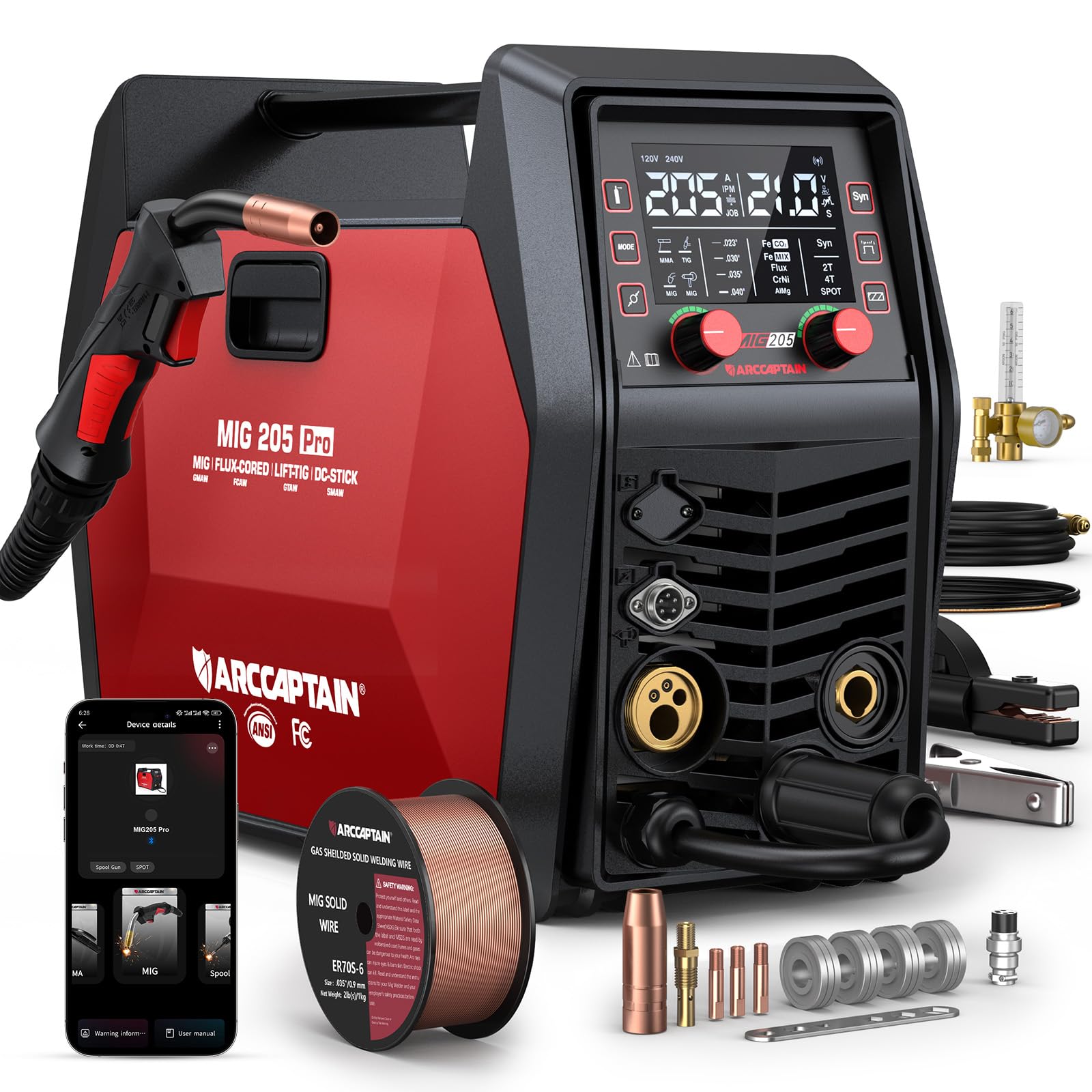
The iControl MIG205 Pro brings a genuinely useful innovation to the 110V MIG category: smartphone app control. You can dial in inductance, burn-back, spot time, and store up to ten custom welding presets without walking to the machine. This is a huge time-saver when you are inside a helmet and grinding between passes. The synergic mode automatically matches wire feed to voltage, which flattens the learning curve for newcomers.
Under the hood, a 40-watt wire drive motor pushes up to 640 inches per minute, and the dual-fan cooling system keeps the 205-amp output consistent during longer runs. The large LED screen displays parameters clearly through your helmet shade. Users report smooth, consistent welds on 1/8-inch steel with 6013 rods in stick mode, and excellent puddle control with the integrated inductance adjustment from -10 to +10.
The kit includes a 220V adapter cable, though some users found the adapter design less robust than the primary torch. The machine is lightweight at around 10 pounds, making it the most travel-friendly choice for multi-process work. It lacks a spool gun or TIG torch in the box, so factor that in if aluminum or TIG are immediate needs.
Why it’s great
- Smartphone app control for remote tuning
- High wire feed speed minimizes birdnesting
- Synergic mode for beginners
Good to know
- TIG torch and spool gun sold separately
- Adapter cable quality could be better
3. ARCCAPTAIN MIG Welder 200A
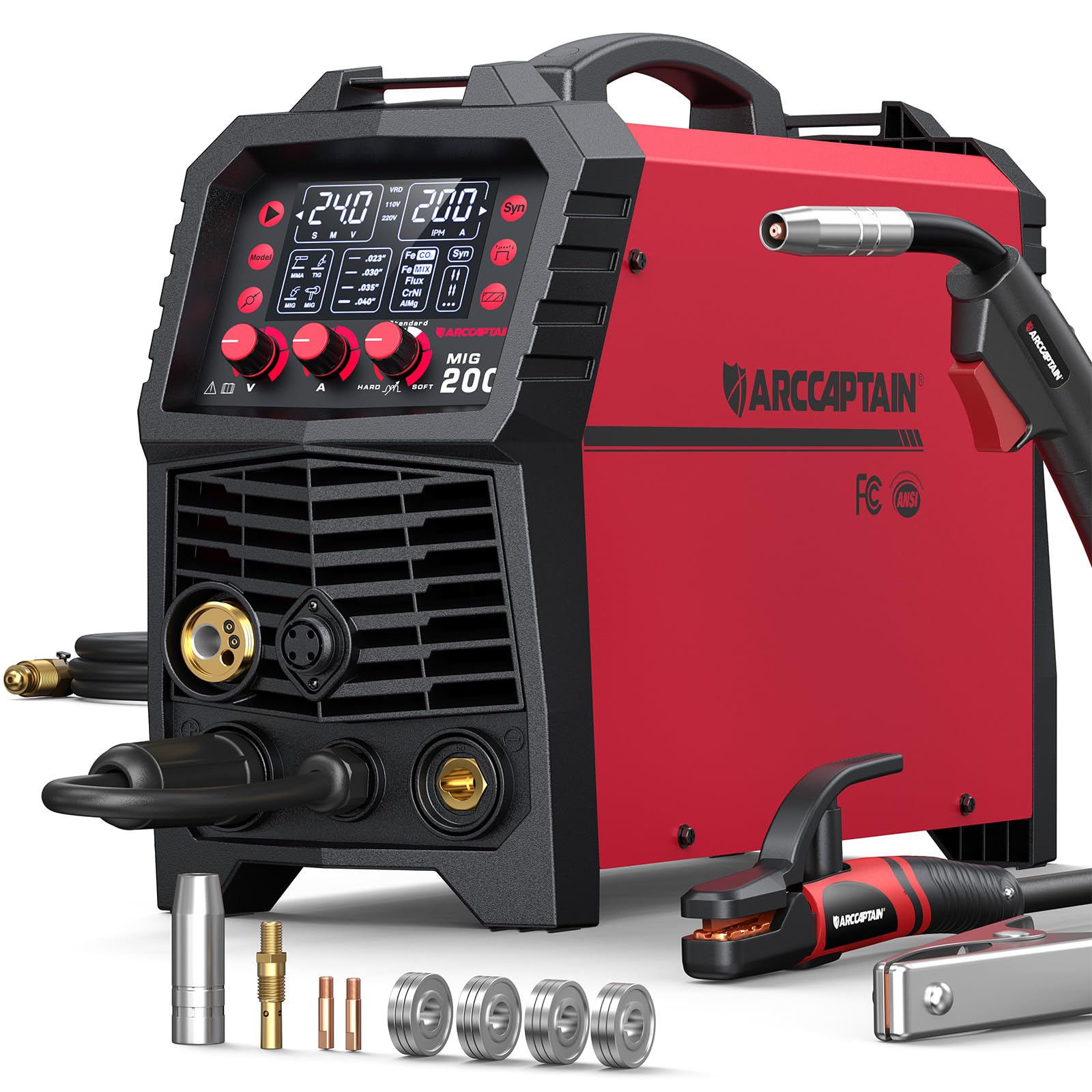
The previous-generation ARCCAPTAIN MIG200 is still a strong contender because it packs six welding modes — including spot welding — into a single compact unit. The synergic control adjusts wire feed and voltage as you turn the amperage knob, which helps novices avoid setting up a spatter-prone arc. Burn-back adjustment lets you fine-tune wire stick-out, preventing the wire from freezing into the puddle. The 200-amp peak on 220V gives enough headroom for farm and auto repair up to 5/16-inch material.
Welders who have used Miller and Lincoln units note the ARCCAPTAIN produces surprisingly clean beads for a fraction of the cost. The large LED display shows parameters in real time, so you can monitor settings without lifting your helmet. The unit handles both 2-pound and 10-pound spools and uses standard Tweco-style tips, making consumables easy to source. The cooling fan runs on demand, cutting down on noise when the machine is idle.
On the downside, the 0.035-inch drive rollers are not included, which means you need to order them separately for that wire size. The 220V adapter cable also drew some criticism for its thin gauge. Despite these small gripes, this machine delivers authentic multi-process versatility at a mid-range price point that punches above its weight.
Why it’s great
- Six welding modes including spot weld
- Synergic control with adjustable burn-back
- Tweco-style consumable compatibility
Good to know
- 0.035-inch drive rollers not included
- 220V adapter cable is thin
4. Forney 271 Easy Weld 140 MP

The Forney 271 is the definition of a no-nonsense 120V multi-process welder. It strips away the digital displays and synergic wizardry in favor of a three-position switch and infinite voltage/wire feed knobs. This simplicity is a virtue when you are crouched over a rusty tractor fender and don’t want to scroll through menus. The all-metal case gives it a toughness that plastic-shelled competitors lack, and at 26 pounds it’s easy to move from the shelf to the job.
Customers praise its smooth DC TIG capability for thin steel and the fact that it runs happily on a 20-amp household circuit. The included 20-amp to 15-amp adapter ensures you can plug into a standard garage outlet without hassle. Stick welding with 6013 rods produces stable arcs, and MIG mode with 0.030 wire delivers clean beads on 1/8-inch stock. The machine is generator-friendly, making it a strong choice for remote repair work where power quality is inconsistent.
The stock MIG gun feels somewhat flimsy compared to the main unit’s build quality, but it performs adequately for light-duty use. This welder lacks 240V capability, so material over 1/4-inch will require multiple passes or preheating. For a dedicated 120V-only shop where reliability and simplicity take priority over feature count, the Forney 271 is a proven workhorse.
Why it’s great
- All-metal case for durability
- Generator-friendly inverter
- Simple controls with infinite voltage adjustment
Good to know
- No 240V input option
- Stock MIG gun quality is average
5. VEVOR MIG Welder 270A

The VEVOR MIG-270 is built for the user who needs maximum amps on a 220V circuit and still wants 110V portability. At 270 amps peak, it punches above its size, welding 3/8-inch steel in a single pass when fed from a 220V outlet. The IGBT inverter technology provides a stable arc even when the input voltage fluctuates, a common issue on construction sites. The orange and black chassis is compact at 21.7 pounds, and the top-mounted handle makes it easy to carry.
Users report that the machine runs impressively cool during extended flux-core welding on 110V, with the LCD display giving clear readouts of voltage and wire speed. The three-in-one design (MIG, Lift TIG, Stick) covers the essential processes, though the Lift TIG torch requires a separate purchase. The included accessories package is generous, featuring a gas-shielded torch, argon tube, slag hammer, and a 2.2-pound spool of welding wire.
Weak points include a regulator that some users found defective out of the box and a nozzle that needed replacement. The manual is minimal, so expect some trial-and-error dialing in settings. If you need a machine that can go from thin sheet metal on 110V to heavy structural steel on 220V without breaking the bank, the VEVOR MIG-270 deserves a close look.
Why it’s great
- High 270A peak handles thick steel
- IGBT inverter for arc stability
- Packed with accessories
Good to know
- Included regulator can be faulty
- Thin manual lacking setup guidance
6. YESWELDER 160A MIG Welder
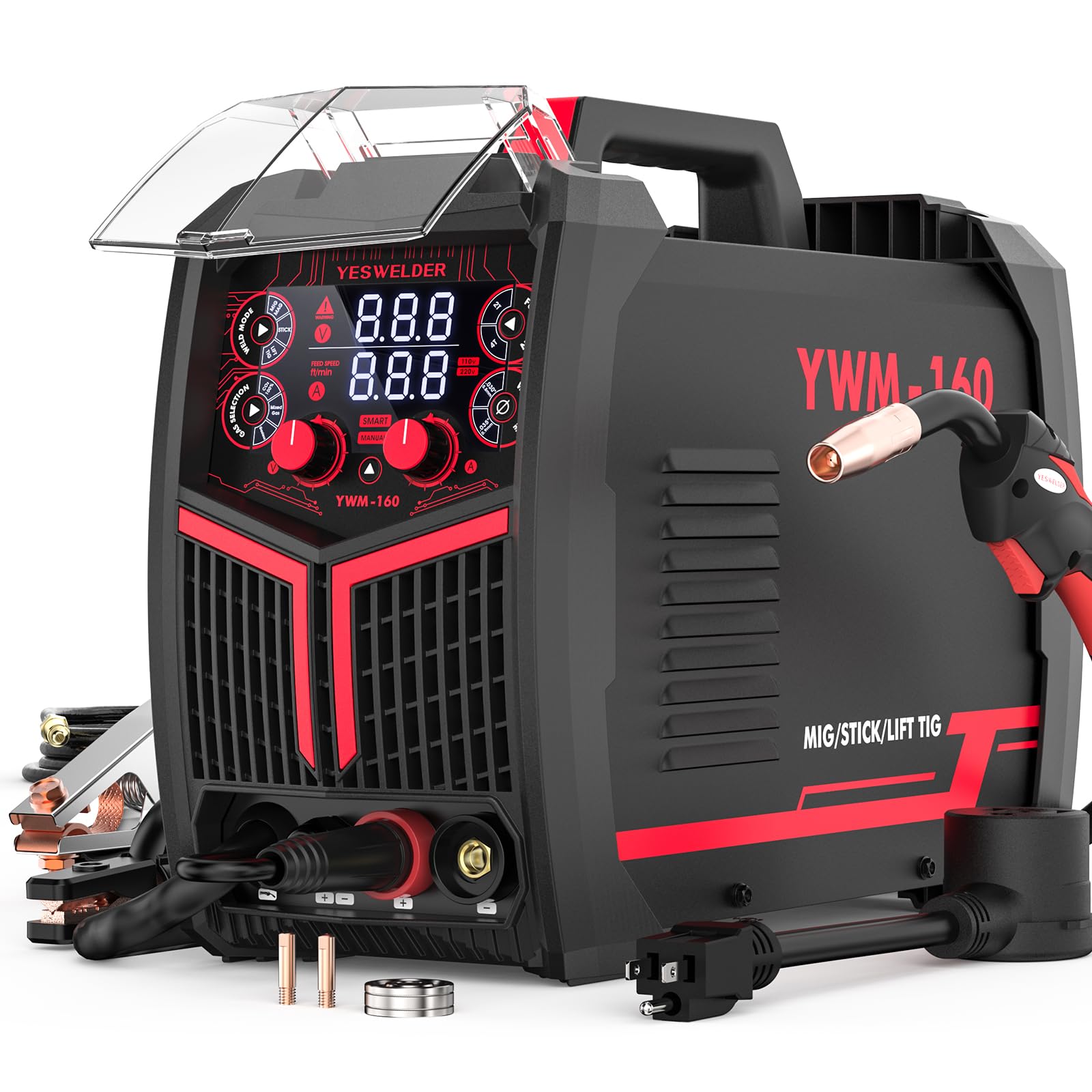
The YESWELDER 160A is a standout for the first-time buyer who wants a synergic system that removes the guesswork from voltage and wire feed matching. Simply adjust the amperage, and the machine automatically selects the recommended settings. Users with no prior welding experience report laying down solid beads on their first attempt. The dual-voltage detection works seamlessly, with an indicator light on the front panel confirming the input.
This 4-in-1 unit covers flux-core MIG, gas MIG, stick, and lift TIG (torch not included). The 160-amp output on 110V is sufficient for 1/8-inch steel, and switching to 220V opens up 1/4-inch material. The LED display is bright and easy to read, and the carrying handle makes transport simple. A 220V to 110V adapter is included, covering both power scenarios out of the box.
Stick welding requires a practiced hand to start the arc, but once it establishes, the arc is stable and consistent. Some users noted that the wire feed speed range could be finer for precise low-speed work. Overall, the YESWELDER provides a friendly entry point with enough capability to grow into, making it a top pick for the home garage.
Why it’s great
- Automatic synergic control reduces setup errors
- Dual-voltage with included adapter
- Great value for the price
Good to know
- Stick arc start can be tricky
- Lift TIG torch not included
7. Bestarc 165A MIG Welder
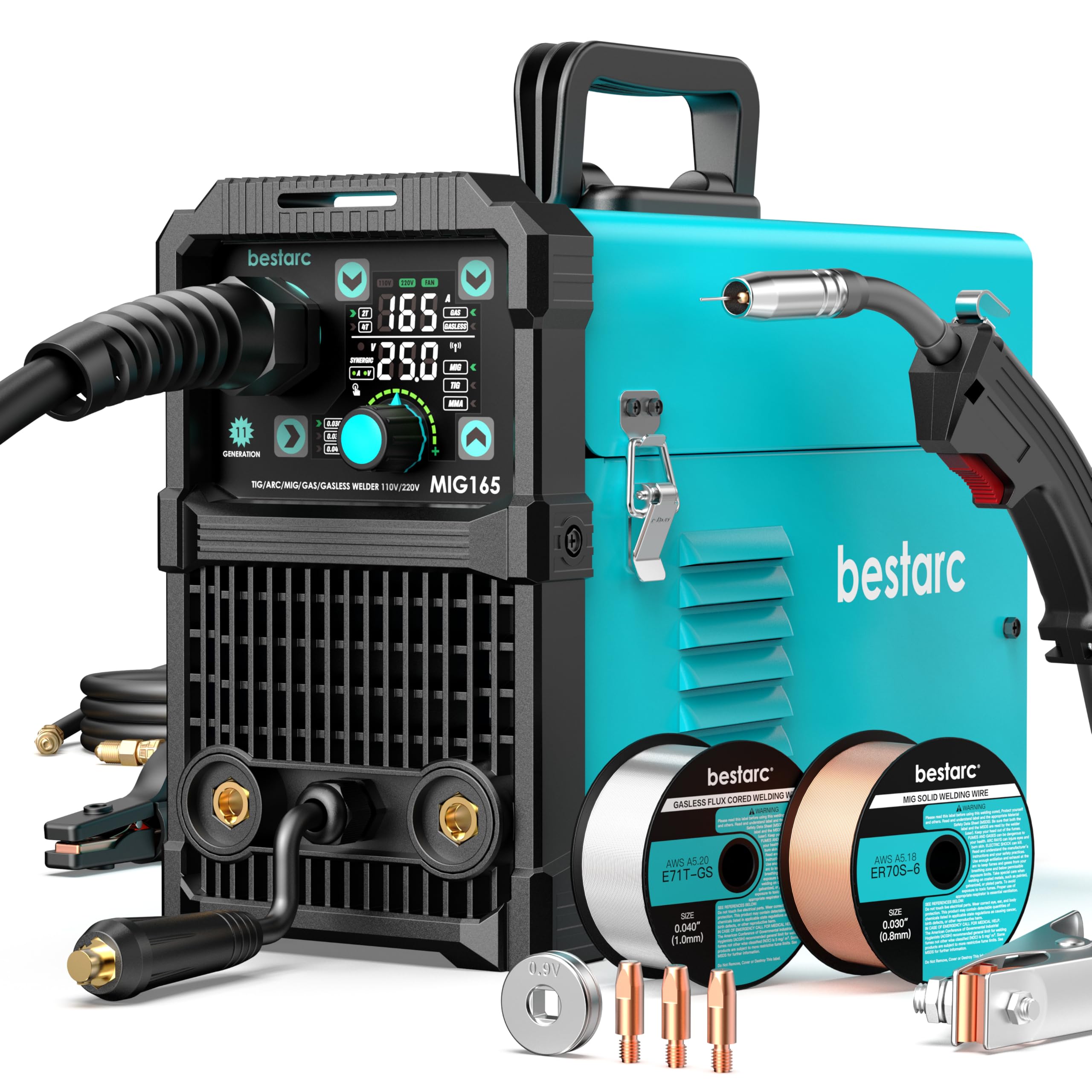
The Bestarc MIG165 is the lightest dual-voltage synergic welder on this list at 13.7 pounds, complete with a shoulder strap for truly one-handed portability. The cyan-colored chassis is compact enough to fit under a truck seat, making it the go-to option for mobile welders doing fence repairs or equipment patching. Despite its tiny footprint, it packs a 4-in-1 function set covering gas MIG, flux-core, lift TIG, and stick welding.
The large LED digital display is positioned so you can check voltage, current, and wire speed without removing your helmet. Synergic control automatically matches voltage to wire feed, and you can tweak the voltage plus or minus 3V to fine-tune the bead. The unit automatically detects 110V or 220V input and shows it on the front indicator. Many users noted that after initial setup issues with earlier production runs (short torch lead, missing knurled drive rolls), Bestarc has addressed these with longer leads and included knurled rollers for flux-core wire.
Stick welding output peaks around 130A, which is adequate for 1/8-inch rods but not for heavy electrodes. The included flux-core and solid wire spools allow immediate testing. If absolute portability is your primary constraint and you need to weld stainless steel or carbon steel across different job sites, the Bestarc MIG165 is the lightest solution that still delivers synergic control.
Why it’s great
- Extremely portable at 13.7 lb
- Synergic control in a tiny package
- Large LED display for helmet-free monitoring
Good to know
- Stick output limited to 130A
- Spool spring tension can be tight
8. Lincoln Electric 90i FC Weld-PAK

The Lincoln Electric 90i FC is the smallest and most specialized entry here, designed exclusively for flux-core welding on a 120V circuit. It trades multi-process flexibility for a refined single-task experience with a brand name trusted in professional shops worldwide. The inverter technology produces a noticeably smoother arc and less spatter than traditional transformer-based flux-core welders. At just 15 pounds and shoe-box dimensions, it fits into tight spaces and travels easily with the included shoulder strap.
Infinite voltage adjustment replaces the two-position rocker switch found on many entry-level units, allowing precise dialing-in for different material thicknesses. The torch lacks a gas nozzle, which improves visibility of the weld puddle — a real advantage for beginners learning to manipulate the arc. Users report deep penetration on 1/8-inch steel and surprisingly strong welds on 1/2-inch plate in multiple passes. The cold feed switch makes spool changes safer by preventing accidental wire feed.
The major limitation is the 1-pound spool capacity, which means frequent spool changes for larger projects. It also lacks a carrying handle — the shoulder strap is the primary transport method. This is a flux-core-only machine; it cannot be converted to gas MIG or stick welding. For someone who needs a no-compromise dedicated flux-core welder for sheet metal repair and doesn’t want to sort through aftermarket brands, the Lincoln 90i FC delivers proven reliability.
Why it’s great
- Lincoln build quality and reliability
- Smooth inverter arc with less spatter
- Compact and ultra-portable
Good to know
- Flux-core only — no gas MIG or stick
- Only accepts 1 lb spools
9. AZZUNO 200A MIG Welder

The AZZUNO MIG200F is the value king of this list, offering a 4-in-1 synergic welder at a price that undercuts most competitors by a wide margin. The 200-amp peak on 220V gives it the same output ceiling as more expensive units, and the synergic control automatically sets voltage and wire feed when you select wire diameter and amperage. Users who built their first projects with this machine report immediate success with flux-core welding on 1/8-inch steel — a testament to how well the automation works.
Customer support from AZZUNO has drawn consistent praise, with one user receiving a prompt replacement after shipping damage. The build quality is decent for the price, featuring clear digital readouts and cables that feel substantial. Gas MIG, flux-core, stick, and lift TIG modes are all available, and the machine accepts both 2-pound and 10-pound spools. The 8mm maximum weld thickness on mild steel is realistic for light fabrication and repair.
Weaknesses include a manual that is poorly translated and missing explanations for several advanced features. The gas inlet uses a 1/4-inch hose barb rather than a standard CGA fitting, so you may need an adapter for some gas regulators. Some users also noted that aluminum MIG welding without a spool gun tends to birdnest easily. If your budget is tight and you want a synergic welder that gets the job done, the AZZUNO is a remarkable value as long as you are willing to work around a less polished manual.
Why it’s great
- Excellent value for a synergic 200A machine
- Responsive customer support
- Handles 10 lb spools
Good to know
- Poorly translated manual
- Gas inlet uses a hose barb fitting
FAQ
Will a 110 Volt MIG Welder weld 1/4-inch steel?
What is the difference between flux-core and gas MIG on a 110V machine?
Do I need a dedicated 20-amp circuit for a 110V MIG welder?
Final Thoughts: The Verdict
For most users, the 110 volt mig welder winner is the PrimeWeld MIG180 because its included spool gun and dual-voltage capability make aluminum and steel welding equally accessible right out of the box. If you want app-controlled remote tuning and a lightweight multi-process machine, grab the ARCCAPTAIN iControl MIG205 Pro. And for the budget-conscious beginner who needs synergic guidance and reliable tech support, nothing beats the AZZUNO 200A MIG Welder.