
Our readers keep the lights on and the weekend projects moving. As an Amazon Associate, I earn from qualifying purchases.
The right adapter eliminates this lag by selecting the correct audio codec and matching it to your TV or audio source’s output ports.
I’m Rikta — the co-founder and writer behind FitlyFast. After spending countless hours analyzing the technical specs, codec support, and port compatibility of dozens of audio adapters, I’ve distilled the key differences that actually matter when you’re trying to cut the cord without cutting the quality.
Whether you’re streaming TV audio to a pair of AirPods, connecting hearing aids for a clearer dialogue, or sharing a movie with someone beside you, understanding the difference between an optical port and an AUX jack or a codec like aptX Low Latency versus standard SBC is the difference between a seamless experience and a frustrating one. That is why this guide cuts through the noise to help you find the best bluetooth transmitter and receiver for your specific setup.
How To Choose The Best Bluetooth Transmitter And Receiver
Picking the wrong adapter means dealing with constant audio dropouts or a noticeable lag that makes dialogue appear to be dubbed. Focus on a few critical specs to avoid that headache.
Check Your TV’s Audio Output Port First
This is the single most common mistake. Many adapters only work with TVs that have an optical (TOSLINK) or a 3.5mm AUX output. If your TV only has an HDMI ARC port, most standard adapters will not work without an additional HDMI audio extractor. Always confirm your TV has one of these ports before you buy.
Understand Bluetooth Codecs and Latency
The standard SBC codec built into most Bluetooth devices introduces a noticeable delay—about 200 to 300 milliseconds. For lip-sync, you want an adapter and headphones that both support aptX Low Latency (under 40ms) or aptX Adaptive. If you are a gamer or watch a lot of dialogue-heavy content, this is non-negotiable.
Transmitter vs. Receiver vs. Dual Mode
A transmitter sends audio from a source like a TV to your headphones. A receiver lets you connect your phone to an old stereo or car AUX port. Dual-mode adapters can do both, but you typically cannot operate both functions at the same time—you must switch between them.
Quick Comparison
On smaller screens, swipe sideways to see the full table.
| Model | Category | Best For | Key Spec | Amazon |
|---|---|---|---|---|
| 1Mii B03+ | Mid-Range | TVs with optical output and soundbar passthrough | aptX Adaptive / aptX HD / aptX LL | Amazon |
| Avantree Audikast 4 | Mid-Range | Hearing aid users with Auracast support | Auracast + aptX Adaptive | Amazon |
| AirFly Pro 2 Deluxe | Premium | Travelers using in-flight entertainment | aptX HD Adaptive, 25+ hr battery | Amazon |
| MEE audio Connect Hub | Premium | Home stereo systems with pass-through | aptX LL, 98ft range, Volume Boost | Amazon |
| Avantree Audikast 3 | Mid-Range | TV watching with two headphones | aptX Adaptive, 100ft range | Amazon |
| Twelve South AirFly Pro | Mid-Range | Frequent flyers and car AUX use | aptX LL, 25+ hr battery | Amazon |
In‑Depth Reviews
1. 1Mii B03+ Bluetooth 5.3 Transmitter Receiver
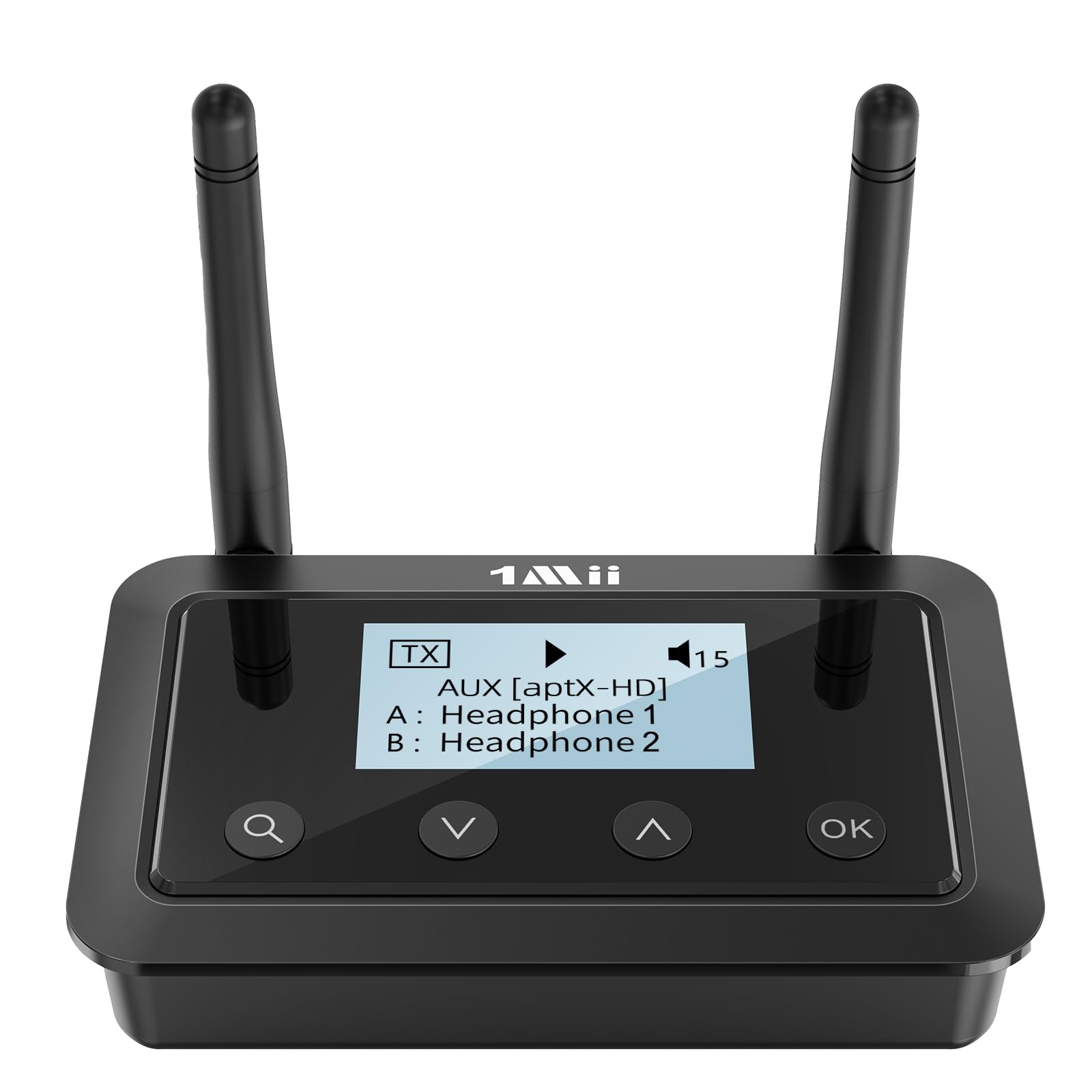
The 1Mii B03+ is the most versatile option for home TV use because it supports every major low-latency codec—aptX Adaptive, aptX HD, and aptX Low Latency—meaning you can pair it with almost any modern Bluetooth headphone and still get near-perfect lip sync. Its LCD screen makes navigating pairing and mode selection far easier than the blinking-LED approach of many competitors.
Beyond codec support, it offers both optical and analog (AUX/RCA) inputs and outputs, plus a soundbar passthrough that lets you send audio to wired speakers and wireless headphones at the same time. Dual Link supports two headphones simultaneously, and the tested indoor range of 70 to 100 feet gives you real freedom to move around the house.
One trade-off: when connecting two headphones that both support aptX Low Latency, the unit automatically downgrades to standard aptX for stability. Still, that is a minor concession for a unit that covers nearly every home audio scenario out of the box.
Why it’s great
- Triple codec support (Adaptive, HD, LL) for best-in-class lip sync
- LCD screen simplifies setup and device selection
- Soundbar passthrough allows simultaneous wired and wireless audio
Good to know
- Dual aptX LL headphones get downgraded to standard aptX for stability
- Long-term reliability complaints from a minority of users after a year of use
2. Avantree Audikast 4
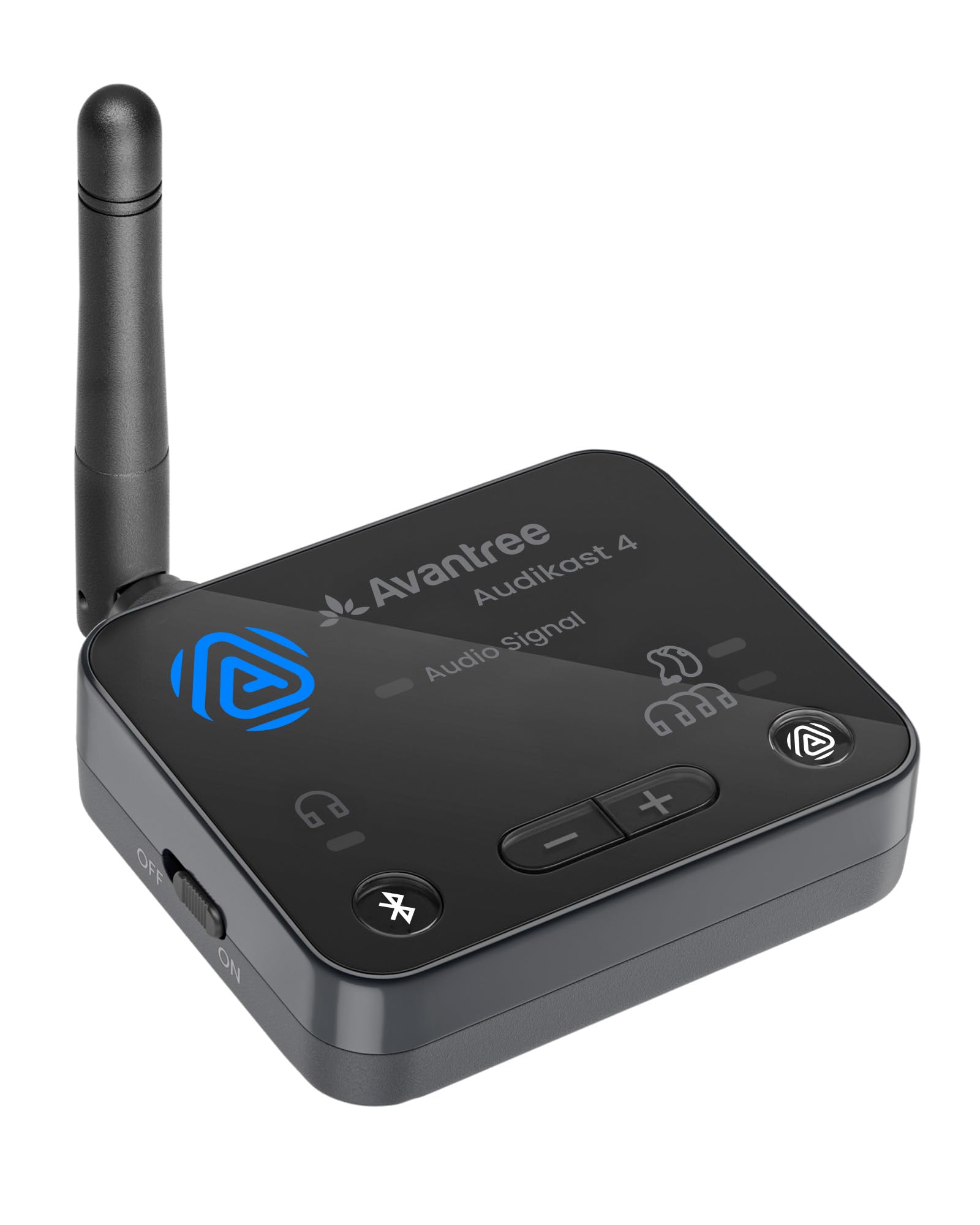
The Avantree Audikast 4 is a specialized device aimed squarely at hearing aid users who need Auracast broadcast audio. Unlike standard adapters that pair one-to-one, Auracast allows multiple Auracast-enabled hearing aids to receive the same TV audio stream with zero lip-sync lag, which is a game-changer for anyone relying on Oticon, Starkey, or Jabra hearing aids.
It also works as a classic Bluetooth transmitter for regular headphones, but only connects to one device at a time in classic mode. The real value here is the future-proof Auracast compatibility, which is increasingly being adopted in public spaces like airports and cinemas. Setup is as simple as plugging into your TV’s optical or AUX port and powering via USB.
Some users reported occasional disconnection with certain hearing aid models, and a few units failed after the return window closed. Still, for the price, it is roughly half the cost of proprietary hearing aid TV streamers and offers broader compatibility with modern Auracast hardware.
Why it’s great
- Auracast support allows lag-free TV audio to multiple hearing aids
- Significantly cheaper than proprietary hearing aid streamers
- Easy plug-and-play via optical or AUX
Good to know
- Classic Bluetooth mode only supports one headphone at a time
- Some reliability concerns after extended use
3. AirFly Pro 2 Deluxe

The AirFly Pro 2 Deluxe is built for the road. It uses Bluetooth 5.3 with aptX HD Adaptive support to deliver high-quality, low-latency audio from airplane seatback screens, gym equipment, or any device with a 3.5mm jack. The 25+ hour battery means you can fly transatlantic without needing a recharge, and the compact white plastic body slips easily into a carry-on pouch.
Dual pairing lets you and a travel companion both connect wireless headphones to the same entertainment screen, and dedicated buttons make adding a second device straightforward. As a receiver, it can also stream music from your phone to an older car stereo via AUX, though you’ll need to remember to disconnect to avoid draining the battery.
The main drawback is that it relies purely on the 3.5mm AUX port—there is no optical input, so it will not work with TVs that only have optical outputs without an additional adapter. The pairing process can occasionally be finicky, especially in crowded airplane environments with competing Bluetooth signals.
Why it’s great
- Over 25 hours of battery life for long flights
- Dual headphone pairing for shared travel viewing
- aptX HD Adaptive ensures solid audio quality with low latency
Good to know
- No optical input—AUX only, limiting TV compatibility
- Pairing can be finicky in crowded Bluetooth environments
4. MEE audio Connect Hub

The MEE audio Connect Hub stands out for its audio pass-through feature: it can sit between your TV and soundbar, sending audio to both your soundbar and a pair of Bluetooth headphones simultaneously. This makes it ideal for nighttime viewing when one person wants loud audio and the other needs quiet listening without disturbing anyone.
It supports aptX Low Latency for tight lip sync and features a Volume Boost mode that specifically amplifies analog (RCA/3.5mm) audio signals, which is helpful for older TVs with weak audio outputs. The adjustable antenna provides up to 98 feet of range, and the voice-assisted setup walks you through the initial configuration—though the voice prompts can be disabled once you are familiar with the unit.
On the downside, the Connect Hub uses a Micro-USB power port (not USB-C) and does not include a wall adapter in the box. It also only supports one active input/output at a time despite having multiple physical ports, so you cannot use the optical and RCA inputs simultaneously without manually switching.
Why it’s great
- Pass-through allows simultaneous soundbar and headphone audio
- Volume Boost amplifies weak analog sources
- Easy voice-assisted setup with adjustable antenna for range
Good to know
- Micro-USB power input feels outdated
- Only one audio input/output active at a time
5. Avantree Audikast 3

The Avantree Audikast 3 is a focused transmitter for TV audio, using Bluetooth 5.3 and a Qualcomm chipset to deliver clear, stable sound with aptX Adaptive support. It works exclusively as a transmitter—not a receiver—and connects via optical or 3.5mm AUX output. It is a no-fuss device for anyone who wants to watch TV privately with headphones without introducing lip-sync drift.
Dual Link lets two people connect separate headphones, and the tested range of 60 feet through walls is more than enough for most living rooms. The unit also boosts volume over optical connections, which can help if your TV’s optical output tends to be quiet. Firmware upgradability via the support page is a nice long-term touch.
One real issue: the 2.4GHz Bluetooth signal can interfere with nearby Wi-Fi, causing occasional stuttering. Users report that a longer optical cable to move the unit away from the router helps. Also, it is essential to set your TV’s audio output to PCM, as it does not support Dolby Digital or DTS.
Why it’s great
- Solid aptX Adaptive support for low-latency TV audio
- Volume boost improves quiet optical outputs
- Firmware upgradable for future performance improvements
Good to know
- Bluetooth signal can interfere with 2.4GHz Wi-Fi
- Must set TV to PCM audio output—no Dolby Digital support
6. Twelve South AirFly Pro

The original Twelve South AirFly Pro remains a reliable companion for travelers. It transmits audio from any 3.5mm headphone jack—airline seatback screens, gym treadmills, or portable gaming consoles—to up to two pairs of Bluetooth headphones. The 25+ hour battery easily handles multi-leg international trips without a recharge.
It uses aptX Low Latency and standard aptX codecs to keep audio reasonably in sync, though with standard Bluetooth headphones you may still notice a slight delay. The unit also functions as a receiver, turning a wired car stereo into a Bluetooth-capable system for music streaming from your phone. The compact design means it takes almost no space in a carry-on.
On the negative side, the black model’s TX/RX switch lettering is nearly unreadable, which can make mode changes frustrating in dim airplane cabins. Some users also report occasional static or audio dropouts, and the USB charging can introduce noise if you use the device while it is plugged in.
Why it’s great
- Long battery life covers multiple long-haul flights
- Compact and portable for travel kits
- Dual mode works for both in-flight and car AUX use
Good to know
- TX/RX labels are hard to read on the black model
- USB charging can introduce signal noise during use
FAQ
Will a Bluetooth transmitter work if my TV only has an HDMI ARC port?
Why is my TV audio out of sync when using a Bluetooth transmitter?
Can I use a Bluetooth transmitter as a receiver to stream music to my stereo?
Final Thoughts: The Verdict
For most users, the bluetooth transmitter and receiver winner is the 1Mii B03+ because it combines triple codec support for near-zero latency with an LCD screen, soundbar passthrough, and coverage for both optical and analog TV ports. If you use hearing aids and need Auracast compatibility, grab the Avantree Audikast 4. And for frequent flyers who need a compact, long-battery travel companion, nothing beats the AirFly Pro 2 Deluxe.