
Our readers keep the lights on and the weekend projects moving. As an Amazon Associate, I earn from qualifying purchases.
A home blood pressure monitor that reads five points off your actual number isn’t just inaccurate — it’s dangerous. The wrong reading can mask a hypertensive crisis or convince you to skip medication that keeps you stable. Yet most buyers pick a monitor based on price or brand alone, ignoring the validation and sensor technology that separate a useless toy from a clinical-grade tool.
I’m Rikta — the co-founder and writer behind FitlyFast. I’ve spent hundreds of hours analyzing oscillometric sensor accuracy, clinical validation protocols, and user-reported consistency data across dozens of blood pressure monitors to separate genuinely precise machines from those that merely look the part.
This guide focuses exclusively on models backed by real-world repeatability testing and independent clinical standards, so you can find the accurate blood pressure monitor that delivers trustworthy readings every time you wrap the cuff.
How To Choose The Best Accurate Blood Pressure Monitor
Not every home monitor that claims clinical accuracy actually delivers it. The difference between a trustworthy device and a decorative one comes down to three factors: cuff-fit detection, motion tolerance algorithms, and independent clinical validation. Here’s what to look for.
Clinical Validation Standards (ANSI/AAMI/ISO 81060-2)
This is the only standard that matters. A monitor certified to this protocol has been tested against a mercury sphygmomanometer in a controlled study. Without this certification, you’re trusting marketing copy — not science. Models that publish their validation study results (like Omron and A&D Medical) allow you to verify the mean error and standard deviation, typically ±3 mmHg or better.
Cuff-Fit Detection and Wide-Range Cuffs
An accurate sensor is useless if the cuff doesn’t fit your arm. Proper cuff sizing — wrapping 80–100% of your upper arm circumference — is the single most common source of user error. Monitors with automatic cuff-fit detection (like the A&D UA-1040TBLE) alert you if the cuff is too loose or too tight, preventing a reading that looks correct but isn’t. Wide-range cuffs (9–17 inches or 22–42 cm) accommodate more arm sizes, but detection technology is what guarantees the fit is right.
Motion Tolerance and Multi-Read Averaging
Even the best sensor produces a false reading if you move, talk, or cross your legs during measurement. Advanced monitors use motion-detection algorithms that flag or discard readings taken while you shifted. The most reliable approach is a TriCheck or multi-read averaging mode: three consecutive readings taken at one-minute intervals, with the monitor automatically calculating the average. This cancels out the white-coat effect and the natural variability of a single reading.
Quick Comparison
On smaller screens, swipe sideways to see the full table.
| Model | Category | Best For | Key Spec | Amazon |
|---|---|---|---|---|
| Omron Gold BP5360 | Premium | AFib detection & daily trending | Clinically validated ±3 mmHg | Amazon |
| Withings BPM Connect | Premium | Wi-Fi sync & sleek design | FDA cleared, rechargeable | Amazon |
| Greater Goods Bluetooth | Mid-Range | Wirecutter pick, app integration | 8.7–16.5 in cuff, 120 total memory | Amazon |
| A&D Medical UA-1040TBLE | Mid-Range | Voice guidance for visually impaired | TriCheck 3-reading average | Amazon |
| FDA-Cleared U80A | Premium | Large LED display for seniors | 4.5-inch bright LED screen | Amazon |
| AQESO 2-Cuff BP Machine | Mid-Range | Two cuff sizes for 9–21 in arms | 2 sizes M/L & XL included | Amazon |
| Acenis AOJ-30F | Budget | Simple, affordable basic tracking | 3-user memory, 40 sec readings | Amazon |
In‑Depth Reviews
1. Omron Gold Blood Pressure Monitor (BP5360)
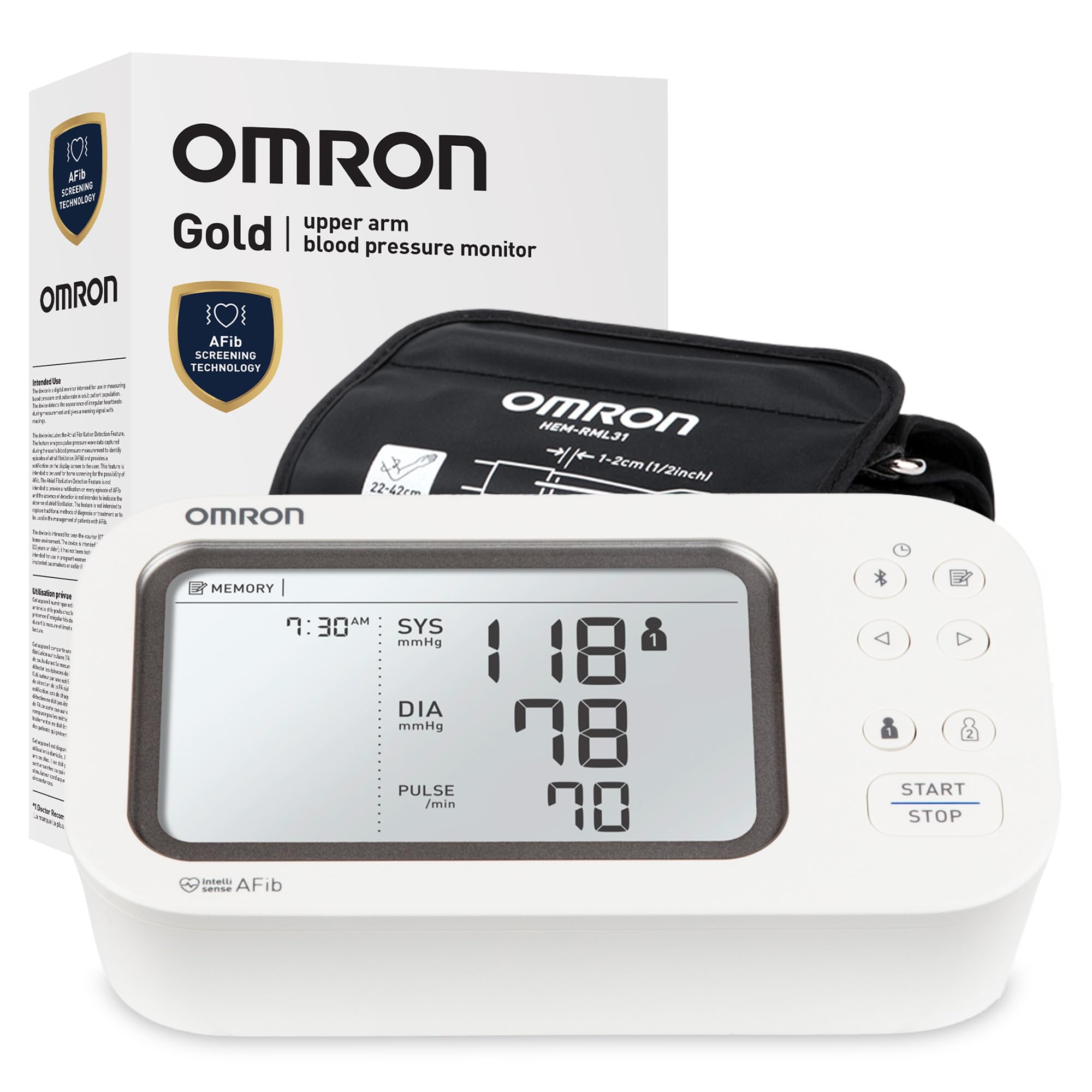
The Omron Gold is the monitor your cardiologist is most likely to trust — it’s the number one doctor- and pharmacist-recommended brand for a reason. The BP5360 uses Omron’s exclusive atrial fibrillation (AFib) detection algorithm that screens for irregular heart rhythms during every reading, a feature found on very few home monitors at any price. The wide-range D-ring cuff (9–17 inches) secures easily, and the High Morning Average Indicator flags morning spikes linked to elevated cardiovascular risk — a subtle but powerful early warning.
Bluetooth syncs effortlessly to the Omron connect app, storing unlimited readings and generating trend reports you can share with your doctor. Users consistently report readings within 3 mmHg of their physician’s office monitor when they follow proper protocol (five minutes of quiet rest, feet flat, back supported). The one caveat: the AFib detection algorithm prevents the device from displaying a reading if it detects an irregular rhythm — not a bug, but it can frustrate users who want a number anyway. This monitor is clinically validated under ANSI/AAMI/ISO 81060-2, so the accuracy claims are verifiable, not rhetorical.
If you’re tracking hypertension and want the highest confidence that every number is real, this is the machine. The dual-user support (separate tracking for two people) and quiet pump operation make it practical for shared household use. It’s not cheap, but for anyone managing a heart condition, the clinical validation alone justifies the premium positioning.
Why it’s great
- Clinically validated ±3 mmHg with published study data
- AFib detection screens for irregular rhythms automatically
- High Morning Average Indicator catches risky morning spikes
- Bluetooth sync with unlimited storage and trend graphs
Good to know
- AFib detection blocks reading display for irregular rhythms
- No on-screen light; display visible but not backlit
- Some users report inaccurate readings vs. doctor’s monitor
2. Withings BPM Connect

The Withings BPM Connect is the only monitor in this lineup that combines Wi-Fi and Bluetooth sync with a rechargeable battery lasting six months — no hunting for AAA batteries at midnight. The stainless steel build and compact footprint (6.07 x 2.31 x 2.16 inches) make it genuinely portable for travel, and the color-coded feedback on the LCD gives you instant context (green, orange, red) without needing the app. FDA cleared and FSA/HSA eligible, this is a monitor designed for people who already use the Health Mate ecosystem for weight and sleep tracking.
Accuracy-wise, one reviewer compared it directly against a professional-grade monitor and found systolic within 2 points and diastolic within 5 points — solid for a home device. The cuff fits arms 22–42 cm, and the automatic inflation algorithm adjusts to your specific pressure level, minimizing over-inflation discomfort. However, some users have reported significant discrepancies (10+ points) compared to their doctor’s monitor, and the return policy has frustrated those with unit-specific accuracy issues. The free Health Mate app exports PDF reports ready for email to your physician, but only on iOS — Android users miss this feature.
This is the best choice if you want a monitor that lives in your overnight bag without needing a power brick. The rechargeable battery and dual wireless connectivity eliminate the friction that causes most people to stop monitoring. Just be prepared to cross-check the first few readings against a clinical device to confirm your unit’s accuracy baseline.
Why it’s great
- Wi-Fi and Bluetooth dual sync for automatic data upload
- Rechargeable battery lasts up to 6 months
- Color-coded feedback on display for instant interpretation
- Compact stainless steel build for travel
Good to know
- Some units show 10+ point discrepancy vs. clinical monitors
- PDF export to doctor available only on iOS
- Setup process and profile switching are unintuitive
3. Greater Goods Bluetooth Smart Blood Pressure Monitor
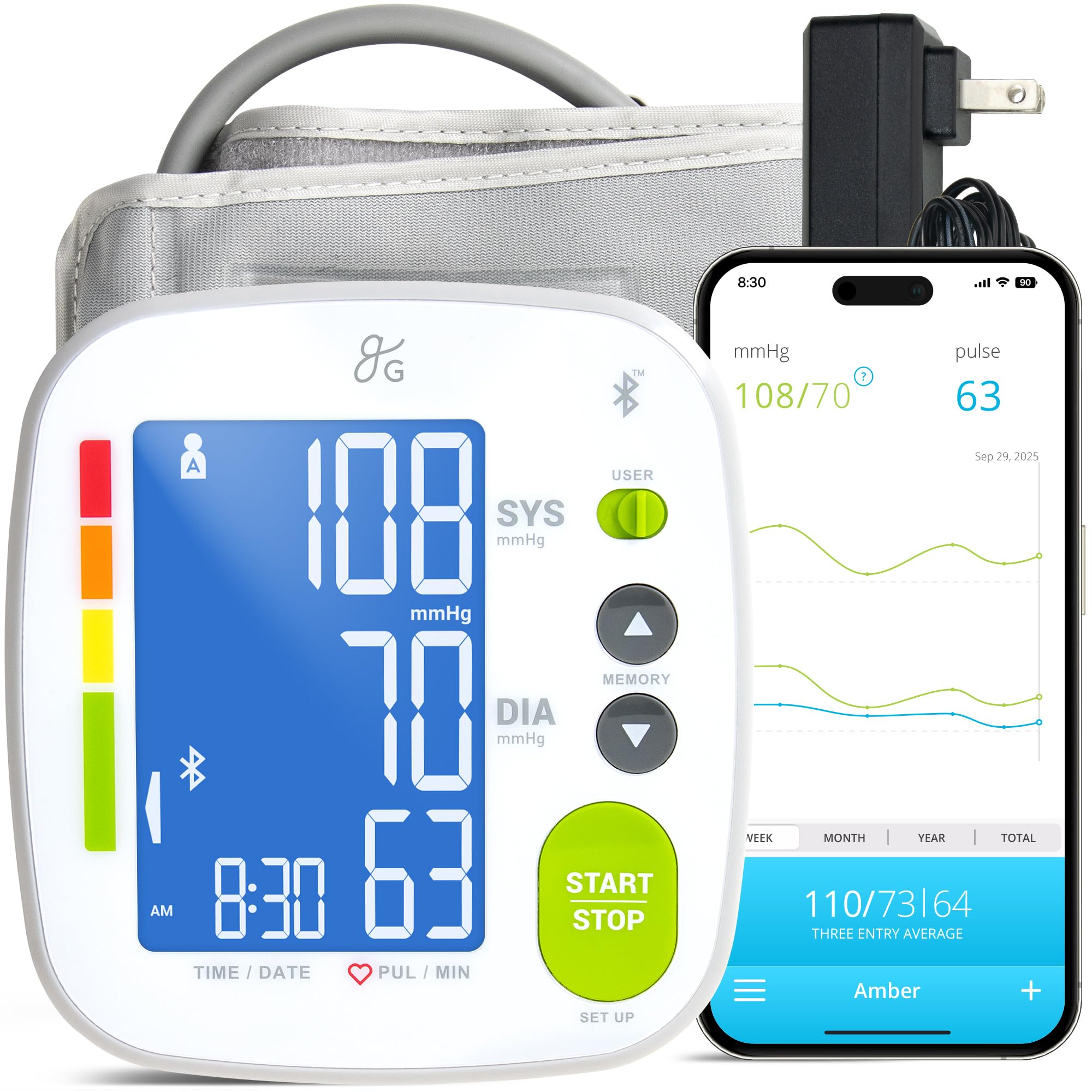
Five-time New York Times Wirecutter pick — that alone tells you the Greater Goods BD3439 has survived the most rigorous consumer testing in the category. The monitor uses an oscillometric sensor paired with an artery alignment guide printed on the cuff to reduce the single biggest accuracy killer: improper cuff placement. The large backlit display shows systolic, diastolic, and pulse in bold numbers visible from across the room, and one-touch operation means you don’t need to navigate a menu to get a reading.
The Balance Health app (iOS and Android) syncs via Bluetooth and stores unlimited readings, with the monitor itself holding 60 readings per user (two users, 120 total) even without the phone nearby. The app integrates with Apple Health and allows you to tag readings with context (before medication, after exercise), which is useful for pattern spotting. Users consistently report readings within 3–5 mmHg of their clinic monitor, and the included travel case and AC adapter mean you can keep it plugged in for consistent power. The start button is easy to bump accidentally, causing unwanted inflation, and the A/B user switch position is counterintuitive — minor annoyances that don’t compromise the accuracy.
If you want a Wirecutter-vetted monitor that doesn’t demand a premium price, this is the sweet spot. The cuff fits 8.7–16.5 inches, and the St. Louis–based support team will send replacement cuffs if you need a different size. For most households tracking hypertension or pre-hypertension, this is the most practical balance of accuracy, app quality, and price.
Why it’s great
- Wirecutter Top Pick — independently verified accuracy
- Artery alignment guide on cuff reduces placement errors
- 120-reading memory (60 per user) with or without Bluetooth
- Includes travel case, AC adapter, and 4 AAA batteries
Good to know
- Start button easily bumped, causing accidental inflation
- User A/B switch position is counterintuitive
- Smaller and larger cuffs sold separately via support
4. A&D Medical Voice-Guided Blood Pressure Monitor UA-1040TBLE
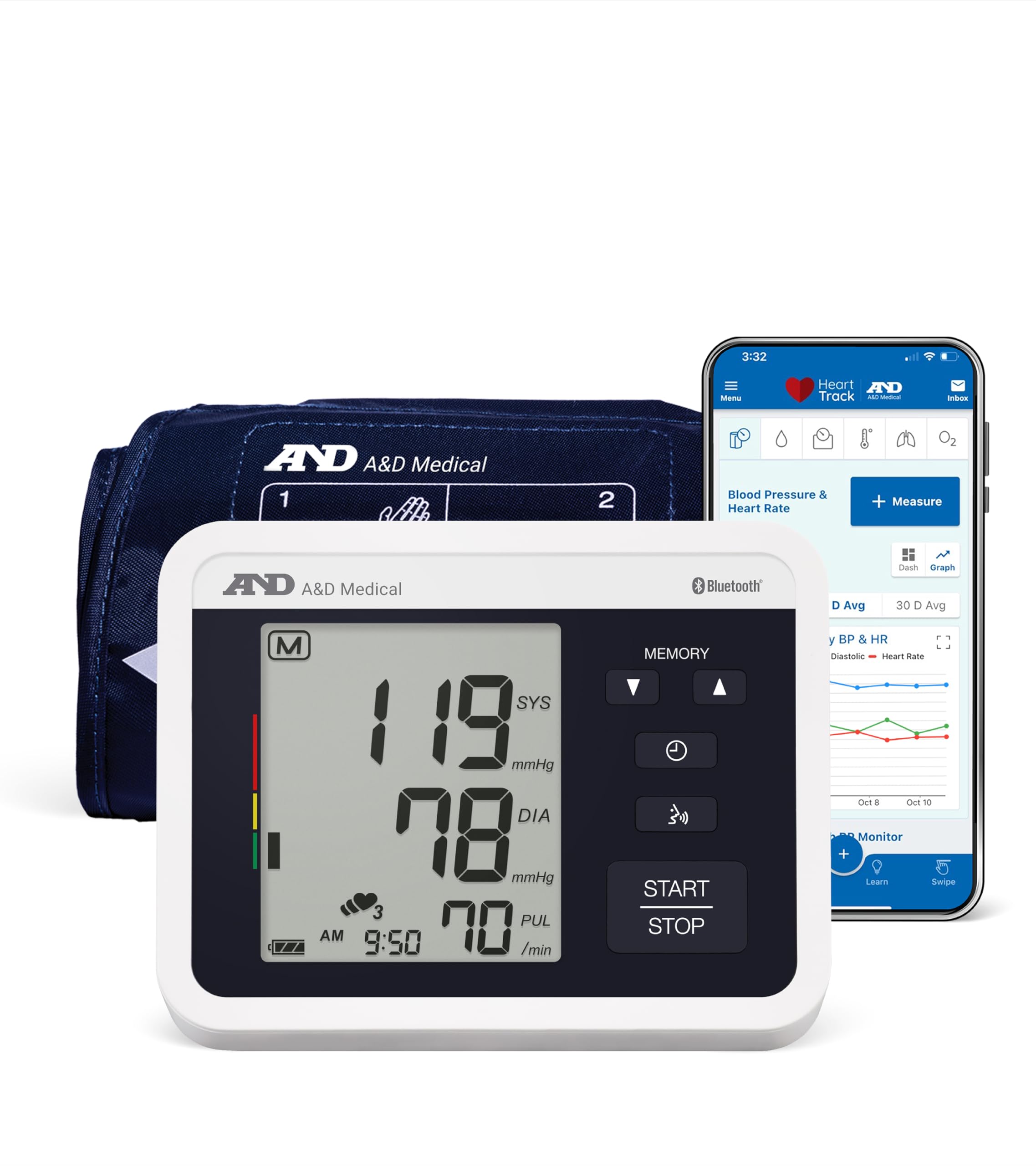
The A&D Medical UA-1040TBLE is the only monitor on this list that speaks your results aloud in English, Spanish, or French — a non-negotiable feature for users with visual impairments or anyone who needs audio confirmation. The voice guidance walks you through the entire measurement process, from cuff placement instructions to announcing the final systolic, diastolic, and pulse numbers. The pre-formed wide-range cuff (8.6–16.5 inches) snaps into position more easily than a traditional wrap-around cuff, and the cuff-fit detection technology alerts you if the wrap is too loose or too tight, eliminating the most common source of bad readings.
Its standout accuracy feature is the TriCheck function: the monitor automatically takes three consecutive readings at one-minute intervals and displays the average. This is clinically proven to produce more reliable numbers than a single reading, especially for users who experience first-reading anxiety (the “white-coat effect”). The A&D Heart Track app syncs via Bluetooth and stores unlimited readings with trend graphs, and the monitor is compatible with four different cuff sizes (small, medium, large, and wide range) sold separately — a rare level of fit customization. The pre-formed cuff also works well on the forearm for users who can’t tolerate upper arm inflation.
If you or a family member has low vision or you simply want the peace of mind that comes with a triple-averaged reading, this is the monitor to buy. The voice quality is clear and loud enough for a 70-year-old with hearing aids, and the large LCD screen with oversized numbers provides a backup. It’s slightly pricier than basic models, but the TriCheck validation and cuff-fit detection justify the spend.
Why it’s great
- Voice guidance in English, Spanish, and French for accessibility
- TriCheck auto-averages three readings for higher accuracy
- Cuff-fit detection alerts you to loose or tight cuffs
- Compatible with 4 different cuff sizes for custom fit
Good to know
- AC adapter sold separately
- Bluetooth requires app open during measurement to sync
- Pre-formed cuff may feel different than traditional cuffs
5. FDA-Cleared Blood Pressure Monitor U80A (4.5-Inch LED)
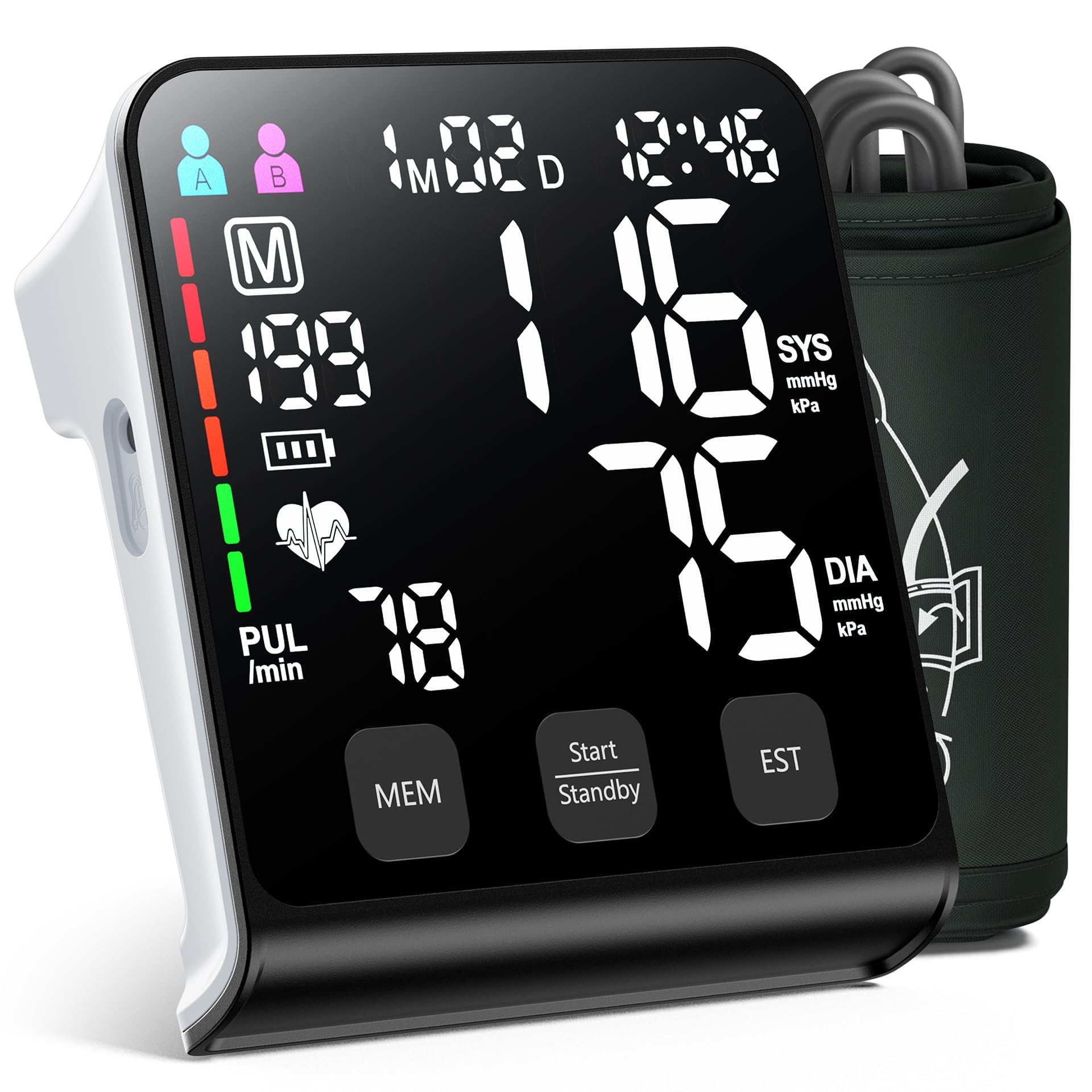
The U80A’s headline feature is the 4.5-inch bright LED display — not just backlit but actively illuminated with bold white digits that are readable from 15 feet away. For seniors or anyone who wears bifocals, this eliminates the squinting and head-tilting that makes most monitors frustrating to use. The monitor sits on a scratch-resistant acrylic panel and includes a blood pressure classification indicator (color-coded bar) so you know at a glance whether you’re in the normal, elevated, or hypertensive range without memorizing numbers.
Accuracy is handled by an intelligent pressure algorithm with an error margin of ≤±3 mmHg, and the adjustable cuff minimizes human error during placement. It supports two users with 199 readings each (398 total) and includes a heart rate irregularity alert — not as advanced as Omron’s AFib detection, but sufficient for flagging obvious rhythm disturbances. The one-touch operation is genuinely simple: wrap, press, and wait for results in under 40 seconds. It’s FSA and HSA eligible, so you can use pre-tax dollars, and it runs on batteries or USB power (cable included).
This monitor is the best pick for a senior parent or grandparent who needs a no-compromise display and doesn’t want to wrestle with an app. The memory function lets you check their readings during visits, and the compact build (4.7 x 1.9 x 4.7 inches) slides into a travel bag. It lacks Bluetooth, so there’s no automatic trend tracking — you’ll log manually or rely on the on-device memory. For pure, daily visibility and reliable ±3 mmHg accuracy, it’s hard to beat at this level.
Why it’s great
- 4.5-inch bright LED display readable from across the room
- ≤±3 mmHg accuracy with adjustable cuff-fit algorithm
- 199 reading memory per user for two users
- FSA/HSA eligible and USB power compatible
Good to know
- No Bluetooth or app connectivity
- Heart rate irregularity alert is basic, not AFib-specific
- AC adapter not included; USB cable provided
6. AQESO Blood Pressure Machine with 2 Size Cuffs

The AQESO solves the most overlooked accuracy problem in home monitoring: cuff size mismatch. It ships with two cuffs — a Medium/Large (9–17 inches) and an Extra Large XL (13–21 inches) — so you can pick the one that wraps 80–100% of your arm circumference. Using the wrong cuff size can skew readings by 10 mmHg or more, and most monitors only include one. The oscillometric sensor uses advanced inflation algorithms to match your baseline pressure, reducing over-inflation discomfort that makes users tense up and skew their numbers.
The large backlit LCD display is legible in low light, and one-touch operation delivers systolic, diastolic, and pulse in under 40 seconds. Two-user support with 500 readings each (1,000 total) captures months of data without needing to clear memory. The WHO classification bar on the display gives you a red-yellow-green visual of where your reading lands, useful for quick interpretation. USB Type-C power means you can run it from any phone charger or power bank, though the device is not rechargeable — it needs continuous USB connection or 4 AAA batteries for portable use.
This is the monitor for households with arm size diversity — a slender adult and a larger-framed family member sharing one device. The two-cuff approach is more honest than a single “wide-range” cuff that fits everyone poorly. Reviewers consistently describe readings as accurate and repeatable, though the date/time setup can be fiddly. For the price, you get a precision-oriented solution to the biggest variable in home BP accuracy.
Why it’s great
- Includes M/L (9–17 in) and XL (13–21 in) cuffs for proper fit
- 1,000-reading total memory (500 per user)
- USB Type-C power for flexible charging
- WHO classification bar for instant result context
Good to know
- Device is not rechargeable; USB connection must stay active
- Date/time setup is initially confusing
- No app or Bluetooth connectivity
7. Acenis Automatic Blood Pressure Monitor AOJ-30F
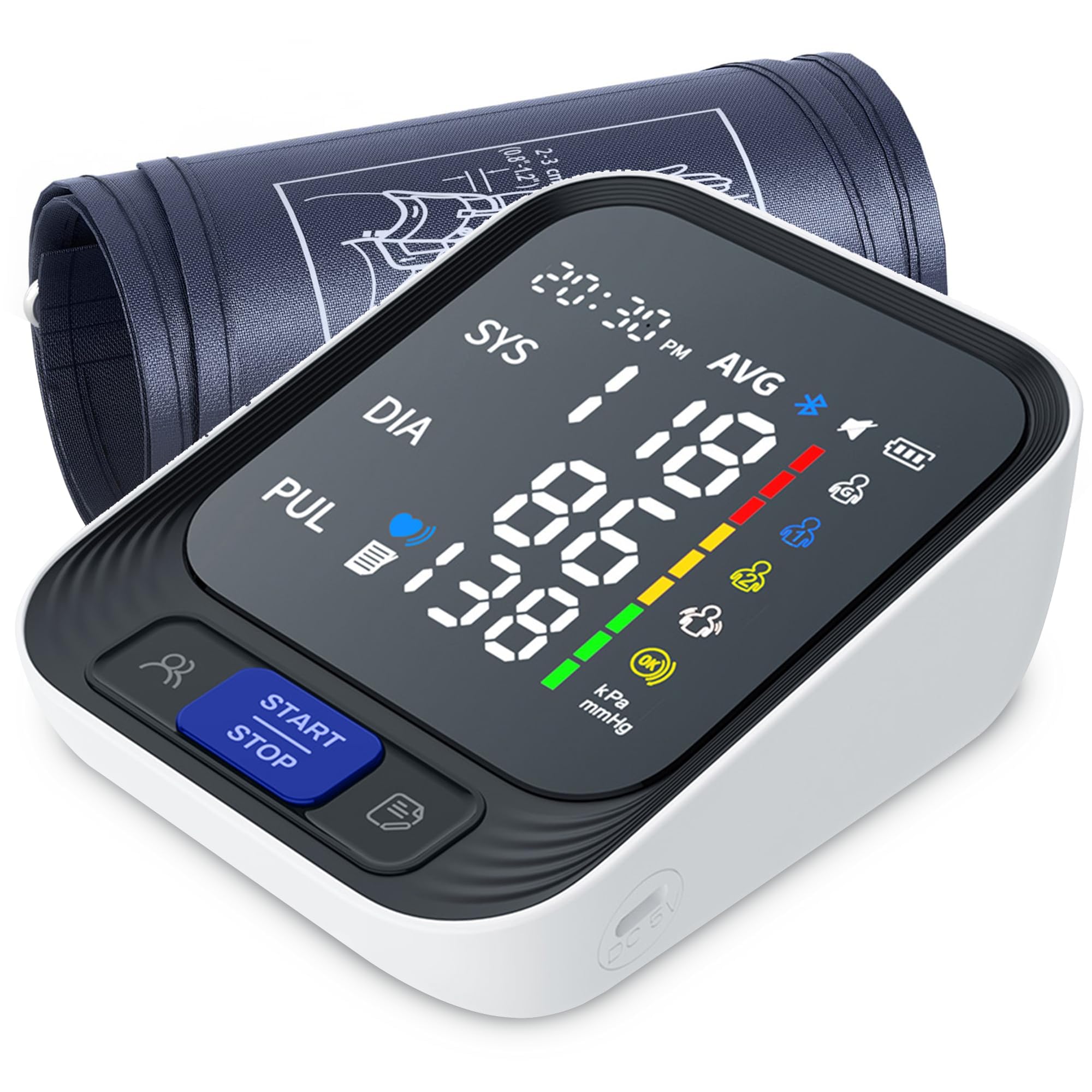
The Acenis AOJ-30F strips the category down to essentials: a large color screen, a comfortable adjustable cuff, and readings in 40 seconds with one button. It tracks three separate users and stores 2 readings per user (6 total) — minimal memory, but enough for a quick morning/evening snapshot. The cuff is described by multiple reviewers as more repeatable than three other tested models, which suggests the oscillometric sensor and inflation algorithm are tuned well despite the entry-level price point.
The color screen is genuinely useful for seniors: the large digits in high-contrast colors eliminate the need for reading glasses. The monitor runs on 4 AAA batteries (included) or a power cord (also included), and the lightweight build (1.1 pounds) makes it easy to carry from room to room. Some users found the date and time setup button sequence confusing, and the memory is too small for any serious trend tracking — you’ll need a paper log or a separate app. But for pure, reliable read-and-record use, this monitor delivers consistent numbers.
If you need a backup monitor, an office device, or a simple unit for a family member who checks BP occasionally and doesn’t want an app, this is the most budget-conscious way to get repeatable readings. It won’t replace a clinical-grade Omron for someone managing AFib, but for general wellness monitoring and pre-hypertension tracking, it punches above its weight on consistency.
Why it’s great
- Repeatable readings — more consistent than several costlier models
- Large color screen with bold digits, easy for seniors
- Includes power cord and AAA batteries
- Tracks 3 separate users for household use
Good to know
- Only 2 reading memory per user (6 total)
- Date/time setup is confusing for some users
- No Bluetooth, app, or advanced trend tracking
FAQ
What is the difference between a clinically validated monitor and one that just claims accuracy?
Why does cuff size matter so much for accurate readings?
Should I take one reading or multiple readings for the most accurate result?
Can I use an accurate blood pressure monitor if I have atrial fibrillation?
Final Thoughts: The Verdict
For most users, the accurate blood pressure monitor winner is the Omron Gold BP5360 because its clinically validated ±3 mmHg accuracy, AFib detection, and morning spike indicator provide the highest confidence for managing hypertension. If you want a Wirecutter-backed option with excellent app integration, grab the Greater Goods Bluetooth Monitor. And for seniors or visually impaired users who need voice-guided readings and a triple-averaging TriCheck mode, nothing beats the A&D Medical UA-1040TBLE.