
A miter saw that drifts mid-cut or fails to lock at common angles turns a simple trim job into a frustrating game of sand-and-fill. The real difference between a usable saw and a shop anchor comes down to three things: motor consistency, fence squareness out of the box, and how well the detent plate holds its click. A 10-inch saw is the sweet spot—big enough to cross-cut a 2×12 in one pass, compact enough to stow under a bench.
I’m Rikta — the co-founder and writer behind FitlyFast. I’ve cross-referenced hundreds of verified customer reports, torque curves, and spec sheets to isolate the models that hold alignment through heavy use and those that shake loose after a few dozen cuts.
The right 10 inch miter saw balances raw cutting capacity with repeatable accuracy, and this guide walks through the models that deliver both without hidden setup headaches.
How To Choose The Best 10 Inch Miter Saw
Every saw in this category cuts wood. But the saws that save you time hold their angle detents without creep, ship with a fence that is actually square from the factory, and have enough table extension to support long baseboard without sag. The choice boils down to bevel complexity, sliding mechanism, and portability versus rigidity.
Single Bevel vs. Double Bevel
A single-bevel saw tilts the blade head to one side (usually left). For crown molding and picture frames, you flip the workpiece or cut from both sides. A double-bevel saw tilts left and right, which means you never flip the board. Pros working production trim choose double bevel; DIY crown-molding installers on a budget can manage with single bevel and a sharp pencil.
Sliding vs. Non-Sliding vs. Axial-Glide
Non-sliding saws (often called chop saws) move straight up and down—perfect for 2x4s and 4x4s but limited to about 6 inches of crosscut width. Sliding saws use rails to pull the blade through wider boards (up to 12 inches or more). Axial-glide replaces the rails with an articulating arm, giving the same wide cut capacity in roughly 10 inches less bench depth. If your workshop is tight, the axial-glide wins.
Laser Guide vs. Shadow Line
Laser guides project a red line where the blade kerf will land—helpful in low light or for beginners. Shadow lines (like Metabo HPT’s Xact Cut) physically cast a shadow of the blade’s profile onto the wood using a built-in light. Shadow lines never need battery alignment and remain accurate even after blade changes. Lasers drift more over time but are simpler to adjust.
Quick Comparison
On smaller screens, swipe sideways to see the full table.
| Model | Category | Best For | Key Spec | Amazon |
|---|---|---|---|---|
| Metabo HPT C10FCG2 | Single Bevel | Lightweight job-site portability | 24 lbs, 5000 RPM, Xact Cut shadow line | Amazon |
| MarvTool JS-1017C3 | Single Bevel | Budget-conscious DIY crosscuts | 20.5 lbs, 5000 RPM, extension tables | Amazon |
| Hoteche P805220A | Single Bevel | Laser-guided entry-level trim work | 1800W motor, 40T TCT blade, laser guide | Amazon |
| Genesis GMS1015LC | Single Bevel | Homeowner with 9 positive miter stops | 15 Amp, 60T carbide blade, laser guide | Amazon |
| Evolution R185SMS+ | Sliding Compound | Multi-material cutting (steel & aluminum) | 1500W, 7-1/4″ blade, 210mm slide | Amazon |
| Evolution R255SMS+ | Sliding Compound | 10″ multi-material with soft start | 15 Amp, 50° miter, dual quick-release clamps | Amazon |
| Makita LS1040 | Single Bevel | Pro trim carpenters wanting rock-solid pivots | 15 Amp, 4600 RPM, 9 positive miter stops | Amazon |
| DEWALT DCS714WW1 | Cordless Double Bevel | Remote job-sites without power | 20V MAX, 434 cuts per charge, 97% dust capture | Amazon |
| BOSCH CM10GD | Dual-Bevel Axial-Glide | Professionals needing compact sliding capacity | Axial-Glide, 60-tooth blade, upfront controls | Amazon |
In‑Depth Reviews
1. Metabo HPT C10FCG2
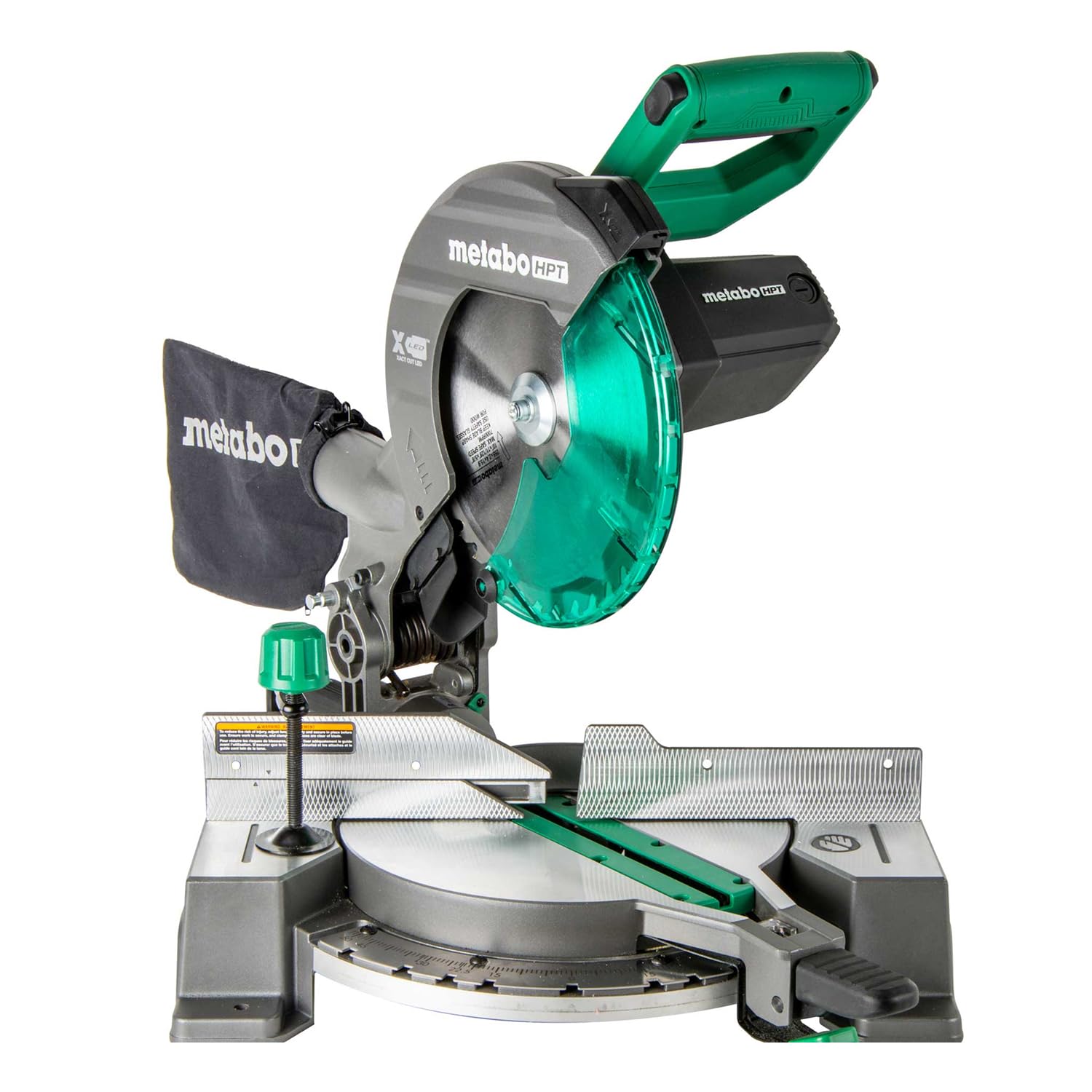
The Metabo HPT C10FCG2 hits a rare balance: 24 pounds of portable weight without feeling flimsy on the bench. The 15-amp motor spins at 5000 RPM, and the Xact Cut shadow line projects a blade-profile shadow onto the wood—no batteries, no laser drift. Reviewers consistently report it arrives square from the box, meaning zero shimming before the first cut on pine or oak.
Miter range spans 0-52° left and right, with positive stops at common angles. The bevel tilts 0-45° left, which covers standard compound cuts for baseboard and crown molding when you flip the work. The included 40-tooth TCT blade delivers clean crosscuts on construction lumber, though users upgrading to a high-end thin-kerf blade notice a marked reduction in drag on hardwoods.
A few owners noted a faint burning smell and rough idle during the first few minutes of break-in—typical for new brushed motors that need a brief run-in period. The included blade wrench uses a 16mm hex that some buyers found missing from their box. Replacement wrenches are inexpensive, but verify yours is packed before the truck leaves.
Why it’s great
- Lightest full-featured 10-inch compound saw at 24 lbs
- Xact Cut shadow line never needs battery replacement
- Five-year tool body warranty from a Japanese-engineered brand
Good to know
- Non-sliding design limits crosscut to roughly 5-1/2 inches
- Some units ship missing the 16mm hex wrench
- Motor may run rough for the first 10-15 cuts
2. MarvTool JS-1017C3
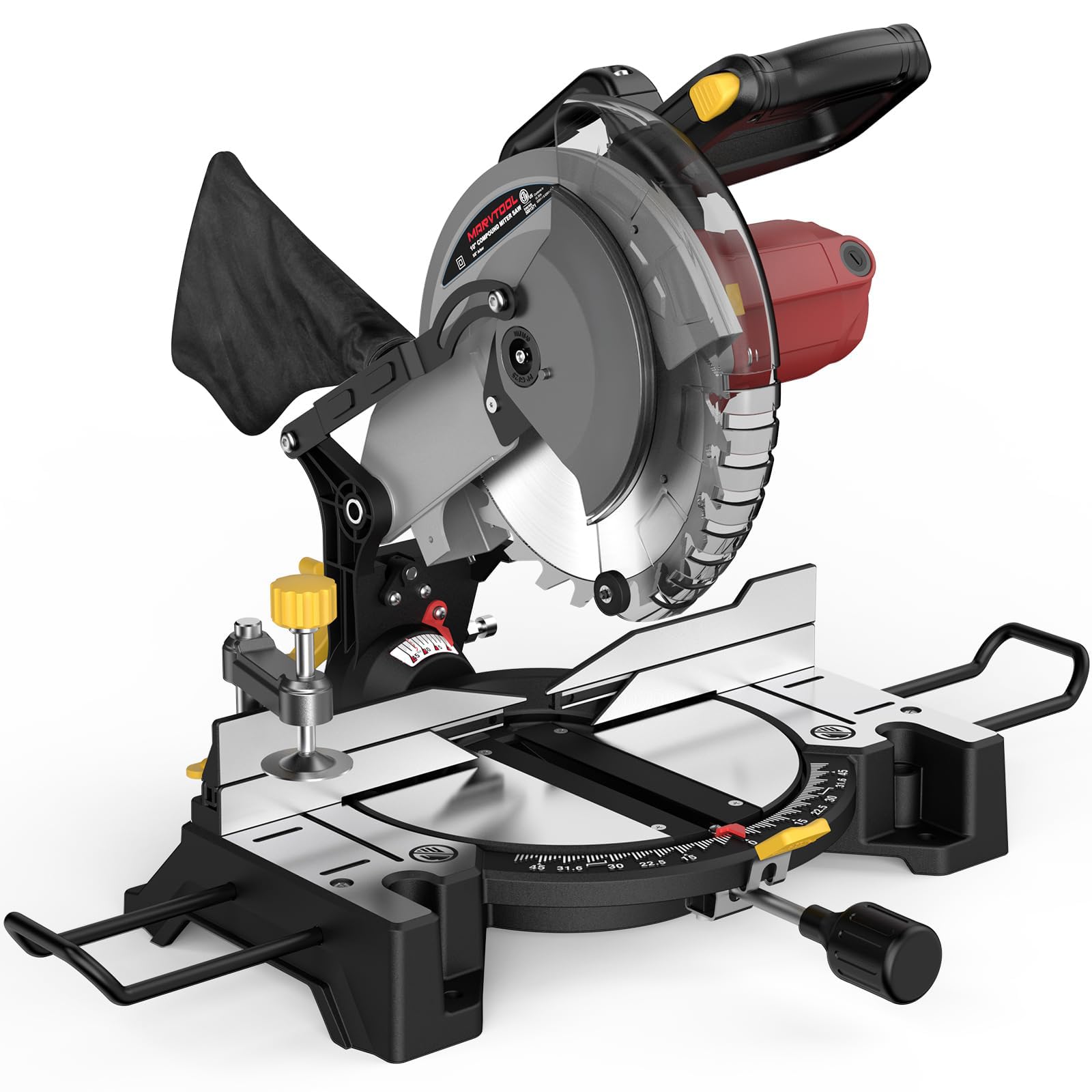
The MarvTool JS-1017C3 sheds weight aggressively—20.5 pounds makes it the lightest saw in this lineup, and the compact footprint (19.5″ x 16.5″) lets it sit on a workmate or tailgate without feeling top-heavy. The 15-amp motor drives a 36-tooth alloy steel blade to 5000 RPM, and included extension tables give you 16 inches of workpiece support on each side.
Miter adjustments swing from 0-45° left, and the base tilts 0-45° for bevel cuts. The depth stop is plastic and functional but not robust—users report it works fine for repetitive dados provided you don’t overtighten. The vice clamp enhances safety for small stock, though the clamp shoe’s grip could be stickier for round or irregular material.
Assembly takes under 15 minutes, but the written instructions for the locking knob are sparse—most users figure out the rotating acute-angle release by trial. The saw has a slight startup kick as the motor catches, so clamping is recommended before every cut. After a few dozen cuts and a blade swap to a quality carbide, the MarvTool holds alignment well for a saw at this tier.
Why it’s great
- Easiest saw to move between job sites at 20.5 lbs
- Two extension tables included in the box
- Strong value for DIY crosscutting on 2x4s and 4x4s
Good to know
- Depth stop is flimsy plastic—modify or replace for repeat cuts
- Replacing the stock blade with a carbide upgrade is recommended
- Miter knob must be loosened almost fully to reach acute angles
3. Hoteche P805220A
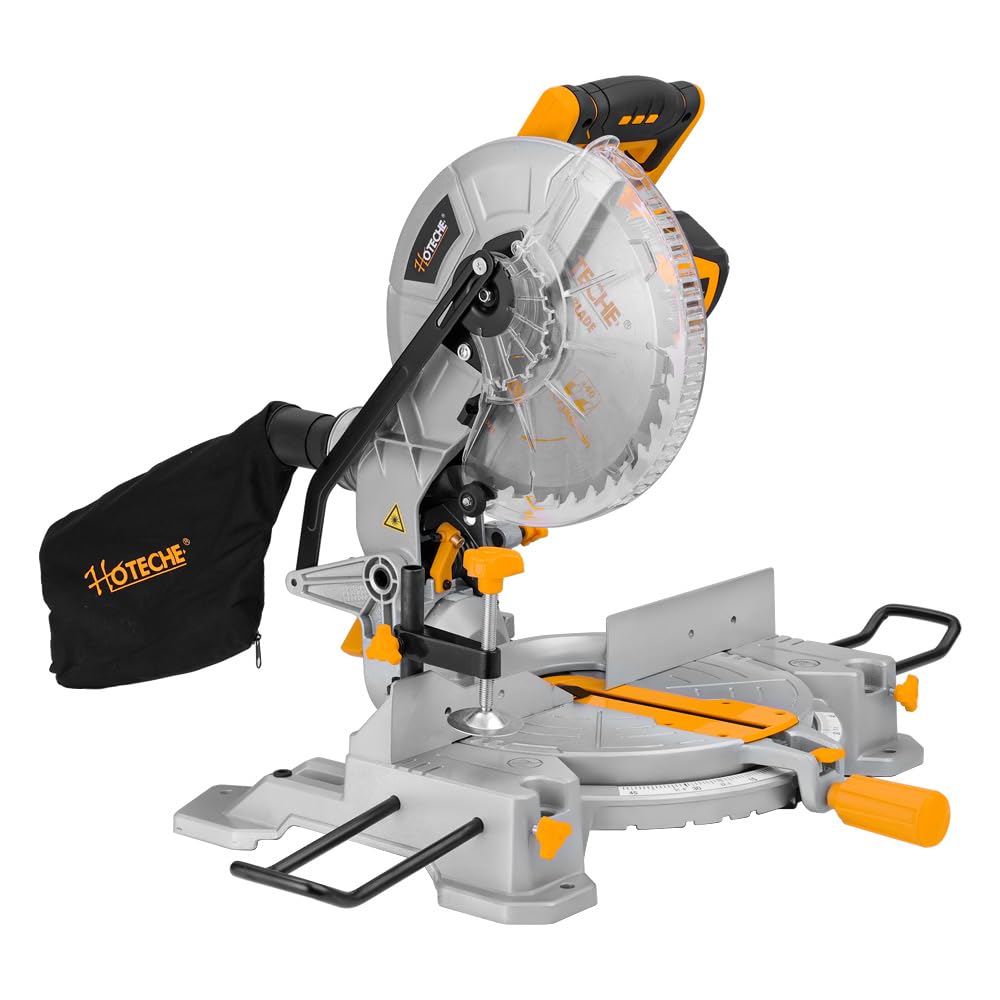
The Hoteche P805220A packs an 1800W motor (roughly 15-amp equivalent) and an integrated laser guide that projects a red cut line directly along the blade path. The kit is unusually complete: a 40-tooth TCT blade, workpiece clamp, dust bag, dust port, extension bars, carbon brushes, and a hex key—everything needed for the first cut except the lumber. The die-cast aluminum base keeps vibration low even at full 5000 RPM.
Miter range is 0-45° left and right, with bevel up to 45° left. The maximum cut capacity at 0° x 0° is 140mm x 70mm (5.5 x 2.75 inches), enough for a 4×4 in one pass. The laser is powered by included batteries and aligns via set screws, but users report it holds zero well through normal use if you don’t knock the saw head during transport.
Some owners found the instruction manual cryptic for the lock-release mechanism—a common pain point for first-time miter-saw buyers. The fence is set slightly forward, which limits the maximum board width you can rest against it. For 1×2 strips and window casing, the laser makes fast work of repetitive angle cuts. A helpful owner posted a video walkthrough that clarifies the lock-up sequence.
Why it’s great
- Bonus accessories: clamp, dust bag, carbon brushes, extension bars
- UL listed with North American 110-120V plug—no adapter needed
- Laser guide speeds setup for repeatable angle cuts
Good to know
- Fence sits forward—wider stock may overhang unsupported
- Lock-release mechanism is non-intuitive; watch a setup video
- Not suited for 6×6 beams despite the motor power
4. Genesis GMS1015LC

The Genesis GMS1015LC ships with a 60-tooth carbide-tipped blade, which is unusually high tooth-count for a budget-tier saw—that extra teeth mean smoother crosscuts on trim and hardwood right out of the box. The 15-amp motor includes an electric brake that stops the blade in seconds, and the arbor lock makes blade swaps quick without needing a second tool to hold the spindle.
Nine positive miter stops at 0°, 15°, 22.5°, 30°, and 45° (both left and right) lock firmly for fast setup. The bevel goes 0-45° left, and the included laser guide runs on two AAA batteries. The die-cast aluminum base is sturdy enough that the saw feels planted during a cut, but the included dust bag is mostly a gesture—plan on attaching a shop vac via the exhaust port for real dust control.
Owners caution against cutting metal with this saw—the plastic components near the motor vent can soften from heat generated by steel friction. The clamps on the extension wings can vibrate loose over time, so check them before each use. For the homeowner cutting baseboard, crown molding, and 2x4s for a weekend shed, the Genesis delivers accurate miters with minimal tuning.
Why it’s great
- 60-tooth carbide blade delivers exceptionally smooth finish cuts
- Electric brake stops blade in seconds for safety
- 9 positive miter stops speed up repetitive angled cuts
Good to know
- Not built for metal cutting—heat damages plastic components
- Extension wings can vibrate loose; re-tighten periodically
- Dust bag is near-useless; shop vac connection is essential
5. Evolution R185SMS+

The Evolution R185SMS+ uses a 7-1/4 inch blade—smaller than the 10-inch standard—but compensates with a patented multi-material cutting system that slices through mild steel, aluminum, wood with embedded nails, and plastic without sparks or burrs. The 1500W optimized gearbox drives the blade through a 210mm sliding action, giving you a crosscut capacity roughly equivalent to a 10-inch non-sliding saw.
Bevel tilts 0-45°, and miter swings 50° left and right. The included TCT blade is designed specifically for Evolution’s multi-material system; replacements are available but proprietary. The laser cutting guide aligns accurately out of the box, and the carry handle makes it the easiest saw in this list to grab and go. The 3-year warranty is best-in-class for this price tier.
Build quality is suited for finish and light steel work, not daily framing. The motor draws around 760W under load despite the 1500W rating, and the cord gauge is smaller than on premium models—expect some voltage drop on long extension cords. The smooth ball-bearing slides and robust clamp system earn high marks from metal fabricators installing handrails and decorative steel.
Why it’s great
- Cuts steel and aluminum with virtually no sparks or heat
- 3-year manufacturer warranty—strong for the price point
- Smooth ball-bearing sliding action; lightweight carry handle
Good to know
- 7-1/4″ blade limits max depth compared to 10-inch saws
- Proprietary blade system means no standard blade swaps
- Not built for heavy framing work; best for finish and metal
6. Evolution R255SMS+

The Evolution R255SMS+ brings the multi-material cutting technology to a full 10-inch format, with a 15-amp motor and soft-start electronics that prevent breaker trips on shared circuits. The sliding system uses hardened rails and ball bearings for smooth travel, and the included dual quick-release clamps hold both sides of the workpiece—critical when cutting thin steel or aluminum that tends to chatter.
Bevel range is 0-45°, and the miter swings 50° in either direction. The taller fences support 5-inch baseboard vertically, and the slide rail protector keeps sawdust from clogging the bearings. The 3-meter power cord is generous for a jobsite saw, and the integrated carry handles make one-person transport manageable despite the saw’s heft.
Some owners note that the included TCT blade leaves a slightly rough edge on plywood—the blade is optimized for metal and nail-embedded wood, not finish-grade ply. A dedicated wood blade improves cut quality significantly. The clamp design is functional but feels less substantial than the main saw body. For a homeowner who frames with lumber and builds steel gates, this saw is one tool that does both.
Why it’s great
- Soft-start motor won’t trip sensitive breakers on startup
- Dual quick-release clamps secure material on both sides
- Tall fences support upright baseboard cuts
Good to know
- Stock blade is optimized for metal—swap for wood for cleaner finish cuts
- Clamp feels less premium than the saw’s main frame
- Throws chips rearward; eye protection is strongly recommended
7. Makita LS1040

The Makita LS1040 uses a single-pivot compound arm with dual posts, which means the blade travels in a fixed arc with zero side-to-side play—a design that advantages trim carpenters over sliding rail systems prone to lateral slop over years of use. The 15-amp motor produces 4600 RPM, slightly slower than the 5000 RPM common in this class, but the torque curve is flatter, delivering consistent power through dense hardwoods like white oak and maple.
Miter capacity is 45° left and 52° right, with nine positive stops at the most common angles. Bevel tilts 45° left. The machined aluminum base is dead flat, and the included 40-tooth micro-polished blade leaves a glassy edge on poplar and pine. The saw weighs 27 pounds—middle-of-the-pack but still portable enough for daily carry between workstations.
The biggest complaint across verified reviews: the saw starts with a loud mechanical bang that surprises new owners. This is normal for the direct-drive engagement but can be jarring on a quiet job site. The blade change bolt is famously tight from the factory; a rubber mallet on the included wrench breaks it free. Extension wings (part 322312-4) are sold separately, which adds cost for homeowners needing long-stock support.
Why it’s great
- Single-pivot arm with dual posts delivers zero-play accuracy
- Machined aluminum base stays flat; no shimming required
- Proven durability—units bought a decade ago still cut square
Good to know
- Loud start-up bang is normal but startling in quiet settings
- Extension wings and M6 screws sold separately
- Blade change bolt is extremely tight from the factory
8. DEWALT DCS714WW1
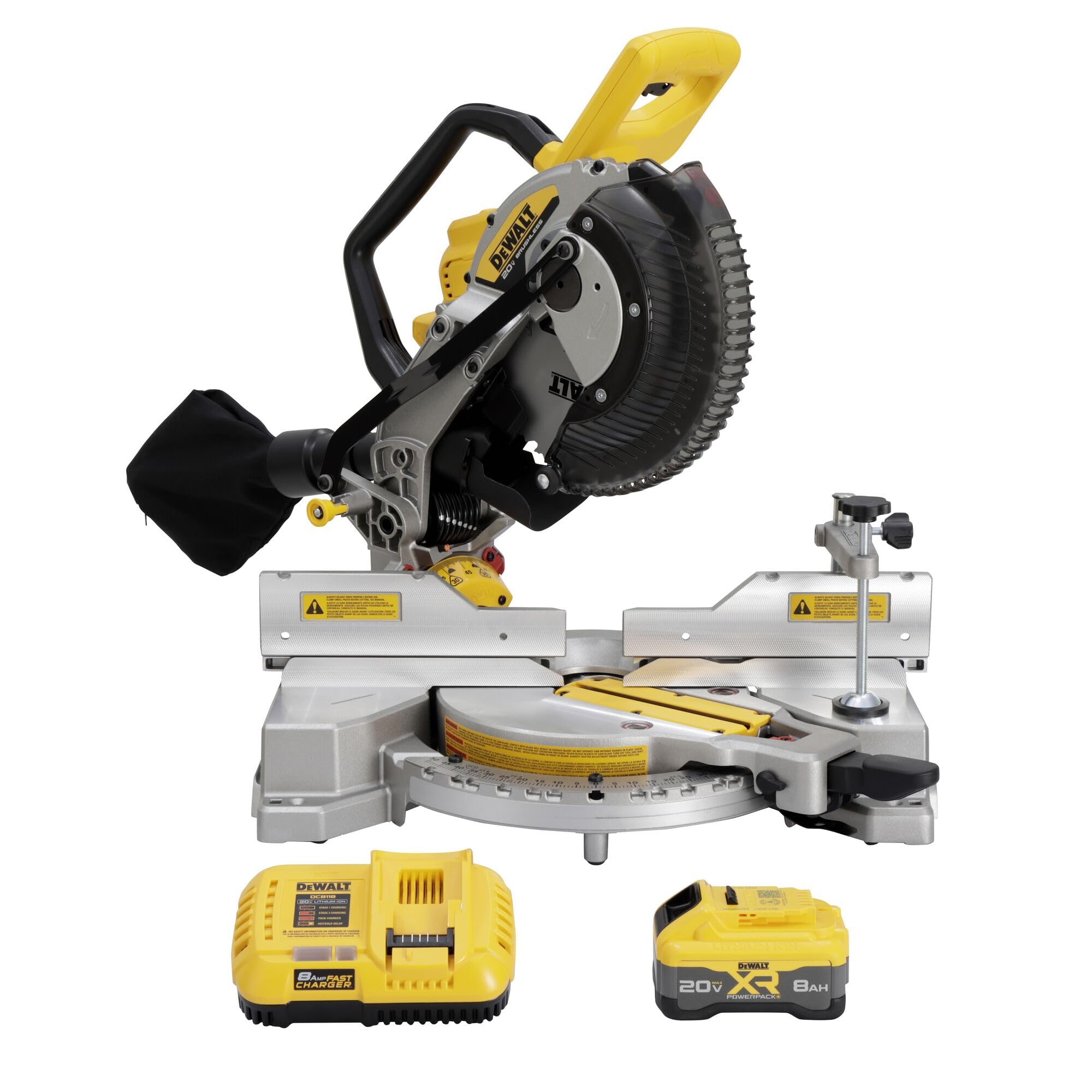
The DEWALT DCS714WW1 is the first 10-inch miter saw from DEWALT to run on the 20V MAX platform, making it truly cordless. The bevel-gear transmission minimizes power loss through the drivetrain, delivering up to 434 cuts in 3-1/4 inch MDF base molding or 311 cuts in 2×4 SPF on a single charge. It’s a double-bevel saw, which saves production time by eliminating workpiece flips.
The dust collection system captures up to 97% of airborne particles during cutting—a meaningful number for those working indoors without a full shop vac setup. Horizontal cut capacity hits 6 inches, vertical baseboard capacity is 5-1/4 inches, and nested crown capacity matches that 5-1/4 inch figure. The 40-tooth high-speed steel blade is adequate for rough work; a pro-grade replacement (like a 60T Diablo) noticeably smooths the finish cuts.
One trade-off: the included battery is a 4Ah unit, and the saw only operates with 4Ah or larger packs—smaller 2Ah or 3Ah batteries won’t supply enough current for the transmission. The clamp is functional but feels flimsy relative to the saw’s premium price. A 35-year contractor reviewer noted the blade alignment was 3 degrees off out of the box but corrected via the factory adjustment screws, which are documented in the manual.
Why it’s great
- True cordless freedom with 400+ cuts per charge
- Double bevel eliminates workpiece flipping for crown molding
- 97% dust capture rate for cleaner indoor work
Good to know
- Only works with 4Ah or larger 20V MAX batteries
- Stock blade leaves rough edges; upgrade recommended
- Clamp feels less substantial than the saw’s overall build
9. BOSCH CM10GD

The BOSCH CM10GD replaces traditional sliding rails with the Axial-Glide system—an articulating arm that glides on ball bearings, providing the same wide crosscut capacity as a sliding saw but in roughly 10 inches less bench depth. This is the defining feature for anyone working in a packed shop, van, or trailer. The 15-amp motor delivers consistent torque through dense hardwoods, and the 60-tooth carbide blade (included) delivers ready-to-finish cuts out of the box.
Dual bevel (0-45° left and right) and upfront metal bevel controls let you dial in compound angles without reaching behind the saw. The SquareLock precision fences lock square and stay square. The ergonomic trigger handle with soft grip fits all hand sizes, and the clear lower guard provides unobstructed line-of-sight on the cut line. Dust collection works well with a shop vac adapter; the included dust bag is average for the fine particles.
At 64 pounds, this is the heaviest saw in the lineup, and the weight is a feature—it stays put during cutting without needing bench bolts. The absence of a soft-start mechanism causes a noticeable jump on power-up, and the trigger safety slide button requires deliberate pressure, which some users find awkward during quick cuts. For a pro installer cutting crown molding all day, the Axial-Glide’s space savings and smooth travel justify the premium tier.
Why it’s great
- Axial-Glide system saves 10 inches of bench depth vs. sliding rail saws
- Dual bevel with upfront controls; reach every adjustment without moving
- 60-tooth carbide blade delivers finish-ready cuts immediately
Good to know
- 64 pounds is heavy—not for daily carry between multiple sites
- No soft-start; motor jumps noticeably on startup
- Trigger safety slide button requires deliberate pressure; can feel stiff
FAQ
What is the difference between a single bevel and a double bevel miter saw?
Can I cut metal with a standard wood-cutting miter saw?
Why does my new miter saw smell like burning on the first use?
Final Thoughts: The Verdict
For most users, the 10 inch miter saw winner is the Metabo HPT C10FCG2 because it combines a sub-25-pound frame, a break-in-friendly 15-amp motor, and the Xact Cut shadow line that never requires battery alignment—all backed by a five-year warranty. If you want cordless freedom for remote job sites, grab the DEWALT DCS714WW1, which delivers 434 cuts per charge in a double-bevel package. And for compact shops where bench depth is the limiting factor, nothing beats the BOSCH CM10GD with its Axial-Glide system that provides full sliding capacity in 10 inches less space.