
Our readers keep the lights on and the weekend projects moving. As an Amazon Associate, I earn from qualifying purchases.
Cutting cast iron pipe is a punishing task that destroys standard blades in seconds. The extreme hardness and brittle nature of cast iron demand a blade engineered specifically to withstand high-impact, abrasive cutting without shattering or losing its edge mid-cut. Choosing the wrong blade means wasted time, ruined material, and a trip back to the hardware store.
I’m Rikta — the co-founder and writer behind FitlyFast. After hundreds of hours analyzing blade specifications, reading through thousands of verified user experiences, and cross-referencing material compatibility charts, I built this guide to help you cut through the noise.
Whether you’re a professional plumber or a homeowner tackling a renovation, this guide to the best blade to cut cast iron pipe breaks down the specific tooth geometries, carbide grades, and shank types that actually survive contact with cast iron.
How To Choose The Best Blade To Cut Cast Iron Pipe
Cast iron is not like cutting wood or soft metal. Its high carbon content and crystalline structure make it abrasive and prone to chipping. Your blade choice must account for tooth material, tooth count, and the saw platform you’re using.
Carbide vs. Bi-Metal: The Material Showdown
Bi-metal blades are fine for general metal cutting, but cast iron will dull bi-metal teeth rapidly. Carbide-tipped blades resist the abrasive wear of cast iron far better, often lasting 30 to 100 times longer. For anything beyond a single quick cut, carbide is the only serious option.
TPI: Finding the Sweet Spot for Cast Iron
Teeth per inch (TPI) governs cut speed and smoothness. For thick cast iron pipe — typically 1/8-inch to 1/2-inch wall thickness — an 8 TPI blade offers the best balance. Fewer teeth (like 6 TPI) cut faster but rougher, while more teeth (10-14 TPI) produce smoother cuts but load up with debris and cut slower.
Shank Compatibility: Universal Fit Matters
Most reciprocating saw blades use a standard 1/2-inch universal shank, which fits all major brands like Milwaukee, DeWalt, Makita, and Bosch. If you’re using an angle grinder, ensure the arbor size (typically 22.23 mm or 7/8-inch) matches your tool. A blade that doesn’t fit your saw on the job site is useless.
Quick Comparison
On smaller screens, swipe sideways to see the full table.
| Model | Category | Best For | Key Spec | Amazon |
|---|---|---|---|---|
| Bosch Expert Diamond Metal Wheel | Premium | Angle grinder cuts on cast iron pipe | Diamond grit, 100x longer life | Amazon |
| USEWIN Expert 9-Inch Reciprocating | Premium | Thick cast iron pipe with reciprocating saw | 9-inch length, TiAlN + ICE coating | Amazon |
| SHDIATOOL 5-Inch Diamond Blade | Mid-Range | Versatile angle grinder cutting | 2.3 mm kerf, vacuum brazed | Amazon |
| USEWIN Carbide Reciprocating 6-Inch | Mid-Range | Entry-level carbide for occasional use | 8 TPI, 6-inch length | Amazon |
| HARDWIN Carbide Reciprocating 6-Inch | Mid-Range | Alloy steel and heavy demolition | 8 TPI, 30x longer life claimed | Amazon |
| Lincoln Abrasives 100-Pack Cut-Off Wheels | Budget | High-volume, disposable angle grinder use | 0.040-inch thick, aluminum oxide | Amazon |
| FOCSTOL Mini Diamond Cutting Disc | Budget | Precision cuts on smaller cast iron pieces | 2-inch diameter, #100/120 grit | Amazon |
In‑Depth Reviews
1. Bosch Professional Expert Diamond Metal Wheel

The Bosch Expert Diamond Metal Wheel lives up to its name with genuine diamond grit bonded to a steel core using Bosch Diamond Technology. Bosch claims this disc lasts up to 100 times longer than standard abrasive wheels, and user reports confirm exceptional durability even under heavy abuse — cutting thick steel tubes and stainless steel without wearing down.
At 125 mm (roughly 5 inches) with a 22.23 mm bore, this disc fits standard angle grinders and is specifically engineered for cast iron, rebar, steel, stainless steel, and non-ferrous metals. The diamond construction delivers faster, cleaner cuts with far less sparking than composite abrasive wheels, producing a more precise kerf and less surface damage to the pipe.
While this is a premium-tier investment, the longevity per cut makes it more economical over time compared to burning through multiple budget discs. It is the clear choice for professionals who need consistent, reliable performance across multiple cast iron cuts on a single disc.
Why it’s great
- Diamond grit technology delivers 100x longer life vs. standard discs
- Cuts cast iron with minimal sparking and precise kerf width
- Fits standard 22.23 mm arbor angle grinders
Good to know
- Not designed for cutting aluminum, concrete, or stone
- Premium upfront cost may be unnecessary for single cuts
2. USEWIN Expert Reciprocating Saw Blade 3 Pack (9-Inch)
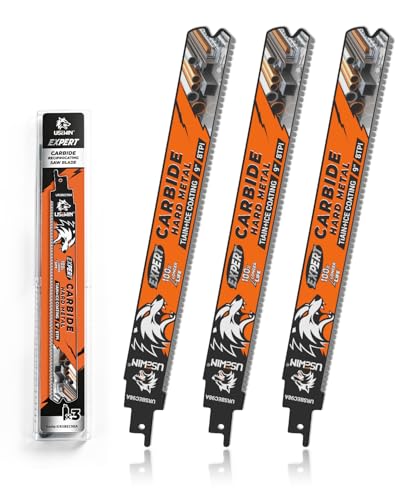
The USEWIN Expert 9-Inch blades bring a longer cutting reach, which is critical when you need to cut through larger-diameter cast iron pipes or access tight spaces where a saw body needs clearance. Each blade features carbide teeth with a TiAlN (Titanium Aluminum Nitride) plus ICE coating that resists heat buildup and extends edge retention during heavy demolition.
Rated for 100x longer life than standard bi-metal blades, these 8 TPI blades strike the proper balance for thick metal. The precision-ground, individually welded carbide teeth reduce vibration and binding, creating a smoother cut experience through hardened steel, iron, and screws embedded in the pipe wall.
The universal 1/2-inch shank fits all major reciprocating saw brands. Users consistently report these blades surviving cuts through cast iron and heavy-duty steel pipe that destroyed lesser blades. For those who need the extra length, this is a premium pack that delivers endurance.
Why it’s great
- 9-inch length reaches through large-diameter pipes easily
- TiAlN + ICE coating manages heat on long cuts
- Individually welded carbide teeth reduce binding
Good to know
- Longer blade requires more clearance around the work area
- Premium-tier investment for a 3-pack
3. SHDIATOOL 5-Inch Metal Cutting Diamond Blade
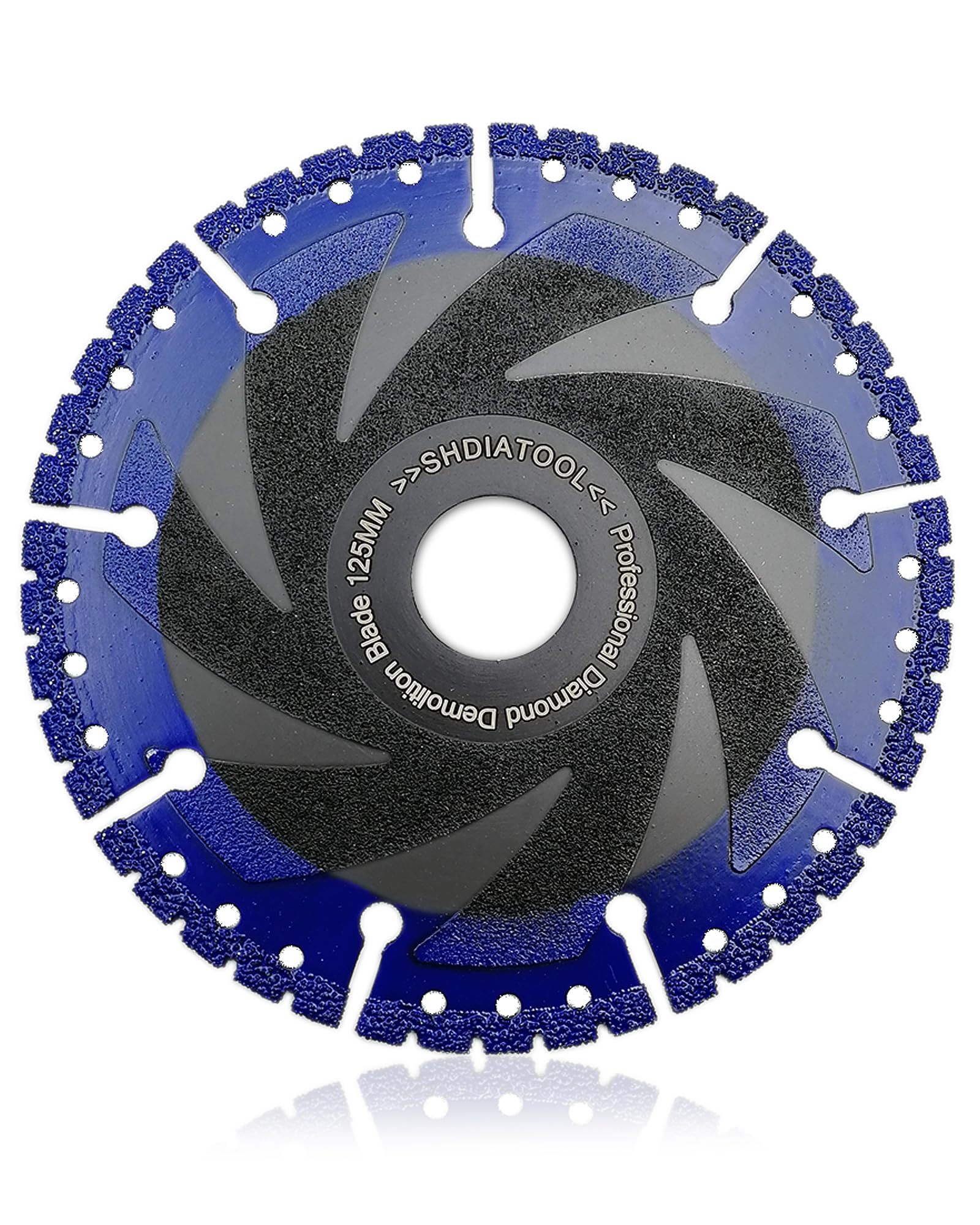
The SHDIATOOL 5-Inch Diamond Blade uses vacuum brazing technology, which permanently fuses diamond grains to a heat-treated high-speed steel core. This construction makes the segments effectively unbreakable and extremely heat resistant — ideal for the high-friction, high-temperature environment of cutting cast iron pipe with an angle grinder.
With a 2.3 mm kerf (incision thickness) and a 22.23 mm arbor, this blade is compatible with most handheld grinders and trim saws. The abrasive coating on both sides of the core reduces heat generation and delivers a smoother cut with less residue compared to traditional abrasive wheels. Users highlight its ability to survive bending and heavy abuse on thick steel tubes without shedding segments.
While the cut speed is slightly slower than a fresh abrasive disc, the blade lasts dramatically longer — effectively replacing dozens of disposable wheels. This makes it a strong mid-range choice for anyone who needs a single durable blade for multiple jobs rather than a bulk pack of disposables.
Why it’s great
- Vacuum brazed diamond segments resist heat and impact
- 2.3 mm kerf produces clean, precise cuts with minimal burr
- Cuts a wide range of materials beyond cast iron (rebar, masonry, wood)
Good to know
- Wider kerf than some abrasive discs generates slightly more material waste
- Max safe operating speed is 12,000 RPM
4. USEWIN Carbide Reciprocating Saw Blades 3 Pack (6-Inch)
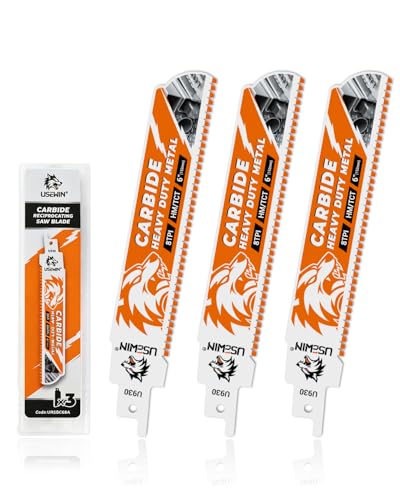
The USEWIN 6-Inch Carbide blades offer an accessible entry point into carbide-tipped reciprocating blades without a premium price tag. Made from high bi-metal material with carbide teeth welded on, these blades claim up to 50 times longer life than standard bi-metal blades — a realistic figure based on user feedback confirming they survive cast iron pipe cutting that destroys standard blades.
The scientific angle tooth shape design reduces cutting friction and heat, helping maintain sharpness through multiple cuts. At 8 TPI and 6 inches in length, these blades are well-suited for cutting cast iron pipe in confined spaces like under sinks or in crawl spaces where a longer blade won’t fit.
Users report these blades “working very well” on cast iron pipes specifically, though some note they cut slowly through extremely hard metal. The carbide tips stay attached even under high heat, which is the most common failure point for cheaper blades in this category.
Why it’s great
- Affordable entry point into carbide-tipped reciprocating blades
- Compact 6-inch length fits tight workspaces
- Carbide teeth resist heat-induced edge loss on cast iron
Good to know
- Cut speed through very hard cast iron can be slow
- Some users find 6-inch length limits depth of cut on larger pipes
5. HARDWIN Carbide Reciprocating Saw Blades 3 Pack (6-Inch)
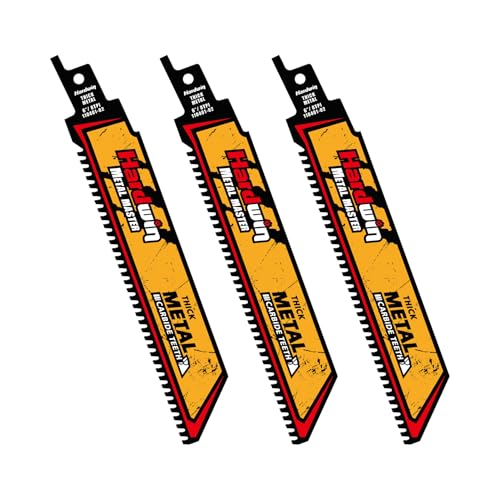
The HARDWIN 6-Inch Carbide blades are positioned specifically for heavy-duty demolition, with individually welded carbide teeth engineered to deliver up to 30 times longer life than conventional bi-metal blades. The 8 TPI tooth design is optimized for thick metal cuts in the 3/16-inch to 1/2-inch range, which covers standard cast iron pipe wall thicknesses.
Each carbide tooth is individually ground and welded to the blade body, which the brand claims delivers low-vibration, clean cuts and prevents blade grabbing or binding in high-alloy steels. The standard 1/2-inch universal shank fits all major reciprocating saw brands, and users confirm compatibility with Craftsman, Milwaukee, and DeWalt models.
Customer reviews highlight the blade’s ability to cut through heavy nails, metal pipe, and even 1/4-inch plate steel with one blade holding up well through the entire job. While some users find the per-pack cost slightly higher than comparable options, the durability per blade offsets the expense for serious demolition work.
Why it’s great
- Individually welded carbide teeth resist impact shock
- 8 TPI optimizes cutting speed for 3/16-inch to 1/2-inch cast iron
- Universal shank fits all major reciprocating saw brands
Good to know
- Some users note the per-pack price feels a bit restrictive
- 6-inch length may be too short for some pipe diameters
6. Lincoln Abrasives 100-Pack 4.5-Inch Cut-Off Wheels

The Lincoln Abrasives 100-Pack represents the traditional approach to cutting cast iron with an angle grinder: disposable aluminum oxide abrasive wheels. At 4.5 inches in diameter with a 0.040-inch thickness and 7/8-inch arbor, these wheels are the standard size for most handheld angle grinders and are fiberglass reinforced for durability.
Made from long-lasting aluminum oxide with fiberglass reinforcement, these wheels meet MPA-Hannover and EN 12413 quality certifications. Users report they cut faster and cleaner than thicker 1/16-inch discs, with less burring on the cut edge. The 100-pack ensures you have a steady supply for high-volume jobs.
However, disposable wheels wear down quickly on cast iron due to the material’s abrasiveness. Each wheel may only last for one or two pipe cuts before being consumed. For occasional use, this bulk pack offers excellent per-wheel value, but for frequent cast iron cutting, a diamond blade will be more cost-effective over time.
Why it’s great
- Very low per-wheel cost with 100-pack bulk pricing
- 0.040-inch thickness cuts faster and cleaner than thicker discs
- Fiberglass reinforced for safety at high RPM
Good to know
- Disposable nature means frequent wheel changes on cast iron
- Aluminum oxide wears faster than diamond on abrasive cast iron
7. FOCSTOL Mini Diamond Glass Cutting Disc Set
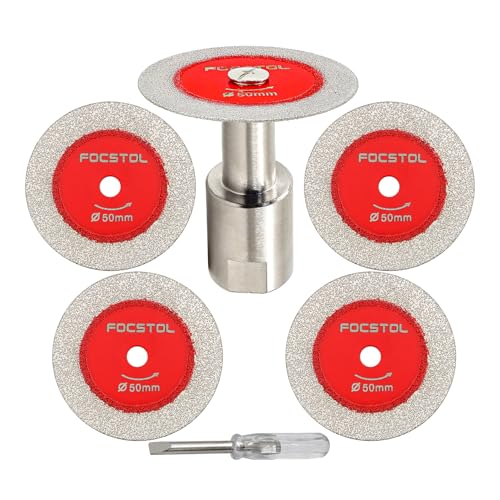
The FOCSTOL Mini Diamond Cutting Disc set takes a specialized approach with five 2-inch diamond discs designed for precision work. While the primary application is glass, jade, and ceramic, some users report successfully cutting thin metal with these discs, making them a niche option for small-diameter cast iron pieces or detail work.
Each disc uses #100/120 diamond grit bonded via vacuum brazing technology, with a 1 mm thickness and 10 mm diamond height. The set includes a 5/8-inch-11 flange and screwdriver for mounting on compatible angle grinders. The recommended speed is 16,000 RPM with a maximum of 27,000 RPM.
These discs are best suited for cutting thin cast iron pipe sections or performing precise trimming on smaller pieces. The ultra-thin design minimizes surface damage and produces a smooth cut edge. However, for standard 4-inch or larger cast iron soil pipe, the 2-inch diameter is too small to cut through effectively — these are a budget-friendly option for fine work only.
Why it’s great
- Very thin 1 mm kerf for precision cuts with minimal waste
- Five discs and flange included for a complete kit
- Vacuum brazed diamond grit for long disc life on small jobs
Good to know
- 2-inch diameter is too small for standard pipe sizes
- Not the primary design for cast iron — better suited for tile and glass
FAQ
Can I use a standard bi-metal blade to cut cast iron pipe?
Which is better for cast iron: a reciprocating saw or an angle grinder?
How do I prevent the blade from grabbing or binding when cutting cast iron?
Final Thoughts: The Verdict
For most users, the best blade to cut cast iron pipe winner is the Bosch Expert Diamond Metal Wheel because it combines unmatched diamond-grit longevity with a precise kerf for angle grinder use, making even multiple cast iron cuts economical. If you need a reciprocating saw blade with extra reach, grab the USEWIN Expert 9-Inch Carbide Blade. And for a versatile mid-range diamond blade that handles everything, nothing beats the SHDIATOOL 5-Inch Diamond Blade.