
Our readers keep the lights on and the weekend projects moving. As an Amazon Associate, I earn from qualifying purchases.
That blurry smudge in the eyepiece isn’t the planet—it’s the telescope. Most beginners buy based on magnification numbers alone, ending up with a wobbly mount and dim views that turn stargazing into a frustrating fight with hardware. The right telescope makes Saturn’s rings snap into focus on the first try, not the tenth.
I’m Rikta — the co-founder and writer behind FitlyFast. I’ve spent hundreds of hours analyzing telescope specifications, reading thousands of verified buyer reports, and cross-referencing aperture sizes against mount stability and optical coatings to separate genuine performance from marketing noise.
This guide cuts through that noise with concrete specs and real-world trade-offs to help you find the best astronomy telescope for your sky.
How To Choose The Best Astronomy Telescope
Choosing a telescope isn’t about picking the highest magnification number you can find. It’s about matching aperture size, mount stability, and optical quality to your viewing goals and location. A 90mm refractor on a shaky tripod will frustrate you more than a well-mounted 70mm scope with smooth slow-motion controls.
Aperture: The Light-Gathering Engine
The aperture is the diameter of the main lens or mirror — the single most important spec. A larger aperture collects more light, revealing fainter objects like nebulae and distant galaxies. For refractors, 80-90mm is a solid starting point. For reflectors, 114-150mm gives you deep-sky capability without overwhelming your budget or storage space.
Mount: Altazimuth vs Equatorial
Altazimuth mounts move up-down and left-right, intuitive for terrestrial use and casual stargazing. Equatorial mounts are tilted to align with Earth’s axis, letting you track celestial objects with a single slow-motion control — essential for high-power planetary viewing and long-exposure astrophotography. Beginners should start with altazimuth unless they’re already committed to astrophotography.
Optical Design: Refractor vs Reflector vs Catadioptric
Refractors use lenses — they’re sealed, require little maintenance, and deliver sharp, high-contrast views of the moon and planets. Reflectors use mirrors — they pack more aperture per dollar but need periodic collimation (mirror alignment) and are bulkier. Catadioptric designs (like Schmidt-Cassegrain) mix lenses and mirrors for compact portability but cost more per inch of aperture.
Quick Comparison
On smaller screens, swipe sideways to see the full table.
| Model | Category | Best For | Key Spec | Amazon |
|---|---|---|---|---|
| SVBONY SV503 102mm ED | Premium Refractor OTA | Astrophotography & Visual | 102mm aperture, FPL51 ED glass | Amazon |
| DWARFLAB Dwarf 3 | Smart Telescope | Portable Astrophotography | Dual camera, 4K auto-tracking | Amazon |
| Celestron StarSense LT 80AZ | App-Enabled Refractor | Beginners & Family Use | 80mm aperture, StarSense app | Amazon |
| Celestron 114LCM | Computerized GoTo | Automated Sky Tours | 114mm reflector, 4,000 objects | Amazon |
| MEEZAA 150EQ | Large Reflector | Deep-Sky Observation | 150mm aperture, German EQ mount | Amazon |
| Gskyer 130EQ | Reflector | Value Deep-Sky Views | 130mm aperture, EQ mount | Amazon |
| Gskyer 90mm AZ | Refractor | Casual Stargazing | 90mm aperture, AZ mount | Amazon |
| Koolpte 90mm AZ | Beginner Refractor | Entry-Level Family Use | 90mm aperture, Vertisteel AZ mount | Amazon |
| MEEZAA 90mm AZ | Starter Refractor | Budget Beginners | 90mm aperture, 800mm focal length | Amazon |
In‑Depth Reviews
8. SVBONY SV503 102mm F7 ED

The SVBONY SV503 is an optical tube assembly that punches well above its price point, using S-FPL51 ED glass to suppress chromatic aberration to near-APO levels. Buyers consistently report seeing crisp lunar detail at 275X with minimal color fringing, a performance usually reserved for scopes costing significantly more. The dual-speed 1:10 focuser with 90mm of focus travel provides the fine control needed for critical focus in both planetary observation and deep-sky astrophotography.
The all-metal build includes a retractable 133mm dew shield and a 360-degree field rotator, eliminating the need to rotate the entire tube when aligning a camera sensor. At roughly 8 pounds, this OTA demands a sturdy equatorial mount — a 15-20 pound capacity mount is recommended for stable imaging. The focuser has been noted by some users to have minor backlash out of the box, but adjustment screws make it simple to tune.
This is a serious instrument for the aspiring astrophotographer or visual observer who wants one refractor that handles planetary, lunar, and brighter deep-sky objects without breaking the bank. It comes as an OTA only — no eyepieces, finderscope, or mount included — so budget for those separately if you’re starting from scratch.
Why it’s great
- Excellent ED optics with minimal chromatic aberration
- Dual-speed focuser with 90mm travel for precise focusing
- Retractable dew shield and 360-degree field rotator
Good to know
- OTA only — requires separate mount, eyepieces, and finder
- Some initial focuser backlash may need adjustment
9. DWARFLAB Dwarf 3
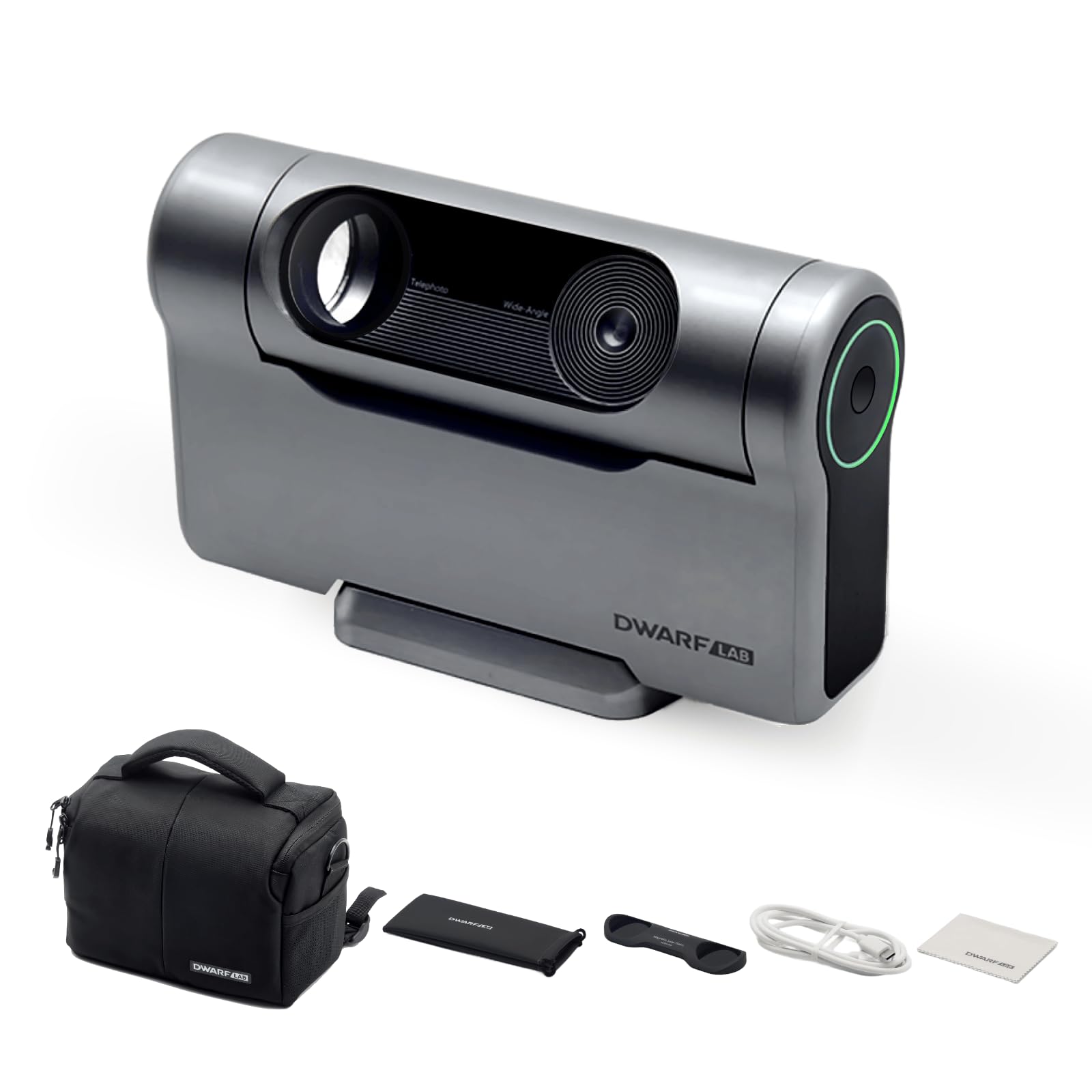
The Dwarf 3 redefines what a telescope can be: a 3-pound, backpack-friendly smart scope that fits in a standard daypack yet captures Milky Way panoramas and deep-sky objects like galaxies and nebulae. Its dual-camera system — a telephoto for deep-space targets and a wide-angle for star trails and the Milky Way — is controlled entirely through the DWARFLAB app, which handles auto-tracking, stacking, and post-processing on-device or through cloud computing.
Users report taking stunning images of dim objects even from heavily light-polluted suburban backyards, a feat that normally requires expensive filters and hours of manual stacking. The built-in EQ mode, combined with a tilt-head tripod and a bubble level, allows scheduling autonomous overnight tracking sessions. The magnetic dual-band filter and included solar filter add versatility for both day and night imaging.
The trade-off is that this is purely an imaging device — there’s no eyepiece for direct visual observation. The app can occasionally glitch during connection or after a power loss, and the unit relies on an external battery for all-night sessions. But for anyone who wants instant astrophotography results without a steep learning curve, the Dwarf 3 is a remarkably complete package.
Why it’s great
- Ultra-portable 3-pound design with carrying case
- App-controlled auto-tracking and cloud processing
- Works well even in light-polluted skies
Good to know
- No eyepiece for direct visual observation
- App can have occasional connectivity glitches
3. Celestron StarSense Explorer LT 80AZ

The StarSense Explorer LT 80AZ solves the biggest barrier for beginners: finding objects in the night sky. By docking your smartphone into the included mount, the StarSense app analyzes star patterns overhead and guides you with on-screen arrows to any target — planets, nebulas, star clusters — with no prior astronomy knowledge required. The 80mm refractor with fully coated optics delivers sharp, bright views of the moon’s craters, Jupiter’s bands and moons, and Saturn’s rings.
The manual altazimuth mount includes altitude slow-motion adjustment via a sliding rod, and the 400mm focal length provides a wide enough field to keep objects in view while you learn to track manually. The lightweight design (under 10 pounds fully assembled) makes it easy to carry to darker skies. Users consistently praise the sharp lunar detail and the ability to see features like Titan near Saturn immediately after aligning.
Stock eyepieces are decent — a 25mm and 10mm pair with a 2X Barlow — though upgrading to a wider-field eyepiece later helps counteract the field drift inherent in this mount. The red-dot finderscope can arrive misaligned, but Celestron’s US-based support is responsive. This is the telescope to buy if you want to actually see things on your first night out rather than spend weeks learning the sky.
Why it’s great
- Patented StarSense app eliminates learning curve for finding objects
- Lightweight and easy to transport to darker skies
- 2-year US warranty and strong Celestron support
Good to know
- Short 400mm focal length causes field drift without wider eyepieces
- Red-dot finder may need alignment out of the box
7. Celestron 114LCM Computerized Newtonian
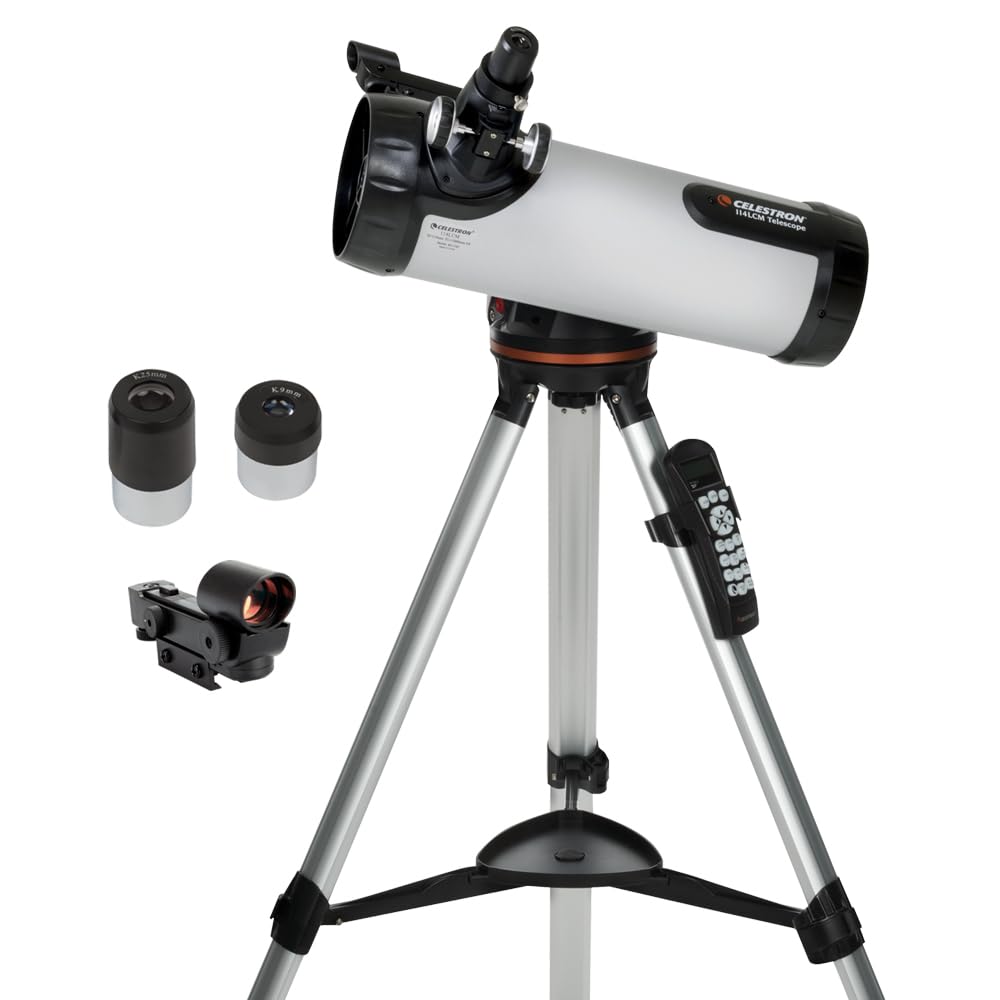
The Celestron 114LCM brings a fully motorized GoTo mount to the entry-level segment, automatically slewing to over 4,000 celestial objects at the press of a button. The Sky Tour feature generates a curated list of the best objects currently visible based on your location and time, making it ideal for urban observers who rarely see enough stars to navigate manually. The 114mm Newtonian reflector provides solid light-gathering for deep-sky objects like star clusters and brighter nebulas.
Setup takes about five minutes, and the computerized hand controller is intuitive even for first-time users. The mount tracks objects smoothly once aligned, though some users report slight drift over extended sessions. A minor drawback: the optical system uses a Bird-Jones design with a built-in Barlow lens, making collimation more involved than a standard Newtonian. The laser scope can get knocked out of alignment easily, and the coarse focus knob oscillates at high magnification.
The GoTo mount runs on AA batteries which drain fairly quickly — rechargeable packs are a necessary upgrade. Users planning to stick with the hobby should budget for better eyepieces and a moon filter, which is notably absent from the box. For the price, the 114LCM delivers a computerized experience that skips the frustration of manual star-hopping.
Why it’s great
- Motorized GoTo mount finds 4,000+ objects automatically
- Sky Tour feature generates nightly observing lists
- Compact and easy to transport for its aperture
Good to know
- Battery drain is significant — rechargeable pack recommended
- Bird-Jones optics require more careful collimation
6. MEEZAA 150EQ Newtonian Reflector
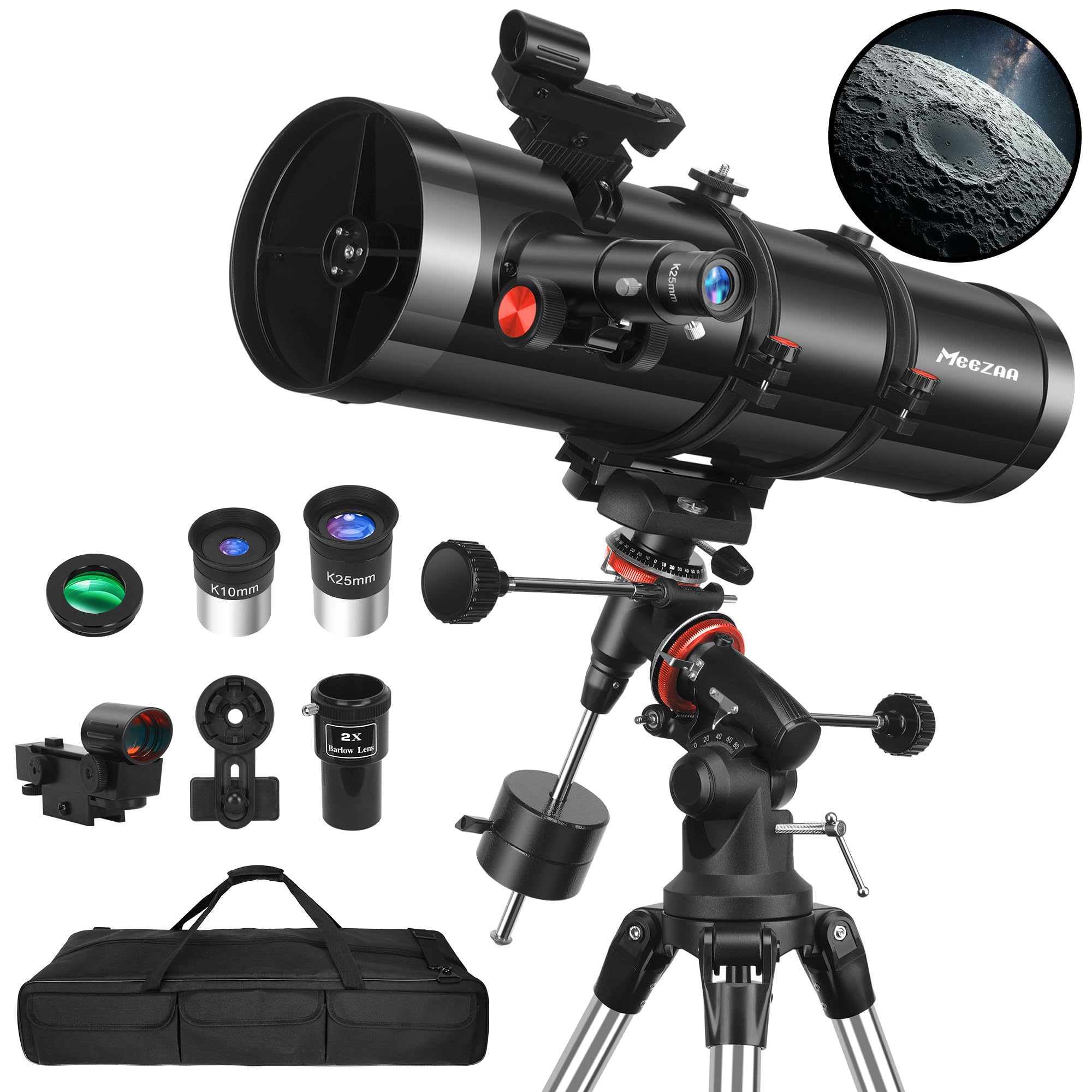
The MEEZAA 150EQ packs a 6-inch aperture into a package aimed at beginners hungry for deep-sky performance without the premium price tag. Its 150mm parabolic mirror gathers significantly more light than smaller refractors, revealing details in globular clusters, the Orion Nebula, and fainter galaxies that smaller scopes can’t touch. The German equatorial mount with slow-motion control knobs provides smooth manual tracking once polar-aligned.
Users note the sturdy stainless steel tripod and solid build of the mount, though the included eyepieces (25mm and 10mm Kellners) are entry-level and will likely be the first upgrade for serious observers. The 2X Barlow provides magnification up to 130X, sufficient for detailed lunar surface studies and a clear view of Saturn’s rings. The red-dot finderscope and included moon filter are practical additions that enhance the out-of-box experience.
Assembly requires patience — the equatorial mount has many parts and the instructions could be clearer. Replacing eyepieces can shift focus and require readjustment, a common annoyance with budget focusers. The 30-pound total weight means this is a permanent backyard setup rather than a grab-and-go scope. For the aperture-to-cost ratio, the MEEZAA 150EQ is hard to beat for visual deep-sky observing.
Why it’s great
- Large 150mm aperture for deep-sky light collection
- EQ mount with slow-motion controls for smooth tracking
- Includes moon filter and phone adapter
Good to know
- Heavy setup at around 30 pounds — not portable
- Entry-level eyepieces benefit from an upgrade
5. Gskyer 130EQ Professional Reflector

The Gskyer 130EQ brings a 5.1-inch parabolic mirror to the mid-range market, using a fast f/5 focal ratio and a toothless focusing base for smooth adjustments. Users report excellent clarity on the moon’s craters and see the rings of Saturn and bands on Jupiter without difficulty. The short 24-inch optical tube makes the scope easier to mount and store than longer Newtonians of similar aperture.
The German equatorial mount includes slow-motion cables, and the 650mm focal length provides a good balance between wide-field sweeping and planetary detail. The three eyepieces and 3X Barlow give a useful magnification range, though the included phone adapter and Bluetooth remote offer a surprisingly easy path to capturing smartphone images of your best views.
The mount can feel a bit underdressed for the 30-pound system — some users report slippage during tracking, particularly at higher magnifications. The manual translation is poor and the instructions are out of sequence, so allocating an evening for assembly is wise. For beginners wanting an equatorial mount without paying premium prices, the Gskyer 130EQ is a functional stepping stone into serious observing.
Why it’s great
- 5.1-inch aperture captures deep-sky objects well
- EQ mount with slow-motion cables for manual tracking
- Includes Bluetooth remote and phone adapter for smartphone photography
Good to know
- Mount can slip during tracking at high power
- Manual is poorly translated and difficult to follow
4. Gskyer 600x90mm AZ Refractor

The Gskyer 90mm AZ is one of the most popular beginner refractors on the market, and for good reason: its 90mm aperture and fully coated optics deliver bright, crisp views of the moon and Jupiter with minimal hassle. The 600mm focal length at f/6.7 gives a pleasing balance between field of view and magnification. The three eyepieces (24X, 60X, 120X) plus a 3X Barlow provide flexibility without overwhelming a new user.
The adjustable aluminum tripod extends from 31.5 to 49 inches, though some users above 5’10” find it too short for comfortable standing viewing. The altazimuth mount is tool-free and intuitive, though it lacks slow-motion controls, making fine adjustments at high magnification tricky. Some users have reported altitude backlash and an uneven non-geared mount that can make tracking planets more of a challenge.
Gskyer’s customer support is responsive — users who encountered stripped screws received replacements quickly. The tripod can feel shaky at maximum extension, but placing rubber washers between connections helps. For a hassle-free, no-tools-required introduction to lunar and planetary observing, this telescope delivers solid optical performance at a budget-friendly price.
Why it’s great
- 90mm fully coated optics provide great lunar and planetary views
- Tool-free assembly in minutes
- Responsive Gskyer customer support
Good to know
- Tripod can be too short and slightly shaky at full extension
- No slow-motion controls on the altazimuth mount
1. Koolpte 90mm AZ with Vertisteel Mount
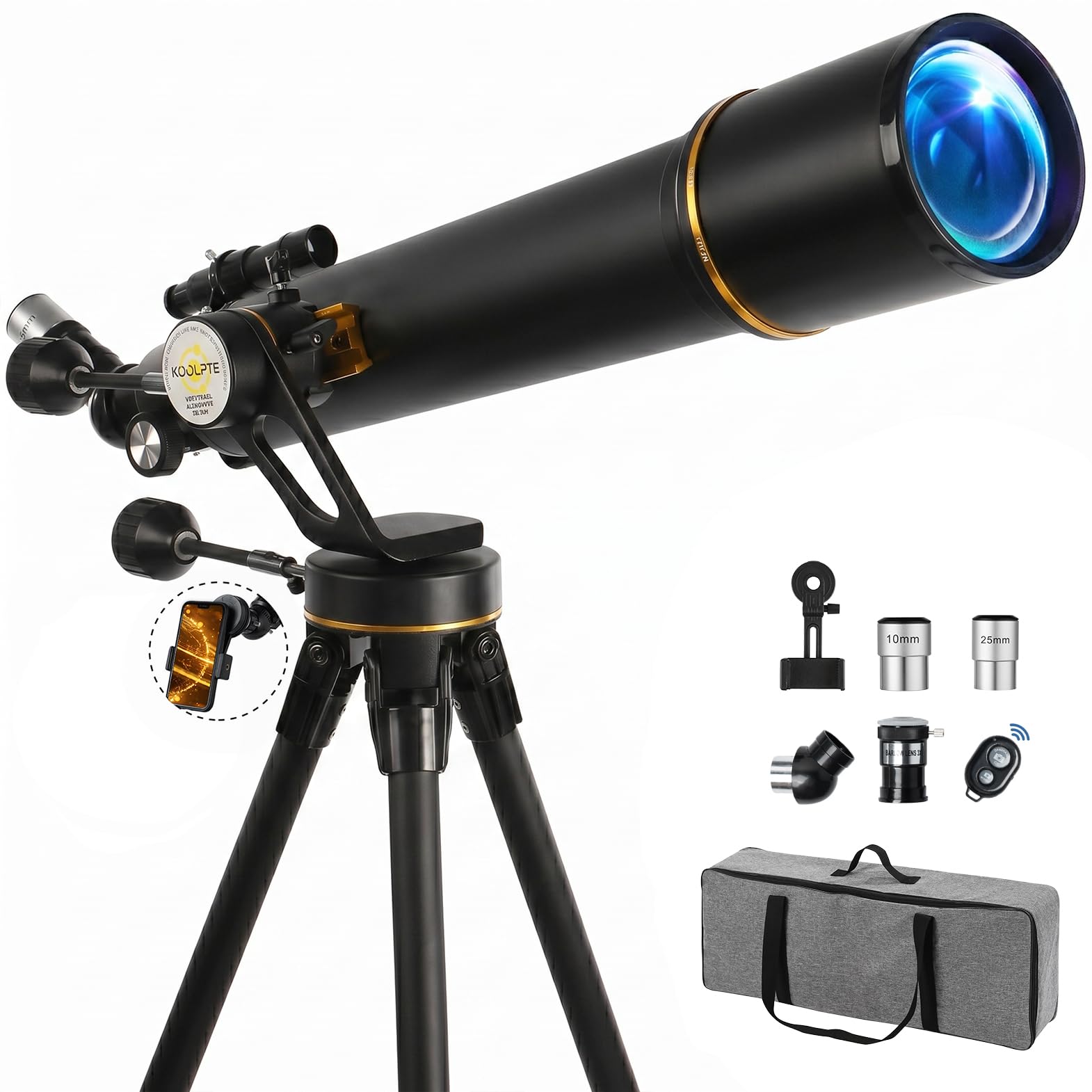
The Koolpte 90mm stands out from other entry-level refractors with its Vertisteel AZ Slow-Motion Mount, which provides smooth, precise adjustments without the overshooting and wobble common in budget mounts. The 90mm aperture and fully multi-coated optics transmit 99% of light, delivering bright, high-contrast images of the moon, Saturn’s rings, and Jupiter’s moons. The 700mm focal length provides a nice middle ground between wide sweeping and detailed close-ups.
The kit is remarkably complete: two Kellner eyepieces (10mm and 25mm), a 3X Barlow, a reflex finderscope, a phone adapter, a wireless remote, and a carrying bag that holds everything including the tripod. Users report assembling the scope in under 15 minutes with clear instructions. The moon looks “razor sharp” with the 25mm eyepiece, and the bag makes it genuinely portable for camping trips or dark-sky outings.
One common complaint: the tripod is too short for tall users above 6 feet, especially when viewing targets near the zenith. There are also isolated reports of internal parts coming loose after a few uses — quality control seems inconsistent. For the accessory bundle and the smooth mount, the Koolpte is a strong contender for families wanting a complete, portable, and easy-to-use first telescope.
Why it’s great
- Vertisteel mount with slow-motion control for smooth tracking
- Complete kit includes phone adapter, remote, and carrying bag
- Very quick assembly — under 15 minutes
Good to know
- Tripod too short for comfortable use by adults over 6 feet
- Some quality control issues with internal parts reported
2. MEEZAA 90mm AZ Refractor

The MEEZAA 90mm AZ is a straightforward, no-surprises beginner refractor that focuses on optical quality over flashy extras. The 90mm aperture with fully multi-coated lenses and 800mm focal length provides a longer focal ratio (f/8.88) than most competitors, which naturally reduces chromatic aberration and improves contrast on lunar and planetary targets. Users consistently praise the view clarity on the moon, Jupiter, and Saturn straight out of the box.
The stainless steel tripod is notably more stable than the aluminum legs found on many budget scopes, withstanding light wind without shaking. The altazimuth mount is simple and intuitive, though it lacks slow-motion controls. The included accessories — two Kellner eyepieces, a 3X Barlow, phone adapter, and carrying bag — cover the basics well. Assembly is manageable in about 20 minutes using the printed manual.
The tripod leg locks need occasional re-tightening during use, and the straight-through finderscope shows an inverted image, which can confuse absolute beginners. The erect image diagonal helps for daytime terrestrial use but doesn’t affect nighttime astronomy. Given its stable tripod and solid optics, the MEEZAA 90mm is a reliable entry point for someone who wants a functional, frustration-free start in astronomy without a steep learning curve.
Why it’s great
- Stainless steel tripod offers good stability
- Long focal ratio (f/8.88) reduces chromatic aberration
- Clear views of the moon and planets out of the box
Good to know
- No slow-motion controls on the altazimuth mount
- Tripod leg locks may need occasional retightening
FAQ
What does 90mm aperture actually mean for what I’ll see?
Do I need an equatorial mount as a beginner?
Why do some telescopes show purple fringing around the moon?
Final Thoughts: The Verdict
For most users, the best astronomy telescope winner is the Celestron StarSense Explorer LT 80AZ because it eliminates the biggest frustration for beginners — finding objects — with its app-guided navigation, all in a lightweight, portable package with solid 80mm optics. If you want uncompromising optical quality for both visual and astrophotography, grab the SVBONY SV503 102mm ED. And for instant astrophotography results without any learning curve, nothing beats the DWARFLAB Dwarf 3.