
Our readers keep the lights on and the weekend projects moving. As an Amazon Associate, I earn from qualifying purchases.
Fine wood dust lingers in the air for hours after you’ve put the tools away, settling on every surface and, more critically, deep in your lungs. A dedicated air filtration system captures this airborne particulate before it becomes part of your shop’s atmosphere — and your respiratory burden.
I’m Rikta — the co-founder and writer behind FitlyFast. This guide is built on hundreds of hours of cross-referencing CFM ratings, filter efficiency grades, noise data, and real-world user experiences to separate the units that actually clean a woodshop from the ones that just move air around.
Whether you work out of a single-car garage or a dedicated 1,000-square-foot shop, choosing the right air filtration system for woodshop comes down to matching air movement capacity, filter media quality, and physical footprint to the realities of your space and workflow.
How To Choose The Best Air Filtration System For Woodshop
Woodshop air filtration is not the same as a home air purifier. The dust loads are heavier, the particle sizes range from visible chips to sub-micron fines, and the unit must survive in a space filled with vibration, temperature swings, and combustible dust. Three core specs determine whether a system will actually clean your shop or just circulate debris.
CFM and Air Exchange Rate
Cubic Feet per Minute (CFM) is the single most important number. Industry guidelines suggest your filtration system should cycle the entire volume of your shop’s air four to six times per hour. Calculate your shop volume in cubic feet (length × width × ceiling height), divide by 10 to get the minimum CFM needed for six air changes per hour. A 20×24 foot shop with 10-foot ceilings needs at least 480 CFM. Systems rated below 400 CFM are best reserved for very small basement shops.
Filter Efficiency and Media Quality
Look for MERV-11 or better (MERV-13 or HEPA H11 is ideal). MERV-11 captures 85 to 90 percent of particles in the 1 to 3 micron range — exactly the dangerous fine dust that stays airborne longest. Washable pre-filters are convenient but degrade quickly; replaceable filter media delivers consistent performance over the unit’s life. Some units use HEPA H11 filters capable of capturing 95 percent of 0.3 micron particles, which is a meaningful upgrade for shops generating heavy sanding dust.
Mounting, Placement, and Remote Control
Ceiling-mounted units recirculate air more effectively than floor models because they pull dust from the breathing zone. Confirm the unit includes mounting hardware rated to its weight — some 55-pound units like the WEN 3417 require additional bracing. RF remotes work through walls and tool cabinets, while IR remotes require direct line-of-sight. Timer functionality lets you run the system after you leave the shop, clearing airborne dust before your next session.
Quick Comparison
On smaller screens, swipe sideways to see the full table.
| Model | Category | Best For | Key Spec | Amazon |
|---|---|---|---|---|
| WEN 3417 | Premium Hanging | Medium to large shops up to 1000 sq. ft. | 556–1044 CFM, RF remote | Amazon |
| DeWALT DWXAF101 | Premium Hanging | Auto-mode filtration with HEPA H11 | H11 HEPA, auto sensor mode | Amazon |
| Scheppach HDA-14 | Mid-Range Hanging | Ultra-quiet operation (50 dB) | 740 m³/h, 1 μm filtration | Amazon |
| ALORAIR Purecare 1350IG | Premium Hanging | Large shops needing high CFM with 360° intake | 1050–1350 CFM, MERV-11 | Amazon |
| ABESTORM DecDust 1350IG | Premium Hanging | High CFM with 360° intake and ionizer | 1050–1350 CFM, MERV-11 | Amazon |
| WEN DC1300 | Dust Collector | Source capture with 50-gallon bag | 1,300 CFM, 5-micron bag | Amazon |
| Bosch VAC090AH | HEPA Extractor | OSHA-compliant source extraction | 150 CFM, HEPA, auto filter clean | Amazon |
| PURISYSTEMS PuriCare 500IG | Mid-Range Hanging | Small to medium shops with ionizer | 350–500 CFM, built-in ionizer | Amazon |
| ECOMAX MCF03 | Entry-Level Hanging | Small shops on a strict budget | 300–400 CFM, washable filters | Amazon |
In‑Depth Reviews
1. WEN 3417 3-Speed Remote-Controlled Industrial-Strength Air Filtration System

The WEN 3417 delivers the best balance of CFM, build quality, and control for a proper woodshop. Its three speeds range from a quiet 556 CFM up to 1,044 CFM — enough to cycle a 1,000-square-foot shop four times per hour. The RF remote works through walls and obstacles, unlike IR remotes that demand direct line-of-sight from every corner of the shop.
At 55 pounds, this is a heavy unit that requires sturdy ceiling mounting. It uses a 1-micron inner filter and a 5-micron pre-filter, giving it strong fine-dust capture. The programmable timer lets you set auto shut-off after a specific number of minutes, so you can run it after you leave and return to clean air.
Noise levels sit between 63 and 68 dB — about the volume of a normal conversation — which is quieter than most table saws or routers running in the same space. The sheet metal housing is functional but thin; careful handling during installation is recommended. The package does not include chains or eyebolts, so factor that into your setup.
Why it’s great
- Highest CFM in its price tier with RF remote
- Programmable timer for post-shop cleaning
- 1-micron inner filter captures fine sanding dust
Good to know
- Heavy (55 lbs) needing reinforced mounting
- No chains or mounting hardware included
- Thin sheet metal can dent during shipping
2. DeWALT DWXAF101 Air Filtration System

The DeWALT DWXAF101 stands apart with its H11 HEPA filter that captures over 95 percent of 0.3-micron particles — the most dangerous fine dust for woodworkers. It also includes an AUTO mode that uses a sensor to detect air quality and automatically shifts between HI, MID, and LO speeds, which is rare in this category.
The unit hangs from the ceiling via included hooks and chains, and it weighs only 20.9 pounds, making installation significantly easier than heavier competitors. Timer options cover 1, 2, 4, and 8 hours, and a filter replacement indicator takes the guesswork out of maintenance. The washable pre-filter extends the life of the HEPA filter, reducing long-term costs.
The IR remote requires direct line-of-sight, which is a minor inconvenience if the unit is mounted behind a cabinet or large machine. Some users report the remote needing multiple button presses. Overall noise at 64 dB is reasonable, and the exit air angles downward at 45 degrees to improve circulation in the room.
Why it’s great
- H11 HEPA filter captures 95% of 0.3µm particles
- Auto mode with air quality sensor
- Lightweight at 20.9 lbs with included mounting hardware
Good to know
- IR remote needs direct line-of-sight
- Remote battery type can be mismatched from factory
- Lower max CFM than some premium units
3. Scheppach HDA-14 Air Purifier

The Scheppach HDA-14 is the quietest air filtration system in this roundup at just 50 dB — quieter than a refrigerator. If you work in a shared space, a garage attached to your home, or simply value not wearing earplugs just to run your air filter, this unit delivers serious performance without the jet-engine whine common to high-CFM competitors.
With 740 m³/h (approximately 435 CFM) and three-stage filtration down to 1 micron, it is well suited for workshops up to 400 square meters. The unit is lightweight at 8 kilograms (about 17.6 pounds) and includes a remote control, timer, and wall-mounting or ceiling-mounting capability. It comes with a replacement filter set in the box, which is a thoughtful inclusion.
The trade-off is lower absolute CFM compared to larger units like the ALORAIR or WEN 3417. This system is best for small to medium shops where quiet operation matters more than raw air-moving power. The energy-efficient 100-watt motor keeps running costs very low, and the compact footprint means it tucks away under a ceiling joist without dominating the space.
Why it’s great
- Extremely quiet 50 dB operation
- Lightweight and easy to install
- Energy-efficient 100-watt motor
Good to know
- Lower CFM than premium hanging units
- Best suited for small to medium shops
- No built-in ionizer or auto mode
4. ALORAIR 360 Degree Intake Air Filtration System Purecare 1350IG

The ALORAIR Purecare 1350IG uses a 360-degree air intake design and a strong vortex fan to move 1,050 to 1,350 CFM, making it the highest-airflow unit in this list. It is rated for rooms up to 1,700 square feet, so even a two-car garage workshop with high ceilings will get multiple air changes per hour on the high setting.
It includes a built-in ionizer that generates positive and negative ions to help agglomerate fine particles for better filter capture. The MERV-11 filter stops 90 percent of 3-to-10 micron particles and 85 percent of 1-micron particles. A 1-to-9 hour timer lets you run it long after you have left the shop, and the IR remote offers strong anti-interference performance.
The noise level ranges from 60 to 69 dB, which is louder than the Scheppach but typical for a high-CFM unit. Multiple users note a high-pitched frequency on this model that can be fatiguing during extended use. The 27-pound weight is manageable, but the 360-degree intake means it needs clearance on all sides, which affects placement options.
Why it’s great
- Highest CFM (1050–1350) for large shops
- 360-degree intake maximizes air capture
- Built-in ionizer helps fine particle agglomeration
Good to know
- High-pitched noise noted by multiple users
- IR remote, not RF
- Cannot be shipped to California
5. ABESTORM DecDust 1350IG Air Filtration System
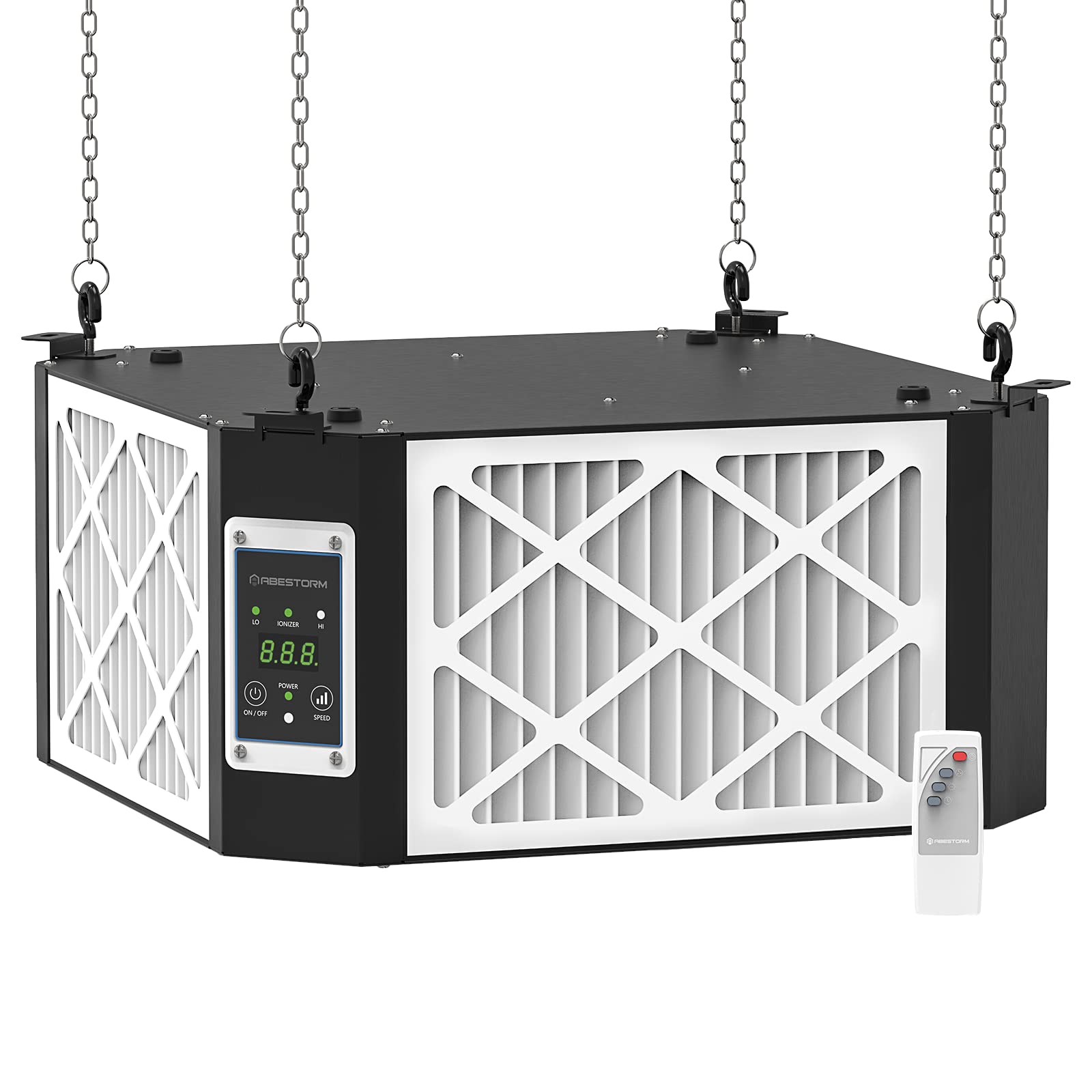
The ABESTORM DecDust 1350IG shares the same 360-degree intake architecture and 1,350 CFM peak output as the ALORAIR unit but comes with four MERV-11 filters included instead of two. This means more replacement media in the box and less frequent reordering, which is a practical advantage for heavy-use shops.
It includes both touch panel controls and an RF remote that works from up to 27 feet away, giving you more control flexibility than the ALORAIR’s IR-only system. The built-in ionizer is standard, and the two-speed fan offers 1,050 CFM on low and 1,350 CFM on high. The 27-pound weight and included mounting hooks make ceiling installation straightforward, though a second person is recommended.
Noise is the dominant complaint here. Both low and high speed are described as loud enough to interfere with conversation, and the sound profile is not pleasant. Quality control issues have also been reported, including upside-down control panels and defective hanging chain loops. The noise issue is consistent across reviews, so factor that in if you plan to run the unit while you work rather than only after hours.
Why it’s great
- Includes four MERV-11 filters
- RF remote works through obstacles
- High CFM suited for large shops
Good to know
- Loud on both speed settings
- Quality control reported as inconsistent
- Hanging hardware durability concerns
6. WEN DC1300 1,300 CFM 14-Amp Woodworking Dust Collector

The WEN DC1300 is not a ceiling-mounted air filter — it is a dedicated dust collector designed for source capture. It attaches directly to your table saw, planer, or bandsaw via dual 4-inch inlets, pulling dust and chips directly from the tool before they become airborne. This makes it a complement to an air filtration system, not a replacement.
The 14-amp motor spins a 10-inch steel impeller at 3,450 RPM, moving 1,300 CFM through a 50-gallon collection bag. The mobile base with four swivel casters lets you roll it between machines. Users report capturing 99 percent of table saw dust and around 85 percent of bandsaw dust with a single hose, improving to near-total capture with a second hose.
Assembly takes about 45 minutes, though the instructions and screw labeling could be clearer. The vertical supports are a bit flimsy, and the bag hook can slip off if not secured tightly. Noise is moderate and acceptable with hearing protection. This unit is best for woodworkers who want to stop dust at the source before it ever hits the air.
Why it’s great
- Captures dust at the tool source
- Dual 4-inch inlets for multiple tools
- Mobile base with casters for easy positioning
Good to know
- Not an ambient air filtration system
- Flimsy vertical supports and bag hook
- Manual lacks clear assembly details
7. Bosch VAC090AH Portable 9 Gallon Dust Extractor
The Bosch VAC090AH is a HEPA-equipped dust extractor that integrates with power tools via auto-activation. Plug your miter saw, track saw, or router into the vacuum, and it turns on automatically when the tool starts — a genuinely useful workflow improvement for shops where source extraction is the primary strategy.
It delivers 150 CFM at 97 inches of static water lift, which is strong suction for a compact 9-gallon unit. The automatic filter cleaning pulses every 15 seconds to maintain peak suction, though the thumping noise is noticeable (and can be disabled). The HEPA filter captures 99.97 percent of particles at 0.3 microns, meeting OSHA silica Table 1 compliance.
This is not a general shop vac for cleanup — it is optimized for fine dust extraction at the tool. The 20.5-foot hose and long cord provide good reach, but the high price does not include a full attachment set. The auto-clean thump every 30 seconds bothers some users, but the dust capture results (99 percent plus in real-world use) speak for themselves.
Why it’s great
- HEPA filter meets OSHA Table 1 compliance
- Auto tool activation for seamless workflow
- Automatic filter cleaning maintains suction
Good to know
- Auto-clean thump may be annoying
- No full attachment kit included
- Not a general shop vac for floor cleanup
8. PURISYSTEMS PuriCare 500IG Hanging Air Filter

The PURISYSTEMS PuriCare 500IG is a mid-range ceiling-mounted unit that combines three-speed filtration with a built-in ionizer generating up to 15 million negative ions per second. The ionizer helps charge fine particles so they stick to the filter media more effectively, which can improve overall capture efficiency for sub-micron dust.
It moves 350, 450, or 500 CFM across three speeds and covers rooms up to 500 square feet. The RF remote works from any angle and up to 26 feet away, and the timer settings range from 1 to 6 hours for automatic shut-off. The unit is portable with easy-grip handles and rubber feet if you prefer benchtop placement instead of ceiling hanging.
Customer reports highlight excellent fine particulate removal, but the replacement filters are considered overpriced. Some users have experienced remote failures after several months, and a squeaking noise has been reported on certain units. At 25.5 pounds, it is reasonable for ceiling installation. This unit works best in small to medium shops where the ionizer can make a noticeable difference in fine dust capture.
Why it’s great
- Built-in ionizer boosts fine particle capture
- RF remote works from any angle
- Portable with handles and rubber feet
Good to know
- Replacement filters are expensive
- Remote reliability issues reported
- Some units develop a squeaking noise
9. ECOMAX MCF03 Air Filtration System

The ECOMAX MCF03 is the most affordable entry-level unit in this roundup, offering three speeds from 300 to 400 CFM — enough for small basement shops or hobbyist workspaces up to roughly 400 cubic feet. It uses a dual-layer filtration system with an outer washable pre-filter for large chips and an inner washable filter for finer particles. Both filters are washable and reusable, which eliminates ongoing filter replacement costs.
Operation is straightforward with a remote control that works up to 26 feet away, and the built-in timer offers 1, 2, or 4-hour auto shut-off. Noise levels range from 58 to 62 dB, which is quieter than most competitors. The unit comes with a hook and chain for ceiling mounting, and it weighs just 17.86 pounds, making installation a one-person job.
The trade-off for the low price is that both filters are washable rather than replaceable, which means they lose efficiency over time as the pores clog with fine particles. At 400 CFM max, it will not keep up with heavy sanding in a medium or large shop. Reviews from users with tiny basement shops report effective dust reduction, but this is a starter unit, not a shop-long solution for serious woodworkers.
Why it’s great
- Washable filters eliminate replacement costs
- Lightweight at 17.86 lbs for easy ceiling mount
- Quiet operation at 58–62 dB
Good to know
- Low max CFM (400) limits to small shops
- Washable filters degrade over time
- No HEPA or MERV rating provided
FAQ
Can I use a home air purifier in my woodshop instead of a dedicated woodshop air filtration system?
Should I buy a ceiling-mounted air filter or a portable dust collector with a hose?
How often should I replace the filters on my woodshop air filtration system?
Does a built-in ionizer actually help in a woodshop air filtration system?
How loud are woodshop air filtration systems, and can I run one while working without hearing protection?
Final Thoughts: The Verdict
For most users, the air filtration system for woodshop winner is the WEN 3417 because it delivers the best combination of high CFM (up to 1,044), programmable timer, RF remote reliability, and 1-micron filtration at a price that undercuts premium competitors by a wide margin. If you want true HEPA-grade filtration with auto-mode convenience, grab the DeWALT DWXAF101. And for the quietest operation in a small to medium shop where noise matters, nothing beats the Scheppach HDA-14.