
Our readers keep the lights on and the weekend projects moving. As an Amazon Associate, I earn from qualifying purchases.
Finding a board game that two people actually both enjoy requires dodging the same tired two-player traps: either the game is too simple to hold attention past one round or it requires a group to truly shine. The right couples game lands in a sweet spot where mechanics match the dynamic of a duo, offering head-to-head tension or cooperative problem-solving without needing a referee.
I’m Rikta — the co-founder and writer behind FitlyFast. For this guide, I spent hours digging through community discussions and box-to-table breakdowns to isolate the titles that genuinely reward pair play over repeated sessions, filtering out the filler that loses its charm after a single date night.
Whether you prefer drafting gemstones in silence or shouting clues across the table, the best board games for couples deliver shared focus and real replay value without demanding a full evening commitment.
How To Choose The Best Board Games For Couples
Not every popular game translates well to exactly two players. Many board games labeled “2–6 players” were clearly designed with larger groups in mind, leaving couples with dull subgames or reduced interaction. Choosing wisely means focusing on titles built or adapted specifically for pair play.
Competitive vs. Cooperative vs. Co-op
Competitive games pit you against each other — great for couples who enjoy a bit of healthy tension and rubbing in victories. Cooperative games, where you win or lose as a team, eliminate the sore-loser dynamic and foster shared problem-solving. Some games blend both, but the key is matching your couple’s natural dynamic at the table.
Playtime and Rules Weight
A 20-minute game with easy rules can become a weekday staple, while a 60-minute strategy-heavy session works better for weekend evenings. Pay attention to the estimated playtime and the “teachability” — if you need to watch a 20-minute tutorial video just to set up, your game night frequency will drop fast.
Component Quality and Storage
Card thickness, token weight, and box insert design directly affect how often you pull a game off the shelf. Flimsy cards crease after a few shuffles, cardboard tokens peel, and messy inserts cause setup frustration. For couples, a compact box that fits on a coffee table without dominating the space is a practical bonus.
Quick Comparison
On smaller screens, swipe sideways to see the full table.
| Model | Category | Best For | Key Spec | Amazon |
|---|---|---|---|---|
| Sky Team | Cooperative | Intense teamwork with limited communication | 20–30 min playtime, 8 dice, silent placement | Amazon |
| Azul Duel | Competitive | Abstract tile placement with high visual appeal | 75 acrylic tiles, 30–45 min playtime | Amazon |
| Splendor Duel | Competitive | Fast gem-drafting with strategic depth | 67 jewel cards, 25 plastic gem tokens | Amazon |
| Codenames: Duet | Cooperative | Word association played as a team | 400 codenames, 5×5 grid, 10–15 min rounds | Amazon |
| BOOP | Competitive | Adorable cat-themed abstract strategy | 32 wooden pieces, 20 min playtime | Amazon |
| Duel for Middle-Earth | Competitive | Thematic LOTR strategy with asymmetrical sides | 69 cards, 44 pawns, 3 win conditions | Amazon |
| The Ultimate Date Night Game | Party / Conversation | Low-pressure prompts for connection | 200 cards, spinner, designed for 2+ players | Amazon |
In‑Depth Reviews
1. Sky Team

Sky Team won the 2024 Game of the Year title for good reason — it transforms the stressful cockpit of a commercial airplane into a tense cooperative puzzle where both pilots place dice silently on a shared control panel. The core restriction is brilliant: you can strategize between rounds, but once dice are rolled, no talking is allowed. This mechanic eliminates the common “alpha player” problem, forcing real trust and communication through shared glances and deliberate moves.
The components are exceptional for the box size. The control panel board, airplane axis disc, and altitude track create genuine immersion, and the wooden coffee tokens you spend to reroll bad dice add a satisfying resource-management layer. Each of the twenty airport scenarios introduces new rules — ice on the tarmac, a fuel leak, a distracting intern — that shift the strategy dramatically. A standard game lasts roughly 20–25 minutes, but you’ll often hear “one more landing” repeated across an entire evening.
Setup takes under two minutes, and the rulebook is clean enough that you’re playing the introductory scenario inside ten minutes. The cooperative design means both partners feel equally responsible for victory or crash, making it an ideal pick for couples who want to bond over shared pressure and celebrate small wins together. The compact box fits neatly on a coffee table shelf, encouraging regular use.
Why it’s great
- Silent dice placement eliminates quarterbacking and fosters true teamwork
- Twenty diverse scenarios provide high long-term replayability
- Fast setup and 20-minute rounds make it a perfect weeknight game
Good to know
- Some scenarios are noticeably harder, which might frustrate casual couples
- The silent-round mechanic feels restrictive for players who prefer constant chatter
2. Asmodee Azul Duel

Azul Duel takes the beloved tile-drafting system of the original Azul and trims it down to a pure two-player experience. The game board features a unique design inspired by Chinese shadow theatre, and the 75 acrylic tiles are satisfyingly thick with a smooth, glossy finish. Instead of competing on individual player boards, both opponents draft from a shared set of five factories, placing tiles onto a central grid that both players build upon simultaneously.
The streamlined mechanics increase tension on every turn. Since there is no downtime between separate boards, each tile you pick directly blocks your partner from their next move. The scoring system includes bonus chips and variable setup configurations, so no two games play out the same way. Replayability is genuinely high — the tile bag mixing and factory randomization keep the early game unpredictable even after twenty plays.
One drawback is the cardboard quality of the player boards and the tower insert, which feel flimsy compared to the hefty tiles. The rules take a bit longer to internalize than the original Azul, but the reward is a tighter, more interactive duel. For couples who enjoy abstract strategy with a strong visual payoff, this is the standout choice in its tier.
Why it’s great
- Excellent acrylic tiles with a gorgeous, thematic art style
- Shared board creates constant player interaction and blocking
- High setup variability ensures fresh games each session
Good to know
- Cardboard player boards and tower feel less premium than the tiles
- Rules have a steeper learning curve than standard Azul
3. Splendor Duel
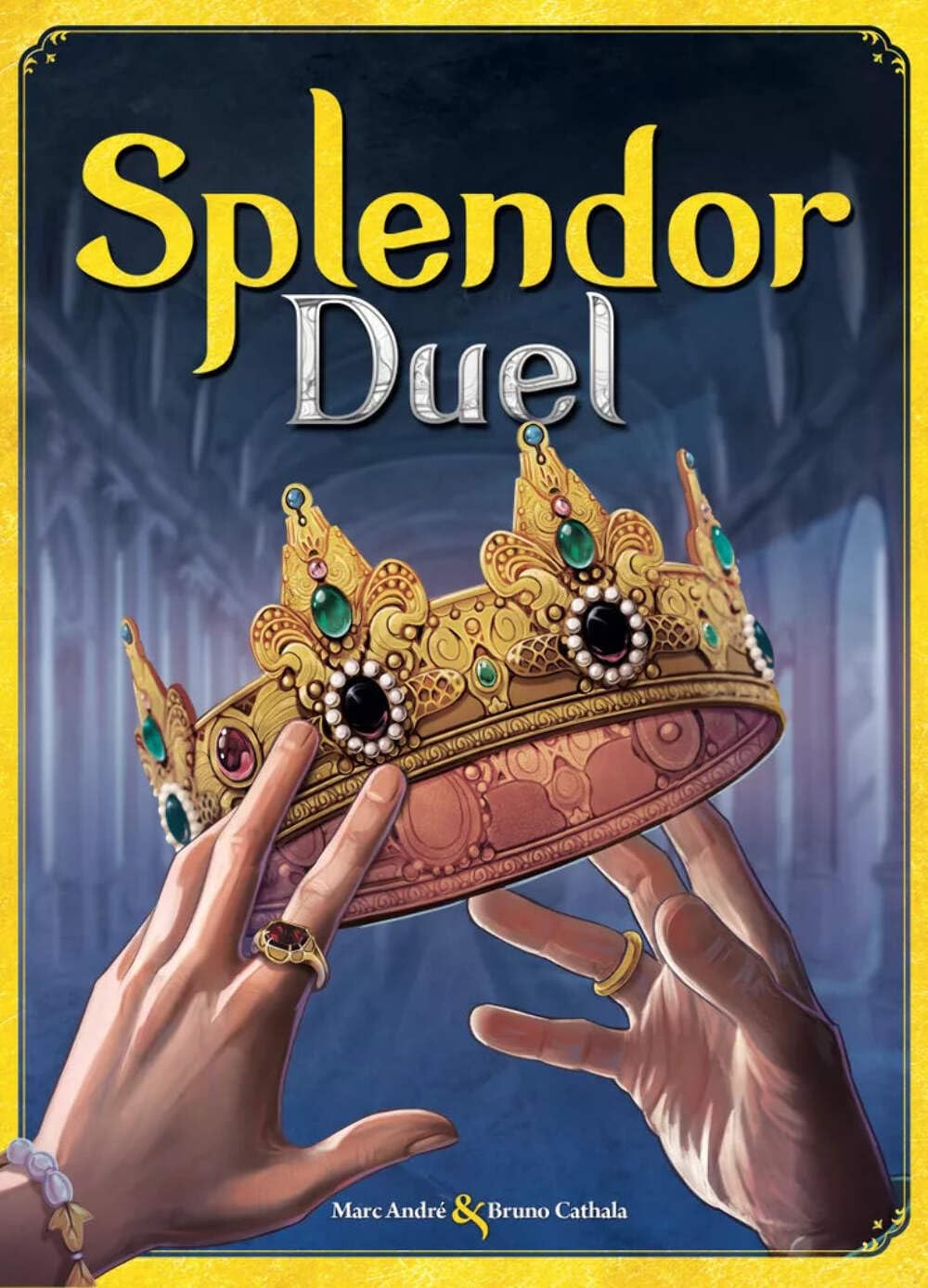
Splendor Duel retains the core loop of collecting gem tokens to purchase development cards for prestige points, but adds meaningful twists that make it a vastly superior two-player game than the original Splendor at two players. The shared board features a dynamic gem market where certain tokens are restricted, forcing you to compete directly for resources. Pearl tokens and privilege scrolls introduce special powers and alternate win conditions, creating multiple paths to victory beyond simply hitting fifteen prestige points.
The component quality is excellent. The plastic gem tokens are chunky and weighty, the cards are thick with a linen finish, and the insert keeps everything organized without a bag of spare bits floating around. A typical game wraps up in twenty-five to thirty minutes, making it easy to squeeze in a round before dinner. The strategic depth unfolds gradually — after five or six plays, you start recognizing card synergies and counter-strategies that keep the game fresh.
The primary limitation is that dedicated two-player design means you cannot add a third or fourth player later. For couples who exclusively play as a duo, this is a non-issue. The standalone nature also means you do not need the original Splendor to enjoy it. If you want a competitive engine-builder that rewards repeated plays and fits in a compact box, this is the strongest option at the price tier.
Why it’s great
- Premium component quality with thick cards and heavy plastic tokens
- Multiple win conditions add strategic variety beyond the original Splendor
- Quick 30-minute sessions fit easily into a regular routine
Good to know
- Dedicated two-player design — cannot expand to larger groups
- Gem restriction mechanics can feel punishing on bad draws
4. Codenames: Duet (2nd Edition)
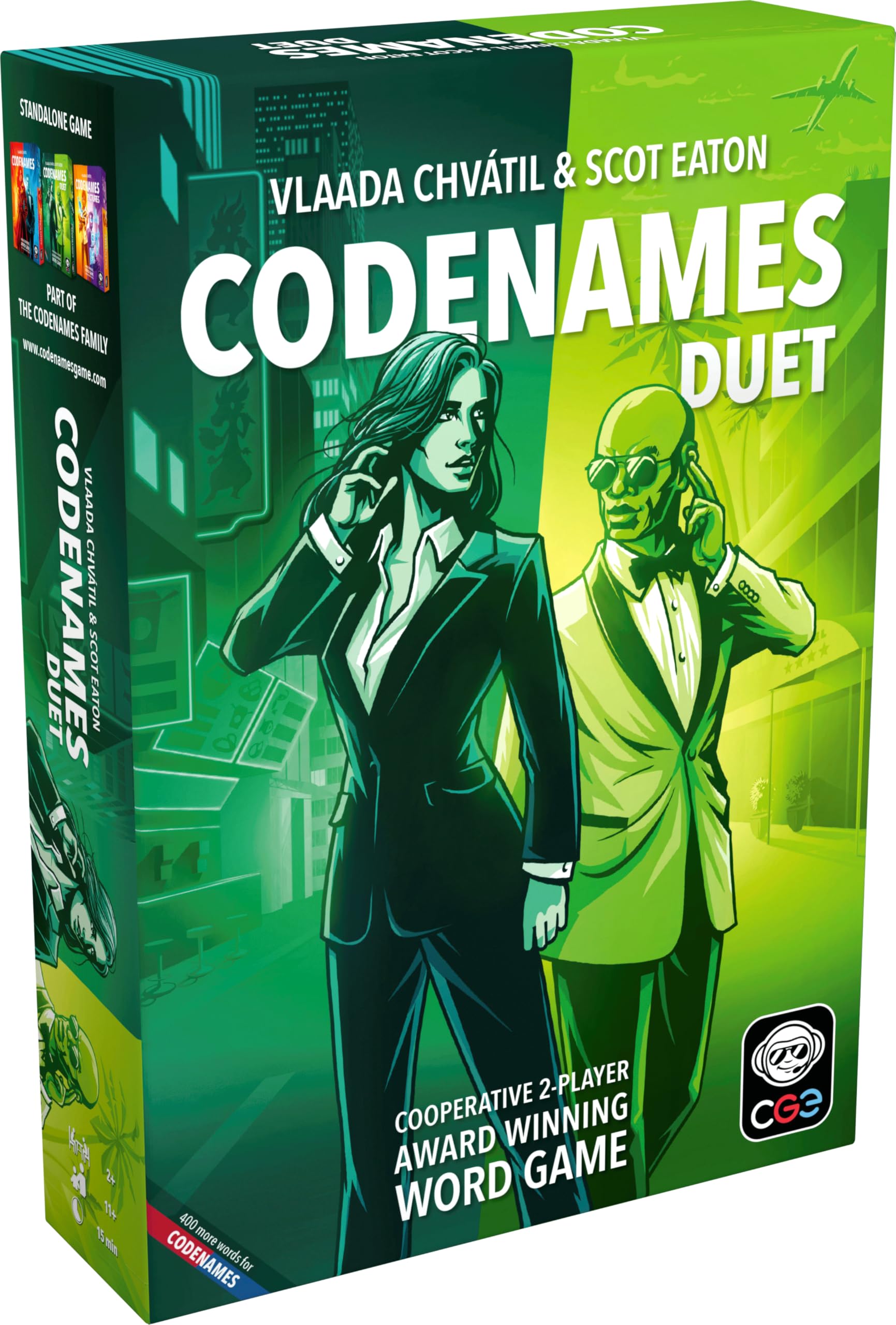
Codenames: Duet flips the classic spy-word game into a cooperative format where both players see a portion of the key and must guide each other with single-word clues. The objective is to find all fifteen friendly agents hidden across a five-by-five grid while avoiding the assassin and innocent bystanders. The tension is real — a poor clue can end the game instantly.
The second edition includes a refreshed card set with 200 double-sided cards totaling 400 codenames, along with an improved insert that holds everything securely. The key cards are double-sided and reusable, so the game practically never runs out of content. Individual rounds last ten to fifteen minutes, making it easy to play multiple rounds in a session as you refine your cluing strategy.
One caveat: the game shines brightest as a social deduction activity with larger groups, and the cooperative format inevitably loses the “gotcha” satisfaction of the original team-versus-team mode. However, for two players who enjoy wordplay and mental gymnastics, the shared puzzle creates a unique bonding dynamic. The small box is highly portable and fits in a larger purse or bag for travel.
Why it’s great
- Cooperative design works well for couples who prefer team-based play
- 400 codenames provide strong replayability without expansions
- Fast 15-minute rounds suit short attention windows
Good to know
- Co-op mode lacks the competitive bite of the original party version
- Clue restrictions can lead to quiet frustration if partners think differently
5. BOOP by Smirk and Dagger

BOOP reimagines tic-tac-toe as a cat-and-kitten-themed abstract strategy game where every piece you place pushes adjacent pieces one space away. The core loop is deceptively simple: line up three cats in a row to win, but kittens are smaller and can be disrupted by larger cat pieces. The “boop” mechanic, where placing a kitten shoves neighboring kittens, creates chain reactions that dramatically shift the board state with every move.
The physical components are charming without sacrificing function. The 32 wooden pieces are painted with distinct cat and kitten designs, and the soft quilted fabric board keeps them from sliding too easily — though some users noted the pieces can shift if the board is nudged. The game plays in under twenty minutes and takes about three minutes to learn, making it ideal for couples who want quick, competitive rounds without deep rules study.
The strategic depth is real despite the cute theme. Because kittens push adjacent pieces, you must think two or three moves ahead to set up sequences that your partner cannot disrupt. The randomness is minimal — the only real factor is the order in which you deploy kittens versus cats. For cat lovers and strategy fans alike, this is a rare crossover that earns its spot on the short-list.
Why it’s great
- Exceptionally fast to learn and play, with genuine tactical depth
- Adorable theme with well-crafted wooden pieces and fabric board
- Chain-reaction mechanics create unpredictable, exciting turns
Good to know
- Pieces can slide on the fabric board if the table is bumped
- Gameplay depth plateaus after roughly 15–20 plays
6. The Lord of the Rings: Duel for Middle-Earth

Duel for Middle-Earth adapts the celebrated 7 Wonders Duel engine into a Lord of the Rings battle where one player controls the Fellowship racing to destroy the Ring while the other commands Sauron’s forces aiming to conquer the land. The game plays over three chapters with a shared card draft and an area-control layer that adds a tactical dimension absent from the original Duel formula.
Each side operates asymmetrically. The Fellowship player focuses on advancing the Ring track and collecting ally tokens, while Sauron builds armies and erects towers to dominate territory. The three win conditions — completing the Quest for the Ring, allying with all six Peoples, or achieving military dominance — keep both players constantly adjusting their strategy. The components are top-tier: thick cards, durable player boards, and small tokens that feel solid in hand.
Setup is quick given the box size, and thirty-minute playtimes make it a viable option for couples who want thematic depth without a marathon session. The main caution is the learning curve — the asymmetrical rules mean each side plays differently, so the first two or three games involve regular rulebook checks. Once the flow clicks, however, the tension of each chapter builds to a satisfying conclusion that feels earned regardless of who wins.
Why it’s great
- Asymmetrical sides create fresh strategic challenges on replay
- Excellent component quality with strong LOTR theming
- Three win conditions prevent stale strategic paths
Good to know
- Asymmetrical rules require dedicated learning time for both players
- Theme may not appeal to couples who are not LOTR fans
7. The Ultimate Date Night Game by Relatable

The Ultimate Date Night Game is not a strategy exercise — it is a conversation starter packed into 200 cards across five categories. Players spin a spinner, draw a card, and follow the prompt, which ranges from silly dares to deeper personal questions. The goal is to collect 25 cards by completing the activities, but the real value lies in the quality of the interaction rather than the competition.
The card stock is noticeably thick and durable, holding up well to frequent shuffling. The spinner is lightweight but functional, and the compact box (roughly 9 x 5 inches) slides into a larger purse or weekend bag for use at a cabin or hotel. The prompts are varied enough that you will not exhaust them in a single evening, though several reviews note that repeat play reveals the same themes within roughly five to six sessions.
This is the most accessible entry in this list — there are no complex rules, no setup time, and no winner dynamics to navigate. It works best for couples who view game night as a backdrop for conversation rather than a tactical contest. For those seeking genuine strategic depth, one of the titles above will provide more lasting engagement, but as a low-pressure, low-cost icebreaker, this game delivers exactly what it promises.
Why it’s great
- Zero rules overhead — open the box and start talking within a minute
- Durable card stock that survives repeated shuffling
- Portable size fits easily into a travel bag
Good to know
- Prompts become repetitive after half a dozen plays
- Not a competitive game — no real strategic depth
FAQ
Are board games for two players actually fun for couples who have different skill levels?
How can I tell if a board game’s rules are too complex for a casual couple’s game night?
Which type of board game lasts longer for couples — competitive or cooperative?
Final Thoughts: The Verdict
For most users, the board games for couples winner is the Sky Team because it delivers tense cooperative teamwork in under 30 minutes with nearly infinite replayability through its twenty scenarios. If you want a competitive head-to-head duel with premium components, grab the Splendor Duel for its satisfying engine-building and strategic variety. And for a light-hearted, conversation-driven evening with zero rules overhead, nothing beats the The Ultimate Date Night Game.