
Our readers keep the lights on and the weekend projects moving. As an Amazon Associate, I earn from qualifying purchases.
The right receiver is the invisible anchor of any serious home theater, yet most buyers get lost in wattage wars and HDMI version numbers. A bad pick means garbled dialogue, dropped signals, and constant remote juggling. Get it right and the hardware vanishes — leaving only the movie.
I’m Rikta — the co-founder and writer behind FitlyFast. I’ve spent hundreds of hours cross-referencing published lab measurements, analyzing real-user failure reports across thousands of reviews, and mapping the feature sets that actually survive long-term ownership in the sub-$1000 bracket.
This guide breaks down the model choices that deliver clean amplification, reliable HDMI 2.1 handshaking, and room-correction that works. It reveals how to find the best av receiver under $1000 for your specific speaker setup and gaming needs.
How To Choose The Best AV Receiver Under $1000
Every sub-$1000 receiver makes tradeoffs in amplifier quality, room-correction sophistication, and HDMI feature support. Knowing which compromises hurt and which you can safely ignore is the difference between a system you love and one you replace in two years.
Channel Count and Future-Proofing
Five-channel receivers handle a basic 5.1 setup, but seven or nine channels let you add front-height speakers for Dolby Atmos without sacrificing surrounds. The catch: many 7-channel models disable Zone 2 when you bi-amp the fronts. Check the manual for channel-assignment limitations before buying.
Room Correction Matters More Than Wattage
Audyssey MultEQ, Dirac Live, and YPAO R.S.C. each measure speaker distance, level, and EQ, but Dirac Live offers the most precise time-domain correction, taming bass modes that other systems miss. In this price tier, only the Onkyo TX-NR7100 includes Dirac Live out of the box — a major advantage for difficult rooms.
HDMI 2.1 and Gaming Features
If you own a PS5, Xbox Series X, or a PC with an RTX 30/40 series card, 4K/120Hz passthrough is non-negotiable. Look for receivers with 40 Gbps HDMI 2.1 ports (not the older 24 Gbps version) that support VRR, ALLM, and QFT. Some 2021 models received firmware updates to fix bandwidth limitations — verify the serial number range.
Quick Comparison
On smaller screens, swipe sideways to see the full table.
| Model | Category | Best For | Key Spec | Amazon |
|---|---|---|---|---|
| Onkyo TX-NR7100 | Premium | Dirac Live Room Correction | 9.2 ch, 100W/ch, Dirac Live, THX | Amazon |
| Denon AVR-S970H | Mid-Range | Phono Input and 8K Gaming | 7.2 ch, 90W/ch, 3x 8K HDMI | Amazon |
| Sony STR-AN1000 | Premium | 360 Spatial Sound Mapping | 7.2 ch, 165W (6 ohms), DCAC IX | Amazon |
| Yamaha RX-A2A | Premium | Surround:AI and Build Quality | 7.2 ch, 100W/ch, Aventage line | Amazon |
| Denon AVR-S770H | Mid-Range | Entry-Level 8K with Audyssey | 7.2 ch, 75W/ch, 8K/60Hz | Amazon |
| Onkyo TX-NR6100 | Mid-Range | THX Certification | 7.2 ch, 210W/ch (dynamic), THX | Amazon |
| JBL MA710 | Mid-Range | Shallow Depth for Media Consoles | 7.2 ch, 110W/ch, 8K, eARC | Amazon |
| Yamaha RX-V6A | Mid-Range | MusicCast Multi-Room | 7.2 ch, 100W/ch, 8K/60Hz | Amazon |
| Marantz NR1510 | Mid-Range | Compact Slim Chassis | 5.2 ch, 50W/ch, HEOS, 4K | Amazon |
| Pioneer VSX-935 | Mid-Range | Dual-Zone Output | 7.2 ch, 80W/ch, 8K/60Hz | Amazon |
| JBL MA310 | Value | Budget 5.2 for Small Rooms | 5.2 ch, 60W/ch, 4K, ARC | Amazon |
In‑Depth Reviews
1. Onkyo TX-NR7100 9.2-Channel AV Receiver
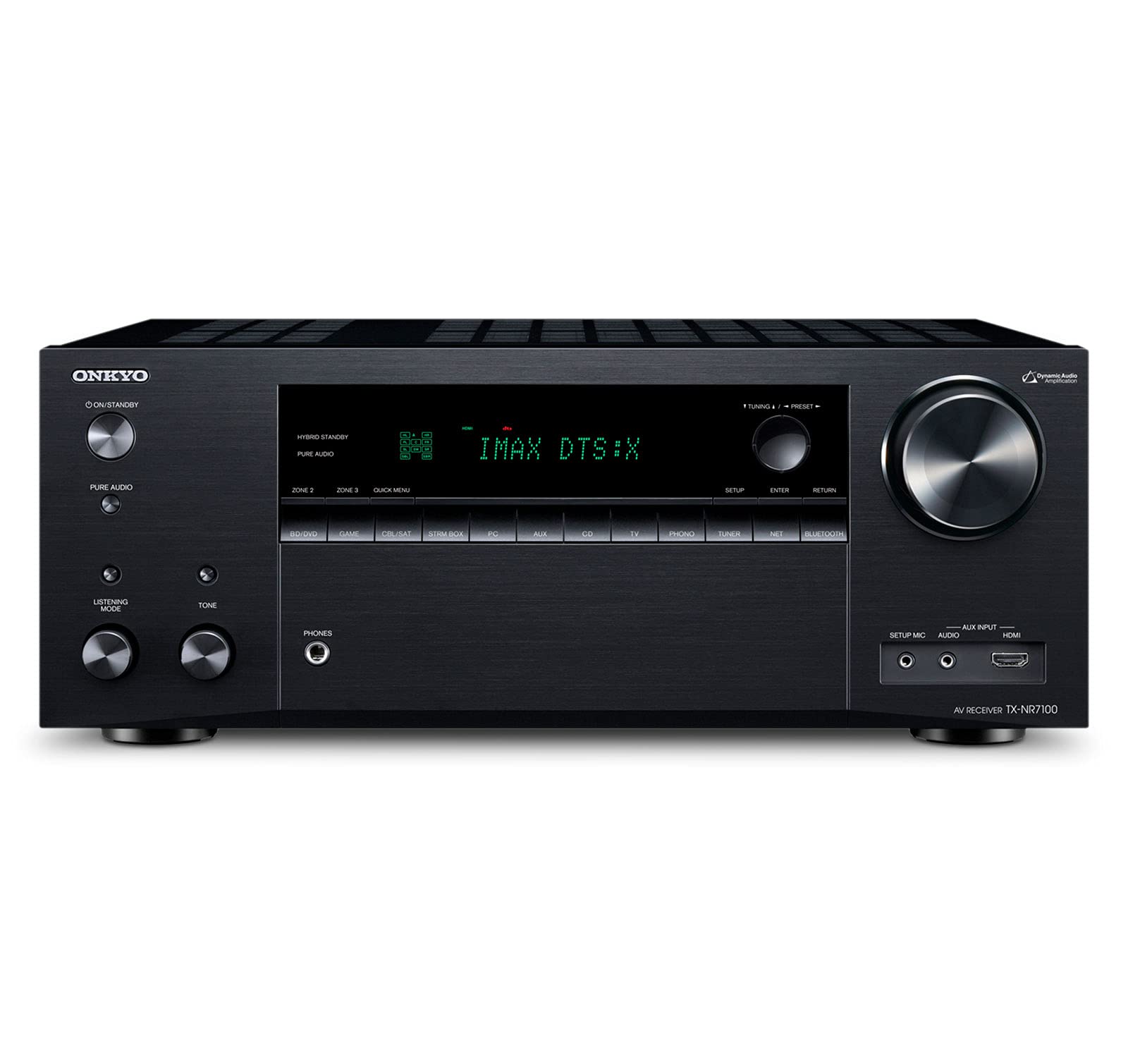
The Onkyo TX-NR7100 is the only receiver in this price range that ships with Dirac Live out of the box — a room-correction system that measures impulse response across multiple positions and applies FIR filters to flatten both frequency and time domain. For rooms with problematic bass modes or asymmetrical layouts, Dirac delivers a measurable improvement in bass clarity and imaging precision that Audyssey and YPAO struggle to match.
With nine channels of processing (100W per channel into 8 ohms), it supports 5.1.4 or 7.1.2 Atmos setups. All three HDMI 2.1 inputs run at 40 Gbps, passing 4K/120Hz VRR and ALLM signals from PS5 and Xbox Series X without chroma subsampling drops. The THX Select certification adds confidence that the amplifier stage can drive lower-impedance speakers at reference levels without distortion.
Build quality is solid, though the remote lacks a backlight and the on-screen menu feels dated. The included calibration mic works with the Dirac Live smartphone app, but serious users should pair it with a UMIK-1 USB mic for higher measurement accuracy. Fan noise is present during heavy operation but inaudible at normal listening distances above 30 dB.
Why it’s great
- Dirac Live room correction included
- Nine processing channels for 5.1.4 Atmos
- Full HDMI 2.1 at 40 Gbps with VRR/ALLM
- THX Select certified
Good to know
- Remote not backlit
- On-screen menus feel dated
- Fan can be audible near unit
2. Denon AVR-S970H 8K Ultra HD 7.2 Channel

The Denon AVR-S970H bridges the gap between entry-level and mid-tier by including a moving magnet phono input — a feature typically reserved for more expensive models. This makes it the ideal hub for vinyl listeners who also want 8K/60Hz and 4K/120Hz passthrough for modern gaming. The 90W per channel (two channels driven, 8 ohms, 20 Hz–20 kHz) is honest power that handles most bookshelf and tower speakers in medium-sized rooms.
Audyssey MultEQ runs the calibration with a supplied microphone and stand, measuring up to six positions to generate EQ filters. The HEOS platform supports multi-room audio with Amazon Music HD, TIDAL, and Spotify Connect. Two HDMI 2.1 inputs (three total 8K inputs) support VRR and ALLM, making this a capable companion for the Xbox Series X or PS5.
The on-screen setup assistant walks through speaker configuration, input assignment, and network connection faster than any competitor. Zone 2 works in 5.2 mode if you skip the surround backs. The remote is functional but generic — a universal remote or app control feels more natural for daily use. Some users report the HEOS app occasionally loses connection and requires a restart.
Why it’s great
- Built-in phono preamp for turntables
- 90W/channel continuous power rating
- Audyssey MultEQ with six-point measurement
- Three 8K HDMI 2.1 inputs
Good to know
- Zone 2 limits to 5.2 channels
- HEOS app stability can improve
3. Sony STR-AN1000 7.2 CH Surround Sound

Sony’s STR-AN1000 uses their Digital Cinema Auto Calibration IX (DCAC IX) along with 360 Spatial Sound Mapping to create a wider, more enveloping sound field than traditional room correction allows. The algorithm synthesizes phantom speakers between your physical channels, which is especially effective for filling the gap between front left/right and the center channel. Dialogue clarity in films like “Blade Runner 2049” is noticeably more anchored to the screen.
With six HDMI inputs (two output), including two HDMI 2.1 ports that support 4K/120Hz VRR, the AN1000 covers modern console gaming. The 165W per channel rating is into 6 ohms at 1 kHz — real-world 8-ohm output is closer to 100W. The unit includes Chromecast built-in, Apple AirPlay 2, and Spotify Connect. The “Works with Sonos” certification allows integration with existing Sonos systems.
One known quirk: the AN1000 sometimes fails to pass Dolby Vision from an Apple TV 4K, requiring a direct HDMI connection from the Apple TV to the display with optical audio back to the receiver. The remote is well-laid-out with dedicated input buttons. The unit runs cool compared to competing Denon and Onkyo models, which helps in tight ventilation spaces.
Why it’s great
- 360 Spatial Sound Mapping widens soundstage
- DCAC IX calibration with multi-point measurement
- Cool operating temperature
- Works with Sonos
Good to know
- Dolby Vision passthrough glitch with Apple TV 4K
- No phono input
4. Yamaha RX-A2A AVENTAGE 7.2-Channel

The Yamaha RX-A2A belongs to the Aventage line, which uses a higher-grade chassis with a fifth anti-vibration foot, premium DACs, and thicker circuit boards. This translates to lower noise floor and better channel separation than the RX-V series at similar power ratings. The Surround:AI engine analyzes audio content in real-time and adjusts DSP parameters to emphasize dialogue or expand effects depending on the scene.
YPAO R.S.C. with multipoint measurement uses a supplied microphone and stand to perform EQ and distance calibration. It lacks the full frequency-domain correction of Dirac Live, but the “Reflected Sound Control” feature helps minimize early reflections in reflective rooms. Three HDMI inputs support 8K/60Hz and 4K/120Hz with ALLM and VRR. MusicCast handles multi-room streaming across Yamaha wireless speakers.
Build quality is exceptional — the binding posts are solid, the knobs have weighted feel, and the unit weighs 25.4 pounds. The phono input supports moving magnet cartridges. Some users report HDMI handshake issues with Sony TVs that sometimes require a full power cycle. The remote is better than the Onkyo unit but still not backlit.
Why it’s great
- Aventage build with anti-vibration chassis
- Surround:AI real-time DSP adjustment
- YPAO R.S.C. with multipoint calibration
- Phono input included
Good to know
- Intermittent HDMI handshake with Sony TVs
- Remote not backlit
5. Denon AVR-S770H 7.2 Ch Home Theater Receiver

The Denon AVR-S770H is the most affordable way to get Audyssey MultEQ and 8K/60Hz passthrough in a single box. At 75W per channel (two channels driven, 8 ohms), it won’t drive power-hungry floorstanders to reference levels in large rooms, but it pairs well with sensitive speakers like Klipsch or ELAC in medium spaces. The on-screen setup assistant is the same high-quality guide used in Denon’s more expensive models.
Six HDMI inputs with one output support 4K/120Hz VRR for gaming, though only one input is HDMI 2.1 at 40 Gbps — the rest are 24 Gbps. Dolby Height Virtualization and DTS Virtual:X create synthetic overhead channels without physical height speakers, which works surprisingly well for adding vertical space to a 5.1 layout. The HEOS app controls multi-room audio across Amazon Music HD, TIDAL, and Spotify.
The 75W rating is conservative and clean — real-world listening at 80 dB peaks uses only a few watts. The remote is a basic unit with small buttons. A known firmware bug causes occasional random volume drops to zero, typically fixed by a power cycle or firmware update. Overall, this is the smart entry-level 8K receiver for buyers on a tighter budget.
Why it’s great
- Audyssey MultEQ included
- Dolby Height Virtualization for 5.1 users
- Easy on-screen setup assistant
- 8K/60Hz and 4K/120Hz support
Good to know
- Only one full HDMI 2.1 input
- 75W/ch limited for large rooms
- Occasional firmware volume drop bug
6. Onkyo TX-NR6100 7.2 Channel THX Certified
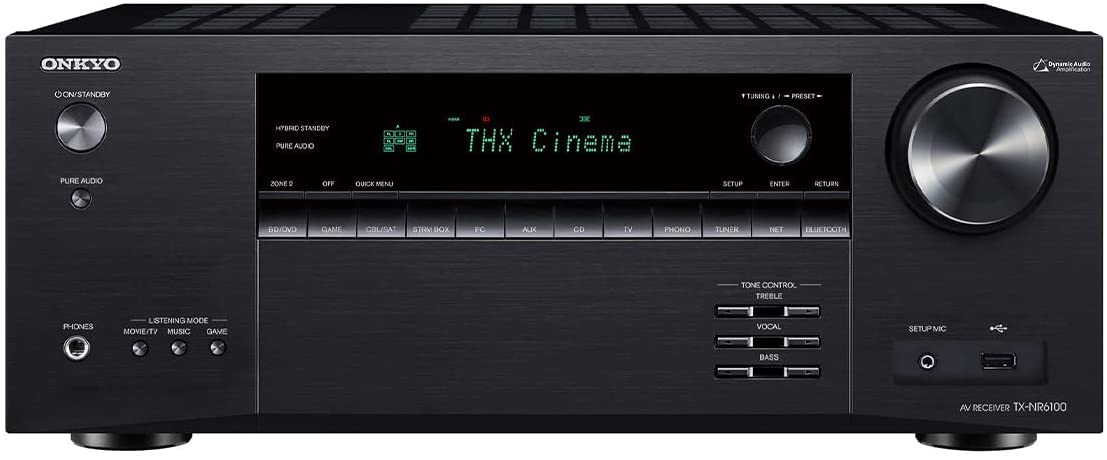
The Onkyo TX-NR6100 is the THX Select Certified entry point, ensuring that the amplifier delivers flat frequency response and low distortion at reference levels in a medium-sized room. The 210W per channel dynamic power rating is peak, but continuous output is around 100W — enough for most 5.1.2 Atmos setups. The eight HDMI inputs (three at 40 Gbps HDMI 2.1) accommodate consoles, streaming boxes, and Blu-ray players without switching fatigue.
It decodes Dolby Atmos and DTS:X natively, and the AccuEQ room calibration handles distance and level setting, though it lacks the sophistication of Dirac or Audyssey. IMAX Enhanced certification ensures compatibility with IMAX-encoded discs. The unit runs cooler than previous Onkyo generations, but one review noted the internal fan can produce a loud click when engaging. The remote feels flimsy compared to the Denon and Yamaha offerings.
Setup is straightforward via the on-screen menu. The AccuReflex technology attempts to align phase between traditional and height speakers, but effectiveness depends on placement. Bi-amping the front channels sacrifices the surround back pair, reducing to 5.1.2. Despite some quality-control reports, the feature-to-price ratio remains strong for gamers prioritizing HDMI 2.1.
Why it’s great
- THX Select Certified for reference playback
- Three HDMI 2.1 inputs at 40 Gbps
- IMAX Enhanced support
- Eight HDMI inputs total
Good to know
- Fan can produce loud click
- Remote feels flimsy
- AccuEQ less advanced than Dirac/Audyssey
7. JBL MA710 7.2 Channel 8K AV Receiver

The JBL MA710 solves a specific physical pain: at 13.7 inches deep, it fits into media consoles where full-depth receivers like the Onkyo TX-NR7100 (14.9 inches) or Yamaha RX-A2A (14.6 inches) simply won’t. Despite the compact footprint, it packs 110W per channel into 7.2 channels with Dolby Atmos and DTS:X decoding. The 6 HDMI inputs include eARC support, and Wi-Fi/Bluetooth streaming covers Apple AirPlay 2 and Google Chromecast built-in.
A moving magnet phono input is a welcome addition for vinyl users, competing directly with the Denon AVR-S970H. Setup is done through the on-screen menu, though the interface is more basic than Denon’s or Sony’s. The unit runs reasonably cool thanks to its Class-D amplifier topology. The remote is compact but not backlit — a common complaint across multiple JBL MA series reviews.
DTS-HD Master Audio does not mix down to 2.1 channels on the MA710, which affects users with stereo-only setups who play Blu-rays. JBL support confirms that profile is handled by the MA710 but only in full multi-channel mode. For standard 5.1.2 home theater with efficient speakers, the MA710 delivers clean, dynamic sound in a form factor that fits tight cabinets.
Why it’s great
- Shallow 13.7-inch depth for tight cabinets
- 110W/ch with Dolby Atmos and DTS:X
- Phono input for turntables
- AirPlay 2 and Chromecast built-in
Good to know
- No DTS-HD downmix to 2.1
- Remote not backlit
- Setup interface is basic
8. Yamaha RX-V6A 7.2-Channel AV Receiver

The Yamaha RX-V6A is the entry gate to the MusicCast multi-room ecosystem, which allows grouping of Yamaha wireless speakers, soundbars, and subwoofers across different rooms. As a 7.2-channel receiver, it supports 5.1.2 Atmos or 7.1 surround. Three of its seven HDMI inputs are 8K/60Hz capable, with eARC on the output port. The 100W per channel rating (two channels driven) is typical for this class.
YPAO with multipoint measurement handles calibration without the “Reflected Sound Control” found on the Aventage line. The receiver processes Dolby Vision, HDR10+, and HLG, making it fully compatible with current HDR standards. Voice control via Alexa and Google Assistant works through MusicCast. The phono input is absent — vinyl users need an external preamp.
The setup process is more involved than the Denon guided assistant, requiring some manual navigation through the YPAO menu. The unit does not auto-turn-on with some Sony Bravia TVs via HDMI CEC, which forces users to use the remote. MusicCast is generally stable, but the app interface feels older than HEOS. At its price point, the RX-V6A delivers solid HDMI 2.1 support and multi-room flexibility.
Why it’s great
- MusicCast multi-room ecosystem
- Three 8K/60Hz HDMI inputs
- Dolby Vision and HDR10+ support
- YPAO multipoint calibration
Good to know
- No phono input
- CEC issues with some Sony TVs
- Setup less intuitive than Denon
9. Marantz NR1510 UHD AV Receiver – Slim 5.2 Channel

At just 4.1 inches tall, the Marantz NR1510 is the slimmest receiver on this list — designed for low-profile media cabinets where full-height units block the TV screen. It is a 5.2-channel receiver with 50W per channel (two channels driven), which limits its reach to efficient speakers in small-to-medium rooms. The Class A/B amplifier topology delivers the warm, musical sound Marantz is known for, though the power output is modest.
Six HDMI inputs with 4K/60Hz support (no 8K, no 4K/120Hz) cover Blu-ray, cable, and streaming boxes. HDR10, Dolby Vision, and HLG are all supported. Built-in HEOS handles multi-room audio with Amazon Music HD, TIDAL, and Spotify. A moving magnet phono input is included. The setup assistant walks through speaker configuration and HDMI ARC pairing, though the unit runs hot and needs ventilation space above.
The NR1510 is not for gamers needing HDMI 2.1 or 4K/120Hz — it tops out at 4K/60. It also lacks Atmos height channel support since it only processes 5.1. However, for a pure stereo or 5.1 music and movie system in a tight space, the Marantz offers build quality and a phono stage that cheaper slim receivers omit. The HEOS app occasionally struggles with initial device discovery.
Why it’s great
- Ultra-slim 4.1-inch height
- Warm Marantz Class A/B sound
- Built-in phono preamp
- HEOS multi-room streaming
Good to know
- 50W/ch limits speaker matching
- No HDMI 2.1 or 4K/120Hz
- Runs hot — needs ventilation
10. Pioneer VSX-935 7.2 Channel Network Receiver
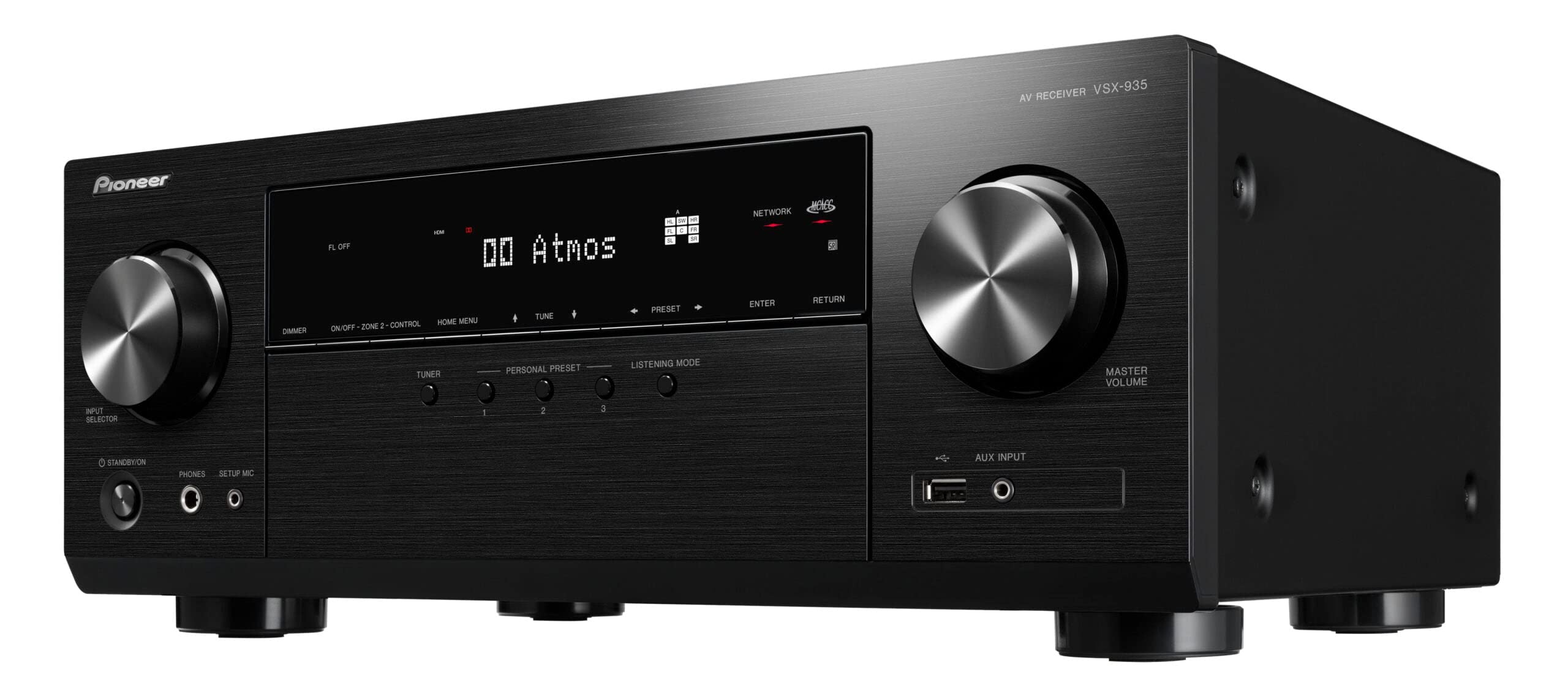
The Pioneer VSX-935 offers 7.2 channels with 8K/60Hz and 4K/120Hz passthrough, making it a viable HDMI 2.1 partner for modern consoles. The amplifier delivers 80W per channel (two channels driven) into 8 ohms — adequate for efficient speakers. Dolby Atmos Height Virtualization allows a 5.1 layout to simulate overhead effects without installing ceiling speakers, a useful feature for renters.
The RF remote works reliably through cabinets and has a clear display with dimmer settings. Dual-zone output lets you send different audio to a second room. The unit decodes WAV, FLAC, and AIFF up to 192 kHz/24-bit via network streaming. Connectivity covers Bluetooth, Wi-Fi, AirPlay 2, and Chromecast built-in. The front-panel layout is clean with a large volume knob.
Setup is not as guided as Denon’s assistant — expect to manually configure speaker levels and distances. The Bluetooth implementation is two-way (can send audio to headphones) but the pairing process is buried in menus with no dedicated button. Some users report the first unit arriving DOA and needing replacement. For the price, the VSX-935 trades room-correction sophistication for HDMI 2.1 support and dual-zone flexibility.
Why it’s great
- 8K/60Hz and 4K/120Hz HDMI passthrough
- Dual-zone independent audio output
- Dolby Atmos Height Virtualization
- RF remote with clear display
Good to know
- Bluetooth pairing is buried in menus
- Setup less guided than competitors
- Some reports of DOA units
11. JBL MA310 5.2 Channel 4K AV Receiver

The JBL MA310 is a 5.2-channel receiver aimed at budget-focused buyers building a simple 5.1 system without 8K or Atmos aspirations. Each of the five channels delivers 60W into 8 ohms — sufficient for small-to-medium rooms with sensitive speakers. It decodes Dolby and DTS surround formats but does not support object-based Atmos or DTS:X. The 4 HDMI inputs with ARC (not eARC) support 4K/60Hz passthrough with HDR10 and Dolby Vision.
Bluetooth 5.1 with Low Energy provides wireless streaming from phones and tablets. The unit is 5.1 kilograms and features a shallow depth that fits standard AV furniture. The on-screen setup menu is functional but basic — users report that initial configuration can be confusing if the firmware update hangs and requires patience. For the price, it lacks HDMI 2.1, pre-outs, and any room correction beyond basic level-setting.
The remote is not backlit, and the auto-shutoff defaults to 20 minutes (must be manually changed in menus). The front-face JBL logo glows brightly in dark rooms, which some find distracting. Despite these tradeoffs, the MA310 drives satellite speakers cleanly and offers a genuine entry into home theater for buyers who don’t need the latest video standards.
Why it’s great
- Affordable entry into 5.1 surround
- Shallow depth fits most cabinets
- Bluetooth 5.1 with low energy
- Dolby Vision and HDR10 passthrough
Good to know
- No Atmos, DTS:X, or 8K support
- No HDMI 2.1 or 4K/120Hz
- Remote not backlit, bright front glow
FAQ
Does a 7.2-channel receiver support Dolby Atmos height speakers?
Can my sub-$1000 receiver drive 4-ohm speakers safely?
What is eARC and why does it matter for a new receiver?
Do I need a 4K/120Hz receiver for a PS5 or Xbox Series X?
Final Thoughts: The Verdict
For most users, the best av receiver under $1000 winner is the Onkyo TX-NR7100 because Dirac Live solves room-acoustic problems that no other receiver at this price addresses, and the nine-channel processing leaves room for future expansion to 5.1.4. If you want a more streamlined setup with a built-in phono input and simpler user interface, grab the Denon AVR-S970H. And for pure build quality and the best real-time DSP engine, nothing beats the Yamaha RX-A2A.