
Our readers keep the lights on and the weekend projects moving. As an Amazon Associate, I earn from qualifying purchases.
Waking up gasping for air in a tent or RV because your CPAP machine shut down is a terrifying way to start a camping trip. A dedicated battery backup eliminates that risk, but choosing the wrong one — with too little capacity or incompatible voltage — leaves you stranded in the dark.
I’m Rikta — the co-founder and writer behind FitlyFast. I’ve spent countless hours analyzing CPAP power consumption data, battery chemistry specs, and real-world runtime reports to separate units that genuinely deliver a full night’s therapy from those that fall short under load.
This guide presents the battery for cpap camping options that balance capacity, weight, and compatibility so you can sleep soundly wherever you roam.
How To Choose The Best Battery For CPAP Camping
Selecting a CPAP camping battery isn’t just about the biggest number on the box. You need to match the battery’s output ports and voltage settings to your specific machine, while also accounting for the power draw of accessories like humidifiers and heated tubing. Ignore these details and your “all-night” battery could die before dawn.
Match Voltage and Connector Type First
ResMed AirSense 10/11 runs on 24V DC, while Philips DreamStation uses 12V DC. A battery with adjustable DC output (12V/15V/20V/24V) or a bundle of dedicated cables eliminates the need for an inefficient AC inverter. Using the DC port directly stretches runtime by 15–20% compared to plugging into a standard AC outlet.
Calculate Runtime With Humidifier Settings
A CPAP machine pulling 50–60W with heated humidifier and hose will drain a 150Wh battery in roughly 2.5 hours. Turn off the humidifier and heated hose, and the same machine draws only 8–12W, giving you 12+ hours from that same battery. Always estimate runtime based on your real pressure setting and accessory use.
Prioritize LiFePO4 Chemistry for Durability
Lithium Iron Phosphate (LiFePO4) batteries handle 3,000 to 4,000 charge cycles before degrading to 80% capacity. Standard lithium-ion packs often fade after 500 cycles. For a battery you’ll drag on every camping trip for years, LiFePO4 delivers the lowest long-term cost per night of use.
Check for Pass-Through Charging
Pass-through charging lets you power your CPAP while the battery itself recharges from a wall outlet, car socket, or solar panel. This is critical when you’re at a campground with intermittent power or when you need to top up during the day without interrupting your sleep schedule the following night.
Quick Comparison
On smaller screens, swipe sideways to see the full table.
| Model | Category | Best For | Key Spec | Amazon |
|---|---|---|---|---|
| BLUETTI X30 | CPAP-Specific | Multi-Night Untethered Sleep | 297Wh, 3x DC ports | Amazon |
| EASYLONGER ES720 | CPAP-Specific | Extended Off-Grid Trips | 266.4Wh, 4 DC cables | Amazon |
| Jackery Explorer 1000 v2 | Power Station | Full-Rig Camping & Home Backup | 1070Wh, 1500W AC | Amazon |
| BLUETTI AC50B | Power Station | Balanced Portability & Power | 448Wh, 700W AC | Amazon |
| DaranEner Cubus600L | Solar Bundle | Solar-Ready Off-Grid Camping | 576Wh, 100W solar included | Amazon |
| LIBRIDS C600 | Power Station | UPS-Style Home & Camp Backup | 640Wh, 600W AC | Amazon |
| Anker SOLIX C300 | Power Station | Ultra-Compact Car Camping | 288Wh, 300W AC | Amazon |
| VTOMAN Jump 600X | Power Station | Car Camping & Emergency Jump Start | 299Wh, regulated 12V DC | Amazon |
| EASYLONGER ES400 AIR | CPAP-Specific | Budget-Friendly One-Nighter | 148Wh, 4 CPAP cables | Amazon |
In‑Depth Reviews
1. BLUETTI X30 CPAP Battery Backup

The BLUETTI X30 is purpose-built for CPAP users who need reliable multi-night performance without dragging a full power station. Its 297Wh capacity and three dedicated DC output ports (12V, 15V, 24V) mean you match your machine’s exact voltage without any inverter loss. Real-world reports show users running a ResMed AirSense 10 for five straight nine-hour nights on a single charge with humidifier turned off — ending with 20% battery remaining.
Weighing just 3.9 pounds and smaller than a hardcover book, it packs easily into a duffel or backpack. The included five color-coded DC cables cover ResMed S9, AirSense 10/11, AirMini, and Philips DreamStation models. The 2,000-plus recharge cycles of its LiFePO4 cells mean this battery will still deliver strong runtime after years of weekend camping trips.
The X30 charges from a wall outlet in about 5 hours, and its simple one-button operation eliminates menu-diving in the dark. Note that it charges via 110V AC input only — solar or car charging requires an external adapter. It’s also limited to powering one device at a time, so it won’t double as a camp-wide power hub.
Why it’s great
- Ultra-lightweight CPAP-specific design
- Three native DC voltages maximize runtime
- Proven 5+ nights for low-power CPAP use
- 2,000-cycle LiFePO4 battery chemistry
Good to know
- Single-device output only
- No solar or car charging included
- Weighs slightly more than listed spec
- Not compatible with Philips DreamStation per some reports
2. EASYLONGER ES720 CPAP Battery Backup

The EASYLONGER ES720 delivers a generous 266.4Wh in a slim 9.1 x 5.9 x 1.7-inch package that slides easily into a carry-on or camping bag. It comes with four dedicated DC cables for ResMed S9, AirSense 10/11, AirMini, and Philips DreamStation, plus an adjustable DC output that lets you dial in the exact voltage your machine requires — eliminating the inefficiency of an AC inverter.
Users report powering a ResMed AirSense 11 for two full nights without humidifier or heat, with more than 50% charge remaining, estimating three to four nights total per charge. The battery also includes a 180W cigarette lighter socket, 60W USB-C PD input, and an LED light with SOS mode, making it a versatile power source for gadgets and emergency signaling.
One downside: the ES720 does not support pass-through charging via its DC port — you need to use the cigarette lighter adapter for that feature. Some users note the battery drains quickly when running a heated hose or humidifier above setting 1. The included AC adapter delivers 72W, which means a full recharge takes 4 to 5 hours.
Why it’s great
- Slim form factor fits travel cases
- Four dedicated CPAP cables included
- Adjustable DC voltage for efficiency
- LED light with SOS for emergencies
Good to know
- No pass-through on DC port
- Heated hose drains battery fast
- Some units underperformed on second night
- Not TSA-approved due to capacity
3. Jackery Explorer 1000 v2

When you need more than just CPAP power — think RV camping, tailgating, or home backup — the Jackery Explorer 1000 v2 delivers serious capacity. The 3,000W surge handles motor startup loads from small appliances.
Recharging from 0 to 100% takes just one hour with the emergency mode activated via the Jackery App, or 1.7 hours in standard mode for better long-term battery health. The unit weighs 23.8 pounds with a foldable handle, making it manageable for car camping but too heavy for backpacking. Three pure sine wave AC outlets, two USB-C ports (100W PD), and a 12V car port cover all your device needs.
At this capacity and price point, the Explorer 1000 v2 is overkill for a single-night backpacker. It’s best for campers who want one power station to handle CPAP therapy and general electronics for a full weekend. The app-based control is convenient but means you’re dependent on smartphone connectivity for advanced features.
Why it’s great
- Massive 1,070Wh for multi-night use
- 1-hour fast recharge from wall outlet
- Pure sine wave safe for sensitive devices
- App control with customizable charging modes
Good to know
- Heavy at 23.8 lbs for carry
- Overkill for short CPAP-only trips
- App required for fast-charge mode
- Expensive for pure CPAP use
4. BLUETTI AC50B Portable Power Station

The BLUETTI AC50B strikes an excellent balance between runtime and portability for CPAP campers who also want to power other gear. Its 448Wh LiFePO4 battery provides about three to four nights of CPAP use (humidifier off) while still having juice for phone charging and camp lights. The 700W AC output (1,000W surge) handles most small appliances, and the two AC outlets let you share power.
Charging speed is a standout: Turbo Mode via the BLUETTI App pushes AC input to 580W, taking the unit from 0 to 80% in 45 minutes. A full charge from a 100W solar panel takes about 6 hours. The six ports include two 65W USB-C outputs, a USB-A port, and a 12V car port, giving you broad compatibility without extra adapters.
At 14.8 pounds, the AC50B is significantly lighter than the Jackery 1000 but still too heavy for backpacking. Some users note the inverter efficiency could be better — you’ll get noticeably longer runtime using DC-powered devices when possible. The built-in AI-BMS provides robust protection against overcharging, short circuits, and temperature extremes.
Why it’s great
- Turbo charge to 80% in 45 minutes
- 448Wh covers 3-4 nights CPAP use
- Two 65W USB-C ports for fast device charging
- LiFePO4 rated for 3,500+ cycles
Good to know
- Heavier than CPAP-specific units
- Inverter efficiency reduces runtime vs DC direct
- App required for Turbo Charging mode
- Not as compact as slim CPAP batteries
5. DaranEner Cubus600L with 100W Solar Panel
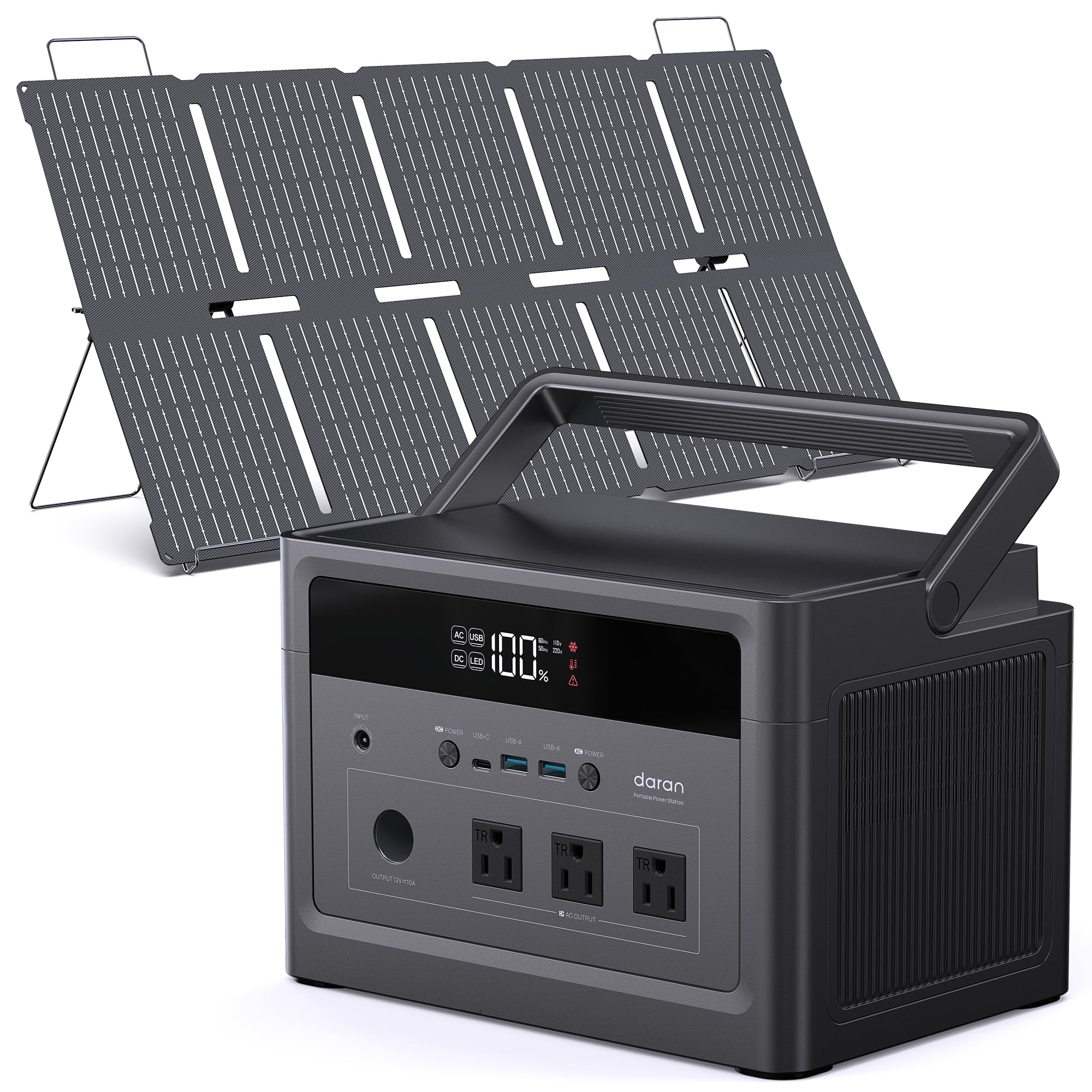
The DaranEner Cubus600L is an all-in-one solar camping solution that pairs a 576Wh LiFePO4 power station with a 100W solar panel. This combination lets you recharge during the day and run your CPAP all night indefinitely, as long as the sun cooperates. The 600W AC output (1,200W peak) powers three AC outlets simultaneously, alongside a 100W USB-C PD port and a 120W car socket.
Reaching 70% charge from a wall outlet takes about 3.3 hours, and the included solar panel tops up the battery in roughly 5–6 hours of direct sunlight. The unit weighs 13.7 pounds and features an ergonomic handle, making it easy to move from car to campsite. The LiFePO4 cells are rated for over 3,000 cycles and include fire-resistant casing rated up to 700°C for safety.
Real-world users find it works well as a large power bank for low-demand items but note the 600W limit means it trips with higher-draw appliances like space heaters or blenders. The solar panel adds significant bulk and cost — if you don’t plan on solar recharging, a simpler power station without the panel may be a better fit.
Why it’s great
- 100W solar panel included for off-grid recharge
- 576Wh capacity for multiple CPAP nights
- Three AC outlets for sharing power
- Fire-resistant LiFePO4 safety certification
Good to know
- 600W limit trips with some appliances
- Solar panel adds bulk and cost
- Not as efficient as DC-direct CPAP batteries
- Slow solar recharge in cloudy conditions
6. LIBRIDS C600 Portable Power Station
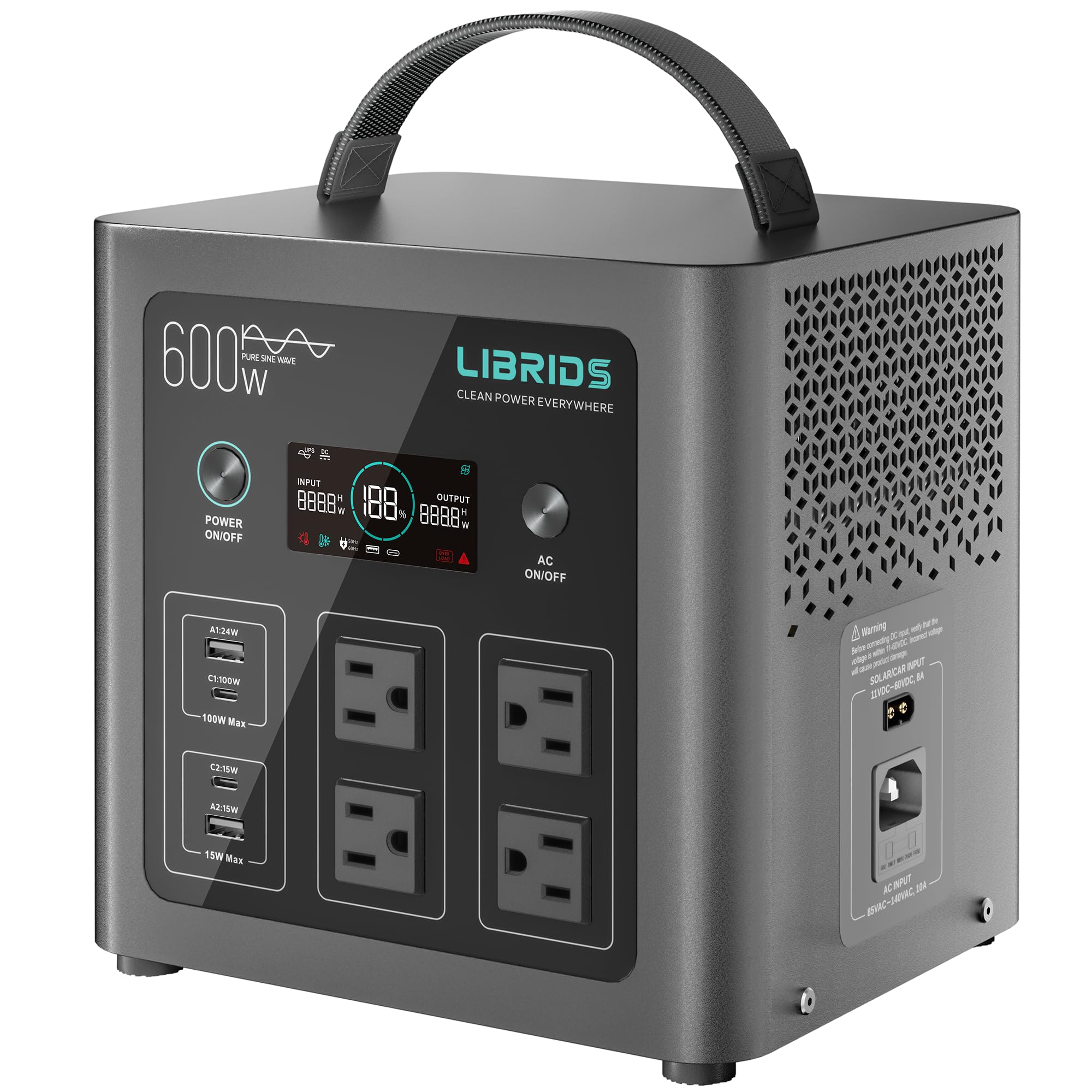
The LIBRIDS C600 offers a compelling feature for CPAP users who also want home backup: a built-in 10ms UPS that automatically switches to battery power during an outage. This means your CPAP machine never blinks off when the campground loses power or a storm knocks out the grid at home. Its 640Wh LiFePO4 battery powers a ResMed AirSense 11 for about 7 hours at standard settings while using only 24% of the battery — translating to roughly three full nights per charge.
The metal enclosure improves heat dissipation and indoor safety, while the 600W pure sine wave inverter (1,200W surge) delivers clean power for sensitive medical electronics. Eight output ports include four AC outlets, USB-A, and USB-C ports, letting you charge multiple devices simultaneously. Full recharge from a wall outlet takes just 1.5 hours — one of the fastest in this category.
The unit is labeled “Indoor Use Only” due to UL safety requirements, but can be used in dry, well-ventilated outdoor conditions like campsites during clear weather. At 8.3 x 6.9 x 8.2 inches, it’s compact for its capacity but heavier than CPAP-specific batteries. The quiet fan operation (25 dB) won’t disturb sleep.
Why it’s great
- 10ms UPS prevents CPAP interruption
- 640Wh high capacity for extended use
- Fast 1.5-hour AC recharge
- Metal enclosure for heat dissipation
Good to know
- “Indoor Use Only” label limits warranty in rain
- Heavier than dedicated CPAP batteries
- AC inverter less efficient than DC direct
- No CPAP-specific DC cables included
7. Anker SOLIX C300 Portable Power Station

The Anker SOLIX C300 proves that big performance can come in a small package. Its 288Wh LiFePO4 battery and 300W AC output (600W surge) are ideal for one to two nights of CPAP use with humidifier off, while the unit itself takes up less space than a shoebox. Dual 140W USB-C ports charge laptops and phones at full speed without needing separate power bricks, making this a versatile travel companion beyond CPAP.
Recharge to 80% in just 50 minutes via wall outlet, and the unit operates at a near-silent 25 dB — quieter than a whisper — so it won’t disrupt your tent or RV at night. Three AC outlets, a car socket, and multiple USB ports give you eight ways to power your gear. The 3,000-cycle LiFePO4 battery is rated to last a decade of regular use.
Capacity is the limiting factor here: with heated hose and humidifier running, the C300 may only last one night. It’s best suited for minimalist campers who keep CPAP accessories off and pack light. The USB-C ports have a reported tendency to wear over time with heavy cable insertion, so handle the ports with care.
Why it’s great
- Ultra-compact size saves pack space
- Dual 140W USB-C fast charging
- 50-minute 80% recharge speed
- Near-silent 25 dB operation
Good to know
- Limited to 1-2 nights for CPAP
- Heated accessories drain battery quickly
- USB-C ports may wear over time
- 300W AC limits high-draw devices
8. VTOMAN Jump 600X Portable Power Station

The VTOMAN Jump 600X is a unique 2-in-1 device that combines a 299Wh portable power station with a built-in car jump starter. For campers who drive to remote sites, this means you can power your CPAP all night and still have the juice to jump-start a dead battery in the morning. The regulated 12V DC outputs are ideal for CPAP machines that natively run on 12V — delivering clean, stable power without inverter loss.
Users report running a CPAP for 10 hours while simultaneously charging phones, and jumping a Dodge Ram instantly. The 600W AC output (1,200W surge) powers two AC outlets, and expandable capacity (up to 939Wh with an optional extra battery) gives you room to grow. The three regulated 12V/10A DC ports are perfect for CPAP, tire inflators, and car refrigerators.
The main trade-off is weight: at 14.6 pounds, it’s heavy for its 299Wh capacity compared to dedicated CPAP batteries. The recharge time of about 3 hours via wall outlet is reasonable, but the 100W max input means slower solar charging than newer competitors. Some users note the fan can be audible under heavy load.
Why it’s great
- Built-in car jump starter for roadside emergencies
- Regulated 12V DC outputs for CPAP efficiency
- Expandable capacity to 939Wh
- Pass-through charging supports simultaneous use
Good to know
- Heavy for its 299Wh capacity
- Slow solar recharge at 100W max
- Fan noise under heavy load
- Jumper cables sold separately
9. EASYLONGER ES400 AIR CPAP Battery Backup
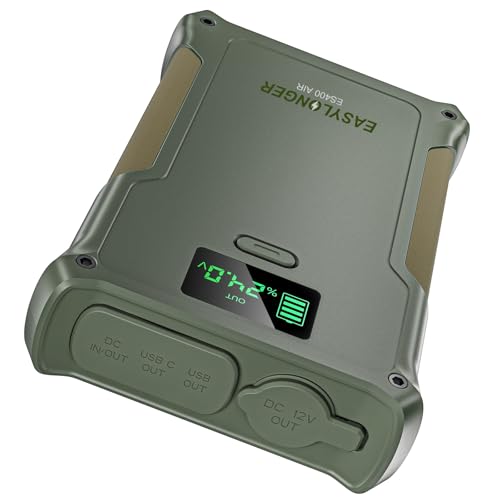
The EASYLONGER ES400 AIR is the most budget-friendly dedicated CPAP battery in this lineup, weighing just 2.05 pounds and slipping into a backpack pocket. Its 148Wh capacity delivers a full night of therapy for most CPAP users — especially when humidifier and heated hose are turned off. The unit includes four CPAP cables covering ResMed AirSense 10/11, AirCurve 10/11, AirMini, S9, and Philips DreamStation models.
Pass-through charging lets you power your CPAP while the battery itself recharges from a wall outlet, preventing interruptions during overnight use. Three recharge options — AC adapter (4–5 hours), car charger (2–3 hours), or solar panel (3–4 hours with 80W panel) — provide flexibility. The 160W car socket, 30W USB-C, and 18W USB-A ports add utility for charging other devices.
Some users report a faint electronic buzzing from the unit, and pass-through operation via a surge protector can be finicky — the manufacturer suggests plugging directly into the wall. The capacity is tight: with humidifier on higher settings, you may not make it through a full night. Consider this a reliable one-nighter for minimalist car campers, not for multi-day off-grid trips.
Why it’s great
- Ultra-light at 2.05 pounds
- Includes four CPAP-specific cables
- Pass-through charging support
- Multiple recharge methods (AC/car/solar)
Good to know
- 148Wh limits to one night with accessories off
- Some units produce faint electronic buzzing
- Pass-through can be finicky with surge protectors
- Humidifier use may drain before morning
FAQ
How many nights will a CPAP battery last on a camping trip?
Can I use a regular portable power station for my CPAP machine?
What size battery do I need for CPAP camping with a heated humidifier?
Final Thoughts: The Verdict
For most users, the battery for cpap camping winner is the BLUETTI X30 because it combines a compact 297Wh capacity, dedicated DC voltage ports, and proven multi-night runtime in a 3.9-pound package purpose-built for CPAP therapy. If you want the flexibility to power laptops, phones, and camp accessories alongside your CPAP, grab the BLUETTI AC50B for its faster charging and broader port selection. And for extended off-grid camping where solar recharging is essential, nothing beats the DaranEner Cubus600L with its included 100W solar panel that keeps you sleeping soundly night after night.