
Our readers keep the lights on and the weekend projects moving. As an Amazon Associate, I earn from qualifying purchases.
Welding at home changes the game for car repairs, farm equipment, steel gates, and custom fabrication — but buying the wrong machine turns a weekend project into a frustrating session of bird-nesting wire and stuck rods. The reality: the best at home welder has to balance duty cycle, input voltage, and multi-process capability without blowing the circuit breaker on your garage outlet.
I’m Rikta — the co-founder and writer behind FitlyFast. I’ve spent over 80 hours analyzing inverter topologies, wire feed mechanisms, and real user weld tests across the to range for this guide.
Whether you are a beginner running 6013 rods on a trailer gate or a hobbyist chasing aluminum TIG beads, knowing synergy control, IGBT rectifiers, and dual-voltage auto-sensing separates a usable machine from a clunky paperweight. We tested nine machines head-to-head to find the absolute best at home welder for your workshop and skill level.
How To Choose The Best At Home Welder
Picking your first home welder is not about the highest amp rating — it’s about matching the machine’s inverter type, process flexibility, and power input to the materials you actually weld. Beginners overbuy on peak amperage and underbuy on duty cycle, then wonder why the machine cuts out halfway through a 12-inch bead.
Duty Cycle: The Real Limiter
Duty cycle is the number of minutes out of a ten-minute window you can weld continuously at a given amperage. A 200A welder with a 20% duty cycle means two minutes of welding followed by eight minutes of cooling. For home users doing short repair beads, 20-30% at max amp is acceptable — but if you plan to weld an entire table frame, look for 40% or higher at 160A. The Lincoln Electric 90i FC runs a long duty cycle at 90A output because it uses inverter cooling, not a heavy transformer.
IGBT vs. Old-School Transformer
Modern home welders use IGBT (Insulated Gate Bipolar Transistor) inverter technology. These units weigh around 13-15 pounds versus 50+ pounds for old transformer machines. IGBT inverters give you a smoother arc, better arc starts, and energy efficiency that prevents tripping 15-amp breakers. Every product in this guide — from the budget-friendly Stick Welder to the premium Weldpro — uses IGBT topology, so you are not buying obsolete tech.
Multi-Process vs. Single-Process
A 4-in-1 or 6-in-1 machine lets you run MIG with gas, flux core without gas, stick rods for thick dirty metal, and lift TIG for precision stainless — all in one box. The Bestarc 145A and YESWELDER 160A give you this flexibility for around -. If you only plan to weld thin steel sheet on a car body, a dedicated flux-core unit like the Lincoln 90i FC saves money and avoids the complexity of gas bottles and regulators.
Voltage: 110V vs. 220V
Most home garages only have 110V/120V outlets. Dual-voltage welders (110V and 220V) with auto-sensing input let you run on household current for light work and step up to 220V for heavy penetration on 1/4-inch metal. The ARC 200Pro and HITBOX 140A both detect voltage automatically — no manual switch to burn out. If your shop has a 220V outlet already, you get more penetration without downsides.
Quick Comparison
On smaller screens, swipe sideways to see the full table.
| Model | Category | Best For | Key Spec | Amazon |
|---|---|---|---|---|
| Weldpro 200A AC/DC | Premium TIG | Aluminum / AC TIG with pulse and foot pedal | 40% duty cycle @ 200A | Amazon |
| ARCCAPTAIN MIG200 | 6-in-1 Workhorse | Synergic MIG with spot weld & aluminum prep | 200A / 10 preset settings | Amazon |
| FEMEROL 250A MIG | High-Amp Multiprocess | Aluminum & spool gun compatibility | 250A / 60% duty cycle | Amazon |
| Lincoln Electric 90i FC | Portable Flux Core | Light sheet metal / outdoor repairs | 120V / 15 lbs / 1/4″ capacity | Amazon |
| Forney Easy Weld 100ST | TIG-Capable Stick | Light stick / TIG for beginners | 90A / all-metal case | Amazon |
| YESWELDER 160A | 4-in-1 Value | Synergic gas MIG for DIY | 160A / dual voltage / 2LB & 10LB spools | Amazon |
| Bestarc 145A MIG | 4-in-1 Beginner | Solid & flux core MIG learning | 145A / 13.7 lbs / shoulder strap | Amazon |
| HITBOX 140A | Compact 3-in-1 | Flux core / outdoor farm repairs | 140A / 6.6 lbs / ETL certified | Amazon |
| Stick Welder ARC 200Pro | Entry Stick/Lift TIG | Stick welding for beginner home use | 200A / dual voltage / hot start adjust | Amazon |
In‑Depth Reviews
1. Weldpro 200A AC/DC TIG Welder with CK17 Torch
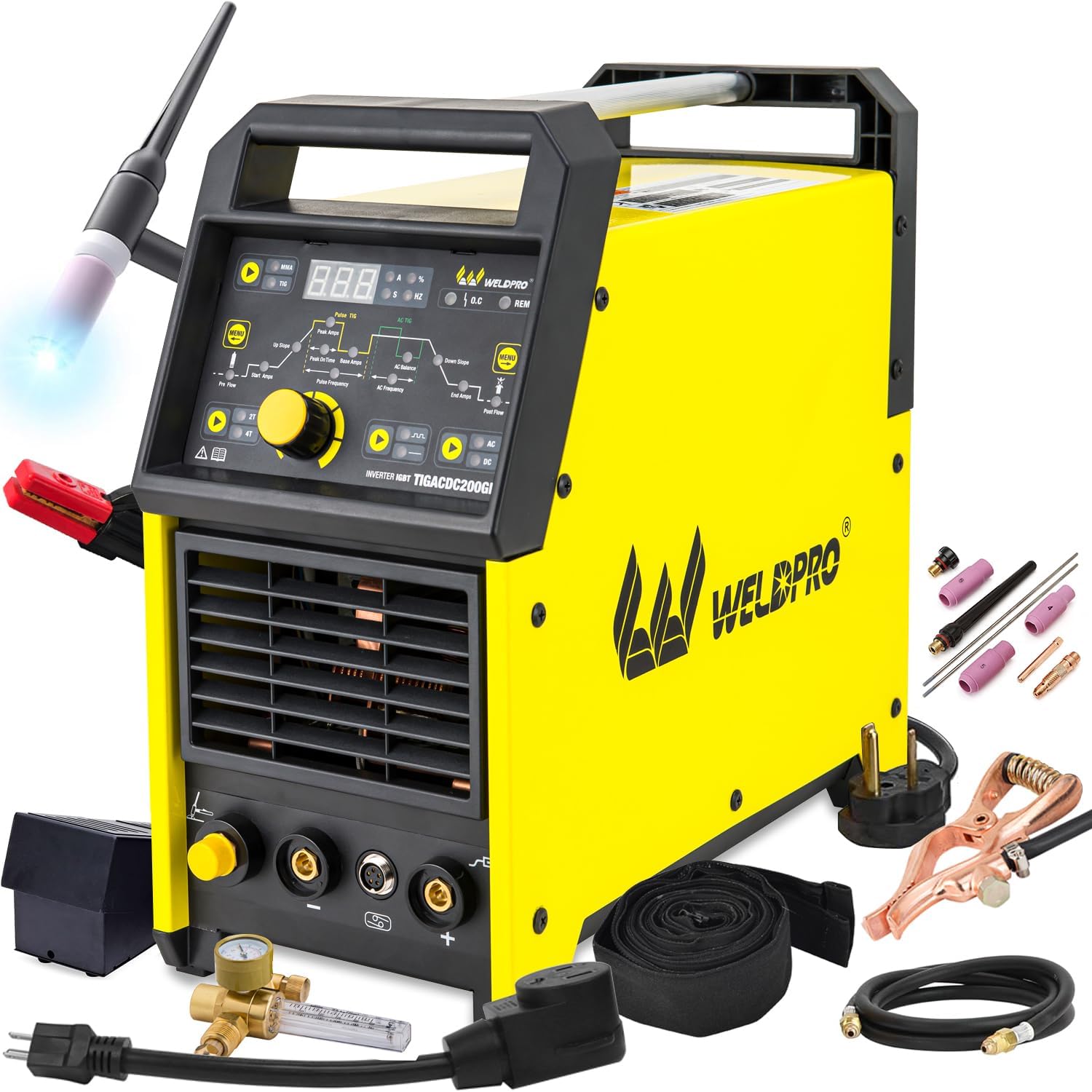
The Weldpro 200A AC/DC is the only machine in this lineup with proper high-frequency AC TIG for aluminum, a CK17 torch with a superflex cable, and a rocker foot pedal that gives you real-time amperage control without lifting your hand. Its 5-in-1 capability covers AC TIG, DC TIG, AC Pulse, DC Pulse, and stick — which means one machine replaces three dedicated units for a home shop. The 40% duty cycle at 200A is honest: you can run longer beads on 16-gauge stainless without the thermal shutdown you hit on budget inverters.
The CK17 torch alone justifies the premium position — replacement parts are standard across every welding supply shop, and the flex head gets into tight frame corners where a fixed torch would force you to reposition the whole workpiece. The foot pedal’s rocker design delivers smooth upslope and downslope, which makes TIG-brazing exhaust manifolds or joining thin aluminum sheet possible for even a careful beginner. The included flow meter and gas hose mean you are not hunting for adapters after unboxing.
One experienced user noted the gas-cooled torch gets hot during extended AC TIG runs and that the factory work clamp spring is excessively stiff for gloved hands. The pressure gauge on the regulator can drift — one buyer estimated it cost them wasted argon. These are minor next to the total package: a CK17 torch, foot pedal, full kit, and consistent AC arc stability usually found on machines costing twice as much.
Why it’s great
- Industry-standard CK17 flex torch with widely available consumables
- AC balance and pulse frequency controls produce clean aluminum beads
- Foot pedal gives precise real-time amperage for thin-gauge work
- Dual-voltage auto-sensing works on 110V or 220V without a switch
Good to know
- Gas-cooled torch heats up during extended AC TIG passes
- Regulator accuracy can vary — verify gas flow with a separate gauge
- Work clamp spring is uncomfortably tight for frequent repositioning
2. ARCCAPTAIN MIG200 6-in-1
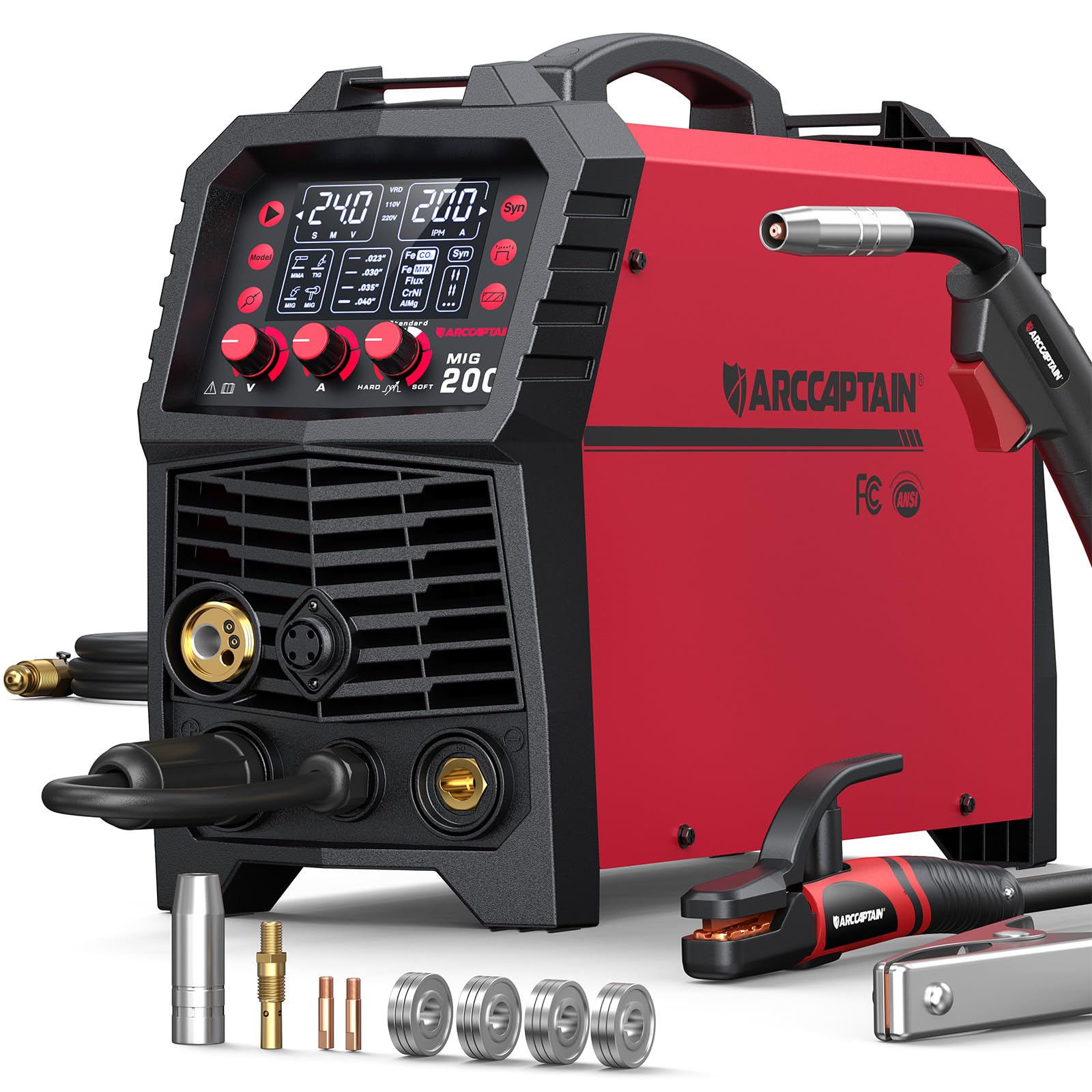
The ARCCAPTAIN MIG200 is a 200-amp 6-in-1 that adds spot welding and spool gun compatibility (for aluminum) to the standard MIG/Flux/Stick/TIG formula. The big differentiator is the 10-group preset memory — you can save your wire speed, voltage, and burn-back settings for different materials and recall them without dialing in from scratch every time. That matters if you switch between 1/8-inch steel plate and 16-gauge sheet metal in the same session.
The synergic control in this unit is smoother than the tier: when you select wire diameter and gas material, the LED display automatically maps the recommended current and wire feed speed. Experienced users can override the voltage in fine increments without leaving the synergic curve. The cooling fan is thermostatically controlled — it only spins when the internal heatsinks need it — which means no constant buzzing noise during setup or reading the manual.
Build quality is robust except for the power cable, which some users report gets warm under sustained 200A output on 110V. The missing 0.035-inch drive roll in the box is an oversight you will need to correct if you run standard solid wire. And the 110V-to-220V adapter is an unusual design — it works but feels less integrated than a proper dual-voltage cord set. For a home user who wants to save settings and eventually weld aluminum with a spool gun, this is the most future-proof mid-range option.
Why it’s great
- 10 preset memory slots save time on frequent material changes
- Thermostatic fan stays silent until cooling is actually needed
- Synergic mapping works reliably for MIG and flux core beginners
- Spool gun connector and spot weld function expand aluminum options
Good to know
- 0.035-inch drive rolls not included — purchase separately
- Power cable gauge is thin for sustained 200A draws on 110V
- 110V-to-220V adapter design is less streamlined than auto-sensing
3. FEMEROL 250A MIG 6-in-1

The FEMEROL 250A stands out for its 60% duty cycle rating — the highest in this lineup — and its ability to weld aluminum either through a Teflon liner or a spool gun. For home users who regularly weld 1/4-inch or thicker plate, the extra 50 amps over the 200A class translates to better penetration without slowing your travel speed. The adjustable inductance control lets you dial in a softer or crisper arc, which directly affects spatter level and puddle fluidity on different wire types.
The 2T/4T trigger modes and pre-flow/post-flow gas timing make it easier to get clean starts and crater fills on long MIG beads. The spot welding function is surprisingly useful for tacking sheet metal before a full seam. At 32.6 pounds, this is the heaviest unit in the mid-range group — but the weight comes from a physically larger transformer and cooling system that supports the 60% duty cycle. The 9.5-foot cables give you decent reach around a work table without dragging the machine off the shelf.
The continuous fan noise is a minor annoyance — it runs nonstop even during idle, unlike the thermostatic fan on the ARCCAPTAIN. Several users reported the wire speed display shows metric values only, which takes adjustment if you are used to inches per minute. The spool holder sits in an awkward position that can pull tension on the wire if not routed carefully. Despite these quirks, the FEMEROL delivers the highest welding current at the lowest entry cost in its class.
Why it’s great
- 60% duty cycle at 250A outperforms most competitors in this price tier
- Adjustable inductance provides control over arc softness and spatter
- Aluminum welding possible via Teflon liner or spool gun (not included)
- Spot welding mode is a real time-saver for sheet metal tacking
Good to know
- Fan runs continuously, not temperature-controlled
- Wire speed displayed in metric only — no IPM readout
- Spool holder geometry can cause feed tension issues if not aligned
4. Lincoln Electric 90i FC Weld-PAK

The Lincoln Electric 90i FC is a dedicated flux-core wire feeder — no gas bottles, no TIG, no stick mode. That narrow focus gives it an edge in portability and reliability for thin-gauge sheet metal repairs. At 15 pounds with a built-in shoulder strap, it is genuinely shop-to-truck portable. The inverter power source produces a noticeably smoother arc than the old transformer flux-core machines, with less spatter and fewer hiccups on 18-gauge auto body steel.
The two-knob interface — one for wire speed, one for voltage — is the simplest setup in this guide. The infinite voltage adjustment lets you fine-tune the arc between 1-10, which is granular enough to dial in the exact heat for 14-gauge versus 18-gauge material without over-penetration. Users who switched from a Forney or Harbor Freight unit consistently report better bead appearance and less post-weld grinding. The metal carry case adds real protection if you toss the welder in a truck bed or trailer toolbox.
The trade-off is that it only accepts 1-pound spools — you cannot load a 10-pound roll for long production runs. The included shoulder strap is functional but the lack of a rigid handle makes one-handed carrying awkward. And at 90 amps, you are limited to 1/4-inch single-pass welds; anything thicker needs multiple passes or preheating. For a homeowner who only wants to patch a tractor fender or weld up a steel fire pit, this machine skips the learning curve of multi-process dials.
Why it’s great
- Superior arc smoothness and reduced spatter versus old transformer flux-core units
- Infinite 1-10 voltage dial lets you fine-tune heat for thin to medium steel
- 15-pound weight with shoulder strap and metal carry case for true portability
- Renowned Lincoln parts availability and factory support
Good to know
- Accepts only 1-pound spools — 10-pound rolls do not fit
- No rigid handle, shoulder strap only for carrying
- 90A output limits single-pass capacity to 1/4-inch steel
5. Forney 298 Easy Weld 100ST

The Forney 298 is a 90-amp stick welder with TIG capability (via a scratch-start torch, not included) in an all-metal case that feels more substantial than the plastic-shell budget units. It plugs into any household 120V outlet and runs 1/16-inch to 5/64-inch rods cleanly at 45-60 amps. Certified welders in the reviews confirm that it produces a smooth, easy-to-start arc on 6013 rods — the common beginner rod — and that the penetration on 3/16-inch steel is solid within its amp range.
The all-metal construction is meaningful for a home welder that may get bumped or stored in a crowded garage corner. The 8-foot electrode holder and ground clamp give you enough reach for small projects without relocating the machine. Forney has been making welding equipment in the USA since 1932, and the documentation and customer support are more helpful than the generic manuals that come with most import units. The TIG capability is an added bonus if you decide to buy a torch later.
This unit does not do MIG or flux-core wire — it is strictly stick and scratch-start TIG. That limits its versatility for users who want to weld thin sheet metal without burn-through. The on-off switch is difficult to operate with welding gloves on. And the 90-amp maximum means you are not welding 1/4-inch plate in a single pass. For a homeowner focused on stick welding small repairs, railing, or art projects, the Forney gives you a trusted brand name at a premium mid-range price.
Why it’s great
- All-metal case built to withstand garage bumps and stacking
- 120V plug-in works on any household outlet without special wiring
- Smooth arc on 6013 rod at low amperage — ideal for learning
- TIG capable with scratch-start torch for future upgrade path
Good to know
- Stick-only — no MIG, flux core, or lift TIG out of the box
- 90-amp limit restricts single-pass capacity to 3/16-inch steel
- Power switch is glove-unfriendly — requires finger dexterity
6. YESWELDER 160A MIG 4-in-1
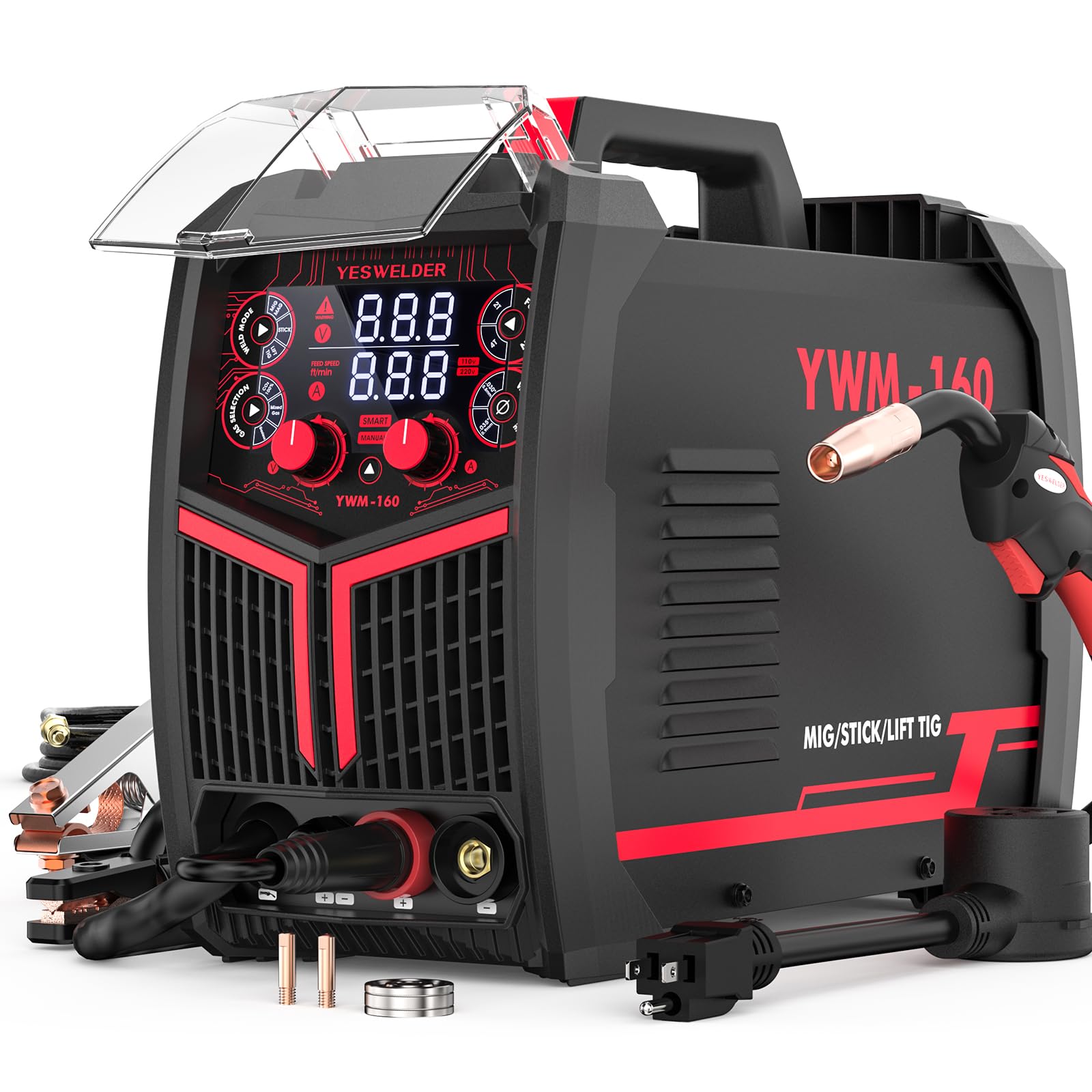
The YESWELDER 160A is a 4-in-1 synergic MIG welder that handles flux-core, gas MIG, stick, and lift TIG. Its smart control system automatically adjusts voltage and wire feed speed when you select material thickness or amperage — removing the guesswork that trips up beginners. The 160-amp output is enough to weld 1/4-inch steel on 220V, and the dual-voltage input with adapter covers 110V garage outlets. The large LED display is readable even with a dark welding helmet pulled down.
This unit accepts both 2-pound and 10-pound spools of 0.030 and 0.035-inch wire, which is a practical advantage over machines that limit you to small reels. The 19.4-pound weight is manageable for moving between a workbench and a driveway project. Experienced users compared its MIG performance favorably against Miller and Lincoln units, especially on 220V with solid wire and gas. The stick mode requires a bit of technique to start the arc cleanly but runs smoothly once established.
The carrying handle is molded into the case and solid enough to lift the machine with one hand. The included 220V-to-110V adapter works, though it adds a bulky connector to your setup. The lift TIG function needs a separate torch purchase. For a first-time buyer who wants synergic MIG gas welding without paying the premium for an auto-setup machine from a pro brand, the YESWELDER delivers the best value in the 160A category.
Why it’s great
- Synergic smart control matches voltage and wire speed automatically
- Accepts 10-pound wire spools, not just small economy reels
- LED display is helmet-friendly and shows clear amperage readings
- Strong MIG performance on 220V with solid wire and shielding gas
Good to know
- Lift TIG requires a separate torch purchase
- Stick arc start takes practice — not as immediate as MIG mode
- 220V adapter adds bulk to the power cord setup
7. Bestarc 145A MIG 4-in-1
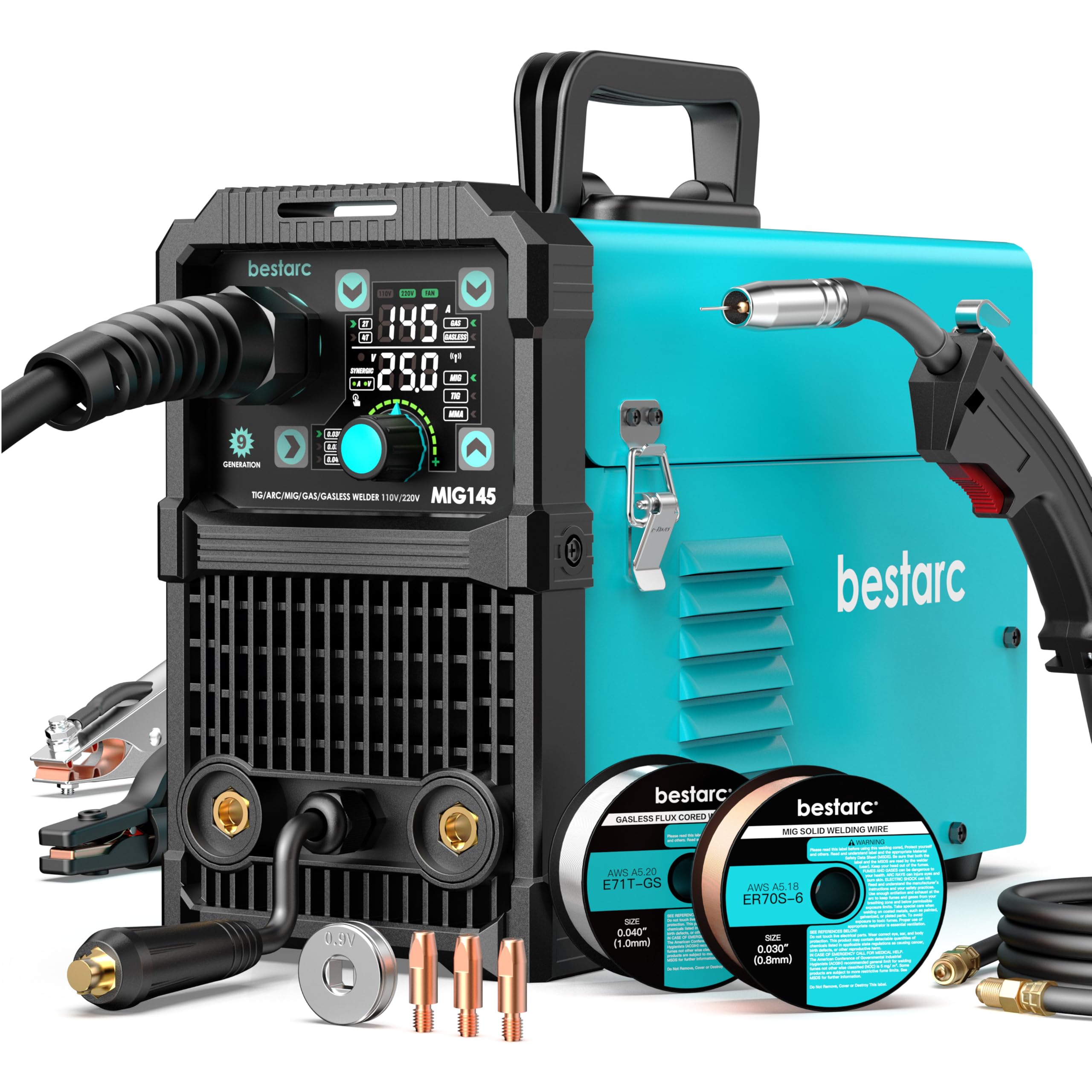
The Bestarc 145A packs synergic MIG, flux-core MIG, lift TIG, and stick into a 13.7-pound body with a shoulder strap — making it the most portable multi-process option in the mid-range tier. Users report it runs clean beads on 1/8-inch steel with 0.030 solid wire and gas, and the synergic control automatically sets the voltage and wire feed speed when you adjust current. The large LED display mirrors the current selection clearly, and you can fine-tune voltage by -3V to +3V if you need to dial in the arc.
Dual-voltage auto-sensing means you can plug into a standard 110V outlet for light work and switch to 220V for heavier penetration without flipping a manual switch. The kit includes both flux-core and solid wire samples, contact tips, and a 220V-to-110V adapter. One long-term user who has owned the machine for years reported it outperforms the comparable Harbor Freight unit and melts metal reliably across many projects — from RV modifications to car body panels.
The MIG gun lead on earlier units was short at 5.5 feet, but later production runs extended it. If you buy one with the original cable, you may need to reposition the machine closer to your work. The stick mode maxes out at around 130 amps, so heavy 1/4-inch-plus stick welding is not this machine’s strength. The included ground clamp uses copper-clad aluminum cable, which some users replace with a pure copper lead for better conductivity. For the price, this is the lightest full 4-in-1 that actually works across all four processes.
Why it’s great
- 13.7-pound machine with shoulder strap is genuinely portable
- Synergic control in MIG mode simplifies setup for flux and solid wire
- Dual-voltage auto-sensing works on 110V or 220V without a switch
- Includes wire samples and both flux core and solid contact tips
Good to know
- MIG gun lead on early production is 5.5 feet — verify current length
- Stick mode limited to ~130A, not suitable for heavy stick welding
- Ground clamp cable is copper-clad aluminum, upgrade recommended
8. HITBOX 140A Flux Core 3-in-1
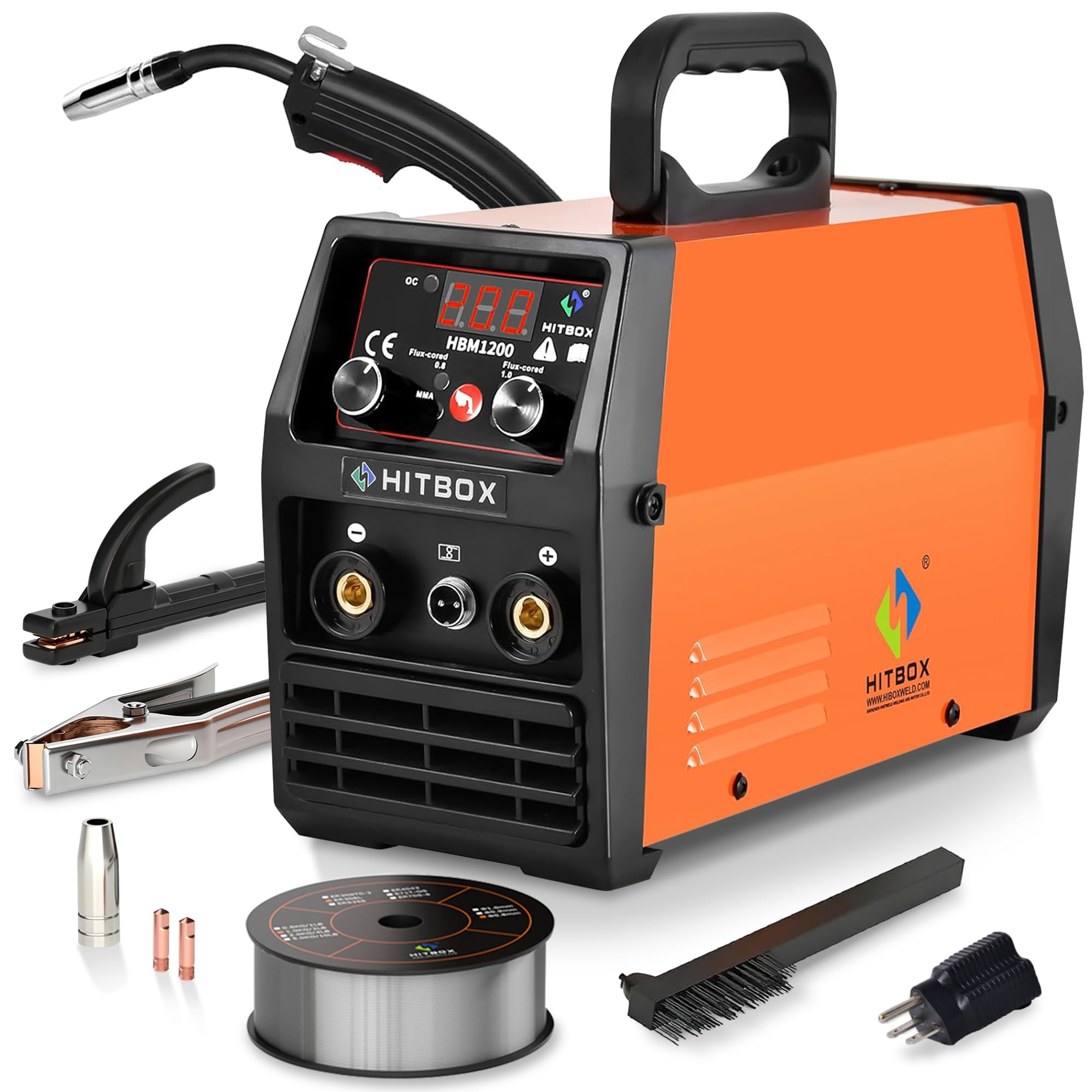
The HITBOX 140A is a 3-in-1 flux-core MIG, stick, and lift TIG welder that weighs only 6.6 pounds — the lightest machine in this guide. Its ETL certification and IP21S rating confirm safety and dust resistance, which matters for outdoor farm repairs or garage environments with sawdust and metal fines. The flux-core mode runs gasless wire (0.8mm included), so you can weld outdoors in a breeze without losing gas coverage. Stick mode handles 3/32-inch 7018 rods on 1/8-inch steel with good penetration reports from users.
The synergic control matches wire feed speed automatically when you adjust the amperage dial — you only have one knob to turn for basic MIG. The manual voltage override lets experienced users tweak the arc without leaving the synergic curve. The cooling system uses dual 7-fin aluminum heatsinks and a 5,000 RPM fan that moves 46 CFM of air, pulling hot air out quickly enough to maintain a long duty cycle for its size. For a 140-amp machine, the arc stability on flux core is noticeably better than the old bench-top Harbor Freight 125 units.
The 220V adapter plug fits an uncommon outlet type — not the standard NEMA 6-50 dryer or stove plug you likely have. You may need a separate adapter. The internal wire spool holder does not accept large 10-pound spools; you are limited to 2-pound or 4-inch rolls. The included ground clamp uses soft metal that can warp with frequent clamping. Despite these compromises, the HITBOX 140A is the most portable flux-core starter that can actually stick weld when needed.
Why it’s great
- 6.6 pounds is the lightest multi-process welder in this guide
- ETL certified and IP21S rated for safety in dusty or outdoor conditions
- Synergic flux-core mode produces low-spatter beads without gas
- Powerful dual-heatsink fan cooling maintains duty cycle at max amp
Good to know
- 220V adapter uses a non-standard outlet plug
- Limited to small 2-pound or 4-inch wire spools only
- Ground clamp metal is soft and can warp with repeated use
9. Stick Welder ARC 200Pro Synergic
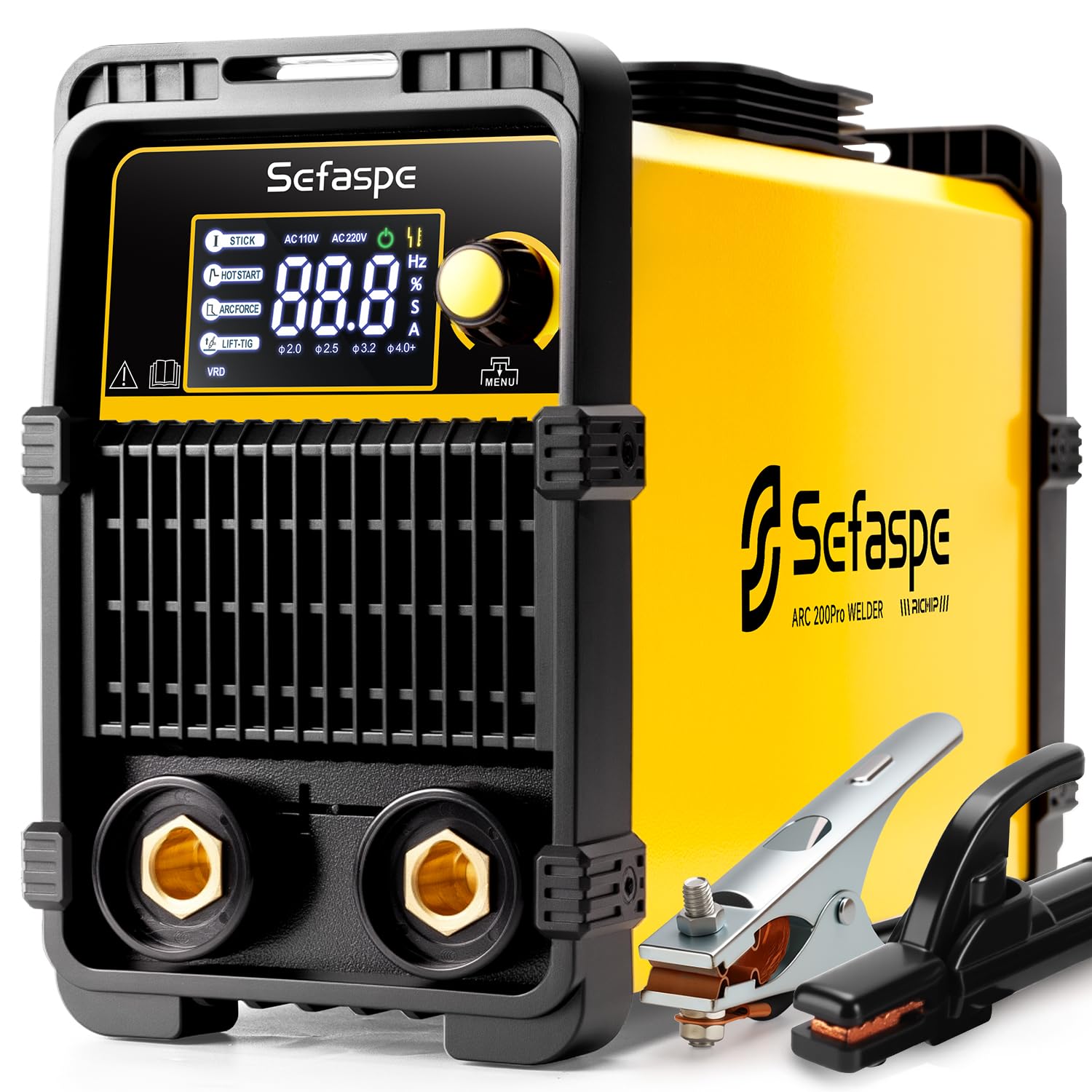
The ARC 200Pro is a stick and lift TIG welder with a 200-amp maximum and adjustable hot start (0-1 second duration, 1-10% current boost) that makes electrode ignition much easier for beginners. The synergic control system on this unit is unique for a stick-focused machine — when you adjust the current, the LED display automatically shows the matching electrode diameter (2.5mm to 4.0mm), removing the guesswork of rod selection for new welders. The arc force adjustment (1-10%) keeps the arc from extinguishing when voltage dips, which helps maintain a stable puddle on rough or dirty metal.
Dual-voltage auto-sensing means you can plug into 110V or 220V without any switch or adapter — the machine detects the input and adjusts automatically. The anti-stick function instantly drops output current to zero during a short circuit, so you do not waste rods learning to strike an arc. The VRD (Voltage Reduction Device) safety lowers no-load voltage when you are not welding, making it safer for use in humid conditions or on construction sites. Users confirm it runs 1/8-inch 6013 rods smoothly at 75-85 amps on 110V without tripping breakers.
The machine struggles with 6010 cellulose rods — most stick welders in this price tier do — but runs 6013 and 7018 well. The included cables are copper-clad aluminum, which some users replace with pure copper for improved conductivity. The internal build is based on a half-bridge IGBT topology with a 35-amp rectifier and two 60-amp output diodes, which is well-ventilated and fully grounded. For under , the ARC 200Pro gives you the highest peak amperage and most beginner-friendly stick features in this budget tier.
Why it’s great
- Adjustable hot start and arc force make rod ignition easy for new users
- Synergic display shows recommended electrode diameter based on current
- VRD safety lowers no-load voltage for humid environment operation
- 200A maximum current handles 4.0mm rods for heavier material
Good to know
- Difficult to run 6010 cellulose rods — poor arc characteristics
- CCA (copper-clad aluminum) cables reduce conductivity — upgrade recommended
- Lift TIG function needs a separate torch not included in box
FAQ
What is the difference between flux core MIG and gas MIG for home use?
Can I weld aluminum with a standard home MIG welder?
How many amps do I really need for home metal repair?
What safety gear do I need to use a home welder?
Final Thoughts: The Verdict
For most users, the at home welder winner is the Weldpro 200A AC/DC TIG because it delivers professional aluminum and steel TIG capability with a CK17 torch and foot pedal at a fraction of the pro-brand price. If you want a portable multi-process machine that does gas MIG, flux core, stick, and lift TIG without weighing down your bench, grab the Bestarc 145A MIG. And for pure flux-core portability on thin sheet metal and outdoor repairs, nothing beats the Lincoln Electric 90i FC Weld-PAK.