
Our readers keep the lights on and the weekend projects moving. As an Amazon Associate, I earn from qualifying purchases.
A scoliosis curve doesn’t just shift your spine—it torques your entire frame, pulling your shoulders uneven and forcing your hips to carry loads they were never designed to handle. The wrong brace adds pressure without correction, while the right one can re-train your posture, decompress the lumbar region, and let you move through your day without that familiar ache radiating up from your lower back.
I’m Rikta — the co-founder and writer behind FitlyFast. I’ve spent hundreds of hours analyzing the traction mechanisms, plate designs, and compression systems of over 40 scoliosis-specific braces to find which ones actually deliver measurable correction and daily relief.
Whether you need rigid immobilization for post-surgery recovery or a flexible support belt for daily activity, this guide breaks down the best back brace for scoliosis on the market, ranking them by real-world performance, adjustability, and material quality.
How To Choose The Best Back Brace For Scoliosis
Scoliosis braces are not one-size-fits-all supports. The curve’s location—thoracic, lumbar, or thoracolumbar—determines whether you need a full LSO rigid corset or a shorter lumbar belt. Your activity level and the severity of the curvature will dictate the level of compression and the type of traction mechanism required.
Compression & Traction Systems
A standard hook-and-loop belt applies even pressure, but scoliosis often requires unequal distribution across the curve. Dual-pulley and 5-to-1 pulley systems allow you to dial in higher local tension on the convex side of the curve, creating a corrective counter-pressure. Look for braided Kevlar cables or reinforced traction cords that won’t stretch or snap under daily tightening.
Back Panel Height & Rigidity
The panel must cover the full length of the curve—typically T11 to S1 for lumbar scoliosis. Bionic vertebra plates with adjustable arch settings offer dynamic correction, while fixed steel-stay panels provide static stabilization. A panel that’s too short will shift the curve’s apical vertebra without support, rendering the brace ineffective for structural correction.
Breathability & All-Day Wear
A scoliosis brace is worn for extended periods—often four to eight hours at a stretch. Multi-layer foam or closed-cell neoprene traps heat and sweat, leading to skin irritation. Look for carbon-fiber mesh, spaced-knit nylon, or vented Kevlar blends that wick moisture and allow air circulation without sacrificing the structural rigidity needed for curve management.
Quick Comparison
On smaller screens, swipe sideways to see the full table.
| Model | Category | Best For | Key Spec | Amazon |
|---|---|---|---|---|
| Comfyorthopedic LSO Brace | Rigid LSO | Post-surgery & heavy correction | Adjustable 25-48 in, detachable pads | Amazon |
| TANDCF ARC LSO Brace | Height-Adjustable LSO | Custom height fit for variable curves | Panel height 11.8-13.5 in | Amazon |
| TIMTAKBO Wide Bionic Plate Brace | Bionic Plate LSO | Targeted lumbar traction | 11 in height, removable vertebra plate | Amazon |
| BaxMAX 5-to-1 Pulley Brace | Pulley Compression | Active lifestyle & sports | 5 oz, Kevlar pulley cable | Amazon |
| T TIMTAKBO Dual-Pulley Brace | Core Decompression | Lower back traction & lifting | Dual-pulley amplified pull | Amazon |
| Copper Fit X-Back Brace | Flexible Support | Mild curvature & daily comfort | X-strap adjustable, copper-infused | Amazon |
| LSO Max Decompression Brace | Arch-Plate LSO | Advanced decompression & alignment | 26° bionic lumbar stretcher | Amazon |
In‑Depth Reviews
1. Comfyorthopedic LSO Back Brace

The Comfyorthopedic is a PDAC-approved LSO corset designed for L1 through L5 vertebral support, making it the only brace in this lineup with formal medical billing codes (L0648/L0631). Its patented one-size range accommodates waist circumferences from 25 to 48 inches without needing a second unit, a critical feature when scoliosis causes uneven body composition shifts. The dual medical-grade drawstrings provide smooth traction that doesn’t bind or pinch at the iliac crest.
The detachable rigid foam back cushion contours to the natural lordotic curve, while the two removable side support pads add lateral stability for the convex side of a lumbar curve. Users recovering from spinal fusion surgery report that the brace replicates the immobilization of a hospital brace, reducing bending torque by approximately 80% during daily movement. The foam padding is 2 inches thick, offering a substantial barrier against impact during falls or sudden movements.
One caveat: the black-on-black fabric makes it difficult to adjust fasteners in low light, and the foam core can trap heat during summer months. However, for structural scoliosis management requiring maximum rigidity, this brace delivers precision support that cheaper alternatives cannot match. The one-year warranty against manufacturing defects offers peace of mind for long-term use.
Why it’s great
- PDAC-approved with medical codes L0648/L0631
- One-size range 25-48 inches eliminates sizing errors
- Detachable side and back pads for targeted curve support
Good to know
- Foam padding can feel warm during extended wear
- Dark fabric makes adjustments harder in low light
2. TANDCF Entire ARC LSO Brace

The TANDCF is the only brace in this review featuring a mechanized height-adjustable back panel that ranges from 11.8 to 13.5 inches. This matters immensely for scoliosis patients whose curve apex sits higher or lower than average—you can lock the panel height to align precisely with the T11-S1 vertebrae. The push-button locking mechanism is tactile and positive, holding the panel rigidly in place even under heavy compression during bending or lifting.
The rear panel uses a raised 3D spacer grid with concave grooves that create air channels against the spine. This design prevents the sweat buildup typical of flat foam panels, making it comfortable for users who wear the brace through full eight-hour work shifts. The adjustable pulley system uses finger-tab pulls that require minimal hand strength, accommodating elderly users or those with arthritis in their hands—a common comorbidity among older scoliosis patients.
Some users have reported that the large grey 3D cushion can detach from the panel after several weeks of use, as it relies on only three small Velcro dots for attachment. A dab of fabric glue solves this, but it’s an annoyance at this price tier. The lace-up closure system allows fine tension adjustments without needing to re-strap the entire belt.
Why it’s great
- Height-adjustable panel from 11.8 to 13.5 inches
- Raised 3D spacer grid for ventilation along the spine
- Pulley tab system easy for users with weak grip strength
Good to know
- Rear cushion may detach over time—reinforce with glue
- One-size range requires careful belly measurement
3. TIMTAKBO Wide Bionic Vertebra Brace
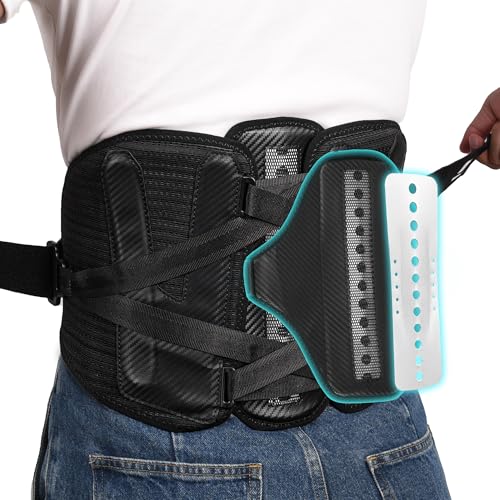
The TIMTAKBO Wide integrates a removable ergonomic bionic vertebra plate plus four steel plate supports into a single 11-inch-high back panel. The bionic plate mimics the segmented structure of the spinal column, allowing the brace to flex slightly with natural movement while maintaining rigid lateral correction for the scoliosis curve. When the plate is removed, the brace functions as a standard lumbar support belt—useful for days when the curve is less inflamed or during the initial adaptation period.
Carbon fiber construction reduces the overall weight of the brace compared to all-steel LSO corsets, so it doesn’t drag on the shoulders during extended wear. The dual-pulley stretching system on both sides provides symmetric compression that can be calibrated independently, allowing you to apply more tension on the side opposite the curve’s convexity. Users with degenerative lumbar scoliosis report that the 11-inch height covers the L1-L5 vertebrae completely, reducing referred pain into the hips.
The sizing runs small—users with a 50-inch navel measurement may need to size up to 2XL. The Velcro attachments are strong but the pull-tab for initial tightening would benefit from a longer loop for easier one-handed adjustment. For the combination of removable support layers and lightweight material, it offers exceptional versatility for varying levels of daily scoliosis pain.
Why it’s great
- Removable bionic vertebra plate for adjustable stiffness
- Carbon fiber build reduces weight to 5-6 ounces
- Dual independent pulley straps for asymmetric correction
Good to know
- Sizing runs small—measure carefully and consider sizing up
- Pull-tab for tightening could be longer for one-handed use
4. BaxMAX 5-to-1 Compression Brace
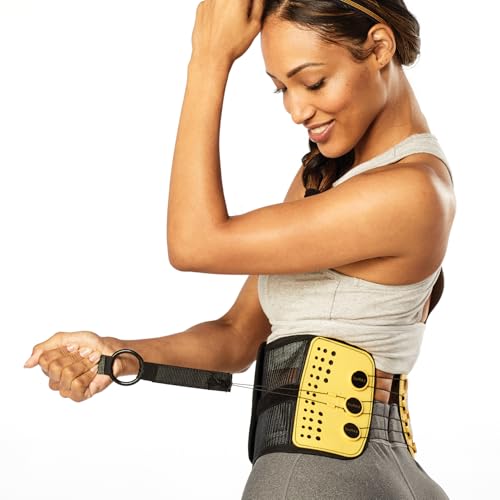
The BaxMAX stands apart with its patented 5-to-1 pulley system that delivers five times the compression force per pull—a critical advantage for scoliosis patients who need high localized tension to counteract a rigid curve. The pulley cable is Kevlar-reinforced, tested across 15 years of use in over 3,000 chiropractic clinics, which means the mechanism won’t degrade under repeated 5X loading. At just 5 ounces, it’s the lightest brace here, made from a nylon-Kevlar blend mesh that breathes significantly better than neoprene alternatives.
The 3-way wear design allows you to reposition the brace for sitting, standing, or moving, which accommodates the shifting pressure points caused by scoliosis during different postures. Users with acute lumbar spasms triggered by their curvature report that the targeted compression can unlock the muscle guarding within minutes, enabling walking when the back would otherwise seize up completely. The belt can also release compression increments without removing the brace entirely—useful for transitioning from standing to seated positions.
One limitation: the material tends to roll up at the bottom edge when sitting for prolonged periods, which can dig into the hip flexors. This brace works best for standing tasks, walking, and active movement rather than desk work. The pulley system’s exposed cable also requires occasional cleaning to prevent grit buildup from affecting the mechanism’s smooth action.
Why it’s great
- 5-to-1 pulley delivers high compression with minimal effort
- 5-ounce weight is the lightest scoliosis brace available
- Kevlar cable proven in thousands of chiropractic clinics
Good to know
- Material can roll up when sitting for long periods
- Pulley cable needs occasional cleaning to stay smooth
5. T TIMTAKBO Dual-Pulley Brace
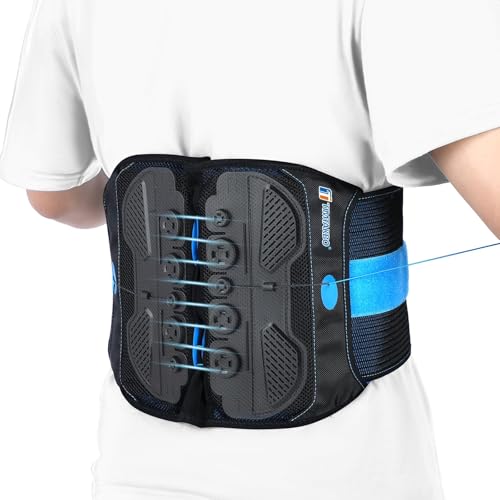
The T TIMTAKBO employs a dual-pulley system where both pulleys work together to multiply the user’s pulling force, creating amplified compression and decompression concentrated on the lower lumbar region where most scoliosis-related pain originates. The wide back panel distributes this traction load across a larger surface area than narrow-strap alternatives, preventing the rope-like pressure lines that can bruise the iliac crest during high-tension pulling.
The breathable nylon inner lining is moisture-wicking and odor-free straight out of the box, avoiding the chemical smell that plagues many budget braces. Users report that the brace resists rolling and bunching even during repeated bending and lifting—a problem common among thinner elastic belts. The hook-and-loop closure offers a secure locked-in fit that stays put during manual labor or home workouts, with the black/blue color scheme remaining discreet under dark clothing.
Critical note: the manufacturer advises against wearing this brace for more than 2 to 3 hours continuously. This is not a full-day scoliosis support. For targeted use during lifting sessions or acute pain flare-ups of 2-3 hours, it performs admirably. The sizing split (SM for 23.5-35 in, LX for 35-47 in) limits mid-range users who fall between size brackets.
Why it’s great
- Dual-pulley system amplifies compression for targeted lumbar traction
- Breathable nylon lining resists rolling and bunching
- Odor-free material out of the box
Good to know
- Limited to 2-3 hours continuous wear per session
- Size gap between SM and LX leaves some users without a perfect fit
6. LSO Max Decompression Brace

The LSO Max stands out for its 26-degree bionic lumbar stretcher arch, an adjustable curved plate that can be set to full arch for pre-activity vertebral alignment, a reduced arc for moderate lumbar and sacroiliac protection, or removed entirely for prevention-only wear. This three-stage adjustability is unique among LSO braces—it allows the same unit to function as a corrective device before lifting, a supportive brace during movement, and a lightweight belt during low-pain periods.
The dual-pulley system provides targeted compression fit with finger-tab pulls suitable for seniors with limited hand strength. The extension Velcro pocket accepts a removable soft plastic abdominal plate that supports the anterior pelvic tilt often associated with scoliosis compensation patterns. Users with CRMO (chronic recurrent multifocal osteomyelitis) and adolescent scoliosis have reported that this brace allows pain-free movement and independence, where other braces failed to provide adequate stabilization.
However, the sizing has been problematic for some users—a size 12 woman found the L/XL too tight, while a 47-inch belly user found the 2XL/3XL adequate. The brace’s construction is heavy at 1.23 pounds, which can feel burdensome over a full day. Measure your navel circumference precisely before ordering, and consider sizing up if you fall near the upper end of a size bracket.
Why it’s great
- Three-stage adjustable arch from 26° correction to no arch
- Dual-pulley system with easy finger-tab pulling
- Includes abdominal plate for anterior pelvic support
Good to know
- Sizing can be inconsistent—measure at navel and consider sizing up
- Weighs 1.23 pounds, heavier than most options
7. Copper Fit X-Back Brace
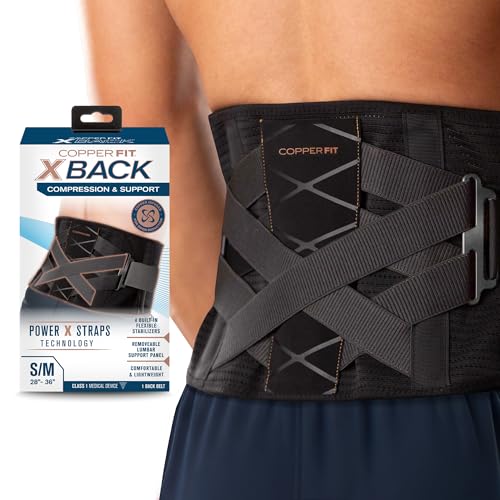
The Copper Fit X-Back uses a power X adjustable strap system with upper and lower compression points that distribute pressure evenly across the lumbar region. Unlike rigid LSO braces, this design prioritizes unrestricted range of motion—the X-straps reinforce weak lumbar muscles without immobilizing the entire torso, making it suitable for mild scoliosis curves where you need to maintain mobility during daily activities like walking, baking, or light gardening.
The curved lumbar panel replicates the natural lordotic arch, providing ergonomic contact that aligns the spine without forcing it into an unnatural position. The copper-infused fabric is designed for odor reduction—a practical feature for users who sweat during extended wear. The material is lightweight and breathable, and users report that it fits comfortably under clothing without adding visible bulk. The three Velcro points (front closure plus two side straps) allow fine-tuning from light to extra support within the same wearing session.
This brace is not built for structural correction of significant curves. Users with moderate to severe scoliosis needing substantial decompression will find it insufficient. The elastic construction can lose tension over months of daily use, requiring replacement sooner than a rigid LSO. For entry-level support, mild curvature, or as a secondary brace for active recovery days, it provides excellent comfort and convenience.
Why it’s great
- X-strap system allows full range of motion while supporting lumbar muscles
- Curved lumbar panel matches natural lordotic arch
- Copper-infused fabric reduces odor during all-day wear
Good to know
- Not suitable for moderate to severe scoliosis correction
- Elastic tension may degrade over months of daily use
FAQ
Can a back brace correct a scoliosis curve permanently?
How many hours per day should I wear a scoliosis brace?
Do I need a prescription for a scoliosis back brace?
Final Thoughts: The Verdict
For most users, the back brace for scoliosis winner is the Comfyorthopedic LSO Brace because it offers the highest level of structural correction with PDAC-approved medical-grade construction, adjustable sizing, and detachable support pads that target specific curve locations. If you need a custom height fit for a mid-thoracic curve, grab the TANDCF ARC LSO Brace with its mechanized panel adjustment. And for active days where you need targeted compression without immobilization, nothing beats the lightweight BaxMAX 5-to-1 Pulley Brace.