
Our readers keep the lights on and the weekend projects moving. As an Amazon Associate, I earn from qualifying purchases.
Reverse engineering demands a 3D scanner that captures geometry accurately enough to reproduce a part, not just a visual approximation. The wrong scanner produces noisy point clouds that waste hours in cleanup and fail under CAD tolerances — a costly mistake when you’re trying to replicate a bracket, a mold, or a mechanical assembly. You need a device that balances resolution, speed, and material adaptability for the specific parts you scan.
I’m Rikta — the co-founder and writer behind FitlyFast. I’ve spent hundreds of hours analyzing the hardware specifications, point cloud quality, and real-world workflow constraints across the mid-range to premium 3D scanner market to build this reverse engineering buying guide.
After reviewing dozens of models and cross-referencing hundreds of verified user reports, I’ve narrowed the field to the eleven most capable options that deliver reliable data for your next project: the 3d scanner for reverse engineering.
How To Choose The Best 3D Scanner For Reverse Engineering
Choosing a scanner for reverse engineering isn’t about the highest resolution number on the box. It’s about matching the technology to the parts you actually scan — small machined components, large automotive body panels, or mixed-material assemblies. Focus on these three areas to avoid disappointment.
Accuracy vs. Precision: What Your CAD Software Actually Needs
Manufacturers advertise single-frame accuracy (0.01mm to 0.05mm) and point distance (resolution). For reverse engineering, volumetric accuracy — the deviation across the entire scan volume — is what determines whether your model fits a real part. A scanner with 0.02mm single-shot accuracy but poor volumetric consistency will produce misaligned flanges on a bracket longer than 300mm. Prioritize volumetric specs when scanning components larger than your hand.
Blue Laser vs. Structured Light vs. Infrared
Blue laser (450nm wavelength) penetrates shiny and dark surfaces without spray, making it the clear winner for metal parts, machined aluminum, and injection-molded plastics. Infrared structured light is eye-safe and great for organic shapes and people but struggles on reflective automotive finishes. Hybrid scanners that combine both technologies offer the most flexibility across a reverse engineering shop — you can scan a glossy intake manifold in laser mode and a clay prototype in structured light without changing hardware.
Marker vs. Marker-Free — When Tracking Dots Dictate Workflow
Feature-rich parts with visible edges, holes, or texture can be scanned marker-free, saving setup time. But featureless surfaces — flat sheet metal, polished curves, or large uniform panels — require adhesive tracking markers or scanning spray. If you constantly scan flat or curved automotive body panels, a marker-free scanner that relies on geometry alone will lose tracking mid-scan. Hybrid alignment modes that combine geometry and markers give you the most control without forcing a universal workflow.
Quick Comparison
On smaller screens, swipe sideways to see the full table.
| Model | Category | Best For | Key Spec | Amazon |
|---|---|---|---|---|
| Shining 3D Einstar Vega | Wireless Hybrid | All-in-one standalone workflow | 20 FPS / 0.1mm point distance | Amazon |
| Shining3D Einstar Rockit | Blue Laser | Industrial reverse engineering | 0.05mm HDR accuracy | Amazon |
| Revopoint MetroY Pro | Blue Laser Hybrid | Precision metrology & deep holes | 0.01mm precision | Amazon |
| Creality Sermoon S1 | Blue Laser | Micro to large object scanning | 0.02mm accuracy | Amazon |
| Shining3D Einstar | IR Structured Light | Consumer/prosumer all-rounder | 14 FPS / 0.1mm point distance | Amazon |
| EINSTAR Pro | IR Structured Light | Color capture & design | 0.1mm resolution | Amazon |
| EinScan SP V2 | Desktop Structured Light | Small part digitization | 0.05mm accuracy | Amazon |
| Revopoint RANGE | Structured Light | Large object scanning | 0.1mm precision | Amazon |
| Revopoint INSPIRE 2 | Hybrid Dual-Module | Versatile wireless scanning | 0.03mm precision | Amazon |
| 3DMakerpro Seal Lite | Blue LED Structured | Entry-level small objects | 0.02mm accuracy | Amazon |
| Matterport Pro3 | LiDAR | Architectural/space scanning | ±20mm @10m | Amazon |
In‑Depth Reviews
1. Shining 3D Einstar Vega

The Einstar Vega eliminates the biggest bottleneck in reverse engineering scanning: tethering to a PC. Its integrated 8-core 2.4GHz CPU, 32GB RAM, and 512GB SSD let you scan, process, and store data on-device without a laptop in sight. Two scanning technologies — VCSEL for large objects (270-1500mm working distance) and MEMS for fine detail (100-350mm) — cover everything from a car bumper to a small bracket without switching tools.
The 6.4-inch 2K AMOLED display provides real-time feedback, and the wireless transfer via Shining3D Cloud lets you offload scans instantly. Hybrid alignment (geometry + markers) keeps tracking stable on featureless surfaces, and the scanning rewind function recovers from alignment errors without restarting. At 20 FPS in fast mode, you can capture a full car front in under ten minutes without spray or tracking dots on most surfaces.
Battery life runs over an hour, and the USB-C power bank support extends that for longer sessions. The infrared light source handles outdoor scanning under direct sunlight, though black and shiny objects still require spray in some cases. Users report that the one-click scanning and automatic configuration selection make this the most beginner-ready high-end scanner on the market, while the raw spec ceiling satisfies demanding reverse engineering workflows.
Why it’s great
- Fully standalone — no PC required for scanning or processing
- Dual scanning technology covers small to large parts
- Wireless transfer and cloud storage speed up team workflows
Good to know
- Black and shiny surfaces still need spray in some conditions
- On-unit software has fewer editing features than PC desktop version
2. Shining3D Einstar Rockit
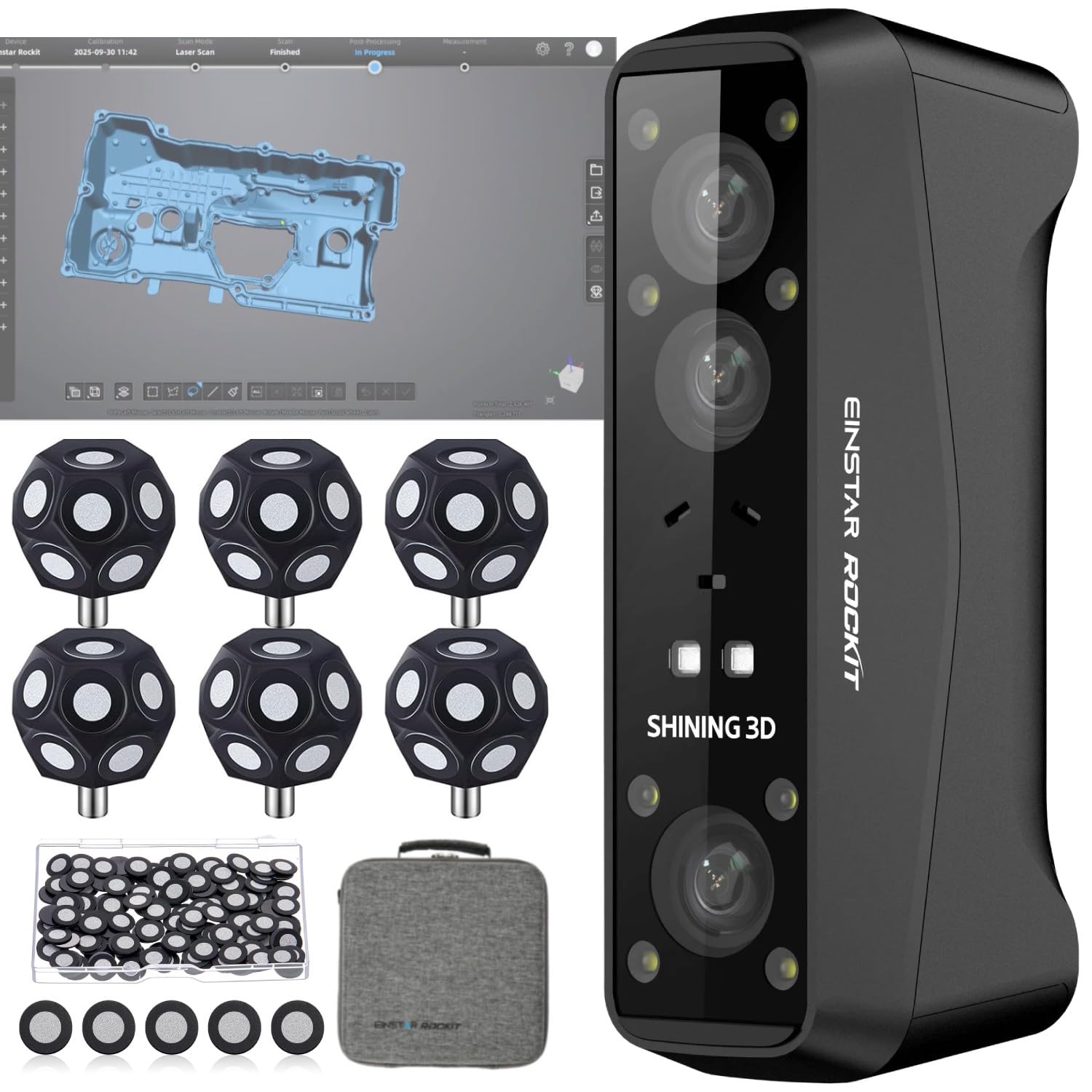
The Einstar Rockit is built for the shop floor. Its 38 blue laser lines (19+19 crossed) capture large areas fast, while the 7 parallel lines resolve fine features and deep holes without switching modes. The 0.05mm HDR accuracy is calibrated for industrial parts — machined aluminum, injection-molded plastics, and reflective surfaces that defeat most structured light scanners — and it handles them without scanning spray.
Marker-free scanning works well on feature-rich objects like engine brackets or gear housings with natural geometry. The built-in 5MP color camera adds texture for documentation, and the wireless connectivity (up to 3 hours on the swappable battery) lets you scan a part on the bench without dragging a PC cart across the shop. The EXStar Hub software streamlines the workflow and reduces system load compared to the first-generation Einstar software.
User reports are split: experienced users praise the speed and detail, while some report difficulty with software setup and connectivity on older PCs. The scanner requires a fast GPU (NVIDIA 1030 or better) and more than 8GB RAM. The slippery grip and lack of a physical power switch frustrate some operators during long sessions. Still, for pure laser scanning performance in a sub- package, the Rockit is a benchmark.
Why it’s great
- Blue laser handles black and reflective metal without spray
- Marker-free scanning on feature-rich industrial parts
- Swappable battery for untethered shop-floor use
Good to know
- Software setup can be finicky on non-recommended hardware
- Ergonomic design lacks grip and power switch
3. Revopoint MetroY Pro
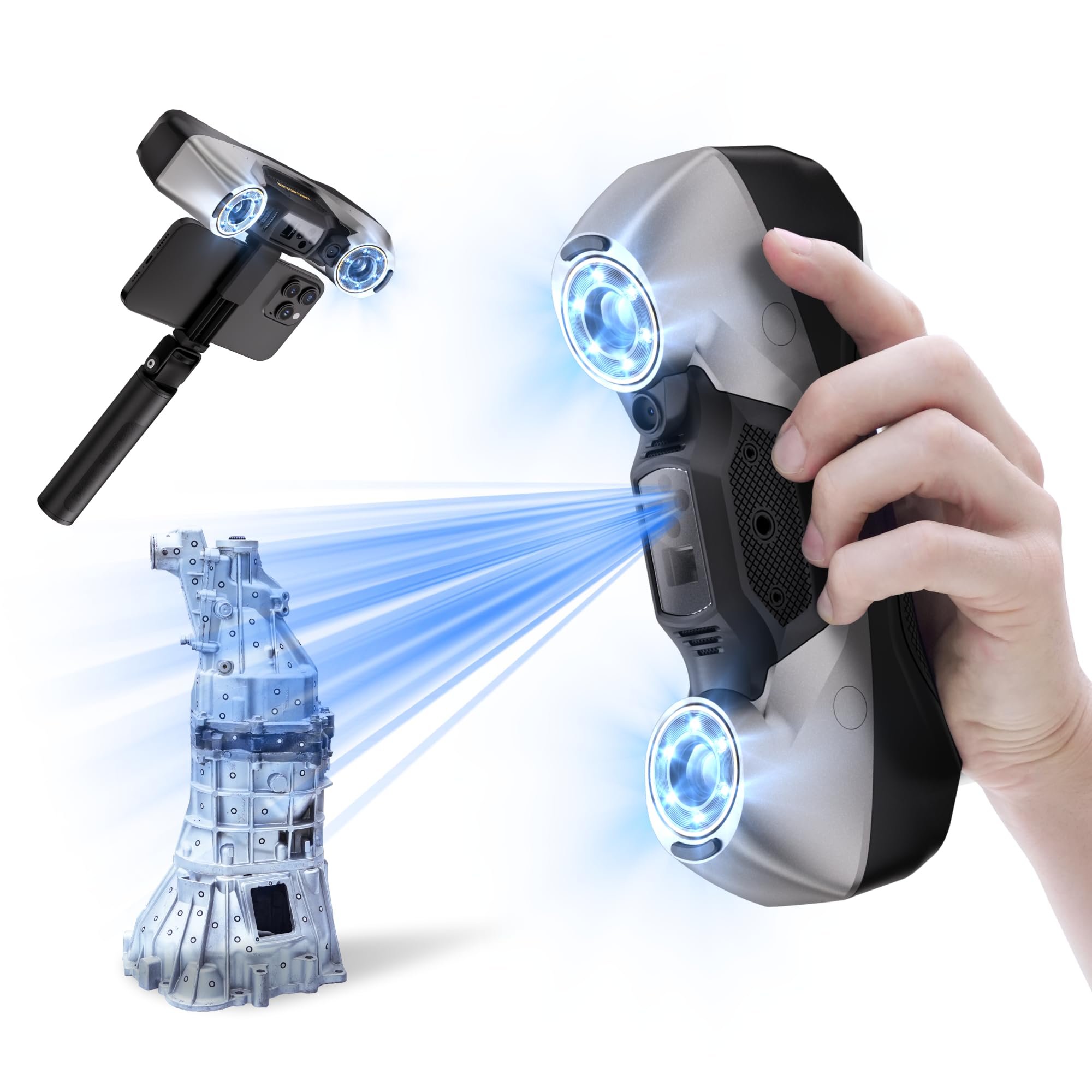
The MetroY Pro is the most precise scanner in this lineup, delivering up to 0.01mm precision and 0.02mm accuracy with industrial-grade blue lasers. The five scanning modes cover every reverse engineering scenario: 34 cross-lines for quick surface capture, 15 parallel lines for detail, single-line deep hole scanning for threaded bores and crevices, the 62-line full-field mode for marker-free capture at 7 million points per second, and a one-click turntable mode for complex small parts.
The real-time temperature monitoring system adjusts fan speed to prevent accuracy drift during long scans — a feature absent from most competitors at this price. WiFi 6 streaming lets you monitor scans from a phone or tablet while the scanner runs wirelessly connected to a PC. The professional Revo Metro software integrates with Revo Measure and Revo Design for a complete scan-to-CAD pipeline, plus third-party tools like Geomagic Control.
User feedback highlights extreme accuracy (measured 0.0005″ to 0.003″ deviation on calibrated parts) but notes that scanning is slower than comparable Creality or Shining3D units. The software still has bugs on macOS, and the full scan-to-CAD workflow requires paid software subscriptions. The included accessories — calibration board, carrying case, turntable, and mobile kit — represent strong value for a metrology-capable scanner at this price point.
Why it’s great
- 0.01mm precision rivals far more expensive scanners
- Five scanning modes handle any geometry
- Temperature stabilization prevents accuracy drift
Good to know
- Slower point capture rate than some competitors
- Mac support is incomplete; Windows PC recommended
4. Creality Sermoon S1
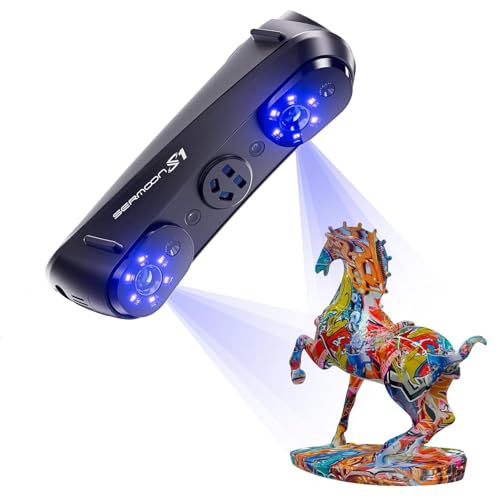
The Creality Sermoon S1 is the only scanner in this guide that captures objects from 5mm to 4 meters — from a tiny gear to a full vehicle — without changing hardware. Its triple blue laser mode (34 crossed lines for speed, 7 parallel lines for detail, single-line for deep holes) adapts automatically, and the 0.02mm accuracy with 0.08mm/m volumetric precision is production-grade. The 90 FPS frame rate makes it one of the fastest scanners in its class.
The 4-lens stereo vision system supports efficient marker-free scanning on feature-rich parts, while the integrated AI-assisted processing streamlines alignment and mesh generation. You can export directly into CAD, CAM, and 3D printing software without conversion bottlenecks. The large scanning range and speed make it ideal for reverse engineering shops that handle everything from small injection-molded parts to large sheet metal assemblies.
The recommended system requirements — i7-10th gen, 32GB RAM on Windows, or M1/M2/M3 on macOS — are demanding but realistic for the data volumes. Some users report that the software is still maturing, with occasional UI quirks during marker-free alignment of completely flat surfaces. For shops that need one scanner to cover every part size, the Sermoon S1 is a compelling single-device solution.
Why it’s great
- Unmatched scanning range from 5mm to 4m
- 90 FPS capture speed for fast data acquisition
- AI-powered mesh and alignment tools
Good to know
- Requires a high-end PC for smooth operation
- Software still undergoing refinement
5. Shining3D Einstar (Original)
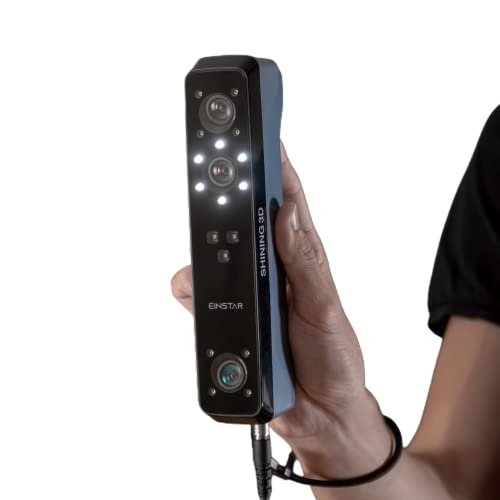
The original Einstar set the bar for sub- reverse engineering scanning. Its three infrared VCSEL projectors and two stereo depth cameras produce dense point clouds at 0.1mm point distance, and the 14 FPS scanning speed is adequate for small to medium parts. The built-in RGB camera captures color for documentation, and the detail enhancement technology optimizes point clouds for complete data acquisition.
The standout feature is the “Hair Mode” for scanning complex organic shapes, but for reverse engineering, the real value is the automatic alignment and smart tracking that holds on dark, non-reflective surfaces without spray or markers. Users report scanning black SUV interior parts with dimensionally accurate results to within +/-0.5mm — impressive for a mid-range scanner. The software (EXstar) provides automatic alignment and a data quality indicator to guide the scan.
The Einstar requires a learning curve around working distance and technique, and it struggles with small objects below 30mm. The single USB cable for power and data keeps the setup clean, and the tripod mount adds stability. For hobbyists and small shops doing automotive trim, furniture parts, or design prototypes, this remains the best value entry point into serious reverse engineering scanning.
Why it’s great
- Excellent tracking on dark surfaces without spray
- Dense 0.1mm point distance for detailed models
- Best value-to-performance ratio under
Good to know
- Steep learning curve for optimal results
- Struggles with very small objects
6. EINSTAR Pro

The EINSTAR Pro is the color-focused sibling of the original Einstar, pairing infrared VCSEL structured light with a dedicated RGB camera for full-color texture capture. The 0.1mm resolution is identical to the standard Einstar, but the Pro’s software pipeline aligns color data with geometry more accurately, making it a better choice for digital archiving and design validation where surface appearance matters alongside dimensions.
The ergonomic, lightweight design (1.1 pounds) is comfortable for extended scanning sessions, and the carrying case makes it portable. It supports export to OBJ, STL, PLY, ASC, and 3MF, covering every major CAD and 3D printing format. Users who also work with color documentation, heritage preservation, or product design will find the Pro’s color fidelity a clear advantage over the monochrome-only Einstar.
This scanner is best for medium-to-large objects. Small items under 30mm lack detail capture, and the system requirements (recommended i7, 32GB RAM, RTX 3060) are demanding. Some users report that the software, while polished, still has occasional alignment drift on featureless geometries. For shops that need both dimensional accuracy and color representation in a single device, the Pro is the right choice.
Why it’s great
- Accurate full-color RGB texture capture
- Lightweight ergonomic design for long sessions
- Broad file format compatibility
Good to know
- Poor detail capture on very small objects
- Demanding hardware requirements
7. EinScan SP V2 Desktop

The EinScan SP V2 takes a different approach — a desktop turntable-based system rather than a handheld scanner. This format delivers consistent, repeatable scans for small objects up to 1200mm³ with 0.05mm single-shot accuracy and 0.17-0.2mm point distance. The fixed position eliminates operator hand-jitter and tracking loss, making it ideal for scanning small mechanical parts, gears, fittings, and electronics enclosures that need CAD-level precision.
The dual scanning modes (fixed and turntable) offer flexibility: turntable mode for automated 360° capture in under 45 seconds, and fixed mode for manual repositioning of larger objects. The white LED light source is eye-safe and works well on matte surfaces. The software supports OBJ, STL, ASC, PLY, and 3MF exports, and integrates with all major CAD tools.
Shiny metal parts require a light baby powder coating, which adds prep time. The software interface looks dated and the USB connections can be finicky — the camera often needs a cable adjustment to be recognized. High-resolution scans produce files that can overwhelm CAD tools like Fusion360 without heavy triangle reduction. For consistent, high-precision digitization of smaller components, the SP V2 is a reliable workhorse, but it is not a one-tool solution for large parts.
Why it’s great
- Turntable eliminates tracking errors from hand motion
- 0.05mm accuracy for small mechanical parts
- Full scan in under 45 seconds
Good to know
- Shiny surfaces need coating before scanning
- USB connections can be unreliable
8. Revopoint RANGE

The Revopoint RANGE is optimized for large objects — cars, furniture, and people — with a single capture range of 360mm x 650mm at 600mm working distance. The 0.1mm precision is paired with an 18 FPS scan speed, and the high-power projector captures data at twice the distance of the older POP 2 (300mm-800mm). The embedded processor allows the RANGE to work with office-level computers, lowering the hardware barrier.
Full-color RGB scans with the aspheric lenses produce lifelike models, and the free Revo Scan software is beginner-friendly with guided workflows. It supports Windows, macOS, iOS, and Android, and works with both handheld and tripod setups. Mobile scanning via phone tethering adds flexibility for workshop environments where a PC is inconvenient.
User reviews are mixed. For scanning large objects like car bumpers or furniture, the RANGE performs well — especially when surfaces are matte and feature-rich. But scanning glossy or reflective surfaces (like a van interior) requires extensive preparation with dry shampoo and hundreds of tracking markers. The scanner loses position easily on featureless curves, forcing restarts. It is a capable large-format scanner for its price, but not a universal tool for all reverse engineering workflows.
Why it’s great
- Large capture range for car parts and furniture
- Works with office-level computers
- Mobile scanning via phone tethering
Good to know
- Struggles with reflective and glossy surfaces
- Loses tracking on featureless geometries
9. Revopoint INSPIRE 2
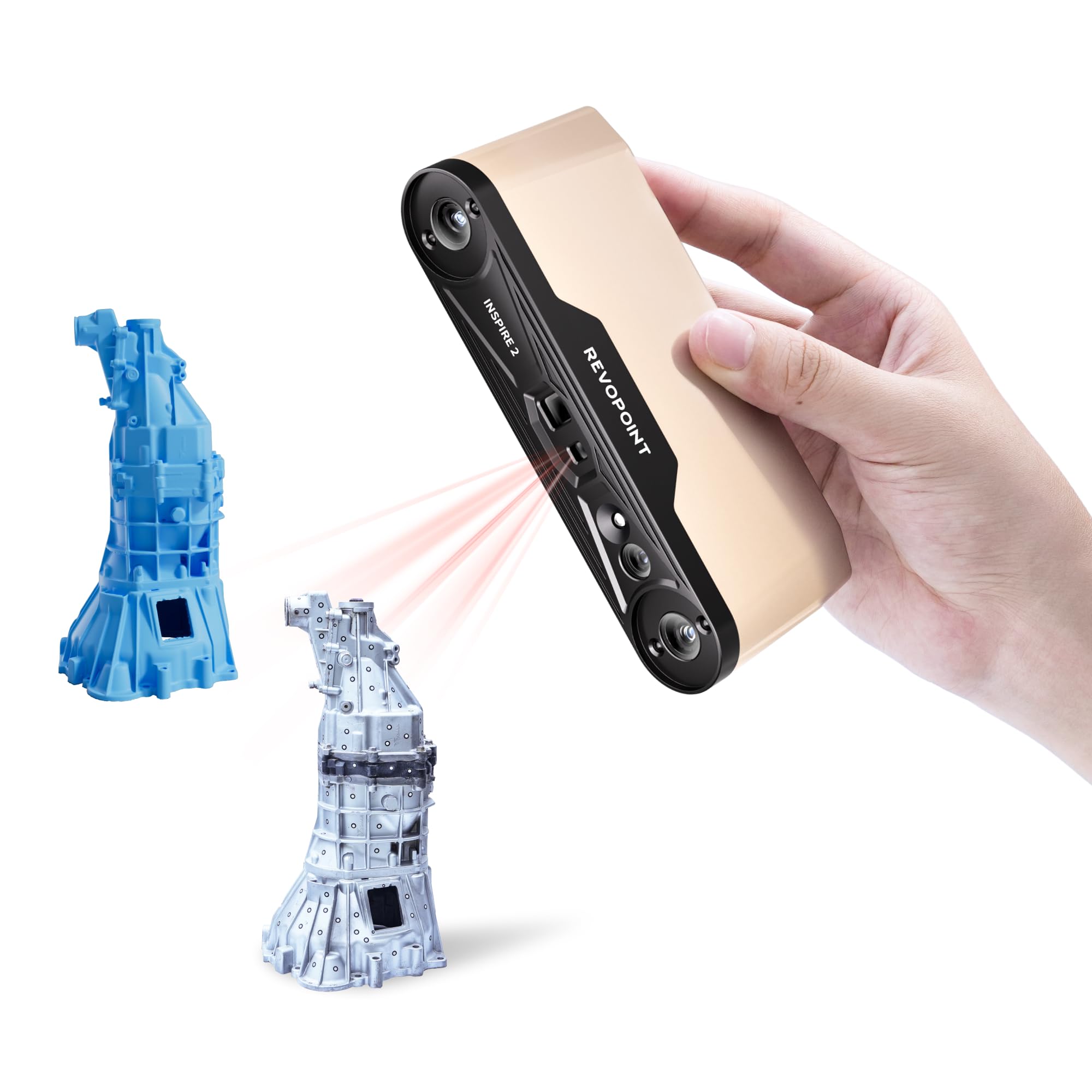
The INSPIRE 2 combines infrared structured light and multi-line laser scanning in a single 190g device, offering flexibility that few mid-range scanners match. The infrared structured light mode handles organic shapes and people, while the 11 infrared laser lines tackle reflective and dark surfaces without spray. The dual-module design lets you switch between modes depending on the surface, saving setup time.
WiFi 6 wireless scanning and real-time streaming to a phone or tablet let you monitor scans while moving around the part. The accuracy is 0.05mm (up to 0.03mm precision) with a high-precision calibration board that improves point cloud accuracy by 75%. The adjustable optical zoom (1.5x, 2x magnification) focuses structured light on mixed-geometry surfaces for more detail. The Revo Metro software provides advanced scan settings and post-processing, with one-click import to Revo Design for scan-to-CAD.
Users appreciate the ease of setup and high-quality color scans right out of the box. The sticky calibration markers, however, have poor adhesion and need frequent replacement. The scanner requires a powerful PC (recommended i7-13th gen, 32GB RAM, RTX 3060) for optimal performance, and some users report initial failures with custom PC configurations before contacting support. For its price, the INSPIRE 2 offers the best hybrid flexibility in its category.
Why it’s great
- Dual scanning modules for different surface types
- WiFi 6 enables truly wireless scanning
- Adjustable optical zoom for fine detail
Good to know
- Calibration markers have poor adhesion
- Requires a very powerful PC for best results
10. 3DMakerpro Seal Lite
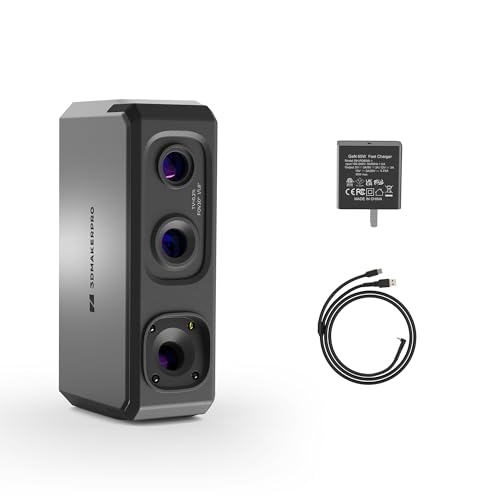
The 3DMakerpro Seal Lite is the most affordable entry point with a blue LED light source (400-500nm wavelength) that achieves 0.02mm accuracy for small objects between 10mm and 300mm. It is designed exclusively for small-format scanning — jewelry, mold cavities, small mechanical parts, and figurines — at a recommended working distance of 180-280mm. The 10 FPS frame rate is slow by modern standards, but the mono texture output is sufficient for CAD modeling.
The JMStudio software provides lifetime free updates and supports OBJ, STL, PLY, and ASC exports. The scan-back and anti-shake features improve stability, and the turntable, tripod, and Smart Grip accessories (sold separately) extend its usability. For the price, the accuracy spec is competitive — but the hardware demand is real: it requires a powerful PC with the 65W power adapter (USB alone won’t power it) and tethered operation.
User reviews highlight a steep learning curve and poor documentation. The scanner fails on shiny, dark, or very small objects — a 0.5-inch flag was un-scanable — and requires scanning spray for any reflective surface. Beginners who expect plug-and-play will be frustrated. The Seal Lite is a capable tool for patient users scanning matte, small parts, but it is not an all-purpose scanner and demands significant technique refinement to produce usable results.
Why it’s great
- Affordable entry point with 0.02mm accuracy
- Blue LED light source for fine detail on small parts
- Free lifetime software updates
Good to know
- Fails on shiny, dark, and very small objects
- Steep learning curve with poor documentation
11. Matterport Pro3

The Matterport Pro3 is a different class of device — a LiDAR-based spatial scanner designed for architectural and environmental capture, not mechanical part reverse engineering. Its 100-meter scanning range, ±20mm accuracy at 10m, and 4K photography create photo-realistic 3D virtual tours of indoor and outdoor spaces. The sweep time is under 20 seconds per scan, and the removable batteries allow continuous scanning on large construction sites.
The Performance Kit includes two batteries, a quick-release tripod mount, wheeled dolly, backpack, and hard case — everything a professional surveyor needs for mobile capture. The LiDAR sensor takes millions of measurements per scan, and the Matterport Capture app (paid subscription required) processes the data into immersive virtual tours. For digital twins of factories, warehouses, or architectural renovation sites, the Pro3 is unmatched.
However, this is not a tool for precise reverse engineering of small metal parts. The ±20mm accuracy is useless for mechanical tolerances, and users report poor scan quality compared to dedicated metrology-grade scanners. The mandatory Matterport subscription for data access and download fees frustrates users who expect professional control over their own scan data. The Pro3 excels at its intended job — spatial documentation — but should not be purchased for part replication.
Why it’s great
- 100m LiDAR range for large architectural spaces
- Sub-20 second sweeps with removable batteries
- Complete kit includes tripod, dolly, and backpack
Good to know
- ±20mm accuracy is far too low for mechanical reverse engineering
- Requires expensive subscription to access full scan data
FAQ
Can a structured light scanner capture machined aluminum parts?
What file format should I export for CAD reverse engineering?
Do I need a high-end gaming PC for a 3D scanner?
Final Thoughts: The Verdict
For most users, the 3d scanner for reverse engineering winner is the Shining 3D Einstar Vega because its standalone wireless design, dual scanning modes, and integrated processing eliminate PC tethering while delivering professional-grade results across small to large parts. If you need maximum precision for metal parts and deep-hole scanning, grab the Revopoint MetroY Pro. And for an unbeatable value-to-performance ratio in a tethered full-body scanner, nothing beats the Shining3D Einstar.