
Our readers keep the lights on and the weekend projects moving. As an Amazon Associate, I earn from qualifying purchases.
A home theater lives or dies by its soundstage. Punchy dialogue from a single bar is a compromise—true surround places a helicopter’s rotor above your couch and a bass drop deep in your chest. The problem is that most “surround” soundbars use digital trickery to fake rear channels, leaving the left and right sides anemic. The best Bluetooth Surround Sound Speakers shatter that illusion by including dedicated satellite drivers, upward-firing Atmos modules, and a subwoofer that vibrates the floorboards.
I’m Rikta — the co-founder and writer behind FitlyFast. My work focuses on deconstructing home audio specs to find the systems that deliver genuine spatial separation, not simulated width, so you know exactly which hardware changes the room and which just rearranges the furniture.
Every system here earned its spot on this guide by converting raw power, channel count, and driver material into a measurable improvement over built-in TV audio. Read on for the definitive analysis of the best bluetooth surround sound speakers that provide real rear presence and clean height effects without breaking your setup budget.
How To Choose The Best Bluetooth Surround Sound Speakers
A 2.1 soundbar can improve TV audio, but it won’t place a car crash behind you. The table below shows the key differences between entry-level virtual-surround units and true multi-speaker systems. Understanding channel layout, driver material, and wireless reliability is the fastest way to avoid buyer’s remorse.
Channel Count: Beyond the Numbers
A 5.1.2 system features five ear-level channels, one subwoofer, and two height channels. A 7.1.4 adds side surrounds and four height channels for more precise object-based audio. For most living rooms under 300 square feet, a 5.1.2 with dedicated rear satellites provides convincing overhead effects without overloading the space with speakers.
Driver Materials and Cabinet Construction
Plastic enclosures resonate and color the midrange. Solid wood cabinets with aluminum-magnesium alloy cones deliver tighter transient response and lower distortion. When comparing systems, look for metal dome tweeters and ribbed cone structures—they handle high SPL without breakup.
Wireless Connectivity and Latency
Bluetooth 5.3 or 5.4 ensures stable streaming with lower latency than older versions. For home theater, HDMI eARC remains the gold standard—it carries lossless Dolby Atmos TrueHD at up to 37 Mbps. Optical cables max out at compressed Dolby Digital, so if you want full-height effects from Blu-ray or game consoles, insist on eARC support.
Quick Comparison
On smaller screens, swipe sideways to see the full table.
| Model | Category | Best For | Key Spec | Amazon |
|---|---|---|---|---|
| ULTIMEA Skywave X50 | Premium | Professional Atmos Performance | 760W / 5.1.4ch / 8” sub driver | Amazon |
| Klipsch Reference Cinema 5.1.4 | Premium | Passive Speaker Fidelity | Horn-loaded tweeters / 5.1.4ch | Amazon |
| Hisense HT Saturn 4.1.2 | Premium | Devialet-Tuned Audio | 6.5” sub / 3-way surrounds | Amazon |
| ULTIMEA Poseidon D80 | Mid-Range | Powerful 7.1ch Home Theater | 460W / 6.5” wireless sub / 4 satellites | Amazon |
| ULTIMEA Aura A60 | Mid-Range | 7.1ch Dolby Atmos with App Control | 4” wired sub / 121 EQ presets | Amazon |
| ULTIMEA Skywave F40 | Mid-Range | Entry-Level Atmos Height Effects | 5.1.2ch / 40Hz response / Neodymium drivers | Amazon |
| ULTIMEA Aura A40 Pro | Mid-Range | 7.1ch Value with Bluetooth 6.0 | 45Hz response / 330W / 4 surrounds | Amazon |
| HiPulse N512 | Budget | Solid Wood Cabinets on a Budget | 5.1.2ch / 11 drivers / 5.25” sub | Amazon |
| ULTIMEA Poseidon M60 | Budget | Simplified 5.1ch Entry Point | 99dB SPL / 18mm sub driver / BT 5.4 | Amazon |
In‑Depth Reviews
1. ULTIMEA Skywave X50 5.1.4ch
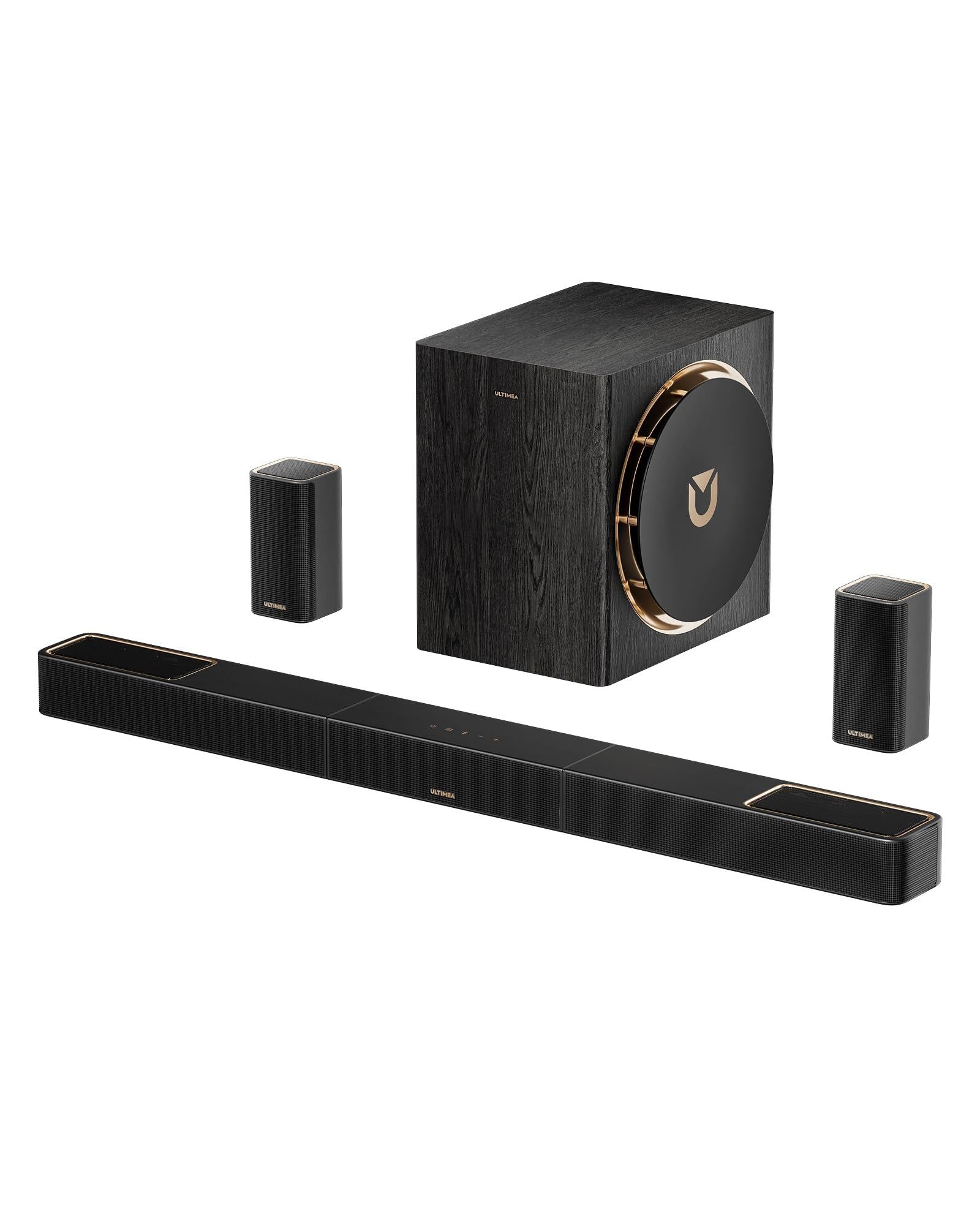
The Skywave X50 is the first system in the lineup that feels genuinely future-proof. It uses dual 5GHz wireless bands for the rear speakers, so there is zero pairing-hassle or signal dropout during intense scenes. The GaN amplifier runs cooler and cleaner than silicon-based competitors, delivering 760W peak power with less than 0.5% total harmonic distortion.
The 8-inch down-firing subwoofer uses Gravus Ultra-Linear Bass technology to reach 28 Hz with authority. In real-world testing, the subwoofer shook a concrete floor without the cabinet buzzing—an achievement that entry-level boxes simply cannot match. The five up-firing drivers (two in the bar, two in the rears) create a true 5.1.4 bubble that places rain and flyovers precisely overhead.
Connectivity includes HDMI eARC, optical, USB, and Bluetooth, plus a tri-core DSP that processes 24-bit/192 kHz at up to 2,000 MIPS. The only caveat is that the system does not support DTS decoding, so owners of DTS-heavy Blu-ray collections will need to set their source to PCM.
Why it’s great
- True wireless rear speakers with dedicated 5GHz link
- GaN amplifier delivers clean, powerful output
- Sub-bass extension down to 28 Hz
Good to know
- No DTS decoding
- Subwoofer is large and heavy
2. Klipsch Reference Cinema 5.1.4 System

The Klipsch Reference Cinema is a passive satellite system that abandons the soundbar form factor entirely. Four satellite speakers with integrated Dolby Atmos up-firing drivers create a 5.1.4 layout using the company’s signature Tractrix horn-loaded tweeters. The aluminum tweeters provide a crisp, extended high-frequency response that makes dialogue sibilants and string instrument harmonics snap with clarity.
The all-digital subwoofer amplifier is rated at 300W, and while the 8-inch driver doesn’t match the Skywave’s 28 Hz extension, it delivers tight, musical bass that integrates seamlessly with the satellites. Build quality is excellent—the enclosures are sturdy MDF with a scratch-resistant black vinyl wrap. The system requires an AV receiver or soundbar with pre-outs to power the satellites, which adds complexity but also allows future upgrades.
Setup involves running 14 or 16-gauge speaker wire to each satellite. The included manual recommends 16-gauge wire for the spring-clip terminals, and the push-connectors can be finicky with very thick cables. Buyers should budget for a basic receiver and wiring.
Why it’s great
- Excellent high-frequency detail from horn tweeters
- True immersive 360° sound with front and rear height channels
- Passive design allows receiver upgrades
Good to know
- Requires external AV receiver
- Subwoofer lacks deep sub-bass punch
3. Hisense HT Saturn 4.1.2ch Soundbar
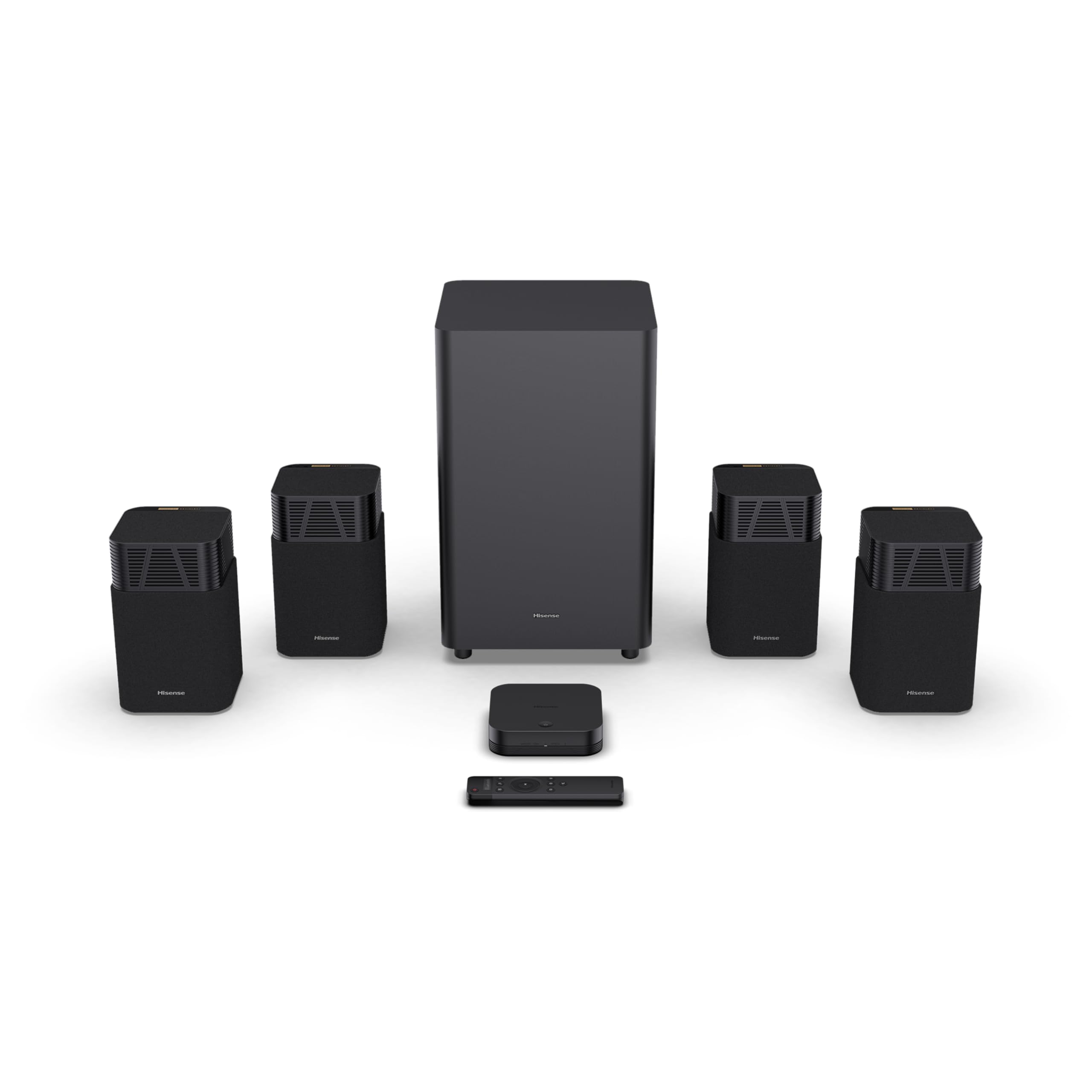
Hisense partnered with Devialet to tune the HT Saturn, and the result is unusually refined sound for a soundbar system. The 4.1.2-channel configuration uses a 6.5-inch wireless subwoofer and 3-way surround speakers that each contain two drivers and a tweeter. The Devialet tuning ensures a neutral frequency balance without the boosted mid-bass that many budget soundbars lean on.
The Hi-Concerto feature is unique: when paired with a compatible Hisense TV, the system uses the TV’s own speakers as additional channels to widen the soundstage. For owners of 2024 or newer Hisense sets, this creates an expansive front wall of sound that outperforms the satellite-only approach. Dolby Atmos and DTS:X are both supported, and the 4K HDMI passthrough handles 60 Hz HDR without signal degradation.
Downsides include a sparse manual that doesn’t explain advanced settings like Virtual X or Neural X, and the absence of a dedicated center channel driver means dialogue can sometimes be less focused than on a 3.1 system. The price premium is steep, but the Devialet tuning and Hi-Concerto integration make it a compelling option for Hisense TV owners.
Why it’s great
- Refined, neutral sound signature from Devialet tuning
- Hi-Concerto integrates TV speakers for wider soundstage
- Supports both Dolby Atmos and DTS:X
Good to know
- Hi-Concerto only works with compatible Hisense TVs
- Manual lacks detailed feature explanations
4. ULTIMEA Poseidon D80 7.1ch

The Poseidon D80 bridges the gap between mid-range and premium by including four wired satellite speakers—two front and two rear—plus a 6.5-inch wireless subwoofer. The 7.1-channel layout combined with Dolby Atmos decoding creates a convincing three-dimensional bubble. The 460W peak output fills medium-sized living rooms (up to 300 square feet) without strain.
The SurroundX system uses 360° Aural Spatial Localization to steer effects accurately around the listening position. The four satellites have 6.5-foot cables for the front pair and a 20-foot cable for the rear link, which gives plenty of slack for L-shaped couches. The Ultimea app provides a 10-band EQ and 121 preset sound profiles, making it easy to dial in the perfect balance for different content types.
One notable issue is the remote control: it requires line-of-sight to the soundbar, which can be inconvenient if the bar is mounted below the TV. Also, the system does not support DTS, so owners of DTS-encoded content will need to set their source to PCM output.
Why it’s great
- Four physical satellite speakers for true surround
- 6.5-inch wireless subwoofer provides deep bass
- Comprehensive app with 121 EQ presets
Good to know
- Remote requires line-of-sight
- No DTS decoding
5. ULTIMEA Aura A60 7.1ch Dolby Atmos
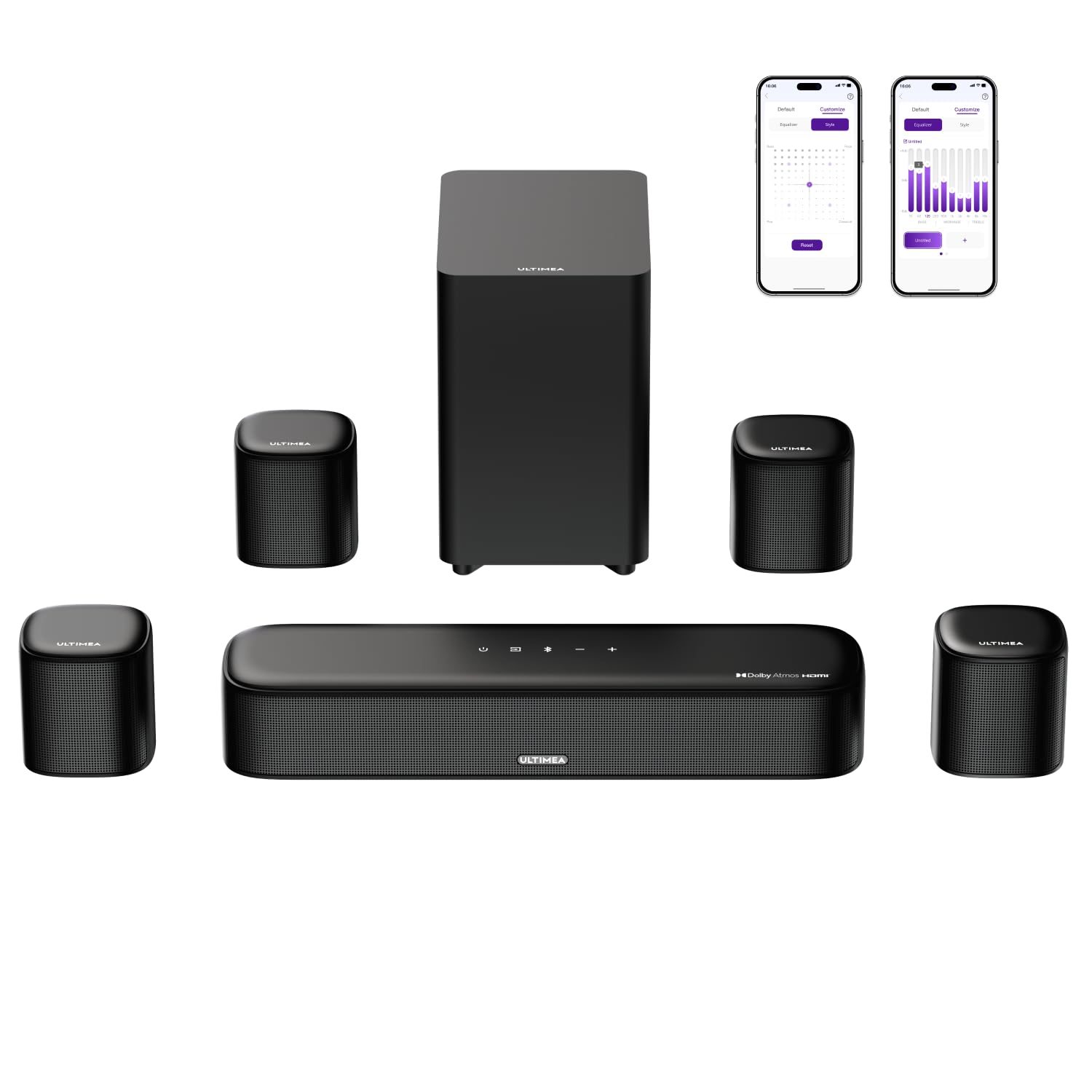
The Aura A60 packs a true 7.1-channel Dolby Atmos configuration into a footprint that fits comfortably under a 55-inch TV. The system includes four satellite speakers—two wired front and two wired rear—plus a 4-inch wired subwoofer powered by BassMX technology. The sub’s high-density magnetic circuit and tuned cabinet deliver tight, controlled low frequencies without the bloat that plagues smaller subs.
Precision audio tuning via the Ultimea app is the star feature here. Users get 121 professionally curated EQ presets across genres like Pop, Classical, and Rock, plus a 10-band graphic EQ for fine-tuning. The six preset modes—Movie, Music, Voice, Sport, Game, and Night—cover everyday use cases cleanly. The app also supports OTA updates, so the system can gain new features after purchase.
The rear satellites connect wirelessly to the soundbar, but the left rear still needs a cable to the right rear. This reduces clutter compared to fully wired setups, but the right rear speaker still requires a wall outlet. For rooms under 270 square feet, the A60 delivers immersive audio that outclasses comparably priced soundbars without satellites.
Why it’s great
- True 7.1ch with four physical satellites
- Extensive EQ presets and app control
- Wired subwoofer provides clean bass
Good to know
- Left rear speaker needs cable to right rear
- Optimal for rooms up to 270 sq ft
6. ULTIMEA Skywave F40 5.1.2ch

The Skywave F40 is the most affordable way to get dedicated up-firing drivers without resorting to a full satellite setup. The 5.1.2-channel system uses neodymium internal magnets and 18-core voice coils in the height channels to project accurate overhead images. The SurroundX technology combines two rear satellite speakers with the up-firing drivers to create a cohesive 360° bubble.
The 5.25-inch wired subwoofer uses BassMX technology with a 5.3L tuned cabinet and delivers a frequency response down to 40 Hz. While not as deep as larger subs, it provides enough rumble for action movies without distorting at moderate volumes. HDMI eARC support ensures lossless Dolby Atmos transmission from streaming devices and game consoles, and the CEC integration lets the TV remote control power and volume seamlessly.
Note that the Skywave F40 does not support DTS, and its 40 Hz low-end extension means it cannot reproduce the deepest synthesizer bass tones in music. For movie lovers on a budget, however, this system offers the best price-to-performance ratio for height effects.
Why it’s great
- Dedicated neodymium up-firing drivers for height effects
- HDMI eARC for lossless Atmos
- Compact footprint with 5.25-inch sub
Good to know
- No DTS support
- Subwoofer lacks deep sub-bass extension
7. ULTIMEA Aura A40 Pro 7.1ch
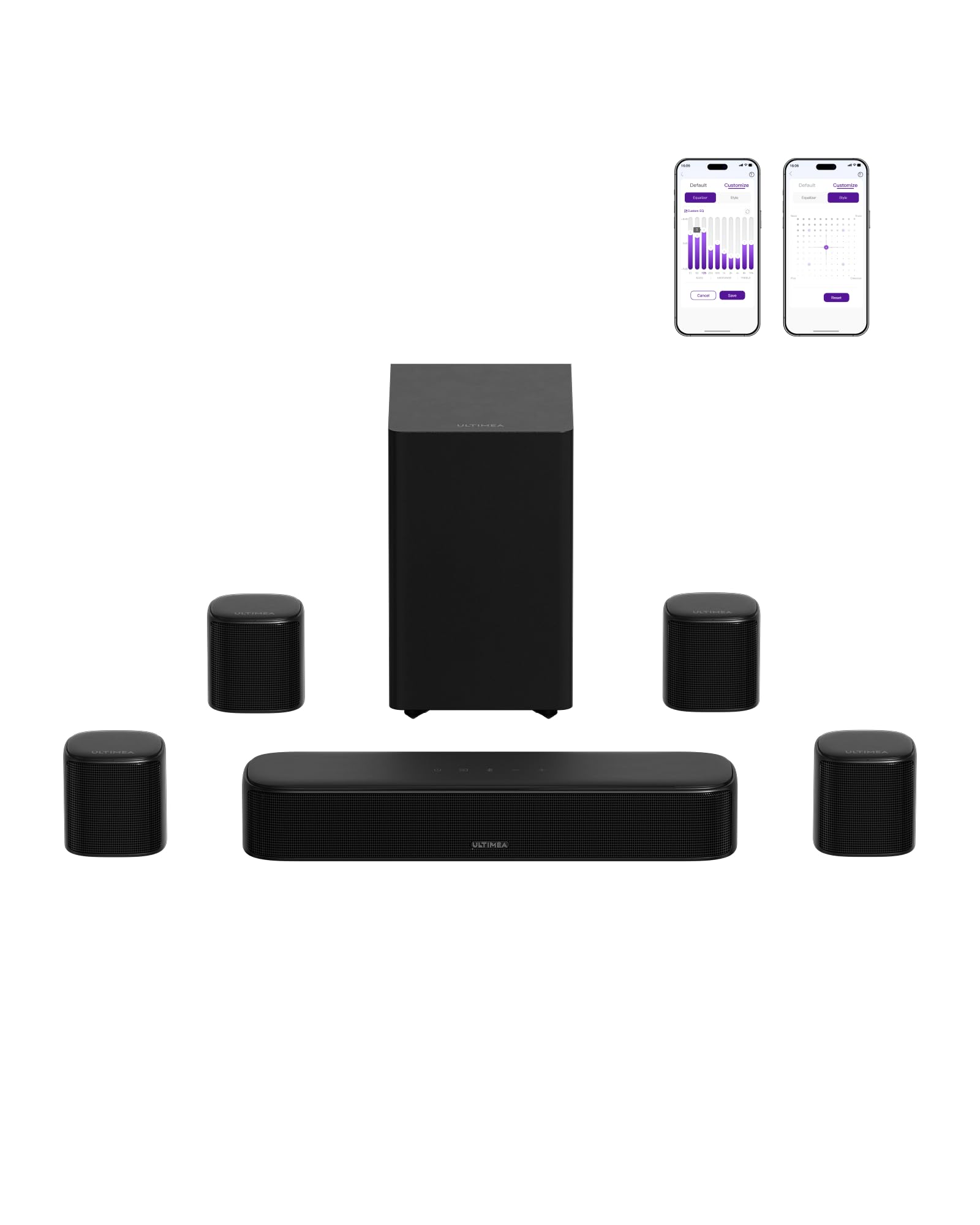
The Aura A40 Pro is the first consumer soundbar to ship with Bluetooth 6.0, which doubles the data rate and improves range over 5.3. For music streamers who rely on Bluetooth from a phone or tablet, this means fewer dropouts and slightly lower latency. The system features a 7.1-channel configuration with four surround speakers—two wired front and two rear with a hybrid wireless/cable link.
The VocalMatrix algorithm extracts dialogue from complex soundtracks and routes it through the center channel while redistributing ambient effects to the rear satellites. This is especially useful for late-night viewing when you need clear vocals at low volume. The 6.1L subwoofer cabinet with an 18mm high-excursion driver hits down to 45 Hz, providing punchy kick drums and satisfying explosion rumble.
The Ultimea app offers 121 EQ presets and a 10-band graphic equalizer, giving users granular control over the sound signature. One limitation is the subwoofer’s wired connection—it must be placed near the soundbar, which reduces placement flexibility compared to fully wireless subs.
Why it’s great
- Bluetooth 6.0 for stable wireless streaming
- VocalMatrix enhances dialogue clarity
- Four physical surround speakers
Good to know
- Subwoofer is wired only
- Rear right speaker needs wall power
8. HiPulse N512 5.1.2ch
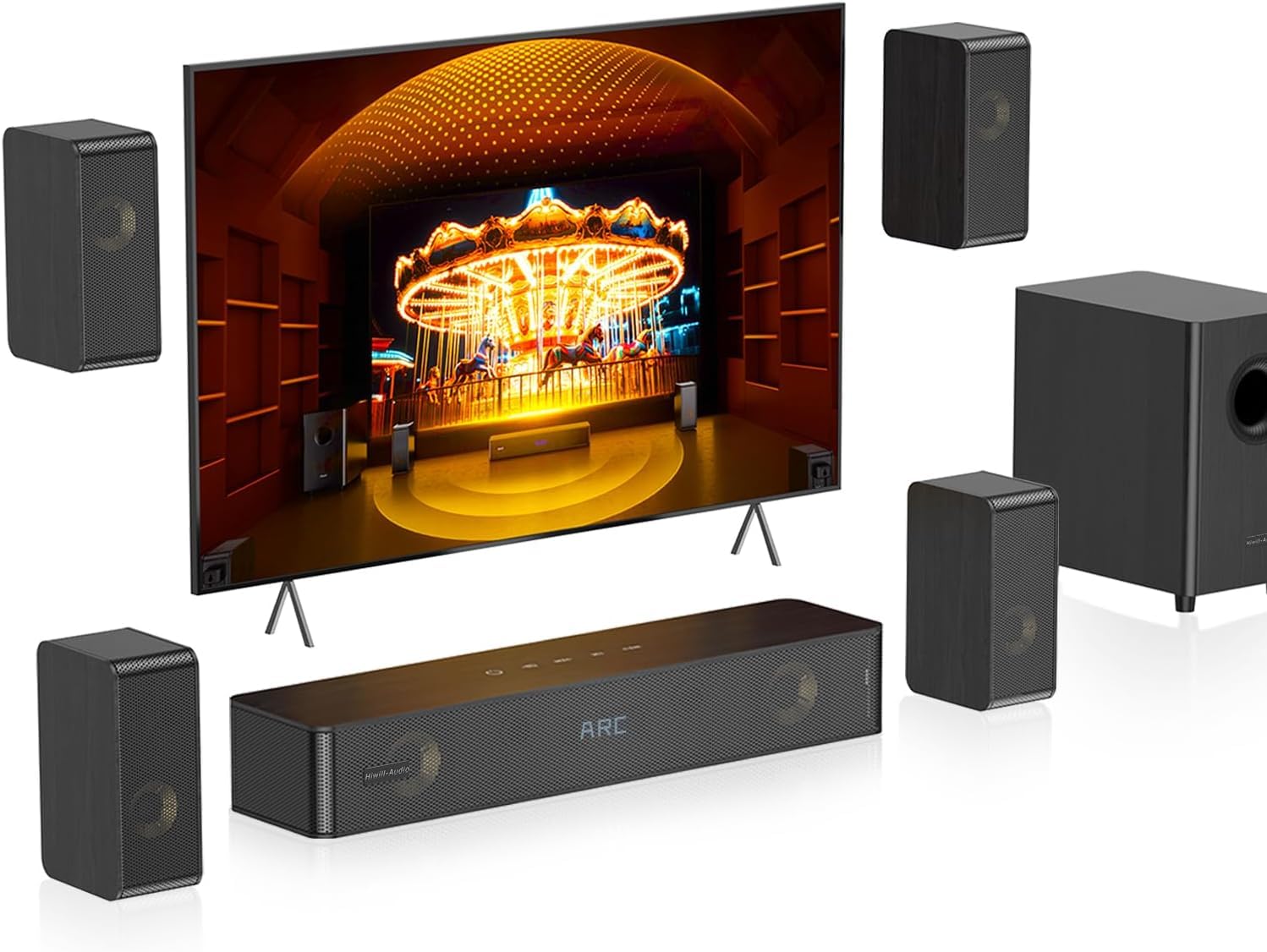
The HiPulse N512 stands out in the budget tier because it uses solid wood cabinets and aluminum-magnesium alloy driver diaphragms instead of the plastic and paper cones common at this price. The 5.1.2-channel configuration includes four surround speakers and two upward-firing drivers for a surprisingly wide soundstage. The 5.25-inch down-firing subwoofer includes adjustable bass control from -6 to +6 for tailoring low-end output.
The proprietary Discrete Spatial Expansion technology enhances the horizontal soundstage, making action sequences feel broader than the physical speaker placement would suggest. The system supports ARC, optical, AUX, USB, and Bluetooth 5.3, so it works with older TVs that lack HDMI eARC. The included remote provides quick access to four EQ presets—Movie, Music, News, and Game—as well as independent rear surround volume control.
Downsides include occasional popping from the rear speakers in certain configurations and the lack of Dolby Atmos or DTS decoding. The N512 relies on its spatial expansion algorithm rather than object-based codecs, so height effects are less precise than systems with dedicated Atmos hardware.
Why it’s great
- Solid wood cabinets reject cabinet resonance
- Aluminum-magnesium alloy drivers for low distortion
- Adjustable rear surround volume
Good to know
- No Dolby Atmos or DTS decoding
- Rear speakers may produce pop sounds
9. ULTIMEA Poseidon M60 5.1ch

The Poseidon M60 is the most affordable entry point for a system that includes a dedicated subwoofer and Dolby Atmos decoding. The 5.1-channel configuration uses five built-in drivers—including two side-firing units—plus a wired 5.25-inch wooden subwoofer. Precision DSP keeps latency under 0.5 ms, so lip-sync errors are imperceptible even during fast-paced action scenes.
The VoiceMX algorithm isolates vocal frequencies in real-time, which makes dialogue intelligible during noisy scenes without raising the overall volume. BassMX technology uses an 18mm high-excursion driver in a 5.3L tuned cabinet to produce deeper and tighter bass than the sub’s modest size suggests. The maximum SPL of 99 dB is sufficient for small to medium rooms, though the system lacks the headroom for larger spaces.
Bluetooth 5.4 ensures stable streaming from phones and tablets, and the Ultimea app provides a 10-band graphic EQ with 121 sound presets. The absence of rear satellite speakers limits the surround effect compared to systems with physical rears, but the side-firing drivers create a convincing front soundstage for the price.
Why it’s great
- Very affordable entry to Dolby Atmos
- VoiceMX enhances dialogue without boosting volume
- Bluetooth 5.4 with low latency
Good to know
- No rear satellite speakers
- Limited headroom for larger rooms
FAQ
Do I need rear satellite speakers for true surround sound?
What is the practical difference between Dolby Atmos and DTS:X?
Does Bluetooth 5.4 vs 5.3 matter for home theater?
Final Thoughts: The Verdict
For most users, the best bluetooth surround sound speakers winner is the ULTIMEA Skywave X50 because its dual-5GHz wireless rears, GaN amplifier, and 28 Hz sub-bass extension deliver professional-grade immersion without the complexity of a passive receiver setup. If you want the flexibility of upgrading individual components later, grab the Klipsch Reference Cinema—its horn-loaded satellites and passive design reward enthusiasts who already own an AV receiver. And for a refined, Devialet-tuned experience that integrates seamlessly with modern Hisense TVs, nothing beats the Hisense HT Saturn.