
Our readers keep the lights on and the weekend projects moving. As an Amazon Associate, I earn from qualifying purchases.
A BBQ temperature controller isn’t just a gadget — it’s the difference between a brisket that’s perfectly tender and one that’s been traumatized by heat spikes. These units manage the airflow to your charcoal or wood fire, automatically adjusting the fan speed to hold a steady pit temperature for hours, freeing you from tending the vents every fifteen minutes.
I’m Rikta — the co-founder and writer behind FitlyFast. I’ve spent countless hours sifting through thermal specs, probe accuracy certifications, and wireless range claims to find the controllers that truly deliver on the promise of set-and-forget smoking.
Whether you’re running a ceramic kamado, a Weber Smokey Mountain, or an offset stick-burner, the right bbq temperature controller locks in your target temp and lets you actually enjoy the cook instead of obsessing over the gauge.
How To Choose The Best BBQ Temperature Controller
Not all controllers are created equal. A basic on/off fan unit might work for a kettle, but a kamado grill demands precise air management to avoid overshooting your target by 50 degrees. Understanding your cooker type and the controller’s communication method is the first step.
Match the Controller to Your Cooker
Kamado-style grills (Big Green Egg, Kamado Joe) have thick ceramic walls and tight seals, so they need a controller with a quiet, variable-speed fan and a lid sensor to stop airflow when you open it. Offset smokers and Weber kettles are less airtight and benefit from controllers with higher CFM fans and robust temperature probes that can handle wider swings. Always check included adapters — some controllers ship with universal vent adapters, others require you to buy separately.
Wireless Range and Connectivity
Bluetooth-only controllers limit you to roughly 30 feet, which is fine if you’re cooking beside the grill but useless if you’re inside the house. Sub-1G technology and WiFi extend range dramatically, often through multiple walls and even through the metal of a closed kamado. Look for dual-band WiFi (2.4GHz) and controllers that offer a standalone base display so you don’t have to rely solely on a phone app.
Probe Count and Accuracy
At minimum, you need one pit probe (for ambient grill temp) and one meat probe. Four-probe setups let you monitor multiple cuts or track both the grate temp and the dome temp simultaneously. NIST certification (like ±0.9°F or ±0.5°F) ensures the readings are trustworthy — uncalibrated probes can be off by 10–15°F, which ruins a long cook. Probe response time also matters: fast-reading probes prevent thermal lag that leads to temperature overshoot.
Quick Comparison
On smaller screens, swipe sideways to see the full table.
| Model | Category | Best For | Key Spec | Amazon |
|---|---|---|---|---|
| BBQOVN WiFi Sub-1G | Smart Probe | App-based multi-sensor monitoring | 7 NIST-certified sensors, Sub-1G range | Amazon |
| ThermoMaven 3000FT | Base Display | No-app, simple standalone operation | Sub-1G 3000ft range, large LCD base | Amazon |
| ChefsTemp ProTemp S1 | Gauge Hub | Replacing dome gauge on any grill | Platinum sensor, 1000°F max, WiFi/BT | Amazon |
| BBQube TempMaster Solo | Fan Controller | Kamado-focused set-and-forget | Variable-speed fan, single-dial control | Amazon |
| Inkbird 027BW-4 | WiFi Fan/Probe | Smart lid detection and multi-user app | 5.0 m/s fan, ±0.9°F accuracy, lid sensor | Amazon |
| Pitmaster IQ IQ110 | Wired Regulator | Classic smokers and kettles | Wired probe, AC/12V power, 8-hr kettle run | Amazon |
| Typhur Sync Gold | Wireless Probe | Premium multi-probe precision | 6 sensors per probe, ±0.5°F, Sub-1G+WiFi | Amazon |
In‑Depth Reviews
1. Typhur Sync Gold
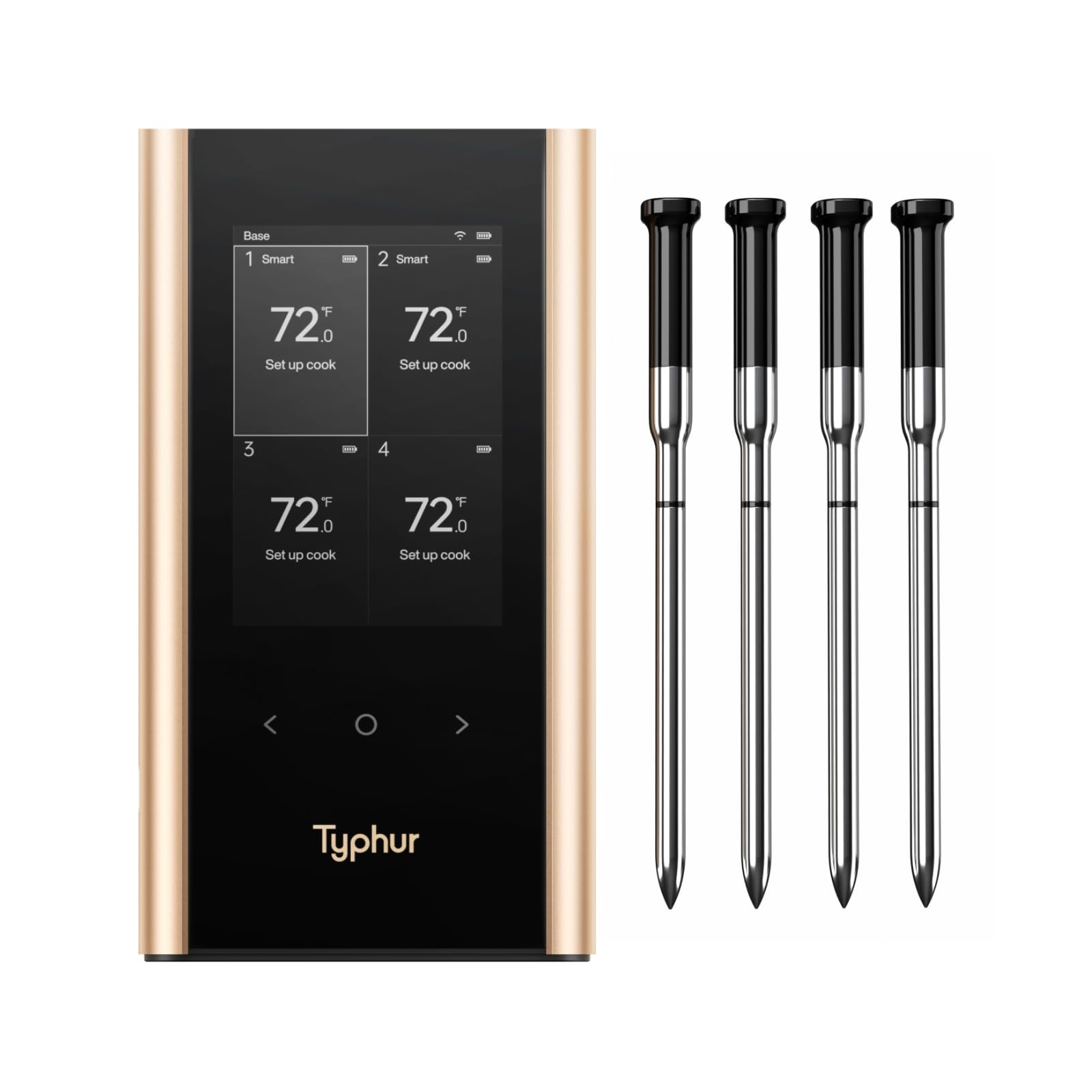
The Sync Gold is the most technologically dense unit on this list. Each probe packs six sensors (five internal plus one ambient tip) and uses Sub-1G wireless to punch through a closed kamado lid and a brick wall without dropping the connection. Accuracy is ±0.5°F with a 0.5-second response time, and the probes are rated IPX8 for dishwasher cleaning. The standalone base lets you set target temps without ever opening the app.
The smart algorithm predicts cook finish times based on real-time temperature curves, which is useful for planning when to start sides or rest meat. WiFi connectivity is rock solid even on rural internet setups. Users report that probes need to be inserted fully to the 3-inch fill line to avoid overheating the sensor board, but once correctly placed the readings are consistent across all four probes.
For home cooks routinely managing two or more protein cuts, or those who want the maximum possible probe count and accuracy without cluttering the grill with wires, the Sync Gold is the premium benchmark. It’s expensive, but the build quality, signal reliability, and app polish justify the investment for serious pitmasters.
Why it’s great
- Six sensors per probe deliver precise internal and ambient readings simultaneously
- Sub-1G signal penetrates kamado ceramic and multiple walls without dropouts
- IPX8 waterproof probes are dishwasher-safe for easy cleanup
Good to know
- Premium price — this is the most expensive controller in the list
- Probes must be inserted fully to the 3-inch line to avoid overheating the electronics
2. Inkbird 027BW-4
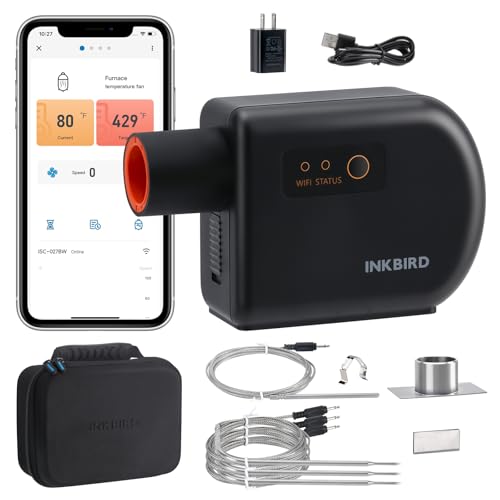
The Inkbird 027BW-4 combines a high-output 5.0 m/s fan with four food-grade probes and both WiFi and Bluetooth 5.0 connectivity. Its standout feature is the intelligent lid detector — when the grill lid opens, the fan automatically stops to prevent oxygen rush and temperature spikes; when closed, it resumes. This is especially valuable on kamado grills where overshooting temp on a lid-open is a constant risk.
Accuracy is rated at ±0.9°F with a ±12°F calibration offset you can adjust manually. The probes are color-coded and the app supports multi-user control — multiple phones can view the same cook session. USB power means you can run it from a portable battery pack, which is essential for tailgating or campsite cooks where AC power isn’t available.
A few users have reported probe longevity issues after several months, so it’s worth testing your probes in boiling water before each long cook. The Inkbird’s app interface isn’t as polished as premium competitors, but its balance of fan power, probe count, lid detection, and WiFi reliability at a mid-range price makes it the best all-around controller for most charcoal and kamado users.
Why it’s great
- Smart lid detection system prevents temperature spikes when opening the grill
- USB-powered for use with portable battery packs — ideal for outdoor cooking
- Four color-coded probes and multi-user app control for group cooks
Good to know
- Probe calibration should be verified periodically; some users report drift over months of use
- App design is functional but less intuitive than premium competitors
3. Pitmaster IQ IQ110
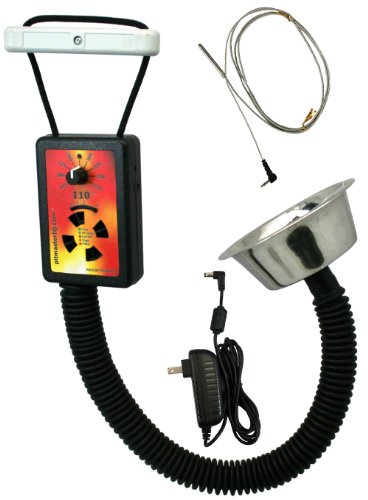
It uses a simple but effective algorithm: the blower runs until the pit hits your target temp, then modulates to maintain it. For a Weber Smokey Mountain or kettle, this controller can hold 225°F on a single load of charcoal for up to 8 hours. Alton Brown featured it on Good Eats, and it’s been a reliable workhorse ever since.
The kit includes the blower box, a 6-foot temperature probe, an AC power supply, and a standard pit adapter that fits flat or spherical surfaces with a damper under 5 inches. It also runs on 12V DC via a cigarette lighter adapter (sold separately) for mobile use. The probe is delicate — exceeding 500°F will damage it — so this is best suited for low-and-slow cooks, not searing.
There’s no WiFi, no Bluetooth, no app. You set the temp on the unit, and it does its job. For traditionalists who want a no-nonsense controller without smartphone dependency, or for those cooking on Weber kettles and vertical water smokers, the IQ110 offers proven performance at a fraction of the cost of modern WiFi-enabled units.
Why it’s great
- Proven track record with Weber Smokey Mountain and kettle grills — holds 225°F for 8+ hours
- No app, no WiFi, no Bluetooth — simple dial-and-go operation
- Runs on AC power or 12V DC for portable use with a cigarette lighter adapter
Good to know
- Probe is delicate and fails if exposed to temperatures above 500°F
- Replacement probes require ordering from the manufacturer rather than Amazon
4. BBQube TempMaster Solo
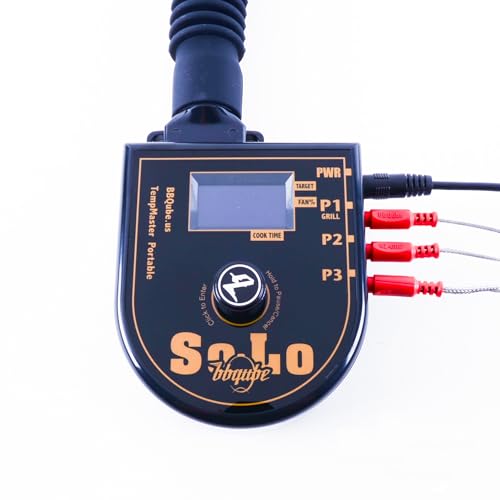
The TempMaster Solo is purpose-built for kamado grills. Its compact form factor sits directly on the bottom vent, and the variable-speed fan is exceptionally quiet — you can barely hear it running during a long smoke. The one-dial interface lets you set target temperature and adjust smoker size without greasy push buttons, and the bright OLED display is readable even in direct sunlight.
It comes with three fast-responding probes: one small grill probe and two meat probes (short and long), plus a practical wire wrap to keep everything organized. The included carrying case is also weather-resistant, so you can leave the controller mounted to the grill and still protect it from rain. A free vent adapter for large kamado vents is included in the box.
The biggest appeal is simplicity — no app, no WiFi, no pairing headaches. You set the dial and the PID algorithm manages airflow precisely. Some users note that the AC power cord can work loose if the unit is bumped, and the metal slide plate where the unit attaches can leak a small amount of smoke, but overall temperature consistency is excellent. For dedicated kamado owners who want a no-fuss fan controller, the TempMaster Solo is a compact powerhouse.
Why it’s great
- Compact, quiet variable-speed fan designed specifically for kamado bottom vents
- Single-dial operation with bright OLED display — no app or smartphone required
- Includes carrying case, vent adapter, and three probes for a complete setup
Good to know
- AC power cord can loosen if bumped during the cook
- Small smoke and heat leak at the metal slide plate attachment point
5. ChefsTemp ProTemp S1

The ProTemp S1 is unique in that it replaces your grill’s existing dial gauge rather than sitting outside the vent. It uses a platinum sensor that is 10x more accurate than a standard bimetallic dial gauge, measuring ambient pit temperature up to 1000°F. The universal version fits nearly every grill with a standard gauge hole (not for Big Green Egg). Once installed, it connects via WiFi and Bluetooth to provide real-time pit temp monitoring from your phone.
Battery life is substantial — up to 40 hours on WiFi mode and 300 hours on Bluetooth-only mode. You can monitor up to 3 S1 units in a single app if you run multiple grills. It also supports up to 4 wireless probes (sold separately) and can pair with the optional ChefsTemp Breezo fan for automatic airflow control, turning your dumb grill into a fully automated cooking rig.
The app is functional but not as polished as some competitors, with a few users noting that alarms don’t always trigger if the app is fully backgrounded. However, the customer support is responsive and the company has a reputation for addressing issues quickly. For anyone who wants to upgrade their grill’s built-in gauge without adding a bulky external controller, the ProTemp S1 is an elegant solution.
Why it’s great
- Direct replacement for your grill’s existing dome gauge — no bulky external unit
- Platinum sensor is 10x more accurate than standard dial gauges
- Long battery life with 40-hour WiFi mode and 300-hour Bluetooth mode
Good to know
- Not compatible with Big Green Egg grills — requires the separate BGE version
- Wireless probes are sold separately, increasing total cost
6. BBQOVN WiFi Sub-1G
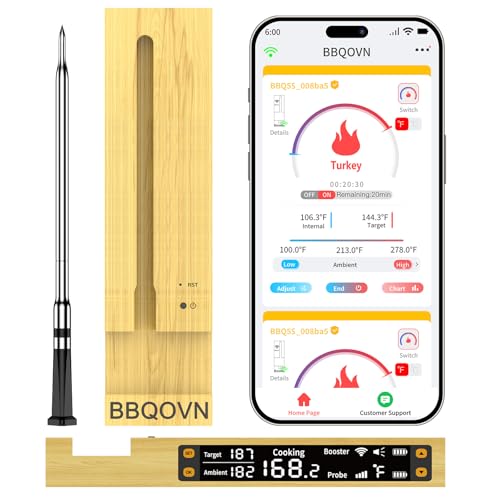
The BBQOVN WiFi Sub-1G packs an impressive seven NIST-certified sensors into a single probe system, tracking ambient temperature, food temperature at multiple depths, minimum internal temperature, and overall temperature calculations. The flip-side algorithm recommends the ideal moment to flip your steak, which is a unique feature no other controller offers. Connectivity is via Sub-1G wireless with WiFi bridge support for unlimited range monitoring through the app.
The probe is made from 304 stainless steel and high-temperature ceramic, with a harvest bamboo base that looks more like kitchen decor than a tech gadget. The app records cooking history, allowing you to fine-tune future cooks based on past data. The temperature range is wide: internal from -4°F to 212°F, and ambient up to 1000°F.
While the feature set is remarkable for the price, battery longevity has been inconsistent in user reports — some units hold charge well for months, while others degrade significantly after a year. Pairing the probe with the app can also be finicky during initial setup. For smokers who want app-driven cooking assistance and sensor density without paying premium prices, the BBQOVN delivers exceptional value, though it may require patience with the occasional technical hiccup.
Why it’s great
- Seven NIST-certified sensors in one probe for comprehensive temperature tracking
- Flip-side algorithm provides actionable cooking guidance in the app
- Sub-1G + WiFi gives unlimited range through the smartphone app
Good to know
- Battery life can degrade significantly after a year of use for some units
- Initial pairing process with the app can be tedious and require multiple attempts
7. ThermoMaven 3000FT
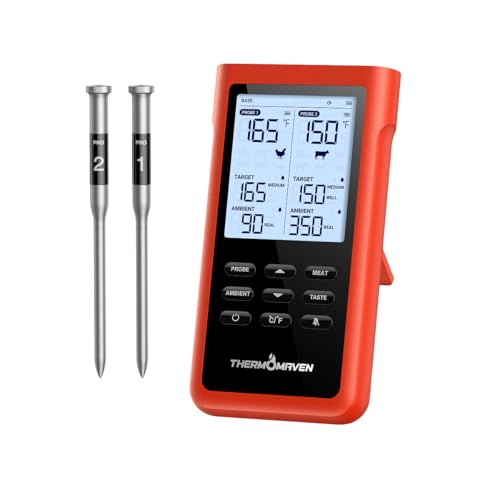
The ThermoMaven 3000FT is the anti-app controller. No sign-up, no account, no personal information collected. You unpack the base, insert the two thin probes, and start monitoring immediately. The Sub-1G wireless technology provides a 3000-foot line-of-sight range that penetrates walls reliably — users confirm it works through multiple interior walls in a typical house without any signal loss.
Each probe has six NIST-certified sensors with ±0.5°F accuracy, and the standalone base features a large LCD display that shows both probe temperatures simultaneously. The base has a magnetic mount for attaching to the grill shelf or any metal surface. The probes are thin, which minimizes juice loss when inserted into meat, and they recharge when seated in the base unit.
The main trade-off is the lack of app-based features: no cook history, no graphing, no estimated finish time. The buttons on the base are also unlabeled and lack a backlight, making nighttime adjustments difficult. Ambient temperature readings have been reported as less accurate than the meat probe readings. For privacy-conscious cooks or those gifting a controller to a tech-averse family member, the ThermoMaven offers excellent wireless range and accuracy without any digital overhead.
Why it’s great
- Zero sign-up or account required — just unpack and use
- Sub-1G wireless with 3000-foot range penetrates walls reliably
- Two thin probes with NIST-certified ±0.5°F accuracy
Good to know
- No app means no cook history, temp graphs, or finish time estimates
- Base buttons are unlabeled and lack a backlight for low-light use
FAQ
Can I use a BBQ temperature controller on a gas grill?
How many probes do I really need for smoking brisket?
What does PID mean in a BBQ controller?
Do I need a controller with a lid detection feature?
Final Thoughts: The Verdict
For most users, the bbq temperature controller winner is the Inkbird 027BW-4 because it combines a powerful 5.0 m/s fan, four probes, WiFi/Bluetooth connectivity, and smart lid detection at a mid-range price. If you want wireless probe luxury with no-compromise accuracy, grab the Typhur Sync Gold. And for a classic set-and-forget controller that needs no app, nothing beats the Pitmaster IQ IQ110.