
Our readers keep the lights on and the weekend projects moving. As an Amazon Associate, I earn from qualifying purchases.
An all-in-one printer that jams, drops Wi-Fi, or costs more in ink than the machine itself is a liability, not a tool. Whether you are equipping a home office, managing a small business, or simply tired of the “low on cyan” anxiety, the difference between a smart buy and a frustrating paperweight comes down to a few specific specs: print engine type, total cost per page, and scan workflow reliability.
I’m Rikta — the co-founder and writer behind FitlyFast. After spending many hours methodically searching consumer reports, analyzing verified buyer feedback, and cross-referencing specifications across multiple market tiers, I have narrowed the field of working printers down to the models that won’t waste your time.
Whether you prioritize monochrome speed, wide-format capability, or cartridge-free ink systems, this guide filters the noise to help you identify the right all-in-one printer for your specific workspace demands.
How To Choose The Best All-In-One Printer
Choosing an all-in-one printer means balancing upfront cost against long-term consumable spending. A cheap inkjet can quickly cost more than a laser printer if you print even a few hundred pages a month. Focus on your primary output: monochrome text-heavy documents favor laser engines, while mixed graphics and color presentations benefit from modern inkjet or color laser systems. Your scanning needs — single-pass duplex versus single-sided simplex — also heavily influence workflow speed.
Print Engine: Laser vs Inkjet
Monochrome laser printers deliver sharp text at lower cost per page and rarely suffer from dried ink clogs. Color laser is more expensive upfront and uses toner that costs more per page than high-yield ink bottles. Modern inkjet systems like EcoTank use refillable bottles that drastically lower running costs, making them viable for color volume. The core tradeoff: inkjets can clog if left idle for weeks, while lasers maintain readiness but carry higher initial hardware investment.
Duty Cycle and Monthly Volume
The duty cycle number (e.g., 50,000 pages per month) describes the maximum the machine can physically handle, but the recommended monthly volume is the real metric. Consumer printers often state 250 to 2,000 pages per month. Exceeding this repeatedly reduces mechanical lifespan. For a small office printing 500 to 1,500 pages a month, a model rated for up to 3,000 recommended pages provides comfortable headroom without overpaying for an enterprise machine.
Scan and Copy Workflow
A 50-page auto document feeder (ADF) is standard on most workgroup all-in-ones, but not all ADFs support dual-sided scanning. Single-pass duplex scanners capture both sides in one pass, saving significant time when digitizing double-sided documents. Scan-to-network folder, scan-to-email, and scan-to-cloud capabilities determine whether the device integrates into your existing document management system without a dedicated PC acting as a relay.
Quick Comparison
On smaller screens, swipe sideways to see the full table.
| Model | Category | Best For | Key Spec | Amazon |
|---|---|---|---|---|
| Brother MFC-L8730CDW | Color Laser | High-volume color office | 33 ppm color, automatic duplex | Amazon |
| Epson EcoTank Pro ET-5150 | Supertank Inkjet | Low-cost color printing | Up to 7,500 pages per ink set | Amazon |
| HP OfficeJet Pro 9730 | Wide-Format Inkjet | 11×17 color documents | 22 ppm black, P3 color gamut | Amazon |
| Brother DCP-L2640DW | Monochrome Laser | Budget B&W volume printing | 36 ppm, automatic duplex | Amazon |
| Epson Workforce Pro WF-7840 | Wide-Format Inkjet | Affordable 13×19 printing | 500-sheet capacity, 4.3″ screen | Amazon |
In‑Depth Reviews
1. Brother MFC-L8730CDW
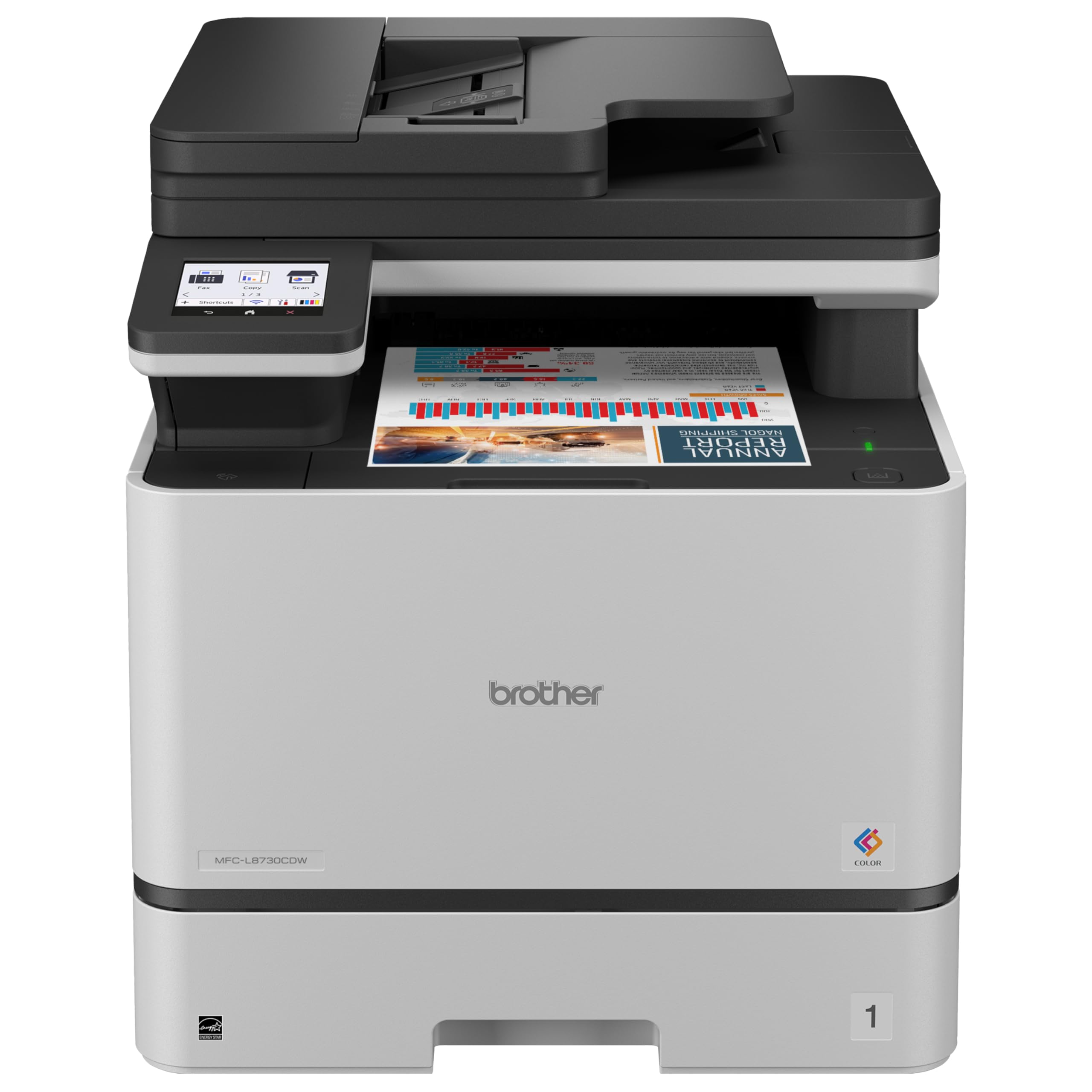
The Brother MFC-L8730CDW is a serious business-grade color laser that combines pro-level print speeds of up to 33 pages per minute with an 80-page auto document feeder capable of high-speed duplex scanning at 104 images per minute. Its updated design is significantly more compact than its predecessor while still supporting legal-size scanning on the flatbed glass, making it a genuine workgroup hub for color documents.
This unit ships with 3,000-page black and 1,800-page color starter toners, enough to get a busy office through several weeks of moderate output. Replacement high-yield cartridges extend to 5,500 pages black and 4,500 color, keeping per-page cost competitive with mid-range inkjet systems. The triple-layer security stack — including NFC card authentication — makes it viable for environments that require restricted print release and encrypted data transmission.
Real-world owners consistently praise the build quality and reliable wireless connectivity, though the proprietary chipped toner system blocks third-party cartridges, a legitimate cost-of-ownership consideration. The 67.9-pound weight means it requires two people to move into place, but this solid construction also explains its long service life reported by users spanning multiple years.
Why it’s great
- Fast 33 ppm color and duplex scanning at 104 ipm
- Enterprise-grade network security and NFC badge support
- Compact design for its class with legal-size flatbed
Good to know
- Proprietary toner cartridges block third-party alternatives
- Heavy build weighs nearly 68 pounds
2. Epson EcoTank Pro ET-5150

The Epson EcoTank Pro ET-5150 effectively eliminates the cartridge cost trap by using refillable ink bottles that deliver up to 7,500 black and 6,000 color pages before needing a refill. Its PrecisionCore printhead is permanent and rated for the life of the printer, which combined with the low-waste bottle system makes this one of the most economical color all-in-ones for a small office printing several hundred color pages each month.
Print speeds of 17 pages per minute black and 9.5 pages per minute color are modest compared to laser units, but there is no warmup time — first page out is nearly instant. The DURABrite ET pigment inks produce water-resistant, smudge-proof output that looks crisp on standard copy paper. The included 30-page ADF supports single-pass duplex scanning, though it is a step down from the 50-sheet capacities found on higher-end models.
User feedback highlights the Wi-Fi as more reliable than earlier EcoTank generations, and the compact footprint fits easily on a desk. Some owners report occasional paper jams, but most found these easy to clear by removing the rear panel. The lack of borderless printing is the most commonly cited omission for those needing full-bleed photos or marketing materials.
Why it’s great
- Up to 7,500 black pages per ink bottle set
- No cartridge waste and low per-page cost
- Compact design with reliable wireless connectivity
Good to know
- Does not support borderless printing
- 30-page ADF is smaller than competing models
3. HP OfficeJet Pro 9730
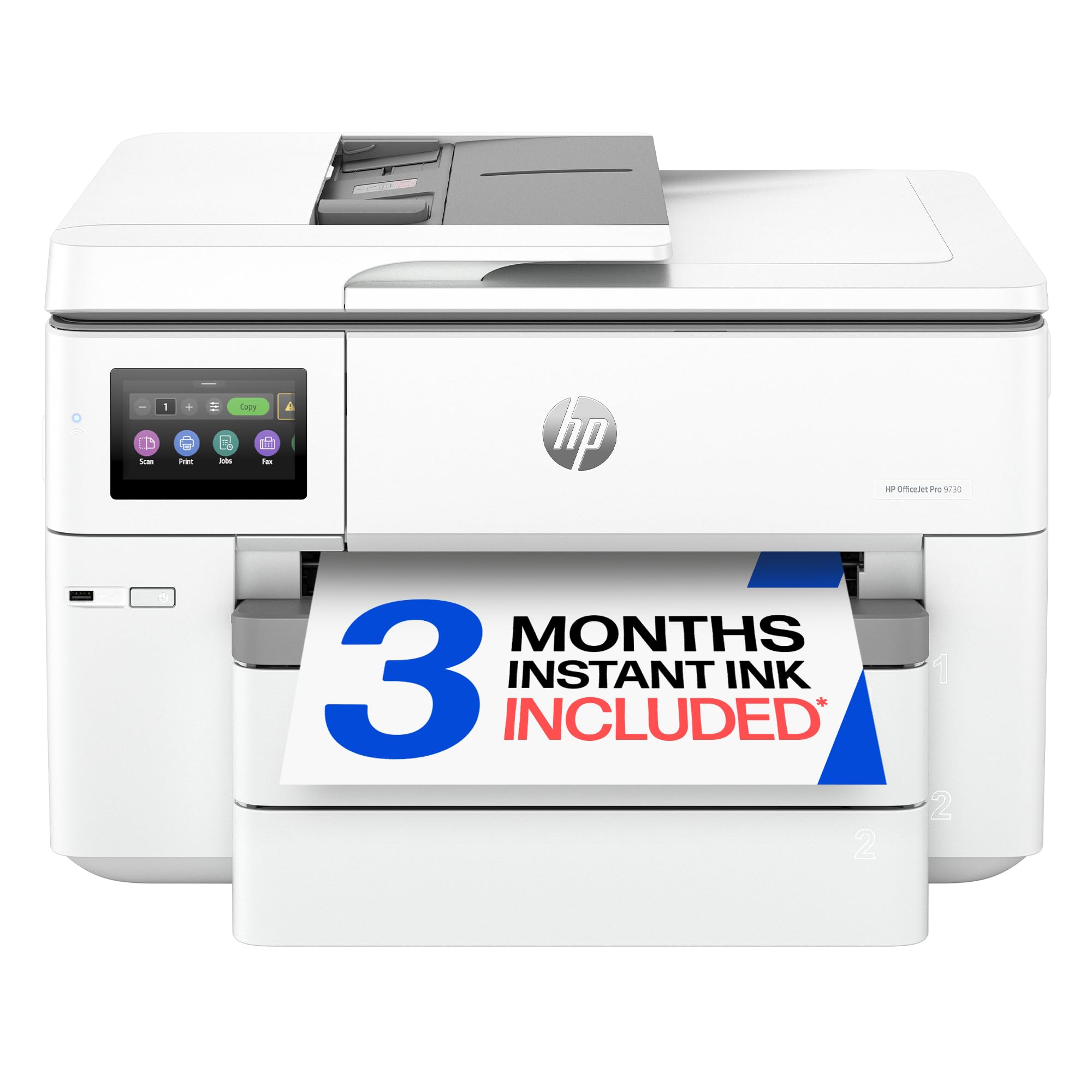
The HP OfficeJet Pro 9730 is built specifically for professionals who need true 11×17 color output without stepping up to an enterprise plotter. It features P3 wide color gamut support, the first and only wide-format printer to offer this, ensuring screen-accurate prints for floorplans, mood boards, and detailed spreadsheets. Dual 250-sheet trays provide a total 500-sheet capacity, reducing paper refill interruptions during long job runs.
Output speeds reach 22 pages per minute black and 18 pages per minute color, impressive for a wide-format inkjet. The single-pass duplex ADF scans both sides of a page in one pass, and the 4.3-inch color touchscreen makes navigating settings for different paper sizes intuitive. HP’s Instant Ink trial is included for three months, but after that the subscription model carries a monthly fee — a factor to evaluate before committing to this ecosystem.
Actual owners note the setup process is straightforward with the HP Smart app, and scan-to-email functionality works reliably once configured. The unit is noticeably large and best suited for a dedicated office corner. A few users experienced Wi-Fi dropouts after sleep mode, resolved by using a wired Ethernet connection for consistent uptime.
Why it’s great
- Wide-format 11×17 printing with P3 color accuracy
- Single-pass duplex scanning with 50-sheet ADF
- Fast 22 ppm black and 18 ppm color output
Good to know
- Large footprint requires dedicated desk space
- Instant Ink subscription model after trial period
4. Brother DCP-L2640DW

The Brother DCP-L2640DW is a 3-in-1 monochrome laser printer that delivers 36 pages per minute with automatic duplex printing, making it the fastest B&W option in this lineup for straight text output. Its 50-page auto document feeder supports multi-page copying and scanning, and the compact footprint fits easily on a small desk or shared shelf without sacrificing paper handling capacity.
Connectivity options include dual-band wireless, Ethernet, and USB, giving you flexibility to integrate into any network topology. The Refresh Subscription Trial can provide automatic toner delivery, but you are not locked in — standard TN830 and TN830XL cartridges are widely available and affordable. Users report the laser engine produces sharp, consistent black text with zero smudging, and the wireless setup completes in minutes without requiring an app.
Veteran Brother owners frequently mention replacing decade-old units with this model and experiencing the same hassle-free operation. The scanning software leaves some room for improvement; a few users found the included PaperPort utility glitchy during network saves, but third-party applications like VueScan resolve this quickly. For a pure monochrome workhorse that prioritizes reliability over frills, this is the most sensible pick.
Why it’s great
- Fast 36 ppm monochrome output with auto duplex
- Dual-band wireless and Ethernet connectivity
- Low running costs with affordable TN830 toner
Good to know
- Included scanning software has limited functionality
- Monochrome only — no color printing capability
5. Epson Workforce Pro WF-7840

The Epson Workforce Pro WF-7840 is a wide-format color inkjet that prints up to 13×19 inches, making it one of the most affordable routes to tabloid and super-tabloid output without investing in a large-format plotter. Its PrecisionCore Heat-Free printhead delivers crisp text at 25 pages per minute black and 12 pages per minute color, with DURABrite Ultra ink that dries quickly and resists smudging on coated or plain paper.
The 500-sheet paper capacity is split between two trays, and the 50-page ADF supports duplex scanning for digitizing double-sided documents. The 4.3-inch touchscreen provides a responsive interface for navigation and job management. Epson Connect, Apple AirPrint, and Mopria compatibility mean mobile workers can send jobs from any device without installing proprietary drivers.
Long-term owners report this printer handles heavy use — one user logged over 12,000 pages across three years without mechanical failure. The downside is size: at 45.4 pounds and nearly 20 inches deep, it requires dedicated floor space. Some users strongly dislike the firmware update prompts that can interfere with third-party ink usage, so budgeting for genuine Epson cartridges is recommended for a smooth ownership experience.
Why it’s great
- Prints up to 13×19 inches at a reasonable upfront cost
- 500-sheet capacity with dual trays
- Proven 12,000+ page reliability in real-world use
Good to know
- Large and heavy at 45.4 pounds
- Firmware updates may block third-party cartridges
FAQ
Will a laser printer save me money compared to an inkjet if I mostly print black text?
How many pages should my printer’s ADF handle for a small office with three staff members?
Does wide-format printing above 11×17 require special paper or ink?
Final Thoughts: The Verdict
For most users, the all-in-one printer winner is the Brother MFC-L8730CDW because it combines fast color laser output, high-speed duplex scanning, and enterprise-grade security features that justify its premium positioning for demanding workgroups. If you want the lowest per-page color printing costs, grab the Epson EcoTank Pro ET-5150, whose refillable bottle system delivers thousands of pages without cartridge waste. And for budget-friendly monochrome volume with zero ink anxiety, nothing beats the Brother DCP-L2640DW.