
Our readers keep the lights on and the weekend projects moving. As an Amazon Associate, I earn from qualifying purchases.
The market for desktop FDM printers under $1000 has fractured into two distinct realities. You can spend hours leveling a bed and chasing first-layer adhesion on a budget machine, or you can tap a button and have a perfect Benchy in under 20 minutes on a modern speedster. The difference comes down to what you are willing to trade: tinkering time for print time.
I’m Rikta — the co-founder and writer behind FitlyFast. After analyzing hundreds of hours of user reports and cross-referencing print-quality benchmarks, acceleration curves, and auto-leveling reliability for these specific models, I’ve mapped out exactly where your money buys speed versus where it buys sheer build volume.
This guide breaks down the eight best FDM printers that stay under the four-figure ceiling, from fully enclosed workhorses to open-frame beginners, so you can match a machine to your actual projects. We are here to help you find the best 3d printer under $1000 that fits your workflow without wasting a single filament.
How To Choose The Best 3D Printer Under $1000
Choosing a printer in this range is not about finding the cheapest option — it is about picking the performance profile that matches the parts you want to print. The main trade-offs are motion system type, build volume, enclosure, and multi-material support.
Motion System: CoreXY vs. Bed-Slinger
A CoreXY machine moves the print head along the X and Y axes using two motors and a belt loop across the top frame. This design allows faster accelerations and higher top speeds (600mm/s is common) because the print bed stays stationary on the Z-axis. The downside: CoreXY frames are more expensive and often have smaller build volumes. Bed-slingers, like the traditional Prusa-style, move the Y-axis with the entire bed. They are cheaper to manufacture and can offer larger build footprints, but the moving mass limits acceleration — you typically top out around 180mm/s. For speed and quality on smaller objects, CoreXY wins. For large single-piece models on a tight budget, a bed-slinger is practical.
Auto Leveling and Calibration
Manual bed leveling — turning four thumbscrews with a piece of paper — is a skill that beginners struggle with and experienced users get tired of. The best feature a modern printer under $1000 can offer is full-auto leveling: the machine probes the bed at multiple points, then compensates for any tilt or warp in the firmware. Some systems also auto-adjust the Z-offset and perform an input-shaping test to eliminate ringing at high speeds. If you value your time, prioritize a printer with a LeviQ, Strain Sensor, or an inductive probe.
Enclosure and Material Compatibility
An enclosed printer retains heat and stabilizes the air temperature around the build area. This is not mandatory for PLA, PETG, or TPU, but it is necessary for ABS, ASA, Polycarbonate, and carbon-fiber filaments. Those materials warp when exposed to drafts. Enclosures also reduce noise and contain fumes. Some printers in this range offer a fully enclosed chamber from the factory (the P1S), while others are open but compatible with aftermarket enclosures or optional side panels. Buy an enclosed model if advanced materials are in your future.
Multi-Color and Multi-Material
Printing in multiple colors used to require manual filament swaps. Now, add-on units like the Bambu Lab AMS or the Anycubic ACE Pro handle automatic filament changes during a print. The trade-off is cost: the printers that support these systems often list a base price under $1000, but the multi-color units are sold separately. Consider whether you truly need color variety for your projects. Most hobbyists will use single-color prints for 80% of their work.
Quick Comparison
On smaller screens, swipe sideways to see the full table.
| Model | Category | Best For | Key Spec | Amazon |
|---|---|---|---|---|
| Bambu Lab P1S | Fully Enclosed | Advanced materials & multi-color | 500mm/s, 20000mm/s² accel | Amazon |
| Anycubic Kobra X | Multi-Color CoreXY | Beginner multi-color printing | 600mm/s, 260mm³ build volume | Amazon |
| Bambu Lab A1 | Quiet Bed-Slinger | Seamless quiet operation | ≤48 dB, 10000mm/s² accel | Amazon |
| Creality K1C | Enclosed CoreXY | Carbon fiber & silent mode | ≤45dB, 300°C nozzle | Amazon |
| Creality Ender 3 V3 Plus | Large CoreXZ | Large single-piece prints | 300x300x330mm, 600mm/s | Amazon |
| FLASHFORGE Adventurer 5M | Entry-Level CoreXY | Beginner speed & value | 600mm/s, 220mm³ build | Amazon |
| Longer LK5 Pro | Large Open Frame | Huge build volume on budget | 300x300x400mm, 180mm/s | Amazon |
In‑Depth Reviews
1. Bambu Lab P1S

The Bambu Lab P1S is the most complete package in this guide. Its CoreXY motion system hits 500mm/s with 20000mm/s² acceleration, and the fully enclosed chassis keeps ambient temperature stable for ABS and ASA prints without requiring a separate enclosure purchase. Auto bed leveling, filament runout detection, and network printing are all standard out of the box. Setup takes under 30 minutes.
The enclosed design and 300°C-capable hotend mean you can print PLA, PETG, TPU, PVA, ABS, and ASA with minimal tweaking. The optional AMS unit adds support for up to 16 colors, making it the best path into multi-color printing without upgrading the printer itself. The 260mm³ build volume is realistic for most functional parts and models.
Users consistently report reliable first prints with zero manual leveling adjustments. The Bambu Studio slicer streamlines the workflow, and the MakerWorld community provides a huge library of ready-to-print models. The P1S costs slightly more than open-frame competitors, but it eliminates the need for upgrades or enclosures later, making it the smartest long-term choice.
Why it’s great
- Fully enclosed for ABS/ASA without buying extra panels.
- Fast 500mm/s speeds with reliable auto-leveling.
- Plug-and-play AMS support for up to 16 colors.
Good to know
- AMS unit required for multi-color — sold separately.
- TPU can be tricky; requires dialing in retraction.
2. Anycubic Kobra X
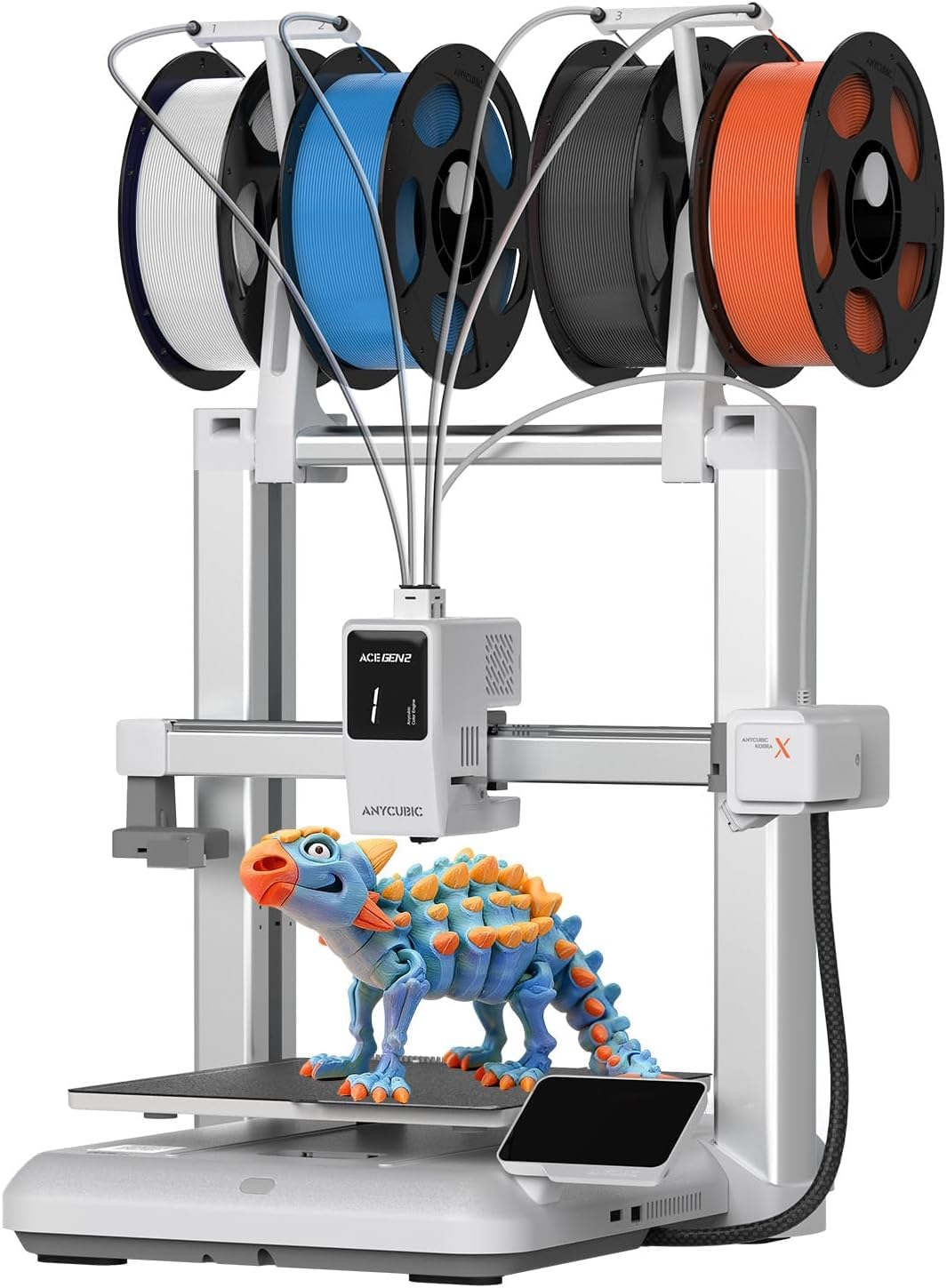
The Anycubic Kobra X is one of the few printers that includes native 4-color support without requiring a separate expensive hub. The Gen 2 ACE system reduces purge waste by 81.25% compared to traditional dual-extrusion setups, cutting material costs significantly. The CoreXY motion system reaches 600mm/s, and the 49-point LeviQ 3.0 auto leveling ensures reliable first layers for PLA and PETG.
The 260mm³ build volume offers more space than the Bambu Lab A1 or the Flashforge Adventurer 5M. The hardened steel nozzle reaches 300°C, making it capable of printing carbon-fiber reinforced materials. The dual-band Wi-Fi and app-based remote monitoring add modern convenience that is often absent in cheaper printers. The AI camera detects spaghetti failures and pauses prints automatically.
User reports show excellent reliability across hundreds of hours of printing with PLA, PETG, and TPU. The largest complaint revolves around the phone app being slightly rough around the edges, but the desktop slicer ecosystem is open and works well. For a user who wants multi-color capability out of the box without piling on extras, this is the strongest value proposition.
Why it’s great
- Four built-in color channels with minimal purging waste.
- 600mm/s high speed with solid auto leveling.
- AI spaghetti detection and remote monitoring.
Good to know
- ACE Pro and ACE 2 Pro are not cross-compatible.
- Phone app polish could be improved.
3. Bambu Lab A1

The Bambu Lab A1 is an open-frame bed-slinger that prioritizes silence and ease of use without sacrificing speed. Active motor noise cancelation keeps operation at or below 48 decibels, making it the quietest printer in this lineup. The 10000mm/s² acceleration is lower than the CoreXY models, but the active flow rate compensation ensures consistent extrusion even during rapid direction changes.
Full-auto calibration handles Z-offset, bed leveling, and vibration compensation without any manual intervention. The 1-Clip quick-swap nozzle system makes maintenance simple. The open design and 256mm³ build volume are adequate for most hobbyist projects. The AMS Lite add-on unlocks multi-color printing at a lower entry cost than the full AMS for the P1S.
Customers highlight the short learning curve and the easy mobile app as major advantages for beginners. The printer works seamlessly with Bambu Studio and offers network printing. The open frame means no ABS or ASA printing without an aftermarket enclosure, but for PLA, PETG, and TPU, the A1 delivers instant results with almost no setup friction.
Why it’s great
- Exceptionally quiet operation at ≤48 dB.
- Full auto calibration with no paper-leveling needed.
- Low-cost AMS Lite option for multi-color.
Good to know
- Open frame — not suitable for ABS without enclosure.
- Some users report clogging with certain filaments.
4. Creality K1C

The Creality K1C is a fully enclosed CoreXY printer designed for high-speed carbon-fiber composite printing. The tri-metal unicorn nozzle and hardened steel tip can handle PLA-CF and PETG-CF at 300°C without degrading. The max speed of 600mm/s paired with 20000mm/s² acceleration makes it competitive with Bambu Lab options, and the switchable silent mode drops noise to ≤45 dB.
The built-in AI camera monitors for print failures and time-lapses. The carbon filter in the recirculation system reduces fumes, allowing safe operation in a living space. The Creality OS is based on Klipper and is fully open source, giving advanced users granular control. Auto leveling is one-touch, and the pre-assembled frame means setup out of the box is under 10 minutes.
Users upgrading from an Ender 3 report a dramatic quality improvement. The printer handles TPU, PETG, and ABS with good consistency. Some customers noted the smooth build plate requires glue stick for adhesion, and the air filter has limited effectiveness. For a user who needs a compact, enclosed, fast printer that can handle carbon fiber without pushing past $1000, the K1C is the strongest choice.
Why it’s great
- Tri-metal nozzle handles carbon-fiber filaments out of box.
- Enclosed chamber and carbon filter for fume reduction.
- Open-source Klipper firmware for advanced tuning.
Good to know
- Smooth build plate requires glue stick — buy textured plate separately.
- Customer service response times are inconsistent.
5. Creality Ender 3 V3 Plus

The Ender 3 V3 Plus is an evolution of the classic open-frame design, but Creality swapped the traditional motion system for a CoreXZ architecture. This means the print bed stays stationary on X and Y axes, while the gantry moves — reducing vibration ringing at high speeds. The 300x300x330mm build volume is among the largest in this guide, capable of printing helmet-sized objects without splitting the model.
The auto-leveling system handles Z-offset and bed calibration in one tap, eliminating the paper-leveling ritual of previous Ender generations. The direct-drive extruder uses a bolster spring and ball plunger to maintain grip on the filament. The Tri-Metal unicorn nozzle resists wear from abrasive filaments. Two Y-axis motors and dual linear rods support the heavy bed during rapid back-and-forth motion.
User feedback is mixed compared to the other printers in this list. Many report excellent results after initial setup, but a significant minority received units with misaligned gantries that required rebuilding. The printer is best suited for someone who does not mind a moderate amount of troubleshooting. For pure build volume per dollar, the V3 Plus is unmatched.
Why it’s great
- Very large 300x300x330mm build volume in an open frame.
- Auto leveling and auto input shaping out of the box.
- Tri-metal nozzle resists abrasive filament wear.
Good to know
- Build quality control is inconsistent — some units need realignment.
- Loud fans may require aftermarket replacements.
6. FLASHFORGE Adventurer 5M

The Flashforge Adventurer 5M is the most affordable CoreXY printer in this lineup. It reaches 600mm/s with 20000mm/s² acceleration, and the full-auto one-click leveling eliminates the setup friction that frustrates beginners. The 220mm³ build volume is smaller than the competition, but it is adequate for most action figures, brackets, and household parts. The direct-drive extruder with a 280°C nozzle handles PLA, PETG, and TPU without issue.
The included dual-sided PEI steel plate provides strong adhesion for PLA and makes print removal easy. The power-loss recovery and filament runout sensor prevent failed prints from ruining long jobs. The open frame is suitable for well-ventilated areas but not for ABS. The printer is compatible with Orca Slicer, which gives users access to a modern toolset rather than a proprietary slicer.
Users with over 40 prints under their belt report consistent performance with no hardware failures. The main complaints involve occasional firmware freezes and a small build volume that limits one-piece projects. The Flashforge support team is responsive, replacing defective parts quickly. For a beginner on a tight budget who wants CoreXY speed, the Adventurer 5M is the best entry point.
Why it’s great
- CoreXY speed at a very low entry price.
- True one-click auto leveling with no manual paper adjustment.
- Responsive technical support for warranty issues.
Good to know
- Small 220mm³ build volume limits single-piece models.
- Firmware freezing reported by several users.
7. Longer LK5 Pro

The Longer LK5 Pro is a bed-slinger that offers the largest Z-height in this guide at 400mm. The 300x300x400mm build volume is designed for tall vases, statues, and functional parts that require a tall vertical space. The reinforced diagonal bars form a triangle that minimizes frame vibration, and the dual Z-axis upgrade reduces wobble during tall prints.
This printer uses an open-source motherboard with TMC2209 silent drivers, keeping noise low. The 180mm/s top speed is modest compared to CoreXY machines, but the huge build floor compensates for the slower pace by allowing more parts per batch. The lattice glass bed provides flatness but requires manual leveling — a BLTouch upgrade is a common aftermarket addition.
User experiences are positive for those who accept manual leveling. The printer is 90% pre-assembled and the community has extensive mod resources. Some units shipped with faulty fans or bad soldering on the motherboard, but Longer provides lifetime technical support. For users who need to print tall objects like full-size helmets or architectural models, the LK5 Pro offers volume that nothing else in this price tier can match.
Why it’s great
- Massive 400mm Z-height for tall single-piece prints.
- Open-source firmware allows extensive customization.
- Very quiet TMC2209 drivers.
Good to know
- Manual bed leveling is required — no auto-probe included.
- Quality control is inconsistent; some units arrive with defects.
FAQ
Can a CoreXY printer print as quietly as a bed-slinger?
Is the Bambu Lab A1 open source?
How much waste does a multi-color printer create per filament change?
Final Thoughts: The Verdict
For most users, the winner of the 3d printer under $1000 category is the Bambu Lab P1S because its fully enclosed chamber, reliable auto-leveling, and fast CoreXY motion system remove the biggest pain points of FDM printing while keeping multi-color expansion as an option. If you want native multi-color printing without buying add-ons, grab the Anycubic Kobra X. And for quiet, beginner-friendly operation that just works on a desk, nothing beats the Bambu Lab A1.