
Our readers keep the lights on and the weekend projects moving. As an Amazon Associate, I earn from qualifying purchases.
The most common mistake people make when shopping for budget solar panels is confusing price with value. The real question isn’t whether you can find a panel under a certain dollar amount—it’s whether that panel will actually deliver the wattage it claims without failing after a handful of cycles. With so many off-brands flooding the market, comparing efficiency per square foot, cell quality, and real-world output is the only way to make a purchase that actually pays itself off.
I’m Rikta — the co-founder and writer behind FitlyFast. I’ve spent countless hours cross-referencing real-user power generation data, voltage curves, and materials specs across dozens of budget-priced solar panels to build this guide. The goal: find the few that genuinely produce usable energy without hidden costs.
Whether you need to keep a marine battery topped off, power an off-grid cabin setup, or just charge a portable power station during weekend trips, the right decision starts with a clear-eyed look at efficiency ratings, cell architecture, and durability. This is the definitive guide to choosing the best cheap solar panels that actually perform.
How To Choose The Best Cheap Solar Panels
At the entry-level and mid-range price tiers, you are not sacrificing the ability to generate real power—you are sacrificing build frills, ultra-light materials, and premium customer support. The key is identifying which compromises are acceptable and which ones will leave you with a paperweight. Every panel in this guide passes the baseline test of delivering near its rated wattage under good sun.
Cell Technology and Efficiency
Monocrystalline silicon is the standard for almost all budget panels worth buying. Polycrystalline panels exist but are less space-efficient. The real differentiator at the budget level is the number of busbars. Panels with 9 or 10 busbars reduce micro-crack impact and improve current collection. Higher-end budget options now use 16 busbar N-type cells, which maintain better output in high heat and partial shade—a feature once exclusive to premium hardware.
Rigid vs. Portable/Foldable Design
Rigid aluminum-framed panels offer the best durability and mounting flexibility for fixed installations on RVs, sheds, or ground mounts. They typically last decades. Portable foldable panels trade some longevity for ease of transport and setup, making them essential for camping or emergency backup. The trade-off is that portable panels sometimes use PET lamination instead of tempered glass, which can degrade faster under constant UV exposure.
Real-World Wattage and Daily Output
Ignore the “max power” sticker. A 100W panel in real-world conditions—angled correctly, no clouds—typically produces between 75W and 95W under standard testing. Budget panels on the lower end of that range are still functional but require more surface area to meet your energy needs. Daily output (watt-hours) is what matters: a 100W panel receiving 4 peak sun hours should deliver roughly 300-400 watt-hours. Calculate your needs before buying.
Quick Comparison
On smaller screens, swipe sideways to see the full table.
| Model | Category | Best For | Key Spec | Amazon |
|---|---|---|---|---|
| DOKIO 100W Suitcase | Portable | 12V battery maintenance | 100W / 18V output / PWM controller | Amazon |
| JJN 200W 2-Pack | Rigid | Full-time RV off-grid | 200W total / 23% eff / half-cut cells | Amazon |
| ZOUPW 100W Portable | Portable | Universal power station charging | 100W / 23.5% eff / 5-in-1 cable | Amazon |
| ECO-WORTHY 200W 2-Pack | Rigid | Budget DIY solar farm | 200W total / 25% eff / PERC tech | Amazon |
| Callsun N-Type 200W 2-Pack | Rigid | High-heat / small space installs | 200W total / 25% eff / 16BB N-type | Amazon |
| EBL 200W Portable | Portable | High-output portable camping | 200W / 23.5% eff / PET laminate | Amazon |
| HQST 200W Ultra-Light | Portable | Ultra-light travel / emergency backup | 200W / 25% eff / N-type / 11 lbs | Amazon |
In‑Depth Reviews
1. JJN 200W Solar Panels (2x100W)

The JJN 200W kit is a significant step up from the commodity 100W panels found at most entry-level price points. Each 100W panel in this pair uses half-cut monocrystalline cells (10 busbars), which reduces resistive losses and improves performance when part of the panel is shaded. Real-world reports consistently show 85W to 106W per panel depending on angle and temperature, with a peak output of 380W from a 400W bifacial setup in one verified review. The half-cut design is the primary reason this kit outperforms cheaper alternatives that use full-cut cells.
The build quality matches the power output. The aluminum frames are corrosion-resistant and rated for 2400Pa wind and 5400Pa snow loads, making them suitable for permanent roof mounting on an RV or cabin. The IP68 connectors and IP65 junction box ensure rain won’t cause degradation. At 28 pounds total for both panels, they are heavy enough to feel solid but manageable for a two-person installation. The included MC4 connectors make daisy-chaining straightforward.
This kit is sold as panels only—no charge controller, wiring, or mounting brackets. That means you must budget separately for an MPPT or PWM controller, but it also means you can pair these panels with a high-quality controller of your choice. The 30-year transferable power output warranty is among the longest at this price tier, which reflects confidence in the Grade A cell sourcing. For someone building a serious off-grid system on a budget, this is the anchor purchase to build around.
Why it’s great
- Half-cut cell design reduces shading losses significantly
- Consistent real-world output matching or exceeding rated wattage
- 30-year transferable warranty provides long-term confidence
Good to know
- Panels only—no controller or mounting hardware included
- Heavier than flexible alternatives at 28 lbs total
2. Callsun N-Type 200W (2x100W)
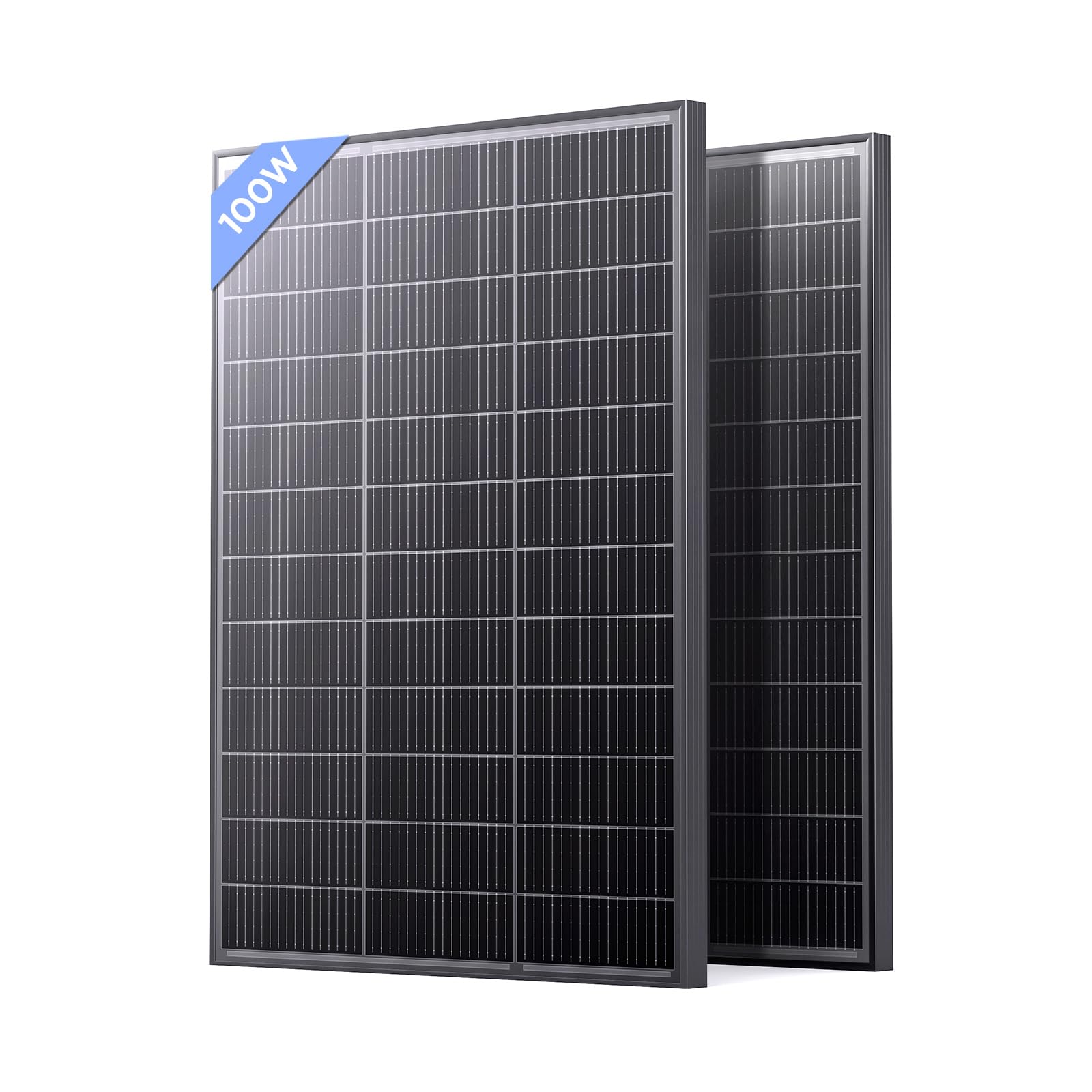
The Callsun N-Type 200W set is a technical standout in the mid-range. The 16-busbar N-type cell architecture delivers a conversion efficiency of 25%, which is notably higher than the 22-23% typical of P-type panels at this price. The real-world impact is that these panels produce more usable wattage per square foot—measuring 31.1 x 22.7 inches per 100W panel, they are about 15% smaller than standard 100W panels while delivering the same or slightly higher output. This makes them ideal for small RVs, vans, or balcony installations where space is tight.
Heat performance is where N-type cells truly separate themselves. With a temperature coefficient of -0.3%/°C, power loss in summer or desert conditions is lower than standard panels that typically lose -0.4% to -0.5% per degree Celsius above 25°C. Verified user reports confirm that these panels achieve 92-95% of rated output even in partial shade. The 3.2mm low-iron tempered glass and IP68 waterproof junction box ensure the panel survives rain, snow, and impacts without degradation.
The primary concern reported by users is inconsistent packaging—some units arrive with dented trim despite the shipping box being intact. The manufacturer has responded with credits or replacements, but it’s worth noting that corner protection could be better. The 25-year performance guarantee (84.5% power output retained) and 10-year workmanship warranty add long-term peace of mind that most budget rigid panels do not offer. If compact efficiency matters more than absolute lowest price, this is the smarter buy.
Why it’s great
- 16-busbar N-type cells deliver 25% efficiency in a compact form
- Excellent high-temperature performance with -0.3%/°C coefficient
- IP68 junction box and tempered glass for long-term outdoor use
Good to know
- Packaging could be more protective—some arrive with minor dents
- Premium build carries a higher entry cost than basic rigid panels
3. ZOUPW 100W Portable Solar Panel

The ZOUPW 100W portable panel is the best universal companion for power station owners at a mid-range price. Its key feature is the 5-in-1 cable that includes DC8020 (for newer Jackery models), XT60 (for EcoFlow, Anker, Bluetti), Anderson (for older Jackery), DC7909/8mm, and DC5521 connectors. This eliminates the need for dongles or adapter purchases. The 23.5% efficient Grade A+ monocrystalline cells are ETFE-coated, which offers better light transmittance and heat resistance than the PET coating found on cheaper portable panels.
Portability is well-executed. Weighing 9.48 pounds and folding to a thickness of just under two inches, it packs down to the size of a small suitcase. The magnetic carry handle and Velcro fasteners keep the panel secured when folded. The two adjustable kickstands allow a 45-degree angle, which users report boosts output by up to 25% compared to laying the panel flat. Real-world testing shows it consistently delivers 60W to a 100W-limited power station (like the Goal Zero Sherpa 100AC) even in suboptimal sun, and it can push the full 100W when paired with a station that can accept it.
The built-in controller includes USB-C PD (rated 45W in practice) and two USB-A ports (one with QC3.0) for direct device charging without a generator. This is useful for topping off phones or tablets while camping. The IP67 waterproof rating on the panel itself means it can handle rain, though the zippered pocket for the controller should be kept dry. The 12-month warranty is shorter than rigid panels, but the lifetime technical support is a nice hedge. For anyone who camps regularly and wants one panel that works with every major power station brand, this is the pick.
Why it’s great
- True universal 5-in-1 cable works with Jackery, EcoFlow, Bluetti, and more
- ETFE coating offers better durability and efficiency than PET panels
- Magnetic carry handle and compact fold make transport effortless
Good to know
- USB-C PD output limited to ~45W despite 60W advertise spec
- Kickstands are fixed at 45°—no multi-angle adjustments
4. ECO-WORTHY 200W (2x100W) Rigid
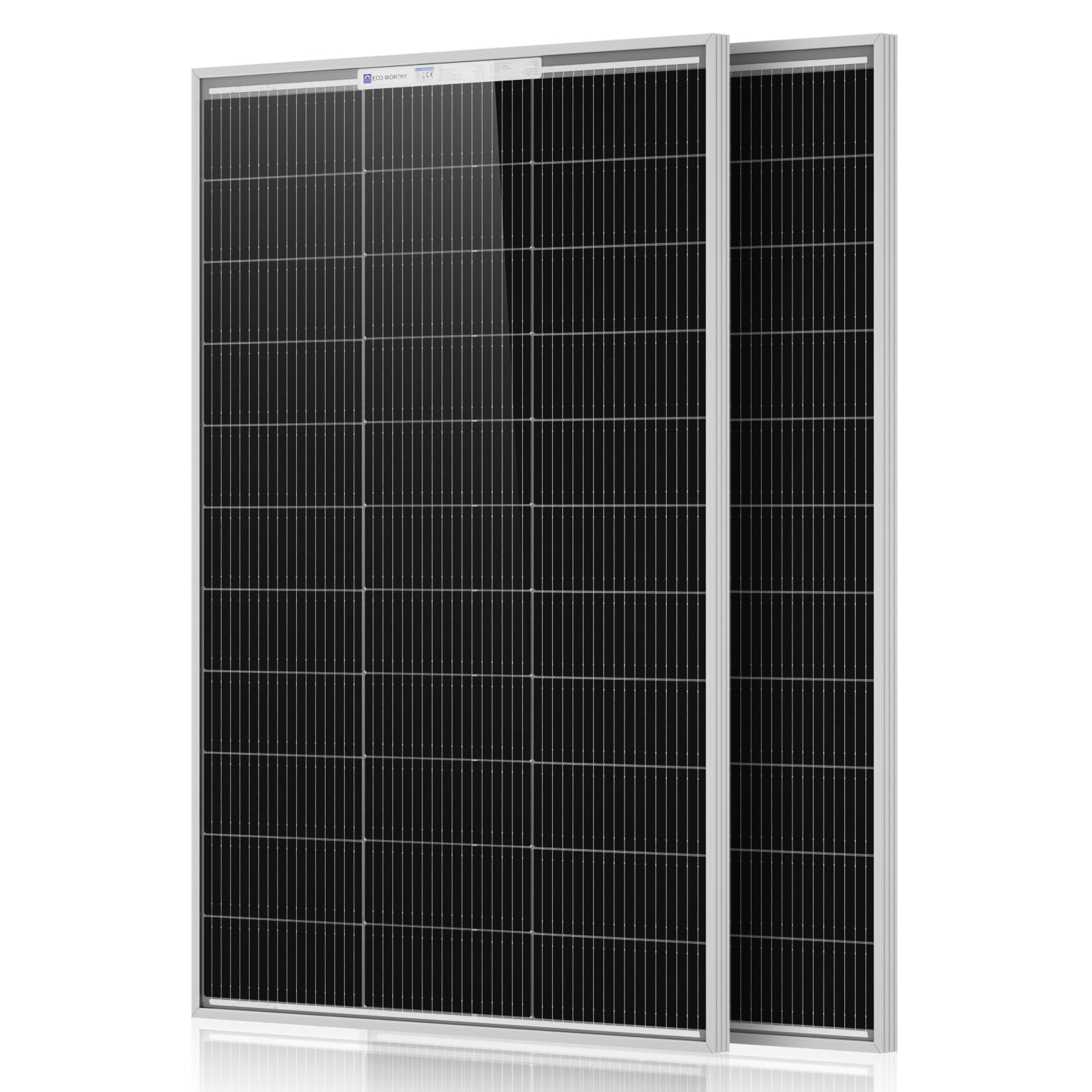
The ECO-WORTHY 200W 2-pack hits the sweet spot for buyers who want rigid, mountable panels at the lowest possible cost per watt. These 100W panels use PERC technology, which adds a reflective layer behind the cells to capture light that passes through the first pass, boosting efficiency to 25% on paper. In real-world conditions, users report outputs of 95W per panel on clear winter days, and 3-4 amps per panel in standard sun. The 1.18-inch thick aluminum frame provides good heat dissipation, and the tempered glass handles standard hail without cracking.
Installation is beginner-friendly. Each panel has pre-drilled holes on the back for mounting brackets, and the 35-inch cables with MC4 connectors make series or parallel wiring simple. Multiple users report daisy-chaining four panels in series (400W total) with zero issues. The panels are lightweight at 11.46 pounds each, making them manageable for one person to position on a roof or ground mount. The IP68 junction box and bypass diodes ensure solid low-light performance—a common test for budget panels.
The main drawback is packaging integrity. Multiple reviews mention panels arriving with cracked glass or dented frames because the foam and pearl cotton protection is insufficient for the rigors of shipping. Eco-Worthy has a reputation for replacing damaged units, but it adds a hassle factor. The other consideration is that these panels lack the half-cut or N-type features found on slightly pricier options, so partial shading will cause more significant power drops. For a simple, fixed installation in full sun, this is the most cost-effective choice available.
Why it’s great
- Extremely low cost per watt for a rigid, mountable panel
- PERC technology boosts low-light performance
- Lightweight and easy to install for beginners
Good to know
- Shipping packaging is inadequate—some units arrive damaged
- No half-cut cells means shading hits output harder
5. EBL 200W Portable Solar Panel
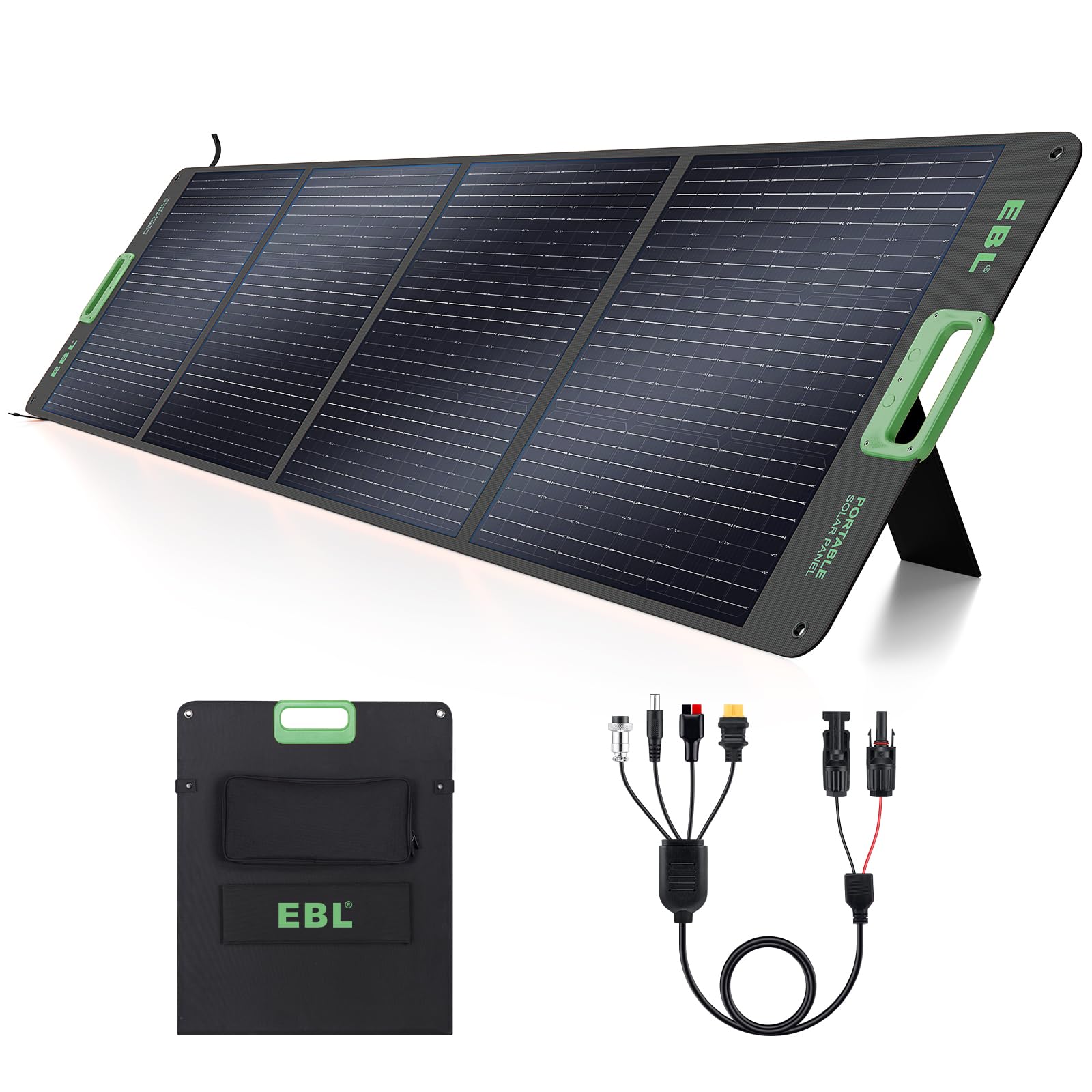
The EBL 200W portable panel is designed for users who need high-wattage portability—campers running refrigerators, CPAP machines, or multiple device charges. The monocrystalline cells deliver a conversion rate of 23.5%, and real-world testing shows outputs between 131W and 191W depending on sun angle and cloud cover. One user reported charging a 448Wh battery from 7% to 100% in just over three hours. The 200W rating makes it substantially faster than 100W rivals at charging larger power stations.
Build quality is solid for the price. The PET lamination and 840D Oxford cloth outer provide water resistance and durability, and the panel is FCC, RoHS, and EMC certified. The included MC-4 to 4-in-1 cable covers XT60, Anderson, DC7909, and aviation connectors, making it compatible with most major power station brands. The panel folds to a manageable 25.31 x 20.87 x 2.17 inches and weighs 18 pounds—reasonable for a 200W unit. The four built-in kickstands allow upright positioning for better sunlight capture.
The main limitation is the panel’s voltage: its maximum output is 35V DC, which is higher than many 12V battery systems can accept directly. You will need a compatible charge controller or a power station with a high-voltage input limit. A few users reported needing a specific DC7909 to DC8020 adapter for certain Jackery models. The 1-year warranty is standard for portable panels, but the customer service response time has been praised in user reviews. For sheer power-per-dollar in a portable format, this panel is unmatched.
Why it’s great
- High 200W output significantly reduces charging time for large batteries
- Rugged PET and Oxford cloth construction resists outdoor wear
- Four kickstands provide stable positioning on uneven ground
Good to know
- 35V output may not work with some 12V systems without a controller
- Heavier than some alternatives at 18 lbs
6. HQST 200W Ultra-Light Portable
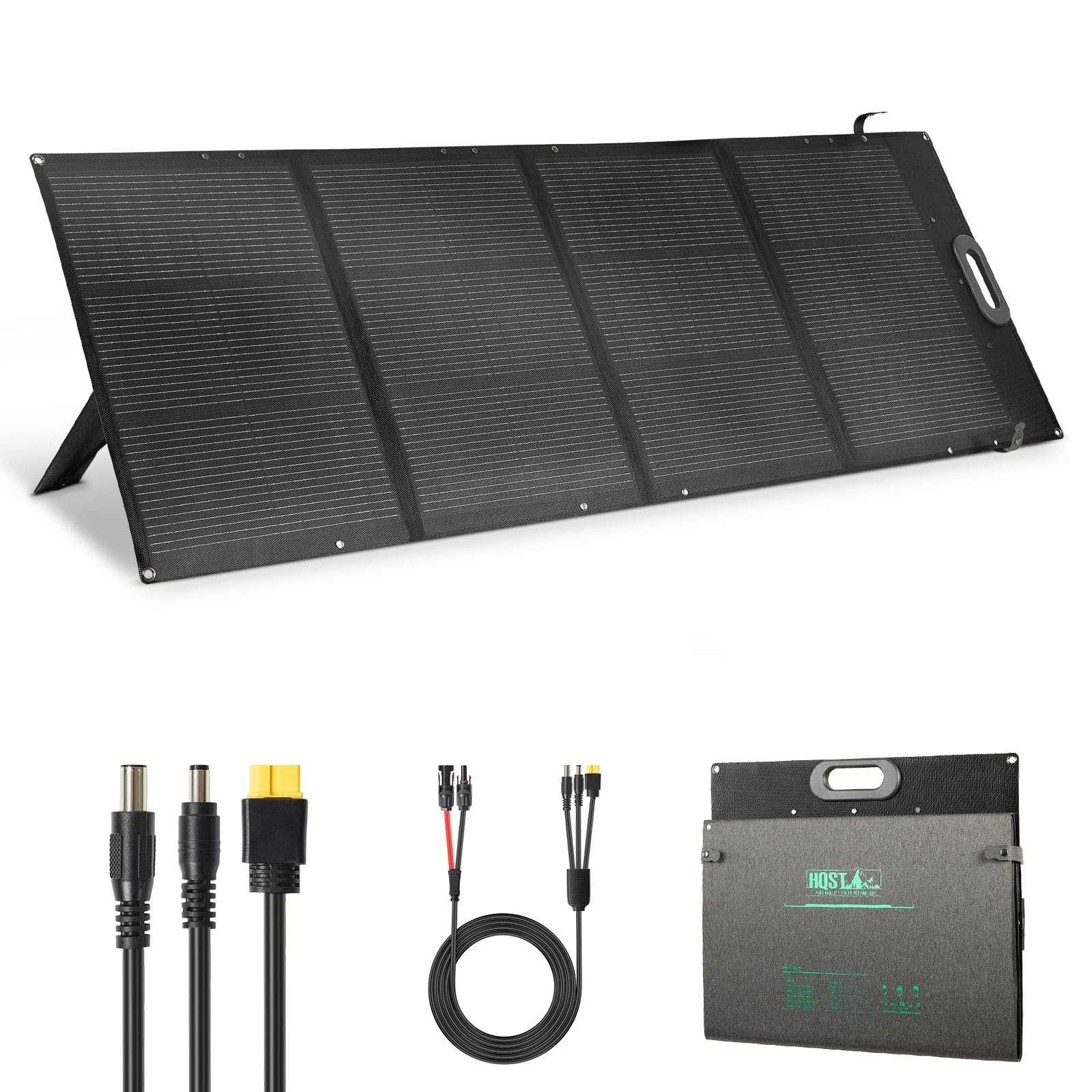
The HQST 200W ultra-light panel solves the biggest complaint about high-wattage portable panels: weight. At 11 pounds, it is roughly 37% lighter than the EBL 200W and most other 200W portable competitors. This is achieved through the use of 16BB N-type cells in a laminated construction that eliminates the heavy aluminum frame. The 25% efficiency rating means it captures more energy per square foot than typical 23% panels, partially compensating for the lighter build. The folded thickness of 1.97 inches makes it easy to store in a trunk or under a seat.
Power delivery is consistent with its N-type architecture. Users report it charges Jckery and EcoFlow stations quickly, with the 3-in-1 adapter cable (XT60, DC7909, DC5521) covering most common power stations. The two adjustable kickstands offer a 40° to 60° range, which is more versatile than the fixed-angle stands on many budget panels. The IP67 waterproof rating and PVDF-coated outer layer mean this panel can handle rain and UV exposure without the stitching-deterioration issues common on cheaper portable panels.
The trade-off for the ultra-light design is that the PET-based lamination, while durable, is not as impact-resistant as the tempered glass on rigid panels. You cannot walk on this panel or drop it onto rocks without risk of cell damage. The 12-month warranty is standard, and while lifetime technical support is offered, it doesn’t cover physical damage. For backpackers, overlanders, or emergency preparedness kits where every pound matters, this is the panel to carry.
Why it’s great
- Extremely lightweight at 11 lbs for a 200W panel
- N-type 16BB cells provide 25% efficiency and good low-light output
- Adjustable kickstands (40-60°) allow fine-tuning of sun angle
Good to know
- PET lamination is less impact-resistant than tempered glass
- Only a 12-month warranty, shorter than some rigid panels
7. DOKIO 100W Solar Suitcase
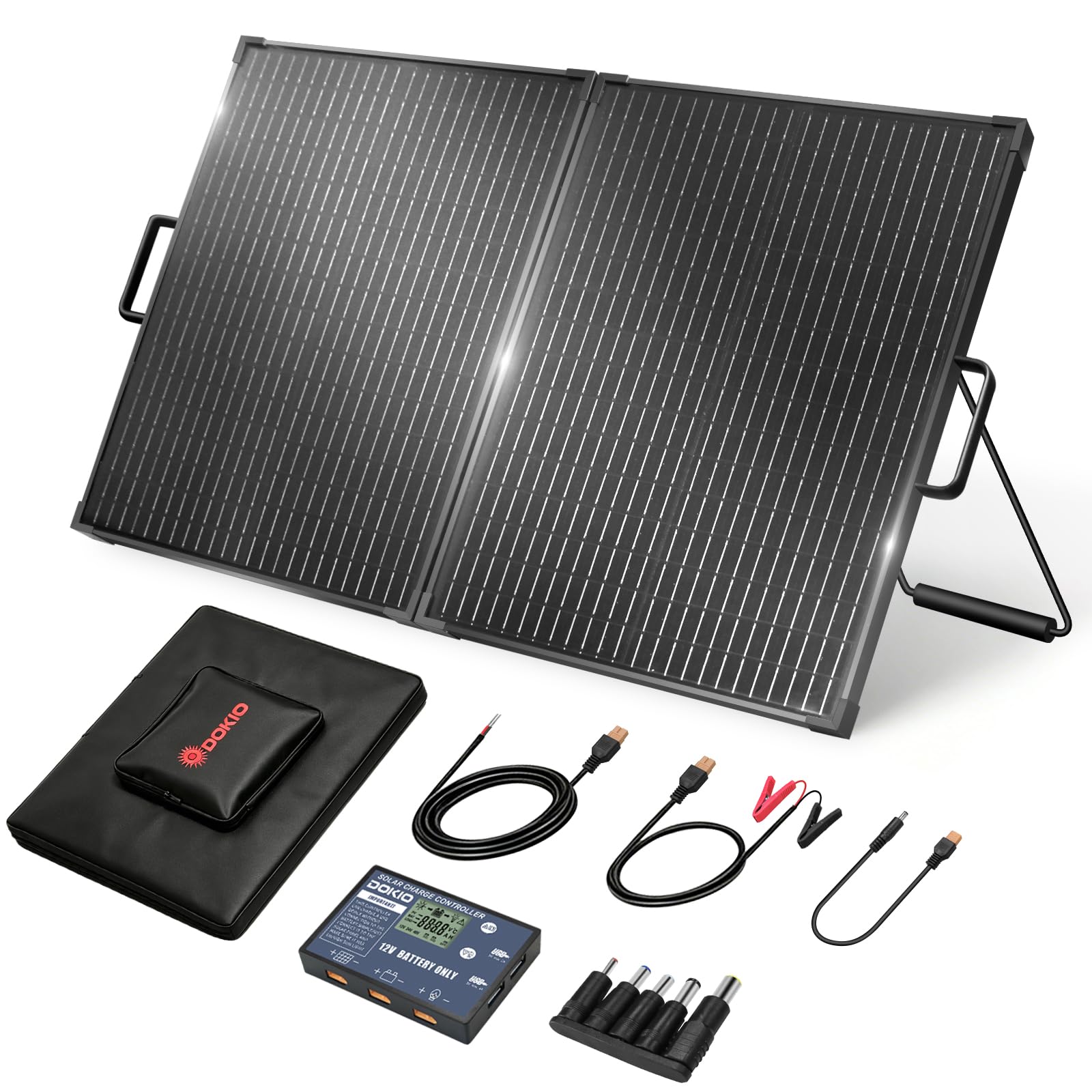
The DOKIO 100W solar suitcase is the most straightforward entry point for anyone who needs to charge a 12V battery without any technical tinkering. It comes as a complete kit: unfold the panel, hook the alligator clips to the battery, and it begins charging. The built-in PWM charge controller prevents reverse polarity, overcharging, and short circuits, making it genuinely idiot-proof for beginners. The 9.8-foot cable allows you to keep the battery in the shade while positioning the panel in full sun.
Build quality is decent for the price. The rigid aluminum frame and tempered glass give it a durable feel that folding portable panels lack. One reviewer measured a peak output of 102W from the 100W panel, which is excellent for a budget unit. Users consistently report it maintains a 12V deep-cycle battery charge for a camper fridge over an entire month without issues. The 5V 2A USB ports are a nice bonus for charging phones directly, though they are passthrough from the controller, not high-speed.
The main compromises are in the accessories. The legs are flimsy and limit the panel angle to around 45 degrees, which means optimal output requires propping the panel up with a rock or stick. One user reported that a polarity reversal killed the USB ports (though the panel itself continued working). The 25-year power output warranty is strong, but the bag quality is inconsistent—some users had zipper failures. For a simple, reliable solar starter kit that works out of the box, this is the lowest-friction option.
Why it’s great
- True plug-and-play setup with alligator clips and built-in PWM controller
- Real-world peak output exceeds its 100W rating in some tests
- Rigid frame and tempered glass feel durable and long-lasting
Good to know
- Integrated legs are flimsy and limit tilt adjustment
- Quality control on the carry bag is inconsistent
FAQ
What does “Grade A” mean for a budget solar cell?
Can I mix 100W and 200W panels from different brands in one system?
How many peak sun hours should I expect for my location?
Final Thoughts: The Verdict
For most users, the best cheap solar panels winner is the JJN 200W 2-Pack because it combines half-cut cell technology, consistent real-world output exceeding its rating, and a 30-year warranty at a mid-range price that undercuts many inferior options. If you need a compact, high-efficiency panel for a small space or hot climate, grab the Callsun N-Type 200W. And for ultralight portability without sacrificing wattage, nothing beats the HQST 200W Ultra-Light.