
Our readers keep the lights on and the weekend projects moving. As an Amazon Associate, I earn from qualifying purchases.
A 4×4 MIMO antenna isn’t just another add-on; it’s the difference between a spinning buffer wheel and a stable, high-speed 5G connection. When your router’s internal antennas are trapped behind walls, roof shingles, and metal framing, you lose the signal before it even has a chance. An external 4×4 array with four independent streams pulls in the weak, scattered cellular energy and turns it into usable bandwidth. You get lower latency, faster downloads, and a connection that doesn’t drop during critical work calls or streaming sessions.
I’m Rikta — the co-founder and writer behind FitlyFast. I’ve spent countless hours dissecting the technical specifications of cellular antennas, comparing gain patterns, frequency coverage, and connector loss across dozens of models to bring you a focused, data-driven selection of real-world performers.
Understanding the raw numbers behind these antennas is the only way to guarantee you aren’t wasting money on a decorative puck. This guide cuts through the marketing to deliver the most reliable 4×4 mimo antenna 5g options on the market for your home, RV, or remote worksite.
How To Choose The Best 4×4 MIMO Antenna 5G
Choosing a 4×4 MIMO antenna requires matching your environment, your router’s connector type, and the physical space you have for mounting. The wrong selection can leave you with weaker performance than the modem’s internal antennas.
Cable Quality and Connector Type
The coaxial cable is the vein carrying your weak cellular signal. A low-loss cable like CFD195 or LMR240 will preserve gain over longer runs up to 50 feet. Thinner cables like RG174 or LMR100 bleed signal quickly. Also, confirm whether your router uses SMA, TS9, or N-type connectors — adapters introduce extra loss that can negate the antenna’s gain.
Gain vs. Coverage Pattern
Omnidirectional antennas (3-5 dBi) offer 360-degree coverage and are ideal for vehicles or RVs where the tower direction changes. Directional panel antennas (7-10 dBi) or parabolic grids (15-30 dBi) trade coverage area for extreme reach, needing precise aiming at a single tower. For rural fixed installations, high-gain directional is the clear winner.
Frequency Band Support
Not all 4×4 MIMO antennas cover all 5G bands. You need an antenna that handles sub-6 GHz (FR1) frequencies, especially mid-band C-Band (3.7-3.98 GHz) and low-band n71 (600 MHz). A narrow-band antenna that only covers 2-3 GHz will miss the long-range low-band or high-speed mid-band that carriers deploy.
Quick Comparison
On smaller screens, swipe sideways to see the full table.
| Model | Category | Best For | Key Spec | Amazon |
|---|---|---|---|---|
| Proxicast ANT-121-T44-W-06 | 4×4 True MIMO | Rugged commercial installs | 4x Isolated Elements, 600-6000 MHz | Amazon |
| Proxicast ANT-121-T44-W-02 | 4×4 True MIMO | Space-limited kiosks | 4x Isolated Elements, 2ft Coax | Amazon |
| SIGNALPLUS Parabolic Grid | High-Gain | Extreme rural range | 30 dBi, 698-6000 MHz | Amazon |
| Proxicast ANT-129-001 | Directional Panel | Fixed-home tower targeting | 7-10 dBi, 75 Degree Beamwidth | Amazon |
| MOPHAMP Log Periodic Kit | Directional Kit | Budget high-gain setup | 15 dBi, 698-3800 MHz | Amazon |
| Proxicast ANT-122-S02 | Omni Puck | Covert small enclosures | 2.5 dBi, 2×2 MIMO, 6.5ft Cable | Amazon |
| Waveform DualMini | Window Kit | Renters & RV quick install | 5.2 dBi, 2×2 MIMO, Suction Mount | Amazon |
In‑Depth Reviews
1. Proxicast 4×4 MIMO 4G/5G Cellular Antenna (ANT-121-T44-W-06)

The Proxicast ANT-121-T44-W-06 is a genuine 4×4 MIMO antenna with four completely isolated omnidirectional elements inside a single vandal-resistant housing. Its IP67 waterproofing and heavy-duty stainless steel through-hole mount make it suitable for long-term outdoor use on fleet vehicles, NEMA enclosures, or home gateways. The 6-foot CFD195 low-loss coax preserves signal integrity far better than standard RG174 cables.
Covering the full 600-6000 MHz range, this antenna handles all sub-6 5G bands including the critical n77 C-band. It locks onto four spatial streams simultaneously, which doubles the data throughput potential against a 2×2 array in the same environment. Users report doubling cellular speeds on routers like the GL.iNet and Cradlepoint IBR1700 after switching from internal antennas.
The low-profile 2.4-inch height is a major win for installations where a tall antenna is impractical or undesirable. The quad SMA female jacks match most professional 4-port routers without requiring adapter pigtails, keeping signal loss minimal. It is TAA compliant for government procurement and built for harsh conditions with a -40C to +80C operating range.
Why it’s great
- True 4×4 MIMO with four isolated elements for maximum throughput
- CFD195 low-loss coax reduces signal degradation over 6-foot run
- IP67 waterproof and vandal-resistant for permanent outdoor use
Good to know
- Omnidirectional gain is moderate (3-5 dBi) compared to directional panels
- Some users report performance variance depending on modem compatibility
2. Proxicast 4×4 MIMO 4G/5G Antenna (ANT-121-T44-W-02)
This variant of the Proxicast 4×4 MIMO antenna is identical in performance specifications to its 6-foot cable sibling but ships with a shorter 2-foot coax tail. It is engineered for installations where the antenna mounts directly on or inside a NEMA enclosure, kiosk, or ATM, and the modem sits within arm’s reach. The short cable run eliminates the need for extension cables and minimizes insertion loss.
The four isolated omnidirectional elements maintain the same 600-6000 MHz coverage, ensuring full 5G band compatibility. The IP67 rating and impact-resistant ABS plastic radome make it equally vandal-resistant, while the 7/8-inch through-hole mount provides a clean, professional look with no exposed cabling. Users have successfully deployed it in locksmith vans and on metal rooftops to bypass building attenuation.
One critical limitation is that the 2-foot cable may not reach a router mounted higher on a wall or in a separate compartment. Plan your mounting location so the router is within 2 feet of the antenna’s SMA jacks. For longer runs, the 6-foot version is the safer choice, but for compact industrial installations, this is the ideal form factor.
Why it’s great
- Ultra-short cable reduces signal loss to near zero
- Perfect for confined spaces like kiosks and small enclosures
- Built with the same IP67 ruggedness as the larger model
Good to know
- 2-foot cable is too short for most home or RV installations
- Requires a router with four SMA female ports for plug-and-play
3. SIGNALPLUS MIMO Parabolic Grid Antenna

The SIGNALPLUS MIMO Parabolic Grid delivers a staggering 30 dBi gain — the highest in this lineup — which allows it to pull in weak signals from towers up to 15 miles away. This is a 2×2 MIMO kit that includes two separate parabolic antennas with 15-meter LMR240 cables and TS9 adapters. When aiming precisely at a distant tower, it dramatically outperforms amplified Yagi antennas, as reported by users in fringe rural zones.
The wide frequency range from 698 to 6000 MHz covers all sub-6 5G bands, AT&T, Verizon, and T-Mobile networks. Users saw speed jumps from 20-30 Mbps to over 120 Mbps when the antennas were correctly aligned. The kit includes a feed horn, bracket, and screws, but you will need to supply a mounting pole with a diameter of 35-50mm.
However, the parabolic design is unforgiving of misalignment. If your location has trees or hills between you and the tower, this antenna can actually degrade performance compared to a less-directional panel. The mounting hardware is basic, and some users recommend upgrading to a 360-degree rotatable mount for fine-tuning. It is a specialist tool for direct line-of-sight rural scenarios only.
Why it’s great
- 30 dBi gain is unmatched for extreme long-range signal capture
- Dual 15-meter LMR240 cables give flexible installation height
- Wide band support covers all major North American 5G carriers
Good to know
- Extremely directional — one degree off ruins performance
- Hardware quality is basic; a professional mount is recommended
4. Proxicast Cross-Polarized Directional Panel (ANT-129-001)

The Proxicast ANT-129-001 is a cross-polarized 2×2 MIMO directional panel antenna that offers a solid 7-10 dBi gain with a 75-degree beamwidth. It is designed for fixed residential or commercial installations where you know the direction of the nearest tower. Users report RSRP improvements of 10-15 dBm and speed increases from 10 Mbps DSL-quality to stable 40-50 Mbps after proper mounting.
One standout feature is that you can pair two of these panels — one mounted vertically and one at 45 degrees — to create a custom 4×4 MIMO setup. This gives you the flexibility to build a true 4-stream system using high-gain directional elements, something most single-housing 4×4 antennas cannot provide. The N-Female connectors are robust and compatible with professional-grade extension cables.
Keep in mind that each panel requires two coax extension cables (not included), so factor in the cost of quality LMR400 or equivalent cable for the run from the antenna to your router. The panel is reasonably compact at 11.8 inches tall and weighs 1.4 pounds, making it manageable for pole or wall mounting. The ivory color blends well with most exterior surfaces.
Why it’s great
- Cross-polarized design reduces signal interference and boosts clarity
- Pair two units to create a true 4×4 MIMO high-gain system
- Proven 10+ dBm signal quality improvements in real-world use
Good to know
- Requires separate coax cables — not included in the box
- 75-degree beamwidth still requires accurate tower aiming
5. MOPHAMP Log Periodic Directional Kit
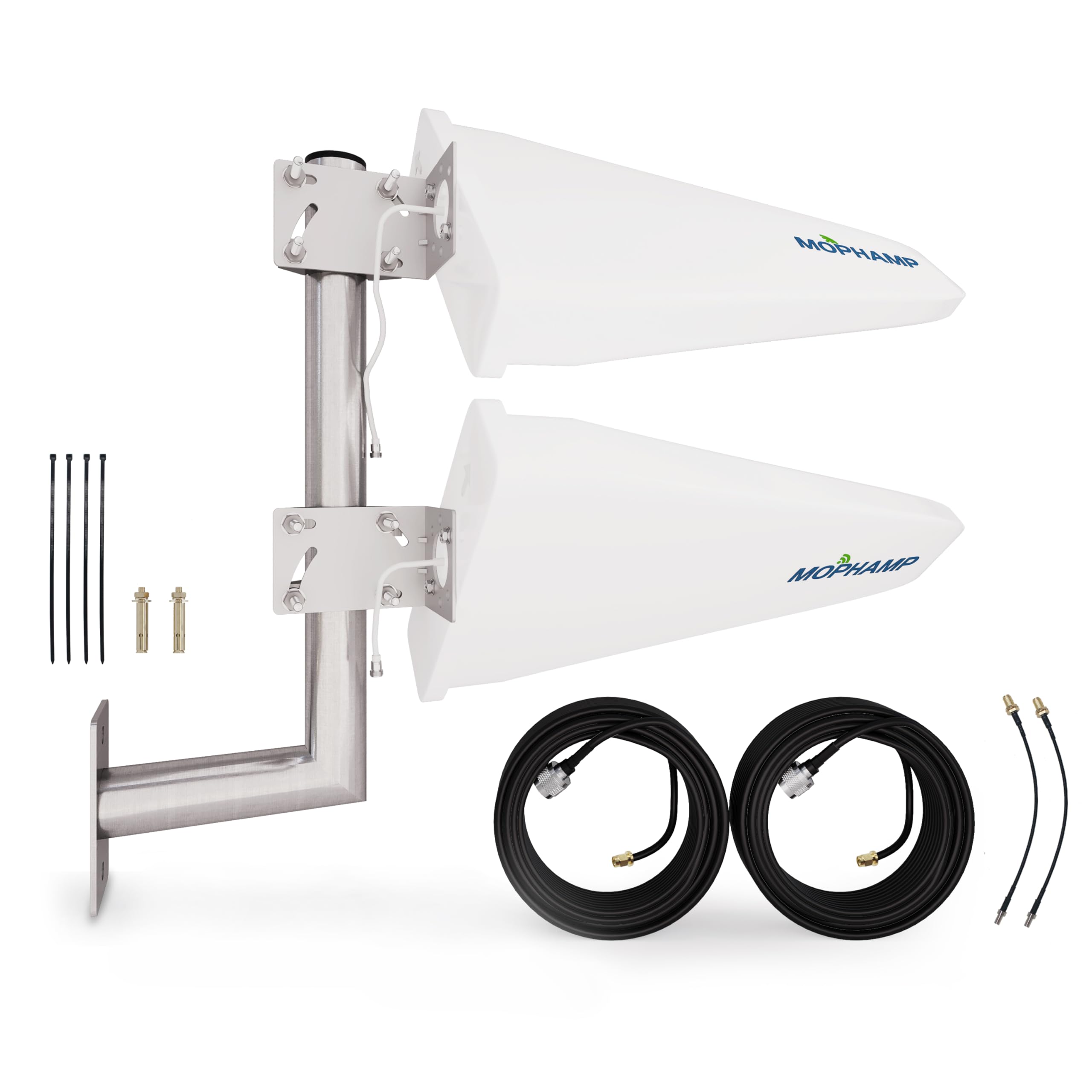
The MOPHAMP Log Periodic Kit provides a solid entry point into directional 5G antennas with its 15 dBi gain and dual 32-foot low-loss cables. It includes two antennas, TS9 adapters, and a stainless steel L-mount — everything you need to get started. One user with a Netgear Nighthawk MR6500 saw speeds jump from less than 1 Mbps indoors to roughly 300 Mbps down after placing the antennas on a tripod near a window.
The 698-3800 MHz frequency range covers most 4G LTE and sub-6 5G bands, though it does not extend into the full 6000 MHz of some competitors. For T-Mobile n71 or n41 users, this coverage is fine, but those on AT&T or Verizon C-Band may want to verify compatibility. The log periodic design offers decent directivity with moderate beamwidth, making it more forgiving than a parabolic grid.
The biggest weakness reported is the L-bracket mount — several users have reported weld failures and wobble in wind. The antenna performance itself is praised, but you should budget for a stronger aftermarket mount or UV-resistant zip ties to secure the bracket. For the price, the performance-to-cost ratio is strong as long as you address the mounting flaw.
Why it’s great
- Impressive 15 dBi gain for medium-range tower targeting
- Complete kit with cables, adapters, and mounting bracket included
- Can turn a weak indoor hotspot signal into a 300 Mbps connection
Good to know
- Mounting bracket is fragile and may fail in windy conditions
- Frequency range tops out at 3800 MHz, missing some 5G bands
6. Proxicast Ultra Low Profile Puck (ANT-122-S02)

The Proxicast ANT-122-S02 is a 2×2 MIMO omnidirectional puck antenna with a vanishingly low profile of just 0.6 inches tall. It is built for covert mounting on ceilings, inside NEMA enclosures, or on the roof of a vehicle where a tall antenna would be damaged or draw attention. The SMA male connector with a 6.5-foot coax cable gives you flexibility for tight spaces.
With a gain of only 2.5 dBi, this is not an antenna for extreme range. Its strength lies in providing a clean, reliable connection when you are already within reasonable tower range but need to defeat the signal-blocking effect of a metal roof or building envelope. It works on all major carriers and has been successfully used with MoFi, Netgear, and Cradlepoint routers.
The threaded mounting shaft is short — about 0.25 inches — which may not be sufficient for thicker walls or roof panels. Some users report needing a longer nut or an adapter for thicker materials. For basic installations on thin metal surfaces or plastic enclosures, the ease of install and unobtrusive design makes it a practical choice.
Why it’s great
- Ultra-low profile is nearly invisible after installation
- Watertight and suitable for outdoor or indoor enclosure mounting
- Compatible with a wide range of 4G/5G routers and modems
Good to know
- 2.5 dBi gain provides minimal boost for weak signal areas
- Short mounting shaft may require modification for thick panels
7. Waveform DualMini Window Antenna Kit
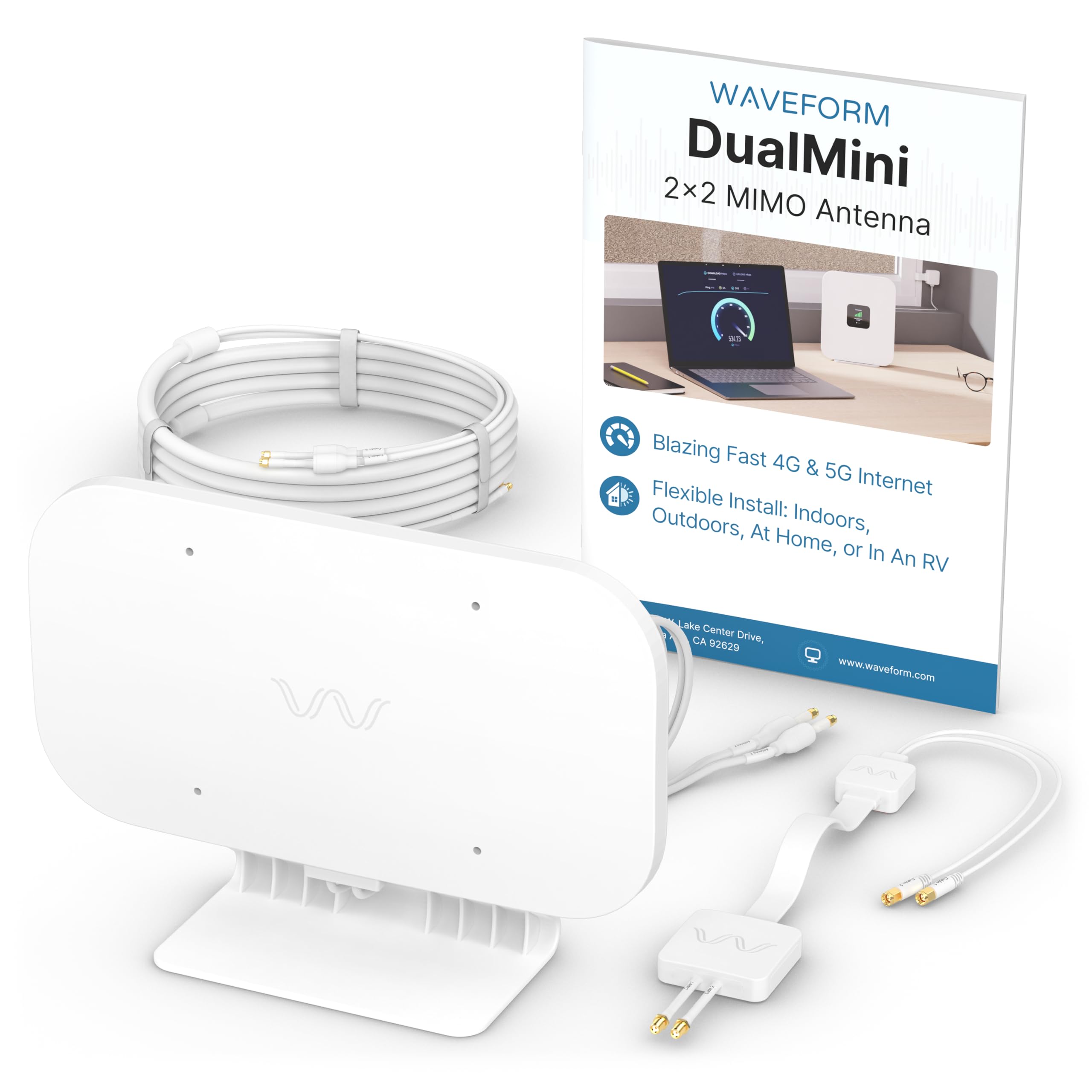
The Waveform DualMini is a 2×2 MIMO omnidirectional window antenna kit that prioritizes ease of installation over raw gain. With suction cups for glass mounting, a pole adapter, and a desktop stand, it can be deployed in minutes without drilling holes. It includes a unique Window Entry Cable that allows you to close the window on the flat cable without damaging it, making it ideal for renters and RV users.
Despite its compact size, the DualMini offers up to 5.2 dBi gain and supports 4×4 MIMO on compatible routers. Waveform’s isolation engineering ensures that the two internal antennas do not interfere with each other, maximizing spatial stream separation. Rural users have reported speed jumps from 2 Mbps to over 30 Mbps on Verizon and AT&T networks after mounting the antenna on a 12-foot pole with a clear line of sight.
The complete kit includes UltraFlex-Twin low-loss cables, TS9 adapters, weatherproofing boots, and a detailed installation manual with expert support. The main trade-off is the relatively high price for a 2×2 system. For users who need a true 4×4 MIMO solution for a stationary home, a dedicated through-hole antenna may deliver better raw performance and value.
Why it’s great
- Tool-free installation with multiple mounting options included
- Window Entry Cable allows cable routing without permanent holes
- Excellent customer support and comprehensive documentation
Good to know
- Higher price point for a 2×2 MIMO setup without extreme gain
- Window glass can still attenuate signal compared to roof mounting
FAQ
Can I use a 2×2 MIMO antenna with a 4×4 MIMO router?
Does a higher dBi rating always mean better performance?
What does “Isolated elements” mean in a 4×4 MIMO antenna?
Do I need an amplifier with a 4×4 MIMO antenna?
Final Thoughts: The Verdict
For most users, the 4×4 mimo antenna 5g winner is the Proxicast ANT-121-T44-W-06 because it delivers true four-stream MIMO from a single rugged, low-profile housing with professional-grade low-loss cabling. If you need extreme range for a fixed rural site with clear tower line-of-sight, grab the SIGNALPLUS Parabolic Grid for its unmatched 30 dBi gain. And for a renter-friendly or RV installation that requires zero drilling, nothing beats the Waveform DualMini with its innovative window entry cable and versatile mounting options.