
Our readers keep the lights on and the weekend projects moving. As an Amazon Associate, I earn from qualifying purchases.
Few things are more frustrating than a call dropping mid-sentence, a web page refusing to load, or an important email stuck in “sending.” The root cause is often simple physics: walls, distance from a tower, or metal structures block the radio frequencies your phone relies on. A cell phone signal booster captures the weak signal outside your home or vehicle, amplifies it, and rebroadcasts it indoors — a proven fix for persistent dead zones.
I’m Rikta — the co-founder and writer behind FitlyFast. My research into this category involves analyzing dozens of specifications, from gain (dB) and coverage area (sq ft) to frequency band compatibility and FCC certification standards, to find the solutions that genuinely deliver measurable improvements.
After sifting through hundreds of verified buyer reports and technical datasheets, I’ve compiled the most reliable cell phone signal booster options available today, factoring in real-world performance across carriers like Verizon, AT&T, and T-Mobile.
How To Choose The Best Cell Phone Signal Booster
Choosing a booster starts with a hard truth: no device can create a signal where none exists. If your phone shows “no service” outside, a booster won’t help. The booster needs at least one usable bar (around -110 dBm) from a nearby tower. Once you confirm that baseline, the key decisions revolve around frequency bands, coverage area, gain, and the physical space you’re trying to fix.
Frequency Bands Are Non-Negotiable
Each carrier broadcasts on specific spectrum slices called bands. Verizon leans on Band 13 (700 MHz). AT&T and T-Mobile use Bands 12 and 17 (also 700 MHz), and many carriers also use Bands 2, 4, 5, and 66. A booster that doesn’t cover your specific carrier’s primary band will deliver zero improvement. Always check your phone’s field test mode or use an app to see which band you’re connecting to before buying.
Coverage Area vs. Real-World Signal
Manufacturers advertise coverage up to 8,000 sq ft, but those numbers assume a strong outdoor signal (around -80 dBm). With a weak signal (1–2 bars), expect coverage to shrink significantly — often to 1,000 sq ft or less, even for the most powerful units. Match the booster’s headline spec to your worst-case outdoor signal, not your best-case hope.
Gain (dB) Measures Amplification Power
Gain is measured in decibels (dB). A 65 dB booster is standard for home use, while 70+ dB models push into large-space territory. Higher gain means stronger amplification, but it also requires careful antenna separation to prevent oscillation (feedback loop). For most homes, 65–72 dB is the sweet spot.
Vehicle vs. Home: Different Design Priorities
Vehicle boosters are built for mobility: compact, often with magnetic antennas that attach to the roof and short cables. Home boosters use larger outdoor antennas (Yagi or panel), longer cables (50+ feet), and higher gain. A vehicle booster mounted in a house will underperform, and a home booster is impractical in a car. Pick the one that matches your primary use location.
Quick Comparison
On smaller screens, swipe sideways to see the full table.
| Model | Category | Best For | Key Spec | Amazon |
|---|---|---|---|---|
| HiBoost 8000 Sq Ft | Home/Office | Large Multi-Room Homes | 5 bands / 70 dB gain | Amazon |
| Metarepeater MG1 | Home | Visual Signal Monitoring | LCD display / 5 bands | Amazon |
| ZORIDA Ace 5S | Home/Studio | App-Guided Installation | 72 dB max gain | Amazon |
| weBoost Drive 4G-X OTR | Vehicle (Truck) | Long-Haul Trucking | Multi-user / 4 bands | Amazon |
| GAGBK 6-Band Vehicle | Vehicle (Car/RV) | RV & Road Trips | 6 bands / 65 dB gain | Amazon |
| JACOOL Verizon Booster | Home (Single Carrier) | Verizon-Only Households | Band 13 only / 4,000 sq ft | Amazon |
| F FREEQUEEN ATT/T-Mobile | Home (Dual Carrier) | AT&T & T-Mobile Users | Band 12/17 / 4,500 sq ft | Amazon |
| GAGBK Car Booster | Vehicle (Universal) | Basic In-Car Signal Lift | Band 12/13/17 / 65 dB | Amazon |
| weBoost Overland Antenna | Antenna (Replace) | Upgrading Drive Reach System | NEMA rated / 5G ready | Amazon |
In‑Depth Reviews
1. HiBoost Cell Phone Signal Booster for Home and Multi Room (8,000 Sq Ft)

This HiBoost is the heavyweight for large homes and offices. With two indoor antennas and a headline coverage of 8,000 sq ft, it’s built for multi-room, multi-floor spaces where signal penetration is most challenging. The 70 dB gain is towards the upper end of the consumer market, translating to meaningful amplification in deep dead zones.
The onboard LCD and companion Bluetooth app are not gimmicks. They display real-time signal strength and gain levels, which simplifies antenna aiming and ensures you’re squeezing every dB out of your setup. Real users report seeing 4–5 bars in basements that previously had 1–2 bars, with data speeds jumping from below 1 Mbps to over 25 Mbps.
It supports all major U.S. carriers across Bands 2, 4, 5, 12, 13, 17, and 25. The AGC (Automatic Gain Control) prevents oscillation without manual tweaking. The one catch is that it lacks Band 71 (600 MHz), used by T-Mobile in some rural areas. Overall, this is the most capable home booster for people who need to cover significant square footage.
Why it’s great
- Massive 8,000 sq ft coverage for large homes or offices
- Bluetooth app provides real-time signal data for precise antenna alignment
- 70 dB gain handles weak outdoor signals effectively
Good to know
- Premium price reflects its pro-level capability
- Does not support T-Mobile Band 71 (600 MHz)
2. Metarepeater MG1 Smart LCD Display Cell Phone Booster

The Metarepeater MG1 stands out with its large color LCD panel that shows the gain level for each of its five frequency bands in real time. This is a practical tool: during installation, you can walk around your property and see exactly how the booster is performing before committing the antenna to a spot. It covers Bands 12/17, 13, 5, 4/66, and 2/25, which covers Verizon, AT&T, and T-Mobile networks.
Its maximum coverage claim is 5,000 sq ft. Real-world reports from users in apartments and single-family homes confirm that with a moderately strong outdoor signal (2–3 bars), the booster can cover a typical 2,000–3,000 sq ft space, turning a frustrating one-bar situation into a three-bar experience with usable data speeds for streaming and calls.
The system includes a 60-foot outdoor cable, which gives flexibility for mounting the Yagi antenna high on the roof — crucial for capturing the strongest available signal. The only recurring complaint is that installation can take a couple of hours for first-timers, particularly when routing the cable. Overall, it’s a strong mid-range choice for visual installers.
Why it’s great
- LCD display shows per-band gain for easy optimization
- 60-foot cable allows flexible outdoor antenna placement
- Five-band support covers all three major U.S. carriers
Good to know
- Installation requires roof access and can take a few hours
- Outdoor signal below -110 dBm reduces coverage range
3. ZORIDA Ace 5S Cell Phone Signal Booster

The ZORIDA Ace 5S packs a 72 dB max gain into a compact form factor, making it one of the more powerful units for its size. It covers Bands 12/17, 13, 5, 4, and 2/25, which means it works across all major U.S. carriers and is 5G ready on those frequency ranges. The max coverage claim of 2,000 sq ft suits smaller homes, apartments, or single rooms.
Its standout feature is the companion app for guided installation. The app provides step-by-step video instructions, helps you locate the best spot for the outdoor antenna, and shows signal data before and after setup. Multiple users report that the app significantly reduces the guesswork, especially when you’re trying to point the Yagi antenna at a tower you can’t see.
Customer support from ZORIDA is frequently praised for being responsive and knowledgeable, including providing 1-on-1 tech support through the app. Note that the coverage is realistically limited to a couple of rooms when the outdoor signal is weak. This is a solid choice for renters or small-home owners who want app-assisted setup without overpaying for coverage they don’t need.
Why it’s great
- 72 dB gain is strong for a compact home booster
- Smartphone app guides installation and shows signal metrics
- Excellent US-based customer support reputation
Good to know
- Coverage area up to 2,000 sq ft is smaller than many competitors
- Requires at least one bar of outdoor signal to function
4. weBoost Drive 4G-X OTR Truck Cell Phone Signal Booster

The weBoost Drive 4G-X OTR is the benchmark for truck signal boosters. It’s designed specifically for big rigs, with a rugged 17-inch omnidirectional antenna, a 3-way CB antenna mount, and a mast extension that handles highway wind speeds without issue. It supports Bands 12/17, 13, 5, 4, and 25/2, covering all major carriers including Verizon, AT&T, and T-Mobile.
Real-world reports from long-haul truckers are consistently positive. Users report going from “no signal” in remote stretches of highway to a stable one to two bars — enough for email, voice calls, and navigation. The booster is multi-user capable, so everyone in the cab can benefit. The system is FCC approved and built with NEMA-rated components for weather resistance.
The downside is the price, which reflects weBoost’s established reputation and US-based support. The antenna is also large and requires permanent or semi-permanent mounting. If you’re a truck driver traveling through rural corridors, this is a professional-grade solution that pays for itself in fewer missed loads and safer communication.
Why it’s great
- Built for heavy-duty truck use with weather-resistant antenna
- Multi-user support for driver and passengers
- Proven signal improvement in remote highway areas
Good to know
- Premium price reflects professional-grade design
- Large antenna requires significant mounting space
5. GAGBK 6-Band Vehicle Cell Phone Signal Booster
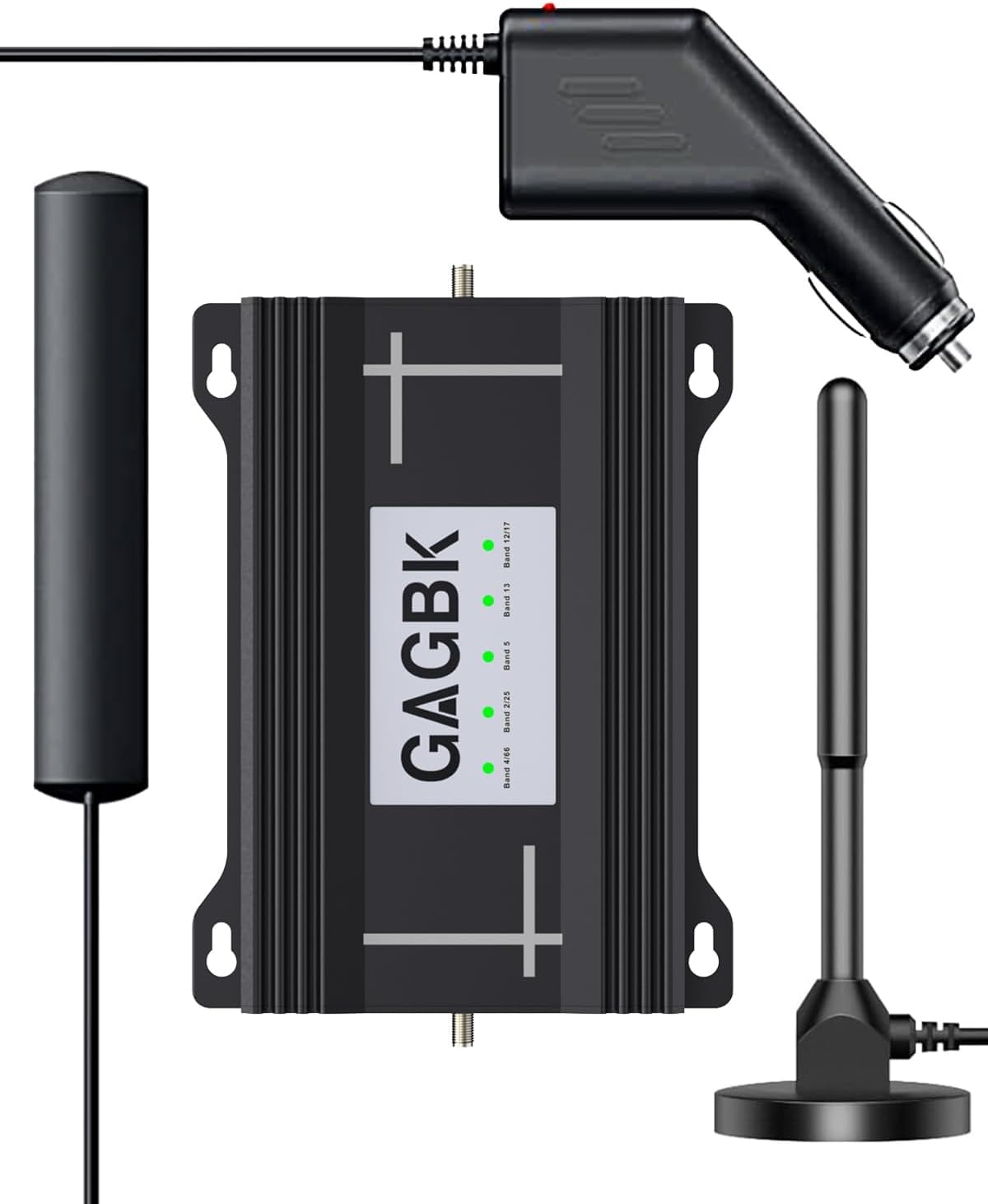
The GAGBK 6-Band booster is a strong rival to the weBoost, offering wider band coverage at a more accessible price. It supports Bands 2, 4, 5, 12, 13, 17, 25, and 66, which covers Verizon, AT&T, and T-Mobile networks, plus 5G bands n2, n5, n7, n12, n25, n41, n66, and n71. The 65 dB gain is standard for vehicle boosters, but the six-band flexibility is a genuine advantage in areas where your phone might hop between towers.
With a magnetic mount antenna and 16-foot cable, installation in a car, RV, or truck takes about 10–20 minutes. The kit includes an indoor patch antenna that you can place on the dashboard or center console. Users report going from one bar to four bars on AT&T in rural areas, and the booster supports multiple devices simultaneously.
The AGC and inactivity sleep mode are welcome features that reduce battery drain when the booster is idle. The main trade-off is that the build quality isn’t as rugged as the weBoost, and the aluminum alloy housing, while good for heat dissipation, may feel less robust over years of use. For RV travelers and road trippers on a tighter budget, this is a very capable choice.
Why it’s great
- Supports 6 frequency bands including 5G for broad carrier coverage
- Quick magnetic mount installation suitable for any vehicle
- AGC and sleep mode optimize performance and battery life
Good to know
- Build quality is not as heavy-duty as professional truck units
- Effective range drops in very weak signal areas
6. JACOOL Cell Phone Signal Booster for Verizon
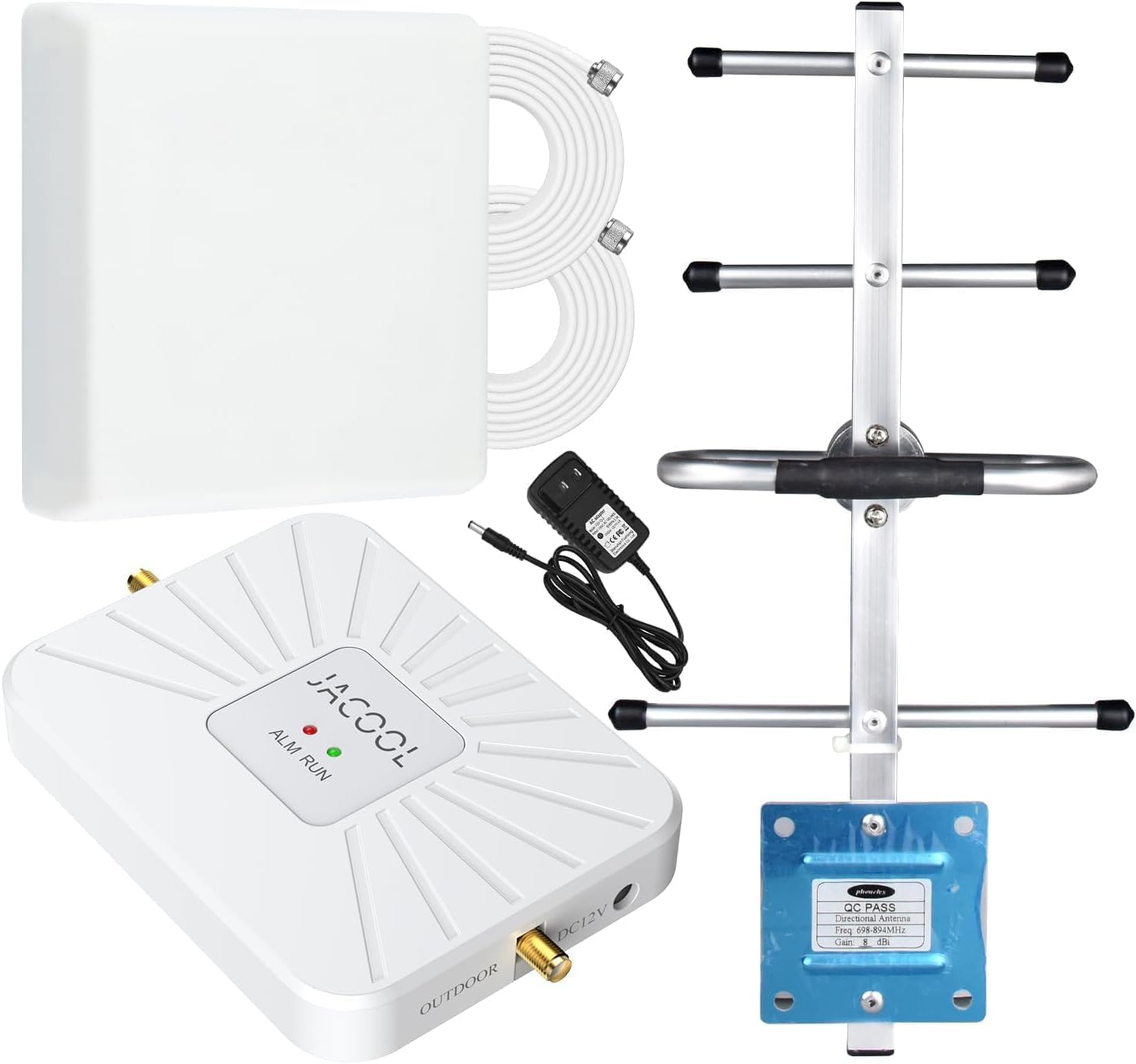
This JACOOL booster is a specialized solution for Verizon users. It operates exclusively on Band 13 (700 MHz), Verizon’s primary LTE and 5G DSS band. If you’re a Verizon postpaid or MVNO customer (like Straight Talk on Verizon’s network), this single-band focus actually enhances performance by dedicating the full 65 dB gain to that one frequency, avoiding the complexity of multi-band systems.
The manufacturer claims coverage up to 4,000 sq ft, but user feedback suggests realistic coverage of 1,500–2,500 sq ft in most residential settings with a moderate outdoor signal. The kit includes a 50-foot coaxial cable and a Yagi outdoor antenna, giving you solid reach for mounting the antenna high on the roof. The indoor panel antenna is slim and can be mounted on a wall or placed on a shelf.
FCC approval, a 3-year warranty, and lifetime tech support provide peace of mind. The main limitation is obvious: this booster will not work with AT&T or T-Mobile phones. If your household uses multiple carriers, this isn’t the right pick. For a dedicated Verizon household trying to fix a spotty signal, it’s a straightforward, effective drop-in fix.
Why it’s great
- Focused Band 13 amplification optimizes Verizon performance
- Includes 50-foot cable for flexible outdoor antenna placement
- 3-year warranty and FCC certified
Good to know
- Only works with Verizon and Verizon-based MVNOs
- Not compatible with AT&T, T-Mobile, or other carriers
7. F FREEQUEEN Cell Phone Signal Booster for AT&T and T-Mobile
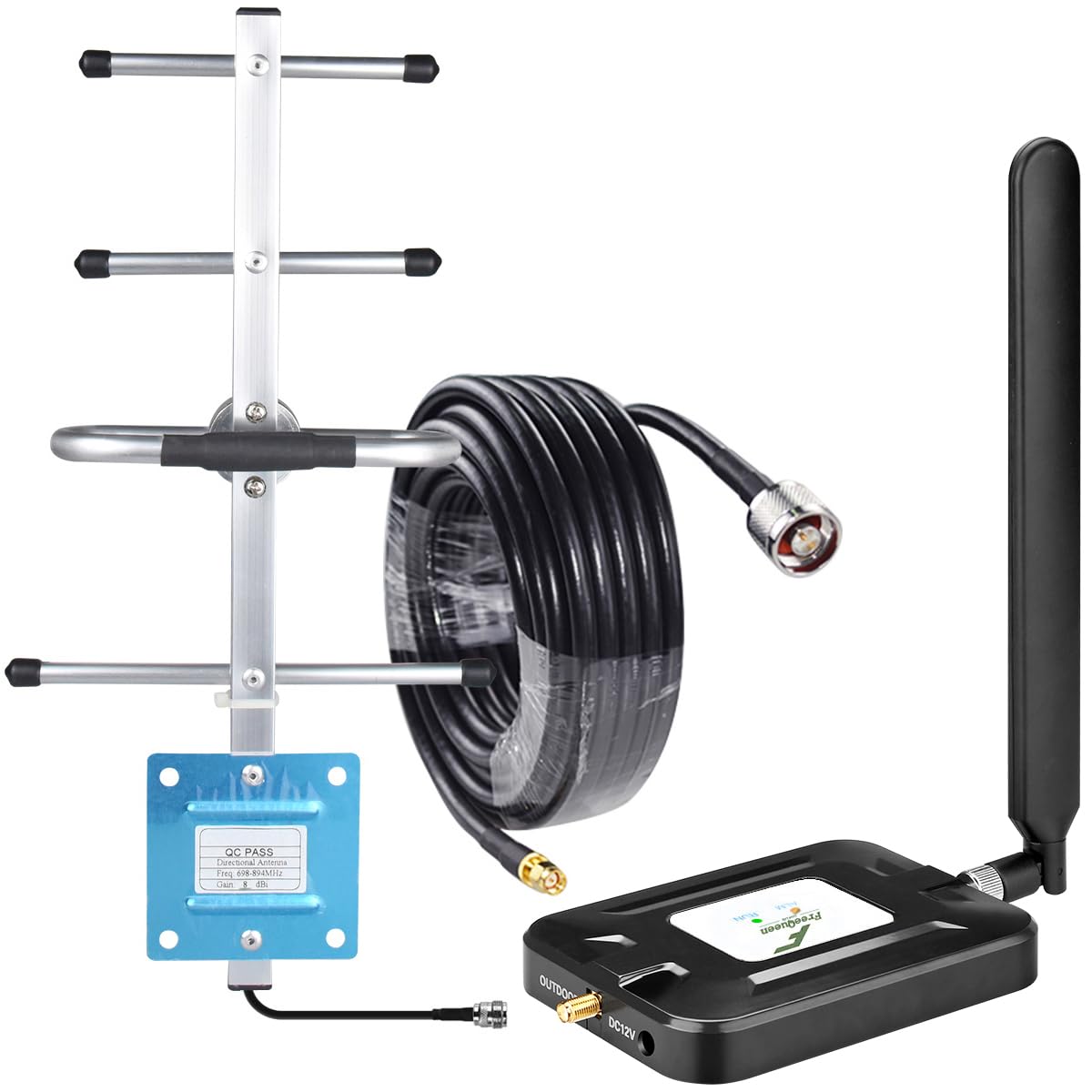
The F FREEQUEEN booster targets AT&T and T-Mobile customers, along with MVNOs like Cricket and Straight Talk that use those networks. It operates on Bands 12 and 17 (700 MHz), which are the primary LTE bands for both carriers. The 65 dB gain and AGC function automatically adjust to changing outdoor signal conditions, maintaining stable performance.
Coverage is claimed at up to 4,500 sq ft. In practice, users in rural areas with a weak outdoor signal report converting one-bar scenarios into four-bar reception, enabling clear calls and functional data. The kit includes a high-gain outdoor directional Yagi antenna, an indoor whip antenna, and a 50-foot coaxial cable that can be extended to 100 feet if needed.
Installation is straightforward if you follow the manual: mount the Yagi antenna high and pointed toward the nearest tower, keep the indoor antenna at least 20 feet away from the outdoor antenna to prevent oscillation, and plug in. The unit also features a sleep/inactivity mode to save power. It will not work with Verizon, so multi-carrier households should look at a five-band model instead.
Why it’s great
- Optimized for AT&T and T-Mobile Band 12/17 networks
- 50-foot cable with extension capability up to 100 feet
- AGC and sleep mode improve efficiency and reduce power draw
Good to know
- Incompatible with Verizon wireless service
- Requires careful antenna separation to avoid feedback
8. GAGBK Car Cell Phone Signal Booster

This GAGBK vehicle booster is a solid entry-level option for drivers who need a basic signal lift on the road. It supports Bands 12, 13, and 17, which covers Verizon, AT&T, T-Mobile, and their MVNOs. The 65 dB gain is adequate for improving one-bar situations into two to three bars, enough for calls and slow data in most rural areas.
Installation is simple: the outdoor magnetic whip antenna attaches to the roof or trunk lid, and the 16-foot cable routes through a door or window seam to the compact booster unit inside. The indoor patch antenna can be placed on the dashboard or center console. No drilling is required, and the whole setup can be done in 10–20 minutes.
Real-world results are mixed — some users report significant improvement in AT&T signal (one bar to four bars), while others mention that the booster stopped working after a few months, which suggests quality inconsistencies. The aluminum alloy housing dissipates heat well, but the unit may not endure years of rough road use. For occasional road trips or RV camping, it’s a budget-friendly way to carry a lifeline. For daily long-haul use, the more robust options above are safer bets.
Why it’s great
- Simple magnetic mount installs on any vehicle without drilling
- Covers the three main bands for universal U.S. carrier use
- Automatic Gain Control adjusts to fluctuating signal strength
Good to know
- Long-term reliability reported as inconsistent by some users
- Best suited for occasional road trips, not daily commercial use
9. weBoost Overland Antenna (Model 311248)

This is not a standalone booster; it’s a replacement or upgrade antenna for the weBoost Drive Reach signal booster kits. The Overland Antenna is designed for RVs, overlanding vehicles, and off-road rigs that need a rugged, low-profile antenna. It’s rated to NEMA standards for dust and water ingress, surviving the mud, rain, and vibration of trail travel.
The antenna is 5G compatible and works on all carrier networks. It includes a 15-foot cable (FME female to SMA female), which is sufficient for most vehicle installations. The antenna can be folded down when not in use, which is a practical feature for garages or automatic car washes. Existing Drive Reach owners report that this antenna often performs better than the original, especially in remote forested areas.
One key point: the antenna does not come with a mount. You’ll need to reuse your existing mount or purchase one separately. This is a pure component swap, not a kit. If you own a Drive Reach system and your antenna is damaged or you want a more compact overlanding profile, this is a direct upgrade. As a standalone purchase without a Drive Reach booster, it’s useless.
Why it’s great
- Rugged NEMA-rated design built for off-road and weather extremes
- 5G compatible and supports all U.S. carrier networks
- Foldable design for easy storage and compact travel profile
Good to know
- Only works with weBoost Drive Reach booster systems
- Requires its own separate mount (not included)
FAQ
Will a cell phone signal booster work if my phone shows “no service” outside?
How do I know which frequency band my carrier uses?
Can I use a home booster in my car or a vehicle booster in my house?
Final Thoughts: The Verdict
For most users, the cell phone signal booster winner is the HiBoost 8,000 Sq Ft because it offers the best coverage and multi-band support for large homes with a reliable app for setup. If you want a smart LCD display and visual signal feedback, grab the Metarepeater MG1. And for RV and road trip use with broad carrier support, the GAGBK 6-Band Vehicle Booster delivers exceptional flexibility at a solid value.