
Our readers keep the lights on and the weekend projects moving. As an Amazon Associate, I earn from qualifying purchases.
Foam board is the backbone of professional displays, model-making, and craft projects — but the wrong adhesive turns it into a warped, bubbling mess. Standard glues eat through the foam core or fail to hold the paper-facing, leaving you with a ruined board and wasted time.
I’m Rikta — the co-founder and writer behind FitlyFast. My research for this guide involved analyzing bond strength data across dozens of formulations to separate the formulas that chemically attack foam from those that create a clean, lasting grip.
Whether you are mounting photos for a presentation or assembling custom scenery, choosing the right adhesive for foam board determines whether your work looks crisp or ends up in the trash.
How To Choose The Best Adhesive For Foam Board
Selecting the wrong glue for foam board is a classic rookie mistake — many common adhesives contain solvents that dissolve the polystyrene core, turning your project into a saggy, disfigured mess. The right choice depends on your material, your need for repositioning, and the environment the board will live in.
Foam Safe vs. Solvent-Based Formulas
Not all glues are foam safe. Standard cyanoacrylates, some contact cements, and many aerosol sprays use aggressive solvents that eat through EPS and XPS foam. Look for labels that explicitly state “foam safe” or test on a scrap piece first. Water-based and engineered spray adhesives typically pass the test; hardware-store all-purpose glues often do not.
Spray Coverage vs. Precision Application
Spray adhesives cover large surfaces fast and produce an even film that prevents bubbles — essential for photo mounting and large-format presentations. Precision bottles and squeeze tubes work better for small models, RC builds, and dioramas where you need to place glue exactly where you want it without overspray ruining clean edges.
Open Time and Repositionability
Open time refers to how long the adhesive remains tacky before it sets permanently. For exacting projects — mounting a valuable photo or aligning several foam board panels — a longer open time lets you shift the board into perfect position. Quick-set glues are fine for repairs and projects where speed matters more than precision.
Quick Comparison
On smaller screens, swipe sideways to see the full table.
| Model | Category | Best For | Key Spec | Amazon |
|---|---|---|---|---|
| Gorilla Heavy Duty Spray | Aerosol Spray | Multi-surface projects | 10 min reposition time | Amazon |
| Beacon Foam-Tac | Bottle | RC model assembly | UV blockers included | Amazon |
| Elmer’s Extra Strength Spray | Aerosol Spray | School & craft projects | Acid-free formula | Amazon |
| Scotch Photo Mount | Aerosol Spray | Photo mounting | ISO 18916 photo safe | Amazon |
| 3M Spray Mount | Aerosol Spray | Layouts & presentations | Repositionable design | Amazon |
| Bob Smith Industries Super-Gold | Liquid Bottle | Diorama & model work | 5-15 sec bond time | Amazon |
| 3M Hi-Strength 94 ET | Aerosol Spray | Heavy-duty lamination | 60 min open time | Amazon |
In‑Depth Reviews
1. Gorilla Heavy Duty Spray Adhesive
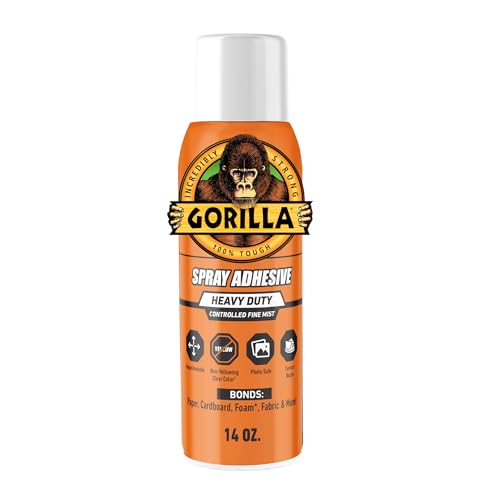
Gorilla’s spray adhesive earned its reputation through a combination of brute holding power and genuine versatility. The 14-ounce can delivers a fine mist that covers foam board evenly without pooling, and the formula dries clear with no yellowing — critical for projects where the bond line might be visible through thin paper facings.
What sets this apart is the 10-minute repositioning window. You can lay a foam board in place, shift it slightly, press it down permanently — a forgiving workflow that beginners and professionals both appreciate. The wide pad nozzle controls the spray pattern better than many competitors, reducing the drift that leaves sticky residue on surrounding surfaces.
The trade-off is that overspray can still be a problem in confined spaces. Users report best results when spraying outdoors or in a well-ventilated area with drop cloths protecting nearby work. On the plus side, moisture resistance means foam board mounted with this adhesive holds up in humid basements or outdoor temporary displays.
Why it’s great
- Clear, non-yellowing finish protects board appearance
- Repositionable for up to 10 minutes
- Moisture resistant for indoor and outdoor use
Good to know
- Overspray requires careful masking in tight areas
- UV exposure may eventually affect color over time
2. Beacon Foam-Tac Powerful Glue
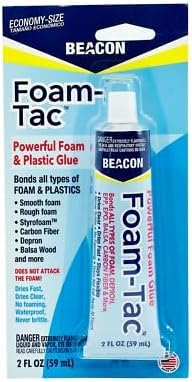
Foam-Tac is a specialty adhesive engineered specifically for RC builders, and its performance on foam board is exceptional. The formula includes UV blockers that prevent degradation when the glued board sits near windows or under display lighting, and the special adhesion promoter creates a bond that actually gets stronger as it cures over 24 hours.
Unlike spray adhesives that cover large surfaces, Foam-Tac applies as a thick, snot-like gel that you must spread or squeeze into position. This makes it perfect for assembling foam board structures — motor mounts, control horns, and wing reinforcements — where precision is more important than speed. The bond remains flexible after full cure, so foam board parts that experience vibration or slight flexing stay intact.
Application requires practice. The glue is extremely thick and stringy, and the bottle comes without a precision nozzle, so expect a learning curve before you get clean results. Cleanup is easier than superglue but still messy. For straight-on foam board repairs and assembly work, however, no other adhesive in this guide matches its specialized hold.
Why it’s great
- UV blockers prevent yellowing and degradation
- Flexible bond ideal for foam board in motion
- Designed specifically for EPP, EPO, and Depron foam
Good to know
- Thick consistency is difficult to apply precisely
- No precision nozzle included with the bottle
3. Elmer’s Extra Strength Spray Adhesive
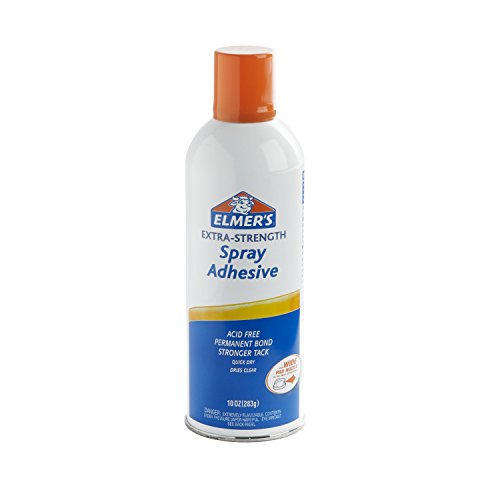
Elmer’s Extra Strength spray is the budget-friendly workhorse for classroom projects, poster mounting, and general craft use. The 10-ounce can produces a quick-drying bond that secures foam board to paper, foil, and cardboard without soaking through or causing wrinkles. The acid-free formulation means it won’t degrade photos or artwork over time.
What you sacrifice for the low cost is repositionability. This adhesive bonds aggressively within seconds — you get one chance to place your foam board correctly, and attempting to lift it will likely damage the board’s paper facing. For straightforward mounting where alignment is straightforward, this speed is actually a benefit.
The spray pattern is wider and less controlled than premium options, so expect some drift. Users report strong results on artificial flowers and glitter crafts, which suggests the tack level is genuinely high despite the entry-level price point. The smell is noticeable but not overpowering — similar to classic white glue from childhood.
Why it’s great
- Acid-free formula safe for photos and artwork
- Dries clear for a clean finished look
- Fast, permanent bond with no reposition delay
Good to know
- No repositioning window — precise placement required
- Wider spray pattern increases overspray risk
4. Scotch Photo Mount Adhesive
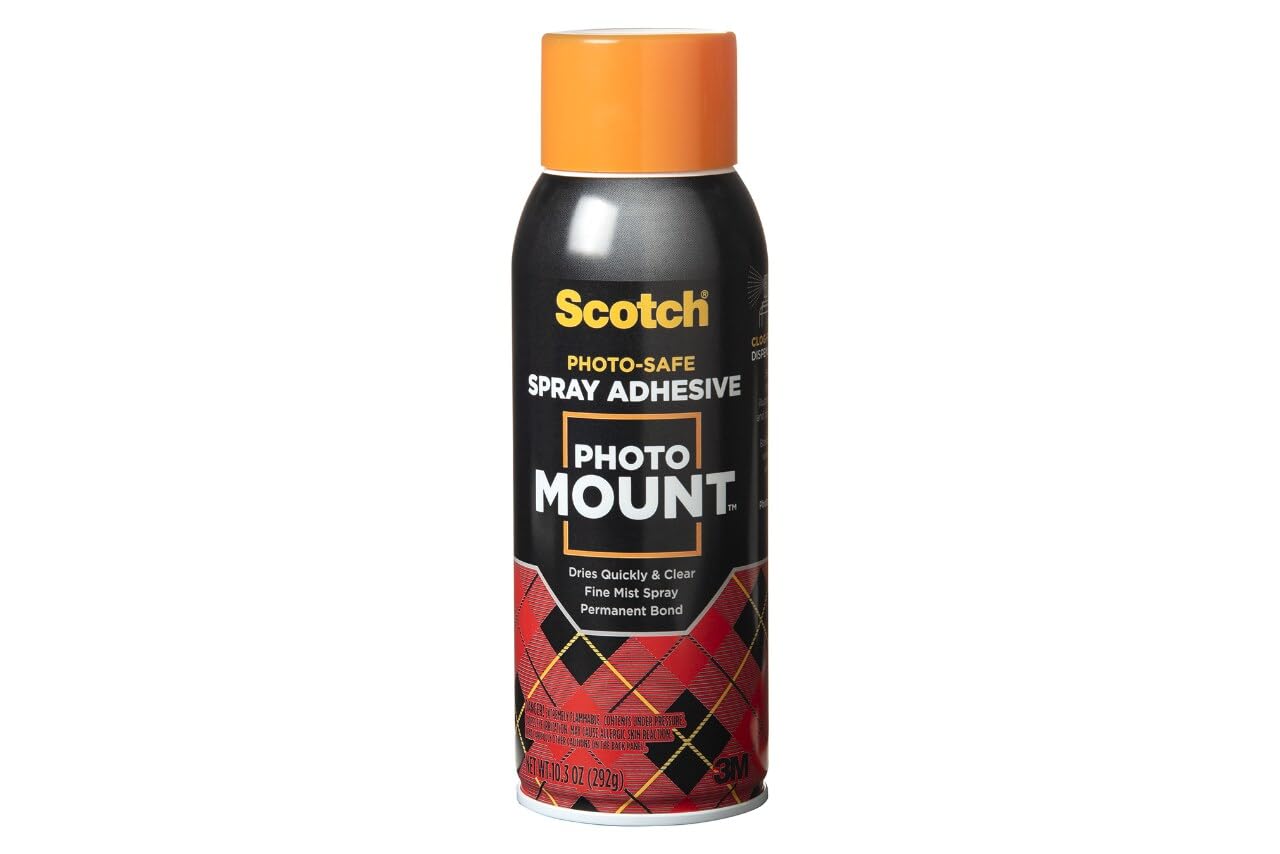
When you are mounting valuable color photographs onto foam board, you need an adhesive that will not chemically react with the print over years of display. Scotch Photo Mount meets ISO Standard 18916 for photo safety, meaning it has been tested and confirmed not to cause fading, staining, or embrittlement of photographic papers.
The spray pattern is notably fine and even, laying down a consistent layer of adhesive that prevents the bubbles and wrinkles that ruin a professional mount. Users report that the bond is extremely aggressive — once the foam board touches the photo, separation is effectively impossible without tearing the print. This is a one-shot adhesive, so use spacers or a hinge method to get alignment perfect before pressing down.
The limitation is that this product is strictly for indoor use. Outdoor exposure to moisture and UV will degrade the bond. It also works best on smooth foam core surfaces — textured or rough-surfaced boards may not achieve full contact. For framing, presentations, and 4-H projects, though, it is the clear specialist.
Why it’s great
- ISO-certified photo safe — no fading or staining
- Even spray pattern prevents air bubbles
- Clear bond stays invisible under prints
Good to know
- No repositioning possible — alignment must be perfect
- Not suitable for outdoor or damp environments
5. 3M Spray Mount Repositionable Adhesive

3M’s Spray Mount is the default choice for graphic designers and layout artists who need to move elements around before committing. The adhesive remains repositionable for a significant period after application — you can lift a foam board panel, adjust its position, and press it back down without losing tack or damaging the board’s surface.
The non-wrinkling formula is a standout feature for thin foam board facings. Many spray adhesives cause paper to ripple as the moisture content hits the fibers, but 3M engineered this one to lay flat even on delicate stock. The low-VOC formulation also makes it more pleasant to use indoors, though ventilation is still recommended.
This is not a heavy-duty structural bond. For permanent installations where the foam board needs to withstand weight or handling, the repositionable nature means the bond is intentionally weaker than permanent spray adhesives. It excels in temporary displays, craft stenciling, and situations where you might want to swap out mounted elements later.
Why it’s great
- Fully repositionable without losing adhesion
- Low-VOC formula reduces indoor odor
- Non-wrinkling on thin foam board facings
Good to know
- Bond strength is lower than permanent adhesives
- Not ideal for heavy or long-term outdoor use
6. Bob Smith Industries Super-Gold Odorless Foam Safe Super Glue
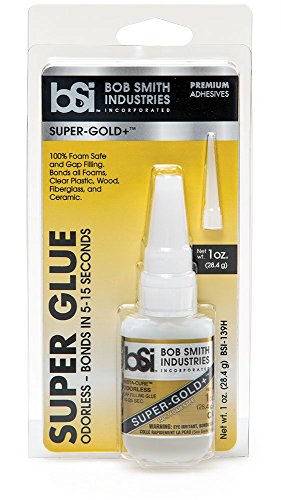
Bob Smith Industries created the first truly odorless foam-safe super glue, and it solved a major problem for model makers and diorama builders: standard cyanoacrylates release fumes that fog clear plastic and irritate sinuses. This formula bonds in 5 to 15 seconds, is completely odorless, and will not dissolve foam board’s polystyrene core or its paper facings.
The 1-ounce bottle with extender tip delivers precision application down to individual foam board edges — ideal for D&D terrain, architectural models, and scratch-building where glue lines must be invisible. The gap-filling property means it bridges small imperfections between foam board pieces, creating a solid bond even when cut edges are not perfectly flush.
Speed is both the advantage and the limitation. The 5-to-15-second working time demands that you have parts positioned and ready before you squeeze. Once the bond forms, it is extremely strong — stronger than the foam board itself in many cases. A test piece is recommended to get a feel for the setting speed on your specific board type.
Why it’s great
- Completely odorless — no fume irritation
- 100% foam safe — will not dissolve EPS or paper facings
- Gap-filling formula for imperfect foam board cuts
Good to know
- Very fast set time — no room for repositioning
- Small 1-ounce bottle limited for large projects
7. 3M Hi-Strength 94 ET Spray Adhesive
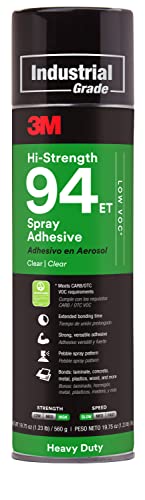
3M’s Hi-Strength 94 ET is the industrial-grade option for serious laminations — bonding foam board to metal, rubber, carpet, or glass with a contact-cement level of aggression. The extended tack time offers up to 60 minutes of open time, meaning you can lay down a coat, wait for optimal tack, and then press materials together with confidence that the bond will be permanent.
The GREENGUARD certification and low-VOC compliance make it viable for interior installations where air quality matters, and the formula can even contribute toward LEED credits on construction projects. Users report excellent adhesion in extreme conditions — one reviewer used it to stick foam soundproofing to plastic in freezing temperatures, and the bond held strong.
The downsides are the strong solvent smell (airplane-glue strength) and the need for careful environmental setup. A respirator mask and heavy ventilation are recommended. The can is also large — nearly 20 ounces — which is overkill for small craft projects but perfect for covering multiple sheets of full-size foam board panels.
Why it’s great
- Up to 60-minute open time for complex alignment
- GREENGUARD certified and low-VOC formula
- Bonds foam board to challenging materials like metal and glass
Good to know
- Strong chemical smell requires mask and ventilation
- Large can size is excessive for small projects
FAQ
Will Gorilla Glue’s original formula work on foam board?
Can I use standard super glue on foam board?
How do I prevent foam board from warping when using spray adhesive?
Is spray adhesive or bottled glue better for foam board models?
Final Thoughts: The Verdict
For most users, the adhesive for foam board winner is the Gorilla Heavy Duty Spray Adhesive because it combines a forgiving reposition window with a clear, moisture-resistant bond that works across nearly every surface you’ll pair with foam board. If you need precision assembly for RC or model work, grab the Beacon Foam-Tac. And for heavy-duty laminations and industrial-scale projects, nothing beats the 3M Hi-Strength 94 ET.