
Our readers keep the lights on and the weekend projects moving. As an Amazon Associate, I earn from qualifying purchases.
A belt sander that loses tracking mid-stroke or fills your shop with airborne dust isn’t a tool—it’s a liability. The difference between a frustrating afternoon and a flawless finish often comes down to motor amperage, belt speed control, and the effectiveness of the dust collection system. Choosing the right machine means understanding the trade-offs between raw removing power and precision control.
I’m Rikta — the co-founder and writer behind FitlyFast. I’ve spent hours analyzing motor specs, belt tracking mechanisms, and dust collection designs across the most popular models to pinpoint which units deliver professional-grade results without the premium price tag.
The woodworking market is flooded with choices, but only a few machines combine the motor torque, belt stability, and ergonomic balance that serious projects demand. This guide breaks down the best belt sander for woodworking, focusing on the metrics that actually predict long-term performance.
How To Choose The Best Belt Sander For Woodworking
The most expensive belt sander isn’t always the best, but the cheapest almost never is. The key is matching the motor’s power and control to the type of woodworking you actually do. A 10-amp behemoth is overkill for furniture detailing, just as a 7-amp unit will frustrate you on a large deck refinishing job.
Motor Amperage and Torque
Amperage is the single best predictor of a belt sander’s ability to remove material without stalling. A 7-amp motor is adequate for trim work and light shaping, while 9-amp units handle hardwoods and edge routing. The 10-amp class is for serious stock removal. Also consider that brushed motors generate more heat under load—some units require brush maintenance after heavy use.
Variable Speed vs. Single Speed
A variable speed dial lets you dial down the belt speed for fine finishing or crank it up for aggressive shaping. Single-speed models run at a fixed line speed (often around 1300-1800 FPM), which forces you to control the material removal rate by pressure alone. For woodworking, variable speed is generally preferable because it prevents burning delicate workpieces.
Dust Collection System
Dust bags on most belt sanders are barely adequate. The real test is whether the unit has a 1.25-inch or larger dust port that can connect to a standard shop vac. Models without a vacuum adapter will fill your shop with fine dust, even if the bag is installed. Some premium units include dual dust ports—one for the belt and one for the disc—which dramatically improves air quality.
Belt Tracking and Change Mechanism
Tool-less belt change systems (single-lever quick-release) save substantial frustration on job sites. The tracking dial should be smooth and responsive, not jumpy. A belt that wanders sideways during a pass leaves uneven surfaces and wastes sandpaper. Look for a clear front cover that lets you see the belt alignment while sanding.
Weight and Ergonomics
A heavier sander (over 8 pounds) provides more momentum for aggressive cuts but fatigues your arms during extended sessions. Lighter units (under 7 pounds) are easier to control for detailed work. The handle design matters—a soft-grip, adjustable front handle and a low-profile body reduce wrist strain.
Quick Comparison
On smaller screens, swipe sideways to see the full table.
| Model | Category | Best For | Key Spec | Amazon |
|---|---|---|---|---|
| Metabo HPT SB8V2 | Handheld | Fine finish & hardwoods | 9.0 Amp Motor | Amazon |
| Milwaukee M18 Fuel | Cordless | Portable precision work | 13500 RPM (no-load) | Amazon |
| WEN HB424V | Handheld/Benchtop | Aggressive stock removal | 10.0 Amp Motor | Amazon |
| Woodskil 4×36 | Stationary | Stationary bench work | 4.3 Amp / 3570 RPM | Amazon |
| Jellas 7Amp | Handheld/Benchtop | Budget benchtop tasks | 7.0 Amp Motor | Amazon |
| Genesis GBS321A | Handheld | Light DIY projects | 8.0 Amp Motor | Amazon |
| Ryobi R18PF-0 | Cordless File | Intricate detail sanding | 18V / 630 m/min | Amazon |
In‑Depth Reviews
1. Metabo HPT SB8V2 3″ x 21″ Belt Sander

The Metabo HPT SB8V2 is the benchmark for a 3×21 handheld sander in this class. Its 9-amp, 1020-watt motor delivers enough torque to chew through hard maple without bogging down, while the variable speed dial at the base of the handle lets you dial back for softer woods or finishing passes. The clear front cover is a real usability win—you can see the belt tracking in real time against the work surface.
Dust collection is handled by a left-side mounted bag that keeps the unit compact when sanding into corners, though like most belt sanders, connecting a shop vac to the port dramatically improves dust capture. The flush-surface design allows edge sanding right up to a vertical face, and the tool-less belt change lever swaps grits in seconds. Reviewers consistently praise its sturdy build and smooth tracking adjustment.
The trade-off is weight: at 9.5 pounds, it’s heavy enough to feel substantial but can fatigue your arms during overhead work. The included dust bag is functional but not bag-vac level. Backed by a 5-year warranty, this is the pick for the woodworker who wants one sander that handles everything from cabinet doors to deck boards.
Why it’s great
- Powerful 9-amp motor resists stalling on hardwoods
- Variable speed dial provides precision control
- Clear front cover aids belt-tracking visibility
- Easy tool-less belt changes
Good to know
- Heavy at 9.5 pounds for extended use
- Dust bag works better with a shop-vac adapter
2. Milwaukee M18 Fuel 3″ x 18″ Belt Sander
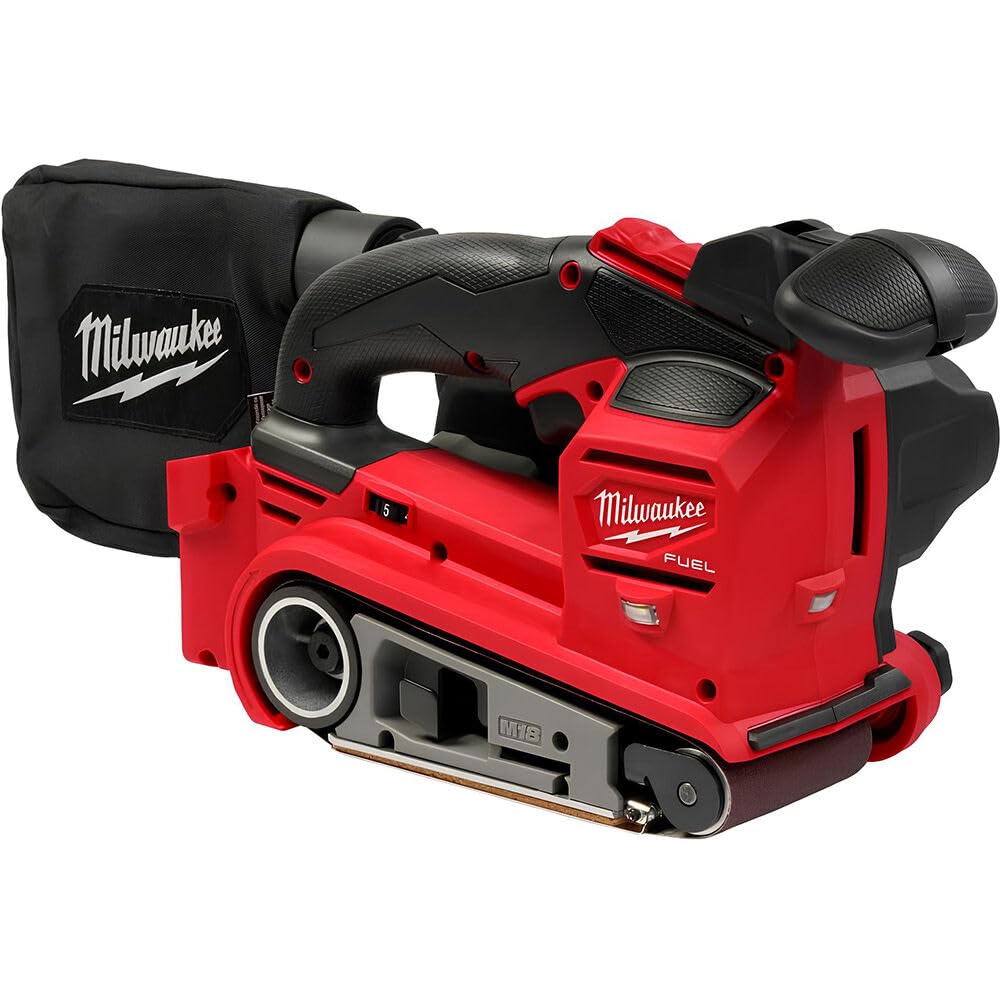
The Milwaukee M18 Fuel redefines what cordless belt sanders can do. Using a brushless motor and the full M18 platform, this 3×18 model spins the belt at up to 13,500 RPM with no cord to manage. The compact form factor—about 4 inches shorter than a standard 3×21—makes it ideal for corner sanding, flush cuts, and overhead work where weight matters.
Dust collection is handled by a zippered dust bag that empties cleanly, but you’ll want a high-output battery (12 AH recommended) to get through a full session without overheating. The variable speed trigger gives you fine control, and the built-in LED lights the work area. Reviewers note it’s quieter than most corded models and the belt tracking holds true even under load.
The catch is battery consumption: at full power, it drains an 8 AH pack in under 20 minutes. The tool-only body also means you need to own into the M18 system. For the user already on the Milwaukee platform who values cordless freedom for trim work and small projects, this is the most capable cordless sander available.
Why it’s great
- True cordless freedom with brushless power
- Compact size for flush and tight-spot sanding
- Zippered dust bag for easy cleanup
- LED lighting improves visibility
Good to know
- Battery drain is high requires 12 AH for heavy jobs
- Tool-only body excludes batteries
3. WEN 10-Amp 4″ x 24″ Variable Speed Belt Sander (HB424V)

The WEN HB424V is a 10-amp monster that operates as both a handheld sander and an upward-facing stationary benchtop unit. With a 4-inch wide by 24-inch long belt, it’s larger than the standard 3×21 format, which means faster material removal on large panels and beams. The variable speed control adjusts belt line speed from 660 to 1310 FPM, giving you flexibility from rough stock removal to fine finishing.
Switching to stationary mode takes about 30 seconds using the included L-clamps and rubber mounting pad. The lock-on power switch is great for bench work, and the quick-release belt tension lever makes changing grits painless. Reviewers consistently call it a “beast” that performs comparably to units costing three times as much, with excellent tracking and minimal bogging.
The major downside is dust collection: the included bag is nearly useless without a shop-vac adapter, and the 1.2-inch port is a non-standard size requiring a 1-3/8-inch adapter. A few reports of bearing failure under commercial-grade heavy use suggest this is best suited for serious hobbyists and prosumer woodworkers rather than daily professional use.
Why it’s great
- 10-amp motor for aggressive stock removal
- Dual handheld and benchtop modes
- Variable speed from 660 to 1310 FPM
- Excellent belt tracking and easy changes
Good to know
- Dust collection requires shop-vac adapter
- Non-standard port size (1.2 inch)
- Some durability concerns under heavy commercial use
4. Woodskil 4″ x 36″ Belt & 6″ Disc Sander

The Woodskil 4×36 is a stationary bench sander that combines a 4-inch by 36-inch belt with a 6-inch disc, giving you two sanding surfaces in one footprint. The 4.3-amp motor spins the belt at 3570 RPM (1732 FPM), which is adequate for shaping, deburring, and finishing. The belt tilts from 0 to 90 degrees, and the work table adjusts from 0 to 45 degrees with a miter gauge for angled cuts.
Double dust exhaust ports—one for the belt and one for the disc—connect to separate ports, which improves dust collection efficiency. The transparent PC guard lets you monitor the belt condition. At 25 pounds with a steel base, it’s stable enough to bolt to a workbench without vibrating. Reviewers praise its ease of setup and consistent performance on wood, metal, and plastic.
The main limitation is the 4.3-amp motor, which lacks the torque of a 3/4 HP or 1 HP unit. If you’re sanding dense hardwoods or removing significant material, the belt can bog down. The included sandpaper is entry-level. This sander is best for the home DIYer or light workshop where the combination of belt and disc in a stationary format is useful for small projects and sharpening.
Why it’s great
- Combines belt and disc sanding in one machine
- Tilting belt and adjustable work table
- Dual dust exhaust ports for better cleanup
- Stable steel base for benchtop mounting
Good to know
- 4.3-amp motor can bog on dense hardwoods
- Entry-level included sandpapers
5. Jellas 7Amp 3″ x 21″ Belt Sander with Variable Speed
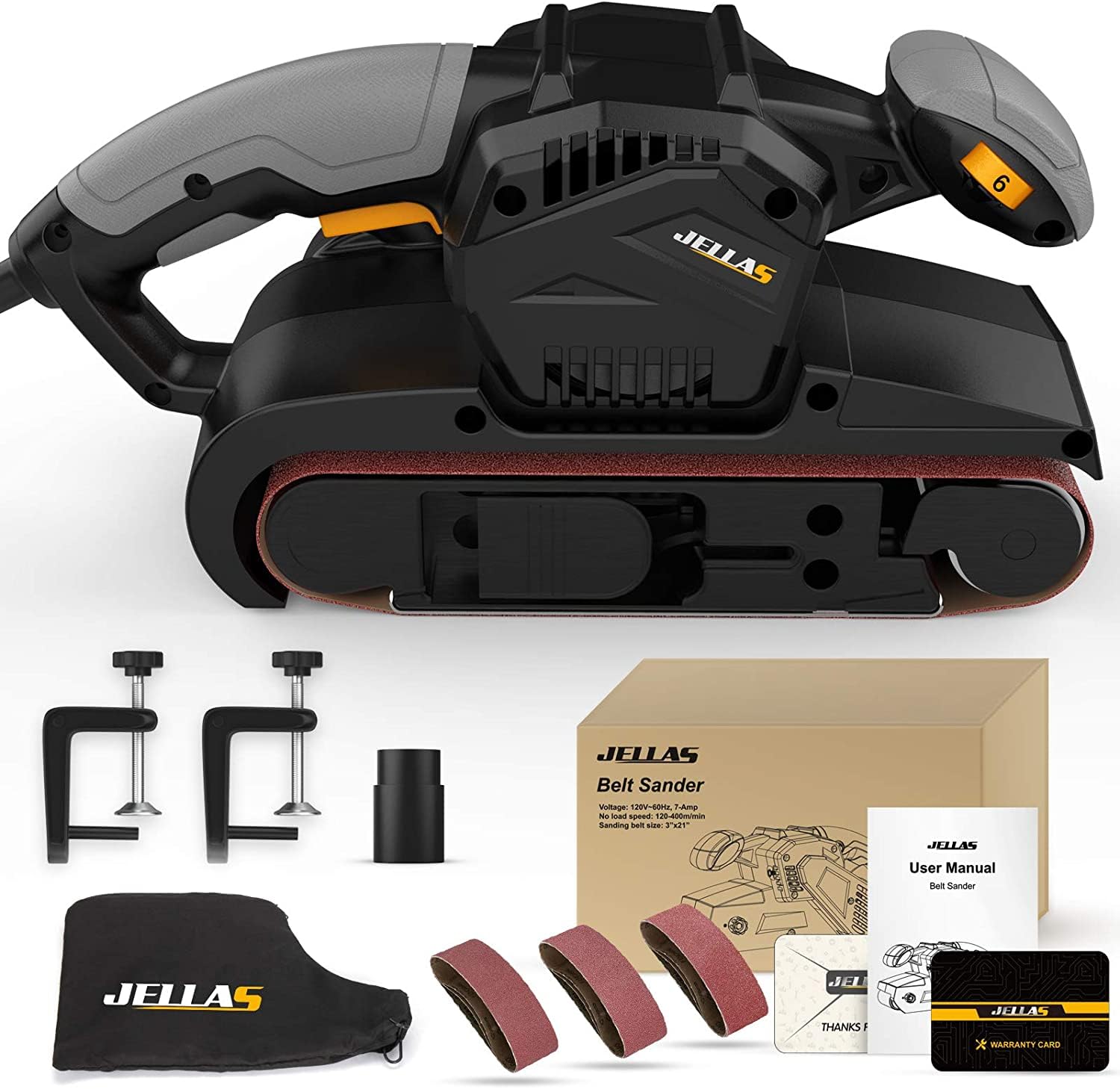
The Jellas 7Amp belt sander punches above its class by including a 2-in-1 vacuum adapter (35mm and 32mm) that lets you connect to a standard shop vac for real dust control. The variable-speed dial offers 6 settings from 120 to 400 RPM, which is unusual at this price and gives you fine control for finishing. It also includes 10 belts across grits 40 to 180, so you’re ready to start sanding immediately.
A 10-foot power cord is a thoughtful upgrade for workshop reach, and the soft-grip handle reduces fatigue. The unit can be mounted upside-down on a bench using the included metal C-clamps, acting as a stationary sander. Reviewers consistently note it’s lightweight (under 7 pounds) and comfortable for extended sessions, with solid belt tracking.
The 7-amp motor is adequate for trim, furniture repair, and light to medium stock removal, but it lacks the grunt for large hardwoods or aggressive shaping. The dust bag is basic and works best when complemented with the vacuum adapter. For the price, this is the strongest value proposition for the weekend woodworker.
Why it’s great
- Includes 35mm/32mm vacuum adapter for dust control
- Variable speed with 6 settings
- 10-foot power cord for workshop flexibility
- Can be mounted as benchtop sander
Good to know
- 7-amp motor not for heavy stock removal
- Basic dust bag works best with shop vac
6. Genesis GBS321A 3″ x 21″ Variable Speed Belt Sander

The Genesis GBS321A is an 8-amp, variable-speed belt sander designed with a low-profile front that reaches into tight spots like door jambs and cabinet interiors. The single-lever quick-change belt system is genuinely tool-less—flip the lever, swap belts, and you’re back to sanding in under 10 seconds. The adjustable front handle gives you control over the sanding direction.
Reviewers report good belt tracking and the variable speed knob provides useful range for different applications. The included dust bag and 80-grit belt get you started. At 7.8 pounds, it’s mid-weight and balanced enough for controlled passes. Several users note the motor is strong and powerful for the price, performing well on substantial projects like bar tops and tabletops.
The complaints center on dust collection: the bag is flimsy, tears easily, and doesn’t capture fine dust effectively. Some units have a poorly sealed dust port causing dust to leak from the front of the belt. The motor can also heat up during extended use, and brush replacement support from Genesis is limited. This is a decent entry-level choice for DIY projects where dust collection is secondary.
Why it’s great
- 8-amp motor provides solid power for DIY tasks
- Tool-less quick-change belt system
- Low-profile design for tight-space sanding
- Variable speed control adds versatility
Good to know
- Poor dust collection even with bag installed
- Motor heats up during extended use
- Limited customer support for replacements
7. Ryobi R18PF-0 18V ONE+ Cordless Power File

The Ryobi R18PF-0 is a specialized power file rather than a full-size belt sander. It uses a 3-sided sanding belt (13mm x 457mm) that rotates at up to 630 m/min, designed for intricate work in extremely tight spaces—think sanding inside window frames, shaping small curves, or finishing cut lines on ABS panels. The slimline ergonomic handle makes it easy to maneuver and control.
The tool-less tension locking lever and belt tracking dial allow quick belt changes and adjustments. Reviewers praise its strong performance for detail work and the rapid material removal with coarse grits. It runs hot during continuous use, but doesn’t shut down. The variable speed control gives you the option to slow down for finishing passes.
The main limitation is the narrow belt width and small contact surface area—it’s not designed for broad stock removal or large panels. There’s no vacuum port, so dust collection is non-existent. The tool-only format requires an existing Ryobi ONE+ battery system. This is a precision detail sanding tool, not a general-purpose belt sander.
Why it’s great
- Excellent for tight-space and intricate sanding
- Tool-less belt change and tracking dial
- Lightweight at 2.24 pounds
- Variable speed for finish control
Good to know
- Narrow belt not for large-area sanding
- No dust collection port
- Runs hot under continuous use
FAQ
What belt size is best for general woodworking?
How do I stop my belt sander from leaving swirl marks?
Can I use a belt sander with a shop vacuum?
Final Thoughts: The Verdict
For most users, the belt sander for woodworking winner is the Metabo HPT SB8V2 because its 9-amp motor, variable speed control, and 5-year warranty deliver the best balance of power, precision, and reliability for the serious woodworker. If you want cordless freedom for trim work and small projects, grab the Milwaukee M18 Fuel. And for aggressive stock removal on large panels where dust collection is less of a concern, nothing beats the raw power of the WEN HB424V.