
Our readers keep the lights on and the weekend projects moving. As an Amazon Associate, I earn from qualifying purchases.
Bridge cameras occupy a unique space — they pack the telephoto muscle of a dedicated super-telephoto lens into a single, all-in-one body that won’t require a second mortgage. For wildlife enthusiasts, safari travelers, and bird watchers, the difference between spotting a distant subject and capturing a frame-filling, detailed image comes down to that one core spec: optical zoom range.
I’m Rikta — the co-founder and writer behind FitlyFast. My approach to selecting the best bridge camera involves analyzing sensor performance, optical stabilization systems, and real-world autofocus reliability across diverse shooting scenarios, not just cherry-picking spec sheets.
Whether you need to photograph a grizzly from a safe distance or capture the lunar surface from your backyard, finding the right bridge camera means understanding the trade-offs between zoom reach, image quality, and portability.
How To Choose The Best Bridge Camera
A bridge camera’s entire purpose is to deliver extreme reach without the bulk of interchangeable glass. But within that general promise, the differences between models can dramatically affect what you actually bring home in your memory card. Nail these three decisions and you will avoid the regret of a camera that looks great on paper but frustrates you in the field.
Optical Zoom Range and Aperture
Ignore digital or dynamic zoom numbers entirely. The only number that matters is the optical zoom multiplier — 60x, 83x, or 125x — and its equivalent focal length in millimeters. A 24-2000mm lens (roughly 83x) lets you fill the frame with a deer at 100 yards. A 24-3000mm lens (125x) brings in birds at 200 yards. The trade-off is aperture: extreme zooms tend to narrow to f/5.6 or f/6.5 at the telephoto end, forcing higher ISO in overcast conditions. Faster lenses (f/2.8 at the wide end) allow more light but rarely sustain that speed across the entire zoom range.
Image Stabilization Technology
Hand-holding a 2000mm equivalent lens without image stabilization is nearly impossible. Optical VR or O.I.S. systems that compensate for pitch and yaw are non-negotiable. Look for dual-detect or 5-axis systems rated to multiple stops of shake correction. Without strong stabilization, every shot beyond half zoom becomes a tripod-only proposition, which defeats the main advantage of a bridge camera — mobility.
Sensor Size and Megapixel Reality
Nearly every bridge camera uses a 1/2.3-inch sensor, roughly the same size as many compact point-and-shoots. This small sensor limits dynamic range and high-ISO performance compared to DSLRs or mirrorless cameras with APS-C or full-frame sensors. Megapixel counts (16MP to 20MP) are adequate for sharing and medium prints but will show grain above ISO 800. If low-light stills are your priority, a used entry-level DSLR with a 70-300mm lens may serve you better. If reach and daylight image quality are your goals, the small sensor is a worthy trade-off for 3000mm of zoom.
Quick Comparison
On smaller screens, swipe sideways to see the full table.
| Model | Category | Best For | Key Spec | Amazon |
|---|---|---|---|---|
| Nikon COOLPIX P1000 | Premium Superzoom | Ultimate reach & astronomy | 125x optical zoom (3000mm) | Amazon |
| Nikon COOLPIX P1100 | Premium Superzoom | Distant wildlife & birding | 125x optical zoom (3000mm) | Amazon |
| Nikon COOLPIX P950 | Mid-Range Superzoom | Versatile all-round telephoto | 83x optical zoom (2000mm) | Amazon |
| Panasonic LUMIX FZ80D | Mid-Range Superzoom | Budget 4K video + zoom | 60x optical zoom (1200mm) | Amazon |
| Panasonic LUMIX FZ80D Bundle | Mid-Range Superzoom | Vlogging & outdoor hiking | 60x optical zoom (1200mm) | Amazon |
| Canon PowerShot SX740 HS | Compact Travel Zoom | Pocket telephoto for concerts | 40x optical zoom (960mm) | Amazon |
| Panasonic LUMIX ZS99 | Compact Travel Zoom | Slim travel & everyday carry | 30x optical zoom (720mm) | Amazon |
| Nikon COOLPIX P900 | Refurbished Superzoom | Entry-level extreme zoom | 83x optical zoom (2000mm) | Amazon |
| Minolta MN40Z | Budget Beginner | Casual family & travel | 40x optical zoom | Amazon |
| KODAK PIXPRO AZ528 | Entry-Level Superzoom | First-time bridge camera buyer | 52x optical zoom (1248mm) | Amazon |
| Canon VIXIA HF G70 | Premium Camcorder | 4K livestreaming videography | 20x optical zoom | Amazon |
In‑Depth Reviews
1. Nikon COOLPIX P1000
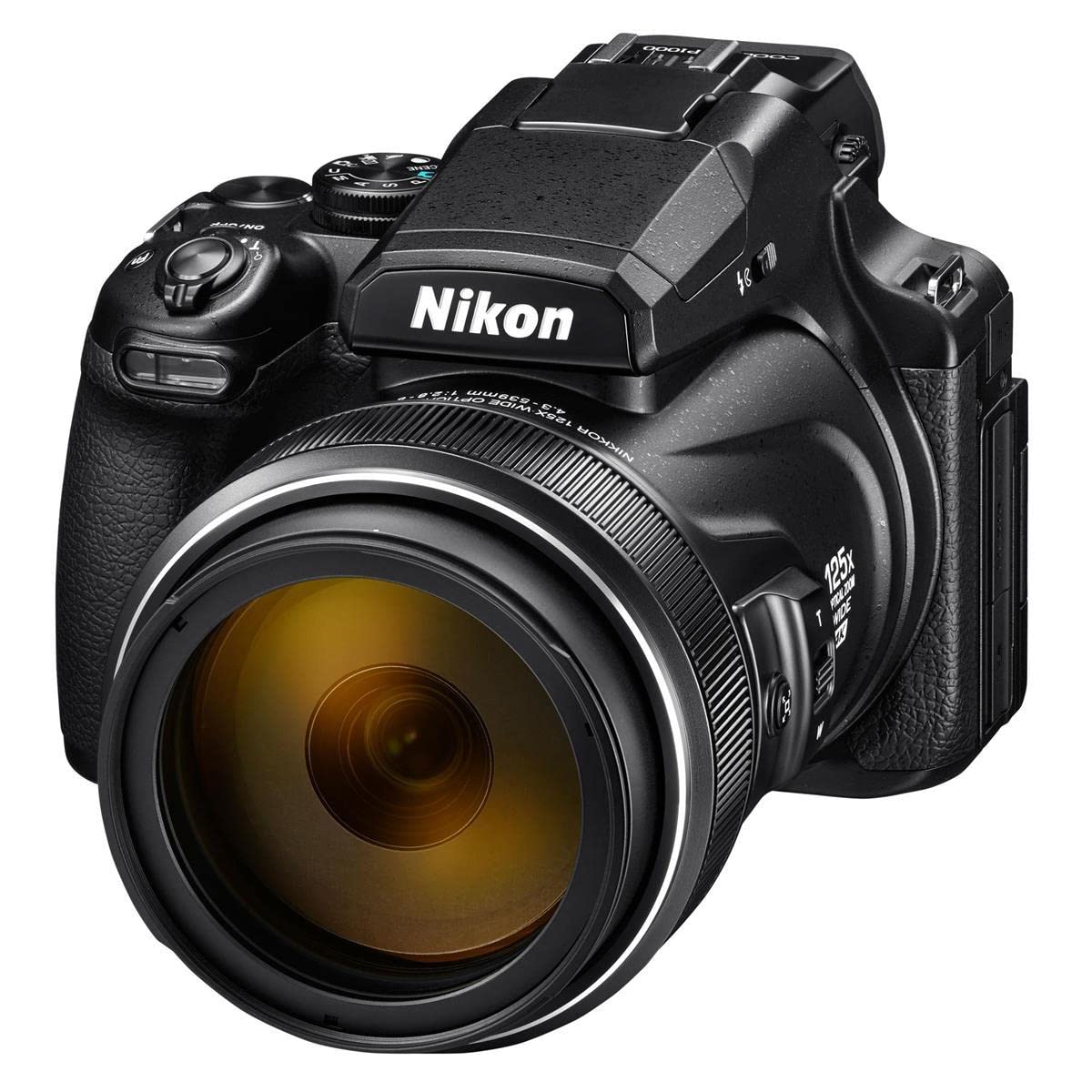
The Nikon P1000 remains the king of reach in the bridge camera world, packing an astonishing 125x optical zoom that stretches from a 24mm wide-angle to a 3000mm super-telephoto equivalent. No other all-in-one camera comes close to this focal length, making it the definitive tool for lunar photography, distant wildlife identification, and subjects that would require a spotting scope with any other system.
Its 16MP CMOS sensor delivers adequate detail in good light, while the dual-detect optical VR tries to tame the shake at 3000mm — a challenging feat even for the best stabilization. The 3.2-inch vari-angle LCD and 2.36M-dot OLED electronic viewfinder make composition manageable, though the camera body is noticeably hefty at about 3.1 pounds.
Autofocus can hunt in low contrast or at extreme zoom lengths, and the small sensor struggles past ISO 800, producing visible grain. However, for the specific use case of maximizing optical reach without carrying a telescope, the P1000 stands alone in its class.
Why it’s great
- Unrivaled 3000mm optical reach for moon and distant wildlife shots.
- RAW capture and full manual controls for advanced editing flexibility.
- Dual-detect image stabilization helps handheld shots at extreme zoom.
Good to know
- Small 1/2.3-inch sensor limits low-light performance and dynamic range.
- Large and heavy body requires a sturdy tripod for stable telephoto work.
- Autofocus can struggle with fast-moving subjects at 3000mm.
2. Nikon COOLPIX P1100

The P1100 refines Nikon’s extreme-zoom formula with a dedicated Bird-Watching mode on the mode dial, optimizing shutter speed and focus for avian subjects. Like the P1000, it delivers 125x optical zoom from 24mm to 3000mm, but adds a customizable control ring for manual focus and exposure adjustments without diving into menus — a welcome upgrade for field use.
The Dual Detect Optical VR claims 4.0-stop shake correction, which helps when hand-holding the 3000mm reach, though a tripod remains the safer bet for critical sharpness. The 16MP sensor and 4K UHD video capabilities mirror the P1000, but the birding mode genuinely simplifies setup for a common bridge camera use case.
Some users report the bird-tracking mode does not lock onto fast-flying birds as reliably as a mirrorless system with phase-detect AF, and the plastic build feels less sturdy than premium bridge cameras. Still, for the dedicated birder or wildlife enthusiast who wants the maximum zoom in a single lens, the P1100 is the current-generation choice.
Why it’s great
- Dedicated Bird-Watching mode simplifies field settings for wildlife.
- Customizable control ring for manual focus and exposure compensation.
- Dual Detect Optical VR provides 4-stop stabilization at extreme zoom.
Good to know
- Bird tracking struggles with fast-moving subjects in flight.
- Lightweight plastic construction feels less robust than premium options.
- Small sensor limits image quality in low-light conditions.
3. Nikon COOLPIX P950

The P950 strikes a strong balance between extreme zoom and everyday usability, offering 83x optical zoom (24-2000mm) with improved image stabilization over its predecessor P900. This range covers 95 percent of wildlife and travel scenarios without the bulk and weight penalty of the 125x models, making it a more practical carry for all-day hikes.
It records 4K UHD video at 30fps and includes built-in bird and moon scene modes that automatically adjust settings for those specific subjects. The 16MP sensor with 12-bit RAW output gives reasonable latitude for post-processing, though the contrast-detect autofocus can miss on small, fast-moving subjects, forcing reliance on the manual focus ring.
Macro performance down to 1 cm is genuinely useful for flower and insect close-ups, adding versatility beyond telephoto. The rotating LCD screen and 2.36M-dot electronic viewfinder aid composition in bright conditions, and Wi-Fi connectivity allows quick image transfers to your phone.
Why it’s great
- 83x zoom covers wide landscapes to distant wildlife effectively.
- Dedicated Bird and Moon modes simplify complex settings.
- Close macro focus delivers good detail for small subjects.
Good to know
- Contrast-detect AF struggles with fast-moving or small subjects.
- Small aperture at telephoto end limits low-light performance.
- Image quality shows limitations compared to larger sensor cameras.
4. Panasonic LUMIX FZ80D

The Panasonic FZ80D packs a 60x optical zoom (20-1200mm equivalent) into a lightweight body that weighs under 1.5 pounds, making it one of the most hike-friendly bridge cameras with serious reach. Its 18.1MP MOS sensor and 4K video recording at 30p provide decent image quality for the price tier, while the POWER O.I.S. stabilization effectively counters hand shake at the telephoto end.
A standout feature is the 4K Photo mode, which lets you extract 8MP stills from 4K burst video — a practical workaround for capturing action scenes where timing the shutter is difficult. The Post Focus feature similarly allows you to change the focus point after the shot, useful for macro and flower photography.
The biggest compromise is the small 1/2.3-inch sensor, which produces grain above ISO 800 and struggles in dim conditions. The interface can feel unintuitive compared to Canon and Nikon options, and the lack of a microphone jack limits vlogging potential. For budget-conscious travelers needing 1200mm of reach and 4K video, the FZ80D is a strong contender.
Why it’s great
- Excellent 60x zoom range in a lightweight, packable body.
- 4K Photo mode captures stills from 4K burst video.
- POWER O.I.S. stabilization performs well at maximum zoom.
Good to know
- Small sensor shows noise above ISO 800 in low light.
- Interface can be non-intuitive for first-time users.
- No external microphone input for video recording.
5. Panasonic LUMIX FZ80D Bundle
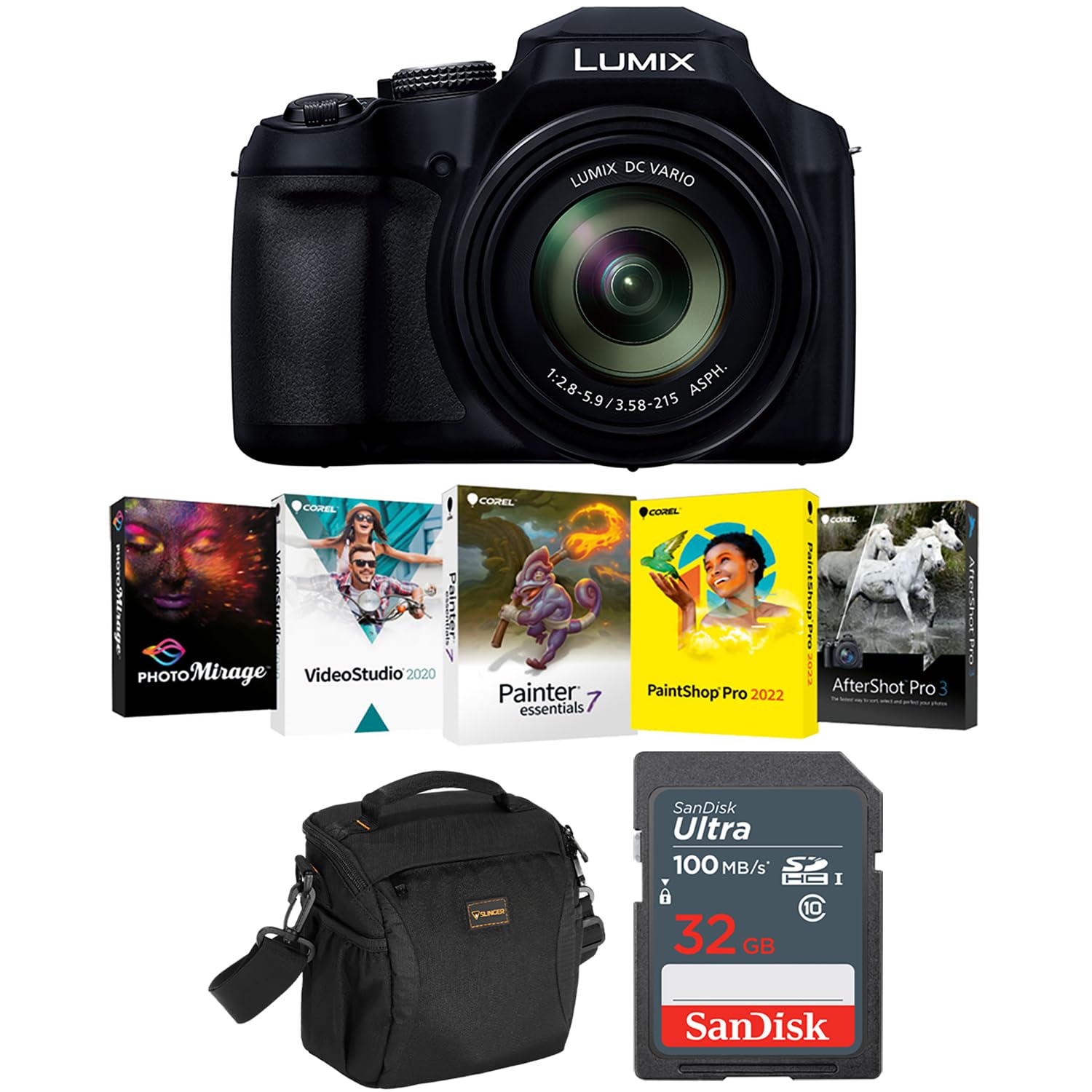
This bundle packages the same core FZ80D camera — 60x optical zoom, 4K video, and 18.1MP MOS sensor — with a 32GB SD card, shoulder bag, and software kit, essentially providing the accessories you would buy anyway at a consolidated value. The camera itself inherits Panasonic’s POWER O.I.S. stabilization and 4K Photo extraction capabilities that make it versatile for both stills and video.
The 20-1200mm effective focal range covers everything from group landscapes to distant mountain peaks, and the camera supports RAW and JPEG capture alongside 4K UHD video at 30fps. The 2.36M-dot OLED live viewfinder provides a clear view for composition even in bright sunlight, a feature often missing at this price level.
Battery life is serviceable for a day of moderate shooting, though heavy zoom use drains it faster than typical mirrorless cameras. The included software kit requires downloading from the manufacturer’s site, which some users found cumbersome. If you are starting from scratch without cards or a bag, this bundle saves the hassle of sourcing accessories separately.
Why it’s great
- Includes essential accessories like SD card, bag, and software.
- 4K Photo and Post Focus features increase shooting versatility.
- Bright OLED viewfinder aids outdoor composition.
Good to know
- Sensor limitations in low light persist from the base model.
- Software download process may not suit all users.
- Battery drains faster during heavy zoom and video use.
6. Canon PowerShot SX740 HS
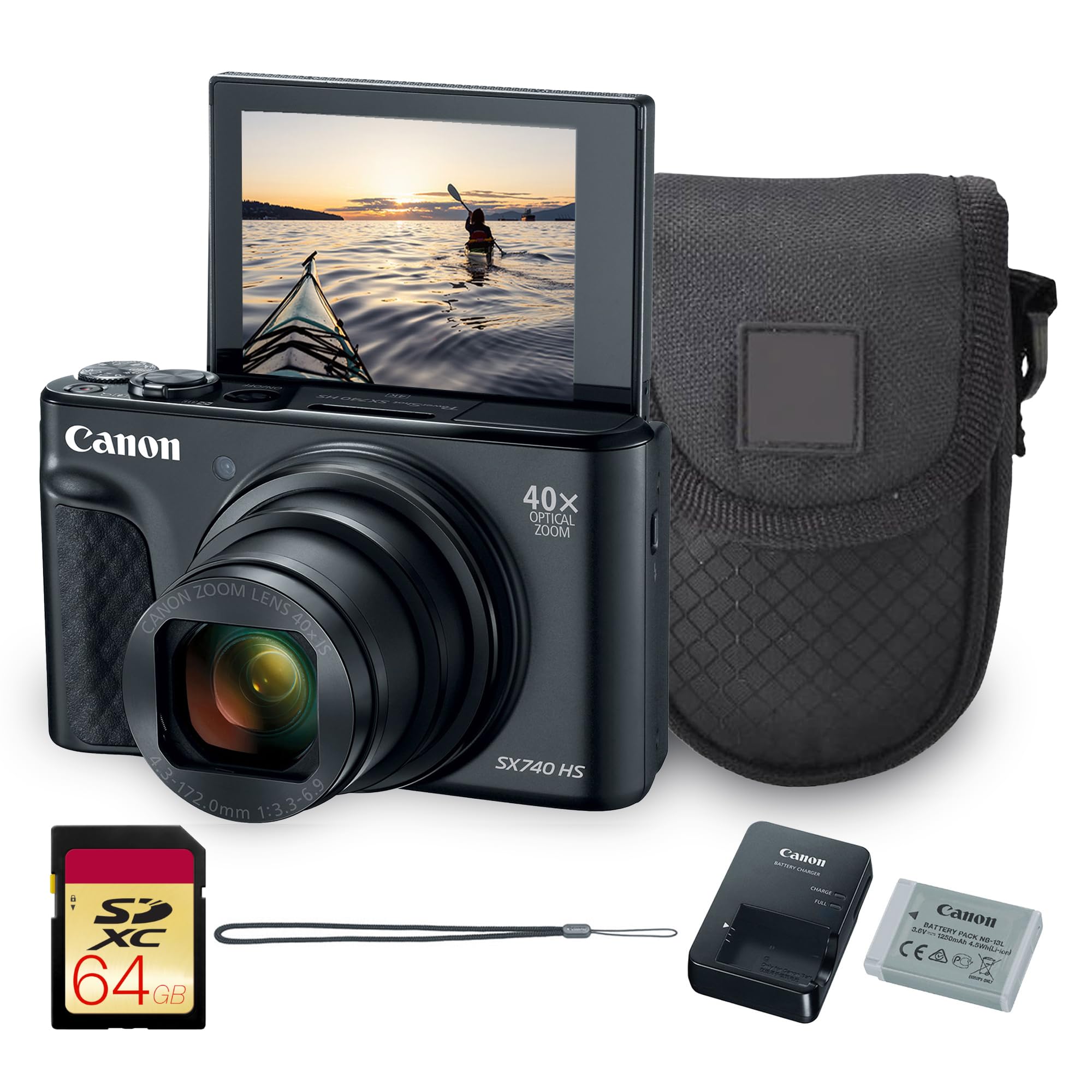
The SX740 HS is the bridge camera for people who hate carrying camera bags. Its retracting 40x optical zoom (24-960mm) collapses into a body that slips into a jacket pocket, offering reach that no smartphone can match without sacrificing portability. The 20.3MP CMOS sensor paired with Canon’s DIGIC 8 processor delivers vibrant daytime images with reliable auto white balance.
4K UHD video recording at 30p with 5-axis image stabilization smooths handheld footage, making it viable for concert and event videography where larger cameras are prohibited. The 3-inch tilt-type LCD works well for selfies and low-angle shots, while Wi-Fi and Bluetooth connectivity via the Canon Camera Connect app streamlines social media sharing.
The built-in flash is weak for telephoto subjects beyond a few meters, and the lack of a hot shoe eliminates external flash options. Battery life is better than many competitors — users report lasting through multi-day trips without recharging. For the traveler who prioritizes pocketability over ultimate image quality, the SX740 HS is the most portable bridge camera with meaningful zoom.
Why it’s great
- Extremely compact body fits in a pocket while offering 40x zoom.
- 4K video with 5-axis stabilization captures smooth footage.
- Strong battery life supports multi-day outings without charging.
Good to know
- Built-in flash is weak for distant subjects beyond a few meters.
- No hot shoe for external flash or microphone accessories.
- Small sensor limits low-light performance compared to larger cameras.
7. Panasonic LUMIX ZS99

The ZS99 is the pocket companion for travelers who want more reach than a standard zoom compact but refuse to carry a full-size bridge camera. Its 30x LEICA DC Vario-Elmar lens (24-720mm equivalent) collapses into a body slim enough for a jeans pocket, while the 5-Axis HYBRID O.I.S.+ provides effective stabilization for handheld telephoto shots.
The 20.3MP high-sensitivity MOS sensor records 4K video at 30fps and supports 4K PHOTO burst capture at 30fps for extracting frames. The 1,840k-dot tiltable touchscreen enables flexible framing angles, and USB Type-C charging ensures you can recharge from power banks or laptop ports without carrying a separate charger.
The ZS99 lacks a built-in flash, which limits flexibility in dim environments, and the 15-minute limit on 4K recording can interrupt event coverage. Battery life is adequate for a day of casual shooting, but the compact chassis heats up during extended 4K use. For the traveler who demands zoom in the smallest possible package, the ZS99 is the class leader.
Why it’s great
- Remarkably compact body with a 30x LEICA zoom lens.
- 5-axis hybrid stabilization delivers sharp telephoto images.
- USB Type-C charging allows convenient recharging anywhere.
Good to know
- No built-in flash limits low-light and fill-in photography.
- 4K recording stops after 15 minutes due to heat management.
- Battery life is modest during extended video use.
8. Nikon COOLPIX P900

The P900 remains a relevant choice for budget-minded buyers who want 83x optical zoom without the price tag of newer models. As a certified refurbished unit, it offers the same 24-2000mm equivalent zoom range and 16MP CMOS sensor that made it a cultural phenomenon for moon photography, at a significantly lower entry cost.
Its Dual Detect Optical VR provides solid stabilization for a camera of its era, and the vari-angle LCD and eye-level electronic viewfinder offer flexible composition options. Built-in Wi-Fi and NFC enable quick image sharing to smartphones, and the lens-based stabilization helps achieve sharp results even at the 2000mm telephoto end when mounted on a tripod.
The P900 lacks 4K video — it records 1080p at 60fps — and the contrast-detect autofocus is slower than modern bridge cameras. Some refurbished units may arrive missing accessories like the lens cap or manual, so verify the included items before purchase. For the lowest cost entry into 2000mm reach, the P900 still delivers.
Why it’s great
- 83x optical zoom offers excellent reach at a budget-friendly price.
- Refurbished certification provides tested functionality at lower cost.
- Dual Detect stabilization aids handheld telephoto shooting.
Good to know
- Limited to 1080p video, no 4K recording capability.
- Autofocus is slower than newer bridge camera models.
- Refurbished units may arrive missing some accessories.
9. Minolta MN40Z

The Minolta MN40Z targets the first-time bridge camera buyer who wants optical zoom without the investment of premium models. Its 40x optical zoom lens reaches far enough for most casual wildlife and stadium sports, while the 20MP sensor records 1080p Full HD video at 30fps for basic vlogging and family event coverage.
The 3-inch LCD display and built-in Wi-Fi with smartphone app support enable remote shooting and quick image transfers, features typically reserved for more expensive cameras. Face, smile, and blink detection assist with portrait scenarios, and the lightweight 1.8-pound body makes it easy to pack for day trips.
The autofocus can freeze or become unresponsive when switching between zoom extremes, requiring a battery pull to reset. Low-light image quality is unimpressive, with visible noise even at moderate ISO settings. For absolute beginners who want to learn on a zoom camera before committing to a more expensive system, the MN40Z offers an approachable entry point.
Why it’s great
- Affordable 40x zoom camera suitable for casual beginners.
- Wi-Fi connectivity supports remote control and easy sharing.
- Face, smile, and blink detection aids portrait shooting.
Good to know
- Autofocus can freeze intermittently, requiring battery reset.
- Low-light image quality shows significant noise above base ISO.
- No optical viewfinder, relying solely on the LCD screen.
10. KODAK PIXPRO AZ528

The KODAK PIXPRO AZ528 offers 52x optical zoom with a maximum focal length of 1248mm, placing it above entry-level compact zooms while undercutting the price of major-brand bridge cameras. The 16MP BSI-CMOS sensor captures 1080p video and stills with reasonable color reproduction in good light, and built-in Wi-Fi enables direct sharing to social platforms.
The refurbished pricing makes this an accessible option for casual users who want telephoto reach for outdoor events, nature walks, or travel snapshots without investing heavily in a system. The camera supports aperture priority and manual modes for users who want to grow their photography skills beyond auto.
Image quality degrades noticeably in low light, with grain visible at moderate ISO settings, and the autofocus can be inconsistent in dim conditions. Some refurbished units may ship with missing accessories like the lens cap, so inspect the package on arrival. For the lowest price point in the superzoom segment, the AZ528 delivers the core zoom experience.
Why it’s great
- 52x optical zoom provides significant reach at a low entry price.
- Built-in Wi-Fi enables easy image sharing and remote control.
- Manual and semi-automatic modes support skill development.
Good to know
- Image quality suffers in low-light conditions above base ISO.
- Autofocus can be inconsistent in dim environments.
- Refurbished units may miss small accessories like the lens cap.
11. Canon VIXIA HF G70

The Canon VIXIA HF G70 is a dedicated camcorder rather than a stills-first bridge camera, optimized for videographers who need 4K UHD recording with a built-in 20x optical zoom lens. Its 1/2.3-inch 4K CMOS sensor paired with the DIGIC DV 6 image processor delivers sharp video with an 8-blade aperture that creates cinema-style out-of-focus highlights.
A standout feature for professional workflows is the On-Screen Display Time Stamp recording, which embeds date, time, and timecode directly into the video file. UVC livestreaming allows HD video streaming directly to a computer via USB, eliminating the need for a separate capture card. Dual SD card slots enable relay recording for extended events without interruption.
The 20x optical zoom is modest by bridge camera standards, and the effective still resolution of 8.29MP limits its usability as a hybrid photo camera. Low-light performance shows visible noise at higher gain settings. For the videographer who needs reliable 4K recording with professional features like timecode and livestreaming, the HF G70 is a specialized tool that outperforms bridge cameras in its niche.
Why it’s great
- Professional 4K video quality with 8-blade aperture cinematic highlights.
- Time stamp recording and UVC livestreaming for professional workflows.
- Dual SD card slots enable relay recording for long events.
Good to know
- 20x optical zoom is limited compared to stills-focused bridge cameras.
- Low-light video quality degrades noticeably at higher gain settings.
- Still image resolution is limited to 8.29MP for photo capture.
FAQ
Why do bridge cameras use tiny sensors instead of larger ones?
Can a bridge camera replace a DSLR or mirrorless system?
What does the “x” in optical zoom mean practically?
Is image stabilization necessary for bridge cameras?
Why do some bridge cameras lack external flash or microphone jacks?
Final Thoughts: The Verdict
For most users, the bridge camera winner is the Nikon COOLPIX P950 because it delivers 83x optical zoom, dual-detect stabilization, and 4K video in a balanced package that does not demand the bulk and weight of the 125x models. If you need pocketable portability for concerts and travel, grab the Canon PowerShot SX740 HS. And for ultimate wildlife reach where nothing less than 3000mm will do, nothing beats the Nikon COOLPIX P1000.