
Our readers keep the lights on and the weekend projects moving. As an Amazon Associate, I earn from qualifying purchases.
Breastfeeding is a delicate dance of supply, latch, and timing — the last thing any nursing parent needs is a pacifier that disrupts that rhythm. A poorly chosen binky can cause nipple confusion, encourage a shallow latch, or simply be rejected outright, leaving you with a screaming infant and zero relief. The right pacifier, however, becomes an extension of the feeding experience, settling your little one without sabotaging your breastfeeding bond.
I’m Rikta — the co-founder and writer behind FitlyFast. I’ve spent many hours analyzing pediatric dental research and comparing orthodontic nipple geometries to compile this guide on the best breastfeeding pacifier options that prioritize both latch integrity and soothing effectiveness.
Choosing the wrong pacifier can introduce confusion at the breast, but the models in this guide are engineered with orthodontic symmetry and breast-like softness to support natural oral development while giving you a much-needed break.
How To Choose The Best Breastfeeding Pacifier
A pacifier for a breastfed baby is not the same as a general-purpose binky. You need a design that reinforces a deep, wide latch rather than encouraging a shallow, nipple-only grip. The three criteria below separate safe options from potential disruptors.
Orthodontic Nipple Profile
The nipple’s shape dictates how your baby’s tongue and palate engage. An orthodontic, symmetrical nipple — flattened on the bottom and rounded on top — fits the natural contours of a nursing mouth, keeping the tongue forward and the airways open. This profile mimics the breast’s shape during feeding and reduces the risk of misaligned teeth later on.
One-Piece Silicone Construction
Two-piece pacifiers can trap moisture and bacteria where the nipple meets the shield, creating a mold hazard. A seamless one-piece molded from 100% medical-grade silicone eliminates those crevices, making sterilization simple and preventing skin irritation from trapped debris. The material should be BPA-free, latex-free, and phthalate-free to be safe for sensitive skin.
Weight and Shield Ventilation
An ultra-lightweight pacifier stays in your baby’s mouth longer, reducing the need for constant reinsertion. Look for shields with multiple large air holes — this allows the skin to breathe, prevents drool rash, and keeps the pacifier from leaving deep red marks on the cheek or chin.
Quick Comparison
On smaller screens, swipe sideways to see the full table.
| Model | Category | Best For | Key Spec | Amazon |
|---|---|---|---|---|
| Tommee Tippee Ultra-Light | Silicone | Exclusive breastfeeding acceptance | 0.3 oz ultra-light symmetrical nipple | Amazon |
| Nanobebe | Silicone | Breast-shaped latch mimicry | One-piece 100% silicone, contour face curve | Amazon |
| Philips Avent Ultra Air Nighttime | Silicone | Nighttime self-soothing | Glow-in-the-dark shield, 6-18m size | Amazon |
| Philips Avent Ultra Soft | Silicone | Flexible shield comfort | Flexible rounded shield, fewer skin marks | Amazon |
| MAM Supreme | Silicone | Orthodontic precision + glow | SkinSoft silicone, extra air holes, glow | Amazon |
| Lee Lee and Me | Medical Silicone | Natural latch practice | Gradual curve nipple, medical-grade silicone | Amazon |
| Minbie Orthodontic Soother | Silicone | Anti-reflux + oral development | Patented anti-reflux nipple, food-grade silicone | Amazon |
In‑Depth Reviews
1. Tommee Tippee Ultra-Light Silicone Pacifier

The Tommee Tippee Ultra-Light is the single most popular pacifier among breastfeeding parents in our data set — and for good reason. Its featherweight 0.3-ounce silicone body stays lodged in even the shallowest of sucks, dramatically reducing drop-and-crawl scenarios that expose the nipple to floor germs. The symmetrical nipple design means no fumbling to find “up” in the dark; any orientation is correct.
Reviewers consistently report that exclusive breastfeeders who previously rejected five or more brands took this one immediately at around one month old. The ventilated shield includes air holes that prevent moisture build-up against the chin, minimizing drool rash. The included plastic cap keeps each pacifier sterile between uses, and the entire unit is dishwasher-safe for easy sanitizing.
One minor oversight: the shield lacks dedicated slots for attaching a pacifier clip, so you’ll need a clip that wraps around the ring rather than threading through a hole. Despite that, the raw acceptance rate and lightweight design make it the most reliable entry point for the breastfed baby who refuses everything else.
Why it’s great
- Extremely lightweight, rarely falls out of baby’s mouth
- Symmetrical nipple eliminates upside-down placement mistakes
- Breastfed babies show remarkably high acceptance rates
Good to know
- Shield has no clip slots — requires wrap-around clip adapters
- Runs small for some older 6-month-olds
2. Nanobebe Baby Pacifiers 0-3 Month
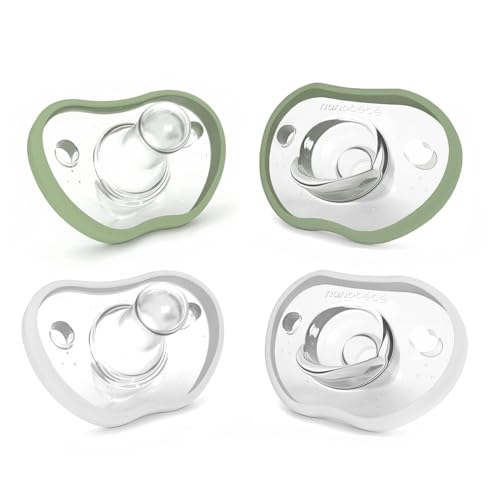
Nanobebe engineered this pacifier to physically mirror the shape of a mother’s breast during feeding — the nipple flares at the base and narrows toward the tip, closely approximating the latch pattern your baby learns at the source. The ergonomic shield curves around the nose and chin, resting snugly without pressing into the cheeks, and the one-piece silicone design has zero crevices where moisture can hide.
Breastfeeding parents note that this pacifier passes the “triangle test” — meaning the nipple collapses in the right direction during sucking, forcing the tongue into a deep, wide position that reinforces optimal latch mechanics rather than lazy sucking. The second stage active version, with open side vents, adds airflow for mobile crawlers.
One parent flagged that an older baby’s thumb got temporarily caught in an air vent hole during a car ride, so supervised use is advised. The 0-3 month size fits small mouths perfectly, but some babies need to size up to the 4-36 month variant around six months for continued satisfaction.
Why it’s great
- Nipple shape genuinely resembles breast latch pattern
- One-piece construction prevents bacteria buildup
- Shield contours comfortably around nose and chin
Good to know
- Small vent holes could catch a curious thumb
- Best for younger infants under 6 months
3. Philips Avent Ultra Air Nighttime Pacifier

The Philips Avent Ultra Air Nighttime pacifier solves the eternal midnight hunt: its shield glows faintly but persistently after lights-out, allowing both parent and baby to locate a dropped binky without turning on a lamp. The orthodontic symmetrical nipple has a narrow neck design intended to reduce pressure on developing teeth and gums, and the textured silicone surface helps boost nipple acceptance to a claimed 98%.
Each set includes two microwave-sterilizing cases made from 80% plant-based materials, which double as carrying cases for on-the-go cleanliness. Parents report that placing four pacifiers in the crib allows the baby to self-soothe by finding one independently during night wakings — the glow makes this possible even in pitch darkness.
The 6-18 month size means this is not suitable for newborns; you’ll need a 0-6 month option from another brand first. A few reviewers mention that the glow fades significantly after several months of washing, but the pacifier remains functional without the light-up feature.
Why it’s great
- Glow-in-the-dark shield stays visible all night
- Two microwave-sterilizing cases included
- High acceptance rate with textured silicone
Good to know
- Not for newborns — 6-month minimum age
- Glow intensity may diminish over months of washing
4. Philips Avent Ultra Soft Pacifier
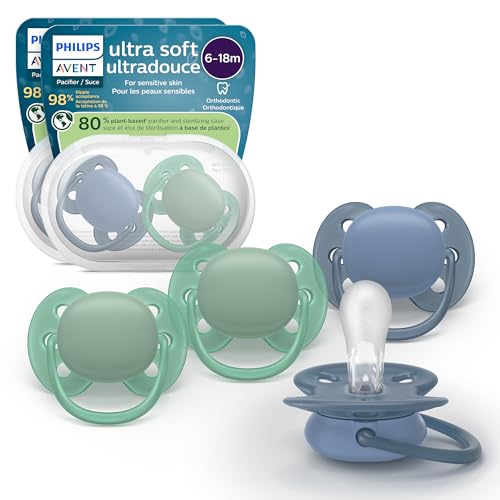
The Ultra Soft variant from Philips Avent prioritizes shield comfort above all else. Rather than a rigid plastic disc, the shield is made from a flexible silicone-like material that bends with your baby’s facial movements, significantly reducing red pressure marks on the cheeks and chin. The rounded edges minimize friction against the skin, making it a solid choice for babies prone to drool rash or sensitive skin.
It shares the same orthodontic symmetrical nipple and narrow neck as the Nighttime version, so you get the same 98% acceptance rate without the glow feature. The 4-pack includes two sterilizing cases, each holding two pacifiers, and the materials are plant-based for reduced environmental impact.
A quirk several parents noticed: the nipple retains a small amount of water inside after washing. Shaking firmly and squeezing the nipple tip expels most of the moisture, but it’s worth drying thoroughly between uses to prevent any residual dampness. The pacifier body withstands frequent sterilization without warping or discoloration.
Why it’s great
- Flexible shield prevents cheek marks and irritation
- Same high-acceptance nipple as Ultra Air
- Plant-based materials and microwave cases included
Good to know
- Nipple can trap water — needs thorough drying
- 6-18m size only; no newborn variant available
5. MAM Supreme Baby Premium Pacifier
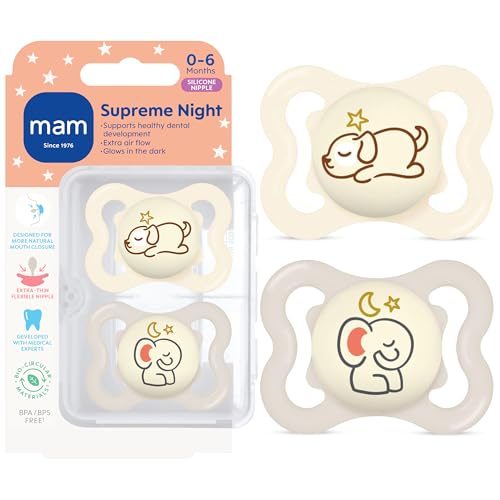
MAM developed this pacifier in collaboration with orthodontists and pediatric dentists, resulting in an extra-thin, super-flexible SkinSoft silicone nipple that allows natural mouth closure and reduces the risk of misaligned teeth. The nipple has a 94% acceptance rate and is symmetrical, meaning no right-side-up orientation is needed — it works correctly every single time.
The shield features extra-large air holes for maximum breathability, crucial for sensitive skin prone to drool rash. A glow-in-the-dark front makes nighttime retrieval easy, and the included bespoke case sterilizes the pacifier in three minutes in the microwave. The entire pacifier is manufactured in Europe, exceeding both American and European safety standards.
Parents of exclusively breastfed babies frequently report that MAM is the only pacifier their child will accept after trying dozens of alternatives. The 2-pack pricing is slightly higher per unit than multi-packs from other brands, but the durability and targeted orthodontic design justify the premium for families focused on dental development.
Why it’s great
- Orthodontist-developed nipple supports jaw alignment
- Extra-large air holes prevent skin irritation
- Glow-in-the-dark shield for easy night recovery
Good to know
- 2-pack only — higher per-unit cost
- May require sizing up for older infants
6. Lee Lee and Me Newborn Pacifier
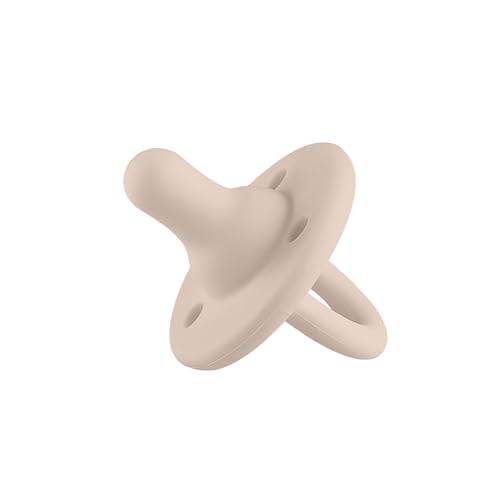
Lee Lee and Me took a different approach: instead of a symmetrical nipple, they designed a gradual curve with a wider base that anatomically mirrors the shape of a mother’s breast during letdown. The theory is that a baby who practices on this pacifier will carry that deep, flanged latch back to the breast — essentially using the paci as a latch-training tool between feeds.
The construction is 100% medical-grade silicone, free of BPA, phthalates, and latex. The large handle ring doubles as a self-insertion aid for older babies who are learning to guide the pacifier into their own mouths. It’s top-rack dishwasher safe, though the manufacturer recommends replacement every four to six weeks based on wear.
Early reviews from exclusive breastfeeders are overwhelmingly positive — newborns who rejected five or more competing pacifiers accepted this one from day one. The single sand-colored unit in the 0-18 month size means you don’t need to swap sizes as the baby grows, though the price per pacifier is on the higher side compared to multi-packs.
Why it’s great
- Unique gradual curve closely mimics breast shape
- Medical-grade silicone for sensitive skin safety
- Single size fits 0-18 months — no size swaps
Good to know
- Sold individually — higher cost per unit
- Not symmetrical; orientation must be correct
7. Minbie Orthodontic Soother Pacifier 2 Pack

Minbie stands apart with its patented anti-reflux nipple design. The shape is engineered to soothe the feeding reflex and position the soother forward in the mouth, keeping the airways open and reducing pressure on the gums. This forward placement also helps babies who struggle with acid reflux by encouraging a more upright oral posture during self-soothing.
Made from food-grade silicone that is latex-free, BPA-free, phthalate-free, and nitrosamine-free, the Minbie pacifier is hypoallergenic and safe for the most sensitive skin. The set includes a handy carry case that doubles as a one-minute microwave sterilizer and clips onto the stroller for travel convenience.
Parents report that breastfeeding babies take to this pacifier readily, with many noting that the unique shape helps the baby maintain a deep latch without accidentally spitting it out. The 2-pack format with the travel container makes it easy to keep one clean while the other is in use. Some users mention the nipple feels slightly firmer than competitors, but that firmness seems to be what prevents accidental dislodging.
Why it’s great
- Anti-reflux nipple design supports breathing and reduces spit-up
- Full set of free certifications (BPA, phthalate, latex, nitrosamine)
- Portable case with 1-minute microwave sterilization
Good to know
- Nipple is slightly firmer than some alternatives
- 2-pack only — may need to buy multiple sets
FAQ
Will a pacifier cause nipple confusion for my breastfed baby?
What age range should I select for a newborn pacifier?
How often should I replace a silicone breastfeeding pacifier?
Final Thoughts: The Verdict
For most users, the best breastfeeding pacifier winner is the Tommee Tippee Ultra-Light because its featherweight body and symmetrical nipple achieve the highest acceptance rate among exclusively breastfed babies while staying put long enough to actually soothe. If you want a shield that doubles as a nightlight and night-navigation tool, grab the Philips Avent Ultra Air Nighttime. And for anti-reflux support and orthodontist-grade engineering, nothing beats the Minbie Orthodontic Soother.