
Our readers keep the lights on and the weekend projects moving. As an Amazon Associate, I earn from qualifying purchases.
Your back is already groaning under the weight of your pack, and the last thing you need is a pair of heavy, clunky binoculars that rattle around and fail you in the dim light of dusk. You need glass that disappears into your kit until you need it, then delivers a bright, sharp image without forcing you to trade ounces for optical quality. The wrong choice means sacrificed clarity, fogged lenses, and a sore neck at the end of the trail.
I’m Rikta — the co-founder and writer behind FitlyFast. I’ve sifted through hundreds of hours of optical spec sheets, customer durability reports, and real-world field tests to understand exactly what separates a trail-worthy optic from a waste of pack space.
This guide cuts through the noise, comparing nine carefully vetted models to help you find the absolute best backpacking binoculars for your next adventure.
How To Choose The Best Backpacking Binoculars
Selecting binoculars for the backcountry is a different game than choosing a pair for your back porch. Every ounce counts, and your optics must perform reliably in rain, fog, and the fading light of a canyon. Here are the three most critical factors to weigh before you buy.
Magnification and Objective Lens Size (8x vs 10x)
The first number (magnification) is about reach; the second number (objective lens diameter in millimeters) is about light gathering. An 8×42 pair brings you eight times closer with a 42mm front lens, offering a bright, steady image that forgives shaky hands. A 10×42 pair brings you ten times closer but magnifies hand shake and often dims in low light because you are asking more from the same 42mm lens. For backpacking, 8x is generally the smarter pick for stability and weight. A 10x is only worth the trade-off if you frequently glass across wide open terrain at dawn or dusk.
Weight, Size, and Durability
A full-size 42mm binocular can weigh over 25 ounces — that is more than a pound of dead weight on your chest strap. Compact roof-prism designs with 25mm or 28mm objectives often come in under 12 ounces, making them easy to tuck into a hip belt pocket. But lighter glass usually means smaller exit pupils and dimmer views at twilight. Look for a body that is rubber-armored for shock protection, O-ring sealed for waterproofing, and nitrogen-purged to prevent internal fogging. A tripod socket adds versatility for long glassing sessions without adding meaningful weight.
Optical Coatings and Glass Quality
The coating on the lens elements determines how much light actually reaches your eye. Budget models use a single coating on one surface. Mid-range options use fully multi-coated (FMC) optics, meaning every air-to-glass surface has multiple anti-reflective layers. Premium models add Extra-Low Dispersion (ED) glass to eliminate color fringing — the purple or green halos around high-contrast edges like a bird against a bright sky. BaK-4 prisms are essential for efficient light transmission; cheaper BK-7 prisms often produce a blurred edge. For the trail, fully multi-coated optics and BaK-4 prisms are your non-negotiable baseline.
Quick Comparison
On smaller screens, swipe sideways to see the full table.
| Model | Category | Best For | Key Spec | Amazon |
|---|---|---|---|---|
| Zeiss Terra ED 10×42 | Premium | Serious birders & hunters | 88% light transmission | Amazon |
| Zeiss Terra ED Pocket 8×25 | Premium | Ultralight backpacking | SCHOTT ED glass | Amazon |
| Celestron TrailSeeker ED 8×42 | Mid-Range | Dedicated birding on trail | 5.2mm exit pupil | Amazon |
| Nikon Travelite EX 8×25 | Mid-Range | Day hikes & everyday carry | 10.1 oz weight | Amazon |
| Vortex Copperhead HD 10×42 | Mid-Range | All-season hunting | 17mm eye relief | Amazon |
| Nocs Provisions Standard Issue 10×25 | Mid-Range | Style-conscious hikers | IPX7 waterproof | Amazon |
| Pentax UP 8-16×21 Zoom | Budget | Casual spotting | Zoom magnification | Amazon |
| Nikon Sportstar EX 8×25 | Budget | Lightweight trekking | Waterproof & fog-free | Amazon |
| Bushnell H20 Xtreme 10×42 | Budget | Wet-weather boating | IPX7 waterproof | Amazon |
In‑Depth Reviews
1. Zeiss Terra ED 10×42

The Zeiss Terra ED 10×42 delivers the optical performance that serious birders and backcountry hunters demand. Its Schmidt-Pechan ED glass with hydrophobic multi-coating achieves 88% light transmission, producing images that are crisp, color-true, and remarkably bright even as the sun dips below the ridge.
At 10x magnification, the Terra ED reveals feather detail and antler tines that lesser glass misses entirely. The large focus wheel is intuitive and fast — your index finger lands naturally on it every time. The fiberglass-reinforced polycarbonate body is waterproof and built to survive drops on rocky talus.
It is not the lightest option for multi-day carries, but the image quality and 18mm of eye relief (excellent for eyeglass wearers) justify the weight for anyone who prioritizes observation over ounces. This is a lens system that rivals optics costing significantly more.
Why it’s great
- Stunning 88% light transmission for low light
- Fast, ergonomic center focus wheel
- Great eye relief for glasses
Good to know
- Heavier than compact 25mm models
- Premium price reflects Zeiss engineering
2. Zeiss Terra ED Pocket 8×25

If every gram in your pack is accounted for, the Zeiss Terra ED Pocket 8×25 is the quintessential trail companion. Weighing just over 10 ounces, it disappears into a jacket pocket or hip belt pouch, yet the SCHOTT ED glass and Zeiss T* multi-coating deliver sharp, high-contrast images that embarrass much larger optics.
The magnesium chassis is wrapped in a tough fiberglass-reinforced casing, and the hydrophobic LotuTec coating beads water instantly so a passing rain shower doesn’t ruin your view. The large focus wheel is smooth and precise, allowing you to track a moving warbler without fumbling.
With a 3.1mm exit pupil, low-light performance is adequate but not exceptional — these are daytime-use binoculars for the weight-conscious adventurer. The included case and strap are functional, but you will likely want to ditch the strap for a simple tether.
Why it’s great
- Incredibly light and compact
- ED glass eliminates chromatic aberration
- Hydrophobic coating for wet weather
Good to know
- Limited low-light performance
- No tethered lens caps included
3. Celestron TrailSeeker ED 8×42
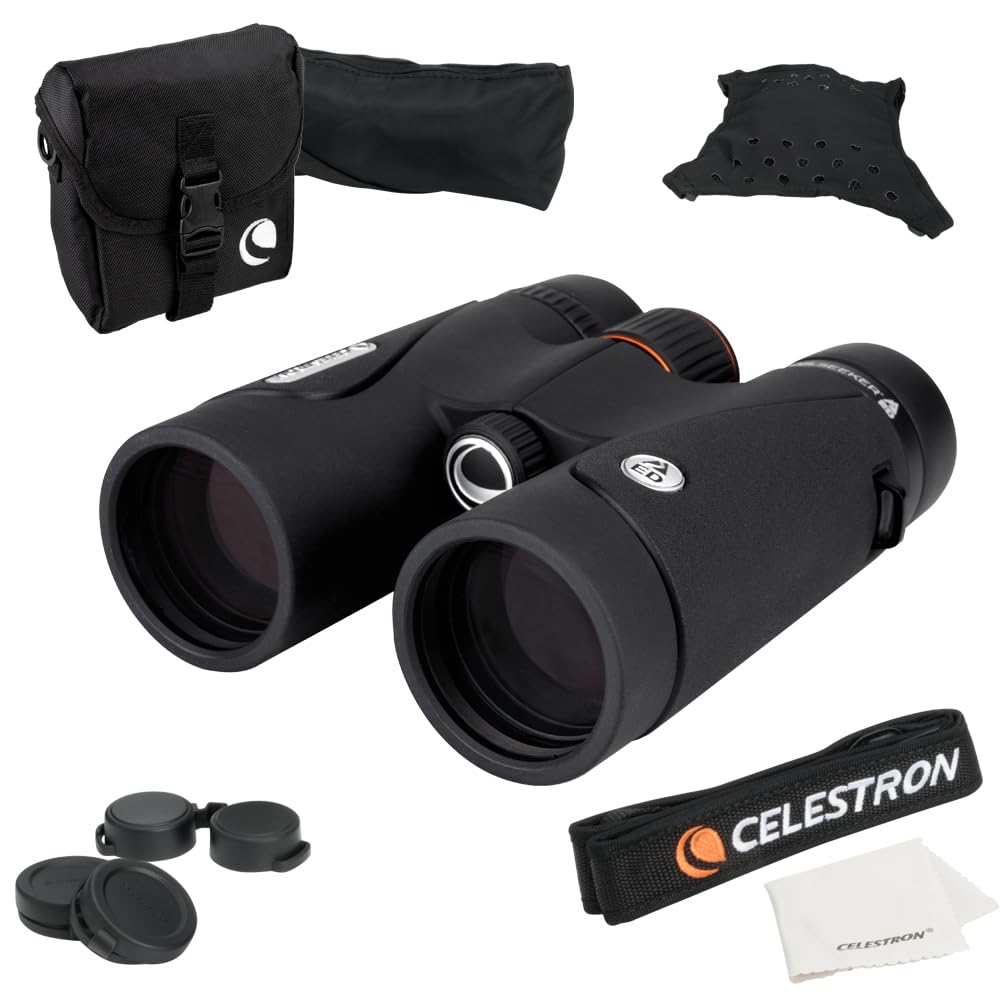
The Celestron TrailSeeker ED 8×42 punches so far above its price point that it has been consistently recommended by the Cornell Lab of Ornithology and Audubon. Extra-Low Dispersion glass virtually eliminates the purple fringing that plagues lesser optics, and the phase-coated BaK-4 prisms maximize light transmission for bright, razor-sharp images.
With a 5.2mm exit pupil, this binocular excels in the low-light conditions of a forest understory at dawn. The twist-up eyecups offer three position stops, accommodating both eyeglass wearers and bare eyes. The included carry harness distributes the weight comfortably for all-day hikes.
It is heavier than compact models, tipping the scales at just under 29 ounces. For dedicated birders who do not count every gram, that slight heft is a small price for the combination of ED glass, wide field of view, and close focus distance of 6.5 feet — perfect for watching a butterfly on a flower inches away.
Why it’s great
- ED glass for zero chromatic aberration
- Excellent low-light 5.2mm exit pupil
- Close focus under 7 feet
Good to know
- Heavier than ultralight options
- Padded neck strap can fatigue on long days
4. Nikon Travelite EX 8×25

The Nikon Travelite EX 8×25 has earned a loyal following among backpackers for one simple reason: it offers an outstanding balance of optical clarity, portability, and weather protection. Multilayer-coated optics and aspherical eyepiece lenses produce a flat, sharp field of view with minimal distortion at the edges.
Nitrogen-purged and O-ring sealed, these binoculars are waterproof to two meters for five minutes and completely fogproof — essential for humid creek valleys and sudden mountain downpours. The turn-and-slide eyecups provide a comfortable fit for eyeglass wearers, and the click-type diopter adjustment holds its setting securely.
At just over 10 ounces, the Travelite EX disappears into a pack pocket. The 8×25 configuration offers a steady, stable image that is easy on the eyes during long viewing sessions. It is not a low-light champion, but for daytime trail use it is nearly perfect.
Why it’s great
- Lightweight and truly compact
- Waterproof and fogproof construction
- Smooth center focus with click diopter
Good to know
- Small 25mm objective limits low-light use
- Eye relief tight for some glasses
5. Vortex Copperhead HD 10×42

Vortex built the Copperhead HD to be a rugged, all-weather workhorse that can take a beating on the trail. The HD optical system and fully multi-coated lenses deliver accurate color rendition and good edge-to-edge sharpness, making it a solid performer for a wide range of backcountry conditions.
The rubber armor provides a secure grip even in sleet and snow. The included GlassPak binocular harness keeps the unit snug against your chest, reducing bounce during a power hike. At a 10×42 configuration, the exit pupil is 4.2mm — reasonable for low light, though not class-leading.
The real headline here is Vortex’s unlimited, unconditional, lifetime VIP warranty. If these binoculars ever break for any reason — even if you run over them with your truck — Vortex will repair or replace them at no charge. That guarantee alone makes the Copperhead HD a compelling choice for the long-term backpacker.
Why it’s great
- Unconditional lifetime warranty
- HD optics with good color fidelity
- Included GlassPak harness for comfort
Good to know
- A bit heavy for ultralight trips
- Edges less crisp than premium ED glass
6. Nocs Provisions Standard Issue 10×25

Nocs Provisions designed the Standard Issue 10×25 to appeal to a younger generation of hikers who care about aesthetics as much as performance. The fully multi-coated optics and Swiss-designed BaK-4 prism deliver a surprising amount of clarity for a 10×25 frame, and the vibrant color options stand out on the trail.
The IPX7 rating means these binoculars can be submerged in three feet of water for 30 minutes without damage — a serious durability claim that backs up the stylish look. The patented Rugged Wave Grip ensures a slip-free hold in wet conditions, and the multi-stop twist-up eyecups work well for both glasses and bare eyes.
The 10×25 format has inherent limitations: a 2.4mm exit pupil struggles in deep shade, and the 10x magnification will show hand shake. But for sunny-day hikes, summit views, and concert pits, the Nocs Provisions packs portability and personality into one compelling package.
Why it’s great
- IPX7 waterproof and submersible
- Stylish design in multiple colors
- Comfortable wave-grip rubber body
Good to know
- Strap installation is fiddly
- Small exit pupil limits low light
7. Pentax UP 8-16×21 Zoom

The Pentax UP 8-16×21 Zoom is a cleverly designed compact that packs variable magnification into a lightweight, inverse porro-prism body. The fully multi-coated optics ensure good light transmission, and the aspherical lens elements deliver commendable edge-to-edge sharpness at all zoom positions.
The uni-body construction locks the objective lenses in a single housing, reducing moving parts and improving long-term durability. The hide-away fine-focus knob and pop-out diopter are elegant touches that keep the profile clean. A tripod socket adds versatility for stationary glassing.
At 21mm objective lenses, the low-light performance is limited, and optically speaking a zoom binocular always involves some compromises compared to a fixed-power model. But for a budget-friendly option that offers both reach and portability, the Pentax UP is a smart choice for casual trail use.
Why it’s great
- Versatile zoom magnification range
- Durable uni-body construction
- Compact and easy to carry
Good to know
- Small 21mm objective limits low-light use
- Optical compromises inherent to zoom design
8. Bushnell H20 Xtreme 10×42

Bushnell’s H20 Xtreme series is purpose-built for wet environments. The 10×42 configuration is O-ring sealed and nitrogen-purged to IPX7 standards, meaning it can handle a dunk in the river without internal fogging. The fully multi-coated glass and BaK-4 prisms produce a view that is bright and clear for a budget-tier optic.
The rubberized body provides a slip-resistant grip even with wet hands, and the tethered objective lens covers are a thoughtful inclusion for kayakers and canoeists. At roughly 25 ounces, it is not the lightest option, but the robust build inspires confidence in harsh conditions.
Several users note that this model lacks a tripod adapter socket, which limits mounting options for long glassing sessions. The neck strap is also reported as uncomfortable for all-day wear. Still, for the backpacker who frequently operates in drizzle and spray, the H20 Xtreme offers genuine waterproofing at a very accessible price.
Why it’s great
- Genuine IPX7 waterproofing
- Fully multi-coated optics for the price
- Durable rubber armor
Good to know
- No tripod adapter socket
- Heavier than compact alternatives
9. Nikon Sportstar EX 8×25

The Nikon Sportstar EX 8×25 is a classic entry-level compact that introduces backpackers to the convenience of a foldable roof-prism design. The multilayer-coated lenses produce reasonably bright images in good light, and the nitrogen-filled body prevents internal fogging during temperature swings.
At just over 11 ounces, the Sportstar EX is easy to slip into a jacket pocket or daypack side pouch. The turn-and-slide rubber eyecups are a nice touch, though they can feel a bit loose on some units. The fold-up design reduces its packed profile significantly.
The optics are not as sharp or bright as more modern, fully multi-coated competitors. The 10mm eye relief is insufficient for many eyeglass wearers, and the 25mm objective lenses fade quickly in low light. For the casual day hiker on a tight budget, it gets the job done, but serious backcountry users will quickly outgrow its capabilities.
Why it’s great
- Very lightweight and foldable
- Waterproof and fogproof
- Budget-friendly entry point
Good to know
- Eye relief too short for glasses
- Optics not as bright as FMC competitors
FAQ
What magnification is best for backpacking binoculars?
Are compact 25mm binoculars good enough for the trail?
What does fully multi-coated mean and why does it matter?
Do I need waterproof binoculars for backpacking?
Final Thoughts: The Verdict
For most users, the backpacking binoculars winner is the Celestron TrailSeeker ED 8×42 because it delivers premium ED glass performance and a large exit pupil for low-light conditions at a mid-range price that serious birders and hikers can justify. If you want ultralight portability without sacrificing Zeiss-level clarity, grab the Zeiss Terra ED Pocket 8×25. And for wet-weather expeditions or a worry-free lifetime investment, nothing beats the Vortex Copperhead HD 10×42 backed by its unconditional warranty.