
Our readers keep the lights on and the weekend projects moving. As an Amazon Associate, I earn from qualifying purchases.
A fan that rattles all night, blasts directly on your face, or hums at a pitch that cuts through earplugs — the wrong choice can turn your bedroom into a source of frustration instead of recovery. The market for bedroom fans has evolved far beyond simple blades and a switch, offering everything from ultra-quiet air circulators at 18 dB to adjustable towers that push air 40 feet. The trick is matching the right fan’s noise profile, oscillation pattern, and airflow reach to the specific dimensions and sleep needs of your room.
I’m Rikta — the co-founder and writer behind FitlyFast. I have analyzed dozens of fan specifications, cross-referenced customer experiences, and examined the decibel ratings, airflow velocities, and build quality of the most popular models to separate the genuinely sleep-friendly fans from the marketing claims.
Whether you need a silent desk companion, a tall oscillating tower for a shared bedroom, or a powerful circulator that moves air without a disruptive draft, this guide breaks down the seven best options available. Here is your complete resource for finding the best bedroom fans for sleeping.
How To Choose The Best Bedroom Fans For Sleeping
Selecting a fan for sleep isn’t about raw power — it’s about the interplay of noise, airflow behavior, and placement. A fan that pushes too much air directly at you can dry out your sinuses and disturb your sleep cycle, while one that is too weak might not circulate the room’s air at all. Bedroom fans must balance coverage with comfort, and subtle specs like blade pitch, motor type, and oscillation angle determine whether that balance is achieved.
Understanding Noise — Beyond “Quiet” Claims
Many fans advertise “whisper-quiet” operation but only at the lowest speed. Check the decibel range across all speeds. For sleepers, a noise floor of under 30 dB at low speed is ideal — that’s the volume of a library. Some budget units climb to 45+ dB on high, which is comparable to a running refrigerator. Look for fans that publish dB ratings for multiple speed levels. Brands like DREO and Windmill are particularly transparent here, with models that dip as low as 18 dB at their quietest setting.
Air Movement Types: Circulators vs. Standard Fans
An air circulator (like the IRIS USA WOOZOO or PELONIS OmniFlow) uses a specially designed blade and nozzle to create a focused column of air that reaches across the room, mixing the entire volume of air. A standard tower fan (like most Lasko models) produces a wider, gentler breeze that is more directional. For small- to medium-sized bedrooms, a circulator offers better temperature evenness without a direct blast. For larger rooms or those that only need gentle movement near the bed, a standard tower fan may be sufficient and less disruptive.
Oscillation Patterns — Horizontal, Vertical, or Both
Standard oscillation moves air left and right, covering a horizontal arc. For a single sleeper this often works fine, but if you share a bed you may need a fan that can tilt vertically as well to direct air over one person without hitting the other. The PELONIS pedestal fan stands out here with its 3D OmniFlow technology that combines 135° horizontal with 90° vertical oscillation, creating a true full-room circulation. For deep sleepers who don’t move much, a simple 90° horizontal sweep may be enough.
Physical Footprint and Adjustability
Bedroom real estate is precious. A 42-inch tower fan takes up floor space but can double as a piece of furniture if designed well. A compact desktop fan like the Windmill Smart Fan occupies only a small corner of a nightstand. For adjustable height, the Lasko Elevation tower fan can extend from 42 to 54 inches, allowing you to position airflow above the bed rather than directly on it. Also consider whether the fan has a built-in handle or remote compartment — small conveniences that make nightly adjustments smoother.
Quick Comparison
On smaller screens, swipe sideways to see the full table.
| Model | Category | Best For | Key Spec | Amazon |
|---|---|---|---|---|
| Windmill Smart Fan | Desk Fan | Near-silent sleep at 18 dB | 18 dB noise floor at low speed | Amazon |
| DREO Tower Fan 307 | Tower Fan | Powerful 25 ft/s airflow with ultra-quiet sleep mode | Max airflow speed of 25 ft/s | Amazon |
| Lasko Elevation Tower Fan | Tower Fan | Adjustable height to avoid direct-face draft | Adjustable height 42 to 54 inches | Amazon |
| PELONIS Pedestal Fan | Pedestal Fan | Full-room 3D oscillation for shared bedrooms | 135° horizontal + 90° vertical oscillation | Amazon |
| Lasko Wind Curve Tower Fan | Tower Fan | Proven reliability over years of use | 7.5 hour programmable timer | Amazon |
| IRIS USA WOOZOO Desk Fan | Desk Fan | Budget-friendly air circulator for small rooms | 29 dB quiet motor rating | Amazon |
| PELONIS Tower Fan 30-Inch | Tower Fan | Entry-level oscillating tower for small bedrooms | 37 dB operation at low speed | Amazon |
In‑Depth Reviews
1. Windmill Smart Fan

The Windmill Smart Fan earns the top spot here because its lowest setting produces only 18 dB — quieter than any other fan tested and effectively inaudible to most sleepers. The compact 10.71-inch tall body fits neatly on a nightstand, and the 2-in-1 design means you can use the lower three speeds as a personal desk fan and the top two speeds as an air circulator for the entire room. The marine blue finish and weighted base give it a premium feel that doesn’t look out of place in a bedroom.
Smart features are genuinely useful here: you can control the fan via the app set schedules on timers, or use voice commands if you prefer. The fan remembers your last setting, so if you power it off at speed 4 it will come back on at speed 4 — a small but appreciated detail for nightly routines. The blade assembly is easy to clean with a single screw, and the motor has held up reliably according to users with 18 months of use.
The main trade-off is the lack of oscillation: this is a fixed-direction fan that requires manual tilting. If you need air to sweep across a wide area, this isn’t the right choice. Additionally, users note a minor pitch change when transitioning between speeds, which is audible only if you are very sensitive. At its price, it offers the quietest sleep experience of any fan on this list.
Why it’s great
- Lowest noise floor at 18 dB
- Five-speed range from whisper to boost circulation
- Easy-to-clean blade design
- Smart app control with scheduling
Good to know
- No oscillation — fixed directional airflow only
- Premium price for a desk fan without oscillation
- Minor pitch change between speeds
2. DREO Bladeless Tower Fan 307

The DREO Tower Fan 307 delivers a powerful 25 ft/s airspeed through a bladeless design that is both safer for children/pets and easier to clean than traditional blade fans. The 36-inch tower offers 90° oscillation, and the sleep mode automatically dims the LED display and switches to the lowest noise profile — a combination that makes it a top-tier choice for serious sleepers. The rear grille and impeller wheel are removable, so you can keep the fan clean without disassembly tools.
Four modes (Normal, Natural, Sleep, and Auto) and four speeds give you fine control over the airflow character. The “Sleep” mode is particularly well-tuned: it gradually reduces speed over time, mimicking a natural breeze pattern that helps you drift off without sudden changes. Users consistently praise how quiet the fan is at its lowest setting, with the oscillation motor itself being nearly silent — no clicking or whirring noises.
The remote control includes a built-in magnetic storage compartment on the back of the fan, solving the problem of lost remotes. However, the fan’s 11.81-inch diameter base takes up more floor space than some narrow towers, and the highest speed, while powerful, produces a noticeable whoosh that may bother light sleepers. The DREO is best for those who want a powerful, quiet, and safe fan with a sleek silhouette.
Why it’s great
- Powerful 25 ft/s airflow for medium-large rooms
- Sleep mode with auto-mute and display dim
- Bladeless design is safe and easy to clean
- Magnetic remote storage slot
Good to know
- Base footprint larger than some towers
- High speed can generate noticeable whoosh noise
- No adjustable height option
3. Lasko Elevation Tower Fan

The Lasko Elevation Tower Fan solves the most common complaint about bedroom fans: the airflow hits your face or chest directly. With a telescoping column that adjusts from 42 to 54 inches, you can position the air stream above your head or direct it toward your feet, effectively avoiding the dry-eye and sinus issues that plague many sleepers. The 90° oscillation ensures the air sweeps the room, while the 31 ft/s maximum airflow cools spaces up to 40 feet away.
Operation is whisper-quiet at 28 dB on low, making it one of the quietest full-size towers available. The AirSense technology adjusts fan speed automatically based on the room temperature — a feature that is genuinely useful for maintaining consistent sleep conditions throughout the night. The control panel displays the ambient temperature and can be set to turn off completely for total darkness, critical for sensitive sleepers. Assembly is tool-free and takes minutes.
One minor drawback is the non-standard footprint: at nearly 12 inches wide, it’s not as space-efficient as some slimmer towers. The plastic build feels sturdy but some users caution against bumping the base. The remote control is responsive but requires direct line-of-sight. Overall, the adjustable height and temperature-sensing features make this the most adaptable fan for a wide variety of bedroom layouts and sleep preferences.
Why it’s great
- Adjustable height avoids direct facial airflow
- 28 dB low-speed operation
- Temperature-sensing auto-adjust mode
- Display can be fully darkened
Good to know
- Somewhat wide base for a tower fan
- Remote requires direct line-of-sight
- Plastic base can be fragile if knocked
4. PELONIS Pedestal Fan (OmniFlow)

The PELONIS OmniFlow pedestal fan redefines oscillation for bedroom circulation. Instead of the standard horizontal sweep, it automatically combines 135° horizontal rotation with 90° vertical tilt in a single continuous motion — meaning the air column sweeps up and down while it turns left and right, eliminating dead zones and hot spots. This is ideal for shared bedrooms where one person prefers air overhead and the other near the floor, or for rooms with vaulted ceilings.
Airflow capacity is rated at 900 CFM, and the Bionic Butterfly-Blade design produces a soft, wide breeze that doesn’t feel sharp or invasive. The memory function is a standout: if the power cuts out (or you turn it off with a smart plug), the fan returns to precisely your last speed, mode, and oscillation settings — perfect for nightly routines. The dual-height design (23.2 to 42.5 inches) makes it versatile for desk, floor, or lofted-bed use.
The noise floor at 26 dB on low is excellent, though the non-DC motor produces a slight electrical hum that is more noticeable than premium brushless designs. The remote requires direct line-of-sight, and the capacitive touch buttons on the base can be hard to find in the dark. At its mid-range price, the PELONIS offers the most advanced airflow pattern for the money, especially for medium-sized rooms up to 225 sq. ft.
Why it’s great
- Unique 3D oscillation for full-room coverage
- Memory function retains settings after power loss
- 26 dB noise floor on low
- Dual-height positioning from 23 to 42 inches
Good to know
- Non-DC motor produces slight electrical hum
- Remote needs direct line-of-sight
- Capacitive buttons hard to locate in complete darkness
5. Lasko Wind Curve Tower Fan T42954
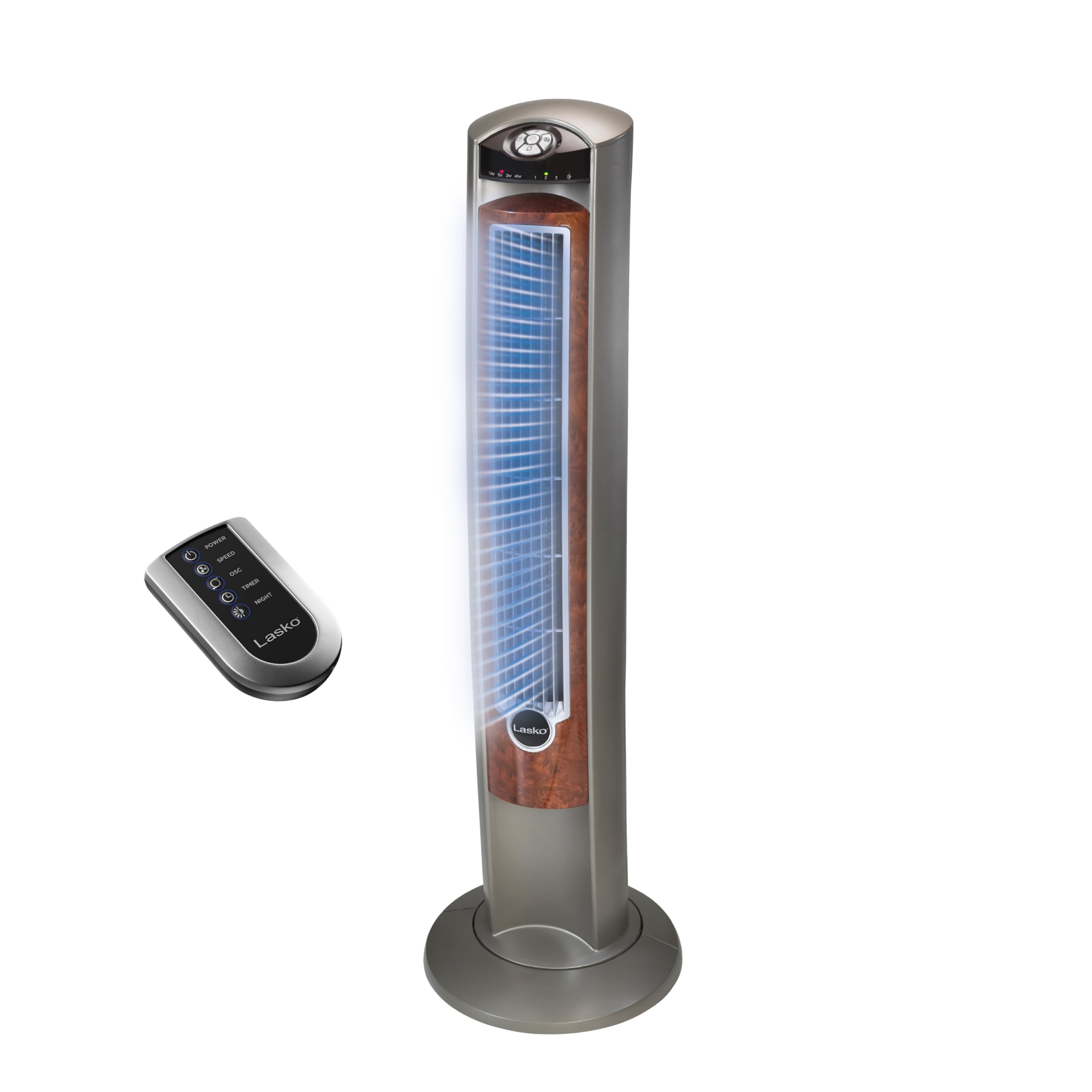
The Lasko Wind Curve T42954 has been a trusted bedroom companion for years, with numerous reports of units lasting seven years or more without any degradation in performance. The 42-inch tower features a woodgrain and grey finish that blends with most bedroom furniture, and the 7.5-hour timer lets you schedule cooling precisely for your sleep cycle. The 262 CFM airflow is modest compared to newer competition, but it is surprisingly quiet for a fan of this size — the low setting is virtually inaudible after a few minutes of use.
Assembly is tool-free and takes under five minutes: snap the two base pieces together, insert the power cord, and twist the locking nut. The remote control conveniently stores in a slot on the back of the fan, and the top-mounted control panel is intuitive even in low light. Users consistently praise the fan for being reliable, durable, and just the right size for a standard bedroom without dominating the space.
The main limitation is the limited 262 CFM airflow, which may not be sufficient for large or open-concept bedrooms. The base plastic is somewhat fragile — a hard knock can crack it, though replacement parts are available. The oscillation arc is about 90°, which is narrower than some competitors. This fan is best for someone who values long-term reliability and simple operation over advanced features or ultra-high airflow.
Why it’s great
- Proven reliability lasting 7+ years
- Quiet operation at low speed
- Intuitive top-mounted controls
- Built-in remote storage slot
Good to know
- Modest 262 CFM may not cool large rooms
- Plastic base can crack if knocked over
- 90° oscillation is narrower than some towers
6. IRIS USA WOOZOO Desk Fan
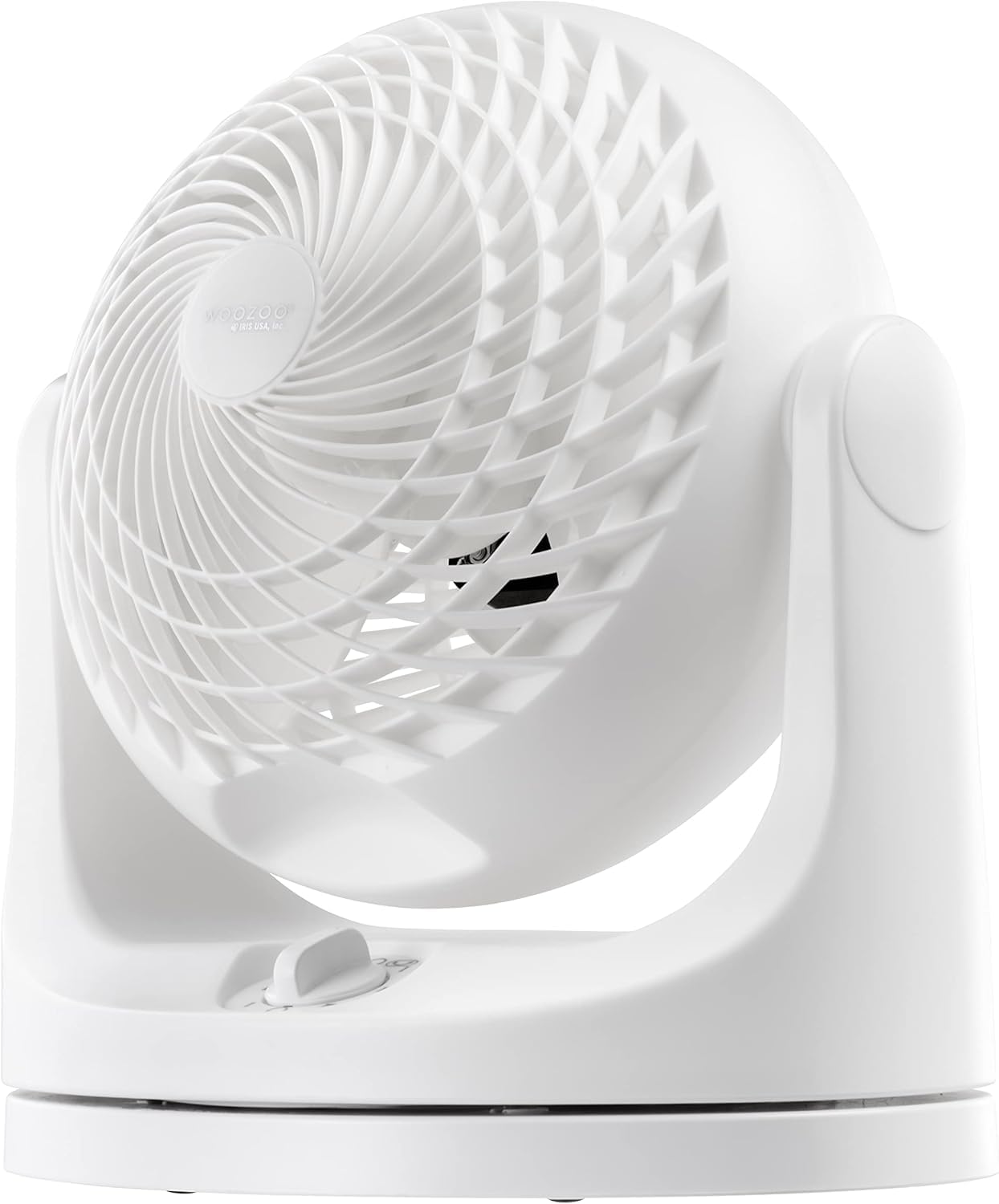
The IRIS USA WOOZOO is a compact air circulator that punches above its size, pushing air across 36 feet with a coverage area of 244 sq. ft. The spiral grid and deep-pitch blades create a focused beam of air that reaches every corner of a small room, making it surprisingly effective as a personal cooling solution for a dorm, a single bed bedside table, or a WFH desk. The 29 dB low-speed operation is genuinely unobtrusive — quieter than a bedside fan.
The built-in handle makes it easy to move between rooms, and the 112° adjustable vertical tilt gives you solid control over air direction. The 65° oscillation is less than some full-size towers, but for a desk fan this is still ample for spreading air across a desk or a single bed. Users who previously used Vornado fans report preferring the WOOZOO because it doesn’t rattle and costs about half as much.
The primary trade-off is that this is a desktop/table fan, not a floor-standing model. Its 12.2-inch height means it won’t work as a primary room cooler for a large bedroom. The plastic build feels durable for its weight class, but it can be tipped if the cord is yanked. The three-speed manual control is simple but lacks a timer — so you must remember to turn it off. It’s the best budget-friendly pick for targeted personal cooling.
Why it’s great
- Impressive 36 ft air throw in a compact body
- 29 dB low-speed operation
- Built-in handle for portability
- Great value vs. premium circulator brands
Good to know
- Desktop form factor, not a floor fan
- No timer function
- Plastic build can tip with cord tension
7. PELONIS 30-Inch Tower Fan

The PELONIS 30-inch tower fan is the most affordable full-size oscillating tower on this list, offering a solid mix of features for budget-conscious buyers. The CycleBoost technology and 847 CFM airflow rating mean it can move a surprising amount of air despite its smaller 30-inch height. The 90° oscillation and three manual speeds provide enough customization for most small-to-medium bedrooms. The 7-hour timer lets you set it to run for the first half of the night and then shut off automatically.
Assembly is genuinely effortless — snap the two-piece base together, feed the power cord through the center, and twist the locking nut. The built-in top handle makes it easy to carry from room to room, and the grey finish is neutral enough for any bedroom decor. Users consistently mention that the fan is extremely quiet on low speed (around 30-37 dB depending on the source), creating a gentle white noise that helps with sleep onset.
The main compromises are in build quality and long-term reliability. Some users report that after two years the oscillation mechanism can develop a slight wobble, and the remote can be unresponsive at angles beyond 30 degrees. The highest speed, while powerful, produces a noticeable whoosh that some sleepers find intrusive. For the price, this is still a capable entry-level tower fan that punches above its weight — just don’t expect premium build quality or ultra-quiet operation at higher speeds.
Why it’s great
- Very affordable entry price
- 847 CFM airflow is strong for a small tower
- 7-hour timer for scheduled sleep
- Tool-free assembly in minutes
Good to know
- Oscillation mechanism can become wobbly over time
- Remote has limited angle sensitivity
- High speed is noticeably whooshy
FAQ
Is a tower fan better than a desk fan for the bedroom?
How many decibels is too loud for a bedroom fan?
What is the difference between a fan and an air circulator?
Final Thoughts: The Verdict
For most users, the best bedroom fans for sleeping winner is the Lasko Elevation Tower Fan because it combines adjustable height to avoid direct-face draft, a low 28 dB noise floor, temperature-sensing auto-adjust, and reliable build quality at a mid-range price. If you want the absolute quietest possible sleep fan, grab the Windmill Smart Fan for its 18 dB whispering setting — just be prepared for no oscillation. And for a full-room 3D circulation that eliminates every dead spot in a medium bedroom, nothing beats the PELONIS Pedestal Fan with its 135° horizontal and 90° vertical oscillation.