
Our readers keep the lights on and the weekend projects moving. As an Amazon Associate, I earn from qualifying purchases.
A 1,000Wh power station sits at the sweet spot of portable energy—enough capacity to run a mini-fridge for a full day, keep a CPAP machine running for multiple nights, or recharge every device in your home during an outage. The challenge is separating the genuinely reliable units with robust inverters and long-lasting LiFePO4 cells from the ones that oversell their specs and undershoot real-world performance.
I’m Rikta — the co-founder and writer behind FitlyFast. I’ve spent dozens of hours analyzing battery chemistry, inverter topology, charge cycle ratings, and real user load-test data across the full spectrum of 1kWh power stations to find which ones actually deliver on their promises.
This guide evaluates a carefully selected group of models — from compact units that charge in under an hour to expandable systems capable of backing up an entire home — helping you identify the right 1000wh power station for your specific power needs.
How To Choose The Best 1000Wh Power Station
A 1000Wh power station is a serious investment in energy independence, but not every model delivers the same real-world usability. Here’s what separates a reliable backup companion from a frustrating paperweight.
Battery Chemistry and Cycle Life
Nearly every modern 1kWh station uses LiFePO4 (lithium iron phosphate) cells. The key differentiator is the rated cycle count at 80% capacity retention — look for 3,500 cycles (common in entry-level units) versus 4,000+ cycles (found in premium models). A 500-cycle gap can mean years of additional daily use, directly impacting cost-per-cycle over the station’s lifespan.
Inverter Continuous vs Surge Watts
The continuous AC wattage determines what you can run steadily — 1,200W covers a compact refrigerator and lights, while 1,800W handles a microwave or electric grill. Surge (peak) wattage matters for motor-driven appliances like refrigerators and pumps that draw 2–3× their running power on startup. A station with a strong surge rating prevents nuisance overload shutdowns.
AC Recharge Speed and Solar Input
Fast AC charging (0–80% in under 60 minutes) is critical for emergency top-ups between outages. For off-grid use, solar input voltage range and wattage capacity determine how quickly you can replenish the battery from panels. A station accepting 500W of solar input recharges twice as fast in full sun as one limited to 200W.
UPS and Pass-Through Capabilities
If you plan to keep a router, computer, or medical device running during outages, a built-in UPS with sub-10ms switchover is essential. Some budget stations lack UPS entirely or switch slowly enough that electronics reboot. Pass-through charging — powering devices while the station itself recharges — is a convenience feature worth verifying.
Quick Comparison
On smaller screens, swipe sideways to see the full table.
| Model | Category | Best For | Key Spec | Amazon |
|---|---|---|---|---|
| Anker SOLIX F3000 | Premium | Whole-home backup | 3072Wh, 3600W, 6000W recharge | Amazon |
| BLUETTI Apex 300 | Premium | 120V/240V split-phase | 2765Wh, 3840W, 6000+ cycles | Amazon |
| DJI Power 2000 | Premium | Quiet RV/indoor use | 2048Wh, 3000W, 55min 0-80% | Amazon |
| AFERIY P210 | Premium | High capacity/16 ports | 2048Wh, 2400W, <10ms UPS | Amazon |
| Enphase IQ PowerPack | Premium | UL certification/integration | 1500Wh, 1500W, IQ8 microinverters | Amazon |
| EcoFlow DELTA 3 Classic | Mid-Range | Fast charging/compact | 1024Wh, 1800W, 45min 0-80% | Amazon |
| BLUETTI Elite 100 V2 | Mid-Range | Compact/lightweight | 1024Wh, 1800W, 70min full charge | Amazon |
| Jackery Explorer 1000 v2 | Mid-Range | Reliable daily backup | 1070Wh, 1500W, 1hr emergency charge | Amazon |
| OUPES Mega 1 | Mid-Range | Fastest AC recharge | 1024Wh, 2000W, 36min 0-80% | Amazon |
| ALLWEI 1200W | Budget | CPAP/light backup | 1008Wh, 1200W, 1.5hr full charge | Amazon |
| BLAVOR S1600 | Budget | Built-in solar panel | 1024Wh, 1600W, 40W foldable panel | Amazon |
In‑Depth Reviews
1. Anker SOLIX F3000
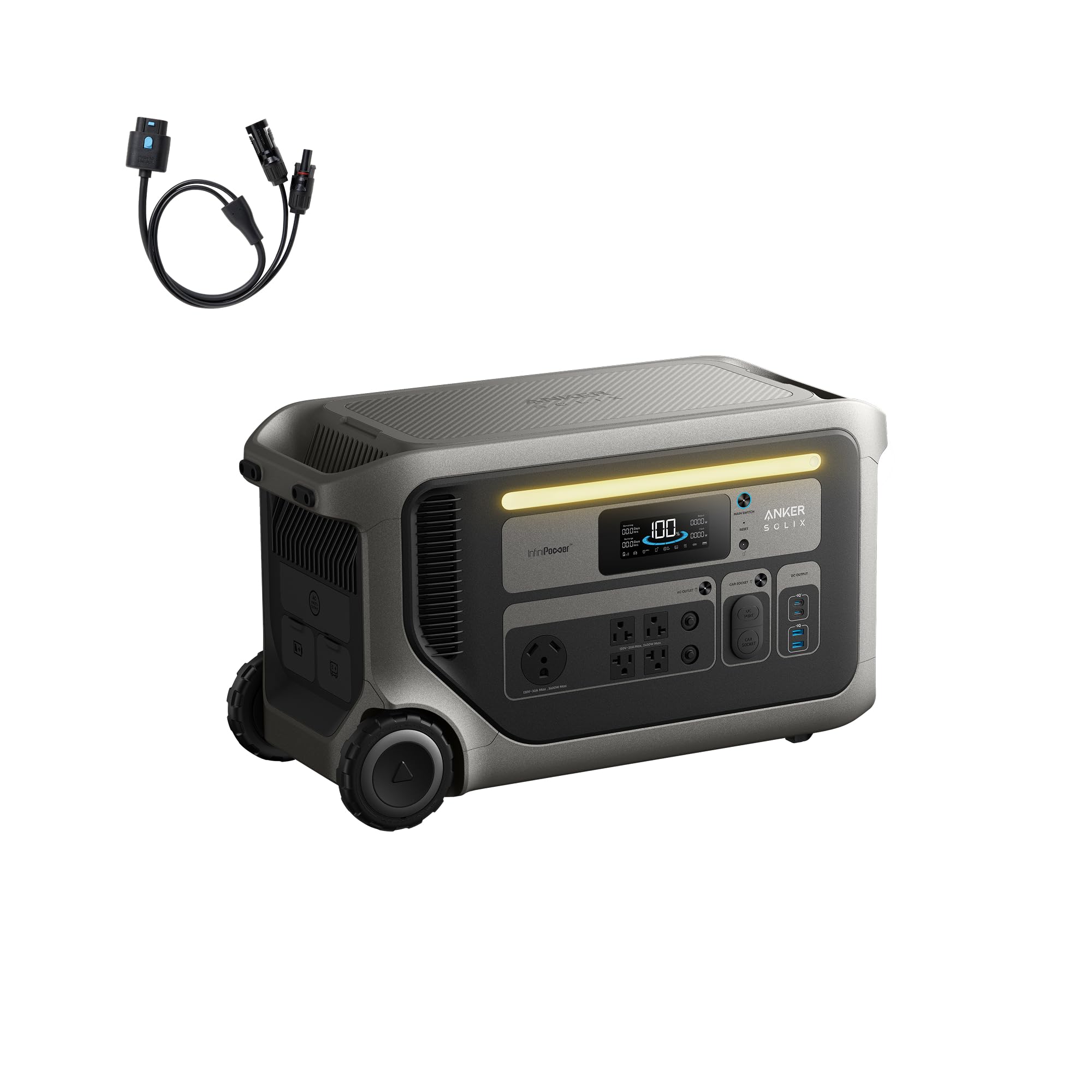
The Anker SOLIX F3000 redefines what a “home backup” power station can be at this capacity tier. Its 3,072Wh starting capacity and 3,600W continuous output run a full-size refrigerator for over 40 hours, while the industry-leading 6,000W pass-through recharge allows simultaneous generator and solar input to refill the battery without interrupting connected devices. The ultra-low idle consumption — 125 hours of AC standby — means it won’t drain itself between outages.
The built-in wheels and telescoping handle make its 91.5-pound chassis genuinely mobile, a rare feature for a 3kWh station. Dual solar inputs accept up to 2,400W from panels, and the unit can pair with a second F3000 for 240V split-phase output, powering well pumps or EV chargers. The app enables charge limits, power-saving schedules, and real-time monitoring — essential for optimizing solar capture or time-of-use utility rates.
Users consistently praise its build quality and the ease of keeping it topped off overnight. The lack of built-in 240V without a second unit is the only notable compromise, but for 99% of home scenarios, the 120V capacity and expandability to 24kWh via extra batteries make this the most versatile single-unit powerhouse available.
Why it’s great
- Massive 3,072Wh capacity with 42-hour fridge runtime
- 6,000W dual-input pass-through recharge is unmatched
- Wheeled chassis for easy movement at 91.5 lbs
- Expandable to 24kWh for extended outages
Good to know
- 240V output requires pairing two units
- Heavy — not suited for frequent portable carry
2. BLUETTI Apex 300
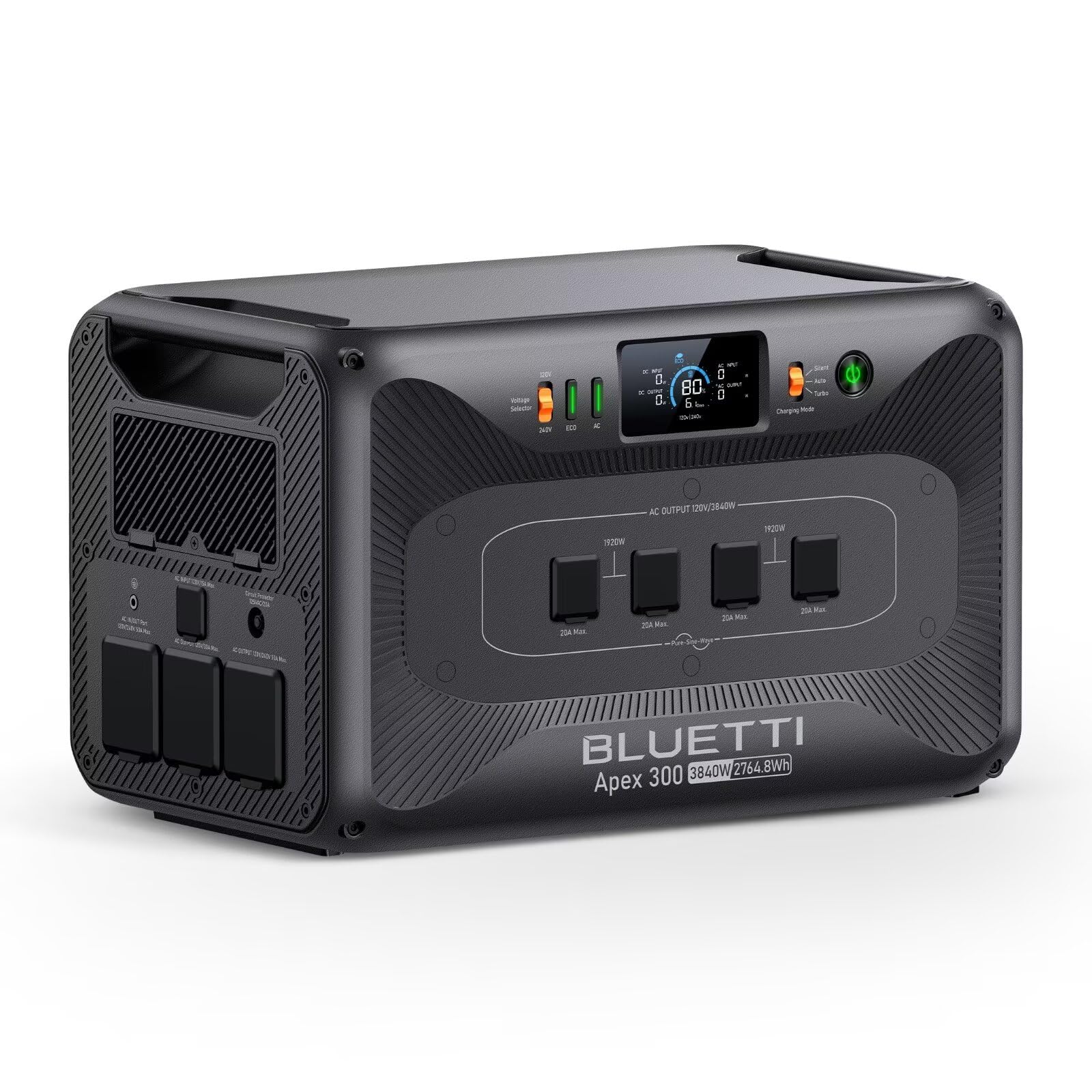
The BLUETTI Apex 300 stands alone in this group by offering native 120V/240V split-phase output from a single unit — a critical differentiator for homes with well pumps, EV chargers, or large RV air conditioners. Its 2,764.8Wh LiFePO4 battery is rated for over 6,000 cycles to 80% capacity, the highest cycle life here, delivering roughly 17 years of daily use under normal conditions. The 3,840W continuous inverter (7,680W surge via Power Lifting) handles virtually any residential appliance.
Beyond raw specs, the Apex 300 is designed as a building block for whole-home backup. Adding the Hub D1 enables dedicated 12V RV loads and alternator charging via Charger 1 or Charger 2, while the SolarX 4K accessory supports up to 4,000W of solar input. The zero-millisecond UPS is genuinely instantaneous — no reboot flicker for connected electronics. Users with 50-amp transfer switches report seamless integration, though they note the need to manually isolate the feed breaker during an outage to avoid error states.
The absence of dedicated DC ports is a deliberate cost-saving measure — BLUETTI expects buyers to use the modular expansion ecosystem instead. At nearly 66 pounds and lacking wheels, this is a semi-permanent installation piece rather than a grab-and-go unit, but its modularity and unmatched cycle life make it the best long-term investment for home integration.
Why it’s great
- Single-unit 120V/240V split-phase output
- 6,000+ cycle LiFePO4 battery — longest lifespan in class
- Zero-millisecond UPS for sensitive electronics
- Modular expansion via B300K/B500K and Hub D1
Good to know
- No DC ports — relies on accessory hub
- Heavy (66 lbs) with no built-in wheels
3. DJI Power 2000
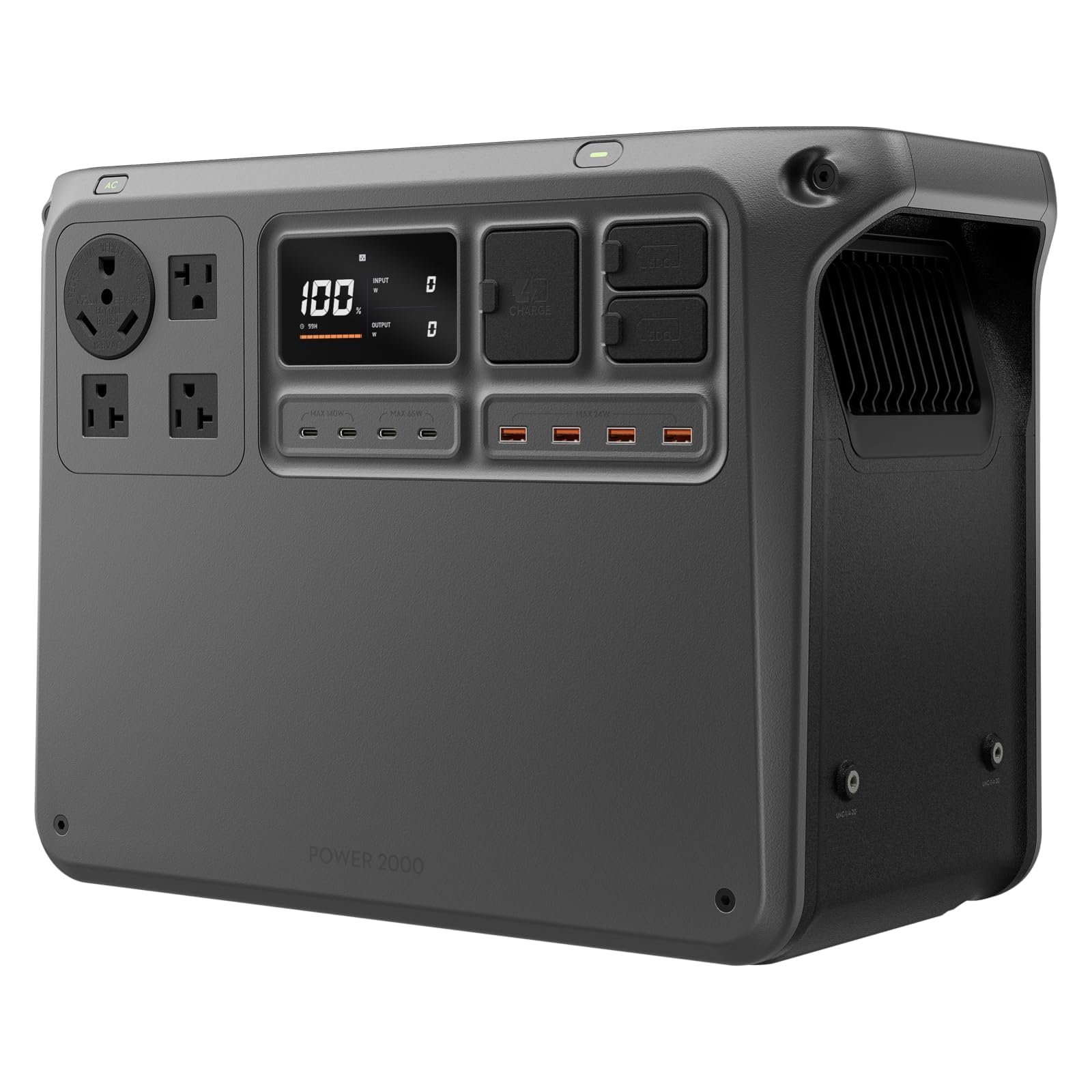
DJI brings drone-grade engineering to the power station market with the Power 2000, a 2,048Wh unit that prioritizes quiet operation and rugged safety. At under 30 dB during normal use, it’s virtually silent — no loud fan cycling to disturb sleep in an RV or bedroom. The 3,000W continuous inverter (4,000W peak) covers 99% of household appliances, and the sub-10ms UPS ensures connected computers never skip a beat.
The 0–80% recharge in 55 minutes via AC is genuinely fast, while solar input caps at 1,800W for quick off-grid replenishment. DJI’s smart BMS includes 26 temperature sensors and flame-retardant housing, giving it an edge in safety-conscious installations. The dual full SDC ports deliver up to 280W via USB-C, enough to fast-charge two high-end laptops simultaneously. Expansion batteries can push total capacity to 22.5kWh for multi-day backup.
Real-world feedback is overwhelmingly positive for RV use, with users reporting 40+ hours of runtime powering entire campers. The main caveat is the proprietary SDC connector system, which limits accessory compatibility to DJI’s ecosystem, and the lack of built-in wheels for its 48-pound weight. For those prioritizing whisper-quiet operation and drone-grade reliability, this is a standout choice.
Why it’s great
- Under 30 dB — near-silent operation
- 55-minute 0-80% AC recharge
- 1,800W solar input for fast off-grid refill
- 26 temperature sensors for extensive safety monitoring
Good to know
- Proprietary SDC connectors limit accessory compatibility
- No built-in wheels for the 48-pound unit
4. AFERIY P210

The AFERIY P210 packs 2,048Wh of LiFePO4 capacity — double that of most 1kWh stations — into a chassis that’s 20% lighter than comparable units at 48.5 pounds. The 2,400W inverter (4,800W surge) handles heavy kitchen appliances and power tools, while the server-grade <10ms UPS keeps sensitive gear online during grid blips. With 16 output ports — including six AC outlets, dual 100W USB-C, and a dedicated XT60 12V/25A DC port — it’s the most versatile outlet configuration in the mid-range bracket.
Charging is quick: AC input refills the battery from empty to full in roughly two hours. The app offers energy management and automation scheduling, though some users report occasional connectivity hiccups. The included 7-year warranty is the most generous at this price tier, reflecting confidence in the build quality. Quiet operation at 16 dB under normal load makes it suitable for indoor overnight use.
While some early units had display issues after solar charging, AFERIY’s customer service has been responsive per user reports.
Why it’s great
- 2,048Wh capacity at mid-range pricing
- 16 versatile output ports including XT60 DC
- 7-year warranty — longest standard coverage
- Near-silent operation at 16 dB normal load
Good to know
- Occasional app connectivity issues reported
- Some units had display bugs after solar charging
5. Enphase IQ PowerPack 1500
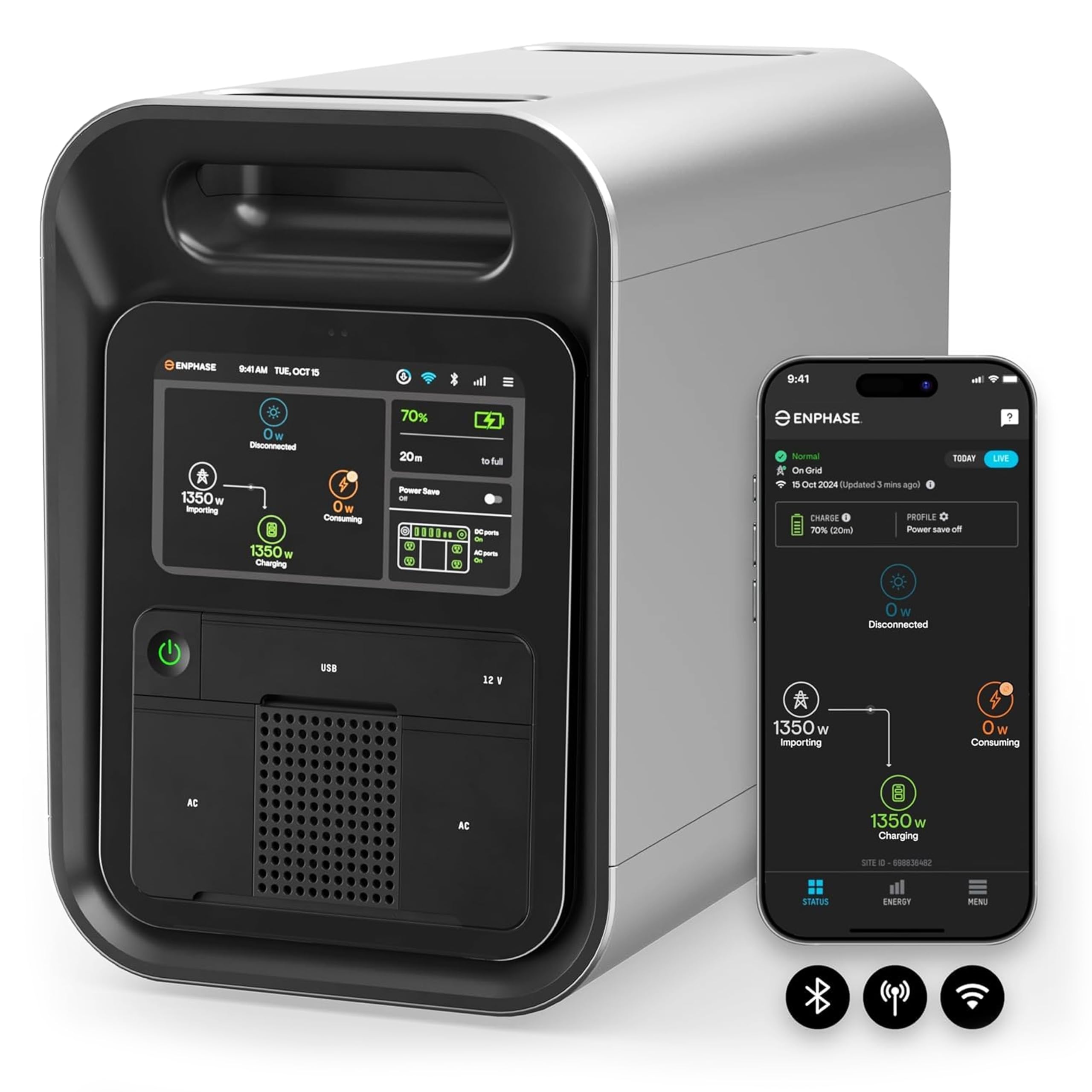
The Enphase IQ PowerPack 1500 brings utility-grade engineering to the portable market, with UL 9540A thermal runaway and UL 2743 outdoor certifications that most competitors lack. The secret weapon is three built-in IQ8 microinverters — the same technology used in over five million Enphase home solar systems. If one inverter fails, the other two keep running, providing redundancy you won’t find elsewhere. The 1,500Wh capacity and 1,500W continuous output are modest by comparison, but the power quality is exceptional: clean, stable sine wave that matches grid power.
The 7-inch color LCD touchscreen provides clear real-time data, and the Enphase app offers remote monitoring via built-in 4G cellular, Wi-Fi, or Bluetooth — no smartphone tethering required. Full recharge takes under 75 minutes from AC or roughly four hours from solar. The design splits input and output ports on opposite sides for clean cable management, and rubber flaps seal connectors against moisture and dust. At 45.9 pounds, it’s manageable for short carries, and a roller cart accessory is available.
Users appreciate the weather-resistant construction and seamless integration with existing Enphase solar systems. The main trade-off is higher cost per watt-hour compared to less-certified competitors, and a quirk where AC charging below 700W can trip the internal breaker. For buyers who prioritize safety certification and inverter redundancy over raw capacity, the IQ PowerPack is the most trustworthy unit on this list.
Why it’s great
- UL 9540A and UL 2743 certified for safety
- Triple-redundant IQ8 microinverters
- Built-in 4G cellular for remote monitoring anywhere
- Rugged weather-resistant design with sealed ports
Good to know
- Higher cost per watt-hour than comparable units
- AC charging below 700W may trip internal breaker
6. EF ECOFLOW DELTA 3 Classic
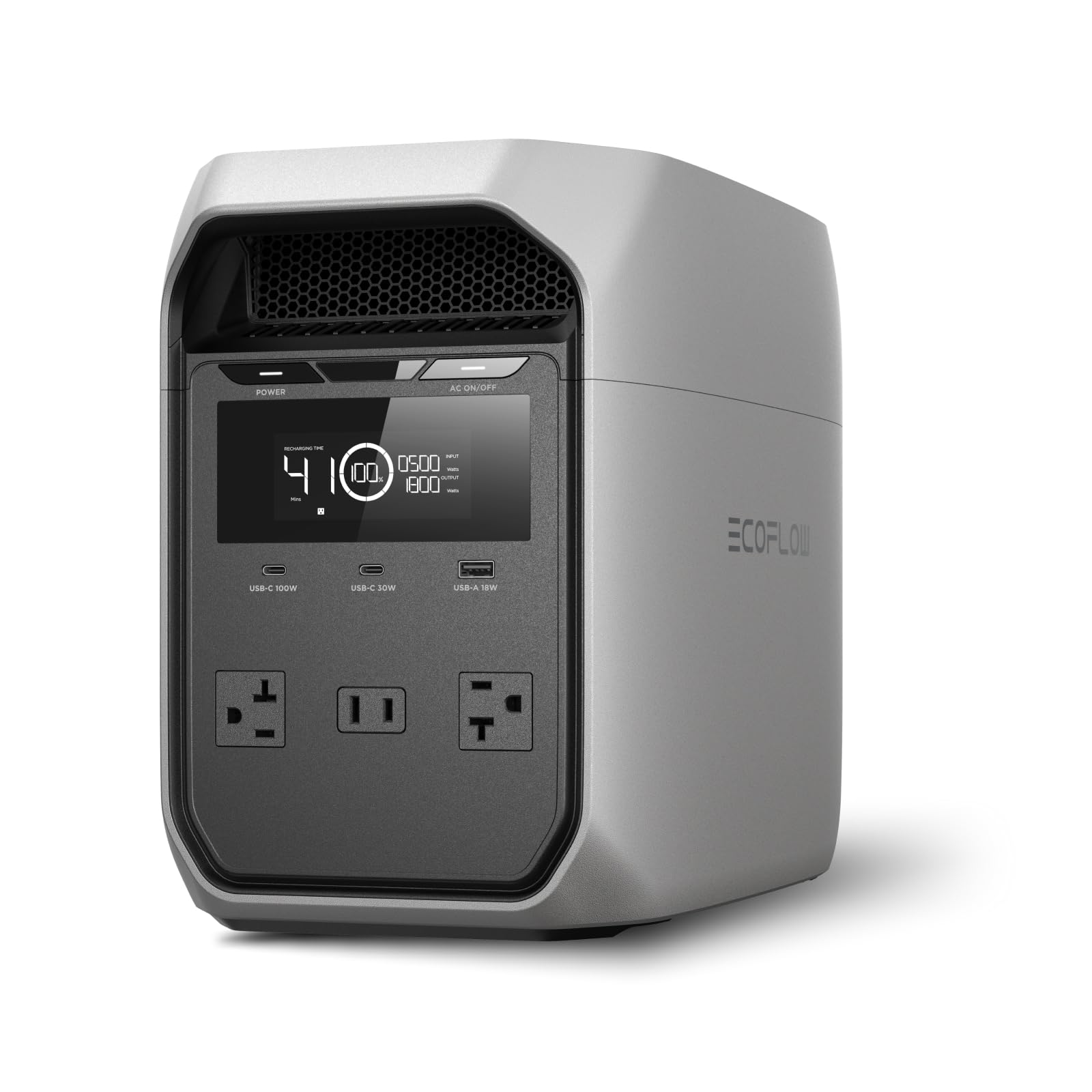
The EcoFlow DELTA 3 Classic delivers the most aggressive charging speed in the 1kWh segment — 0–80% in just 45 minutes via X-Stream AC charging. The 1,800W continuous inverter (3,600W surge) with X-Boost technology pushes usable wattage even higher for demanding appliances. The sub-10ms UPS is fast enough that a desktop PC won’t flicker during a switchover, and the metal-frame construction gives it a premium, durable feel.
At only 15 pounds, it’s the lightest unit in this review — a full 8 pounds lighter than the Jackery Explorer 1000 v2 and 10 pounds lighter than the BLUETTI Elite 100 V2. Despite the low weight, it packs 1,024Wh of LiFePO4 power with a 10-year lifespan. The dual handles, non-skid pads, and swing-up input cover show thoughtful design details that users consistently highlight. Solar input up to 500W recharges the battery in roughly 2.5 hours in full sun.
The EcoFlow app adds smart features like Storm Alert, Self-Powered Mode, and schedulable on/off timing for peak/off-peak utility savings. The only downsides are the lack of expandability with older DELTA 2 batteries and the slightly higher price per watt-hour than some budget competitors. For anyone who prioritizes extreme portability and the fastest recharge in class, the DELTA 3 Classic is the clear winner.
Why it’s great
- 45-minute 0-80% AC recharge — fastest in 1kWh class
- Only 15 pounds — ultralight for the capacity
- 1800W/3600W surge with X-Boost technology
- Metal-frame build with premium design details
Good to know
- Not compatible with Delta 2 expansion batteries
- Slightly higher cost per watt-hour than budget options
7. BLUETTI Elite 100 V2
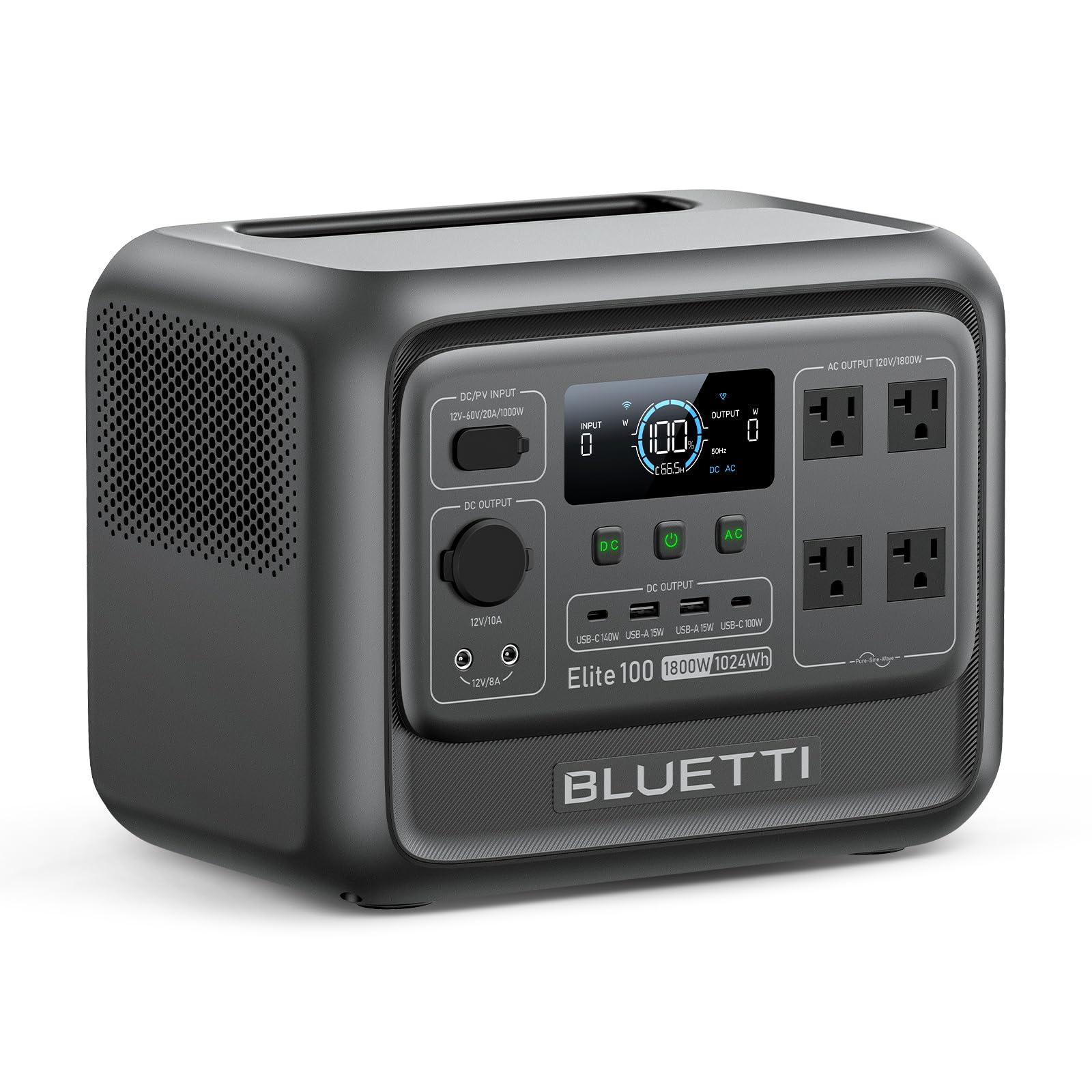
BLUETTI’s Elite 100 V2 is 35% smaller and 30% lighter than its predecessor, achieving a 1,024Wh capacity in a 17-liter chassis that weighs just 25 pounds. The hidden carry handle allows one-handed transport, making this one of the most portable fully-featured 1kWh stations available. The 1,800W continuous AC output (3,600W surge) with Power Lifting mode handles up to 90% of common household appliances, from mini-fridges to electric kettles.
Charging is versatile: 1,200W TurboBoost AC input fills the battery in roughly 70 minutes, while the solar input accepts up to 1,000W — the fastest solar charge rate for any 1kWh station here. The built-in <10ms UPS keeps Wi-Fi routers and computers running through outages, and silent mode drops fan noise to 30 dB, which is 50% quieter than typical 1kWh units. The 11 output ports include dual 100W USB-C, three AC outlets, and a car port.
Users running mobile businesses and CPAP machines praise its reliability and quiet operation. The lack of an integrated light or wireless charger is a minor downgrade from the previous EB3A, and the app could be more responsive. For the balance of compact size, fast solar charging, and quiet UPS capability, the Elite 100 V2 is the best pick for those who need to move their power station regularly.
Why it’s great
- 35% smaller, 30% lighter than previous models
- 1,000W solar input — fastest in 1kWh class
- 70-minute full AC recharge
- 30 dB silent mode for overnight use
Good to know
- No built-in light or wireless charger
- App can be sluggish at times
8. Jackery Explorer 1000 v2

The Jackery Explorer 1000 v2 refines the brand’s proven formula with a 1,070Wh LiFePO4 battery rated for over 4,000 cycles — the highest cycle count in the standard 1kWh class. The ChargeShield 2.0 technology defaults to a 1.7-hour charge for battery health but can be set to a one-hour emergency mode via the Jackery app.
At 23.8 pounds with a foldable handle, it’s easy to carry from home to car to campsite. The three pure sine wave AC outlets, dual USB-C (100W PD), USB-A, and DC car port cover essential gear for camping, RV overnight use, and home backup. Users report running Starlink, iPads, and phones for a full overnight charge cycle without issue, and the display clearly shows remaining time and power draw. The app allows switching between charging modes — emergency, quiet overnight (30 dB), and energy efficiency.
The main limitation is solar compatibility: the Explorer 1000 v2 only works with Jackery solar panels, which is more restrictive than the standard MC4 connector found on most competitors. Jackery’s reputation for longevity — users report units still at peak performance after five years — combined with the 4,000-cycle battery, makes this the safest long-term bet for consistent, moderate-demand backup power.
Why it’s great
- 4,000-cycle LiFePO4 — class-leading battery longevity
- Proven reliability with 5+ year track record
- Compact 23.8 lbs with foldable handle
- App-adjustable charging speeds for battery health
Good to know
- Solar charging only works with Jackery brand panels
- Three AC outlets vs four on some competitors
9. OUPES Mega 1
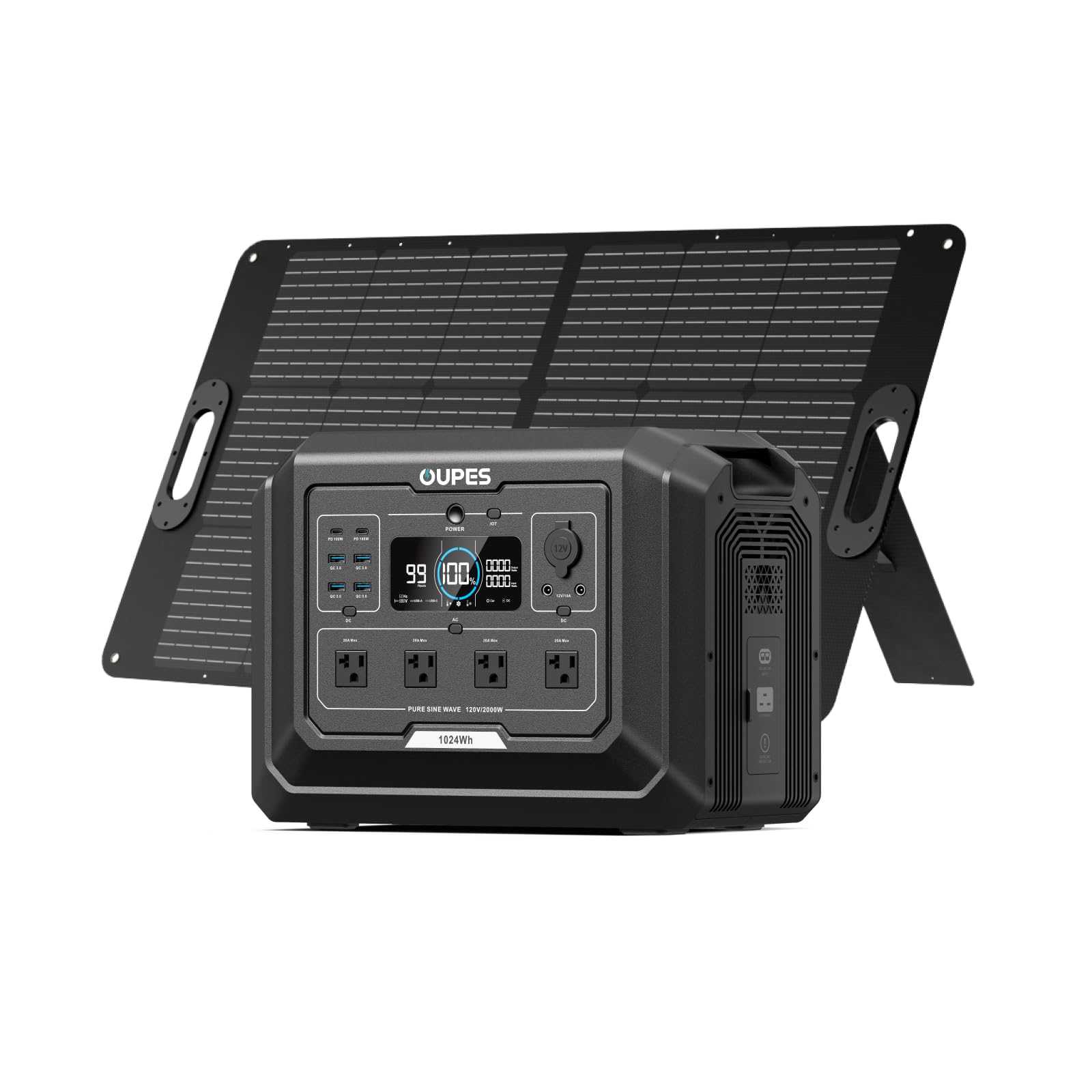
The OUPES Mega 1 claims the crown for absolute charging speed among 1kWh stations: 0–80% in just 36 minutes via AC power. When pairing AC and solar simultaneously, it achieves 0–80% in just 26 minutes — faster than some competitors manage with AC alone. The 2,000W pure sine wave inverter (4,500W surge) is the highest continuous wattage in the 1kWh segment here, handling heavy-duty appliances like microwaves and power tools without breaking a sweat.
Starting capacity is 1,024Wh, expandable to a massive 5,120Wh by adding two B2 extra batteries — a rare expansion capability at this price point. The included 100W solar panel adds immediate off-grid value, and the system accepts up to 800W solar input for rapid sun-powered replenishment. The 13 output ports include four 120V AC outlets, dual 100W USB-C, and four USB-A QC3.0 ports. The app supports remote monitoring via Bluetooth/Wi-Fi, and the UPS switches in under 20ms.
At 27.8 pounds, it’s reasonably portable for a 2,000W inverter station, and the compact dimensions fit easily in a car trunk. Some users note the app lacks certain advanced features found on higher-end competitors, and the fan can be audible during high-load charging. For the combination of fastest AC recharge, expandable capacity, and included solar panel, the Mega 1 offers the best raw speed value in the category.
Why it’s great
- 36-minute 0-80% AC recharge — fastest in class
- Dual AC+Solar charging achieves 26-minute 0-80%
- Expandable to 5,120Wh with extra batteries
- Includes 100W solar panel in the package
Good to know
- App lacks some advanced scheduling features
- Fan is audible during high-load AC charging
10. ALLWEI 1200W
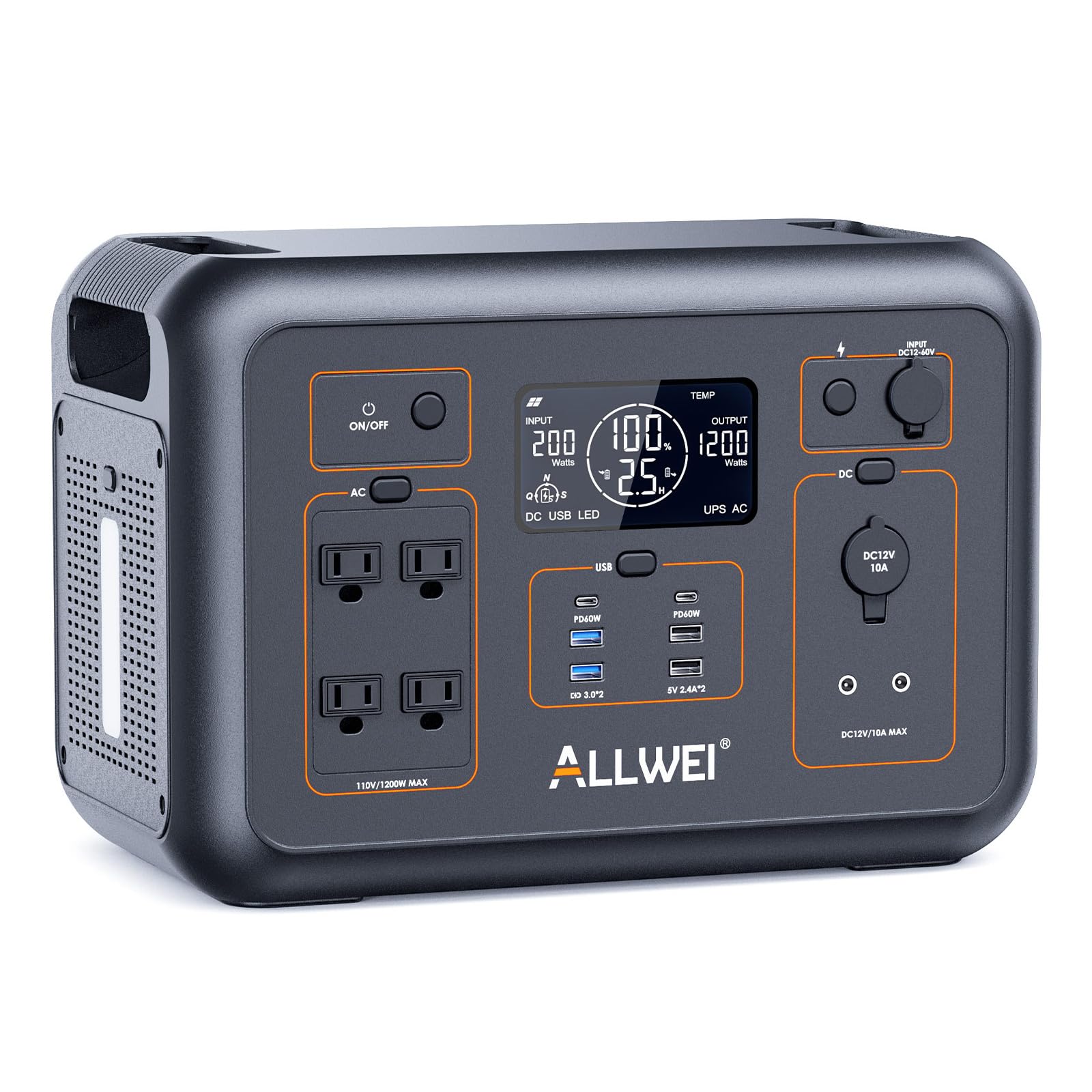
The ALLWEI 1200W offers a budget entry point into genuine LiFePO4 power stations without cutting essential safety features. The 1,008Wh battery and 1,200W pure sine wave inverter (2,400W surge) handle CPAP machines, mini-fridges, televisions, and phone charging for multiple nights. The UPS mode switches in under 10ms — matching premium units — making it suitable for critical medical devices. Full recharge takes 1.5 hours in Quick Mode, with Normal and Silent options available.
The 13 output ports include four 110V AC outlets, two 60W USB-C, two 18W USB-A, two standard USB-A, two DC5521 ports, and a car lighter — enough variety for most home and camping scenarios. At 28 pounds with a compact 14.9×8.6×10.2-inch footprint, it’s manageable for short carries. The BMS and MPPT system work reliably, and the 3,500-cycle battery provides a 10-year lifespan with proper care.
Some users reported AC output failure and fan noise under heavy load, though these appear to be isolated incidents given the generally positive feedback from buyers who use them for CPAP backup and refrigerator runtime. The proprietary solar connector is less convenient than standard MC4, and the 1,200W continuous output limits appliance options compared to the 1,500W+ competition. For low-draw emergency backup on a strict budget, the ALLWEI provides acceptable performance at the lowest entry cost.
Why it’s great
- Lowest entry cost for genuine LiFePO4 power
- <10ms UPS — matches premium-tier response
- 13 versatile ports for multiple devices
- Compact and manageable 28-pound weight
Good to know
- 1,200W inverter limits heavy appliance use
- Proprietary solar connector less flexible
- Isolated reports of AC output issues
11. BLAVOR S1600
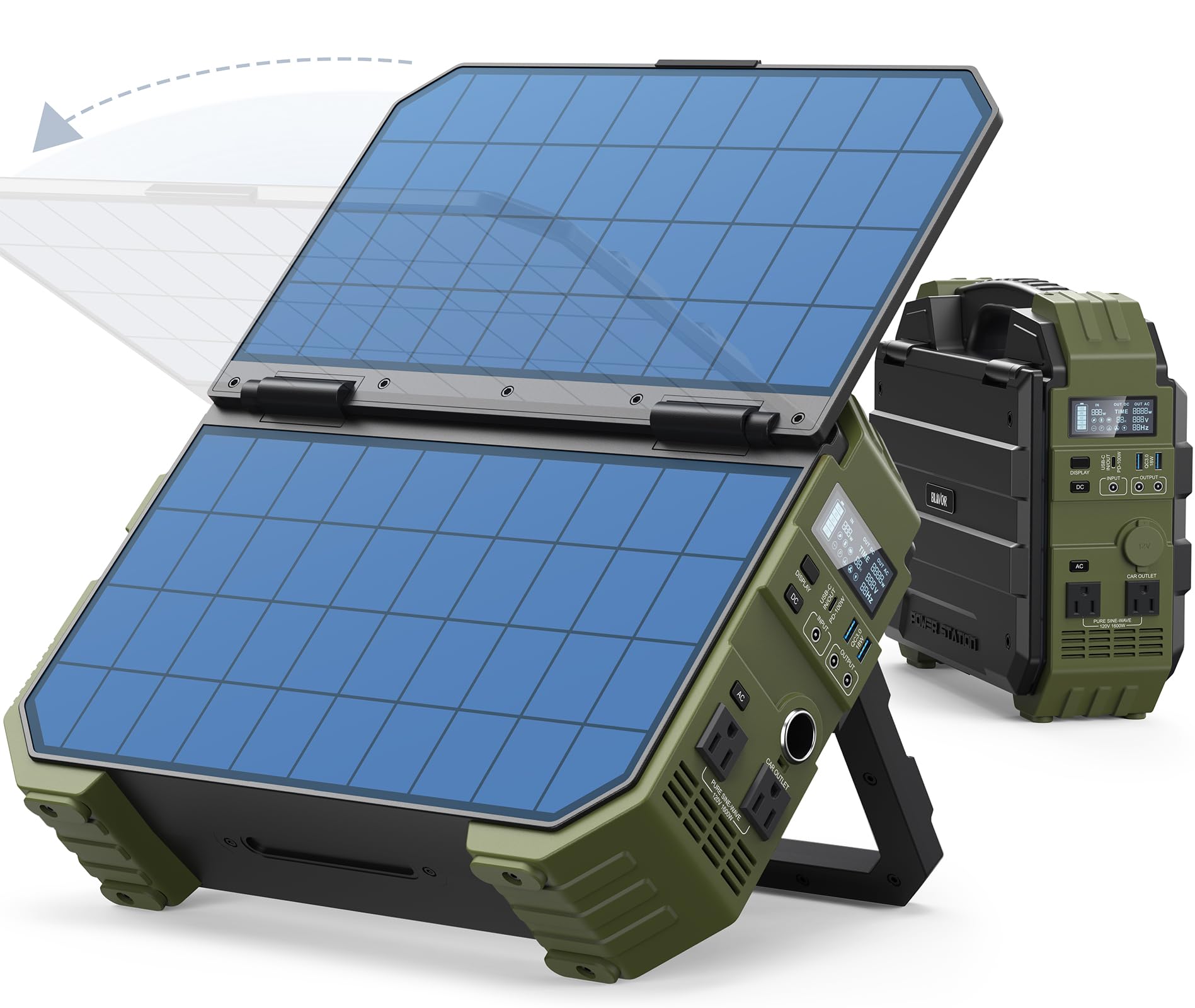
The BLAVOR S1600 stands alone with its built-in foldable 40W solar panel — an award-winning design (2022 German IF Design Award) that eliminates the need to carry a separate panel for low-power topping off. The 1,024Wh LiFePO4 battery and 1,600W continuous inverter (3,200W surge) run deep freezers for 20 hours and handle standard kitchen appliances. The integrated panel trickle-charges during daylight, extending off-grid runtime significantly without external gear.
Beyond the built-in panel, the S1600 accepts external solar panels via included adapter heads, supporting up to 200W total solar input. The 100W two-way USB-C port can both charge laptops and recharge the station itself from a compatible USB-C power source. The 26-pound weight and suitcase-style design with fixed handle make it easy to carry to campsites or around the house. The clear LCD display shows input/output wattage and remaining battery level.
The built-in panel generates roughly 200–300Wh per day in full sun — enough to recharge phones and keep the station topped off, but not sufficient to fully replenish the battery from empty. The ports have low-contrast labeling that’s hard to read in dim light, and external solar charging is slower than dedicated solar stations. For users who want the convenience of never forgetting or losing a solar panel, especially for emergency preparedness where every bit of passive charging helps, the BLAVOR S1600 is a unique and practical option.
Why it’s great
- Integrated 40W foldable solar panel — no separate panel needed
- 1,600W/3,200W surge for heavy appliances
- 26-pound suitcase design for easy carry
- Two-way 100W USB-C for laptop charging
Good to know
- Built-in panel only provides trickle charging
- Port labels are low-contrast in dim lighting
- External solar input limited to 200W total
FAQ
Can a 1000Wh power station run a full-size refrigerator?
What is the difference between UPS mode and standard pass-through charging?
How long should a LiFePO4 power station last before needing replacement?
Can I connect a 1000Wh power station to my home breaker panel?
What does “X-Boost” or “Power Lifting” mode actually do?
Final Thoughts: The Verdict
For most users, the 1000wh power station winner is the Anker SOLIX F3000 because its 3,072Wh capacity, 3,600W inverter, and 6,000W pass-through recharge set a new standard for whole-home backup in a mobile form factor. If you want true split-phase 240V output and modular expansion, grab the BLUETTI Apex 300. And for ultra-portable 1kWh performance with the fastest recharge in class, nothing beats the EF ECOFLOW DELTA 3 Classic.