
Our readers keep the lights on and the weekend projects moving. As an Amazon Associate, I earn from qualifying purchases.
Choosing between real wood, composite, and plastic tiles for your patio or balcony feels like a decision with no clear winner. Natural wood offers a classic look but demands regular sealing, while composite and plastic options promise durability with less maintenance. The right choice depends on where you live, how much sun and rain your deck sees, and whether you want a permanent upgrade or a quick, removable floor.
I’m Rikta — the co-founder and writer behind FitlyFast. I’ve spent countless hours analyzing material composition, drainage engineering, and long-term durability claims to separate marketing hype from genuine performance in the outdoor decking market.
In this guide, I break down what separates a weekend DIY refresh from a long-term flooring investment for the best artificial decking options that balance aesthetics, weather resistance, and ease of installation.
How To Choose The Best Artificial Decking
Not all deck tiles are built the same. A tile that looks great in a product photo might buckle under direct sun or trap water against your patio surface. Before you click buy, weigh these four factors.
Material Type: Wood, Composite, or Plastic
Natural wood tiles like acacia or fir deliver a warm, premium look but require annual oiling or sealing to prevent moisture damage and cracking. Composite tiles blend wood fibers with recycled plastic and a polymer coating — they resist fading and need no staining but cost more per square foot. All-plastic tiles (PP or HDPE) are the most waterproof and maintenance-free, though their appearance leans toward the artificial side. For a true wood grain feel without the upkeep, composite sits in the sweet spot.
Warranty and UV Stability
A tile that fades in two summers becomes an eyesore fast. Composite brands like NewTechWood design their polymer shell to hold color for years under direct sunlight. Plastic tiles from VEVOR and Big Floors also claim UV resistance, but the durability varies by resin quality. Check whether the manufacturer lists a residential warranty — that’s the strongest signal they believe in their color retention.
Drainage and Base Design
Standing water under your deck tiles leads to mold, mildew, and surface damage. The best tiles use a raised-grid base that lifts the walking surface off the ground and allows airflow. Look for slat spacing or drainage holes between each board. Tiles with a solid plastic backing trap moisture and should only be used over well-sealed concrete or in covered areas.
Installation and Cutting Flexibility
Almost all interlocking tiles snap together without tools, but some require a rubber mallet for a tight fit. If you plan to work around posts, railings, or irregular corners, pick a tile you can cut easily — composite tiles need a jigsaw, while plastic tiles can be scored with a utility knife. Tiles with a 4-way interlocking pattern also allow creative layouts like herringbone or basketweave.
Quick Comparison
On smaller screens, swipe sideways to see the full table.
| Model | Category | Best For | Key Spec | Amazon |
|---|---|---|---|---|
| NewTechWood Canadian Maple | Composite | Color retention & no maintenance | 0.88 in thickness | Amazon |
| NewTechWood Peruvian Teak | Composite | Darker finish with same durability | 0.88 in thickness | Amazon |
| PrimeZone 36 Pack | Plastic | Large coverage on a budget | 36 tiles per pack | Amazon |
| THYOI Acacia Wood | Wood | Natural grain on a small patio | 0.5 in thickness | Amazon |
| Big Floors DuraGrid | Plastic | Self-draining over concrete | 24 pack, 24 sq ft | Amazon |
| VEVOR 54 Pack | Plastic | High load capacity (440 lb) | 0.8 in thickness | Amazon |
| Yaheetech 55 Pack | Wood | Budget-friendly fir wood look | 55 tiles per box | Amazon |
In‑Depth Reviews
1. NewTechWood UltraShield Naturale Quick Deck — Canadian Maple
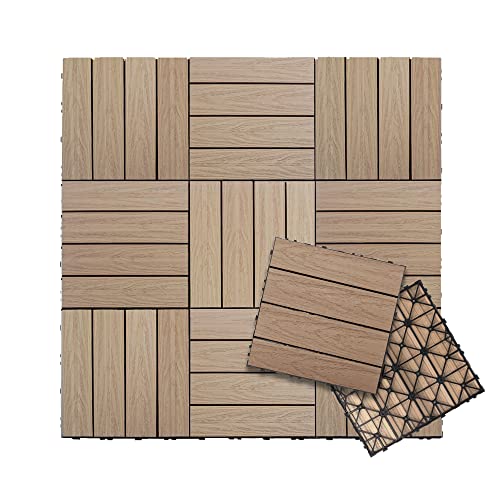
NewTechWood’s UltraShield Naturale line solves the biggest pain point in outdoor decking: color fading. The Canadian Maple finish uses a HDPE-and-wood-fiber core wrapped in a polymer shell that resists UV bleaching. Real-world reviews confirm the color stays vibrant after four years of rain and sun exposure with no washing required.
Each tile measures 12 x 12 inches and sits 0.88 inches thick — thick enough to feel solid underfoot but thin enough to cut with a jigsaw for railing posts or irregular edges. The raised base lifts the tile off the ground, promoting airflow and drainage that prevents water pooling.
Installation runs fast: one buyer covered a small balcony in under 20 minutes, and multiple users report that cutting tiles to fit around corners is straightforward with a standard jigsaw. The only real limitation is compatibility — NewTechWood tiles lock only with other NewTechWood tiles, so you cannot mix brands mid-project.
Why it’s great
- Proven color retention over multiple years
- Tool-free snap installation with 4-way locking
- Raised base allows water to drain and air to circulate
Good to know
- Only compatible with NewTechWood deck tiles
- Requires a solid, level base for a stable fit
2. NewTechWood UltraShield Naturale Quick Deck — Peruvian Teak
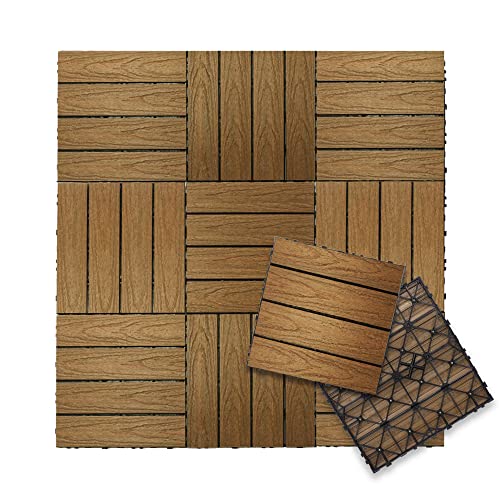
If Canadian Maple feels too light for your space, the Peruvian Teak finish delivers a richer, darker brown that mimics exotic hardwood without the annual oiling requirement. This is the same UltraShield construction — composite core with a polymer coating — so you get the same UV stability, stain resistance, and easy snap-together assembly.
Like its maple counterpart, the teak version sits 0.88 inches thick and uses a raised base for drainage. Buyers report the same fast installation experience and the ability to cut tiles with a jigsaw for custom fits. The color consistency between batches is good, though ordering all your tiles at once is still the safest move to avoid any slight variation.
One subtle difference: the darker surface absorbs more heat in direct sun, making it slightly warmer to the touch on a hot afternoon. For covered patios or shaded decks, that matters little. For a full-sun installation, the lighter maple finish may stay cooler. Either way, the material won’t warp or crack like untreated wood would.
Why it’s great
- Rich teak color that holds up to UV exposure
- Same durable polymer shell as the maple version
- Tool-free installation with flexible cutting options
Good to know
- Dark color absorbs more heat in direct sun
- Works only with other NewTechWood tiles
3. PrimeZone 36 PCS Plastic Interlocking Patio Deck Tiles
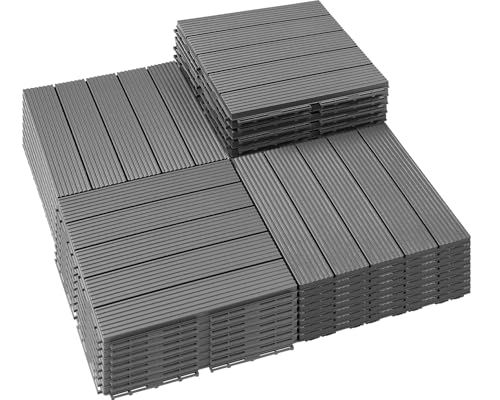
The PrimeZone 36-pack covers a full 36 square feet in one box, making it the most economical way to resurface a medium-sized patio or balcony. Each tile is made from high-hardness PP plastic with an imitation wood grain texture that adds traction without looking completely artificial. The 1-inch thickness provides a solid, stable feel underfoot.
Drainage is handled by four gaps between the five slats per tile, letting water flow through quickly. The grid structure on the underside increases friction with the ground, so the whole installation stays put even in high-traffic areas. Buyers report that cutting tiles with a utility knife is simple, and the snap-together connection requires firm pressure but no tools.
A few users noted a strong plastic smell out of the box that faded over a few days in the sun. The color between batches can vary slightly, so ordering your full project quantity at once prevents mismatched panels. For renters or anyone who wants a reversible floor upgrade, these tiles disassemble easily and leave no residue.
Why it’s great
- Large coverage with 36 tiles per box
- Easy to cut with a utility knife
- Waterproof and simple to hose clean
Good to know
- New tiles may have a temporary plastic odor
- Color consistency depends on ordering in one lot
4. THYOI Premium Group Acacia Wood Deck Tiles

For buyers who prefer real wood grain and are willing to spend a little maintenance time, the THYOI acacia tiles deliver a premium look that composite cannot fully replicate. Each tile uses 100% natural acacia wood with a deep-oil finish and a PPC base. The dark brown crossed pattern adds visual depth that stands out against standard linear decking.
The tiles are sanded smooth and splinter-free, a meaningful consideration for households with kids or pets who walk barefoot. The snap-lock mechanism is straightforward, and the slat spacing provides effective drainage. At 0.5 inches thick, these tiles are thinner than the composite options but still feel sturdy on a flat concrete base.
The trade-off is weather exposure. Buyers in humid climates report excellent durability, but the manufacturer recommends treating the wood with oil at least twice a year if used outdoors. Without that care, the top layer can degrade and develop cracks. For covered balconies or seasonal use, the risk is lower. For full-exposure decks, budget for periodic sealing.
Why it’s great
- Authentic acacia wood grain with deep-oil finish
- Splinter-free surface safe for bare feet
- Attractive crossed pattern for a custom look
Good to know
- Needs annual oiling to prevent moisture damage
- Thinner profile at 0.5 inches versus composite tiles
5. Big Floors DuraGrid Interlocking Deck Tiles

The DuraGrid tiles from Big Floors use a patented free-draining open-grid design that eliminates standing water almost immediately. This makes them a strong choice for pool surrounds, wet basements, and exposed rooftop decks where moisture management is the top concern. The beige color stays relatively cool in direct sun compared to dark tiles.
Installation is simple but requires a rubber mallet to lock the tiles together securely. Each tile measures 24 x 24 inches and can be cut in half to create a 12 x 12 inch grid if your layout demands smaller sections. The surface texture is slightly raised, providing slip resistance even when wet. Buyers note that the tiles feel firm but not hard enough to be uncomfortable for standing.
One reported downside: once snapped together, the tiles are difficult to separate without a flat screwdriver to pry the clips apart. Plan your layout carefully before final assembly. The 24-pack covers 24 square feet, so larger areas will need multiple boxes. Despite that, the durability and drainage performance make it a go-to for problem moisture spots.
Why it’s great
- Patented open-grid drainage prevents puddling
- UV resistant and built for heavy foot traffic
- Easy to cut and install with a rubber mallet
Good to know
- Difficult to disassemble once locked
- Covers 24 sq ft per box — multiple boxes needed for large areas
6. VEVOR 54 sq. ft Plastic Interlocking Deck Tiles

The VEVOR 54-pack covers a generous 54 square feet and supports up to 440 pounds per tile, making it the best option for hosting heavy furniture, grills, or even a hot tub on your deck. Each tile is 11.6 x 11.6 inches and 0.8 inches thick, molded from high-density PP plastic with a wood-like surface texture. The dark brown color blends well with most outdoor settings.
Drainage is handled by grooves and gaps between the slats, which channel water away quickly to reduce slip hazards. The cross-patterned backing adds structural stability and impact resistance. Buyers have used these tiles under hot tubs to allow ventilation and prevent moisture damage to the underlying wood deck — a clear sign of the load capacity in action.
Cutting is possible with a jigsaw or a sharp utility knife, though the dense plastic requires a bit more elbow grease than softer PP tiles. The interlocking tabs click together with a satisfying snap, but some users recommend installing in warm weather when the plastic is more flexible. The tiles are also easy to disassemble for cleaning or reconfiguration.
Why it’s great
- High load capacity supports heavy furniture and appliances
- 54 sq ft coverage in a single box
- Grooved surface provides reliable slip resistance
Good to know
- Plastic can be stiff in cold weather during installation
- Dark brown color warms up in direct sunlight
7. Yaheetech 55pcs Fir Wood Composite Deck Tiles

The Yaheetech 55-pack brings the warmth of real fir wood at a per-tile cost that beats most composite alternatives. Each tile is a 12 x 12 inch square made from natural fir wood attached to a polypropylene base. The high-temperature drying process helps the wood resist humidity better than untreated lumber, but the material still needs yearly oiling for full weather protection.
The surface is grooved to improve traction when wet, and the snap-together base allows for tool-free assembly. Buyers praise the transformation these tiles make on worn concrete patios — the reddish-brown color and visible wood grain elevate the space quickly. Cutting the tiles to fit around posts or railings is possible with a standard saw, and each box includes an extra tile for mistakes or future replacements.
The plastic backing is lighter and less robust than the NewTechWood composite core. Some users report that the staples holding the wood slats can loosen in high-traffic areas. If you plan to use these outdoors year-round, applying a wood preservative before installation and resealing annually is not optional — it is required to prevent surface cracking and moisture absorption.
Why it’s great
- Budget-friendly entry into real wood deck tiles
- 55 tiles cover a large area in one box
- Genuine fir wood grain with easy snap assembly
Good to know
- Requires annual oiling or sealing for outdoor durability
- Plastic backing is lighter and less durable than composite
FAQ
Can I install deck tiles directly over grass or dirt?
Will composite deck tiles fade in direct sunlight?
Do I need to seal real wood deck tiles before use?
Final Thoughts: The Verdict
For most users, the best artificial decking winner is the NewTechWood UltraShield in Canadian Maple because it combines authentic wood texture with a polymer shell that resists fading, cracking, and water damage with almost zero maintenance. If you want a darker, richer tone that matches teak furniture, grab the Peruvian Teak version. And for covering a large patio on a tight budget with a waterproof material that snaps together in minutes, nothing beats the PrimeZone 36-pack.