
Our readers keep the lights on and the weekend projects moving. As an Amazon Associate, I earn from qualifying purchases.
Choosing the first building set for a one-year-old means balancing two non-negotiable realities: the blocks must survive a teething mouth’s assault, and they must be large enough to prevent any choking incident. Most standard building bricks marketed to older toddlers are too small and too hard for a 12-month-old who still explores the world by putting things in their mouth. The gap between a toy that frustrates and one that genuinely supports fine motor development comes down to material softness, edge rounding, and weight distribution — specs that are invisible on the box but critical during play.
I’m Rikta — the co-founder and writer behind FitlyFast. I’ve spent hundreds of hours cross-referencing toy safety standards, material certifications, and real parent feedback to isolate the blocks that deliver developmental value without introducing unnecessary risk for this specific age group.
Whether you need a sensory-friendly stacking set, a multi-activity cube, or a durable bulk option for daycare, the blocks for 1 year old that pass both the mouth-safety test and the engagement test are rarer than most parents realize, and this guide separates the genuinely safe from the merely advertised as safe.
How To Choose The Best Blocks For 1 Year Old
A one-year-old’s play pattern shifts rapidly from mouthing and dropping to attempting two-block towers. The wrong block set either frustrates because it won’t stack easily or poses a hidden danger through small parts or toxic finishes. Focus on three decision points to land on the right set the first time.
Material Safety and Choking Prevention
At 12 months, mouthing is still a primary sensory tool. Blocks must pass two safety gates: the material must be non-toxic (BPA-free plastic or water-based paint on wood), and each block must measure at least 1.6 inches in diameter to clear standard choke tube regulations. Avoid any set labeled for ages 3+ because those blocks are often smaller and harder, designed for precision stacking that a 1-year-old cannot perform safely.
Tactile Grip and Stackability
Blocks for this age need surface friction — smooth, slippery plastic frustrates a baby who lacks the wrist control to align two blocks. Soft silicone or textured wood allows the blocks to catch against each other, making the first successful stack feel intentional rather than accidental. The weight also matters: too light and the tower topples at a breath; too heavy and the toddler struggles to lift and aim.
Developmental Versatility
The best blocks for a 1-year-old serve more than one play mode. Look for sets that allow both stacking and independent exploration — blocks with letters, numbers, or embedded sensory elements extend the toy’s lifespan beyond the stacking phase. Activity cubes that combine shape sorting, bead mazes, and xylophones offer rotational interest that a single block type cannot match, keeping a short attention span engaged across multiple skill domains.
Quick Comparison
On smaller screens, swipe sideways to see the full table.
| Model | Category | Best For | Key Spec | Amazon |
|---|---|---|---|---|
| Infantino Super Soft Blocks | Soft Plastic | Teething & mouthing safety | BPA-Free silicone material | Amazon |
| WOODMAM 7-in-1 Activity Cube | Activity Cube | Multi-skill development | 7 play activities in 1 cube | Amazon |
| Bravmate 8-in-1 Cube | Activity Cube | Rotating engagement | 8 games: maze, xylophone, abacus | Amazon |
| Gemileo ABC Wooden Blocks | Wooden Alphabet | Letter & number recognition | 1.7 inch block size | Amazon |
| BUNMO Wooden Stacking | Montessori Wood | Fine motor & focus | 40-piece stacking set | Amazon |
| Migargle 80-Piece Beech | Classic Wood | Bulk wooden block play | Natural beech wood construction | Amazon |
| FUBAODA 180-Piece Set | Interlocking Plastic | Older sibling share play | 180 interlocking pieces | Amazon |
In‑Depth Reviews
1. Infantino Super Soft Building Blocks
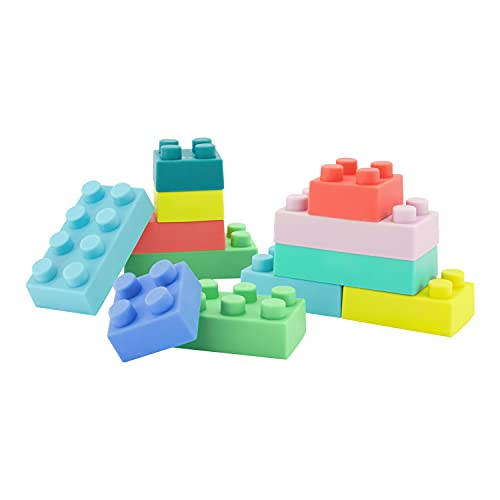
This 12-piece set is the gold standard for the 12-month age bracket because the blocks are made from a soft, BPA-free material that collapses slightly under pressure — meaning no painful steps, no hard edges, and no damage when thrown. The three different size varieties introduce the concept of small, medium, and large, giving a toddler their first tactile size comparison lesson without requiring language.
Parents consistently report that these blocks survive chewing, drool, and being dropped onto hard floors without any degradation in shape or color. The squishable texture makes them ideal for babies who are still teething, and the large size means there is zero choking risk even under close supervision. The set includes 12 pieces — enough for stacking towers without overwhelming a one-year-old’s short attention span.
What sets these apart from wooden alternatives is that they can be cleaned with a damp cloth or thrown in the dishwasher top rack, making them the most hygienic option for a toy that will inevitably spend time in a toddler’s mouth. The colors are bright but not neon, and the blocks nest inside each other for easy storage.
Why it’s great
- Completely painless to step on or throw
- Dishwasher-safe for easy sanitizing
- Three distinct sizes teach size differentiation
Good to know
- Soft material limits stacking height to about 4 blocks
- Not designed for complex building or interlocking
2. WOODMAM Wooden 7-in-1 Activity Cube

This activity cube consolidates seven distinct play modes — xylophone, bead maze, shape sorter, spinning gears, animal sliding game, learning clock, and a sorting stacking board — into a single compact footprint. For a 1-year-old who needs variety every few minutes, the ability to rotate between sides without requiring adult intervention is a significant engagement advantage. The cube is built from natural wood with water-based paint and smooth, rounded edges that meet safety requirements for the 12-month age group.
The chunkier shape blocks are designed to be large enough to prevent choking but small enough for a 1-year-old to grasp and fit into the sorter holes. The xylophone produces a recognizable note, and the bead maze offers a different tactile challenge from the stacking blocks on the opposite side. The learning clock on the detachable top provides a preview of number recognition that will become more relevant as the child approaches age 2.
Parents note that the top bead maze detaches easily — which can be a minor frustration if a toddler separates it during play, but also adds portability for travel or table-top sessions. The cube measures 7.09 by 6.5 by 7.48 inches, making it a mid-sized toy that fits on a shelf without dominating the playroom.
Why it’s great
- Seven activities in one toy reduce clutter
- Water-based paint and smooth edges ensure safety
- Detachable top converts to a travel toy
Good to know
- Xylophone has a tinny, less resonant sound
- Top detaches with moderate force during play
3. Bravmate Wooden Activity Cube, 8-in-1

Bravmate’s 8-in-1 cube expands on the standard activity cube formula by adding an abacus and word cards alongside the expected bead maze, xylophone, shape sorter, gears, clock, and sorting blocks. The natural rubber wood construction with water-based paint delivers the same safety profile as the WOODMAM cube, but the extra two activities give a slightly longer engagement window for a rapidly developing toddler. The bonus sorting and stacking board provides a flat-surface alternative when the child is ready to sit and focus rather than rotate around a cube.
The cube is 7.6 inches per side, which is large enough to remain stable during play but compact enough to pack for a trip. The wooden pieces are solid and show no splintering or paint chipping even after months of use. Parents who bought this for a 12-month-old report that the shape sorter and gears are the initial draws, with the abacus and word cards becoming more interesting around 18 months, effectively extending the toy’s practical lifespan beyond the first birthday.
The storage bag included for the sorting blocks is a small but appreciated detail — it teaches clean-up habits early and prevents losing the small shape pieces that are essential for the sorting game.
Why it’s great
- Eight activities plus a bonus sorting board
- Sturdy rubber wood withstands active play
- Activities scale in difficulty from 12 to 24 months
Good to know
- Heavier than expected for travel
- Some find the abacus beads small for 12-month-old hands
4. Gemileo Wooden ABC Toy Building Blocks

This 36-piece set from Gemileo addresses the biggest complaint parents have about alphabet blocks — most sets use blocks that are too small for a 1-year-old to grip safely. At 1.7 inches per cube, these blocks exceed the safe sizing threshold while remaining lightweight enough for a toddler to lift and stack repeatedly. Each block features an uppercase letter on one side and the corresponding lowercase letter on the opposite side, plus colorful illustrations of animals, fruits, and vegetables that provide vocabulary-building talking points during play.
The thermal transfer printing is more durable than painted letters — it resists fading from drool and wiping without peeling off. The blocks come with a carry bag, which helps contain the set and prevents pieces from scattering under furniture. Parents consistently note that these blocks stack well because the flat surfaces and square edges provide reliable stability, unlike rounded or irregular Montessori blocks that topple easily.
For a 1-year-old, the primary activity is stacking and knocking down towers. The letter recognition aspect becomes useful later, but the immediate value is in the block geometry — uniform cubes that teach cause and effect through reliable toppling physics.
Why it’s great
- Large 1.7-inch size eliminates choking risk
- Thermal transfer printing stays intact through mouthing
- Includes carry bag for organized storage
Good to know
- Illustrations are printed on only two sides per block
- Wood finish is smooth but not coated for extra grip
5. BUNMO 40pcs Wooden Stacking Toys
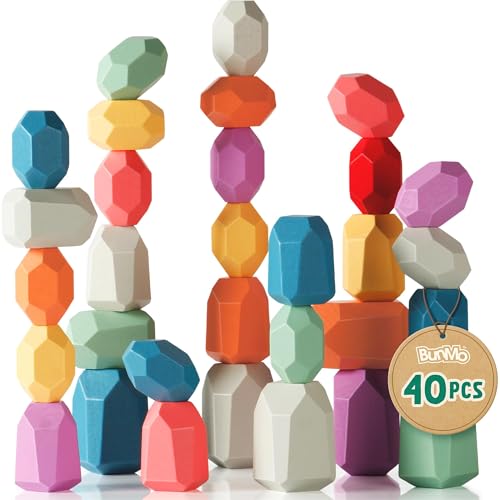
BUNMO’s 40-piece stacking set takes a Montessori approach with muted, desaturated colors that are deliberately less visually overwhelming than the neon-bright plastic sets. Each of the 40 pieces is sanded smooth and coated with a non-toxic finish that passes choke tube testing, making them safe for the mouthing phase. The blocks vary in size from a 2-inch base piece down to smaller accent pieces, though parents should remove the smallest pieces if the child is still actively mouthing everything within reach.
The stacking challenge here is higher than with soft plastic blocks — the wooden surfaces require more precise alignment, which builds hand-eye coordination and patience. Many parents report that this set doubles as a focus tool for older siblings and even adults, suggesting that the toy has an unusually long developmental arc from 12 months well into preschool. The blocks are packaged in a reusable box that doubles as storage.
Several parents noted that the smallest pieces can fit into a 1-year-old’s mouth, so the set is best suited for children closer to 14 months who have started to outgrow the oral exploration phase, or for supervised play where an adult actively removes small pieces.
Why it’s great
- Calming muted colors reduce sensory overstimulation
- Varied sizes offer progressive difficulty levels
- Smooth sanded finish with no splinters reported
Good to know
- Smallest pieces may pose a choking risk for heavy mouthing
- Wide stacking is unstable compared to flat-topped cubes
6. Migargle Kids Wooden Blocks 80 Pcs

This 80-piece set from Migargle is made from solid natural beech wood, which is significantly harder and more durable than pine or the composite wood used in lower-tier block sets. The blocks are coated with water-based, non-toxic paint that meets international safety standards, and each block features smooth, rounded edges. The set includes a variety of shapes — rectangles, squares, triangles, and arches — that allow for more creative building than identical cubes. For a 1-year-old who has mastered two-block towers, the shape variety introduces the concept of balance and symmetry.
The included carrying bag makes cleanup practical, and at 3.7 pounds total weight, the set is portable enough to bring to a grandparent’s house or daycare. Parents should note that some blocks in this set are smaller than the 1.6-inch threshold, so supervision is essential for children who still mouth toys. The smaller pieces are closer to 1 inch, making them more appropriate as the child approaches 18 months and has largely stopped putting objects in the mouth.
Many parents praise the beech wood construction for its durability — blocks dropped from toddler height onto hardwood floors show no cracks or splintering even after extended use.
Why it’s great
- Solid beech wood resists denting and cracking
- Multiple shapes expand creative building possibilities
- Carry bag makes portable storage simple
Good to know
- Some smaller blocks are not safe for heavy mouthing
- Blocks are smaller than typical unit blocks
7. FUBAODA 180 Pcs Interlocking Building Blocks

FUBAODA’s 180-piece interlocking set is the only entry-level building brick option on this list, and it earns a spot because many families with a 1-year-old also have an older sibling who needs age-appropriate toys. The interlocking mechanism requires more finger strength than a 12-month-old can typically muster — the pieces snap together with moderate resistance — but the set works as a shared play experience where the older child builds and the younger child destroys. The 8-color palette introduces color sorting and counting that supports early STEM learning.
Parents should be aware that the 36-month minimum age recommendation is accurate for independent play. A 1-year-old should not be left unsupervised with these blocks because individual pieces are small enough to pose a choking risk. However, as a supervised group toy or a future-proof investment for when the child turns 2, the 180-piece count and color variety provide exceptional value. The blocks are made from standard ABS plastic, which is durable and easy to clean.
The main critique from parents is that the pieces can be difficult for young toddlers to snap together and pull apart, which can lead to frustration. The set also lacks an instruction booklet, relying on open-ended creativity rather than guided builds.
Why it’s great
- Large piece count supports shared sibling play
- 8 distinct colors aid color recognition learning
- Standard ABS plastic is easy to sanitize
Good to know
- Too small for independent play under age 3
- Snap-fit requires more grip strength than 1-year-olds have
FAQ
Are wooden blocks safe for a 1-year-old who still puts everything in their mouth?
How many blocks should a 1-year-old have in a set?
What is the difference between Montessori blocks and regular building blocks?
Can a 1-year-old play with interlocking blocks like LEGO Duplo?
Final Thoughts: The Verdict
For most users, the blocks for 1 year old winner is the Infantino Super Soft Building Blocks because the soft, BPA-free material completely eliminates the injury and choking risk while providing a satisfying sensory experience for stacking, chewing, and throwing. If you want a multi-activity toy that builds multiple skills from a single footprint, grab the WOODMAM 7-in-1 Activity Cube. And for alphabet exposure and long-term stacking value that grows with the child, nothing beats the Gemileo Wooden ABC Blocks.