
Our readers keep the lights on and the weekend projects moving. As an Amazon Associate, I earn from qualifying purchases.
Your internet service provider’s rental router is a quiet monthly drain that delivers mediocre performance across your home. Replacing it with your own hardware pays for itself within a year and unlocks the speed you’re already paying for.
I’m Rikta — the co-founder and writer behind FitlyFast. I have analyzed dozens of routers under , digging into chipset generations, antenna configurations, and real-world throughput data to find the units that genuinely outperform their price tags.
The right home network upgrade starts with a solid, future-ready foundation. This guide cuts through the marketing noise to help you find the very best affordable wifi router for your specific home layout and device load.
How To Choose The Best Affordable WiFi Router
The market is flooded with routers at every price point, but not all of them deliver the stability and speed your household needs. Before you click buy, focus on three pillars: the WiFi generation, the physical coverage your home requires, and the number of devices that will connect simultaneously.
WiFi 6 vs. WiFi 5 — The Generation Gap
A budget-friendly router today should be WiFi 6 (802.11ax). Older WiFi 5 (802.11ac) routers are cheaper, but they lack OFDMA, which allows the router to talk to multiple devices at once instead of one at a time. For a home with smart bulbs, tablets, phones, and laptops all competing for bandwidth, WiFi 6 is the only sensible entry point.
Square Footage and Construction
Most affordable routers advertise coverage between 1,500 and 2,500 square feet. Drywall, floors, and appliances all weaken the signal. If your home is a single-level open floor plan, a standard router will suffice. For multi-story homes or spaces with thick walls, a mesh system like the TP-Link Deco series is a better investment.
Ports and Wired Backhaul
Gigabit Ethernet ports are non-negotiable. Even if you plan to use WiFi for everything, a wired connection to your gaming console or PC offers the lowest latency. Some mesh units also support Ethernet backhaul, meaning you can wire the satellite nodes together for faster, more stable speeds than wireless linking alone.
Quick Comparison
On smaller screens, swipe sideways to see the full table.
| Model | Category | Best For | Key Spec | Amazon |
|---|---|---|---|---|
| TP-Link Archer AX21 | Standalone Router | Best Overall Value | AX1800, 1.8 Gbps total | Amazon |
| Netgear Nighthawk RAX43 | Standalone Router | Raw Speed for Gaming | AX4200, 4.2 Gbps total | Amazon |
| TP-Link Deco X55 | Mesh System | Whole-Home Coverage | AX3000, 2,500 sq ft | Amazon |
| Linksys MR7350 | Standalone Router | Simple Setup | AX1800, 1,700 sq ft | Amazon |
| Netgear R6700AX | Standalone Router | Compact Design | AX1800, 1,500 sq ft | Amazon |
| Amazon eero 6 | Mesh System | Smart Home Integration | WiFi 6, 900 Mbps plan | Amazon |
| ASUS RT-AX82U | Gaming Router | Low Latency Gaming | AX5400, 160MHz channels | Amazon |
In‑Depth Reviews
1. TP-Link Archer AX21 (AX1800)

The Archer AX21 is the gold standard for budget-friendly WiFi 6. Its dual-band AX1800 architecture delivers up to 1.8 Gbps total bandwidth, and the four high-gain antennas with beamforming focus the signal directly to your devices. In a typical 1,500-square-foot home, this unit eliminates dead zones that plague older ISP-provided hardware.
Setup is straightforward through the Tether app, and the admin interface gives you granular control over network splitting, guest access, and parental controls. The OFDMA technology handles up to 30 devices without noticeable congestion — a critical advantage over older WiFi 5 routers that stagger data transmissions.
Long-term reliability is strong, with automatic firmware updates and a VPN server built in. Users report stable uptimes measured in months, not weeks, and the router recovers quickly after ISP outages. The Archer AX21 is the smartest first step away from rental fees.
Why it’s great
- Excellent range for a single-unit router
- Easy mesh expansion if you need more coverage later
Good to know
- Basic QoS implementation — not as granular as premium gaming routers
- Smart Connect may auto-merge bands; disabling it fixes device drops
2. Netgear Nighthawk RAX43 (AX4200)

The Nighthawk RAX43 pushes toward the premium side of budget territory with five data streams and a combined AX4200 speed rating. The 1.5GHz triple-core processor handles intense workloads — think simultaneous 4K streaming, file downloads, and online gaming — without stuttering. It covers up to 2,000 square feet when positioned centrally.
Setting up via the Nighthawk app is quick, and the interface provides deep analytics on connected devices and bandwidth usage. The retractable antennas are a neat design touch, and the router ships with NETGEAR Armor for basic security protection. Users on gigabit plans see wireless speeds close to wired performance.
Reliability is the main concern here. While many units run flawlessly for months, a subset of users report intermittent 5GHz dropouts after 90 days, and Netgear’s support requires a paid subscription after the first year. Buying the renewed version lowers the entry cost, but you may need to apply a manual firmware update immediately.
Why it’s great
- Fastest total bandwidth in this price tier
- Strong 5GHz performance for gaming when stable
Good to know
- Some units develop 5GHz instability after a few months
- Renewed model may require manual firmware patching
3. TP-Link Deco X55 (AX3000)

The Deco X55 is a single-unit mesh node that covers 2,500 square feet, making it ideal for larger apartments or ranch-style homes. Its AX3000 speed rating combines a 2.4GHz band and a 5GHz band with HE160 technology for double the data throughput. The AI-driven mesh intelligence learns your network patterns and optimizes traffic routing automatically.
Each Deco unit packs three Gigabit Ethernet ports, and all of them support wired Ethernet backhaul. This is a massive advantage over older mesh systems that waste a port for the internet connection. If you buy a second node later, you can wire them together for near-gigabit wireless speeds throughout the house.
The Deco app provides clear visual guidance during setup and gives you remote control over security, QoS, and parental controls. TP-Link’s HomeShield adds a free security layer without a subscription. Firmware updates have added features like custom IP reservations and an IoT network, making the X55 a system that genuinely improves over time.
Why it’s great
- All three ports are functional Gigabit Ethernet — no wasted WAN-only ports
- Wired backhaul support for maximum mesh stability
Good to know
- Single SSID only — no separate 2.4GHz and 5GHz network names
- LAN ports can become unresponsive if the internet connection drops
4. Linksys MR7350 (AX1800)

The Linksys MR7350 uses Intelligent Mesh technology, which means it can dynamically route traffic to maximize speed and eliminate dead zones. The Qualcomm chipset provides stable, low-latency connections for up to 25 devices across 1,700 square feet. It is a straightforward router for users who want reliability without tweaking settings.
Setup through the Linksys App is fast — most users report being online in under five minutes. The router supports WiFi 6’s full benefits, including higher bandwidth limits for streaming and gaming. The hardware is compact and the white finish blends into most living spaces, a welcome break from the typical black gaming aesthetic.
The trade-off is a simplified admin interface that lacks advanced options like hidden SSID configuration. Users accustomed to deep customization may find the app-controlled settings limiting. Some units have also been reported to ship with old firmware, requiring a manual check before use.
Why it’s great
- Dead-simple app setup that works for non-technical users
- Intelligent Mesh dynamically optimizes signal paths
Good to know
- No hidden SSID option for privacy-conscious users
- Lacks advanced admin controls found on TP-Link and Netgear alternatives
5. Netgear R6700AX (AX1800)
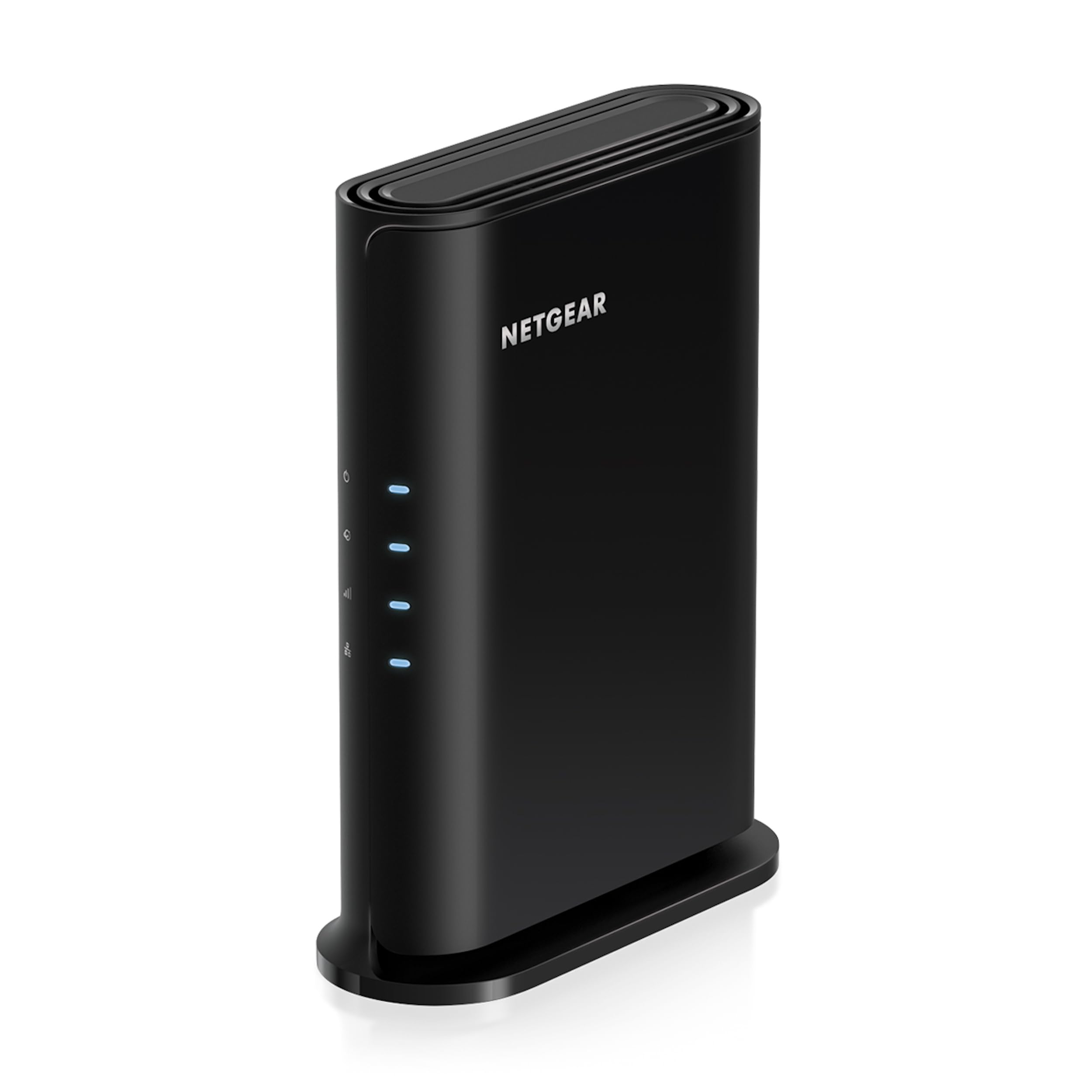
The R6700AX is a no-nonsense 4-stream WiFi 6 router that covers up to 1,500 square feet and supports 20 connected devices. Its compact internal antenna design makes it one of the smallest AX1800 routers on the market, and the 1 Gigabit WAN port ensures compatibility with any cable, fiber, DSL, or satellite modem.
Setup is flexible — use the Nighthawk app or a standard web browser. The guided installation takes less than 10 minutes. Users switching from an ISP rental immediately notice stronger signal penetration through walls and a significant speed improvement on devices that support WiFi 6. The router pays for itself within a year compared to typical -per-month rental fees.
Security features include WPA3 encryption and automatic firmware updates at no cost. Netgear Armor is available as a paid subscription after a 30-day trial. The main drawback is the lack of 160MHz channel support, which limits peak speeds compared to the ASUS RT-AX82U, but for most households, the R6700AX delivers everything needed at a lower entry cost.
Why it’s great
- Very compact footprint with internal antennas
- Fast, reliable setup for users switching from ISP routers
Good to know
- No 160MHz channel support — max real-world speed is limited
- Renewed or open-box units may have inconsistent firmware versions
6. Amazon eero 6

The eero 6 is a mesh WiFi 6 node that handles internet plans up to 900 Mbps and covers 1,500 square feet per unit. Its TrueMesh technology intelligently routes traffic to reduce buffering and drop-offs, making it a strong choice for homes with multiple streaming devices and video calls happening simultaneously.
What sets the eero 6 apart is its built-in Zigbee smart home hub. You can connect compatible Zigbee devices — like smart lights, sensors, and locks — directly to the eero without needing a separate hub. Amazon Alexa integration is native, allowing voice control of your network and connected devices from the same ecosystem.
Setup takes minutes through the eero app, and automatic updates keep the network secure without user intervention. The system is expandable with any cross-compatible eero product. The downside is that the eero 6 is limited to 900 Mbps internet plans, so gigabit subscribers will want the eero Pro 6 instead.
Why it’s great
- Built-in Zigbee hub eliminates need for separate smart home bridges
- TrueMesh technology delivers strong, stable coverage
Good to know
- Capped at 900 Mbps — not suitable for gigabit internet plans
- Limited advanced settings compared to TP-Link and Netgear rivals
7. ASUS RT-AX82U (AX5400)

The ASUS RT-AX82U is a gaming-oriented router that delivers AX5400 speeds thanks to 160MHz channel support. The dedicated mobile game mode minimizes latency with a single tap in the ASUS Router app, and the Aura RGB lighting lets you customize the aesthetic to match your setup. For competitive gamers, this router consistently delivers sub-30ms pings in fast-paced titles.
Beyond gaming, the router supports ASUS AiMesh, allowing you to build a seamless whole-home mesh by adding compatible ASUS nodes. The lifetime free AiProtection Pro, powered by Trend Micro, provides commercial-grade security without a subscription — a significant advantage over Netgear’s paid Armor plan. The admin interface is among the deepest in this price range, offering VLANs, traffic monitoring, and scheduled reboots.
The renewed unit is the budget entry point for this high-performance hardware. Users report that the refurbished units arrive in like-new condition with all original accessories. The main caveat is that the feature-rich interface can overwhelm novice users, and some units experience persistent ISP DHCP errors that require troubleshooting.
Why it’s great
- 160MHz channel support for real-world speeds above 600 Mbps
- Lifetime free AiProtection Pro with no subscription fees
Good to know
- Overwhelming interface for non-technical users
- Some renewed units report ISP DHCP errors
FAQ
Do I need a separate modem for these routers?
What does a renewed router mean for reliability?
How many devices can an affordable WiFi 6 router handle?
Final Thoughts: The Verdict
For most users, the affordable wifi router winner is the TP-Link Archer AX21 because it delivers reliable WiFi 6 performance, excellent range, and easy setup at a price that pays for itself within a year of skipping ISP rental fees. If you need whole-home coverage without dead zones, grab the TP-Link Deco X55 and its wired backhaul support. And for low-latency gaming with 160MHz channel speeds, nothing beats the ASUS RT-AX82U on a budget.