
Our readers keep the lights on and the weekend projects moving. As an Amazon Associate, I earn from qualifying purchases.
A cold garage turns a productive workspace into a frozen storage unit. Whether you’re restoring a classic car, building furniture, or just trying to survive the winter workout, an undersized heater that can’t handle the volume of a two-car garage is a waste of money and patience. The key is matching the heater’s BTU output and voltage to your insulation level and square footage, not just picking the cheapest unit on the shelf.
I’m Rikta — the co-founder and writer behind FitlyFast. I’ve spent hundreds of hours parsing through wiring specs, heating element types, and customer installation headaches to identify which heaters actually deliver consistent warmth in uninsulated and semi-insulated two-car garages ranging from 400 to 700 square feet.
For the serious shopper, finding the best 2 car garage heater means balancing heat output measured in BTUs or watts against your existing electrical capacity while factoring in ceiling mount versus portable form factors and thermostatic control precision down to a single degree Fahrenheit.
How To Choose The Best 2 Car Garage Heater
Choosing the right heater starts with understanding that a standard two-car garage is roughly 400 to 600 square feet with ceiling heights that trap cold air. The heater must overcome that volume without tripping breakers or burning through your monthly budget. Focus on these three factors before reading any product label.
Voltage and Electrical Capacity
The biggest mistake buyers make is assuming any heater works on a standard 110V outlet. For a two-car garage, 1500-watt 110V units are supplemental at best. Real warmth requires 240V circuits pulling 20 to 30 amps. Verify your breaker panel has spare slots and the correct gauge wire before committing to a hardwired unit.
BTU Output Against Square Footage
A general rule is 10 watts per square foot for electric heaters, which translates to roughly 5000 watts or 17,000 BTUs for a 500-square-foot garage. Uninsulated garages with high ceilings may need 20 to 30 percent more capacity. Infrared and forced air systems distribute heat differently, so match the heating method to your garage’s air circulation and typical use case.
Mounting and Form Factor
Ceiling-mounted and wall-mounted heaters preserve valuable floor space and project heat downward where you actually work. Portable units offer flexibility but take up space and often lack the safety features of fixed installations. Consider whether you want a hardwired unit with a remote thermostat or a plug-in model that moves between your garage and workshop.
Quick Comparison
On smaller screens, swipe sideways to see the full table.
| Model | Category | Best For | Key Spec | Amazon |
|---|---|---|---|---|
| Heat Storm HS-6000-GC | Premium WiFi | Smart scheduling & full-garage warmth | 6000W / 20,000 BTU | Amazon |
| VEVOR 7500W Digital | High-Power Forced Air | Intense heat for uninsulated spaces | 7500W / 25,600 BTU | Amazon |
| Mr. Heater Blue Flame NG | Natural Gas | No electricity needed | 20,000 BTU | Amazon |
| Comfort Zone 5000W Ceiling | Mid-Range Ceiling | Budget-friendly full-shop coverage | 5000W / 17,000 BTU | Amazon |
| Cadet Com-Pak Twin CSTC402TW | In-Wall Forced Air | Permanent in-wall installation | 4000W / 13,648 BTU | Amazon |
| DR. INFRARED HEATER DR218-3000W | Compact Radiant | Small greenhouse or workshop spot heat | 3000W / 10,200 BTU | Amazon |
| Dura Heat EUH4000R | Portable Forced Air | Flexible mounting with remote control | 3750W / 12,800 BTU | Amazon |
| Heat Storm HS-1500-PHX-WIFI | Infrared WiFi | Smart control for insulated small garages | 1500W / 5200 BTU | Amazon |
| Shinic 2-Pack Radiant | Budget Twin Pack | Spot heating with built-in work light | 1500W each | Amazon |
In‑Depth Reviews
1. Heat Storm HS-6000-GC
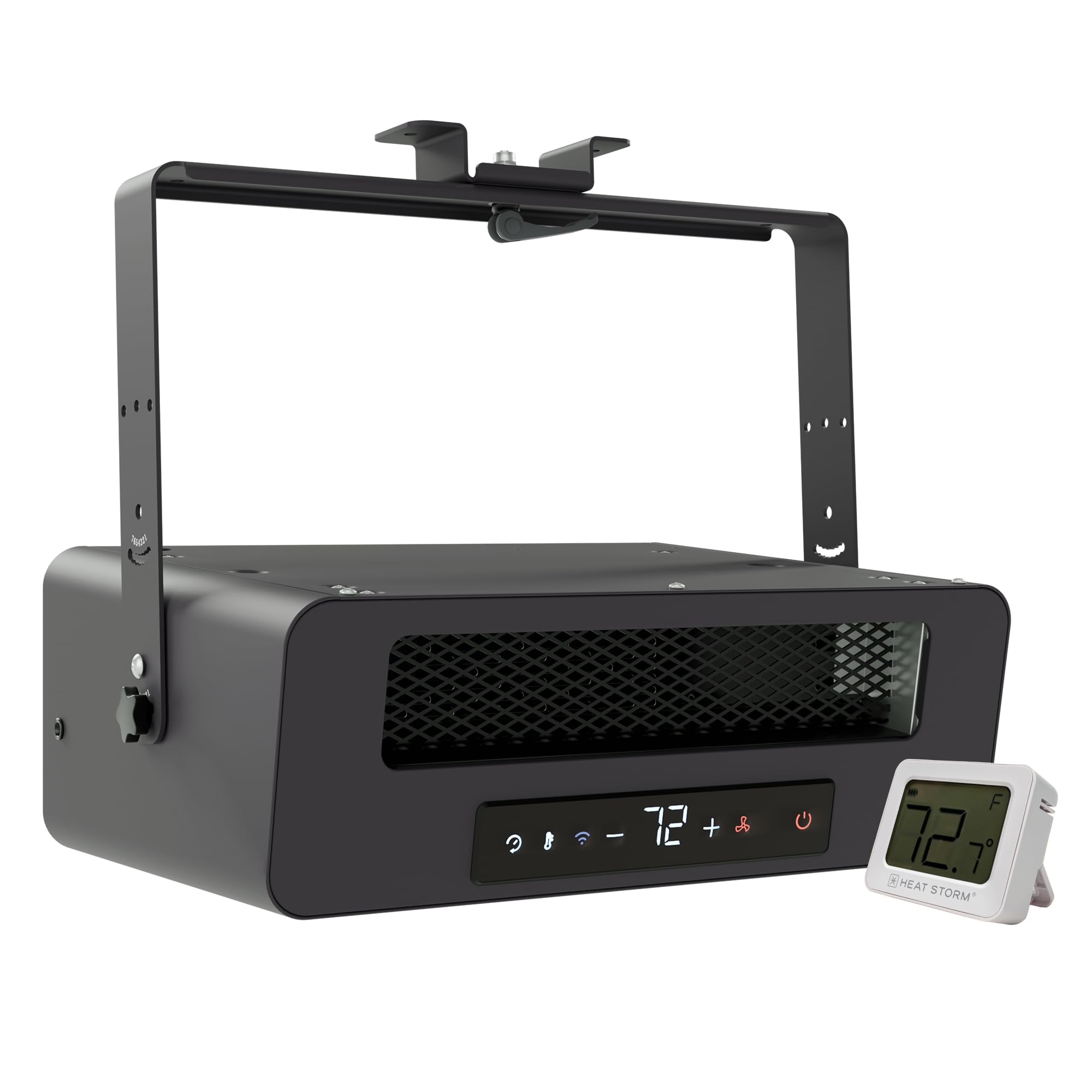
The Heat Storm HS-6000-GC delivers a hefty 6000 watts of adjustable output ranging from 10,000 to 20,000 BTUs, making it one of the most versatile hardwired units for a two-car garage. Its compact footprint measures just 7 inches deep by 18 inches wide, so it mounts flush to the ceiling or wall without dominating the visual space. The built-in thermostat cycles the unit to hold a precise temperature, and the WiFi connectivity lets you schedule the heater to warm the garage before you even step inside.
Real-world testing in a 400-square-foot insulated Chicago garage showed the HS-6000-GC maintained a comfortable 60 degrees when outside temps dropped to -3, and the built-in directional louvers directed heat exactly where needed. The fan delay function continues circulating residual heat after the heating cycle ends, improving efficiency. Installation requires a 240V circuit with a 25-amp breaker and hardwiring, so plan for an electrician if you are not comfortable with electrical work.
The unit is whisper-quiet compared to smaller forced-air heaters, and the gray powder-coat finish resists rust in humid garage environments. For anyone with a semi-insulated or fully insulated two-car garage who wants smart home integration without sacrificing raw heat output, this is the most capable all-around package available.
Why it’s great
- WiFi scheduling with app control for pre-heating the garage before arrival
- Compact ceiling-mount design saves floor space and distributes heat downward
- Built-in thermostat holds temperature within a narrow range for consistent comfort
Good to know
- Requires hardwiring to a 240V 25-amp circuit; not a plug-in unit
- Best results observed in insulated garages; uninsulated spaces may need two units
- WiFi setup process can be slightly unintuitive for first-time users
2. VEVOR 7500W Digital Fan-Forced Heater

If raw power is your priority, the VEVOR 7500W is the highest-wattage unit in this comparison, pumping out 25,600 BTUs to cover up to 732 square feet. That makes it the best option for uninsulated garages where smaller heaters simply cannot keep up. The digital control panel features a precise thermostat that maintains temperature within a narrow 2-degree Fahrenheit window, and the included remote control means you can adjust settings without climbing off the work stool.
The forced-air design pushes hot air across the room at high velocity, eliminating cold pockets in spaces with high ceilings or drafts. Users with 25-by-30-foot insulated garages reported the VEVOR kept the space comfortable with minimal impact on their electric bill, thanks to the thermostat cycling rather than running continuously at full power. The 9-hour timer is useful for pre-heating before weekend work sessions.
Bear in mind that this unit requires a 240V circuit rated above 32 amps with 8-gauge wiring, which is a heavier electrical demand than typical garage circuits. The fan noise is noticeable — some owners describe it as comparable to a vacuum cleaner running on low — so it is not ideal for quiet work environments. Still, for punishing cold climates and large uninsulated shops, the VEVOR delivers unmatched thermal output.
Why it’s great
- Highest wattage among the group at 7500W for extreme cold conditions
- Digital thermostat with 2-degree precision for consistent temperature control
- Includes remote control and 9-hour timer for convenience
Good to know
- Requires a dedicated 240V 32-amp circuit with heavy-gauge wiring
- Fan noise is loud enough to be heard from across the room
- SPCC steel shell is sturdy but adds weight during installation
3. Mr. Heater 20,000 BTU Blue Flame Natural Gas Heater
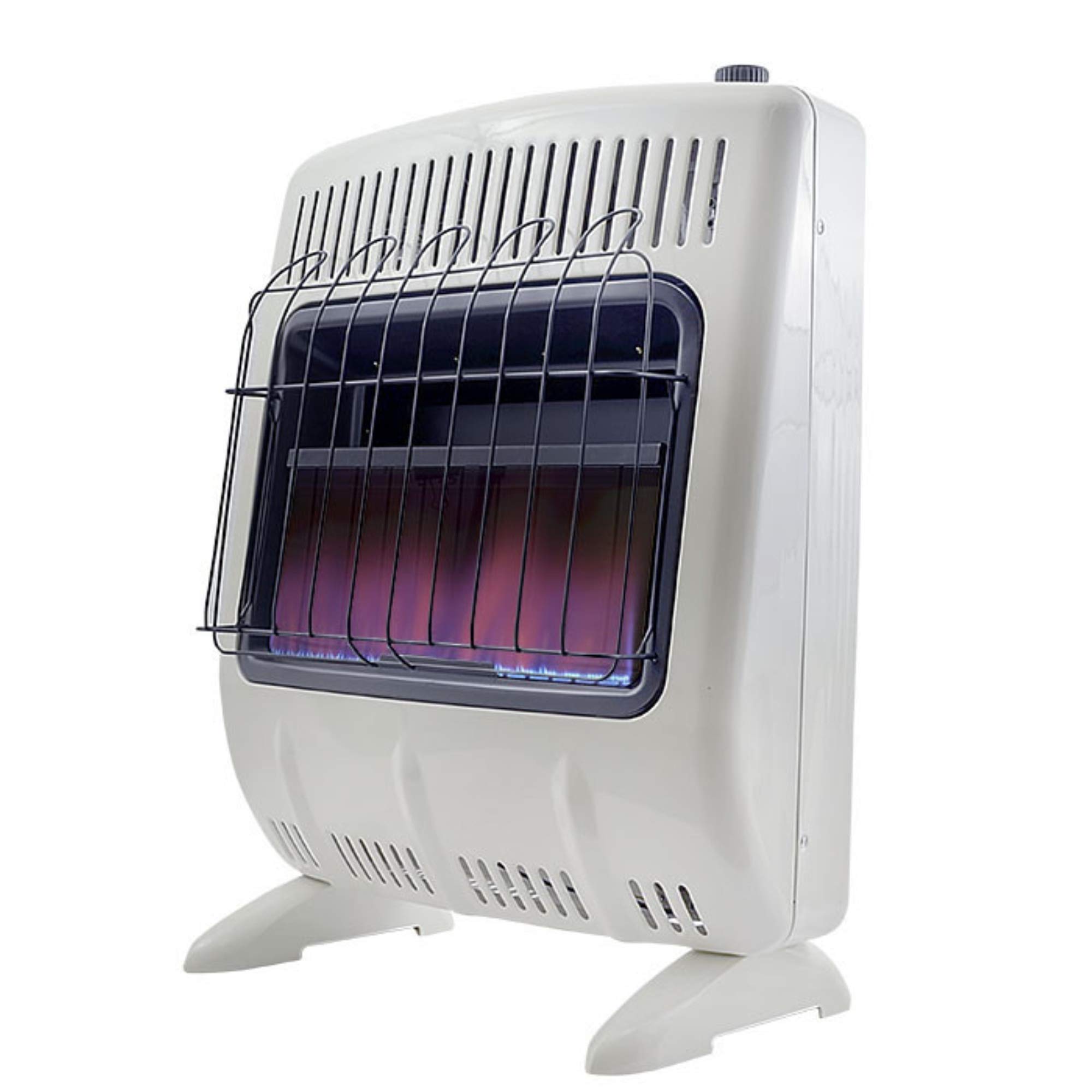
For garages where running a 240V circuit is impractical or where power outages are common, the Mr. Heater Blue Flame Natural Gas unit operates entirely without electricity — just a single AA battery for the electronic ignition. The 20,000 BTU output covers up to 500 square feet using a blue flame convection system that heats the air directly without blowing dust around. Because it is vent free, installation is limited to connecting a gas line and mounting it to the wall.
Buyers in cold climates report heating 600-square-foot spaces to the 70s even when outdoor temps are in the teens, and the silent operation is a major advantage over fan-forced electric units. The built-in adjustable thermostat modulates the gas flow to maintain your target temperature without constant manual adjustment. The blue flame design produces no visible glow, making it less distracting than radiant gas heaters.
The major trade-off is the need for a dedicated natural gas line, which typically requires a licensed plumber to tap into your existing supply. The heater also consumes oxygen from the room, so a carbon monoxide detector is strongly recommended — and some local building codes require one. For off-grid capability and fuel cost savings over electric resistance heating, this is the most energy-independent option available.
Why it’s great
- Runs without electrical power — works during outages or off-grid use
- Silent convection heat with no fan noise for concentrated work
- Natural gas fuel is typically cheaper per BTU than electricity
Good to know
- Requires professional installation of a natural gas supply line
- Vent-free design means combustion byproducts stay in the garage — a CO detector is essential
- Heats the air rising to the ceiling first rather than blowing heat forward
4. Comfort Zone 5000W Ceiling Mounted Garage Heater
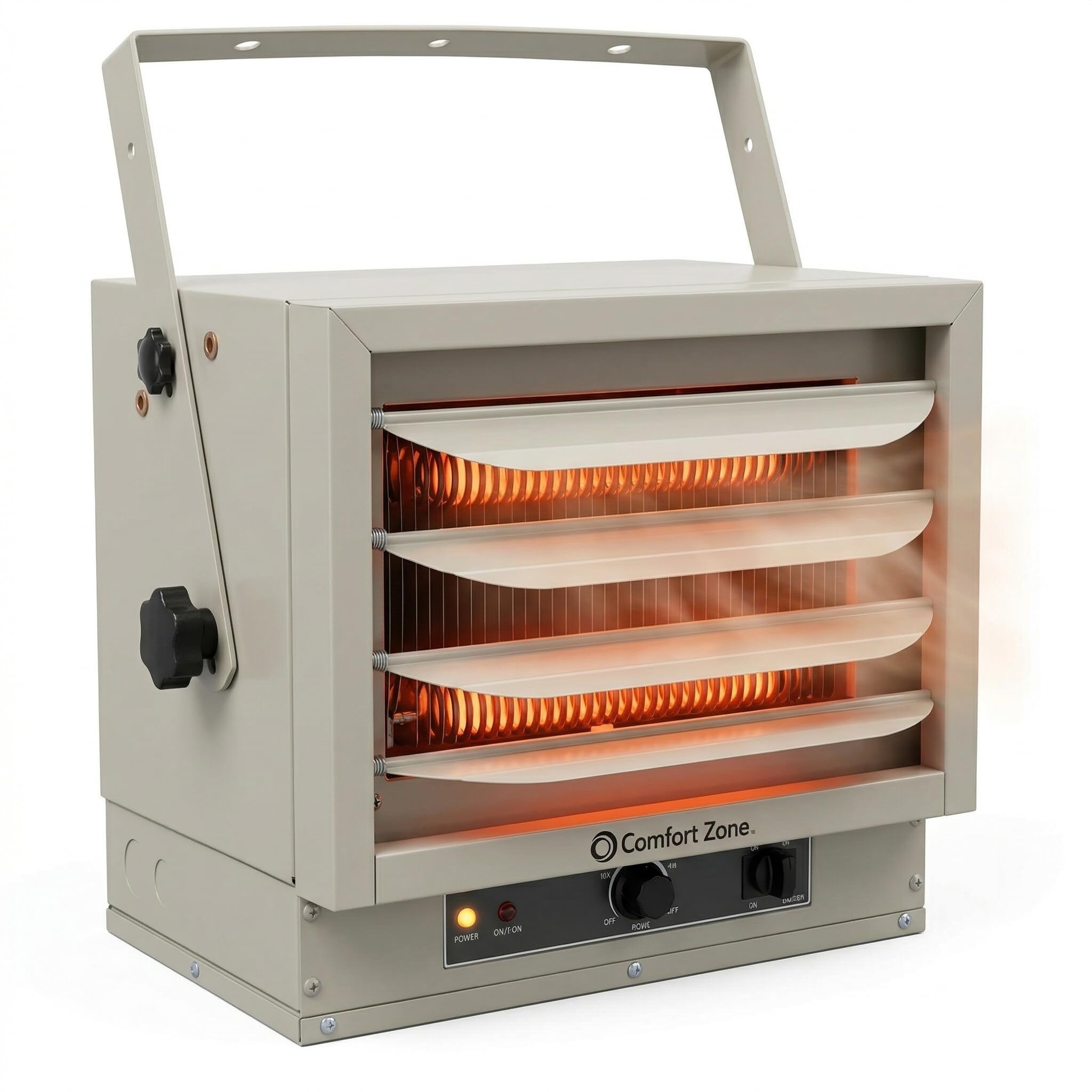
The Comfort Zone CZ220 is the heater that keeps appearing in garage forums for good reason: it delivers 5000 watts of forced-air heat at a price point that undercuts most competitors. The ceiling-mount design keeps it out of the way, and the heavy-gauge steel construction holds up to the temperature swings of uninsulated garages. Louvers and an adjustable mounting angle let you direct the airflow precisely where you need it.
Testing in a 625-square-foot insulated shop showed the unit maintained comfortable working temperatures even in sub-freezing conditions in Omaha. The three heat settings (3000W, 4000W, 5000W) give flexibility to match the output to the weather and your breaker capacity. The double-pole solid-state thermostat is reliable and the finned Kel-rod heating elements transfer heat efficiently. Noise level is a moderate 52 dB at one foot — quieter than the VEVOR.
Installation requires a 240V 30-amp breaker and 10-gauge wire, plus hardwiring. Some users report the fan blade nut arriving loose from the factory, which is easily corrected with blue Loctite on the reverse-threaded nut. For a garage owner who wants proven performance without smart features or WiFi, the Comfort Zone offers the best performance-per-dollar in the mid-range category.
Why it’s great
- Three heat settings provide flexibility to match weather conditions and breaker capacity
- Quiet operation at 52 dB compared to other forced-air units
- Heavy-gauge steel body withstands temperature fluctuations in poorly insulated spaces
Good to know
- Fan blade nut often arrives loose — check and apply blue Loctite during installation
- Hardwired installation required; no plug-in option for quick setup
- Built-in thermostat is functional but not as precise as digital models
5. Cadet Com-Pak Twin CSTC402TW
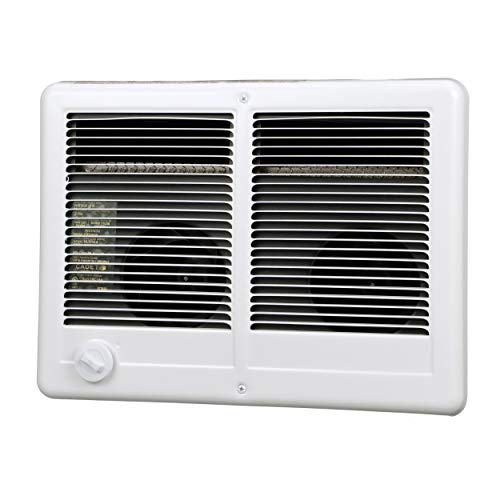
The Cadet Com-Pak Twin is a unique entry because it installs directly into the wall between standard 16-inch stud spacing, giving it a flush profile that takes up zero floor space. The 4000-watt twin-fan design pushes heated air out into the room rather than relying on convection, making it effective in enclosed garages where ceiling-mount options are not feasible. The built-in thermostat controls both heating elements, and the high-temperature safety shut-off provides peace of mind.
Real-world feedback from a 564-square-foot insulated garage owner confirmed the Cadet heats the space comfortably with quiet fan operation that is quieter than a table fan. The unit is made in the USA and replacement parts are readily available, which matters for long-term ownership. It operates on a 240V 20-amp circuit with 12-gauge wire, a relatively light electrical requirement compared to larger forced-air units.
One drawback is that the built-in thermostat can be imprecise, and some users report better results by wiring an external Honeywell thermostat. The unit is best suited for mild climates or occasional use, as continuous operation in extreme cold climates can drive up the electric bill noticeably. For the owner who wants a permanent invisible heating solution that does not intrude on garage wall space, the Cadet is the cleanest installation option.
Why it’s great
- Flush in-wall mount between standard studs eliminates any floor or ceiling intrusion
- Made in the USA with readily available replacement parts
- Relatively light electrical requirement with 240V 20-amp circuit
Good to know
- Built-in thermostat accuracy is mediocre — an external thermostat is recommended for precise control
- More expensive to run continuously in cold climates compared to gas options
- Fan noise is noticeable but quieter than larger forced-air units
6. DR. INFRARED HEATER DR218-3000W

The DR. INFRARED HEATER DR218 is a 3000-watt radiant unit designed specifically for greenhouses and smaller workshop spaces. It operates on a 240V 20-amp circuit and uses an enclosed heating element that stays safe to the touch, making it a solid choice for environments where moisture or plant debris is present. The IPX4 splash-proof rating means it can handle the occasional water spray from a hose or plant misting system without shorting out.
Users in New England with a 50-by-13-foot garage reported the DR218 kept temperatures in the low 60s by cycling at 15 to 25 percent power on high fan, with an electric bill that stayed manageable. The warm rather than hot air output is intentional — it prevents burning tender plant leaves while still maintaining 42 to 48 degrees Fahrenheit inside a greenhouse during a 22-degree freeze. The compact 10-by-10-by-13-inch footprint fits on a bench or shelf easily.
The main concern is reliability. Some owners reported the wiring harness from the thermostat burned up after extended use, with one unit sparking and smoking. This suggests the internal wiring gauge may be undersized for continuous 240V 20-amp draw. For intermittent use in small greenhouses or as a backup heater, it works fine, but it is not recommended as a primary 24/7 heater for a large garage.
Why it’s great
- IPX4 splash-proof rating ideal for greenhouses and damp workshop environments
- Compact 13-inch tall form factor fits on shelves and workbenches without dominating space
- Radiant heat warms objects and plants without burning delicate foliage
Good to know
- Multiple reports of thermostat wiring burning up under continuous high-load use
- Heat output is warm rather than hot — insufficient for uninsulated garages in deep cold
- Requires a NEMA 6-20R outlet (240V 20A) which is uncommon in most homes
7. Dura Heat EUH4000R
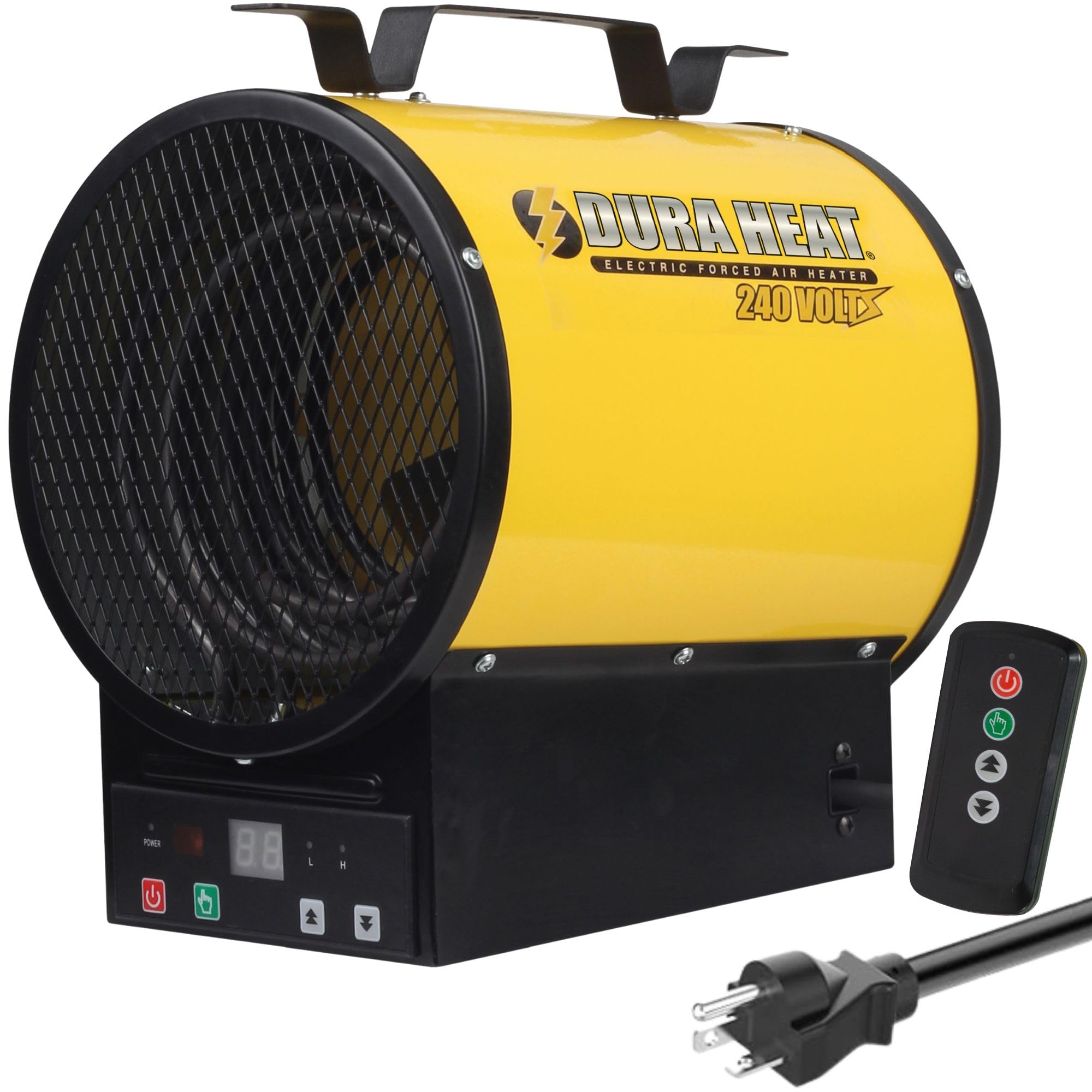
The Dura Heat EUH4000R bridges the gap between portable flexibility and permanent installation. It comes with a ceiling and wall mounting kit but remains lightweight enough to move around the shop when needed. The 3750-watt forced-air system produces 12,800 BTUs and covers up to 500 square feet, making it best suited for a smaller two-car garage or as a supplementary heater for a larger space.
The stainless steel heating element is more durable than standard nickel-chrome elements, and the fan-only mode provides year-round utility for air circulation without heat. The remote control is a practical addition — you can adjust the thermostat from across the garage without walking over to the unit. Owners using it in RVs and travel trailers in negative 14-degree weather reported the unit maintained 75 degrees inside a 22-foot space when running 24/7.
The biggest limitation is the NEMA 6-20P plug that requires a 240V outlet — not a standard household receptacle. Some users reported receiving units that blew cool air instead of hot, indicating potential quality control issues in the heating element assembly. The 65 dB noise level is louder than average, though acceptable in a noisy shop environment. For the user who wants the option to mount or move the heater, the Dura Heat offers rare versatility.
Why it’s great
- Includes both ceiling and wall mounting hardware plus portable freedom
- Stainless steel heating element offers better corrosion resistance than standard elements
- Fan-only mode provides summer air circulation without consuming heating power
Good to know
- Requires a NEMA 6-20R 240V outlet which is uncommon in residential garages
- Some units ship with heating element defects that produce cool air only
- Operates at 65 dB noise level — noticeably louder than ceiling-mount competitors
8. Heat Storm HS-1500-PHX-WIFI
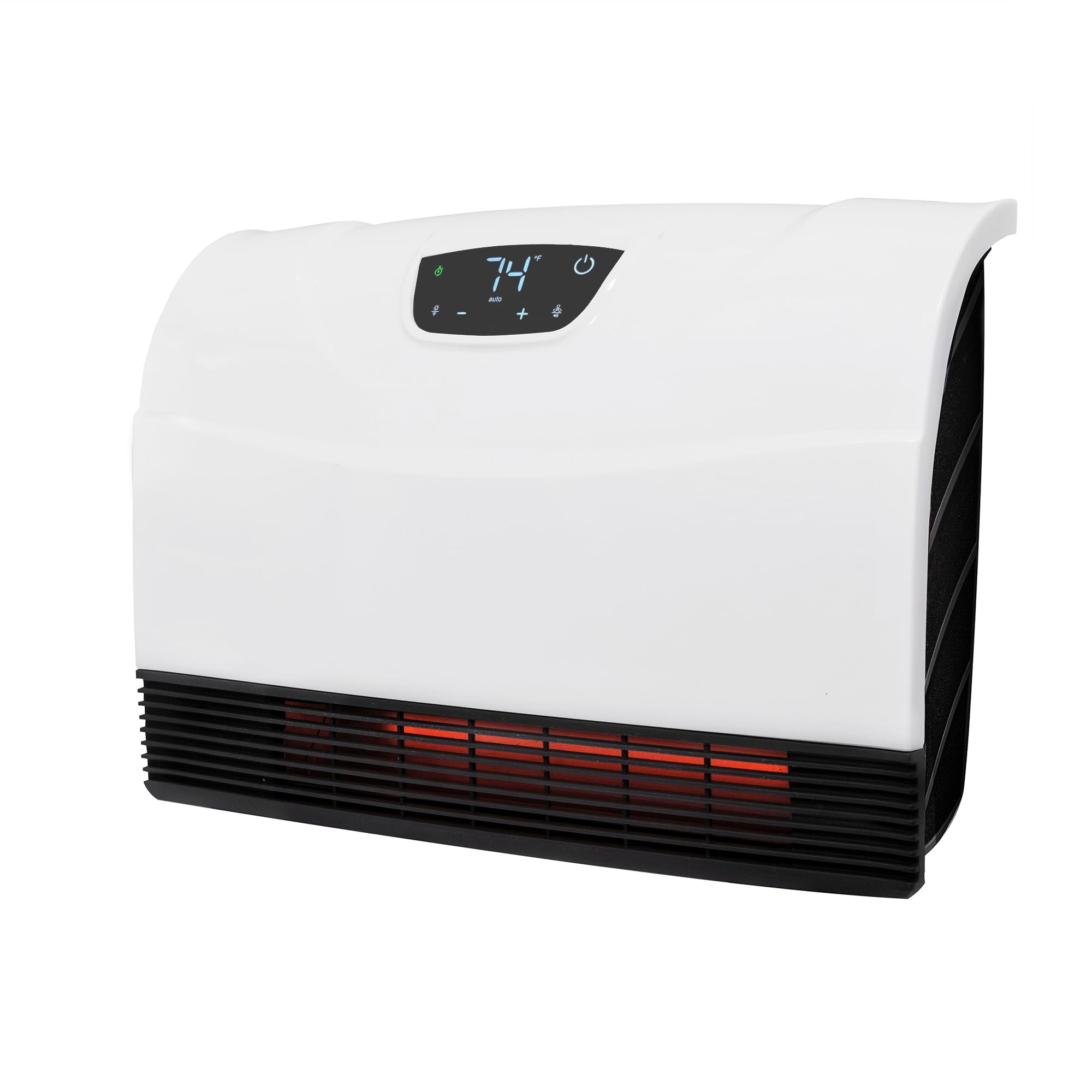
The Heat Storm HS-1500-PHX-WIFI is a 1500-watt wall-mounted infrared heater that plugs into a standard 110V outlet, making it the easiest to install in this entire list — no electrician required. The WiFi connectivity allows full control through the Heat Storm app or voice commands via Alexa and Google Assistant, so you can turn it on from the house before heading to the garage. The infrared heating element warms objects directly rather than heating the air, which reduces energy waste in drafty spaces.
In a 480-square-foot insulated garage, one owner reported the heater maintained 65 degrees when outside temps hit 20 degrees, which is impressive for a 1500-watt unit. The touch screen digital thermostat maintains temperature within a single degree of the set point, and the three-speed fan-only mode provides air circulation during warmer months. The wall mount design hides the cord inside the heater when installed directly over an outlet, keeping the installation clean.
The primary limitation is the heat output — 5200 BTUs is not enough to warm a full two-car uninsulated garage to comfortable working temperatures. It works best as a supplemental heater for a small insulated space or as a spot heater for a workbench area. The app programming can be inconsistent, though the manual controls are reliable. For the user who prioritizes smart features and plug-and-play simplicity over raw BTUs, this is the most convenient option available.
Why it’s great
- Plugs into standard 110V outlet with no hardwiring or electrician needed
- WiFi and voice control via app, Alexa, and Google Assistant for remote operation
- Infrared heating warms objects directly, reducing energy waste in drafty garages
Good to know
- 1500W output is only suitable for small insulated garages or spot heating
- App scheduling and programming can be inconsistent at times
- Not powerful enough to heat an uninsulated two-car garage in deep winter
9. Shinic 2-Pack Radiant Heaters with Halogen Light

The Shinic 2-Pack offers a pair of 1500-watt radiant quartz heaters for the price of a single mid-range unit, making it the most budget-friendly path to heating a two-car garage. Each unit includes a built-in halogen work light, which provides functional illumination for late-night projects while you warm up. The 90-degree adjustable mounting bracket lets you tilt the heater toward your workbench or away from stored items.
The five modes allow independent control of each heating tube and the work light: low heat at 750 watts, high heat at 1500 watts, or combinations with the halogen light on either setting. Owners report that hanging two units at opposite ends of the garage and working directly under them keeps the body warm even when the ambient air is cold. The radiant heat warms skin and tools immediately rather than waiting for the air to heat up.
Durability is the main weakness — several users reported the pull-string switch breaking after a few months, leaving the heater stuck on one mode or completely inoperable. The manufacturer provides no customer support contact for replacement parts. These heaters are best viewed as consumable spot heaters for a season or two rather than a permanent solution. For the casual garage user who wants quick personal warmth on a tight budget, the Shinic twin pack delivers solid value for the money.
Why it’s great
- Two heaters plus integrated halogen work lights provide warmth and illumination in one package
- Radiant quartz heat warms body and tools immediately without waiting for room air to heat
- Adjustable 90-degree mounting bracket directs heat exactly where you are working
Good to know
- Pull-string mode switch prone to mechanical failure after a few months of use
- No manufacturer support or replacement parts available for broken components
- Each unit only provides 1500W — insufficient for heating the entire garage ambiently
FAQ
Can I use a 110V garage heater for a two-car garage?
Do I need an electrician to install a hardwired garage heater?
Which is better for a garage — infrared radiant heat or forced air?
Final Thoughts: The Verdict
For most users, the best 2 car garage heater winner is the Heat Storm HS-6000-GC because it combines high heat output with WiFi scheduling and a compact ceiling-mount design that works in insulated garages down to freezing temperatures. If you want maximum raw power for an uninsulated shop, grab the VEVOR 7500W Digital. And for off-grid reliability with silent natural gas heat, nothing beats the Mr. Heater Blue Flame NG.