
Our readers keep the lights on and the weekend projects moving. As an Amazon Associate, I earn from qualifying purchases.
The problem with most solar lights isn’t the solar panel—it’s the battery. Standard alkaline cells die quickly under the strain of daily charge-discharge cycles, leaking corrosive fluid inside your fixtures and leaving your walkways dark after a season. NiMH rechargeables handle this cycle hundreds of times without the leak risk, making them the only logical power source for outdoor solar lighting.
I’m Rikta — the co-founder and writer behind FitlyFast. I’ve spent dozens of hours analyzing capacity ratings, self-discharge rates, and real-world performance data for NiMH cells to help you find the best match for your garden, pathway, and security lights.
You need a battery that survives extreme temperatures, holds its charge between sunsets, and delivers consistent voltage to keep your lights on through the night. After crunching the specs and user test results across seven products, this guide breaks down exactly how to pick the right batteries for solar lights and which models deliver real value.
How To Choose The Best Batteries For Solar Lights
Solar lights demand a battery that can handle daily recharging from a small panel, survive temperature swings, and still deliver power after months of use. The wrong cell fades fast or leaks, ruining both the battery and the light fixture. Here are the key specs to compare before buying.
Capacity: Matching mAh to Your Light’s Drain
Milliamp-hours (mAh) tells you how much energy the battery stores. A higher mAh rating means longer runtime—critical for lights that need to stay illuminated from dusk to dawn. Standard NiMH AA cells for solar lights range from 900 mAh to 2800 mAh. Smaller solar path lights with a single LED work fine with 900–1200 mAh cells. Larger floodlights or string lights benefit from 2000 mAh or higher to avoid dimming mid-night.
Low Self-Discharge: Holding Charge Between Sunsets
Not all NiMH batteries are created equal. Low self-discharge (LSD) technology allows a cell to retain 70–80% of its charge after sitting unused for months. For solar lights, this is non-negotiable—your battery charges during the day and must still have power to discharge at night, even after overcast days. Non-LSD NiMH cells lose 1% of their charge daily, leaving your lights dim or dark quickly.
Cycle Life: How Many Times Can You Reuse It?
Cycle life is the number of full charge-discharge cycles a battery can handle before its capacity drops significantly. Budget cells may last 500 cycles, while premium models like Eneloop claim up to 2100 cycles. More cycles mean fewer replacements over the life of your solar lights. Factor in that your lights cycle once per day, so a 500-cycle battery lasts about 1.4 years, while a 2100-cycle battery can go nearly six years before needing replacement.
Quick Comparison
On smaller screens, swipe sideways to see the full table.
| Model | Category | Best For | Key Spec | Amazon |
|---|---|---|---|---|
| Eneloop Panasonic BK-3MCCA8BA (8-Pack) | Premium | Long-term reliability & extreme temps | 2100 cycles, 70% charge after 10 years | Amazon |
| NICEBATT 16-Pack 2800mAh | Premium | High-capacity for bright lights | 2800 mAh, 1200 cycles | Amazon |
| Granicell 24-Pack 2800mAh | Premium | Bulk value & high-capacity storage | 2800 mAh, 80% charge after 3 years | Amazon |
| Amazon Basics 12-Pack 2000mAh | Mid-Range | Budget-friendly household solar lights | 2000 mAh, 80% charge after 2 years | Amazon |
| Eneloop Panasonic BK-3MCCA4BA (4-Pack) | Premium | Small batch for critical lights | 2100 cycles, pre-charged via solar | Amazon |
| Howardly 12-Pack 900mAh | Budget | Entry-level path and lawn lights | 900 mAh, 900 cycles | Amazon |
| Amazon Basics 24-Pack AAA 850mAh | Budget | Small AAA solar fixtures in bulk | 850 mAh, 80% charge after 24 months | Amazon |
In‑Depth Reviews
1. Eneloop Panasonic BK-3MCCA8BA AA 2100 Cycle Ni-MH Pre-Charged Rechargeable Batteries (8-Pack)

Eneloop has built a reputation for reliability, and the 8-pack BK-3MCCA8BA lives up to it. Independent testing shows these cells averaging 2245 mAh—exceeding the stated 2000 mAh minimum—with consistent internal resistance around 170 mΩ across all eight batteries. For solar lights, this consistency matters because mismatched cells in a multi-light system cause uneven brightness and early failure of weaker units.
The low self-discharge performance is the standout feature for outdoor use. Eneloop maintains up to 70% of its charge after 10 years of storage, which means even after several cloudy days where your solar panel barely charges, these batteries will still deliver enough stored power to light your path. They also operate down to -4°F, surviving winter nights that kill cheaper alkaline and budget NiMH cells.
Long-term cost analysis favors Eneloop heavily. Rated for 2100 recharge cycles, these cells can outlast your solar light fixtures themselves. One reviewer reported using Eneloop cells in door locks and remotes for years with no replacements needed. The higher upfront cost per battery is offset by not having to replace them every 1–2 years like budget options.
Why it’s great
- Exceptional 2100-cycle lifespan—holds up for years in daily solar use
- Retains 70% charge after a decade in storage, ideal for seasonal lights
- Consistent 2000+ mAh real-world capacity verified by user tests
Good to know
- 4-pack and 8-pack only—buying multiple packs for large installations adds up
- Premium price per cell compared to high-capacity budget alternatives
2. NICEBATT Rechargeable aa Batteries 16 Count, 2800mAh Premium NiMH Double A Battery
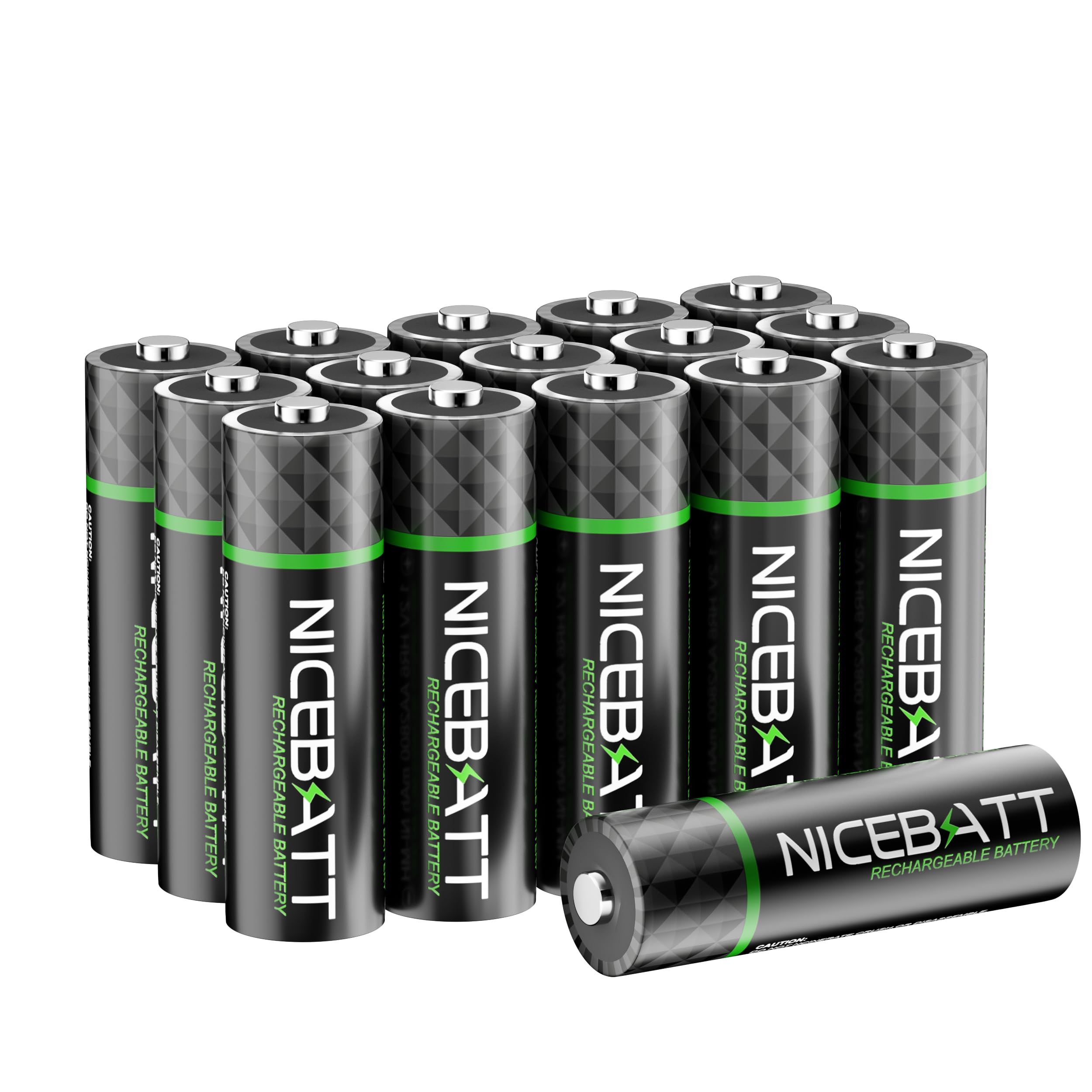
NICEBATT packs a raw capacity punch with 2800 mAh cells—the highest in this roundup. For solar lights that need to burn bright through long winter nights, that extra capacity translates directly to more illuminated hours. The 16-count package is also the largest premium offering here, making it viable for households with multiple string lights, floodlights, and path lights all running simultaneously.
Real-world testing from reviewers showed actual capacity between 2350–2400 mAh under a 500 mA load, which is still strong though below the 2800 mAh rating. The cells are rated for 1200 recharge cycles and retain 80% capacity after two years of non-use—solid LSD performance that works well for solar applications where the battery sits before installation. The operating temperature range of -4°F to 140°F covers most climates.
A practical note: the reviewer data suggests these cells ship with inconsistent pre-charge levels (65–80%), so a full charge before first use is essential. Once activated over 2–3 cycles, they reach full capacity. The 16-pack format also gives you spares for devices like controllers or flashlights without needing a second order.
Why it’s great
- High 2800 mAh capacity provides longer runtime for bright solar floodlights
- 16-pack offers good value for multi-fixture solar setups
- Wide temperature tolerance (-4°F to 140°F) handles outdoor extremes
Good to know
- Real-world capacity tested lower than advertised (2350–2400 mAh)
- Inconsistent pre-charge levels require full activation cycle before use
3. Granicell AA Rechargeable Batteries 2800 mAh High Capacity 1500 Cycle 24 Pack
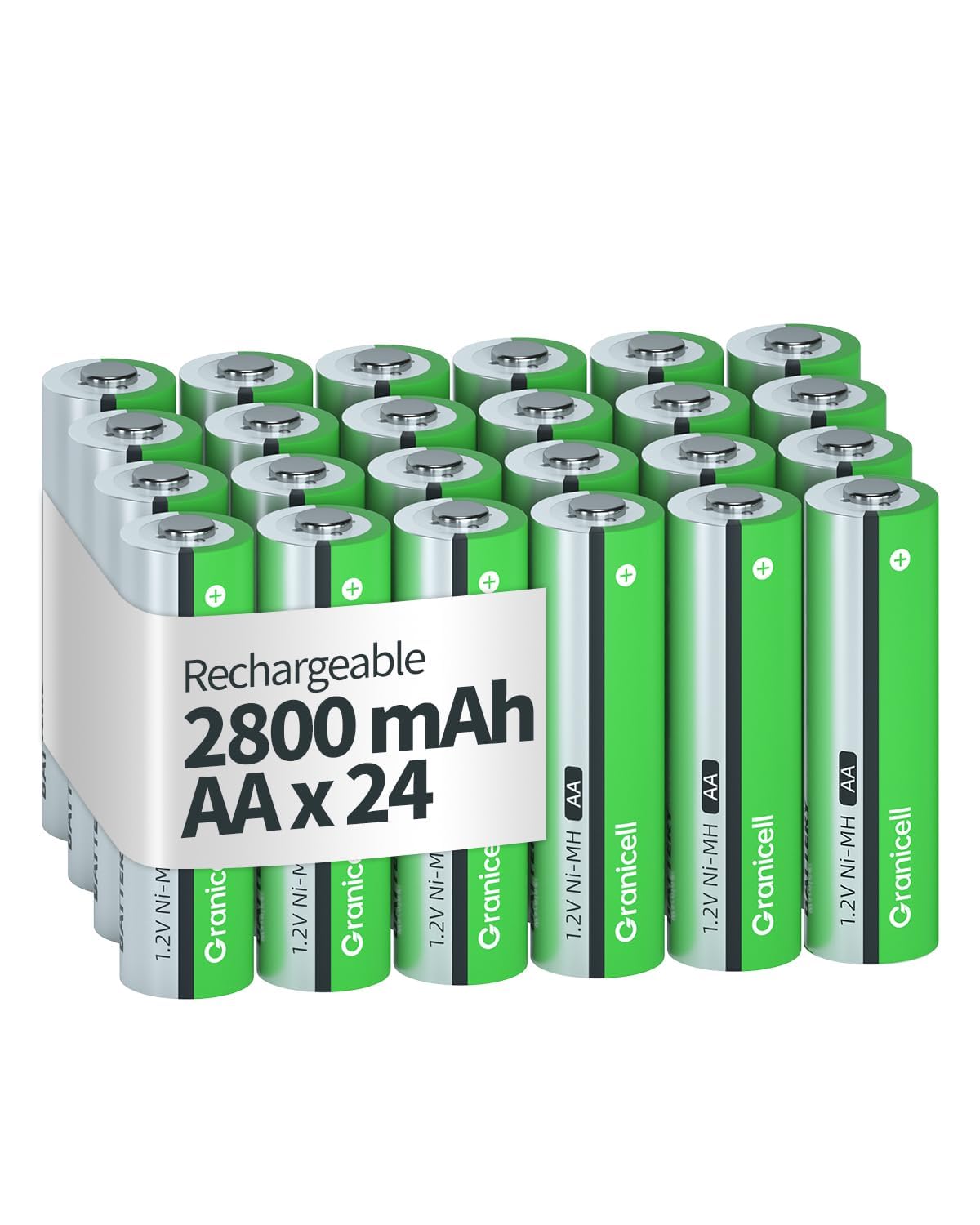
Granicell delivers the highest value proposition in the premium tier: a full 24-pack of 2800 mAh cells rated for 1500 cycles. The sheer count means you can replace batteries across a large solar installation—potentially 12 lights with two cells each—in one clean purchase. The capacity rivals NICEBATT but adds an extra 300 cycles on the rating sheet, suggesting better longevity at the high end.
The low self-discharge rating here is exceptional: 80% capacity retention after three years in storage. This is better than most competitors and means that even if you buy the 24-pack as a long-term stock, the cells you install a year from now will still perform near new. User reviews confirm consistent performance in solar path lights, with one reviewer noting their lights stayed bright from 9:30 PM to 6 AM.
One important caveat surfaced in customer reviews: these are NiMH, not lithium, and some chargers may misidentify them. If your charger is designed solely for lithium-ion, it will show a compatibility error. A standard NiMH smart charger works fine. The pre-charge for transport means you’ll need to run a full charge cycle before first use to activate the full capacity.
Why it’s great
- 24-pack covers entire large solar installations in one purchase
- 1500 cycle rating and 3-year LSD retention are best-in-class on paper
- High 2800 mAh capacity supports bright, long-running solar lights
Good to know
- NiMH chemistry—incompatible with lithium-only chargers
- Needs activation cycle before full capacity is reached
4. Amazon Basics 12-Pack Rechargeable AA NiMH Batteries, 2000 mAh

Amazon Basics 2000 mAh cells are the mid-range benchmark for cost-conscious solar light buyers. Independent testing revealed that multiple samples averaged 2130 mAh after proper activation—actually exceeding the 2000 mAh rating. This level of consistency across a 12-pack is impressive, with only 4 out of 24 tested cells falling short at roughly 1350 mAh. The 1000 recharge cycle rating covers roughly 2.7 years of daily solar light use.
The low self-discharge spec shows these maintain 80% capacity after two years, which is sufficient for most solar setups. However, user reports note that in practice, stored cells do lose noticeable charge over months and may need topping up before installation during the off-season. For lights that run daily, this is less of an issue—the panel tops them off each day.
The 12-pack strikes a strong balance between initial cost and performance. You get enough cells for six standard solar lights (two per light) at a price that undercuts premium offerings while still delivering genuine 2000 mAh capacity. One reviewer reported 24-hour continuous runtime on a continuous night-light setting, confirming decent real-world longevity for low-drain solar fixtures.
Why it’s great
- Actual tested capacity exceeds the 2000 mAh advertised rating
- 12-pack provides good coverage for mid-size solar light collections
- Low self-discharge retains 80% charge for up to 2 years in storage
Good to know
- Small percentage of cells in a batch may test well below capacity
- Self-discharge in practice is higher than premium Eneloop cells
5. Eneloop Panasonic BK-3MCCA4BA AA 2100 Cycle Ni-MH Pre-Charged Rechargeable Batteries (4-Pack)

The 4-pack Eneloop BK-3MCCA4BA offers the same legendary 2100-cycle lifespan and 70% charge retention after 10 years as the 8-pack but in a smaller, lower-initial-investment format. For homeowners who only need to replace batteries in a few key solar path lights or a single spotlight, this avoids buying more cells than you need. The cells are pre-charged at the factory using solar power, which aligns with the eco-friendly intent of solar lighting.
User reviews confirm the exceptional reliability: one reviewer reported using Eneloop cells for years in high-drain devices like Meta Quest 3 controllers with 90%+ charge retention after weeks of storage. This same low self-discharge characteristic means your solar lights will be ready to perform even after a string of overcast days. The cells operate down to -4°F, ensuring winter performance that budget cells can’t match.
The value proposition here is about longevity rather than initial capacity. While the 2000 mAh rating is lower than the 2800 mAh competitors, the 2100-cycle rating means you’ll replace these batteries far less often. For solar lights with small single-LED fixtures that don’t draw heavily, these cells can outlive the lights themselves, making them the most cost-effective option per year of service.
Why it’s great
- Industry-leading 2100 recharge cycles for years of daily solar use
- Retains 70% charge after 10 years, unmatched shelf-life for storage
- Pre-charged using solar power at the factory
Good to know
- Only 4 batteries included—limited coverage for large installations
- 2000 mAh capacity is lower than premium high-capacity alternatives
6. Howardly 1.2v AA Ni-MH Rechargeable Battery, Double A 900mAh 1.2V (12-Pack)

Howardly’s 900 mAh cells are designed explicitly for solar garden lights, lawn lamps, and string lights. The lower capacity is actually a natural fit for small solar fixtures that use a single LED or a small cluster—these lights typically have small solar panels that can’t fully charge a high-capacity 2800 mAh cell in one day. The 900 mAh rating ensures a full charge is reached by midday, maximizing the light’s nightly runtime.
With 900 recharge cycles, these cells will last about 2.5 years of daily use. The 12-pack price is easy to justify even for first-time solar light users. User feedback highlights that they work well in older solar fixtures—one reviewer replaced the batteries in aging path lights and they “worked well” with minimal effort, restoring function to lights that had dimmed with old cells.
A crucial detail: these batteries ship with only 30–50% pre-charge for transport safety. You must fully charge them before first use, and recharging every three months during storage extends their lifespan. The lower internal resistance of the 900 mAh design also means faster charging from small solar panels, making them particularly suitable for budget solar lights with minimal solar cell area.
Why it’s great
- Optimized 900 mAh capacity matches small solar panel charging ability
- 12-pack covers multiple fixtures at an accessible entry price
- 900 cycle rating provides roughly 2.5 years of nightly service
Good to know
- Ships at 30–50% charge—requires full charge cycle before first use
- Lower capacity means shorter runtime for high-drain or bright lights
7. Amazon Basics 24-Pack Rechargeable AAA NiMH High-Capacity Batteries, 850 mAh

This Amazon Basics 24-pack addresses the AAA-sized solar light niche—many smaller solar candles, fairy string lights, and decorative pathway markers use AAA cells. The 850 mAh rating is solid for AAA NiMH, and independent testing revealed an average real-world capacity of 1079 mAh—well above the stated 850 mAh. The 500-cycle rating is lower than the AA versions but still reasonable for smaller lights that may not be used year-round.
The low self-discharge rating of 80% capacity after 24 months makes these suitable for seasonal solar decorations. You can pack them away after the holiday season and install them next year with minimal capacity loss. User reviews note they charge quickly and hold voltage well across devices, though some caution that the 500 cycles limit their lifespan compared to AA alternatives.
One practical limitation: multiple reviewers noted that these cells deliver consistent 85–95% charge readings rather than a full 100%. For solar lights, this isn’t a dealbreaker—the small panel will still charge them fully during the day. However, for high-drain devices like smart locks, the charging time becomes an issue. Stick to using these in low-drain solar lights and remotes where their performance is solid.
Why it’s great
- Actual measured capacity exceeds the 850 mAh rating by up to 27%
- 24-pack at a budget price covers many small AAA solar fixtures
- Low self-discharge holds 80% charge for up to 2 years in storage
Good to know
- Only 500 cycles—shorter lifespan than premium NiMH options
- Not ideal for high-drain devices like smart locks or bright floodlights
FAQ
Can I use regular alkaline batteries in solar lights?
Should I choose a high 2800 mAh or lower 900 mAh battery for my solar lights?
Why do my new NiMH batteries need charging before first use?
How does cold weather affect NiMH solar light batteries?
Final Thoughts: The Verdict
For most users, the best batteries for solar lights winner is the Eneloop Panasonic 8-Pack because its 2100-cycle lifespan and unmatched 10-year charge retention make it the most reliable and cost-effective long-term choice for any solar light. If you want maximum nightly brightness, grab the NICEBATT 16-Pack with 2800 mAh capacity. And for a large budget-friendly installation, nothing beats the Granicell 24-Pack for sheer volume and 1500-cycle endurance.