
Our readers keep the lights on and the weekend projects moving. As an Amazon Associate, I earn from qualifying purchases.
Staring at a cramped 16:9 screen while juggling three windows side-by-side is a productivity killer. A 34-inch ultrawide monitor carves that clutter away, replacing it with a single, sweeping canvas of pixels that wraps around your peripheral vision. The transition from a standard display to a 21:9 panel is not just a size upgrade—it is a fundamental shift in how you organize work, immerse in games, and manage your digital real estate.
I’m Rikta — the co-founder and writer behind FitlyFast. I have spent thousands of hours parsing panel technology specifications, refresh rate curves, and color gamut coverage data to identify the monitors that deliver genuine value without marketing fluff.
This guide breaks down the absolute best options available right now so you can match the perfect panel to your specific needs. We sorted through the specs, the real user feedback, and the hidden trade-offs to deliver a straightforward verdict on the best 34 inch ultrawide monitor for gaming, productivity, and everything in between.
How To Choose The Best 34 Inch Ultrawide Monitor
Selecting the right ultrawide is more than picking the cheapest panel with the right diagonal. The 34-inch class sits at a crossroads between immersive gaming, professional productivity, and content creation. Understanding a few key specifications will prevent an expensive mistake.
Panel Technology: VA vs IPS vs QD-OLED
The panel type defines everything you see. VA panels offer the highest static contrast ratio (3000:1 to 4000:1), delivering deep blacks that make dark scenes in games or movies look rich and defined. IPS panels traditionally offer superior viewing angles and color consistency but at a lower contrast ratio. QD-OLED represents the current peak: infinite contrast, per-pixel lighting, and the fastest response times (0.03ms) combined with vibrant quantum dot color saturation. For mixed use involving productivity and media, VA provides excellent value. For competitive gaming or critical HDR content, QD-OLED is transformative.
Resolution: The 3440×1440 Standard
Almost every 34-inch ultrawide on the market uses a WQHD resolution of 3440 by 1440 pixels. This pixel density delivers crisp text and detailed images without demanding the extreme GPU power required by a 4K panel. It is the sweet spot for the category—sharp enough for photo editing and graphic design yet manageable for mid-range and high-end graphics cards to drive at high frame rates. A few premium productivity monitors in this class offer a 5K2K resolution (5120×2160), which provides significantly more vertical and horizontal workspace but requires a powerful system to run smoothly.
Refresh Rate and Adaptive Sync
Refresh rate determines how many frames per second the monitor can display. A standard 60Hz panel is fine for office work, but 100Hz to 120Hz provides noticeably smoother mouse cursor movement and scrolling. For gaming, 165Hz or 240Hz drastically reduces motion blur and increases perceived responsiveness. Adaptive sync technologies—AMD FreeSync or NVIDIA G-Sync—match the monitor’s refresh rate to the graphics card’s output, eliminating screen tearing and stuttering. FreeSync Premium and G-Sync Compatible labels indicate official validation for a tear-free experience.
Connectivity: USB-C and the KVM Factor
A single USB-C cable that delivers video signal, data transfer, and power to a laptop is the single biggest convenience feature for anyone with a modern notebook. Look for USB-C ports with at least 65W of power delivery (90W is better) to keep a laptop charged without a separate power brick. A built-in KVM switch allows you to control two different PCs (e.g., a work laptop and a gaming desktop) with a single keyboard and mouse, seamlessly switching between them. This feature alone can transform a cluttered desk into an efficient command center.
Quick Comparison
On smaller screens, swipe sideways to see the full table.
| Model | Category | Best For | Key Spec | Amazon |
|---|---|---|---|---|
| Dell UltraSharp U4025QW | Productivity Pro | Professional creative work & 5K2K workspace | 5120×2160, 120Hz, IPS Black | Amazon |
| Alienware AW3425DW | Elite Gaming | High-refresh QD-OLED gaming with G-Sync | 3440×1440, 240Hz, QD-OLED | Amazon |
| LG 34GX90SA-W | Immersive OLED | 240Hz OLED gaming with steep 800R curve | 3440×1440, 240Hz, 800R curve | Amazon |
| Acer Predator X34 | OLED Speed | 240Hz OLED with HDMI 2.1 & KVM switch | 3440×1440, 240Hz, 0.01ms | Amazon |
| AOC Agon PRO AG346UCD | QD-OLED Value | Entry price to glossy QD-OLED gaming | 3440×1440, 175Hz, 0.03ms | Amazon |
| Alienware AW3423DWF | Established OLED | Proven QD-OLED with burn-in warranty | 3440×1440, 165Hz, 1800R | Amazon |
| Philips Evnia 34M2C6500 | Budget OLED | Lowest-cost entry to QD-OLED gaming | 3440×1440, 175Hz, QD-OLED | Amazon |
| Dell S3425DW | Work & Play | 120Hz VA with USB-C for hybrid workflows | 3440×1440, 120Hz, VA | Amazon |
| LG 34SR60QC-W | Smart Monitor | Desktop monitor with built-in streaming apps | 3440×1440, 100Hz, webOS | Amazon |
| Samsung Viewfinity S65UA | Ergonomic Value | 1000R curve with 90W USB-C for productivity | 3440×1440, 100Hz, 1000R curve | Amazon |
| ASUS TUF Gaming VG34VQ3B | Budget Gamer | 180Hz VA for competitive gaming on a budget | 3440×1440, 180Hz, 1ms MPRT | Amazon |
In‑Depth Reviews
1. Dell UltraSharp U4025QW

The Dell UltraSharp U4025QW is the definitive productivity monitor for professionals who demand pixel real estate without compromise. Its 40-inch 5K2K (5120×2160) IPS Black panel delivers a pixel density that makes 4K look ordinary—text is razor-sharp, and the extra vertical height provides roughly 33% more workspace than a standard 34-inch WQHD ultrawide. The 120Hz refresh rate and USB-C hub with KVM functionality make it a seamless command center for creative work and multi-PC setups.
Real-world feedback from users who transitioned from standard ultrawides highlights the jaw-dropping clarity for spreadsheets, professional editing, and data analysis, with many calling it a “game-changer” for productivity. The built-in KVM switch allows smooth switching between a Mac and a PC using a single keyboard and mouse, and the IPS Black technology delivers noticeably deeper blacks than traditional IPS panels. Some users note that the included stand feels slightly plasticky for this price point, and the 2000:1 contrast ratio, while good for IPS, does not match VA or OLED panels for pure black levels.
The U4025QW is not a budget option—it sits at the premium end of the ultrawide spectrum. It also lacks a remote control and its color modes are limited to three presets, requiring some adjustment through Dell Display Manager for ideal picture tuning. For the creative professional or power user who stares at a screen all day and values space and clarity above all else, this monitor represents the gold standard.
Why it’s great
- Stunning 5K2K resolution provides unmatched screen real estate for multitasking.
- IPS Black technology offers excellent contrast for an IPS panel with wide viewing angles.
- Integrated KVM and Thunderbolt hub simplify multi-device workflows dramatically.
Good to know
- Premium price point makes it a serious investment for productivity-focused buyers.
- Contrast ratio is lower than VA or OLED panels, limiting HDR impact in dark scenes.
- Plastic construction on the stand feels less premium than the display itself warrants.
2. Alienware AW3425DW (New Gen)

Alienware’s latest 34-inch QD-OLED monitor, the AW3425DW, doubles the refresh rate to 240Hz while retaining the proven 1800R curvature and 3440×1440 resolution that made its predecessor a legend. The quantum dot OLED panel delivers inky blacks, vibrant colors that surpass 99% DCI-P3 coverage, and near-instantaneous pixel response. It is a gaming powerhouse that also handles creative work with creator-mode presets and Delta E<2 color accuracy out of the box.
Users upgrading from LCD panels consistently describe the motion clarity as transformative, with the 240Hz refresh rate making even 144Hz panels feel sluggish in comparison. The glossy QD-OLED coating means colors appear punchy and deep in controlled lighting, though some buyers note that text can appear slightly funky at default settings—a common trait among QD-OLED panels that requires adjustment of ClearType settings. The build includes customizable AlienFX RGB lighting, a height-adjustable stand with tilt and swivel, and comprehensive ventilation for heat dissipation.
The primary concern with any OLED monitor is burn-in, and Alienware addresses this with a 3-year premium warranty that explicitly covers OLED burn-in. The package includes a factory calibration report, ensuring consistent color performance from day one. For the competitive gamer or the enthusiast who wants the absolute best image quality available in a 34-inch form factor, this monitor delivers elite performance that justifies its premium position.
Why it’s great
- 240Hz QD-OLED delivers buttery smooth motion and infinite contrast for gaming.
- Factory-calibrated Delta E<2 color accuracy suits both gaming and content creation.
- 3-year burn-in warranty provides peace of mind for long-term OLED ownership.
Good to know
- Glossy screen may cause reflections in brightly lit rooms.
- Text clarity requires ClearType tuning for optimal reading sharpness.
- Brightness is capped at 250 nits in SDR, which feels dim in very bright environments.
3. LG 34GX90SA-W (Ultragear OLED)
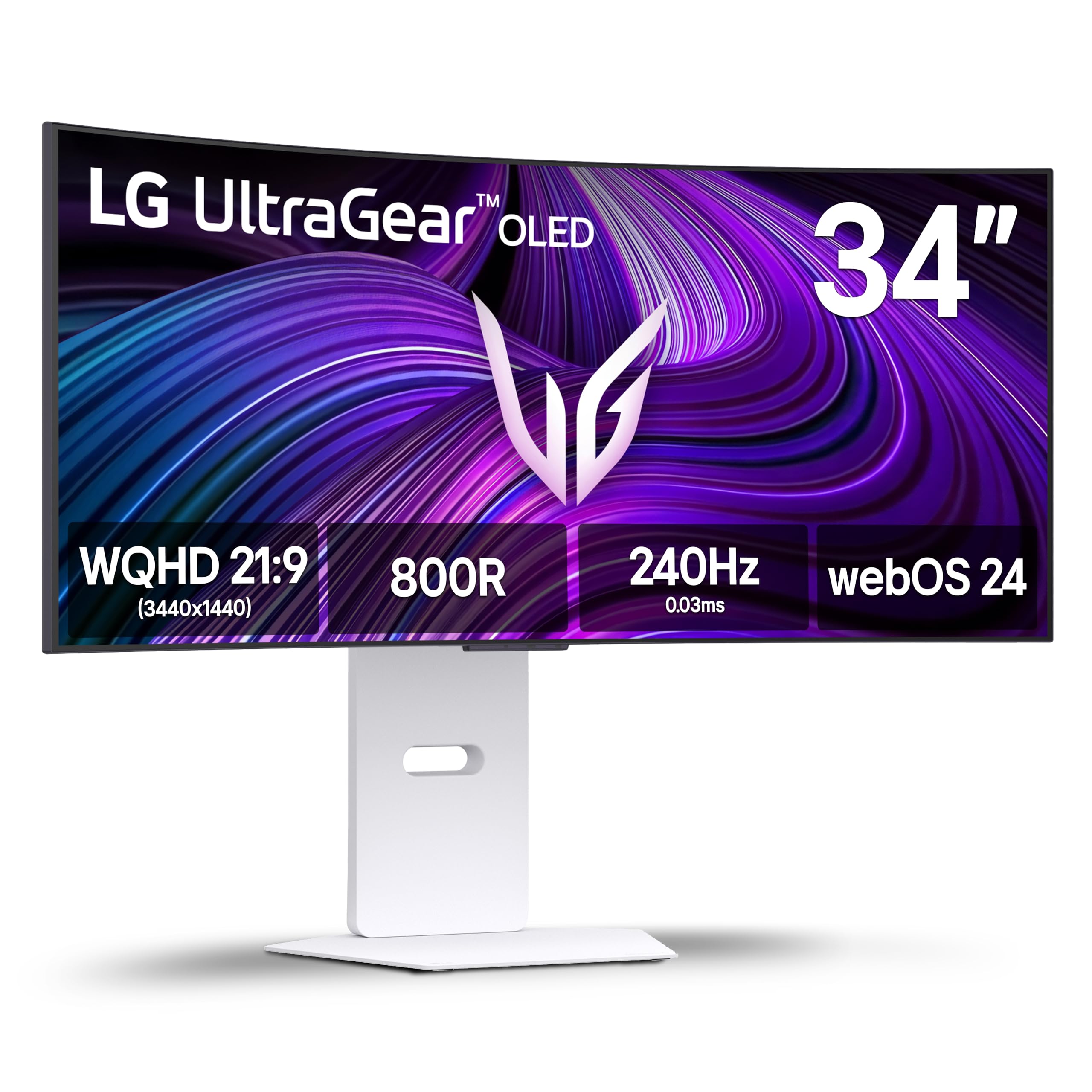
LG pushes immersion to an extreme with the 34GX90SA-W, featuring an aggressive 800R curvature that wraps the 34-inch OLED panel around your peripheral vision. This is the steepest curve available in this size class, and it creates a cockpit-like atmosphere for racing, flight sims, and first-person shooters. The 240Hz refresh rate and 0.03ms response time are standard for top-tier OLEDs, but the matte anti-glare surface sets it apart—reducing reflections in bright rooms without sacrificing contrast.
User feedback emphasizes the immersive quality of the 800R curve, with many noting it pulls them deeper into games compared to the standard 1800R panels. The built-in webOS provides smart TV functionality for streaming and cloud gaming without a PC, a rare convenience in gaming monitors. However, some users report HDR flickering via HDMI when using VRR, which is resolved by switching to USB-C connectivity. The stand is sturdy and offers full ergonomic adjustments, and the white color scheme is a welcome departure from the standard black gaming aesthetic.
At 275 nits SDR brightness, this monitor is not the brightest for HDR content, though peak HDR brightness hits 1300 nits for small highlights. The included 2-year warranty covers OLED panel protection, including burn-in, which is shorter than Alienware’s coverage. For gamers who prioritize an enveloping field of view and want a monitor that doubles as a streaming hub, the LG Ultragear OLED delivers unmatched immersion.
Why it’s great
- 800R curvature is the most immersive available, encircling your peripheral vision.
- Matte anti-glare coating keeps the display usable in lit rooms without reflections.
- Built-in webOS provides streaming and cloud gaming without a connected PC.
Good to know
- HDR flicker with VRR on HDMI requires using USB-C for stable performance.
- 2-year warranty is shorter than some competitors’ OLED burn-in coverage periods.
- Aggressive curve may feel unnatural for productivity tasks like spreadsheets or coding.
4. Acer Predator X34 (OLED)

The Acer Predator X34 enters the OLED arena with a full suite of modern connectivity: two HDMI 2.1 ports, a USB-C port with 90W power delivery, and an integrated KVM switch. This makes it uniquely suited for users who game on a PC and also plug in a PS5 or Xbox Series X, as HDMI 2.1 supports 4K 120Hz VRR from consoles. The 800R curvature and 240Hz refresh rate match the LG competitor, but Acer differentiates with a KVM that allows seamless peripheral sharing between two devices.
Users praise the OLED image quality and matte finish, which reduces glare without muddying the picture. The built-in speakers output 5 watts per channel, offering serviceable audio for casual use. A common frustration reported by buyers is the aggressive image retention refresh pop-up that appears after approximately four hours of use, forcing a five-minute black-screen cleaning cycle. This can be disruptive during gaming or work if not timed properly. Additionally, the sleep mode on some units fails to wake properly, requiring a full PC restart.
The build quality is solid with a fully adjustable stand, but the OSD menu is controlled by a cheap-feeling toggle, and the ambience lighting lacks polish compared to competitors. For the price-conscious OLED seeker who needs HDMI 2.1 for console gaming and a KVM for a multi-PC desk, the Predator X34 packs the right features in a compelling package, despite some firmware quirks.
Why it’s great
- HDMI 2.1 ports enable full-bandwidth 4K 120Hz VRR from PS5 and Xbox Series X.
- USB-C with 90W PD and built-in KVM switch simplifies multi-device desks.
- Matte OLED screen reduces reflections while maintaining deep blacks.
Good to know
- Frequent pixel refresh pop-up interrupts usage every 4 hours with a 5-minute black screen.
- Sleep-mode wake failure reported by multiple users, requiring a hard restart.
- OSD menu and build quality feel less premium than the panel itself.
5. AOC Agon PRO AG346UCD

AOC brings the glossy QD-OLED experience to a more accessible price tier with the Agon PRO AG346UCD. This 34-inch panel uses the same Samsung QD-OLED technology found in pricier monitors, delivering vivid colors, perfect blacks, and a 175Hz refresh rate with 0.03ms response time. It features G-Sync compatibility and HDR400 True Black certification, ensuring smooth, tear-free gameplay with deep HDR shadows. The design includes a height-adjustable stand with tilt and swivel, plus built-in speakers for convenience.
Users upgrading from LCD panels describe the difference as breathtaking, with one report calling it “insane” after switching from a standard IPS display. The glossy coating makes colors and contrast pop in a way that matte panels cannot replicate, but it also means reflections can be distracting in rooms with direct light. The screen protector is notoriously difficult to remove—it has a yellow tab that frequently breaks, leaving sticky residue that is hard to clean without damaging the panel.
The included stand has a V-shaped footprint that can interfere with mouse movement for desk space and some users note the OSD menu is basic. For the price, this monitor undercuts many QD-OLED rivals while delivering the same core visual performance. It is an excellent entry point for gamers who want to experience OLED without paying a premium, provided they are comfortable with the glossy finish and careful screen-protector removal.
Why it’s great
- Glossy QD-OLED delivers vibrant colors and perfect blacks at a competitive price point.
- 175Hz refresh rate and G-Sync compatibility provide smooth gaming performance.
- Full ergonomic stand with height, tilt, and swivel adjustments included.
Good to know
- Screen protector is extremely difficult to remove and may leave residue on the panel.
- V-shaped stand footprint consumes significant desk space and may interfere with mouse pads.
- Built-in speakers are basic and lack volume for immersive audio.
6. Alienware AW3423DWF

The Alienware AW3423DWF is the monitor that established QD-OLED as the gold standard for ultrawide gaming. It features a 34-inch 3440×1440 QD-OLED panel with a 165Hz refresh rate, 0.1ms response time, and VESA DisplayHDR 400 True Black certification. The 1800R curve is immersive without being aggressive, making it suitable for both gaming and productivity. Creator Mode provides native DCI-P3 and sRGB color space options, making this a legit tool for color-critical work.
Long-term users consistently report zero burn-in after 1.5 years of heavy use (10-15 hours daily), a testament to the OLED Care pixel refresh technology. The colors are described as “pop better than anything else,” and the infinite contrast makes HDR content in dark games truly spectacular. The screen is fragile—micro-scratches from cleaning can occur even with a microfiber cloth—though they are invisible when the display is on. The 3-year premium warranty explicitly covers OLED burn-in, which is crucial for buyer confidence.
Some users from 2025 production runs report minor cosmetic scratches on the screen from bubble wrap packaging, though most buff out easily. The stand is solid with height markers for quick adjustment. For gamers and content creators who want a proven, reliable QD-OLED with excellent warranty coverage, the AW3423DWF remains a fantastic choice even as newer models arrive.
Why it’s great
- Proven QD-OLED reliability with extensive real-world feedback after years of heavy use.
- Infinite contrast and DCI-P3 color gamut deliver unmatched HDR and color vibrancy.
- 3-year warranty with explicit OLED burn-in coverage provides long-term peace of mind.
Good to know
- Screen is fragile; micro-scratches from cleaning may appear but are not visible during use.
- Newer units may arrive with minor cosmetic scratches from packaging.
- 165Hz refresh rate has been surpassed by 240Hz options at similar price points.
7. Philips Evnia 34M2C6500
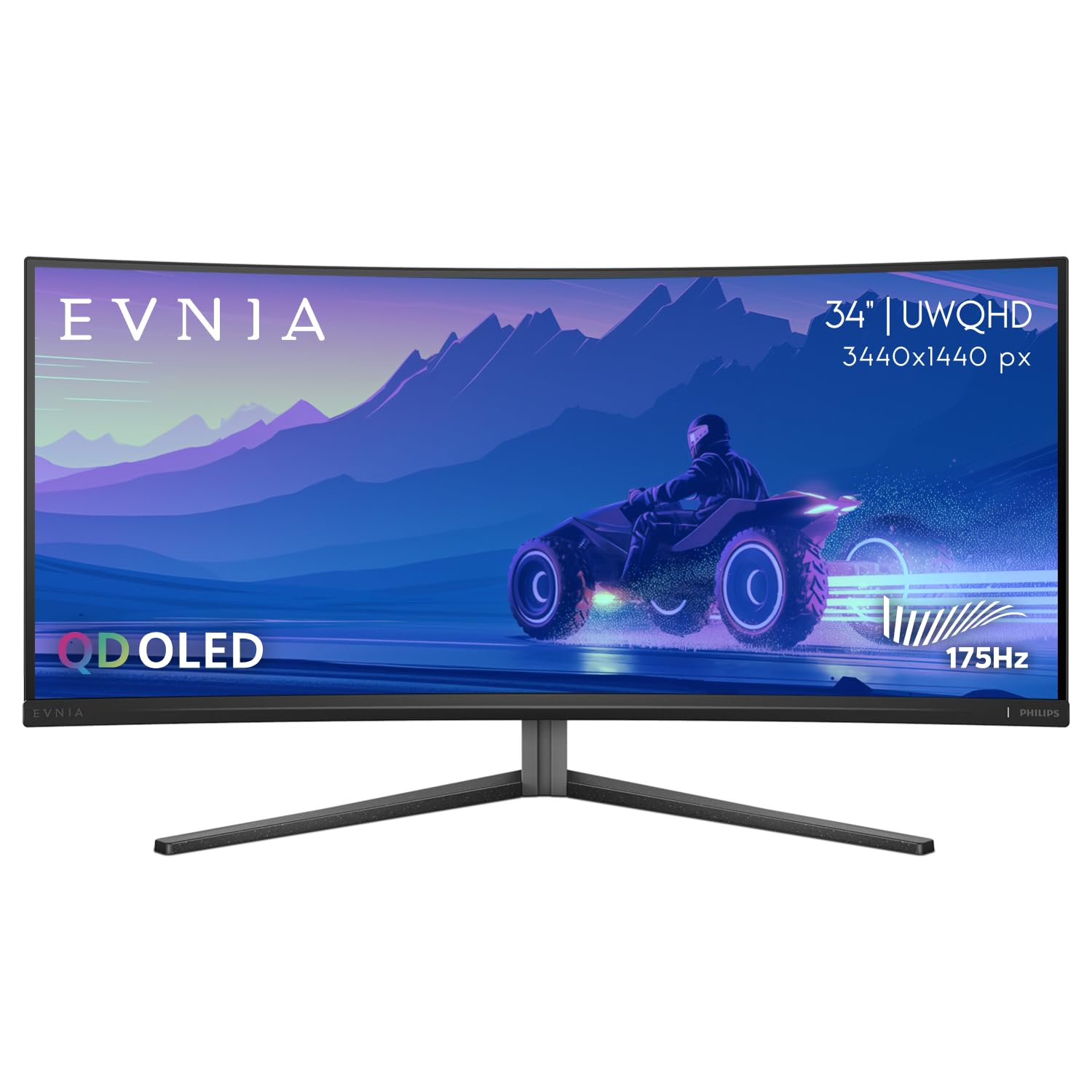
Philips enters the QD-OLED arena with the Evnia 34M2C6500, a 34-inch panel that targets the price-conscious gamer who wants OLED without the premium markup of Alienware or LG. It features a 3440×1440 resolution, 175Hz refresh rate, 0.03ms response time, and VESA DisplayHDR TrueBlack 400 certification. The 1800R curvature provides a standard immersive feel, and the Ambiglow lighting system adds ambient backlight bias that expands the perceived screen size.
Users praise the deep blacks and vibrant colors, noting it outperformed an Acer Nitro IPS panel significantly. The glossy screen coating makes image quality look rich and saturated, particularly in HDR games and movies. However, the Ambiglow system is described as delayed and not smooth, and the monitor lacks built-in speakers—an omission for buyers who want a clean, all-in-one setup. The mandatory pixel refresh pop-up every 12 hours is a known annoyance, forcing a black-screen cleaning cycle that can interrupt gameplay or work.
Build quality is adequate with a plastic stand, and the OSD menu is controlled by a cheap toggle switch that feels out of place on a modern monitor. The 4-year advance replacement warranty is a positive, but some users report that dead pixels within the first few units were not covered as defects. For budget-focused buyers who prioritize pure OLED image quality over polish and features, the Evnia delivers where it matters most.
Why it’s great
- Lowest price point for a genuine 34-inch QD-OLED gaming monitor.
- Glossy OLED delivers stunning color saturation and inky blacks for games.
- HDR400 True Black certification ensures decent HDR performance in dark scenes.
Good to know
- No built-in speakers require external audio for desktop use.
- Ambiglow ambient lighting is delayed and lacks smooth transitions.
- Pixel refresh pop-up every 12 hours interrupts usage for a cleaning cycle.
8. Dell S3425DW (34 Plus)

Dell’s S3425DW strikes a superb balance between work and play with a 34-inch VA panel that offers 3440×1440 resolution, a 120Hz refresh rate, and AMD FreeSync Premium. The VA panel delivers a 3000:1 contrast ratio—significantly higher than IPS—providing deep blacks that make the screen look rich for movies and games. The USB-C port supports up to 65W power delivery, enabling a single-cable connection for modern laptops that keeps desks clean and reduces cable clutter.
Owners of this monitor consistently highlight the excellent color accuracy from its 99% sRGB and 95% DCI-P3 coverage, making it a strong option for graphic design work. The built-in speakers are notably better than previous Dell models, offering more volume and frequency response for casual use. Some users point out the limited port selection (HDMI, USB-C, and only one USB-A) and the missing DisplayPort, which can be a dealbreaker for older desktop GPUs. The VESA mount is recessed, requiring longer screws or spacers for optimal mounting.
The ComfortView Plus feature reduces blue light to 35% without the yellow tint typical of software-based solutions, making it comfortable for all-day work. The 120Hz refresh rate is high enough to make scrolling feel much smoother than 60Hz while being manageable for mid-range gaming. For the user who needs a capable monitor for professional work during the day and casual gaming at night, the Dell S3425DW offers a well-rounded package at a mid-range price.
Why it’s great
- VA panel provides deep 3000:1 contrast for rich blacks and immersive media.
- USB-C with 65W power delivery enables clean single-cable laptop setups.
- 95% DCI-P3 color gamut covers professional color spaces for creative work.
Good to know
- No DisplayPort input limits compatibility with some older GPU configurations.
- VESA mount requires custom screws or spacers due to recessed design.
- Only one USB-A port limits peripheral connectivity without an external hub.
9. LG 34SR60QC-W (Smart Monitor)

The LG 34SR60QC-W is a 34-inch VA curved smart monitor that functions as both a desktop display and a standalone streaming television. It runs webOS 23, giving you built-in access to Netflix, Prime Video, Disney+, Apple TV, and over 300 free LG Channels. You can watch content or cloud-game via NVIDIA GeForce NOW without ever connecting a PC. The 1800R curve and 3440×1440 resolution deliver a cinematic experience for both work and entertainment, and the 99% sRGB color gamut ensures colors look accurate for creative tasks.
User feedback emphasizes the value of the integrated smart TV functionality—many owners report using it as a bedroom TV when not working. The included remote makes switching between PC and streaming effortless. The monitor includes two HDMI ports and three USB ports, plus USB-C connectivity for modern laptops. Some connectivity quirks exist: it requires a USB-C 3.2 Gen 2 cable (10Gbps DisplayPort) to reach full 3440×1440 resolution, as using 2K HDMI cables can result in a blurry picture. The built-in speakers are decent for spoken word but lack bass for cinematic audio.
The 100Hz refresh rate is a step up from basic 60Hz office monitors, providing smoother scrolling and mouse movement. The VA panel’s 3000:1 contrast ratio allows for good black levels. For users who want a versatile screen that can serve as a primary workstation monitor and a secondary living room TV, the LG Smart Monitor delivers unique versatility that no standard ultrawide can match.
Why it’s great
- Built-in webOS streaming makes it a standalone smart TV without a connected computer.
- 99% sRGB color gamut provides accurate colors for photo and design work.
- Included remote control simplifies switching between PC and streaming modes.
Good to know
- Full 3440×1440 resolution requires specific high-bandwidth USB-C cables.
- Smart TV apps display black bars on the sides due to the 21:9 aspect ratio.
- Bluetooth for wireless earbuds can be unreliable with intermittent audio cutouts.
10. Samsung Viewfinity S65UA

Samsung’s Viewfinity S65UA is a productivity-focused ultrawide that packs some serious ergonomic specs into a competitive price bracket. Its 1000R curvature matches the natural curve of the human field of view, creating a more comfortable viewing experience that reduces eye strain during long work sessions. The VA panel offers a 4000:1 contrast ratio and HDR10 support with 1 billion colors. The standout feature is the USB-C port with 90W power delivery, which can charge most laptops faster than the standard 65W PD seen in many competitors.
Users transitioning from dual-monitor setups frequently praise the seamless multitasking experience, noting the 21:9 aspect ratio eliminates the bezel gap. The height-adjustable stand is another strong point, offering 135mm of height adjustment plus tilt and swivel. The 100Hz refresh rate with AMD FreeSync provides smoother visuals than a standard office monitor. Some buyers report the screen quality feels slightly pixelated compared to higher-resolution panels, and the built-in speakers are notably tinny with poor audio quality.
Durability concerns are a factor: a small but significant number of users report the monitor dying after 8-12 months of use, with Samsung customer service being unhelpful in handling warranty claims. The port selection is solid with HDMI, DisplayPort, and the 90W USB-C port. For the productivity user who prioritizes ergonomics and a clean single-cable laptop connection over gaming performance or pixel-perfect sharpness, the S65UA offers excellent value with some risk regarding long-term reliability.
Why it’s great
- 1000R curvature matches the human field of view, reducing eye strain during extended use.
- USB-C with 90W PD can charge most laptops while transmitting video and data.
- Fully adjustable stand with height, tilt, and swivel for optimal ergonomic setup.
Good to know
- Some units have reliability issues; reports of failure within a year are not uncommon.
- Image quality can appear slightly soft compared to higher-resolution panels.
- Built-in speakers are very tinny and lack acceptable audio quality for media consumption.
11. ASUS TUF Gaming VG34VQ3B

The ASUS TUF Gaming VG34VQ3B is the budget champion for gamers who want a high refresh rate ultrawide without paying for an OLED panel. It features a 34-inch VA panel with 3440×1440 resolution, a class-leading 180Hz refresh rate, and a 1ms MPRT response time. The 1500R curvature is more gentle than many competitors, making it suitable for users new to curved displays. ASUS Extreme Low Motion Blur (ELMB SYNC) technology works in tandem with FreeSync Premium to reduce ghosting while maintaining tear-free performance, a rare combination in this price tier.
User reviews are overwhelmingly positive for the price, with buyers praising the bright, vibrant picture quality and the super-smooth 180Hz refresh rate that rivals more expensive panels. The color accuracy is excellent for a VA panel at this price point, covering 90% DCI-P3. The monitor includes a four-port USB 3.2 hub and VESA compatibility. However, three consistent complaints emerge: the built-in speakers are very poor (described as tinny and quiet), the stand is non-adjustable (tilt only), and the six onboard buttons for menu navigation are less intuitive than a joystick.
The 4000:1 static contrast ratio ensures deep blacks for immersive gaming in dark scenes, and the high brightness level makes it usable in bright rooms. The 3-year warranty provides decent long-term coverage for a budget monitor. For the competitive gamer on a tight budget who wants a 34-inch ultrawide with a refresh rate and response time that can rival high-end panels, the ASUS TUF Gaming VG34VQ3B delivers outstanding raw performance where it counts.
Why it’s great
- 180Hz refresh rate and ELMB SYNC provide smooth motion and reduced ghosting for competitive gaming.
- 4000:1 VA contrast ratio offers deep blacks and rich colors at a very accessible price point.
- Integrated USB 3.2 hub and VESA mount add convenience for peripheral connectivity.
Good to know
- Built-in speakers are extremely poor and quiet; external speakers or headphones are necessary.
- Stand only offers tilt adjustment with no height or swivel options.
- Menu navigation uses six buttons instead of a more user-friendly joystick control.
FAQ
Is 3440×1440 resolution sharp enough on a 34-inch screen?
Can a 34-inch ultrawide monitor replace two full-size monitors?
What is the difference between FreeSync and G-Sync for an ultrawide monitor?
Does a 34-inch ultrawide monitor work with a PS5 or Xbox Series X?
Final Thoughts: The Verdict
For most users, the best 34 inch ultrawide monitor winner is the Dell S3425DW because it perfectly balances a high-contrast VA panel, a smooth 120Hz refresh rate, and USB-C convenience at a sensible price—ideal for the work-first, game-second user. If you want uncompromised gaming visuals with perfect blacks, grab the Alienware AW3425DW for its lightning-fast 240Hz QD-OLED response and burn-in warranty. And for pure productivity power with extra vertical room, nothing beats the Dell UltraSharp U4025QW for its expansive 5K2K panel and built-in KVM hub.