
Our readers keep the lights on and the weekend projects moving. As an Amazon Associate, I earn from qualifying purchases.
Getting a piece of wood veneer to lie perfectly flat without bubbling, curling, or sliding out of place is a fight against physics. The wrong adhesive either grabs too fast, causing you to misalign the sheet, or dries too slow, forcing you to hold everything in place for an absurd amount of time. Whether you’re refinishing a mid-century credenza or building custom cabinetry, the chemistry of the bond determines whether your project looks seamless or like a beginner’s mistake.
I’m Rikta — the co-founder and writer behind FitlyFast. For this guide, I’ve analyzed the cure times, open assembly windows, and substrate compatibility of seven top-tier adhesives to give you the practical breakdown that actually matters for veneer work.
These formulations differ in viscosity, heat resistance, and clamping requirements, which is why you need to match the glue to your specific pressing method. This is your definitive resource for finding the best adhesive for veneer on the market right now.
How To Choose The Best Adhesive For Veneer
Picking the wrong veneer adhesive leads to edge pop-ups, bubbling, or a permanent misalignment that ruins the grain pattern. The choice hinges on three factors: application method, working time, and environmental resistance. Here is how to filter through the options.
Contact Cement vs. Spray Adhesive vs. Cyanoacrylate Gel
Contact cement is the gold standard for large flat panels because it bonds on contact after both surfaces are coated and flash off. Spray adhesives like the 3M Max Strength 90 offer even coverage over wide veneer sheets without brush marks. Cyanoacrylate (CA) gel, such as the Titebond Instant Bond, is better for small edge banding or repair spots where clamping is impossible — it bonds in seconds but leaves zero margin for error.
Open Time Matters More Than Drying Speed
Open time is the window you have to position the veneer before the glue grabs. Solvent-based contact cements typically offer 10–20 minutes of repositionability, whereas spray formulas like the 3M Hi-Strength 94 give you up to 60 minutes — a critical advantage for large or complex laminations. Fast-setting CA glues have an open time measured in seconds, so they are only practical for small, pre-fitted pieces.
Heat and Moisture Resistance for Long-Term Stability
Veneer applied to countertops, vanities, or kitchen islands faces steam, heat from appliances, and humidity swings. Standard contact cement holds up to about 180°F, but the Clear-Tite formulation from RH Adhesives is rated to 250°F, making it suitable for areas near stoves or direct sunlight. For automotive or marine interiors, the DAP Weldwood Landau Top & Trim offers proven water and heat resistance with a spray-gun consistency.
Quick Comparison
On smaller screens, swipe sideways to see the full table.
| Model | Category | Best For | Key Spec | Amazon |
|---|---|---|---|---|
| 3M Max Strength 90 | Spray Adhesive | Large veneer sheets & laminates | Max bond in 10 minutes | Amazon |
| 3M Hi-Strength 94 ET | Spray Adhesive | Extended working time on large panels | 60-minute open time | Amazon |
| Clear-Tite Contact Cement | Contact Cement | High-heat countertop veneer | Withstands 250°F | Amazon |
| Titebond Instant Bond Gel | CA Gel | Spot repairs & edge banding | Full cure in 18 seconds | Amazon |
| Barge Contact Cement Bundle | Contact Cement | Shoe & leather-backed veneer repairs | Toluene-free quick dry | Amazon |
| S-18 All-Purpose Adhesive | Solvent Cement | Bonding veneer to non-porous substrates | Water resistant formula | Amazon |
| DAP Weldwood Landau | Spray-Grade Contact | Automotive & marine veneer | High heat & water resistant | Amazon |
In‑Depth Reviews
1. 3M Max Strength 90 Multi-Surface Contact Adhesive
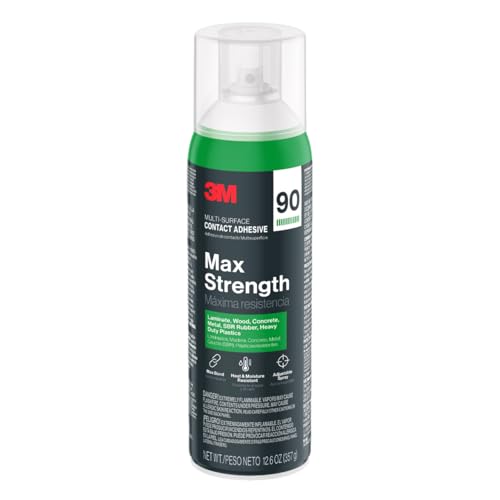
This spray adhesive offers the best balance of bond strength, coverage, and ease of use for veneer work. The web-spray pattern lays down an even coat without pooling, and the adjustable nozzle lets you dial in the fan width for narrow edges or wide panels. The ten-minute cure is remarkably fast for a contact cement, eliminating the need for long clamping sessions or waiting hours before trimming the veneer.
The formulation is heat and moisture resistant, which is critical for veneers applied to kitchen countertops or bathroom vanities. Users consistently report that it bonds laminate, wood, and heavy-duty plastics without the bond breaking down under summer heat or near steam. The low-VOC compliance is a genuine benefit if you are working indoors without an industrial ventilation setup.
Where this glue really shines is in consistency — the nozzle rarely clogs between uses, and the adhesive retains its tack even after a week of storage with the cap on. The only consideration is that the 12.6-ounce can covers roughly 30 square feet of surface, so for large cabinetry projects you may need a second can.
Why it’s great
- Web spray pattern prevents drips and blobs on thin veneer sheets
- Bonds fully in ten minutes with no clamping required
- Heat and moisture resistant for kitchen and bath applications
Good to know
- Small can size may require multiple units for large projects
- Strong solvent odor requires adequate ventilation despite low VOC
2. 3M Hi-Strength 94 ET Spray Adhesive

If you work with large sheets of veneer or complex laminations where precise alignment takes time, the 94 ET is your tool. The 60-minute open assembly window means you can spray both the veneer and the substrate, take a break, and still have plenty of time to lay down the sheet without the adhesive skinning over. This is a huge advantage for first-timers who need to roll out air bubbles slowly.
The aggressive tack is noticeable immediately — once the surfaces meet, they hold without slipping even before the full 24-hour cure. This spray also bonds well to difficult substrates like powder-coated metal and plastic, which makes it a versatile choice if you are laminating veneer to non-wood surfaces. The GREENGUARD certification adds a layer of assurance for indoor air quality, though the smell is still present.
One recurring theme in user reports is the durability of the bond in freezing temperatures — several users applied it in cold garages and the adhesive still held foam and fabric to metal panels without delamination. The 19.75-ounce can provides generous coverage, making it the most economical option for mid-size to large veneer jobs.
Why it’s great
- Up to 60 minutes of working time eliminates rushed alignment
- Aggressive tack prevents edge lifting during positioning
- Large 19.75-ounce can reduces cost per square foot
Good to know
- Full cure takes 24 hours before you can trim or sand veneer
- Requires good ventilation despite low-VOC formula
3. Clear-Tite Contact Cement

When you need a contact cement that can sit under a hot coffee pot or near a stove burner without softening, this is the formulation to reach for. The 250°F temperature threshold is significantly higher than standard contact cements, which start to soften around 180°F. This makes the Clear-Tite a strong candidate for veneered countertops, desktops, and tabletops in direct sunlight.
The liquid consistency applies easily with a brush or roller, and the bond sets within ten minutes of joining the two coated surfaces. Users note that the color is a transparent yellow rather than perfectly clear, but that does not affect performance — the glue line is invisible under most wood veneers anyway. The versatility with materials like Formica, particle board, and crepe rubber means you are not limited to wood-only applications.
One practical detail: the 4-ounce can is small, so this is best for single countertops or tabletop projects rather than whole kitchens. The US-made quality is consistent across batches, and the formula holds up well in high-moisture areas like bathrooms where adhesion failure is common with cheaper alternatives.
Why it’s great
- 250°F heat tolerance is best-in-class for countertop veneer
- Bonds in ten minutes with no clamps needed
- Works on Formica, particle board, and crepe rubber
Good to know
- 4-ounce can covers a limited area; buy multiple cans for large surfaces
- Dries to a transparent yellow, not perfectly clear
4. Titebond Instant Bond Wood Adhesive Thick, 2 oz.

This gel cyanoacrylate is the right tool when you need to bond a small piece of edge banding, repair a corner that lifted, or attach veneer to a vertical surface where clamping is impractical. The thick, non-runny formula stays where you put it instead of dripping down the side of your workpiece, and the eighteen-second cure means you can move on to the next step almost immediately.
The bond strength is remarkable — users report that it fixes oak pieces so strongly that the wood itself breaks before the glue joint fails. Unlike thin CA glues that wick into the wood and leave a visible stain, this gel sits on the surface and fills small gaps between the veneer and substrate. It also bonds MDF, acrylic, and PVC, so it is not limited to pure wood applications.
The trade-off is the speed. With only seconds to position the veneer, you need to have everything pre-fitted and ready before you apply the glue. This is not a forgiving adhesive for large sheets — it belongs in your drawer for edge repairs, tight spots, and small accent pieces where every second of clamping time saved is a win.
Why it’s great
- Gel consistency prevents drips and runs on vertical surfaces
- Bonds stronger than the wood itself in under 30 seconds
- Excellent heat and solvent resistance for durable repairs
Good to know
- Zero margin for alignment error — have your pieces positioned first
- 2-ounce bottle only suits small jobs; not for full panels
5. Barge Contact Cement Adhesive with Pixiss Paste Spreaders

Barge is a name long trusted in the shoe repair world, but this toluene-free contact cement works equally well for small veneer projects where flexibility matters. The bond dries clear and remains flexible, which helps prevent the veneer from cracking when the wood underneath expands and contracts with humidity changes. The included paste spreaders make application neat and controlled.
The formula is water resistant and quick-drying, so you can bond veneer to MDF or particle board and have a functional surface within the day. Users specifically note that it works great for leather-backed veneer repairs and attaching thin wood sheets to curved surfaces where rigid glues would fail. The 2-ounce bottle is small, but for occasional repairs it lasts a long time.
The primary drawback is the chemical smell — even though it is toluene-free, the solvent base is still potent and requires a well-ventilated workspace. Additionally, the glue dries to a yellowish tint, so while it is marketed as clear, the final glue line may be visible under very thin or light-colored veneers.
Why it’s great
- Flexible bond accommodates wood movement in seasonal humidity
- Toluene-free formula with water resistance for practical durability
- Included spreaders help apply an even, thin coat
Good to know
- Dries to a yellowish tint that may show under thin veneers
- Strong solvent odor requires good airflow
6. S-18 All-Purpose Adhesive
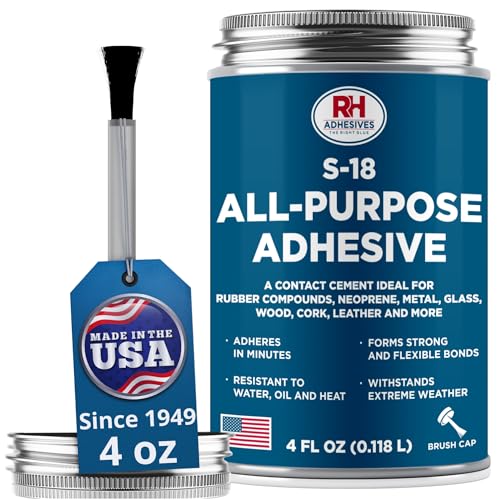
The S-18 is a solvent-based neoprene adhesive that excels at bonding veneer to non-porous substrates like metal, glass, and ceramic. If you are laminating a decorative veneer onto a steel cabinet door or a glass tabletop, this formula creates a strong film with excellent peel strength. The water resistance makes it suitable for marine environments where standard contact cement would break down.
Users find that it works best for rubber and neoprene to metal bonding, which translates well to veneer applications where the substrate is not wood. The 24-hour full cure time is standard for solvent cements, but the initial grab is strong enough that the veneer will stay in place without clamping after a few minutes. The off-white color dries to a tan shade that is invisible under most opaque veneers.
The biggest caution is ventilation — this is a solvent-heavy adhesive and users consistently stress using it in a very well-ventilated area or with a respirator. It is also prone to gumming at the can opening after repeated use, so transferring to a smaller working container helps preserve the remaining adhesive in the can.
Why it’s great
- Strong bond on non-porous surfaces like metal and glass
- Water resistant formula suitable for marine and outdoor veneer
- Excellent peel strength resists edge lifting
Good to know
- Strong solvent fumes require a respirator in enclosed spaces
- Can gum at the opening if not stored properly
7. DAP Weldwood Landau Top & Trim Contact Adhesive
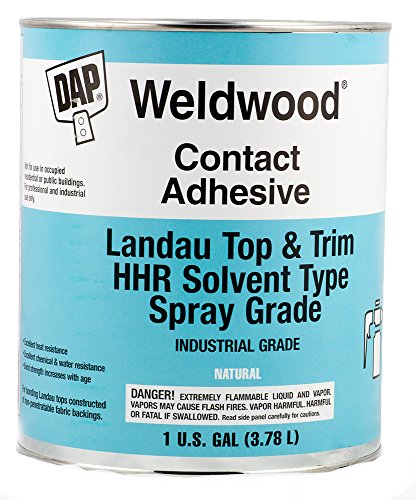
This gallon-size contact adhesive is designed for high-volume automotive upholstery work, but it translates directly to large-scale veneer projects where you need a spray-gun application. The solvent-thin consistency allows it to atomize cleanly through a siphon-feed gun at 45 PSI, giving you full control over coverage on wide veneer sheets and complex contours. It bonds fabric, vinyl, and foam, but it adheres just as well to wood veneer.
The heat and water resistance make this a solid choice for outdoor or automotive veneer applications where interior temperatures can exceed 160°F. Users who have applied it in hot climates report that the bond remains solid even after a full summer of sun exposure. The permanent bond forms within the 24-hour cure window, and the initial tack is aggressive enough that the veneer will not shift after you roll it into place.
The gallon size is clearly meant for professional use — at this volume, you are likely working on multiple large surfaces or a full vehicle interior. The odor is strong, and the product is highly flammable, so proper ventilation and a separate compressor location are non-negotiable. This is the right adhesive when you need industrial-grade performance and have the setup to handle it.
Why it’s great
- Spray-gun compatible for fast, even coverage on large veneer sheets
- High heat and water resistance suit outdoor and automotive use
- Gallon volume offers lowest cost per square foot for heavy users
Good to know
- Requires a spray gun and compressor — not a brush-on product
- Strong odor and high flammability demand strict safety measures
FAQ
Can I use standard wood glue (PVA) for veneer?
How long should I wait before trimming veneer edges after applying contact cement?
Why does my veneer bubble after using contact cement?
Is spray adhesive strong enough for veneer on vertical surfaces?
Final Thoughts: The Verdict
For most users, the adhesive for veneer winner is the 3M Max Strength 90 because it combines fast ten-minute cure with heat and moisture resistance, a precise web-spray pattern, and low-VOC compliance — making it suitable for both shop and indoor use. If you need an extended open time to carefully align large sheets, grab the 3M Hi-Strength 94 ET and use the full 60-minute window. And for high-heat countertop veneer or projects near heat sources, nothing beats the Clear-Tite Contact Cement with its 250°F rating.