
Our readers keep the lights on and the weekend projects moving. As an Amazon Associate, I earn from qualifying purchases.
A faint hum creeping into your speakers, a subtle veil over the cymbals, a soundstage that feels flat instead of three-dimensional—these are the telltale signs that your interconnect chain is choking your system. Unlike standard patch cords, true audiophile RCA cables are engineered with specific dielectric materials, shielding topologies, and conductor purity to preserve the integrity of a delicate signal from your DAC, preamp, or turntable to your amplifier.
I’m Rikta — the co-founder and writer behind FitlyFast. My research for this guide involved cross-referencing technical specs like capacitance per foot, shielding coverage percentages, and conductor gauge across seven distinct models to determine which designs deliver measurable noise rejection without selling snake oil.
Whether you are building a reference-level stereo rig or simply want to banish the 60Hz ground loop buzz from your listening chair, this analysis of the best audiophile rca cables focuses on the concrete specifications and real-world customer experiences that separate genuine engineering from expensive marketing.
How To Choose The Best Audiophile RCA Cables
Selecting the right interconnect for your system goes far beyond brand reputation. The three pillars of a high-performance RCA cable are capacitance, shielding effectiveness, and connector quality. A cable that excels in all three areas will transmit the signal with minimal coloration and maximum noise rejection.
Capacitance: The Silent Frequency Killer
Measured in picofarads per foot (pF/ft), capacitance is the single most important spec for audiophile RCA cables. High capacitance acts as a low-pass filter, rolling off high frequencies and dulling transient detail. For turntable setups with moving magnet cartridges, low capacitance (ideally 12-15 pF/ft) is essential to keep the total load within the cartridge’s recommended range. Budget cables often exceed 30 pF/ft, which can make a system sound recessed and lifeless.
Shielding: Your Defense Against Hum and Hiss
Electromagnetic interference (EMI) and radio-frequency interference (RFI) manifest as audible noise—a persistent hum, buzzing, or hiss that ruins quiet passages. The most effective designs use a dense spiral-wrapped shield that provides 97% or greater coverage. Braided shields offer good flexibility but can leave small gaps. A drain wire connected to the shield at one end is a strong indicator of a well-grounded, noise-rejecting cable.
Conductor and Connector Integrity
High-purity copper—either 99.99% Oxygen-Free Copper (OFC) or 99.9997% Ohno Continuous Cast (OCC)—offers lower resistance and fewer grain boundaries for the signal to cross. Connectors should feature gold-plated brass or beryllium copper contacts for corrosion resistance and consistent conductivity. The termination method matters too: quality soldering with a silver-infused alloy creates a mechanically and electrically superior joint compared to cold-welded crimps.
Quick Comparison
On smaller screens, swipe sideways to see the full table.
| Model | Category | Best For | Key Spec | Amazon |
|---|---|---|---|---|
| WBC-PRO-LOCAP 1.5ft | Low Capacitance | Phono & digital interconnects | 14 pF/ft capacitance | Amazon |
| AudioQuest Tower 0.6m | Solid Conductor | CD & DAC to amplifier | Solid Long-Grain Copper | Amazon |
| Mogami RCA 6ft | Studio Reference | Neutral monitoring | Neglex quad-star geometry | Amazon |
| SKW Premium 3.2ft | OCC Copper | High-resolution stereo | 19 AWG OCC conductor | Amazon |
| AudioQuest Evergreen 1m | PSC+ Copper | Entry-level high-end rigs | Perfect-Surface Copper+ | Amazon |
| GEARit 14AWG 500ft | Speaker Wire | Long speaker runs | 14 AWG CCA conductor | Amazon |
| WBC-PRO-LOCAP 3ft | Low Capacitance | Turntable to preamp | 14 pF/ft capacitance | Amazon |
In‑Depth Reviews
1. WBC-PRO-LOCAP 1.5ft RCA Pair

The WBC-PRO-LOCAP achieves an ultra-low 14 pF/ft capacitance using foamed-polyethylene dielectric, making it the top contender for preserving high-frequency air and transient attack. Its 22 AWG core uses 65 strands of 99.99% OFC copper, and the dense spiral shield provides over 97% coverage to block EMI and RFI. Terminated with Amphenol ACPR metal die-cast RCA plugs featuring gold-plated brass contacts, the build quality here punches well above its tier.
Real-world users confirm the performance. One owner replaced the stock cable on an iFi Zen 2 and eliminated sibilance from a Pro-Ject tube phono preamp. Another connected a Fiio K11 R2R DAC to a Singxer SA-1 and found the cable performed identically to self-made Mogami W2534 terminations. The low capacitance is especially beneficial for moving magnet cartridges from Audio Technica.
The 1.5-foot length is perfect for tight desktop stacks or short runs between source and preamp. Each cable is hand-soldered with a proprietary 4% silver solder blend using a nitrogen-assisted process that improves joint integrity. The UV-protected polyester braided jacket is both rugged and flexible enough for tight bends.
Why it’s great
- Industry-leading 14 pF/ft capacitance preserves high-frequency detail
- Spiral shield with >97% coverage eliminates hum and RFI
- Amphenol ACPR gold plugs ensure corrosion-free contact
- Soldered with 4% silver blend for robust terminations
Good to know
- 1.5-foot length limits placement flexibility for larger racks
- Polyester braid may not match all decor aesthetics
2. AudioQuest Tower 0.6m RCA

The AudioQuest Tower series is widely regarded as the brand’s best price-to-performance offering. It uses solid Long-Grain Copper (LGC) conductors—a significant step up from stranded OFC—which reduces distortion caused by strand interaction. The foamed-polyethylene insulation minimizes timing errors and preserves soundstage width, while the asymmetrical double-balanced geometry keeps ground impedance low for a richer, more dynamic presentation.
Reviews consistently praise the Tower for sounding “better than cables costing hundreds more.” One user connected it between a high-end vintage turntable and tube phono stage and reported tighter mids and lows with a more natural harmonic balance. Another owner solved a persistent left-channel hum that plagued cheaper Monoprice cables, confirming the effectiveness of the Metal-Layer Noise-Dissipation System.
The connectors are well-made but notably tight—several users advise twisting the barrel gently before removal to avoid stressing your gear’s RCA jacks. The single-cable dual-RCA design (versus two separate cables) aids cable management, though the dual-wire construction means you must connect both ends simultaneously to avoid twisting.
Why it’s great
- Solid LGC conductors minimize strand-induced distortion
- Foamed-PE insulation reduces timing errors and smear
- Metal-Layer NDS system effectively suppresses EMI/RFI
- Exceptional value compared to other AudioQuest lines
Good to know
- Connectors are extremely tight and difficult to remove
- Dual-wire design can twist if not attached simultaneously
3. Mogami RCA 6ft

Mogami’s Neglex series is the gold standard in professional recording studios, prized for its neutral, uncolored signal transmission. This 6-foot RCA cable uses the brand’s proprietary quad-star geometry, which cancels electromagnetic interference by twisting four conductors in a specific pattern. The result is a cable that adds no flavor of its own—what goes in comes out exactly as recorded.
Users report a “noticeable improvement in openness, transparency, and detail” when upgrading from generic cables. One owner described the upgrade as feeling like a component swap rather than a simple cable change. Another used it to eliminate turntable hiss without altering tonal balance, preserving the natural timbre of vinyl playback. The thin, flexible jacket is easy to route in tight spaces.
A common critique is the price per single cable—many wish Mogami sold them in pairs since the majority of stereo systems require two. The 6-foot length is generous for longer runs between a preamp and amplifier, but the thin outer jacket lacks the armored feel of braided alternatives. The connectors are standard crimp-on types rather than soldered.
Why it’s great
- Studio-grade quad-star geometry cancels interference
- Absolutely neutral, uncolored signal transmission
- Thin, flexible jacket routes easily in tight spaces
- Excellent for eliminating turntable hiss
Good to know
- Sold individually, not as a stereo pair
- Connectors use crimp termination, not soldered
4. SKW Premium 3.2ft RCA

The SKW Premium uses 19 AWG Ohno Continuous Cast (OCC) copper, which boasts 99.9997% purity—significantly reducing grain boundaries that can cause signal scattering. This conductor is wrapped in a three-layer braided shield that provides superior noise rejection without the stiffness of solid-core designs. The 24K gold-plated connectors resist oxidation and maintain conductivity over decades of use.
Reviews from critical listeners note that the SKW cable “comes close to the big boys” and performs nearly identically to a silver cable, with only minor differences in the highest and lowest frequencies in ultra-revealing systems. One owner compared it favorably to Straight Wire Reference at one-fifth the price, praising its open and revealing character. Another user noted that it eliminated a ground loop hum that plagued his turntable setup.
The 12.8mm outer diameter is noticeably thicker than budget cables, which enhances durability but may be less flexible for very tight bends. The connectors are reported to be slightly tight on initial use—SKW recommends gentle rotation before removal. This is priced as a mid-range cable but delivers performance that rivals premium-tier competition.
Why it’s great
- High-purity OCC copper for minimal signal scattering
- Three-layer braided shield blocks EMI/RFI effectively
- Comparable performance to cables priced far higher
- Corrosion-resistant 24K gold-plated connectors
Good to know
- Thick 12.8mm jacket limits flexibility in tight spaces
- Connectors can be tight on first use
5. AudioQuest Evergreen 1m RCA

The AudioQuest Evergreen sits one tier above the Tower in the brand’s hierarchy, employing Perfect-Surface Copper+ (PSC+) conductors. This surface-treatment technology reduces grain boundaries at the conductor’s surface, where the majority of signal travels due to the skin effect. Combined with double-balanced asymmetrical geometry and foamed-polyethylene insulation, the Evergreen delivers noticeably cleaner treble extension and a blacker background.
User feedback highlights a “noticeable improvement over generic cables” with more detail, depth, and a smoother, more natural presentation. One owner described it as the best cable he had ever experienced when used with Masters-quality Tidal files. Another noted the Evergreen sounds slightly better than the already-impressive Tower, attributing the difference to the thicker LGC conductor under the PSC+ surface treatment.
The connectors use a cold-weld crimp rather than traditional soldering, which some users note can add fragility if the cable is frequently moved. The cable is designed to be directional—there is an arrow on the jacket indicating the signal flow from source to input. At this price point, it competes directly with boutique cabling while offering AudioQuest’s engineering pedigree and warranty support.
Why it’s great
- PSC+ surface treatment reduces grain boundary distortion
- Foamed-PE insulation reduces timing errors
- Notably cleaner treble and deeper soundstage
- Directional geometry for optimized signal flow
Good to know
- Cold-weld crimp connectors may be less durable than soldered
- Directional design requires correct orientation
6. GEARit 14AWG Speaker Wire 500ft
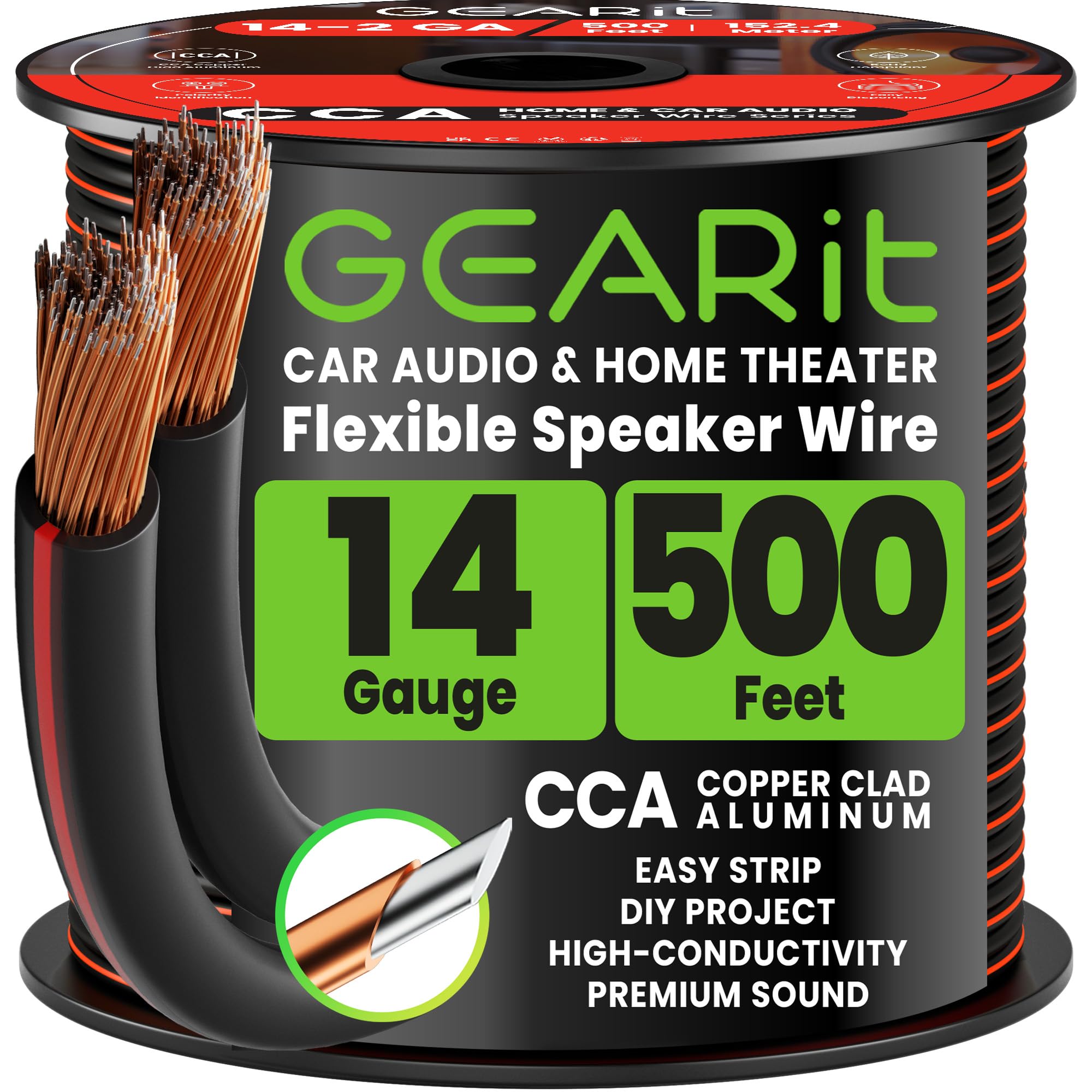
The GEARit 14 AWG speaker wire is positioned as a high-value, bulk solution for long speaker runs. It uses Copper-Clad Aluminum (CCA) technology, which offers acceptable conductivity at a fraction of the weight and cost of pure copper. The soft PVC jacket is flexible and easy to route through walls, under carpets, or around furniture without kinking—a major advantage for DIY installations.
Users appreciate the foot markers printed directly on the jacket, which allow precise cutting without a tape measure. The polarity markings clearly indicate positive and negative wires, reducing installation errors. Buyers report that it feels well-coated and performs well in both home theater and car audio contexts, with one reviewer noting it is “definitely better than standard” wire for the price.
CCA wire is not recommended for high-power, long-distance runs where pure copper would offer lower resistance, but for most home audio setups under 50 feet, the difference is negligible. This is not an RCA interconnect—it is speaker wire. It belongs in this guide as the budget option for users who need to terminate their own cables or run long distances to passive speakers. The two-year warranty provides peace of mind.
Why it’s great
- Budget-friendly bulk solution for long speaker runs
- Foot markers and polarity markings for easy DIY installation
- Flexible PVC jacket resists kinking
- Two-year warranty included
Good to know
- CCA conductor has higher resistance than pure copper
- Not suitable for high-power or very long runs
7. WBC-PRO-LOCAP 3ft RCA Pair
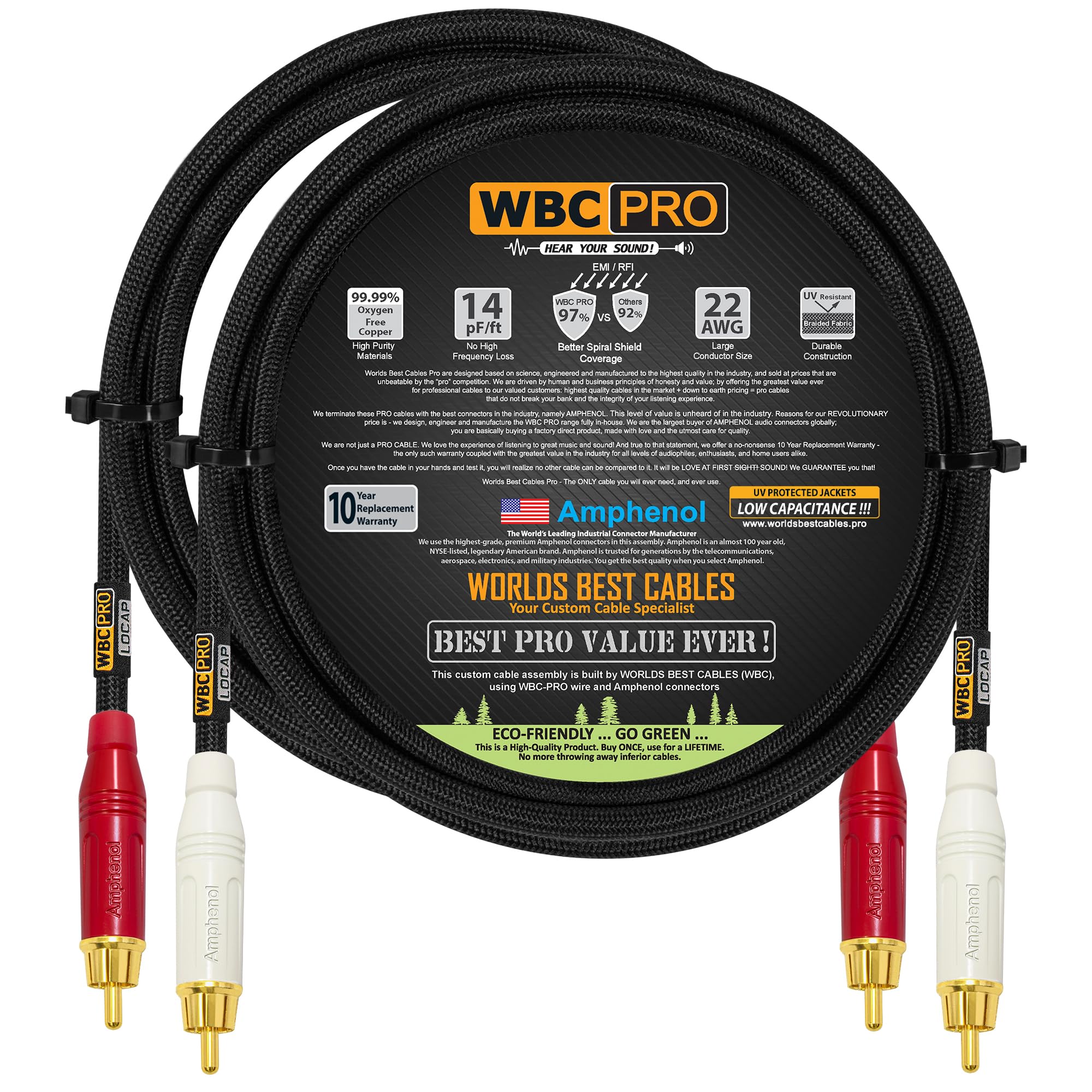
The 3-foot version of the WBC-PRO-LOCAP offers the same ultra-low 14 pF/ft capacitance and spiral shield construction as its shorter sibling, but in a length more suitable for rack-mounted components or turntable-to-preamp runs where the source is several feet away. The 22 AWG OFC core with 65 strands of 0.08mm copper wire provides ample cross-section for current delivery while maintaining flexibility.
Customer reviews echo the 1.5-foot version’s performance, with one user praising the “perfect price to performance ratio” and calling it the only cable brand they buy. Another owner specifically highlighted the low capacitance for an Audio Technica cartridge, noting it achieved the recommended capacitive load range at a fraction of the cost of boutique cables. The shielding effectively reduced high-volume hiss in another user’s system.
The 3-foot length adds versatility without introducing enough cable length to act as an antenna for interference. The weave jacket feels substantial and looks premium compared to rubber-sheathed alternatives, and the Amphenol connectors provide secure, low-resistance mating. If the 1.5-foot cable is too short for your setup, this is the logical step up without any compromise in spec.
Why it’s great
- Lowest capacitance in class at 14 pF/ft
- Versatile 3-foot length for rack or turntable setups
- Premium Amphenol gold-plated RCAs
- Spiral shield with >97% coverage eliminates noise
Good to know
- Longer length slightly increases noise pickup potential
- Braided jacket may show dirt in high-traffic areas
FAQ
What capacitance value should I look for in an RCA cable for my turntable?
Do I really need gold-plated RCA connectors on an audiophile cable?
Will a shorter RCA cable always sound better than a long one?
Final Thoughts: The Verdict
For most users, the best audiophile rca cables winner is the WBC-PRO-LOCAP 1.5ft Pair because its industry-leading 14 pF/ft capacitance, 97%+ spiral shield, and premium Amphenol connectors deliver measurable noise reduction and frequency preservation at a price that undercuts the competition. If you need a solid LGC conductor with proven noise-dissipation technology, grab the AudioQuest Tower 0.6m for its single-cable design and excellent value. And for high-resolution systems demanding OCC purity, nothing beats the SKW Premium 3.2ft with its near-premium performance at a mid-range price.