
Our readers keep the lights on and the weekend projects moving. As an Amazon Associate, I earn from qualifying purchases.
Cutting the cord means nothing if your picture freezes every time a cloud rolls in. An outdoor antenna is the only way to guarantee reliable, uncompressed 1080p and 4K OTA signals without pixelation, and the market is flooded with inflated range claims and flimsy builds that rust after one season.
I’m Rikta — the co-founder and writer behind FitlyFast. I analyze real customer signal reports, compare gain figures, and scrutinize build materials to separate antennas that truly perform at 40 miles from those that barely function at 20.
Whether you are mounting in an attic with a concrete tile roof or installing 50 miles from the nearest tower, choosing the right outdoor antenna comes down to knowing which models deliver reliable VHF reception and which are just marketing hype.
How To Choose The Best Outdoor Antenna
Selecting the right outdoor antenna requires matching your geography to the antenna’s design, not just picking the highest advertised mile range. You need to look at reception bands, gain figures, build quality, and whether your local towers broadcast on VHF or UHF.
Understand VHF vs. UHF Reception
Most local channels (NBC, CBS, ABC) now broadcast on UHF (channels 14-51), but some key stations—especially PBS and smaller networks—still transmit on VHF (channels 2-13). Many budget antennas barely handle VHF-Low (channels 2-6), so if a critical station in your area sits on VHF-Low, you need an antenna with long horizontal elements or a dedicated VHF dipole. Check your local tower frequencies at AntennaWeb or RabbitEars before buying.
Advertised Range vs. Real-World Performance
A 150-mile range claim means little when the antenna is tested under ideal line-of-sight conditions. Real reception depends on terrain, trees, building materials, and altitude. Most users 20-40 miles from towers with standard obstacles will need an antenna rated for at least 60+ miles to get reliable signals. Look for customer reviews that specify real distance and local obstacles, not just star ratings.
Build Materials and Weather Resistance
Outdoor antennas face rain, snow, UV, and wind for years. All-metal construction with aluminum elements and stainless steel hardware resists corrosion far better than plastic clips or zinc-plated parts. If you are mounting on a roof, look for antennas that include weather boots for the coax connection and sealed matching transformers to prevent moisture ingress.
Quick Comparison
On smaller screens, swipe sideways to see the full table.
| Model | Category | Best For | Key Spec | Amazon |
|---|---|---|---|---|
| Televes DAT BOSS Mix LR 149884 | Premium | Fringe areas 60+ miles away | Built-in TForce amp with auto gain control | Amazon |
| Five Star Outdoor HDTV Antenna | Mid-Range | Long-range multi-TV setups | 200 mile advertised range, includes 4-way splitter | Amazon |
| Channel Master Omni+ 50 | Mid-Range | Urban areas with towers in multiple directions | 360-degree omnidirectional reception | Amazon |
| RCA ANT751Z | Mid-Range | Attic installs with compact footprint | Pre-assembled UHF reflector, snap-lock elements | Amazon |
| GE Outdoor Yagi 33685 | Mid-Range | Reliable 30-40 mile suburban reception | 80 mile range, J-mount included, ATSC 3.0 ready | Amazon |
| CeKay Outdoor Yagi HD Antenna | Budget | Entry-level 20 mile attic or RV use | 40ft RG6 cable and J-mount included | Amazon |
| McDuory UHD-3968 Yagi | Budget | Cost-effective 25 mile suburban setup | LPDA design, pre-assembled with few loose elements | Amazon |
In‑Depth Reviews
1. Televes DAT BOSS Mix LR 149884
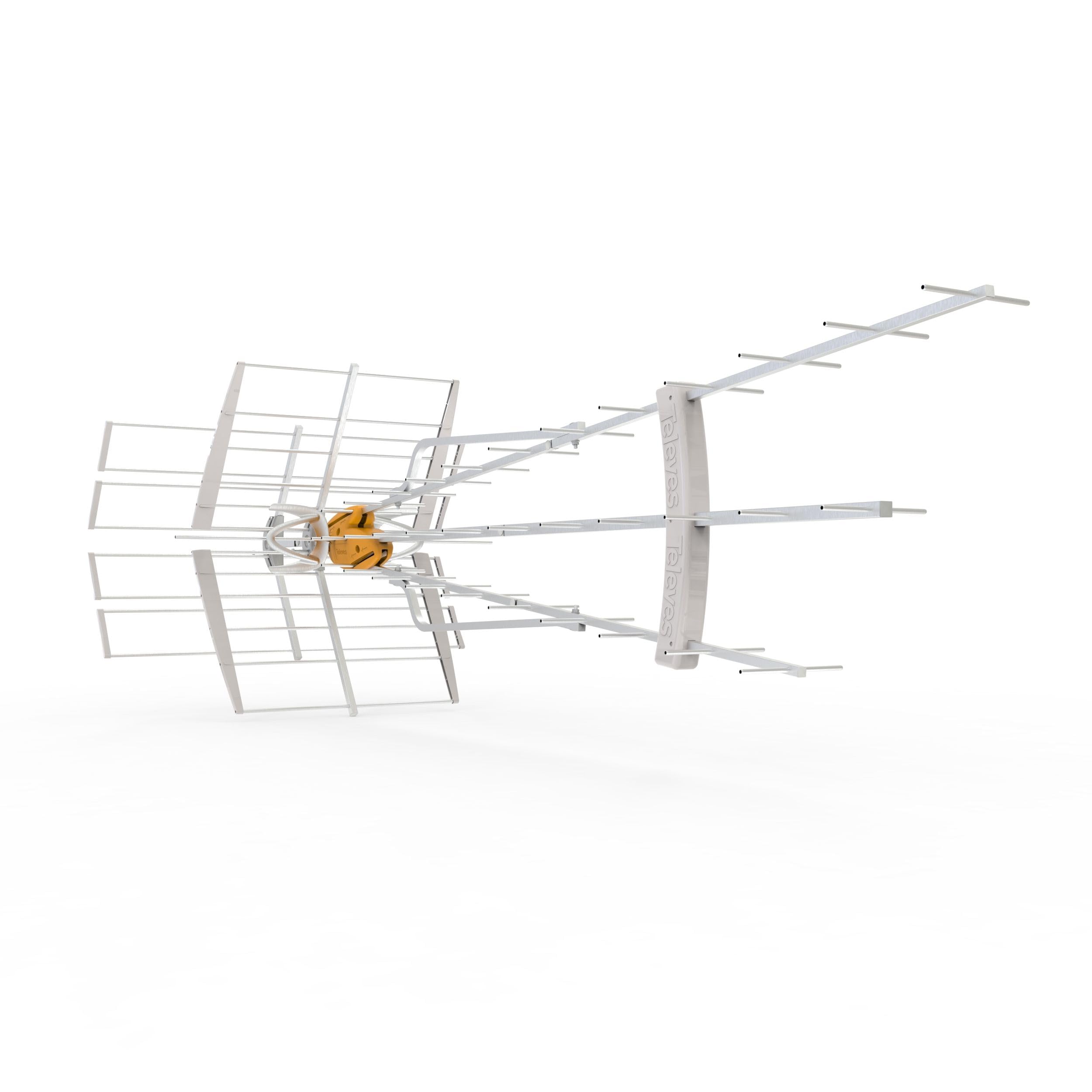
This is the antenna you buy when you live at the absolute fringe of reception—60+ miles from towers with hills, trees, or terrain in the way. The built-in TForce preamplifier uses intelligent gain control to auto-adjust amplification band by band, preventing both weak signal dropouts and overload from nearby strong stations. The integrated FM and LTE/4G/5G filtering is the real deal, cutting interference that makes other antennas pixelate on channels 30+. Users 60 miles from Dallas and 70 miles from rural Wisconsin transmitters consistently report receiving 80-114 clear channels where previous antennas failed entirely.
The stacked triple-boom design delivers 38 dBi gain on High VHF and 46 dBi on UHF, with a 25 dB front-to-back ratio that kills multipath ghosts. Build quality is exceptional: aluminum elements, stainless steel hardware, and a weather boot protect the connector. At 84 inches long, it is physically large and requires a sturdy mast. Two modes—amplified when powered, passive when not—give you flexibility if the power inserter fails.
One reviewer in the Seattle fringe area said this antenna eliminated all pixelation and added 16 channels even after lowering the mount height by 15 feet. The only downside is the price and size, but if you are deep in the country, nothing else in this list touches its performance.
Why it’s great
- True fringe-area performance at 70+ miles with hills
- Auto-gain amp that doesn’t overload near strong signals
- 5G/LTE filtering stops cell tower interference
- Premium all-metal build with corrosion-resistant hardware
Good to know
- Very large (84 inches) — needs a sturdy mast
- Premium price reflects professional-grade components
- Assembly takes longer due to triple-boom setup
2. Five Star Outdoor HDTV Antenna

The Five Star antenna is built for range: its extra-long 46-inch elements and extended design provide 11 dB VHF gain that captures weak signals better than typical budget yagis. Real-world reports from Houston-area users (45+ miles) show it pulling in 128 channels with only a 40-foot cable run. The package includes a J-pole, mounting bracket, and a 4-way TV splitter—everything needed to feed multiple rooms from one antenna without buying extra hardware.
Assembly is straightforward, but the instructions are sparse: one reviewer noted that the VHF vibrator alignment (the two short elements near the front) requires both screw heads to face the same direction for proper contact. Users on mountains at 7,300 feet elevation with 46-mile distances to towers reported 90 channels locked, 72 of them crystal clear. One caveat: the included coax is only 40 feet, so longer runs may require a preamp to compensate for signal loss over 175 feet.
For suburban buyers 30-50 miles from towers who want to feed multiple TVs, this is a strong mid-range pick that delivers real results without the Televes price tag. The 200-mile claim is optimistic, but it performs admirably at 45-50 miles with decent line of sight.
Why it’s great
- High VHF gain (11 dB) for weak signal areas
- Includes J-pole, splitter, and coax for multi-TV setups
- Extended element design stable for 45+ mile reception
- Easy assembly with no tools required
Good to know
- 200-mile claim unrealistic — expect 45-50 miles realistically
- Instructions miss VHF element alignment details
- Large footprint (46 inches) for mounting space
3. Channel Master Omni+ 50

The Omni+ 50 solves a specific problem: towers spread in different directions. Instead of a directional yagi that you aim at one cluster, this antenna offers true 360-degree reception from its UHF loop element while the adjustable VHF dipole handles low-band channels. It is ideal for urban and suburban metro areas where broadcasters sit at different compass points—think one tower north for ABC, another southeast for NBC. One reviewer in flat Florida, 35 miles from towers, pulled in 53 stations with this small unit.
Build quality is solid: it survived heavy rain and winds without issue. The design is unusually compact at 28.75 inches long, making it much easier to hide on a roof or in an attic than a long-boom yagi. It supports separate UHF and VHF paths, so if you have a preamp, you can boost each band independently. The included mounting bracket fits wall, mast, or satellite mounts, giving flexibility for RV and attic installs.
Signal strength improvements are real: one user saw their signal jump from 60% to 95% and SNR from 70% to 98% when switching from a cheap indoor antenna. The trade-off is that omnidirectional antennas inherently have lower gain than directional designs, so if you are beyond 35 miles or in a fringe area, this is not the right pick. It excels in dense metro zones where convenience matters more than extreme range.
Why it’s great
- True 360-degree reception for multi-direction towers
- Compact size (28.75 inches) for attic/RV installs
- Separate UHF and VHF paths for preamp pairing
- Survived heavy rain without signal degradation
Good to know
- Lower gain than directional yagis at 30+ miles
- No mast included — bracket only
- Not suitable for fringe areas beyond 35 miles
4. RCA ANT751Z

The RCA ANT751Z is the attic-install specialist that punches above its size. Its pre-assembled fold-out UHF reflector and snap-lock elements make setup nearly tool-free: you unfold the reflector, snap the VHF dipole into place, and mount it. Despite its compact size, it delivers powerful reception: users 25 miles from towers in foothill terrain picked up 51 channels with full 100% signal on NBC, CBS, and FOX when paired with a Winegard LNA-200 preamp. Even without an amplifier, one reviewer at similar distance got 79 channels with major networks at 80-85% signal strength.
A key design strength is that the UHF and VHF sections are separate, meaning you can aim the main reflector toward UHF towers while the VHF dipole handles low-band independently. This flexibility matters when your VHF station sits at a different compass bearing. The included locking mast clamp and 75-ohm matching transformer are solid, though the coax is not included, so budget for quality RG6 separately.
The RCA Signal Finder app is genuinely useful: it uses your phone’s compass and AR to show which direction each tower sits. One user noted that grounding hardware (wire, clamps, grounding block) is not included but is mandatory for outdoor installs. For attic mounting at 25-35 miles with mixed terrain, it rivals larger yagis in a smaller, easier-installed package.
Why it’s great
- Nearly tool-free assembly with snap-lock elements
- Separate UHF/VHF sections for multi-direction aiming
- Pulls 50+ channels at 25 miles with amplifier
- Compact for easy attic installation
Good to know
- Coax cable not included
- VHF-Low (channels 2-6) reception can be weak
- Wood screws for mounting not included
5. GE Outdoor Yagi 33685

GE is America’s best-selling antenna brand for a reason: the 33685 delivers reliable 30-40 mile suburban reception with a level of support that budget brands cannot match. The Yagi-style design includes a weather-resistant mounting bracket, mast clamp, and J-mount, so you have everything except the coax for a roof or wall install. One reviewer 35 miles from four different towers got rock-solid reception through an attic with concrete tile roof, using a 3-way splitter and Winegard preamp without pixelation—even during storms.
The antenna is ATSC 3.0 compatible, so it works with NextGen TV broadcasts for future-proofing. Build quality is good: the elements are aluminum, and the bracket is powder-coated to resist rust. Setup takes about 30 minutes, but the instructions are famously poor—watch a YouTube video instead. The included J-mount is sturdy enough for most installations but some users replaced it with a heavier mast for extreme wind areas.
At 26.5 inches wide and 37 inches long, it is moderate-sized, fitting most attic spaces easily. One user mounted it on their garage and reused existing satellite coax with great results at 25 miles. The limited-lifetime replacement pledge and free U.S.-based tech support add real peace of mind. It is not a fringe-area beast, but for the vast majority of suburban cord-cutters, it is the most balanced option between price and performance.
Why it’s great
- Balanced 30-40 mile performance for suburban use
- Includes J-mount, bracket, and mast clamp
- ATSC 3.0 ready for NextGen TV
- Limited-lifetime replacement and U.S. support
Good to know
- Poor assembly instructions
- VHF-Low reception inconsistent
- J-mount may flex in high winds
6. CeKay Outdoor Yagi HD Antenna

The CeKay Yagi is built for the budget-conscious cord-cutter who wants a complete kit ready to install out of the box. It comes with a 40-foot RG6 coax cable and a J-mount, which many competitors in its price tier treat as paid extras. The all-metal design is advertised as extreme-weather-ready, and while the materials feel thinner than the GE or RCA, it held up fine in wind and rain during real-world testing. One user in a basement (with no direct line of sight) picked up 30+ stations at 20+ miles with 90-100% signal metrics—remarkable for a unit at this price.
The antenna is ATSC 3.0 compatible and supports 4K, 8K, 1080p, making it technically future-proof. Assembly is mostly pre-assembled, but the rod insertion into rubber holders requires considerable force—several reviewers recommended using a rubber mallet. The J-mount included is functional but the pole connections felt loose to some, making it better suited for attic installation than exposed outdoor roof mounting. One user in an attic with a cement tile roof got 51 channels after assembly.
For entry-level buyers within 20 miles of towers who want a true all-metal yagi with all necessary components, this is an excellent starting point. The 70-mile claim is advertising, not reality, but within its actual sweet spot (10-25 miles) it consistently outperforms amplified indoor antennas by a wide margin.
Why it’s great
- Complete kit with 40ft RG6 cable and J-mount
- All-metal construction for weather resistance
- Excellent 20 mile attic performance
- ATSC 3.0 and 4K/8K compatible
Good to know
- Rod insertion into holders needs brute force
- Thinner metal than premium antennas
- J-mount connections feel loose for outdoor use
7. McDuory UHD-3968 Yagi

The McDuory UHD-3968 is the most affordable true outdoor yagi in this list, and it punches surprisingly well for the price. Its LPDA (log-periodic dipole array) design is directly matched to 75-ohm coax, meaning it does not waste signal through a mismatched balun. One reviewer 25 miles from towers got 100% signal on all local stations (RF channels 9-26) with clear HD picture. The antenna is pre-assembled for the most part—only the longer elements require insertion into plastic sockets, and users recommend pop rivets or small screws to secure them permanently.
Critical for VHF fans: this antenna has solid High VHF reception (channels 8, 19) thanks to its long horizontal elements, something many budget antennas fail to deliver. It handled an attic install at 30 miles from towers with full signal bars on Fox, NBC, ABC, and CBS. The build uses a mix of metal and plastic, and while the lighting protection claim is marketing, the overall construction is sturdy enough for moderate weather if you seal the coax connection with dielectric grease and weatherproof tape.
The main trade-offs are visible at the budget price: the included hardware may rust over time (some reviewers switched to stainless bolts), and instructions are minimal. The 150-mile range claim should be read as 25-40 miles realistically. However, as a proof-of-concept antenna for , it is unbeatable value—you can test cord-cutting with this before committing to a premium Televes or Channel Master install.
Why it’s great
- Best entry price for a true outdoor yagi
- LPDA design matches 75-ohm coax directly
- Good High VHF reception for channel 8-13
- Works well at 25-30 miles in attic or roof
Good to know
- Elements fit loosely — need pop rivets or screws
- Hardware may rust, best replaced with stainless
- Instructions are minimal and confusing
FAQ
Do I need a preamplifier for my outdoor antenna?
Can I install an outdoor antenna in my attic?
What does an antenna’s advertised mile range actually mean?
Final Thoughts: The Verdict
For most users, the outdoor antenna winner is the GE Outdoor Yagi 33685 because it delivers reliable 30-40 mile suburban reception, a trusted brand, and a limited-lifetime replacement pledge. If you live in a fringe area 60+ miles from towers, grab the Televes DAT BOSS Mix LR. And for urban dwellers with towers scattered in every direction, nothing beats the Channel Master Omni+ 50.